You found a great price on marine panels, but fake certificates can ruin your entire shipyard project. Let's look at how to verify these certifications to avoid disastrous project rejections.
To verify marine-grade certification before purchasing accommodation panels, you must validate the manufacturer's credentials, authenticate Wheelmark numbers in databases, examine A-60 fire test reports, demand compliance documents upon delivery, and spot standard architectural panels disguised as marine-grade products.
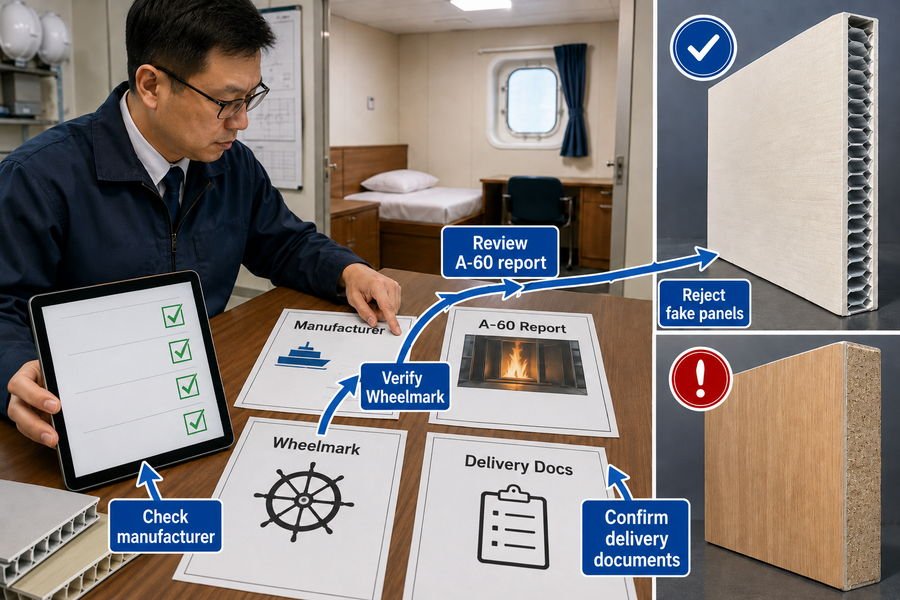
Don't let a simple piece of paper fool you. Learning to spot the truth in these documents is easier than you think, so let's break down the exact verification steps I use.
How to Cross-Check a Marine Accommodation Panel Certificate in the EU MED Database?
A supplier hands you an EU MED certificate, but how do you know it is real? Accepting an invalid certificate leads to failed shipyard inspections and wasted project money.
You cross-check a Marine Accommodation Panel Certificate in the EU MED database through three steps: finding the Notified Body number on the document, entering the specific certificate number into the MarED portal, and verifying the exact product description matches your panels.
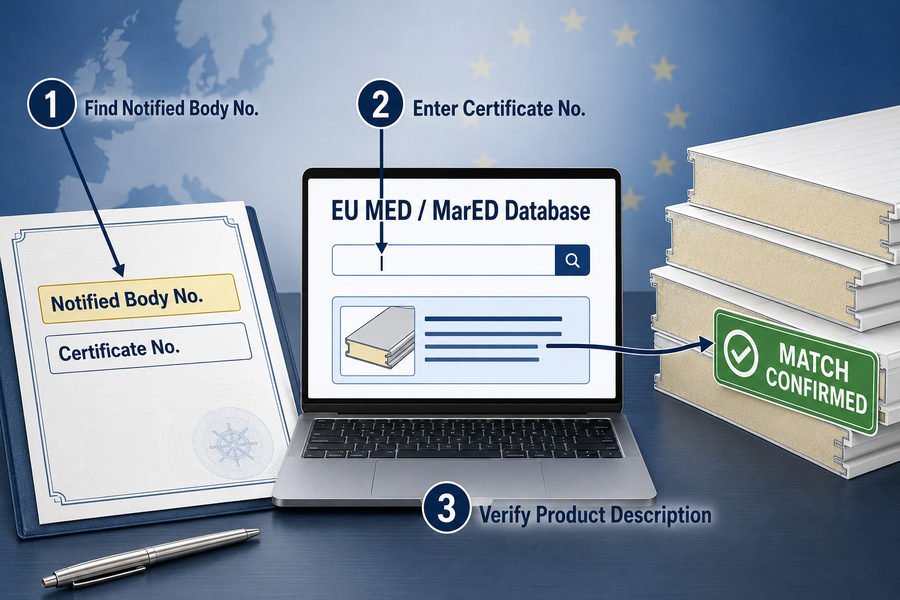
When I first started sourcing marine outfitting products, I quickly learned that you cannot trust a PDF document alone. You have to verify the data at the source. The EU Marine Equipment Directive (MED) database, commonly known as MarED, is your best tool for this job. I will walk you through the three exact steps you need to follow to make sure the certificate is legitimate.
Identifying the Notified Body Number on Panel Certificates
The first step is finding the Notified Body (NB) number. Every authorized testing lab in Europe has a specific four-digit number. For example, DNV uses 0575, and Lloyd's Register uses 0038. You must look at the stamp on the certificate provided by your supplier. If the number is missing or has five digits, the certificate is fake. I always check this number first. According to the European Commission's NANDO database, only registered bodies can issue these marine certificates1. If the number checks out, you can move forward.
Searching the MarED Portal for Panel Verification
The second step is entering the certificate number into the MarED portal. You need to create a free account on mared.org. Once you log in, type the certificate number exactly as it appears on your document. The database will show you the status of that certificate. It will tell you if the certificate is valid, expired, or withdrawn. If the status says anything other than valid, reject the supplier immediately. The third step is verifying the product description. The details on the MarED screen must match your panels exactly. If the portal says the certificate covers a 50mm thick panel, but your supplier is selling you a 25mm thick panel, you have a major problem. The fire rating only applies to the exact specifications tested in the lab.2
| Verification Step | Action Required | Red Flag Indicator |
|---|---|---|
| 1. Notified Body Check | Match 4-digit code to NANDO database | Code is missing, wrong length, or unmatched |
| 2. Certificate Number Search | Query number in MarED product database | Status shows as "Expired" or "Withdrawn" |
| 3. Product Specification Match | Compare database specs to supplier quote | Thickness or density values do not match |
Which Red Flags Reveal Standard Panels Sold as Marine Accommodation Panels?
Some suppliers try to pass off cheap architectural panels as marine-grade products. Installing these on a ship will cause immediate compliance and safety failures during class inspections.
Four red flags reveal standard panels sold as marine accommodation panels: missing IMO FTP Code references on documents, rockwool core densities below 120 kg/m³, a lack of continuous tracking numbers on panel edges, and market prices that are suspiciously under $25 per square meter.
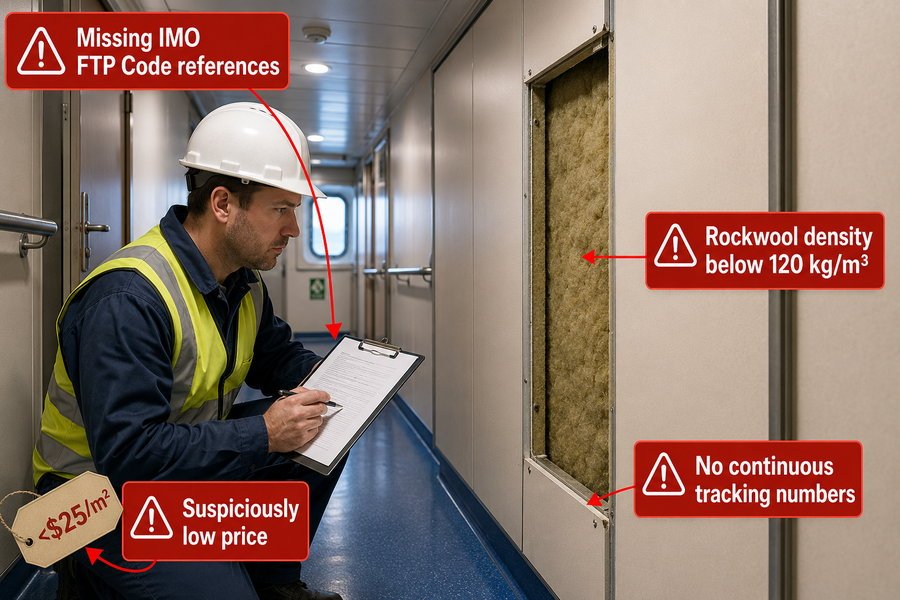
I have seen many buyers fall into the trap of buying standard land-based panels because they look identical to marine panels on the outside. However, the internal materials and testing standards are completely different. You must look for these four specific red flags to protect your projects from failure.
Checking IMO FTP Code References on Panel Documents
The first red flag is the absence of IMO FTP Code references. Marine accommodation panels must be tested according to the International Maritime Organization (IMO) Fire Test Procedures (FTP) Code.3 If the product data sheet only lists land-based standards like EN 13501 or ASTM E84, it is not a marine panel.4 The second red flag involves the panel edge markings. True marine panels have continuous tracking numbers printed along their edges. This allows surveyors to trace the panel back to the exact production batch. If the edges are completely blank, you are likely looking at a standard building panel. Marine classification societies require this traceability.
Analyzing Panel Core Density and Pricing Discrepancies
The third red flag is the core density. Marine panels use high-density rockwool to stop fire from spreading. According to major manufacturers like Rockwool Technical Insulation, the core density for an A-class marine panel must be at least 120 kg/m³, and often up to 150 kg/m³.5 Standard architectural panels usually have a density around 60 kg/m³ to 80 kg/m³. If the supplier cannot confirm a density of at least 120 kg/m³, walk away. The fourth red flag is the price. High-density rockwool and MED certification cost real money. In the current Asian manufacturing market, a genuine marine-grade A-class panel costs between $35 and $55 per square meter. If a supplier offers you a price under $25 per square meter, they are definitely selling you a standard land-based panel.
| Inspection Area | Genuine Marine Panel Standard | Standard Architectural Panel Red Flag |
|---|---|---|
| Testing Standard | Mentions IMO FTP Code | Mentions only EN 13501 or ASTM E84 |
| Core Density | 120 kg/m³ to 150 kg/m³ | 60 kg/m³ to 80 kg/m³ |
| Edge Markings | Printed batch tracking numbers | Blank edges with no tracking data |
| Market Price | $35 to $55 per square meter | Under $25 per square meter |
What Test Reports Confirm A-60 Fire Rating on Marine Accommodation Panels?
An A-60 rating is critical for ship safety, yet many buyers accept vague documents. Missing the right test reports means your ship cannot legally sail.
To confirm an A-60 fire rating on marine accommodation panels, check three specific documents: the IMO Resolution MSC.307(88) non-combustibility test, the 60-minute furnace temperature curve report reaching 945°C, and the insulation temperature rise report staying below 140°C on the unexposed side.
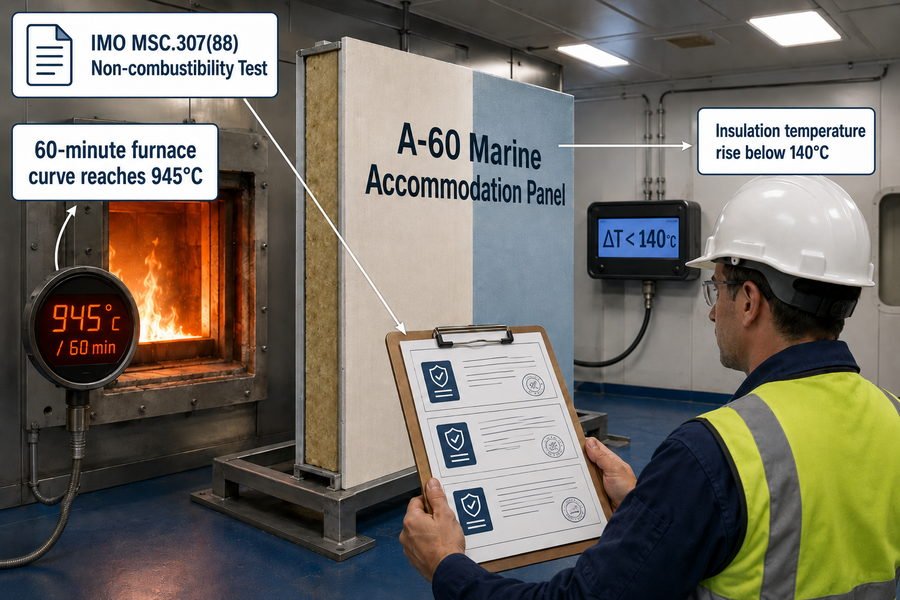
When a shipyard asks you for an A-60 panel, they are asking for a product that can stop a severe fire for one full hour. You cannot just take the supplier's word for it. You must ask for the actual laboratory test reports. I always demand to see these three specific documents before I place any order for a project.
Verifying the IMO Resolution MSC.307(88) Non-Combustibility Test
The first document you need is the non-combustibility test report. According to the current IMO regulations, this test must follow IMO Resolution MSC.307(88), which is also known as the 2010 FTP Code6. This report proves that the core materials, like the rockwool and the internal adhesives, will not add fuel to a fire. The laboratory places the material in a furnace at 750°C7. The report must clearly state that the material did not flame or lose significant mass during the test. If the supplier cannot provide this specific IMO report, their entire A-60 claim is invalid.
Reviewing Furnace Temperature and Insulation Rise Reports for A-60 Panels
The second document is the furnace temperature curve report. To achieve an A-60 rating, the panel must withstand a standard fire test for 60 minutes. The report will show a printed graph. According to the standard ISO 834 fire curve used in marine testing, the furnace temperature must reach exactly 945°C by the end of the 60 minutes8. You must check this graph to ensure the test ran for the full hour. The third document is the insulation temperature rise report. This is the most critical part of the test. While the fire side of the panel is burning at 945°C, the unexposed side must stay cool enough to prevent the fire from spreading to the next room. The IMO rules state that the average temperature on the unexposed side cannot rise more than 140°C above the starting temperature9. If the report shows a temperature rise of 150°C, the panel completely fails the A-60 test.
| Required Test Report | Key Value to Verify | IMO Standard Reference |
|---|---|---|
| Non-Combustibility Test | No flaming at 750°C | IMO Res. MSC.307(88) Part 1 |
| Furnace Temperature Curve | Reaches 945°C at 60 minutes | IMO Res. MSC.307(88) Part 3 |
| Insulation Temperature Rise | Average rise stays below 140°C | IMO Res. MSC.307(88) Part 3 |
How to Authenticate an Accommodation Panel's Wheelmark Number Before Shipment?
You paid for Wheelmark-approved panels, but the box numbers look wrong. Shipping unverified panels across the world wastes massive amounts of time and project money.
Authenticate an accommodation panel's Wheelmark number before shipment by matching the four-digit Notified Body ID with the EU database, checking the two-digit year code against the production date, and requiring high-resolution photos of physical stamps directly on the panel edges.
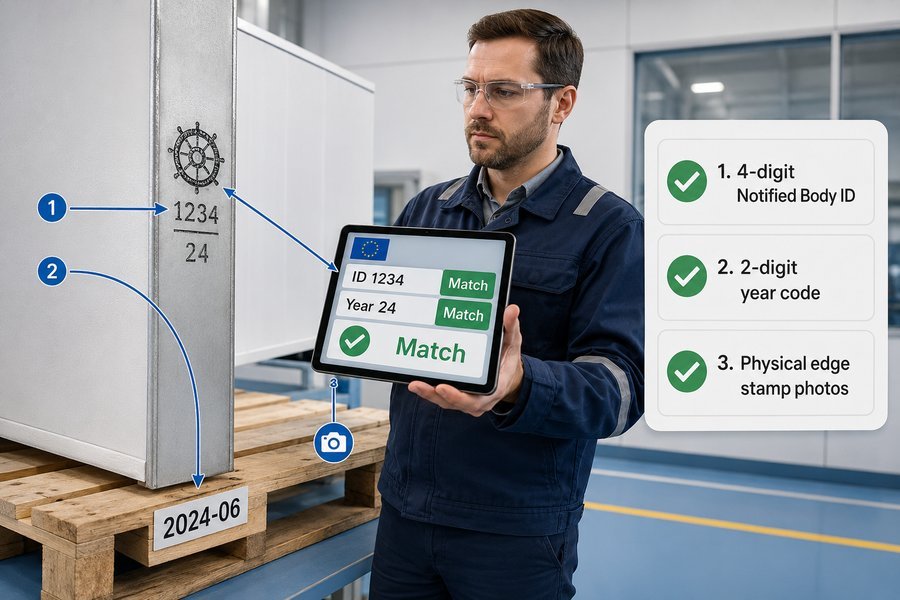
The Wheelmark is the ultimate proof of marine compliance in Europe.10 It is the steering wheel logo you see on certified marine products. But bad factories sometimes print fake Wheelmarks on cheap panels. I never let a container leave the factory without doing a strict Wheelmark check using three specific steps.
Matching Notified Body IDs and Year Codes on Panel Wheelmarks
A real Wheelmark always has two sets of numbers next to the steering wheel logo.11 The first step is to match the four-digit Notified Body ID. This is the number of the agency that audits the factory. You must verify this four-digit number matches the agency listed on the supplier's Module D quality certificate12. The second step is checking the two-digit year code. If the mark says "0575/26", the "26" means the panel was produced in the year 2026. If your supplier claims the panels are brand new, but the year code says "22", they are selling you old stock. Shipyards often reject products with old production years because the certifications might have changed.
Inspecting Physical Wheelmark Stamps on Panel Edges Prior to Shipment
The third step happens right before the panels are packed into the shipping container. You must require high-resolution photos of the physical stamps. The Wheelmark must be permanently marked on the product itself or its data plate.13 For accommodation panels, this is usually printed along the edge of the panel or affixed via a tamper-proof label. I ask the factory manager to take a close-up photo of the panel edge showing the Wheelmark, the Notified Body number, and the year code. If they only show me a Wheelmark printed on a loose piece of paper or a cardboard box, I reject the shipment. The mark must be on the actual panel to be accepted by the marine class surveyor at the shipyard.
| Wheelmark Element | What It Represents | How to Verify It |
|---|---|---|
| Steering Wheel Logo | Symbol of EU MED compliance | Must be clearly printed, not distorted |
| 4-Digit Number (e.g., 0575) | ID of the Notified Body | Match with Module D certificate agency |
| 2-Digit Number (e.g., 26) | Year of product manufacturing | Ensure it matches current production year |
What Compliance Documents Must Accompany Every Accommodation Panel Delivery?
Your container of panels arrives, but the paperwork is incomplete. Missing documents will stop your interior installation dead in its tracks and delay the ship.
Every accommodation panel delivery must include four compliance documents: the Type Approval Certificate Module B, the Quality System Certificate Module D, the manufacturer's Declaration of Conformity linking the batch, and the asbestos-free declaration mandated by SOLAS safety regulations.
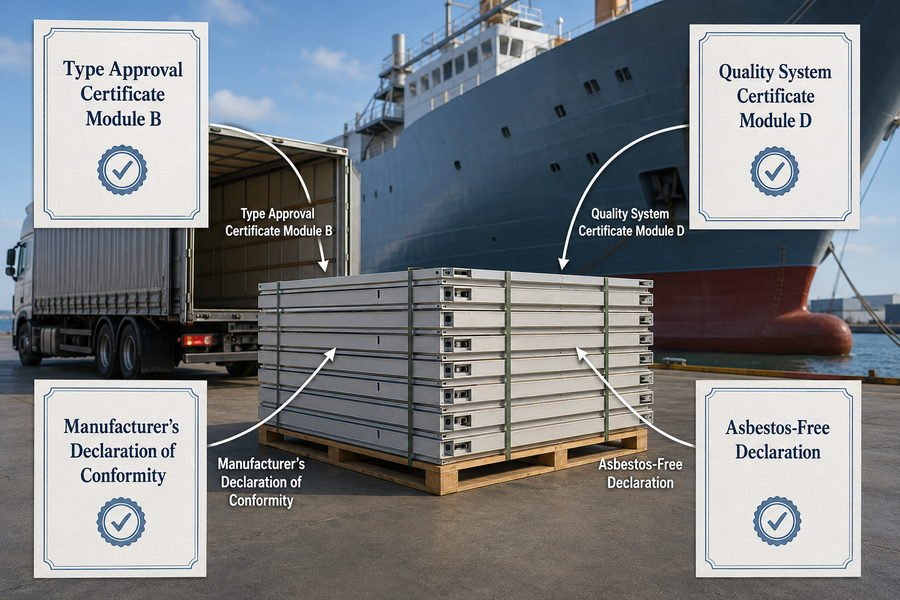
Getting the panels to the shipyard is only half the battle. If you do not hand the correct paperwork to the shipyard's quality inspector, they will not let you install a single panel. Over the years, I have developed a strict checklist of four documents that must arrive with every single delivery to avoid delays.
Validating Module B and Module D Certificates for Panel Deliveries
The first document you need is the Module B certificate, also known as the EC Type Examination Certificate. This document proves that the panel design passed the A-60 or B-15 fire tests14. The second document is the Module D or Module E certificate. This is the production quality assurance certificate. Module B approves the design, but Module D proves the factory is making the mass-produced panels exactly like the tested prototype. Both certificates must be valid and unexpired on the date the panels leave the factory. Without both Module B and Module D, the Wheelmark is legally meaningless and the panels cannot be installed.
Securing the Declaration of Conformity and Asbestos-Free Declarations
The third document is the Declaration of Conformity (DoC). This is a legal paper signed by the manufacturer. It states that the specific batch of panels delivered to you matches the Module B and Module D certificates. It must include your specific invoice number or batch number to connect the physical panels to the certificates. The fourth document is the asbestos-free declaration. The International Convention for the Safety of Life at Sea (SOLAS) strictly bans asbestos on all new ships. The shipyard will demand a formal letter from the panel manufacturer guaranteeing that the rockwool and adhesives contain zero asbestos. If you miss this letter, the shipyard might force you to pay for expensive local lab testing before they allow installation.
| Required Delivery Document | Purpose for Shipyard Inspector | Consequence of Missing Document |
|---|---|---|
| Module B Certificate | Proves the panel design passed fire tests | Product design is considered unverified |
| Module D Certificate | Proves factory maintains quality control | Mass production quality is untrusted |
| Declaration of Conformity (DoC) | Links specific delivery batch to certificates | Delivery batch cannot be legally accepted |
| Asbestos-Free Declaration | Proves compliance with SOLAS asbestos ban | Mandatory local lab testing at buyer's cost |
Why Do Some Suppliers Issue Fake Class Approval Letters for Accommodation Panels?
You received a class approval letter, but it turns out to be forged. Suppliers fake these documents to secure lucrative contracts they simply cannot fulfill legally.
Suppliers issue fake class approval letters for accommodation panels for three reasons: to avoid $10,000 to $30,000 official testing fees, to bypass strict 6-month laboratory waiting periods, and to win bids from foreign buyers who rarely verify technical documents.
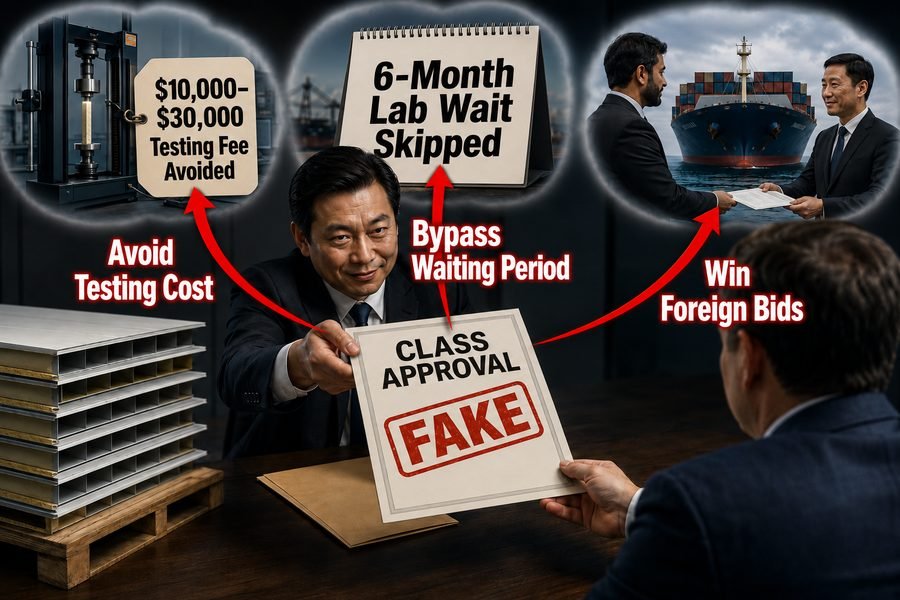
It is a hard truth in the marine outfitting business, but fake certificates are out there15. When you are buying from developing countries to keep your costs down, you have to be very careful. Suppliers do not fake these documents just for fun; they do it because marine certification is a huge barrier to entry16. I have identified three main reasons why bad suppliers forge these letters.
Avoiding High Testing Fees and Long Laboratory Waiting Periods
The first reason is the massive cost of official fire testing. Booking a certified furnace at a Notified Body laboratory to test an A-60 marine panel costs between $10,000 and $30,000 per test17. Small factories simply do not have that kind of cash. It is much cheaper for them to hire someone to edit an old DNV or ABS certificate on a computer. The second reason is time. Even if a factory has the money, the official testing process takes a very long time. Right now, the waiting list for a certified marine fire test lab can be up to 6 months18. If a supplier needs to win your urgent shipyard project today, they cannot wait 6 months for real paperwork, so they forge it to get the order now.
Exploiting Foreign Buyers Through Forged Class Approval Letters
The third reason is that suppliers know many foreign buyers will not check. If a buyer sits in an office in another country and does not understand the MED database, they might just look at the PDF, see a logo, and send the money. These bad suppliers prey on buyers who lack technical expertise. They know that by the time the panels arrive at the shipyard and the class surveyor spots the fake letter, the supplier already has the payment. This is why you must take the lead and verify everything yourself before sending any money.
| Reason for Forging Documents | Supplier Motivation | Cost to Legitimate Business |
|---|---|---|
| High Testing Fees | Save money on lab tests | Real tests cost $10,000 to $30,000 |
| Long Waiting Periods | Win urgent project bids | Real testing takes up to 6 months |
| Buyer Ignorance | Exploit lack of verification | Buyer loses entire project payment |
Conclusion
Verifying marine certifications requires strict attention to detail. By checking databases, demanding proper test reports, and inspecting Wheelmarks, you ensure your accommodation panels meet all strict shipyard safety standards.
-
"Notified body - Wikipedia", https://en.wikipedia.org/wiki/Notified_body. The Marine Equipment Directive requires conformity assessment of covered marine equipment by designated notified bodies, and the Commission’s NANDO system records the bodies notified for that legislation. Evidence role: expert_consensus; source type: government. Supports: Only bodies registered or notified for the relevant Marine Equipment Directive conformity-assessment tasks can issue MED certificates.. Scope note: This supports the legal role of notified bodies under the MED; it does not confirm the authenticity of any individual certificate without checking the certificate record and scope. ↩
-
"How Are Fire Ratings Verified for Marine Wall and Ceiling Panels ...", https://magellanmarinetech.com/how-fire-ratings-verified-for-marine-wall-ceiling-panels/. Fire-test and type-approval regimes for marine equipment assess products against defined constructions and test specimens, so certification is tied to the tested product description and stated conditions of approval. Evidence role: mechanism; source type: institution. Supports: A panel’s fire rating applies to the tested and certified specifications rather than to materially different panel thicknesses or constructions.. Scope note: The source would support the general principle that approvals are specification-dependent; the exact acceptable variation for a panel system depends on the certificate, standard, and notified body assessment. ↩
-
"What Is the Purpose and Scope of the IMO FTP Code? - Magellan ...", https://magellanmarinetech.com/what-purpose-scope-of-imo-ftp-code/. The IMO FTP Code establishes the fire-test procedures used under SOLAS for materials and constructions installed on ships, including fire-resisting divisions used in accommodation and service spaces. Evidence role: expert_consensus; source type: institution. Supports: Marine accommodation panels must be tested according to the IMO Fire Test Procedures Code.. Scope note: This supports the need for IMO FTP Code testing in regulated ship applications, but the exact certificate requirements can vary by flag state, vessel type, and class notation. ↩
-
"[PDF] RESOLUTION MSC.307(88) (adopted on 3 December 2010 ...", https://wwwcdn.imo.org/localresources/en/KnowledgeCentre/IndexofIMOResolutions/MSCResolutions/MSC.307(88).pdf. EN 13501 and ASTM E84 are building-material fire-classification or surface-burning test standards, whereas marine approvals for shipboard fire divisions are normally assessed under IMO/SOLAS fire-test procedures. Evidence role: definition; source type: institution. Supports: A product data sheet that lists only EN 13501 or ASTM E84 lacks the marine fire-test basis expected for marine accommodation panels.. Scope note: This supports the distinction between building and marine fire standards; it does not prove that every product listing only EN 13501 or ASTM E84 is unsuitable for every maritime use. ↩
-
"How to choose the right marine wall panels for marine interior ...", https://magellanmarinetech.com/how-choose-right-marine-wall-panels-for-marine-interior-projects/. Manufacturer technical data and type-approval documentation for A-class marine insulation systems commonly specify mineral-wool core densities in the approximate 120–150 kg/m³ range for tested fire-rated constructions. Evidence role: case_reference; source type: other. Supports: A-class marine panels commonly use high-density rockwool cores around 120–150 kg/m³.. Scope note: This is contextual evidence from tested product systems; density requirements depend on the complete panel design, certificate, thickness, and fire rating, so density alone does not prove A-class compliance. ↩
-
"[PDF] RESOLUTION MSC.307(88) (adopted on 3 December 2010 ...", https://wwwcdn.imo.org/localresources/en/KnowledgeCentre/IndexofIMOResolutions/MSCResolutions/MSC.307(88).pdf. IMO Resolution MSC.307(88) adopted the International Code for Application of Fire Test Procedures, 2010, commonly referred to as the 2010 FTP Code, which sets standardized fire-test procedures for materials and constructions used in ships. Evidence role: definition; source type: institution. Supports: IMO Resolution MSC.307(88) is the 2010 FTP Code and is the relevant IMO fire-test framework for marine fire testing.. ↩
-
"[PDF] RESOLUTION MSC.307(88) (adopted on 3 December 2010 ...", https://wwwcdn.imo.org/localresources/en/KnowledgeCentre/IndexofIMOResolutions/MSCResolutions/MSC.307(88).pdf. Part 1 of the 2010 FTP Code specifies the non-combustibility test method, including exposure of the specimen in a furnace maintained at approximately 750°C, as part of assessing whether materials are non-combustible under the Code. Evidence role: mechanism; source type: institution. Supports: The IMO non-combustibility test uses a furnace temperature of 750°C.. Scope note: This supports the prescribed test condition, not the performance of any particular supplier’s panel or core material. ↩
-
"[PDF] Temperature-Time Curves for Real Compartment-Fire Conditions", https://www.osti.gov/servlets/purl/1305878. The ISO 834 standard time-temperature curve is commonly expressed as T = 20 + 345 log10(8t + 1), which gives a furnace temperature of about 945°C at 60 minutes and is used as the reference heating curve for standard fire-resistance tests. Evidence role: mechanism; source type: paper. Supports: The standard fire curve reaches approximately 945°C after 60 minutes.. Scope note: The formula gives approximately 945°C at 60 minutes; wording such as “exactly” may overstate the precision because standards typically allow tolerances around the prescribed curve. ↩
-
"[PDF] RESOLUTION MSC.307(88) (adopted on 3 December 2010 ...", https://wwwcdn.imo.org/localresources/en/KnowledgeCentre/IndexofIMOResolutions/MSCResolutions/MSC.307(88).pdf. The 2010 FTP Code criteria for class A divisions state that, during the relevant fire-resistance period, the average temperature rise on the unexposed face must not exceed 140°C above the initial temperature, establishing the insulation criterion for ratings such as A-60. Evidence role: expert_consensus; source type: institution. Supports: For an A-class marine fire division, the average unexposed-face temperature rise limit is 140°C above the initial temperature.. Scope note: This supports the average-temperature criterion; full compliance also depends on other requirements, including integrity and maximum local temperature-rise limits. ↩
-
"Directive 96/98/EC - Wikipedia", https://en.wikipedia.org/wiki/Directive_96/98/EC. EU Marine Equipment Directive guidance and legislation describe the wheel mark as the conformity mark for marine equipment meeting applicable EU MED requirements; this supports its role as formal evidence of compliance, though not the broader characterization of being the “ultimate” proof in every acceptance context. Evidence role: definition; source type: government. Supports: The Wheelmark is the official EU conformity mark indicating marine equipment compliance under the Marine Equipment Directive.. Scope note: The source can substantiate the Wheelmark as an official EU conformity mark, but not the article’s emphatic wording or every shipyard/class acceptance practice. ↩
-
"Directive 96/98/EC - Wikipedia", https://en.wikipedia.org/wiki/Directive_96/98/EC. EU rules for the wheel mark specify that the mark is accompanied by the identification number of the notified body involved in the production-control phase and by the year in which the mark is affixed, supporting the claim that compliant markings include these adjacent numerical elements. Evidence role: definition; source type: government. Supports: A valid Wheelmark includes numerical identifiers next to the steering wheel symbol: the notified body identification number and the year marking.. Scope note: The regulation describes the required components of the mark; it may not use the article’s informal phrasing “two sets of numbers.” ↩
-
"Conformity Assessment of Medical Devices: An Overview from a ...", https://pmc.ncbi.nlm.nih.gov/articles/PMC12821529/. The Marine Equipment Directive conformity-assessment modules include Module D, production-quality assurance, under which a notified body assesses and monitors the manufacturer’s quality system; this supports using the Module D certificate to identify the responsible notified body, with the caveat that procedures vary by product and module combination. Evidence role: mechanism; source type: government. Supports: A supplier’s Module D quality certificate is tied to a notified body responsible for production-quality assurance under the Marine Equipment Directive.. Scope note: This supports the regulatory role of Module D and notified bodies generally, but it does not prove that every supplier’s certificate will be sufficient for every panel type or transaction. ↩
-
"How to Verify a Supplier's Wheel Mark Certification for Marine ...", https://magellanmarinetech.com/how-verify-suppliers-wheel-mark-certification-for-marine-accommodation-panels/. The Marine Equipment Directive requires the wheel mark to be affixed visibly, legibly, and indelibly to the marine equipment or to its data plate, supporting the requirement for permanent product-level marking; where that is not possible, the rules allow marking on packaging and accompanying documents. Evidence role: definition; source type: government. Supports: The Wheelmark generally must be permanently affixed to the product itself or its data plate.. Scope note: The source supports the general marking requirement but includes exceptions when affixing the mark directly to the equipment or data plate is impossible or not warranted because of the nature of the equipment. ↩
-
"How Does the IMO FTP Code Connect with Other Marine Fire Safety ...", https://magellanmarinetech.com/how-imo-ftp-code-connect-with-other-marine-fire-safety-frameworks/. The IMO Fire Test Procedures Code describes fire-test procedures and classification criteria for A-class and B-class divisions, including ratings such as A-60 and B-15, which contextualizes why marine panel type approvals cite these classifications. Evidence role: definition; source type: institution. Supports: A-60 and B-15 are recognized fire-test classifications for shipboard divisions or panels.. Scope note: The source explains the classification system and tests; it does not prove that a specific panel design passed them. ↩
-
"Fraudulent Certificates - International Maritime Organization", https://www.imo.org/en/OurWork/HumanElement/Pages/FraudulentCertificates.aspx. IMO and port-state-control materials document recurring problems with fraudulent maritime certificates, supporting the general claim that false certification documents circulate in the maritime sector. Evidence role: general_support; source type: institution. Supports: Fake certificates exist in the marine/maritime sector.. Scope note: Such sources may address fraudulent seafarer, statutory, or class-related documents generally, rather than forged marine outfitting product certificates specifically. ↩
-
"[PDF] RESOLUTION MSC.307(88) (adopted on 3 December 2010 ...", https://wwwcdn.imo.org/localresources/en/KnowledgeCentre/IndexofIMOResolutions/MSCResolutions/MSC.307(88).pdf. International and EU marine-equipment rules require specified testing, conformity assessment, and approval before certain shipboard materials may be placed on board, providing contextual support for the claim that certification can create a substantial entry burden. Evidence role: mechanism; source type: institution. Supports: Marine certification can be a significant barrier to entry for suppliers because it requires formal testing and approval.. Scope note: Regulatory requirements demonstrate procedural burden, but they do not by themselves quantify the commercial barrier for small suppliers. ↩
-
"How Are Integrity and Insulation Judged in Marine Panel Fire Tests?", https://magellanmarinetech.com/how-integrity-insulation-judged-in-marine-panel-fire-tests/. Published laboratory fee schedules or documented industry testing cost estimates can substantiate the stated order of magnitude for A-60 or IMO FTP Code fire-resistance testing. Evidence role: statistic; source type: other. Supports: An official A-60 marine fire test can cost approximately $10,000 to $30,000 per test.. Scope note: Testing prices vary by laboratory, test scope, specimen size, location, witnessing requirements, and retesting needs, so a source may support the range as indicative rather than universal. ↩
-
"How Long Is MED Certification Valid for Marine Accommodation ...", https://magellanmarinetech.com/how-long-med-certification-valid-for-marine-accommodation-panels/. Evidence from accredited fire-test laboratories, notified bodies, or industry testing-capacity reports can support the claim that marine fire-resistance testing may face multi-month scheduling lead times. Evidence role: statistic; source type: institution. Supports: Certified marine fire test laboratories may have waiting lists of up to six months.. Scope note: Lead times are highly time-sensitive and location-specific; a source may only verify that six-month waits occur in some periods or regions, not as a constant global condition. ↩