Struggling to choose the right core for marine panels? Picking the wrong material causes project delays and safety failures. Here is how you can build a reliable selection matrix.
A marine accommodation panel core selection matrix must evaluate six critical factors: fire resistance (A-Class/B-Class), acoustic reduction (Rw values), weight (kg/m2), structural stiffness, cost, and IMO compliance. By mapping these complete criteria, buyers can balance safety and budget for shipyard projects.
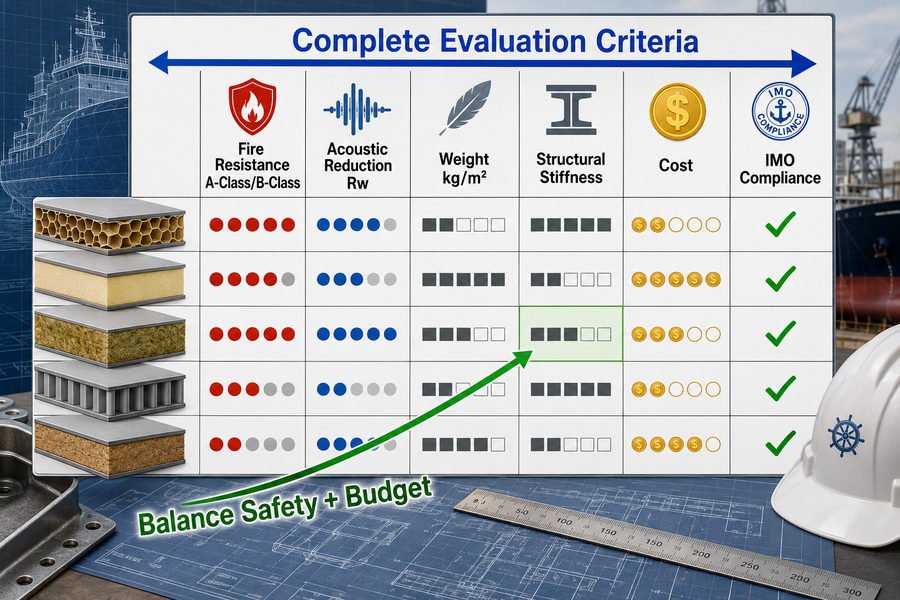
Over my years working from the factory floor to my current role at Magellan Marine, I have seen buyers waste thousands of dollars. They lost money simply because they lacked a clear comparison tool. Let us break down exactly how to build this matrix.
Which Parameters Belong on a Marine Accommodation Panel Core Selection Matrix?
Missing key data in your matrix? Without the right parameters, your panel might fail class inspection. Let us look at the exact metrics you need to track.
A complete marine accommodation panel core selection matrix must include five parameters: fire rating (e.g., B-15), acoustic insulation index (Rw in dB), unit weight (kg/m²), thermal conductivity (W/m·K), and material cost per square meter. These five metrics ensure both safety compliance and commercial viability.
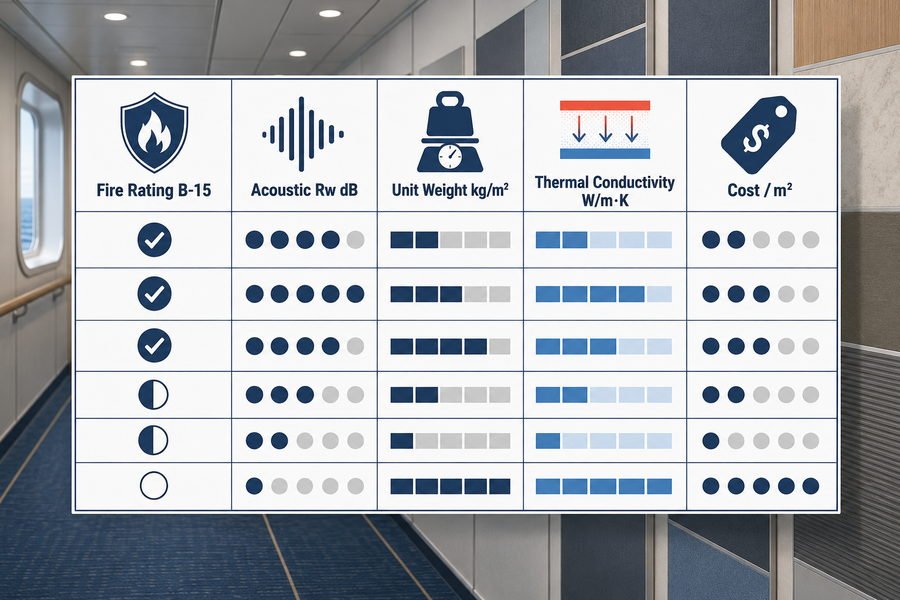
When I first started helping clients source materials from Asia, many buyers only looked at the price tag. But a cheap panel is useless if it fails a noise test. You need to look at all five parameters to make a smart choice. We must break down these five metrics into two groups.
Safety and Performance Parameters for Panel Cores
The first three parameters you must include are fire rating, acoustic index, and thermal conductivity. For fire rating, you must track specific classes like B-15 or B-0 as defined by SOLAS1. You cannot just write "fireproof". For the acoustic insulation index, you need the Rw value in decibels (dB) according to ISO 717-1 standards2. A standard cabin panel should have an Rw value between 30 dB and 35 dB. For thermal conductivity, you need the K-value. A good rock wool core will have a thermal conductivity of about 0.034 to 0.040 W/m·K3. This keeps the cabin warm in winter and cool in summer. If you ignore these three numbers, the ship will not pass the port state control inspection.
Commercial and Physical Parameters for Panel Cores
The last two parameters are unit weight and material cost. Unit weight is measured in kilograms per square meter (kg/m²). A standard 50mm rock wool wall panel weighs about 16 kg/m² to 18 kg/m². If you use a lighter core, you save fuel for the ship owner4. Finally, you must track the material cost per square meter. In the Asian market, a standard B-15 rock wool panel costs about $18 to $25 per square meter. An aluminum honeycomb panel costs about $35 to $45 per square meter. Putting all five of these parameters into your matrix gives you a full picture of what you are buying.
| Parameter Type | Specific Metric | Typical Value Range | Governing Standard |
|---|---|---|---|
| Performance | Fire Rating | B-15, B-0, A-15 | SOLAS Chapter II-2 |
| Performance | Acoustic Index (Rw) | 30 dB - 45 dB | ISO 717-1 |
| Performance | Thermal Conductivity | 0.034 - 0.040 W/m·K | EN 12667 |
| Physical | Unit Weight | 8 kg/m² - 20 kg/m² | Shipyard Spec |
| Commercial | Material Cost | $18 - $45 per m² | Market Rate |
How to Weight Fire, Acoustic, and Weight Criteria for Marine Accommodation Panel Cores?
Confused about which panel feature matters most? Balancing fire safety, noise reduction, and weight is hard. Here is a simple way to assign priority weights.
To properly weight marine accommodation panel core criteria, assign fire rating the highest priority (40%) since SOLAS compliance is mandatory. Weight comes second (35%) for fuel efficiency, and acoustic performance (25%) is prioritized last for crew comfort, ensuring a balanced, compliant, and cost-effective selection.
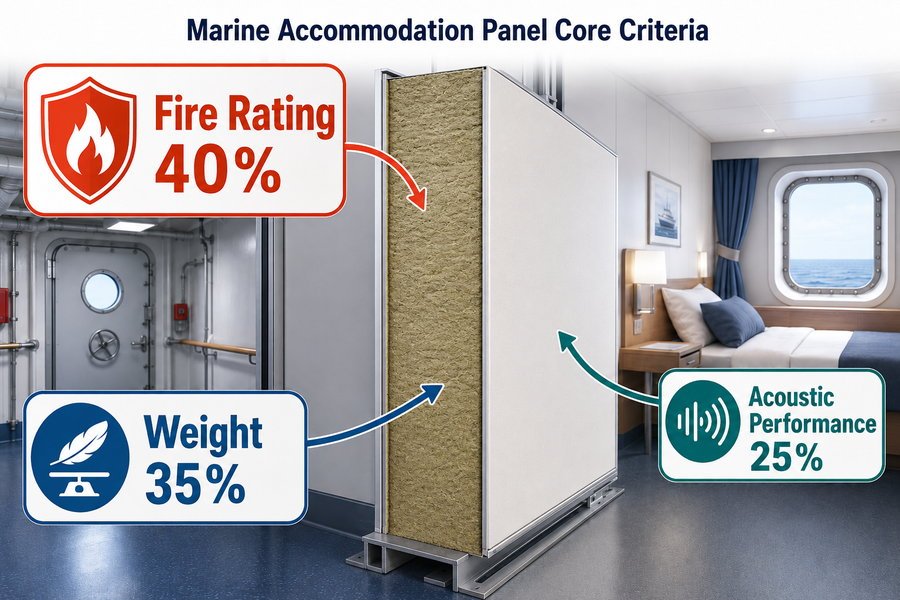
Every shipyard has different needs, but you cannot treat every feature equally. If a panel is quiet but catches fire easily, the ship cannot sail. Let me show you how to apply these three exact percentage weights to your selection matrix.
Assigning High Priority to Fire and Weight Criteria
In your matrix, fire rating must get the highest weight at 40%. Fire safety is a strict pass or fail condition. According to SOLAS Chapter II-2, if a bulkhead requires a B-15 rating, a B-0 panel is illegal.5 You cannot negotiate this with a class surveyor. Because it is a legal rule, it takes up the biggest share of your decision. Weight comes next at 35%. Weight directly changes the cost of running the ship. For example, if you save 3 kg/m² on a cruise ship with 50,000 square meters of panels, you remove 150 tons of dead weight. This saves the owner thousands of dollars in marine diesel oil every year. This is why weight gets a very high priority score right behind fire safety.
Balancing Acoustic Criteria in the Selection Matrix
Acoustic performance takes the final 25% of the total weight. Do not think 25% means noise control is not important. The IMO Code on Noise Levels on Board Ships (Resolution MSC.337(91)) demands that sleeping cabins stay under 60 dB.6 But acoustic performance is easier to fix later than fire or weight. If a room is a little too loud, you can add soft carpets or heavy curtains to absorb the sound. You cannot add a curtain to fix a bad fire rating. So, you give the acoustic index a 25% weight. This covers all three criteria perfectly.
| Evaluation Criterion | Assigned Weight | Primary Reason | Legal / Industry Standard |
|---|---|---|---|
| Fire Rating | 40% | Mandatory for life safety and class approval | SOLAS Chapter II-2 |
| Unit Weight | 35% | Affects fuel consumption and vessel speed | Ship Design Limits |
| Acoustic Index | 25% | Affects crew and passenger comfort | IMO Res. MSC.337(91) |
What Trade-Offs Exist Between Stiffness and Fire Rating in Marine Accommodation Panel Cores?
Need panels that are both strong and fireproof? High stiffness often lowers fire resistance. Understanding this trade-off prevents costly bulkhead failures during installation.
The main trade-off between stiffness and fire rating in marine panel cores involves density and material type. High-density rock wool (120 kg/m³) provides excellent A-Class fire ratings but poor rigidity, while aluminum honeycomb offers high stiffness but requires additional insulation to meet B-15 fire standards.
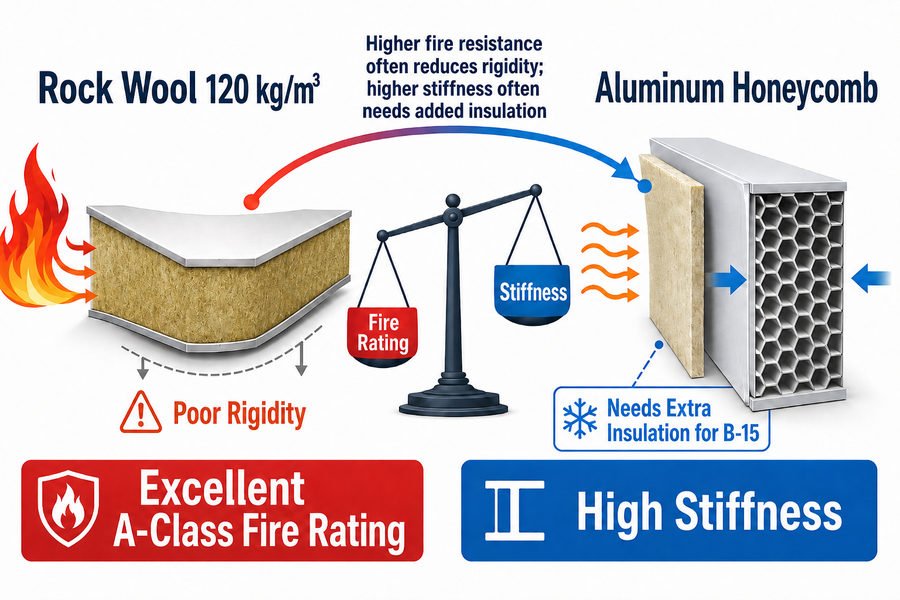
I remember testing panels at the factory. We tried to make a panel that was as hard as steel and as fireproof as a brick. We quickly learned that you have to give up one thing to get another. Let us look at how density and material type force you to make a choice.
Fire Performance of High-Density Rock Wool Cores
When you choose a high-density rock wool core, you get the best fire rating possible. To pass an A-60 fire test, you usually need rock wool with a density of at least 120 kg/m³7. This material handles temperatures over 900°C in the test furnace. But here is the trade-off. Rock wool is basically spun stone fibers. It has very poor structural stiffness.8 If you press hard on a long, thin rock wool panel, it bends easily. During ship installation, workers must handle these panels carefully. If the span is too long, the panel might warp under its own weight. So, you win the fire rating battle, but you lose the stiffness battle. You must add stronger steel skins to hold it straight.
Structural Stiffness Benefits of Aluminum Honeycomb Cores
On the other side, we have aluminum honeycomb cores. This material gives you amazing stiffness. The hexagonal cells, usually 6mm to 12mm wide, create a rigid structure that does not bend easily.9 Workers love it because it is strong and easy to carry. But the trade-off is its fire rating. Aluminum melts at about 660°C. In a standard IMO fire test, the furnace gets much hotter than that.10 If you just put steel skins over a raw aluminum honeycomb core, it will fail a B-15 test quickly. To pass, you must add special ceramic paper or extra fire insulation inside the panel. This increases your cost. You trade away easy fire compliance to get a very stiff panel.
| Core Material Type | Density / Spec | Structural Stiffness | Fire Rating Capability | Main Trade-Off |
|---|---|---|---|---|
| Rock Wool | 120 kg/m³ | Low (bends easily) | High (A-60 possible) | Needs thicker steel skins for support |
| Aluminum Honeycomb | 6mm - 12mm cell | Very High (rigid) | Low (melts at 660°C) | Needs extra ceramic layers for B-15 |
How to Map SOLAS and IMO FTP Code Rules to Marine Accommodation Panel Core Specs?
Finding IMO rules too complex to understand? Failing to map these rules directly to your panel specs leads to class rejection. Here is the straightforward mapping method.
Mapping SOLAS and IMO FTP Code to panel specs requires three direct links: SOLAS Chapter II-2 dictates the fire class (A, B, C), IMO FTP Code Part 3 sets the 30-minute or 60-minute furnace test requirements, and FTP Code Part 5 limits the surface flammability and toxic smoke emissions.
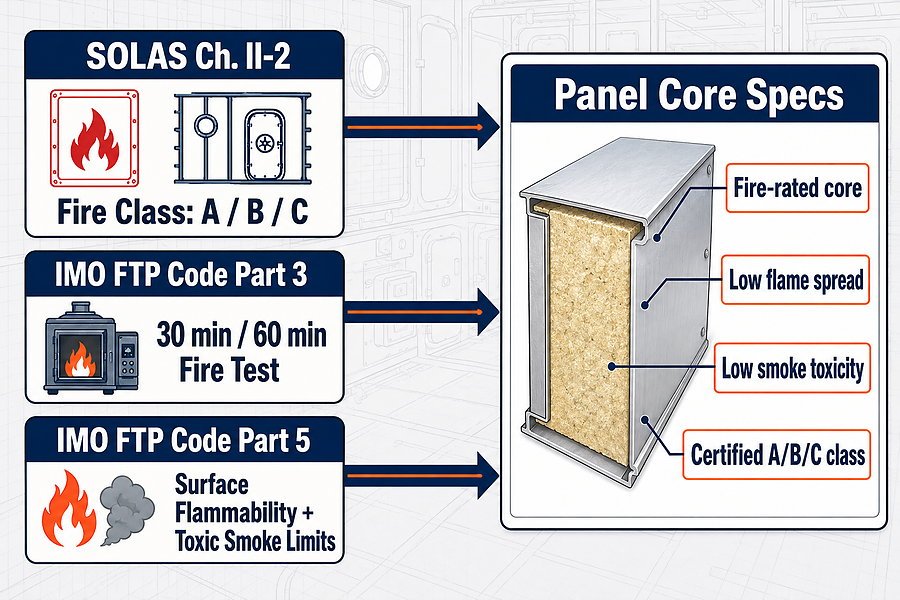
Many buyers get confused by the rule books. They ask me, "Howard, what does FTP even mean for my order?" It stands for Fire Test Procedures11. If you do not link these three exact rules to your factory orders, your panels will be useless.
Mapping SOLAS Chapter II-212 to Panel Fire Classes
The first link you make is from SOLAS Chapter II-2 to your panel's fire class. SOLAS is the main law book. It looks at the ship's layout and tells you what class of panel goes where. For example, SOLAS says the wall between a hallway and a cabin must stop fire from spreading. It assigns a "B-Class" rating to this wall. It assigns an "A-Class" rating to walls near the engine room. And it assigns a "C-Class" rating to walls between two regular spaces with low risk. So, when you write your spec sheet, you look at the shipyard's SOLAS drawing and write down A, B, or C. This is the basic level of fire safety mapping.
Applying IMO FTP Code Parts 3 and 5 to Core Materials
Next, you map the IMO FTP Code Parts 3 and 5 to your actual core material. FTP Code Part 3 is the furnace test. If SOLAS asks for a B-15 panel, FTP Part 3 says your core must survive in an 843°C furnace for 30 minutes13, and the unexposed side must not rise more than 140°C above the starting temperature for the first 15 minutes. This rule tells you exactly how thick your rock wool must be. Then, you apply FTP Code Part 5. This rule tests surface flammability and smoke toxicity14. It means the glue and the core must not create black, poison smoke when heated. You must tell your supplier that their core and adhesives must pass the Part 5 toxicity limits.
| IMO / SOLAS Regulation | What It Regulates | How It Maps to Panel Specs | Specific Test Condition |
|---|---|---|---|
| SOLAS Chapter II-2 | Location Requirements | Determines if panel is A, B, or C class | Ship General Arrangement |
| IMO FTP Code Part 3 | Fire Resistance | Dictates core thickness and density | 843°C for 30 mins (B-Class) |
| IMO FTP Code Part 5 | Flammability & Smoke | Dictates glue and material toxicity | Fails if smoke is too toxic |
Which Thresholds Justify Switching From Rock Wool to Aluminum Honeycomb Core?
Not sure when to stop using rock wool? Using heavy materials on high-speed vessels ruins performance. Know the exact limits that require an aluminum honeycomb switch.
Switching from rock wool to aluminum honeycomb core is justified by three thresholds: when panel weight must remain under 10 kg/m² for high-speed craft, when decorative span unsupported length exceeds 2.5 meters requiring extreme rigidity, and when the required fire rating is only C-Class instead of B-Class.
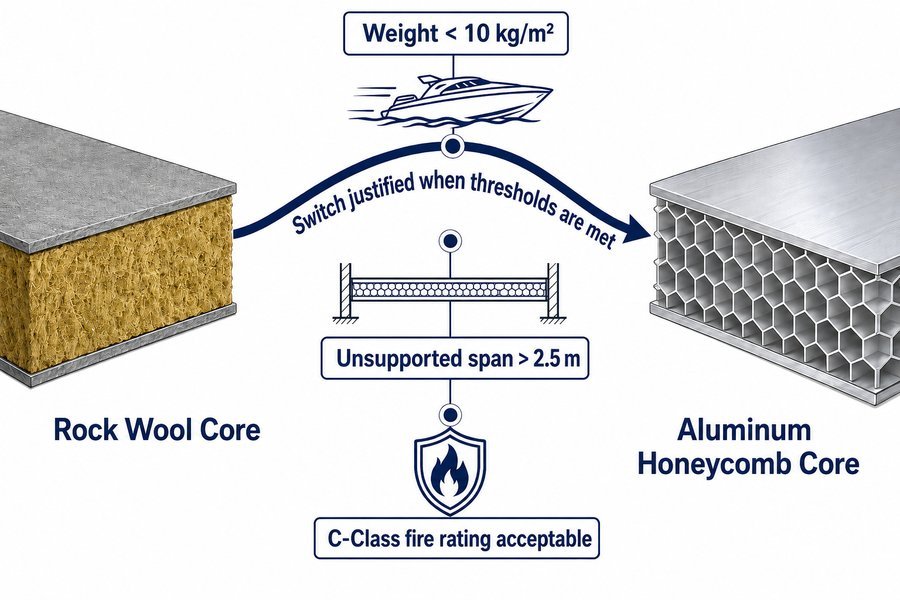
I once helped a client who bought rock wool panels for a fast ferry. The panels were too heavy, and the ferry could not reach its top speed. We had to replace them all. You must watch these three exact thresholds to know when to switch materials.
Weight and Span Thresholds for High-Speed Craft Panels
The first two thresholds are weight and span. If you are building a vessel under the High-Speed Craft (HSC) Code, weight is everything15. The first threshold is 10 kg/m². A standard 50mm rock wool panel weighs about 16 kg/m² to 18 kg/m².16 If your shipyard specification says the wall must be under 10 kg/m², you must drop rock wool immediately. An aluminum honeycomb panel of the same thickness weighs only about 7 kg/m² to 9 kg/m². The second threshold is the unsupported span length. Sometimes public rooms have high ceilings. If the panel needs to stand unsupported for more than 2.5 meters, rock wool will bend. At a 2.5-meter span, aluminum honeycomb stays perfectly straight because of its high stiffness.17 This saves you from building heavy steel frames inside the room.
Fire Rating Thresholds for Core Material Switching
The third threshold is the fire rating requirement. As we discussed earlier, rock wool is great for stopping fire. But not every room on a ship needs to stop a huge fire. Sometimes, the SOLAS drawing only asks for a C-Class division. C-Class means the panel only needs to be made of non-combustible materials. It does not need to block heat for 15 or 30 minutes.18 When you hit this C-Class threshold, using heavy rock wool is a waste of money and weight. You can easily switch to a light aluminum honeycomb core. The honeycomb is non-combustible, so it passes C-Class easily, and it gives you a nicer, flatter finish for the interior design.
| Decision Factor | Threshold for Rock Wool | Threshold for Aluminum Honeycomb | Reason for Switch |
|---|---|---|---|
| Weight Limit | > 15 kg/m² allowable | < 10 kg/m² required | High-speed craft need low weight |
| Unsupported Span | < 2.5 meters | > 2.5 meters | Honeycomb prevents bending over long spans |
| Fire Class Need | A-Class or B-Class | C-Class | C-Class only requires non-combustible material |
How to Document Marine Accommodation Panel Core Selection for Class Approval?
Worried about the class surveyor rejecting your panels? Bad paperwork is a common reason for delays. You need a clear document package for quick approval.
Documenting core selection for class approval requires submitting four main documents: the Type Approval Certificate (MED Module B), the quality system certificate (MED Module D), the lab test reports verifying FTP Code compliance, and the shipyard's final arrangement drawings showing the specific installation locations.
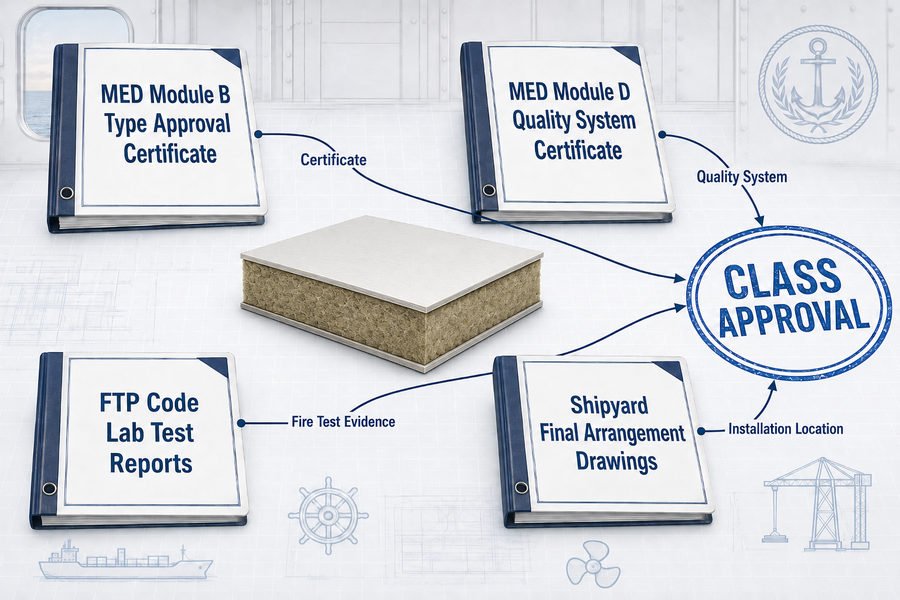
When the class surveyor walks onto the ship, they do not want to hear a sales pitch. They want to see the paper trail. If you cannot show them these four exact documents, they will ask you to tear the panels down. Let me explain how to organize them.
Gathering Type Approval and Quality System Certificates
The first two documents come directly from your supplier. First, you need the Type Approval Certificate. In Europe, this is often called the MED Module B certificate19. It proves that the design of the panel has been checked and approved by a class society like DNV, ABS, or Lloyd's Register. This certificate is usually valid for 5 years20. Second, you need the quality system certificate, known as MED Module D21. This document proves that the factory uses a strict quality control system to make the panels every day. It shows that the panel they made on Tuesday is just as good as the panel they tested last year. If you buy panels from a factory that has Module B but no Module D, the surveyor will not accept the goods.
Submitting Lab Test Reports and Arrangement Drawings
The last two documents tie the product to your specific ship. You need the original lab test reports. The surveyor will read these to check the exact FTP Code furnace results22. If your supplier changed the glue or the core density after the lab test, the report becomes invalid. Always ask for the full report, not just the summary page. Finally, you need the shipyard's general arrangement drawings. These drawings show exactly where panel number 123 is installed on deck 4. The surveyor will hold the drawing, look at the wall, check the label on the panel, and match it to the MED certificate. When all four documents match perfectly, you get your stamp of approval fast.
| Required Document | Source Provider | Purpose for Class Surveyor | Validity / Check Point |
|---|---|---|---|
| Type Approval (Module B) | Panel Manufacturer | Proves panel design meets IMO rules | Usually valid for 5 years |
| Quality Cert (Module D) | Panel Manufacturer | Proves factory has good quality control | Must cover the date of production |
| Lab Test Reports | Independent Test Lab | Shows detailed FTP test numbers | Must match the materials used |
| Arrangement Drawings | Shipyard Design Team | Shows exactly where panels are placed | Surveyor matches drawing to physical wall |
Conclusion
Building a solid selection matrix for marine panels saves money and time. Focus on the core parameters, follow IMO rules, track the specific thresholds, and keep your paperwork organized for easy project approval.
-
"What Is the Purpose and Scope of the IMO FTP Code?", https://magellanmarinetech.com/what-purpose-scope-of-imo-ftp-code/. The SOLAS fire-safety framework and IMO Fire Test Procedures Code define class divisions such as B-0 and B-15 by construction and fire-resistance performance requirements. Evidence role: definition; source type: institution. Supports: SOLAS defines specific marine fire-rating classes such as B-15 and B-0.. ↩
-
"Sound reduction index - Wikipedia", https://en.wikipedia.org/wiki/Sound_reduction_index. ISO 717-1 specifies the rating procedure for airborne sound insulation in buildings and building elements, including the weighted sound reduction index Rw expressed in decibels. Evidence role: definition; source type: institution. Supports: The acoustic insulation index can be expressed as an Rw value in dB according to ISO 717-1.. Scope note: ISO 717-1 defines the acoustic rating method; it does not by itself establish a required Rw value for a particular ship cabin panel. ↩
-
"Determination of Thermal Properties of Mineral Wool Required for ...", https://pmc.ncbi.nlm.nih.gov/articles/PMC10488771/. Published material-property references for mineral wool insulation commonly report thermal conductivity values in the approximate 0.03–0.04 W/m·K range, supporting the stated order of magnitude for rock wool cores. Evidence role: statistic; source type: research. Supports: A good rock wool core can have thermal conductivity of about 0.034 to 0.040 W/m·K.. Scope note: Reported values vary with product density, temperature, test method, and manufacturer; the source supports a typical range rather than a universal specification. ↩
-
"Estimation and Optimization of Ship Fuel Consumption in Maritime", https://arxiv.org/html/2602.21959v1. Naval-architecture research links vessel displacement and lightweighting to propulsion power and fuel consumption, supporting the general principle that reducing onboard mass can reduce fuel use. Evidence role: mechanism; source type: paper. Supports: Using a lighter core can save fuel for the ship owner.. Scope note: The source would support the general weight–fuel relationship, not quantify savings from a specific panel substitution without a vessel-specific energy model. ↩
-
"[PDF] recommendation for fire test procedures for “a” and “b” class ...", https://wwwcdn.imo.org/localresources/en/KnowledgeCentre/IndexofIMOResolutions/AssemblyDocuments/A.163(ES.IV).pdf. SOLAS Chapter II-2 and related IMO fire-test requirements establish mandatory fire integrity classifications for ship divisions; this supports the point that a panel with a lower fire rating cannot be substituted where a higher rated division is required. Evidence role: general_support; source type: institution. Supports: A B-0 panel cannot be used where SOLAS/class requirements specify a B-15 fire-rated bulkhead.. Scope note: The exact required rating depends on vessel type, space category, flag-state implementation, and class interpretation. ↩
-
"[PDF] MSC.337(91) (adopted on 30 November 2012) CODE ON NOISE ...", https://wwwcdn.imo.org/localresources/en/KnowledgeCentre/IndexofIMOResolutions/MSCResolutions/MSC.337(91).pdf. IMO Resolution MSC.337(91), the Code on Noise Levels on Board Ships, specifies maximum permissible noise levels for accommodation spaces, including a 60 dB(A) limit for cabins on many covered ships. Evidence role: definition; source type: institution. Supports: The IMO Code on Noise Levels on Board Ships sets a 60 dB limit for sleeping cabins/accommodation cabins.. Scope note: Applicability depends on ship type, construction date, tonnage, and the Code’s implementation through SOLAS and flag-state rules. ↩
-
"RESOLUTION MSC.307(88) (adopted on 3 December ...", https://wwwcdn.imo.org/localresources/en/KnowledgeCentre/IndexofIMOResolutions/MSCResolutions/MSC.307(88).pdf. IMO fire-test standards define A-class performance by time, temperature-rise limits, and non-combustibility rather than by a universal core density; classification or test reports for A-60 mineral-wool panels can contextualize why densities around 120 kg/m³ are commonly specified for such constructions. Evidence role: general_support; source type: institution. Supports: Passing an A-60 fire test usually requires a high-density rock wool core around at least 120 kg/m³.. Scope note: This would support the density as an industry practice for tested panel designs, not as a mandatory IMO requirement for every A-60 assembly. ↩
-
"Mechanical Properties of Eco-Friendly, Lightweight Flax and Hybrid ...", https://pmc.ncbi.nlm.nih.gov/articles/PMC11313447/. Research on mineral-wool insulation reports low tensile, compressive, or elastic mechanical properties compared with structural sandwich-core materials, supporting the characterization of rock wool as primarily an insulation core rather than a stiffness-providing core. Evidence role: mechanism; source type: paper. Supports: Rock wool has poor structural stiffness compared with structural core materials.. Scope note: Mechanical stiffness varies with density, binder content, fiber orientation, and panel construction, so the source should not be read as proving all rock-wool panels bend easily in every configuration. ↩
-
"(PDF) Bending Behavior of Aluminum Honey Comb Sandwich Panels", https://www.academia.edu/73646212/Bending_Behavior_of_Aluminum_Honey_Comb_Sandwich_Panels. Engineering literature on honeycomb sandwich structures explains that hexagonal cellular cores increase bending stiffness by separating the face sheets while adding little mass, which supports the stated stiffness mechanism for aluminum honeycomb panels. Evidence role: mechanism; source type: paper. Supports: Hexagonal aluminum honeycomb cores provide high panel stiffness and resistance to bending.. Scope note: The source may support the honeycomb stiffness mechanism generally; the specific 6–12 mm cell-size range should be verified separately if presented as a universal specification. ↩
-
"[PDF] RESOLUTION MSC.307(88) (adopted on 3 December 2010 ...", https://wwwcdn.imo.org/localresources/en/KnowledgeCentre/IndexofIMOResolutions/MSCResolutions/MSC.307(88).pdf. Reference data give aluminum’s melting point at approximately 660°C, and IMO/ISO fire-test temperature curves exceed that temperature during standard fire exposure, supporting the concern that unprotected aluminum honeycomb may lose integrity in such tests. Evidence role: mechanism; source type: government. Supports: Aluminum’s melting point is below the furnace temperatures reached in standard IMO fire testing.. Scope note: Melting point and furnace temperature alone do not prove failure of a specific panel, because failure also depends on skin material, insulation layers, heat transfer, and test duration. ↩
-
"How Does the IMO FTP Code Connect with Other Marine Fire Safety ...", https://magellanmarinetech.com/how-imo-ftp-code-connect-with-other-marine-fire-safety-frameworks/. The International Maritime Organization identifies the FTP Code as the International Code for Application of Fire Test Procedures, establishing standardized fire-test methods referenced by SOLAS. Evidence role: definition; source type: institution. Supports: FTP stands for Fire Test Procedures.. Scope note: This supports the meaning and regulatory context of the acronym, not the commercial consequence that panels become unusable without order-level mapping. ↩
-
"[PDF] recommendation for fire test procedures for “a” and “b” class ...", https://wwwcdn.imo.org/localresources/en/KnowledgeCentre/IndexofIMOResolutions/AssemblyDocuments/A.163(ES.IV).pdf. SOLAS Chapter II-2 contains fire protection, fire detection, and fire extinction requirements, including structural fire-containment provisions that use A-, B-, and C-class divisions for bulkheads and decks. Evidence role: historical_context; source type: institution. Supports: SOLAS Chapter II-2 determines how ship spaces are mapped to A, B, or C panel fire classes.. Scope note: The exact class required for a given wall depends on vessel type, space category, and the applicable SOLAS tables, so the source provides regulatory context rather than a complete project-specific mapping. ↩
-
"[PDF] RESOLUTION MSC.307(88) (adopted on 3 December 2010 ...", https://wwwcdn.imo.org/localresources/en/KnowledgeCentre/IndexofIMOResolutions/MSCResolutions/MSC.307(88).pdf. IMO FTP Code Part 3 specifies fire-resistance testing for class divisions using a standard time-temperature furnace curve, which reaches approximately 843°C at 30 minutes for B-class test exposure. Evidence role: mechanism; source type: institution. Supports: For a B-class panel test under IMO FTP Code Part 3, the furnace exposure is approximately 843°C at 30 minutes.. Scope note: Some sources state the furnace exposure as a time-temperature formula or curve rather than as a single fixed 843°C set point. ↩
-
"[PDF] RESOLUTION MSC.307(88) (adopted on 3 December 2010 ...", https://wwwcdn.imo.org/localresources/en/KnowledgeCentre/IndexofIMOResolutions/MSCResolutions/MSC.307(88).pdf. The IMO FTP Code distinguishes material fire-test methods, with Part 5 addressing surface flammability and separate FTP Code provisions addressing smoke and toxicity measurements for materials exposed to fire. Evidence role: definition; source type: institution. Supports: IMO FTP Code requirements cover surface flammability and smoke toxicity testing for materials used in ship interiors.. Scope note: This source may contextualize the combined phrase but may not support the article’s implication that smoke toxicity is tested under Part 5 specifically. ↩
-
"[PDF] A CFD Study on the Performance of High Speed Planing Hulls", https://www.gvsu.edu/cms4/asset/777A03CA-E5D1-90B3-8FF97B7EA6E9ECB3/crosby_thesis_wrp.pdf. Naval-architecture literature on high-speed craft explains that resistance, required power, and achievable speed are strongly affected by displacement, so reducing outfit and structural weight can preserve speed and payload margins. Evidence role: mechanism; source type: paper. Supports: For vessels under the HSC Code, panel weight is a critical design constraint because added weight can reduce achievable speed or payload margin.. Scope note: This supports the importance of weight in high-speed craft design but does not establish the article’s specific material-switching thresholds. ↩
-
"How to choose the right marine wall panels for marine interior ...", https://magellanmarinetech.com/how-choose-right-marine-wall-panels-for-marine-interior-projects/. Classification-society or test-certificate data for marine mineral-wool sandwich panels can document that 50 mm rock-wool panel constructions commonly have mass per unit area in the mid-teens kg/m² range. Evidence role: statistic; source type: institution. Supports: A typical 50 mm rock-wool marine panel weighs approximately 16–18 kg/m².. Scope note: Panel mass varies with face-sheet material and thickness, core density, adhesive, and finish, so the citation would support a representative range rather than a universal standard. ↩
-
"[PDF] Mechanical Properties Characterization of Composite Sandwich ...", https://ntrs.nasa.gov/api/citations/19880000739/downloads/19880000739.pdf. Research on aluminum honeycomb sandwich panels shows that the honeycomb-core sandwich configuration provides high bending stiffness relative to weight, which explains why it is often used where flatness and flexural rigidity are required. Evidence role: mechanism; source type: paper. Supports: Aluminum honeycomb panels can resist bending over longer spans because sandwich construction provides high flexural stiffness at low weight.. Scope note: Such sources support the stiffness mechanism generally; they do not prove that every 2.5 m panel will remain ‘perfectly straight’ without specifying load, support conditions, face-sheet thickness, and allowable deflection. ↩
-
"Are Marine Fire Divisions the Same as Marine Panel Ratings?", https://magellanmarinetech.com/are-marine-fire-divisions-same-as-marine-panel-ratings/. SOLAS/FTP Code descriptions of fire divisions distinguish C-class divisions as non-combustible constructions that are not required to meet the temperature-rise insulation criteria applied to A- or B-class divisions. Evidence role: definition; source type: institution. Supports: C-Class marine divisions require non-combustible materials but do not require 15- or 30-minute thermal insulation performance.. Scope note: The source would define the regulatory class; actual acceptance still depends on the flag administration, classification society, and the tested construction details. ↩
-
"How Do EU Rules Differ From IMO Standards for Marine Panels ...", https://magellanmarinetech.com/how-eu-rules-differ-from-imo-standards-for-marine-panels/. Directive 2014/90/EU and its conformity-assessment modules describe Module B as EU type-examination, under which a notified body examines a representative product type against applicable marine-equipment requirements. Evidence role: definition; source type: government. Supports: In Europe, the Type Approval Certificate is often called the MED Module B certificate and shows that the panel design has been examined and approved.. Scope note: This supports the regulatory meaning of Module B, but item-by-item acceptance still depends on the applicable implementing regulation and certificate scope. ↩
-
"How Long Is MED Certification Valid for Marine Accommodation ...", https://magellanmarinetech.com/how-long-med-certification-valid-for-marine-accommodation-panels/. Marine-equipment notified-body guidance and sample MED type-examination certificates commonly state a five-year validity period for Module B certificates, supporting the article’s characterization as a usual industry practice. Evidence role: general_support; source type: institution. Supports: A MED Module B/type approval certificate is usually valid for 5 years.. Scope note: Validity periods may vary by certificate, equipment category, and regulatory update; the source should be used to support “usually,” not an absolute rule. ↩
-
"How Do EU Rules Differ From IMO Standards for Marine Panels ...", https://magellanmarinetech.com/how-eu-rules-differ-from-imo-standards-for-marine-panels/. The Marine Equipment Directive’s conformity-assessment framework defines Module D as conformity to type based on quality assurance of the production process, supporting the claim that it documents factory production-quality control for approved marine equipment. Evidence role: definition; source type: government. Supports: MED Module D is a quality-system certificate showing that the factory controls production so manufactured panels conform to the approved type.. Scope note: Module D is one accepted production conformity route; some equipment or approvals may use other MED modules such as Module E or F instead. ↩
-
"[PDF] RESOLUTION MSC.307(88) (adopted on 3 December 2010 ...", https://wwwcdn.imo.org/localresources/en/KnowledgeCentre/IndexofIMOResolutions/MSCResolutions/MSC.307(88).pdf. The IMO FTP Code sets out standardized fire-test procedures and test-report requirements for materials and fire-resisting divisions used on ships, including documentation of the tested specimen and its construction; this supports checking furnace-test results against the actual panel materials. Evidence role: mechanism; source type: institution. Supports: Lab test reports should be checked for the exact FTP Code furnace results, and changes to glue or core density can undermine the applicability of the report.. Scope note: The FTP Code supports the need to match tested construction to installed construction, but a separate approval-body decision may determine whether a particular material change formally invalidates a certificate. ↩