Shipbuilders often struggle with damaged cabin walls. Choosing between steel and composite panels causes big headaches for project budgets. I will show you exactly where steel panels solve your biggest outfitting problems.
Steel-faced marine accommodation panels are preferred over composite panels in five main areas: high-traffic commercial vessels, wet galleys and laundries, hygienic hospital zones, cold provision stores, and heavy-duty navy or offshore structures, due to their superior fire resistance, impact strength, and moisture protection.
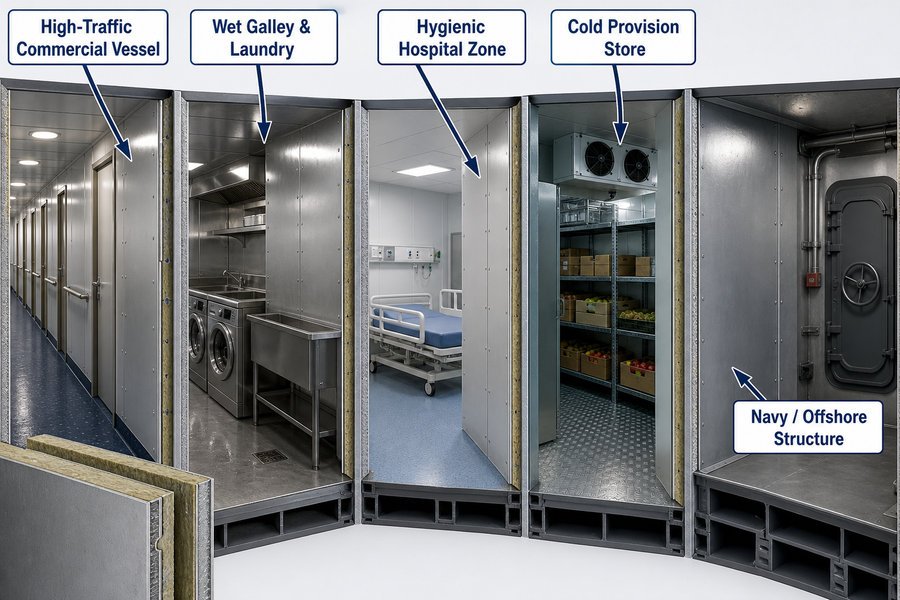
You might think composite panels are good enough and cheap enough for every room on a ship. But that mistake can cost you your shipyard approval and cause massive rework. When I worked in the marine outfitting factory, I saw many buyers fail their inspections because they used the wrong materials. Let me break down exactly where steel-faced panels are the only safe, certified, and cost-effective choice for your next ship interior project.
Which Vessel Types Specify Steel-Faced Marine Accommodation Panels Throughout?
Replacing broken panels on active ships drains your profit quickly. If you use weak materials, the shipowners will complain. Here are the specific ships that need steel panels everywhere.
Three specific vessel types require steel-faced marine accommodation panels throughout: roll-on/roll-off (Ro-Ro) passenger ferries, commercial cargo ships, and offshore support vessels (OSVs), because these ships face daily heavy impacts, extreme vibration, and strict SOLAS A-Class fire safety regulations.
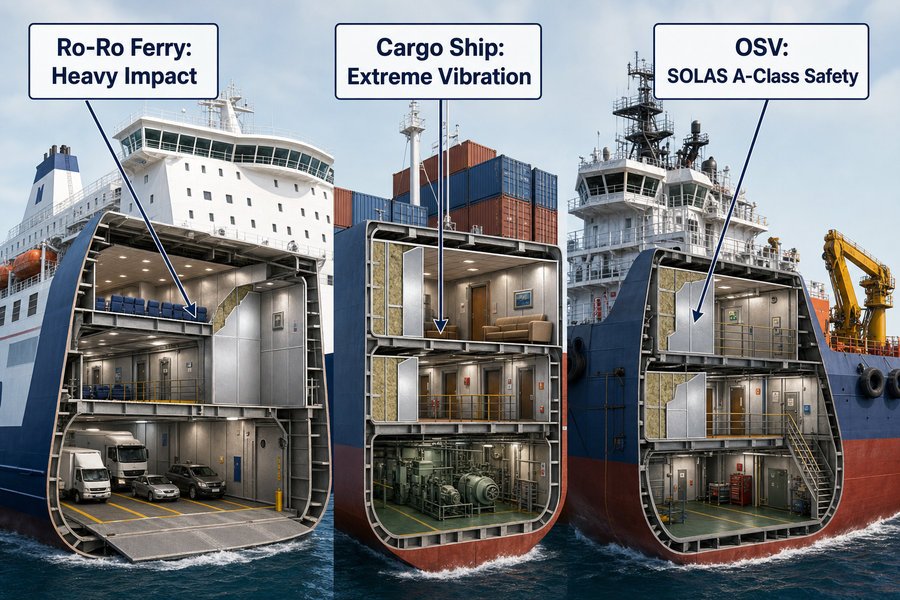
To understand why these three vessel types need steel panels everywhere, we must look at the working conditions on board. I always tell my clients at Magellan Marine to match the panel to the real-world danger. If you buy standard composite panels for these tough ships, you will have to replace them in less than two years. Steel panels cost about $25 to $40 per square meter, depending on the fire rating. This is a small price to pay for walls that last 15 years. Let us look closer at the three types of vessels.
Impact Resistance Needs in Ro-Ro Passenger Ferries
Ro-Ro passenger ferries handle thousands of people and heavy luggage carts every single day1. Passengers are not careful. They bang suitcases into the walls. Cleaning crews hit the bulkheads with heavy carts. Composite panels easily dent and crack under this pressure. But steel-faced panels use a 0.6mm thick galvanized steel sheet on both sides. This steel surface stops luggage impact completely. In my experience, a ferry using steel-faced panels reduces wall maintenance costs by over 80% per year compared to plastic or wood-faced panels.
Vibration Tolerance in Commercial Cargo Ships and Offshore Support Vessels
Commercial cargo ships and offshore support vessels (OSVs) have massive engines. These engines run all day and night. The vibration travels through the steel hull and into the cabin walls. Composite panels can vibrate lose or crack at the joints. Steel-faced panels have a high-density rock wool core, usually 120 kg/m³ according to standard marine supply data. This heavy core, glued tightly to the steel skins, absorbs engine vibration. Also, SOLAS (Safety of Life at Sea) Chapter II-2 demands strict fire safety on cargo ships and OSVs.2 Steel-faced panels easily provide A-60 or B-15 fire ratings3. They stop fire from spreading to the crew sleeping quarters.
| Vessel Type | Primary Challenge | Required Panel Specification | Estimated Cost per Sq. Meter |
|---|---|---|---|
| Ro-Ro Passenger Ferries | Heavy passenger luggage impact | 0.6mm galvanized steel face | $25 - $30 |
| Commercial Cargo Ships | Engine vibration and fire risk | B-15 rated, 120 kg/m³ rock wool | $28 - $35 |
| Offshore Support Vessels | Extreme sea conditions | A-60 rated, heavy duty steel face | $35 - $45 |
Why Are Marine Galley and Laundry Accommodation Panels Steel-Faced?
Moisture ruins normal cabin walls very fast. Rotting panels fail health inspections and cause hidden fire hazards. Let us see why galleys and laundries absolutely demand steel faces.
Marine galley and laundry accommodation panels are steel-faced for three crucial reasons: they provide zero moisture absorption, withstand high washing temperatures exceeding 80°C, and offer a non-combustible barrier against B-15 and A-60 grease fires according to SOLAS regulations.
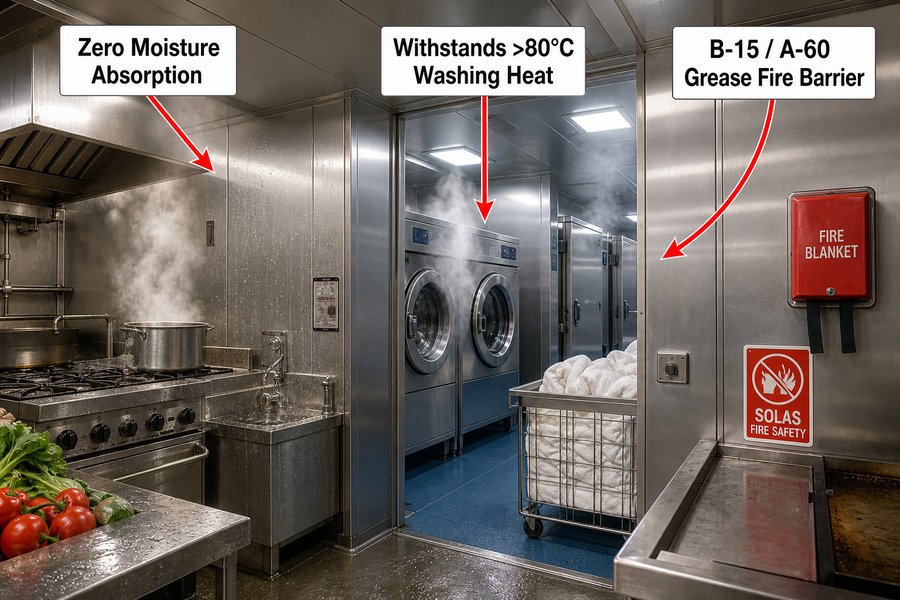
When you design a ship galley or a laundry room, you are dealing with water, heat, and fire all at once. I remember a project where a buyer tried to save money by using standard PVC-faced composite panels in a ship laundry. Within six months, the steam peeled the PVC film off the walls. They had to tear it all down. Steel-faced panels solve all three of these major problems. Let me explain the three reasons in detail so you can make the right buying choice for your shipyard clients.
Preventing Moisture Absorption and Heat Damage in Wet Spaces
The first two reasons we use steel faces are zero moisture absorption and high heat resistance. Galleys and laundries have a relative humidity close to 100%. Dishwashers and laundry machines release steam that is hotter than 80°C.4 Standard wood or composite materials will absorb this water. They will warp, swell, and grow black mold5. A steel surface does not absorb water. It is a solid barrier. Also, the paint on these steel panels is baked on. It can easily survive 80°C steam every day without peeling. The U.S. Public Health Service (USPHS) guidelines say that food preparation walls must be smooth and washable6. Steel is the easiest material to wash clean.
Meeting SOLAS Fire Barrier Rules for High-Risk Galleys
The third reason is fire safety. A marine galley is the most dangerous room on a ship for a fire. Hot cooking oil can ignite fast. SOLAS rules strictly state that galley boundaries must have A-60 or B-15 fire ratings.7 Steel does not burn. The steel face acts as a strong shield that keeps the flames away from the rock wool core. If a grease fire starts, the steel-faced panel will contain the fire inside the room for 60 minutes. This gives the crew enough time to put the fire out.
| Performance Area | Challenge in Galley/Laundry | Steel Panel Benefit | Authoritative Standard |
|---|---|---|---|
| Moisture | 100% Humidity, steam | Zero water absorption | USPHS Vessel Sanitation Program |
| Temperature | >80°C from washing machines | Paint will not peel or blister | ISO 834 Fire Test Standards |
| Fire Risk | Hot oil and grease fires | Non-combustible barrier | SOLAS Chapter II-2 |
Which Marine Hospital Accommodation Zones Require Steel-Faced Hygienic Panels?
Hospital infections at sea are a terrible nightmare. Standard PVC surfaces hold dangerous bacteria. You must use the right hygienic steel panels in the right medical zones.
Steel-faced hygienic panels are strictly required in four marine hospital zones: operating theaters, quarantine wards, medical laboratories, and drug storage rooms, because these areas demand smooth, anti-microbial surfaces that withstand harsh chemical cleaners like bleach without degrading.
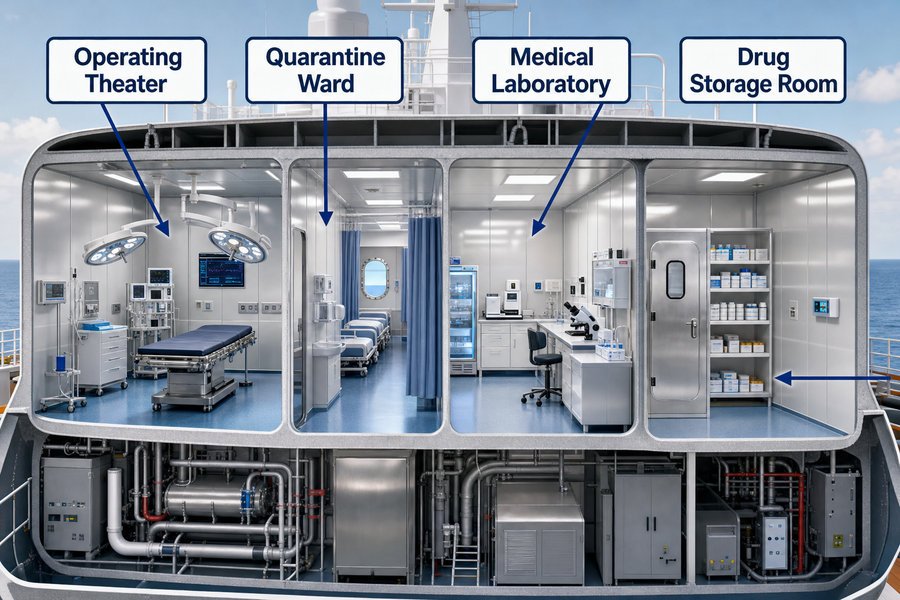
Building a hospital on a ship is very different from building standard cabins. You cannot take any risks with hygiene. The wall panels must be perfectly clean all the time. Standard panels have tiny pores where bacteria can hide and grow8. When I help buyers select panels for marine hospitals, I always insist on hygienic steel panels for the most critical areas. Usually, these panels are coated with a special anti-microbial film or are made of pure stainless steel. We must look at the four specific zones that require these special panels.
Strict Hygiene Rules for Operating Theaters and Quarantine Wards
The first two zones are operating theaters and quarantine wards. In an operating theater, the air and walls must be perfectly sterile. Any bacteria on the wall can enter an open wound9. Quarantine wards hold sick sailors with dangerous infections. We must stop the sickness from spreading. We use steel panels with an anti-microbial coating that meets the ISO 22196 standard for measuring antibacterial activity10. This coating kills 99.9% of bacteria on the surface. These panels usually cost between $40 and $55 per square meter, but they save lives. The smooth steel surface has no gaps for dirt to hide.
Chemical Resistance in Medical Laboratories and Drug Storage Rooms
The next two zones are medical laboratories and drug storage rooms. In a ship's medical lab, doctors use strong chemicals and acids for testing. In drug storage rooms, spilled medicines can ruin standard walls. Cleaning crews in these four zones use strong bleach and harsh disinfectants every single day to kill germs. If you use composite panels, the bleach will eat the plastic face in a few weeks. Steel-faced panels, especially those using 0.5mm or 0.6mm thick 304 or 316L stainless steel, can handle daily bleach washing without any damage11. The steel will not rust from the chemicals.
| Marine Hospital Zone | Primary Need | Steel Panel Solution | Material Recommendation |
|---|---|---|---|
| Operating Theaters | Zero bacteria growth | Anti-microbial coated steel | Galvanized steel with ISO 22196 film |
| Quarantine Wards | Easy daily sanitization | Smooth, gap-free surface | Painted galvanized steel |
| Medical Laboratories | Chemical spill resistance | Bleach-proof metal face | 304 Stainless Steel |
| Drug Storage Rooms | Temperature & chemical control | Durable, non-reactive surface | 304 Stainless Steel |
When Are Steel-Faced Marine Accommodation Ceiling Panels Chosen for Provision Stores?
Dropping ceiling temperatures destroy weak panels very fast. Condensation leads to ice build-up and ruined food. I will explain exactly when steel ceiling panels are the right fix.
Steel-faced marine accommodation ceiling panels are chosen for provision stores in two situations: when internal temperatures drop below 5°C, and when daily high-pressure washdowns occur, because the steel surface prevents vapor transmission and resists physical damage from cleaning hoses.
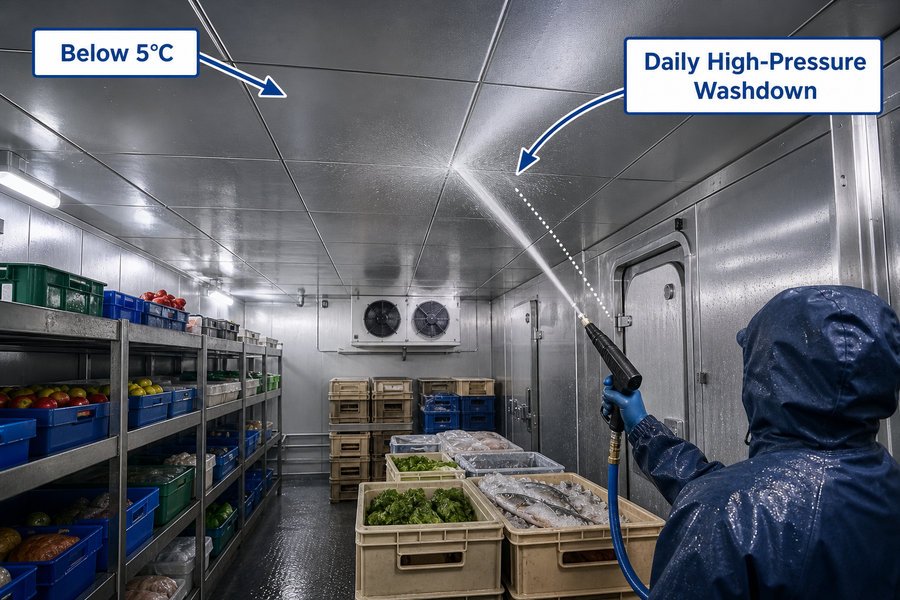
Food storage rooms, also called provision stores, are tough environments. They are very cold and very wet. Many buyers forget about the ceiling panels. They focus on the walls and buy cheap ceilings. This is a big mistake. Water vapor rises. If the ceiling fails, dirty water drips onto the fresh food. I always remind my clients to use steel-faced ceiling panels for these cold rooms. These panels usually cost around $20 to $30 per square meter. Let us talk about the two main situations where you absolutely must choose steel ceilings.
Handling Freezing Temperatures Below 5°C in Food Stores
The first situation is when the room temperature drops below 5°C. Ship provision stores have different zones. A vegetable room might be +4°C, while a meat freezer can drop to -25°C. At these low temperatures, warm air from outside the room tries to push inside. This creates a high water vapor pressure.12 If you use a composite ceiling panel, the water vapor will pass through the plastic face and freeze inside the core of the panel. The panel will break apart from the ice.13 Steel has a vapor transmission rate of exactly zero.14 The steel face stops the water vapor completely, keeping the insulation core dry and effective.
Surviving Daily High-Pressure Washdowns in Marine Cold Rooms
The second situation is daily high-pressure washdowns. According to marine health rules, crew members must wash the provision store floors and walls to prevent bad smells and food rot.15 They use high-pressure water hoses that can shoot water at up to 100 bar (1450 psi). This high-pressure water easily hits the ceiling. If the ceiling is made of soft composite material, the water jet will cut into the panel and destroy it. A steel-faced ceiling panel is strong enough to take a direct hit from a high-pressure hose without breaking. The steel keeps the room sealed and clean.
| Provision Store Situation | Problem Caused by Situation | How Steel Ceiling Panels Solve It |
|---|---|---|
| Temperatures Below 5°C | Water vapor freezing inside panels | Steel has a zero vapor transmission rate |
| High-Pressure Washdowns | Water jets breaking soft ceilings | Steel surface resists 100 bar water impacts |
Military vessels and offshore oil rigs face extreme daily risks. Weak walls collapse under blast waves. Here is exactly why builders choose steel panels for these dangerous zones.
Navy and offshore fit-outs favor steel-faced marine accommodation panels for three main reasons: they provide proven blast resistance, ensure superior electromagnetic interference (EMI) shielding, and deliver the longest service life of over 25 years under severe saltwater corrosion conditions.
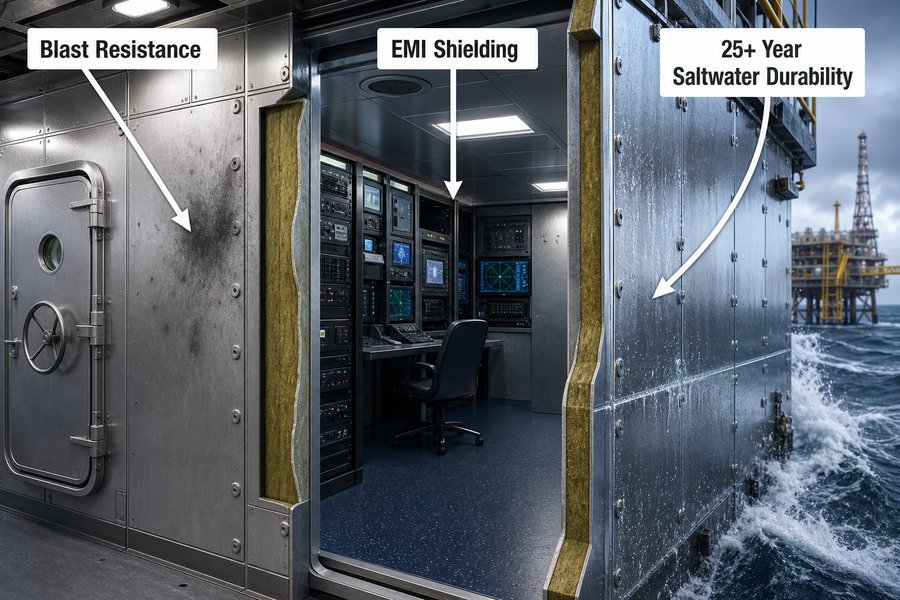
When you build for the Navy or an offshore oil platform, standard commercial ship rules are not enough. The rules here are strict because mistakes cost lives. You cannot use composite panels in these areas. The materials must be heavy, strong, and highly certified. Working with military and offshore buyers, I know they demand detailed test reports before they buy anything. Steel-faced panels for these projects are expensive, often over $60 per square meter, but they are the only option. Let us look at the three big reasons why they demand steel.
The first two reasons are blast resistance and electromagnetic interference (EMI) shielding. Navy ships face the threat of explosions. Standard walls will shatter into dangerous flying pieces if an explosion happens. Steel-faced panels are tested to handle high blast pressures, sometimes up to 0.2 bar or more16. The steel bends but it does not shatter, protecting the sailors inside the room. Also, Navy ships have powerful radar and radio equipment. This creates heavy EMI that can ruin computers. Steel panels block these waves. A good steel panel can provide over 60 decibels of EMI attenuation17. This keeps the ship's secret computers running perfectly without outside interference.
Ensuring a 25-Year Service Life Under Saltwater Corrosion
The third reason is long service life in a saltwater environment. Offshore oil rigs sit in the middle of the ocean. The air is full of heavy salt spray all day and night. This is classified as a C5M marine corrosion environment according to ISO 12944 standards18. This salt destroys cheap materials in a few months. For these projects, we use high-grade steel panels, often stainless steel or heavily galvanized steel with thick epoxy marine paint. These steel panels are proven to last more than 25 years19 in these terrible conditions. The oil companies save money because they do not have to stop drilling to fix broken walls.
| Requirement | Threat Faced by Navy/Offshore | Steel Panel Performance Standard |
|---|---|---|
| Blast Resistance | Explosions and shockwaves | Withstands up to 0.2 bar overpressure |
| EMI Shielding | Radar and radio interference | Provides up to 60 dB attenuation |
| Service Life | C5M heavy saltwater corrosion | 25+ years life with epoxy marine paint |
Conclusion
Steel-faced panels give you unmatched fire safety, hygiene, and durability in tough environments. Using them in high-risk zones ensures your interior decoration passes shipyard rules and keeps the crew completely safe.
-
"[PDF] MSC 108-10-1 - Online training material on domestic ferry safety ...", https://wwwcdn.imo.org/localresources/en/OurWork/Safety/Documents/MSC%20108-10-1%20-%20Online%20training%20material%20on%20domestic%20ferry%20safety%20(China).pdf. Passenger ferry design and operations literature documents that large Ro-Ro/passenger ferries are built to carry high passenger volumes together with vehicles and wheeled cargo, supporting the article’s characterization of frequent human and luggage traffic in these spaces. Evidence role: general_support; source type: institution. Supports: Ro-Ro passenger ferries handle thousands of people and heavy luggage carts every single day.. Scope note: This would support the general operating environment of Ro-Ro passenger ferries, not the exact daily passenger count for every ferry route. ↩
-
"Summary of SOLAS chapter II-2 - International Maritime Organization", https://www.imo.org/en/ourwork/safety/pages/summaryofsolaschapterii-2-default.aspx. The International Convention for the Safety of Life at Sea, Chapter II-2, sets requirements for fire protection, fire detection, and fire extinction on ships, providing regulatory context for the article’s statement about marine fire-safety obligations. Evidence role: historical_context; source type: institution. Supports: SOLAS Chapter II-2 imposes fire-safety requirements relevant to cargo ships and some offshore support vessels.. Scope note: SOLAS applicability depends on vessel type, tonnage, flag-state implementation, and operational category; the source may not specifically name every offshore support vessel configuration. ↩
-
"How Does the IMO FTP Code Connect with Other Marine Fire Safety ...", https://magellanmarinetech.com/how-imo-ftp-code-connect-with-other-marine-fire-safety-frameworks/. IMO fire-test and fire-division standards define A-class and B-class divisions by insulation and fire-resistance performance over specified time periods, including A-60 and B-15 classifications, supporting the technical meaning of these ratings. Evidence role: definition; source type: institution. Supports: A-60 and B-15 are recognized marine fire-resistance classifications for shipboard divisions and panels.. Scope note: The source would define the rating system; it would not verify that any particular commercial steel-faced panel achieves those ratings without a product-specific test certificate. ↩
-
"[PDF] Vessel Sanitation Program Construction Guidelines - CDC Stacks", https://stacks.cdc.gov/view/cdc/7147/cdc_7147_DS1.pdf?. Engineering or public-health ventilation guidance for commercial kitchens, laundries, or vessel service spaces can document that these rooms generate high humidity and hot water vapor; however, exact humidity and steam-temperature values vary with equipment, ventilation rate, and operating conditions. Evidence role: statistic; source type: government. Supports: Ship galleys and laundries commonly experience very high humidity and hot steam exposure from dishwashing and laundry equipment.. Scope note: The source may support high humidity and steam exposure generally rather than proving that every ship galley or laundry reaches 100% relative humidity or exceeds 80°C steam. ↩
-
"Mold Course Chapter 2: | US EPA", https://www.epa.gov/mold/mold-course-chapter-2. Building-science and public-health sources describe how moisture exposure can cause wood-based materials to swell or deform and can support mold growth; this supports the material-risk rationale, though the rate and severity depend on the specific composite, coating, exposure duration, and ventilation. Evidence role: mechanism; source type: government. Supports: Moisture exposure can cause wood or composite materials to swell, warp, and support mold growth.. Scope note: This evidence would support moisture-related degradation mechanisms generally, not the failure of every standard wood or composite panel in marine laundries. ↩
-
"[PDF] 2025 Construction Standards | Vessel Sanitation Program - CDC", https://www.cdc.gov/vessel-sanitation/media/pdfs/2025/06/2025_VSP_Construction_Standards-508.pdf. The CDC Vessel Sanitation Program construction guidance states that food-area surfaces on passenger vessels should be durable, smooth, nonabsorbent, and easily cleanable, supporting the need for washable wall finishes in ship food-preparation spaces. Evidence role: expert_consensus; source type: government. Supports: USPHS/CDC vessel sanitation guidance requires or recommends smooth, washable, cleanable surfaces in food-preparation areas.. Scope note: The guidance applies to vessels within the Vessel Sanitation Program’s scope and does not by itself mandate one specific wall material such as steel. ↩
-
"Which vessel areas under SOLAS Chapter II-2 demand the strictest ...", https://magellanmarinetech.com/which-vessel-areas-under-solas-chapter-ii-2-demand-strictest-marine-panel-requirements/. SOLAS Chapter II-2 and related IMO fire-safety tables classify galleys as service spaces with fire-risk implications and prescribe fire-integrity ratings for divisions depending on vessel type, adjacent spaces, and regulatory table; this provides regulatory context for A- or B-class boundary requirements. Evidence role: historical_context; source type: institution. Supports: SOLAS regulates the fire integrity of galley boundaries and may require A- or B-class divisions depending on ship arrangement and classification.. Scope note: The exact required rating is conditional, so the source may not support a universal A-60 or B-15 requirement for all galley boundaries on all ships. ↩
-
"E. Environmental Services | Infection Control - CDC", https://www.cdc.gov/infection-control/hcp/environmental-control/environmental-services.html. Healthcare environmental-control guidance and microbiology literature describe porous or damaged surfaces as harder to clean and more capable of retaining microorganisms than smooth, nonporous materials; this supports the hygiene rationale but does not test the specific panel products discussed here. Evidence role: mechanism; source type: government. Supports: Standard panels may contain pores or surface defects that can harbor bacteria and make hygiene control more difficult.. Scope note: The support is general to porous healthcare surfaces, not direct evidence about the exact marine wall panels in the article. ↩
-
"[PDF] Surgical Site Infection Event (SSI) - CDC", https://www.cdc.gov/nhsn/pdfs/pscmanual/9pscssicurrent.pdf. Surgical-site infection guidance recognizes that microorganisms from the operating-room environment can contribute to wound contamination, supporting the need for strict environmental hygiene; however, such guidance usually treats walls as part of the broader environment rather than proving direct wall-to-wound transfer. Evidence role: mechanism; source type: government. Supports: Bacterial contamination in an operating-room environment can increase the risk of wound contamination and surgical-site infection.. Scope note: The source would support environmental contamination risk in operating rooms generally, not a direct causal pathway from wall panels to an individual wound. ↩
-
"A Closer Look at Studies Using the ISO 22196:2011 Standard - PMC", https://pmc.ncbi.nlm.nih.gov/articles/PMC10813364/. ISO 22196 specifies a method for measuring antibacterial activity on plastics and other non-porous surfaces, supporting its use as a test standard for antibacterial surface performance; it does not by itself certify clinical effectiveness in a hospital ward. Evidence role: definition; source type: institution. Supports: ISO 22196 is a standard used to measure antibacterial activity on non-porous surfaces.. Scope note: ISO 22196 is a laboratory test method and does not directly prove real-world infection reduction on shipboard hospital panels. ↩
-
"[PDF] Stainless Steel Trap Corrosion - Office of Research Facilities", https://orf.od.nih.gov/TechnicalResources/Documents/DTR%20White%20Papers/FinalTrapCorrosionWhitePaperdocsanitized_508.pdf. Materials compatibility references for austenitic stainless steels indicate broad resistance to many cleaning and disinfecting chemicals, while also noting chloride-containing agents such as bleach can cause corrosion under certain concentrations, contact times, or rinsing conditions; this provides contextual support but not unconditional proof of damage-free daily bleach washing. Evidence role: general_support; source type: research. Supports: 304 or 316L stainless steel panels are generally more chemically resistant than many polymer-faced panels, but bleach compatibility depends on exposure conditions.. Scope note: The evidence would likely require qualification because stainless steel is not universally immune to bleach-related corrosion, especially in chloride-rich or poorly rinsed conditions. ↩
-
"[PDF] Moisture Considerations for Insulated Building Assemblies", https://www.phrc.psu.edu/assets/docs/webinars/PHRCMoistureConsiderationsHandouts.pdf. Building-science references on vapor pressure and condensation explain that temperature gradients across cold-room envelopes can drive water vapor from warmer, more humid air toward colder surfaces or assemblies. Evidence role: mechanism; source type: education. Supports: Low-temperature cold rooms can experience vapor-pressure-driven moisture movement from warmer exterior air toward the cold interior envelope.. Scope note: This supports the physical mechanism generally; it does not verify the specific vapor-pressure conditions in every ship provision store. ↩
-
"[PDF] Effects of Moisture Diffusion in Sandwich Composite Structures", https://www.wichita.edu/industry_and_defense/NIAR/Documents/jams-presentations/13-Jayaram-Moisture-Diffusion.pdf. Research and building-envelope guidance on freeze-thaw deterioration describe how water that enters porous or layered materials can expand during freezing and contribute to cracking, delamination, or loss of integrity. Evidence role: mechanism; source type: research. Supports: Moisture entering a panel core can freeze and cause physical deterioration such as cracking or delamination.. Scope note: This is contextual support for freeze-thaw damage; it may not directly test the exact composite ceiling panel described in the article. ↩
-
"Permeability of Common Building Material to Water Vapor", https://www.uaf.edu/ces/publications/database/energy/permeability-water-vapor.php. Standards and engineering references commonly classify continuous sheet metal as a vapor-impermeable material for practical building-envelope calculations, supporting the use of steel facings as vapor barriers. Evidence role: definition; source type: institution. Supports: A continuous steel face is effectively impermeable to water vapor in cold-room envelope design.. Scope note: The support is practical rather than absolute: joints, fasteners, coatings, corrosion, and penetrations can allow leakage even when the steel sheet itself is effectively impermeable. ↩
-
"Food - Guide to Ship Sanitation - NCBI Bookshelf - NIH", https://www.ncbi.nlm.nih.gov/books/NBK310826/. Ship sanitation and food-hygiene guidance from public-health authorities requires food storage areas on vessels to be kept clean and maintained to prevent contamination and pest or spoilage risks. Evidence role: expert_consensus; source type: government. Supports: Marine food storage areas are subject to sanitation requirements that include cleaning to reduce contamination, odors, spoilage, or pest risks.. Scope note: Such guidance generally requires cleaning and sanitation but may not specify daily washing or the exact cleaning method for every vessel type. ↩
-
"Method to measure blast overpressure exposure on military ... - PMC", https://pmc.ncbi.nlm.nih.gov/articles/PMC12592357/. Blast-effects guidance and naval structural studies commonly express blast loading as reflected or incident overpressure, and 0.2 bar is approximately 20 kPa; this supports treating such pressure as a relevant blast-design parameter for shipboard or protective panels, though it does not by itself verify any specific manufacturer’s panel rating. Evidence role: general_support; source type: government. Supports: Steel-faced panels used in naval applications may be tested against blast pressures around 0.2 bar or higher.. Scope note: Supports the plausibility and engineering relevance of the pressure level, not the performance of a particular steel-faced panel. ↩
-
"[PDF] A study of techniques for measuring the electromagnetic shielding ...", https://nvlpubs.nist.gov/nistpubs/Legacy/TN/nbstechnicalnote1095.pdf. Electromagnetic-shielding literature defines shielding effectiveness in decibels and reports that continuous conductive enclosures or metal panels can provide attenuation levels on the order of tens of decibels or more; this supports the use of dB attenuation as a relevant performance metric, though actual shielding depends on seams, apertures, grounding, and installation quality. Evidence role: mechanism; source type: paper. Supports: A steel panel or conductive enclosure can be evaluated for EMI shielding performance in decibels, including attenuation around or above 60 dB under suitable conditions.. Scope note: Provides general technical support for metal-panel EMI shielding, not a guarantee that every steel panel achieves 60 dB. ↩
-
"Evaluation of Protective Coatings for High-Corrosivity Category ...", https://pmc.ncbi.nlm.nih.gov/articles/PMC6515464/. ISO 12944-2 classifies C5-M as a very high marine corrosivity category associated with offshore areas and coastal environments with high salinity; this supports describing offshore platforms as severe marine corrosion environments, although exact exposure classification should be confirmed for each site. Evidence role: definition; source type: institution. Supports: Offshore marine conditions can fall under the C5-M corrosivity category in ISO 12944.. Scope note: The standard defines the category generally; it does not classify every individual offshore platform without site assessment. ↩
-
"Evaluation of Protective Coatings for High-Corrosivity Category ...", https://pmc.ncbi.nlm.nih.gov/articles/PMC6515464/. ISO 12944 durability guidance includes a “very high” durability range of more than 25 years for protective paint systems, supporting the claim that properly specified marine coatings can be designed for 25-year-plus service intervals; this is a coating-system durability classification, not a prediction of maintenance-free life for all panels. Evidence role: expert_consensus; source type: institution. Supports: Marine protective coating systems for steel can be specified for durability exceeding 25 years under ISO 12944 categories.. Scope note: Applies to correctly specified and maintained coating systems under defined exposure conditions, not automatically to all steel panels in service. ↩