Ship refurbishments often face costly delays. Choosing the wrong interior panels ruins budgets and schedules. You can avoid these material mistakes by following strict selection and compatibility guidelines.
Avoiding material selection mistakes in marine interior panel refurbishment requires verifying existing dimensions, tracking weight limits under SOLAS, checking structural attachment points, ensuring operational noise control, and matching PVC laminate finishes. Addressing all five areas prevents fit failures, weight overloads, and installation delays during retrofits.
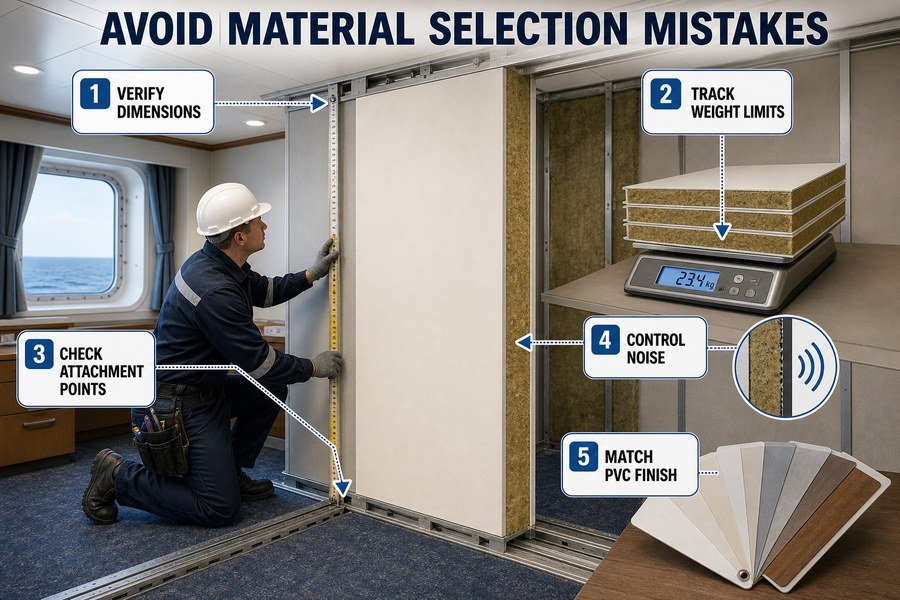
Overlooking these details can stop a project completely. Let us look closely at each problem to keep your next refit moving fast.
What Marine Interior Panel Selection Errors Cause Fit Failures During Ship Refits?
Panels that do not fit waste time and money. Buying standard sizes without checking the ship's actual space causes huge headaches. Accurate measurements solve this fit failure problem.
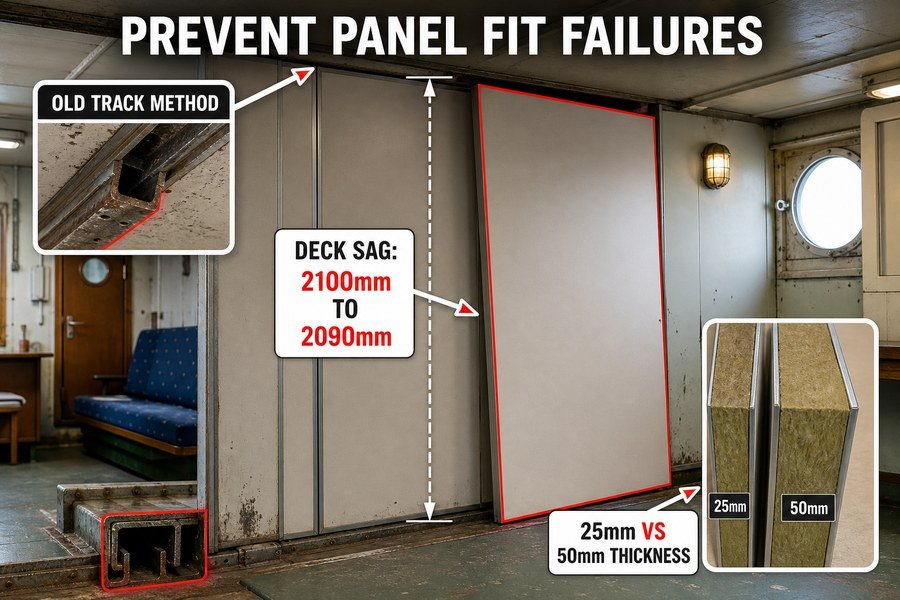
Fit failures during ship refits are caused by three main errors: ignoring the original installation method, failing to measure the deck-to-deck height changes from deck sagging, and overlooking panel thickness differences between European and Asian standards (like 50mm versus 25mm).
Impact of Installation Method and Deck Sagging on Panel Fit
I have seen many buyers ignore the original installation method. Old ships often use custom metal tracks hidden behind ceilings.1 New panels might use a different joint system. If you do not check how the old panels lock together, the new panels will not slide into the existing tracks. You will have to tear out the entire support frame. This costs extra days of labor.
Deck sagging causes another major fit error. Ship decks are made of steel. Over 15 or 20 years, the steel deck bends slightly in the middle of a large room.2 The height near the wall might be 2100mm. The height in the center might be 2090mm. That is a 10mm difference. If you cut all panels to exactly 2100mm based on the original shipyard drawings, the panels will not fit in the center of the room. You must send a team to measure the real deck-to-deck height on board the ship before you order. You must order panels with a top gap allowance.
Dimensional Differences Between European and Asian Marine Panels
Many buyers also overlook panel thickness differences. European shipyards often built older ships using thin panels. These older European panels are often 25mm or 35mm thick.3 Today, many cost-effective Asian factories produce standard marine fire panels that are 50mm thick4.
If you buy 50mm thick panels from Asia to replace a 25mm European panel, the new panel will stick out from the wall. It will not fit into the old bottom track. The standard U-profile track for a 25mm panel is too narrow. You must either buy special custom thin panels or replace all the tracks on the floor and ceiling.
| Specification Point | Older European Standard Panel | Standard Asian Marine Panel | Fit Failure Risk |
|---|---|---|---|
| Panel Thickness | 25mm or 35mm | 50mm | New panels will not fit into old floor tracks. |
| Joint Type | Often tongue and groove | Often spline or H-profile | Panels will not connect to existing adjacent panels. |
| Height Tolerance | Cut exactly to drawing | Requires on-site measurement | Sagging decks will block installation of fixed-height panels. |
How Can Replacement Marine Accommodation Panels Be Prevented From Overloading Existing Vessel Structures?
Adding too much weight to an older ship lowers its safety margins. Heavy panels can violate weight regulations. Strict weight tracking prevents structural overloading during your refit.
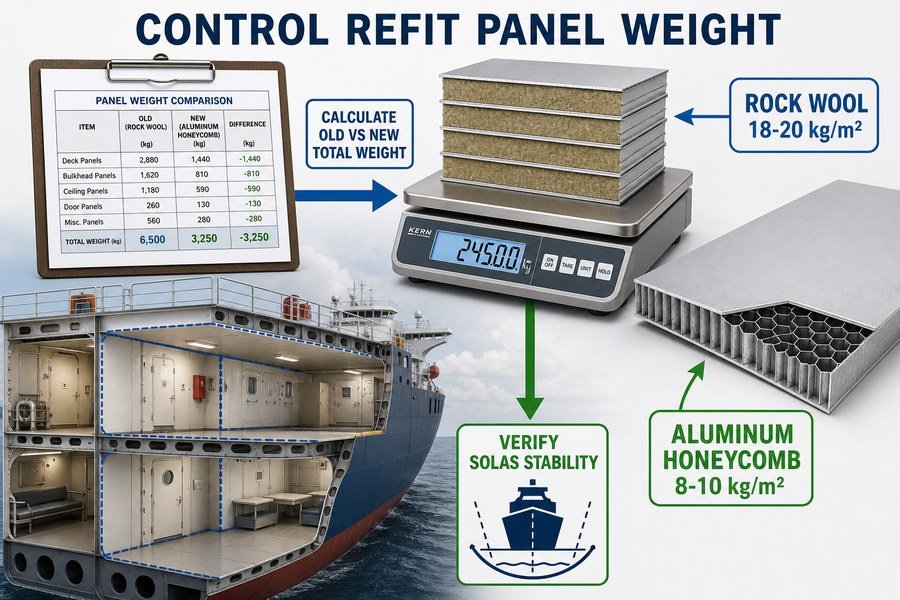
To prevent overloading vessel structures, buyers must calculate the total weight difference between old and new panels, select lightweight aluminum honeycomb cores (saving up to 50% weight compared to rock wool), and verify compliance with SOLAS stability limits through a naval architect's load calculation.
Calculating Weight Differences in Marine Panel Upgrades
Ships have strict weight limits. When you change interior materials, you change the weight of the ship. I worked on a project where the buyer ordered standard heavy panels for a complete deck refit. They did not calculate the total weight difference between the old materials and the new materials.
A standard B-15 class fire panel uses a high-density rock wool core. According to factory specification sheets, a 50mm rock wool panel weighs between 18 kg and 20 kg per square meter. If you replace 2,000 square meters of wall area, you add almost 40 tons of weight. If the old panels were older, lighter wood materials, this new weight changes the center of gravity of the ship.5 The ship will sit lower in the water. This can cause the ship to fail its safety inspection. You must make a spreadsheet. You must list the weight of every old panel removed. You must list the weight of every new panel added.
Utilizing Lightweight Aluminum Honeycomb Cores for Stability
You can avoid this weight problem by choosing the right core materials. If the ship has tight weight limits, do not use rock wool. You must use lightweight aluminum honeycomb cores.
Aluminum honeycomb panels weigh much less.6 A standard 50mm aluminum honeycomb panel weighs about 8 kg to 10 kg per square meter. This saves up to 50% in weight compared to rock wool. You still get good strength. You must make sure the honeycomb panel passes fire tests.7 You must send your weight data to a naval architect. The International Convention for the Safety of Life at Sea (SOLAS) has strict stability limits. The naval architect uses your load calculation to prove the ship meets SOLAS rules.
| Core Material | Average Weight (per square meter) | Best Use Case | SOLAS Impact |
|---|---|---|---|
| Standard Rock Wool (B-15) | 18 kg - 20 kg | Basic refits with no strict weight limits | High added weight; requires close checking. |
| Lightweight Rock Wool | 14 kg - 16 kg | Refits needing minor weight savings | Medium added weight; moderate impact. |
| Aluminum Honeycomb | 8 kg - 10 kg | Weight-critical refits, high-speed vessels | Low added weight; best for strict stability limits. |
What Overlooked Structural Factors Derail Marine Wall Panel Selection During Retrofits?
Ships shift and vibrate over time. Rigid panels crack if they cannot move with the hull. Understanding the ship's hidden structure prevents panel damage after installation.
Three structural factors derail marine wall panel selection: ignoring ship vibrations requiring elastic mounting profiles, failing to account for hidden electrical cable routing spaces, and overlooking the load-bearing capacity of existing deck tracks which must hold up to 20kg per square meter of new paneling.
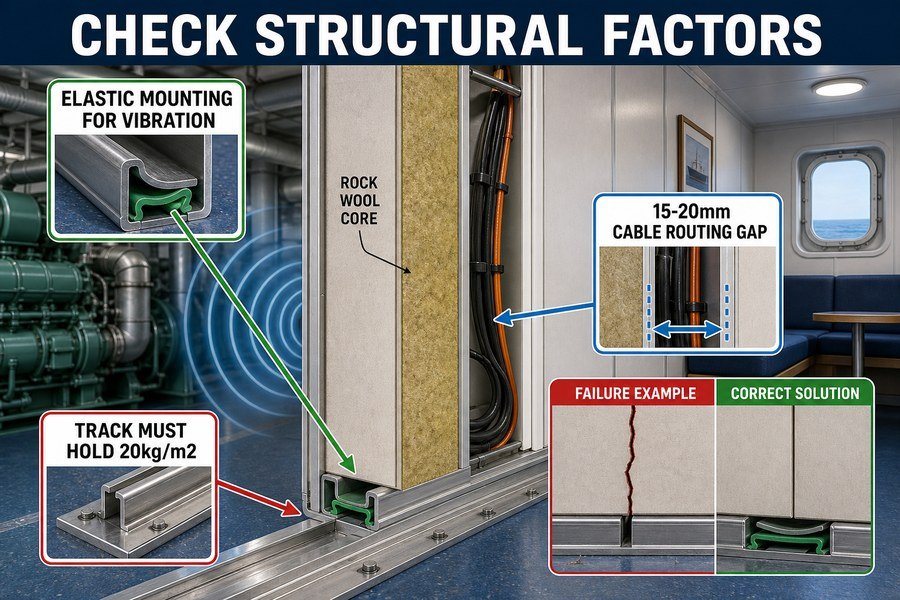
Managing Ship Vibrations with Elastic Mounting Profiles
Many buyers forget that ships are moving machines. Large marine engines create strong vibrations. These vibrations travel through the steel hull and into the interior decks.8 If you attach a stiff wall panel directly to the steel deck, the vibration will shake the panel. Over a few months, the joints will crack. The panel surface might warp.9
I always tell buyers to check the mounting system. You cannot ignore ship vibrations. You must use elastic mounting profiles. These are special rubber or flexible PVC strips. You place them inside the bottom U-track before you insert the panel. The rubber absorbs the engine vibration.10 The panel stays still. If you buy panels that cannot fit inside a track with an elastic strip, you will have broken panels very soon.
Accommodating Cable Routing and Existing Deck Tracks
You must also look behind the walls. Over the years, electricians add new wires for internet, alarms, and lights. These wires run behind the old panels. If you fail to account for hidden electrical cable routing spaces, your new panels will crush the wires. You need to leave a gap. Usually, you need a 15mm to 20mm clearance behind the panel. Some panels come with special built-in cable conduits. These are much easier to install.
Finally, you must look at the floor. You must check the load-bearing capacity of existing deck tracks. A new 50mm rock wool panel puts about 20kg of weight on every square meter of the bottom track.11 If the old track is rusty or weak, it will bend under the weight. You must test the old tracks. If they cannot hold 20kg per square meter, you must buy and install new heavy-duty tracks before you put the panels up.
| Structural Factor | Common Mistake | Correct Solution | Value/Metric to Check |
|---|---|---|---|
| Ship Vibrations | Screwing panels tightly to rigid steel floors. | Use elastic mounting profiles in floor tracks. | Rubber strip thickness (usually 2mm-3mm). |
| Cable Routing | Buying flat panels with no back clearance. | Buy panels with built-in cable conduits or leave a wall gap. | Minimum 15mm-20mm behind panel. |
| Deck Tracks | Reusing old rusty tracks for heavy new panels. | Inspect and replace tracks if they are weak. | Must hold 20kg per square meter load. |
How Are Incompatible Marine Interior Panel Choices Prevented From Disrupting Occupied Vessel Operations?
Refitting an occupied ship is very stressful. Noisy and messy installations anger passengers and crew. Choosing panels designed for clean, fast assembly keeps the ship running smoothly.
Disruptions during occupied vessel refits are prevented by choosing pre-cut modular panels requiring no on-site hot work, selecting acoustic panels with Rw values above 44dB to block installation noise, and using dry joint systems that avoid messy glues and cure times, ensuring fast and clean assembly.
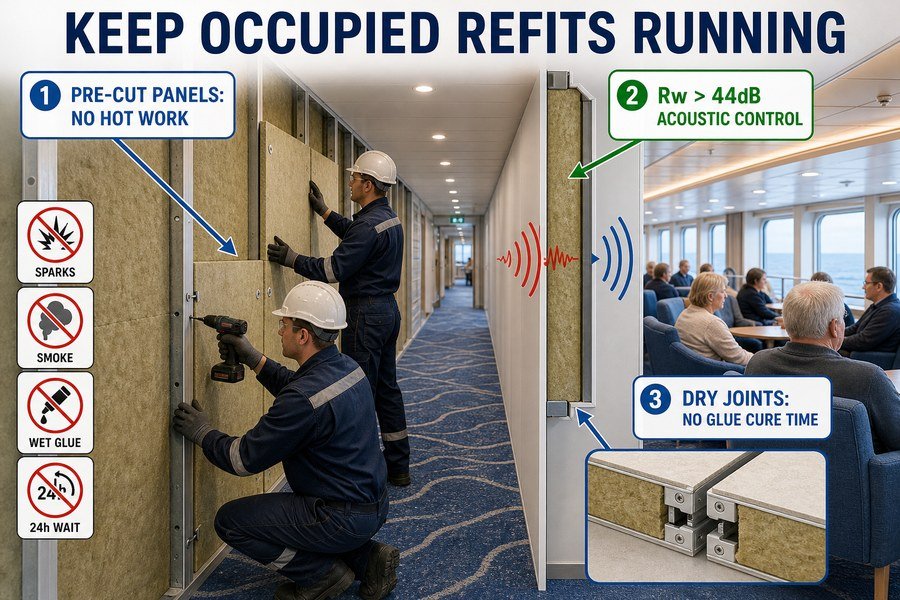
Implementing Pre-cut Modular Panels to Eliminate Hot Work
Refitting a ship while people live on it requires special care. You cannot use standard construction methods. Standard construction requires cutting metal with grinders. It requires welding. This is called hot work.12 Hot work makes smoke. It makes sparks. It sets off fire alarms.
You must stop all hot work in guest areas. You do this by choosing pre-cut modular panels. You send the exact room measurements to the factory. The factory cuts the panels to the right size. They cut the holes for the light switches. They cut the holes for the doors. When the panels arrive on the ship, the workers just put them in place. They use screws or bolts. There is zero hot work on site. This keeps the ship clean and safe. The passengers will not even know heavy work is happening.
Utilizing High Rw Value Acoustic Panels and Dry Joint Systems
Installation is also very noisy. Workers drop tools. They hit walls. You must protect the passengers from this noise. You should select acoustic panels with high sound insulation ratings. According to the ISO 717-1 standard, sound reduction is measured in Rw values. You want an Rw value above 44dB.13 When you build the new wall with 44dB panels, the noise from inside the work zone stays inside. The passengers in the next room can sleep quietly.
You must also avoid bad smells and slow work. Many old panel systems use wet glues to hold joints together. Wet glue smells terrible in a closed ship cabin.14 It also takes 24 hours to dry. You must use dry joint systems. These systems use metal clips. They snap together tightly. You do not need glue. You do not have to wait for cure times. The assembly is fast, clean, and has no smell.
| Feature for Occupied Ships | Outdated Method | Recommended Solution | Benefit |
|---|---|---|---|
| Panel Sizing | Cutting steel panels on the ship deck. | Pre-cut modular panels from factory. | Eliminates hot work and smoke. |
| Acoustic Rating | Standard panels (Rw 30dB - 35dB). | High acoustic panels (Rw > 44dB per ISO 717-1). | Blocks tool noise from sleeping passengers. |
| Joint Connection | Wet industrial glues. | Mechanical dry joint systems. | No bad smells, zero drying time needed. |
Why Do PVC Laminated Film Oversights Compromise Partial Refit Marine Interior Panel Selection?
Mismatched panel colors look terrible. Old panels fade over the years, making new standard colors clash. Fixing PVC film differences is vital for a seamless interior finish.
PVC laminated film oversights compromise partial refits because buyers ignore UV fading of old panels, mismatch the film thickness (often confusing 150-micron with 200-micron films), and overlook IMO-certified low flame spread ratings, leading to visible color differences, poor durability, and safety inspection failures.
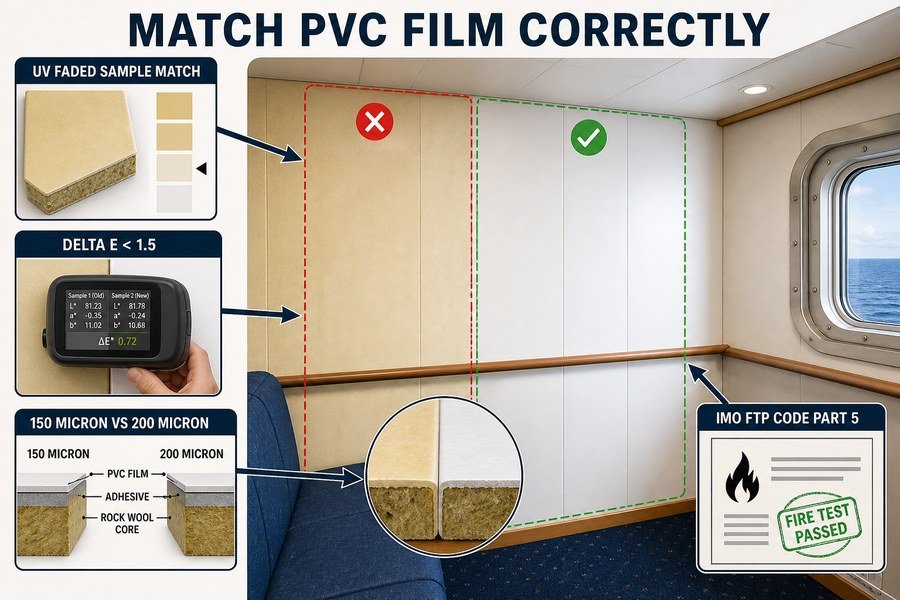
Addressing UV Fading and PVC Film Thickness Discrepancies
Replacing just one damaged wall in a room is very hard. Most marine panels are covered with a colored PVC laminated film. Buyers often look at a color chart, pick the standard white code, and place the order. When the panels arrive, they look wrong.
The buyer ignored the UV fading of the old panels. Sunlight comes through the ship windows. The UV rays turn the old white panels slightly yellow.15 The new white panels are bright and clean. Next to each other, the color difference is huge. You must ask the factory to match the faded color. You send them a small piece of the old panel. They use a machine to make the colors match. The color difference, called the Delta E value, must be less than 1.5.16
You must also check the PVC film thickness. Factories offer different options. Buyers often mismatch the film thickness to save money. They confuse 150-micron film with 200-micron film. A 150-micron film is thin. It is fine for high ceilings. But for walls in busy hallways, a 150-micron film will scratch easily. You must use the thicker 200-micron film for areas where people walk and carry bags.
Ensuring Compliance with IMO Low Flame Spread Ratings
The biggest oversight is about safety. The PVC film is plastic. Plastic can burn. You cannot use standard house wallpaper on a ship. You must use marine PVC film.
You must check the IMO-certified low flame spread ratings. The International Maritime Organization (IMO) has strict fire rules. According to the IMO FTP Code Part 517, the surface material on the wall panel must not spread fire quickly. It must not make too much toxic smoke. If you buy a cheap PVC film that does not have this certificate, the port inspector will see it. The inspector will fail the ship. You will have to remove all the new panels. Always demand the IMO test report for the exact PVC film before you buy.
| PVC Film Requirement | Poor Practice | Best Practice | Technical Metric |
|---|---|---|---|
| Color Matching | Ordering by standard color code alone. | Matching to a physical faded sample. | Delta E value < 1.5. |
| Film Thickness | Using 150-micron film everywhere to save cost. | Using 200-micron film in high-traffic areas. | 200 microns thickness. |
| Fire Safety | Using non-certified commercial vinyl. | Mandating marine-grade certified films. | IMO FTP Code Part 5 pass report. |
Conclusion
Avoiding these material selection mistakes saves time and lowers costs. Check dimensions, control weights, review structures, use clean installation methods, and match PVC films carefully for successful refits.
-
"How to choose the right marine wall panels for marine interior ...", https://magellanmarinetech.com/how-choose-right-marine-wall-panels-for-marine-interior-projects/. A marine outfitting or classification-society source can document that ship accommodation bulkhead and ceiling systems are commonly installed with proprietary or system-specific framing, tracks, and concealed fixing details; this supports the need to verify the original installation method before replacement. Evidence role: general_support; source type: institution. Supports: Older ships may use custom metal tracks hidden behind ceilings, making replacement panels dependent on the original installation method.. Scope note: Such sources usually describe typical construction systems rather than proving that all older ships used custom hidden tracks. ↩
-
"[PDF] course objectives chapter 6 6. ship structures - USNA", https://www.usna.edu/NAOE/_files/documents/Courses/EN400/02.06%20Chapter%206.pdf. A naval architecture or structural engineering source on ship hull girder deflection and deck plating deformation can support the general mechanism that steel ship structures may experience deflection or distortion over service life; it does not by itself establish a universal 10 mm accommodation-room sag after 15–20 years. Evidence role: mechanism; source type: education. Supports: Steel decks on ships can bend or deflect over years of service, affecting actual panel installation height.. Scope note: The exact amount of sag depends on ship type, loading history, structural design, corrosion, and maintenance condition. ↩
-
"How to choose the right marine wall panels for marine interior ...", https://magellanmarinetech.com/how-choose-right-marine-wall-panels-for-marine-interior-projects/. Historical marine accommodation-panel documentation or certified product data can show that 25 mm and 35 mm fire-rated wall panels have been used in European ship accommodation systems; this would contextualize the stated thicknesses as documented product sizes rather than a comprehensive European standard. Evidence role: historical_context; source type: institution. Supports: Older European marine accommodation panels were commonly found in 25 mm or 35 mm thicknesses.. Scope note: Product data may demonstrate availability and use of these thicknesses, but may not prove they were the dominant specification across all older European shipyards. ↩
-
"How to choose the right marine wall panels for marine interior ...", https://magellanmarinetech.com/how-choose-right-marine-wall-panels-for-marine-interior-projects/. Certified marine-panel product documentation or IMO fire-test documentation can establish that 50 mm is a common nominal thickness for marine fire-rated accommodation panels; this supports the dimensional comparison but does not prove that all Asian factories use this size as their standard. Evidence role: general_support; source type: institution. Supports: Many contemporary marine fire-rated panels are supplied in a 50 mm thickness.. Scope note: The source would support 50 mm as a common commercial specification, not as a universal regional standard for Asian manufacturers. ↩
-
"[PDF] Chapter 2 - Review of Intact Statical Stability - USNA", https://www.usna.edu/NAOE/_files/documents/Courses/EN455/EN455_Chapter2.pdf. Naval architecture references explain that changes in onboard weights alter a vessel’s displacement, trim, and vertical or longitudinal center of gravity, which are inputs to stability assessment. Evidence role: mechanism; source type: education. Supports: Replacing old panels with heavier new panels can change the ship’s center of gravity.. Scope note: This supports the physical mechanism generally; it does not verify the specific magnitude of change for the project described. ↩
-
"[PDF] Experimental investigation on flexural behavior and energy ...", https://digitalcommons.usu.edu/cgi/viewcontent.cgi?article=1228&context=mae_facpub. Engineering literature describes honeycomb sandwich panels as lightweight structural materials with low density relative to many solid or mineral-core alternatives, owing to the cellular core geometry. Evidence role: mechanism; source type: paper. Supports: Aluminum honeycomb panels are generally lighter than heavier mineral-core panel constructions.. Scope note: This supports the general weight advantage of aluminum honeycomb construction; exact panel weights depend on skins, core thickness, density, adhesive, and certification requirements. ↩
-
"What Is the IMO FTP Code for Marine Interior Materials?", https://magellanmarinetech.com/what-imo-ftp-code-for-marine-interior-materials/. IMO fire-test procedures define test methods for marine fire divisions and materials used on SOLAS-regulated ships, so panel approval depends on documented performance under the applicable FTP Code tests. Evidence role: definition; source type: institution. Supports: Honeycomb panels used in ship interiors must be verified against applicable marine fire-test requirements.. Scope note: This supports the need for fire testing in principle; it does not show that any specific aluminum honeycomb panel satisfies B-class or other required fire ratings. ↩
-
"Transfer function of the structure-borne noise to underwater radiated ...", https://www.academia.edu/120737806/Transfer_function_of_the_structure_borne_noise_to_underwater_radiated_noise_for_ships_with_hull_of_different_material. A naval engineering source on structure-borne ship vibration supports that machinery excitation can propagate through hull structures and accommodation spaces. Evidence role: mechanism; source type: paper. Supports: Marine engine vibrations can travel through the steel hull and into interior decks.. Scope note: The source would support the transmission mechanism generally, not the vibration level on a specific vessel. ↩
-
"Manual for Repair and Retrofit of Fatigue Cracks in Steel ...", https://www.fhwa.dot.gov/bridge/steel/pubs/hif13020/hif13020.pdf. A structural or materials engineering source on cyclic vibration and fatigue supports that repeated dynamic loading can loosen joints, initiate cracking, or cause deformation in attached components. Evidence role: mechanism; source type: paper. Supports: Rigidly mounted wall panels exposed to ship vibration may develop cracked joints or warped surfaces over time.. Scope note: The source would support the failure mechanism; the specific timeframe of “a few months” would remain application-dependent unless a case study is found. ↩
-
"[PDF] Vibration isolation: use and characterization", https://nvlpubs.nist.gov/nistpubs/Legacy/hb/nbshandbook128.pdf. A vibration isolation reference explains that elastomeric mounts reduce transmitted vibration by adding compliance and damping between a vibrating structure and the supported component. Evidence role: mechanism; source type: education. Supports: Rubber or elastomeric mounting profiles can reduce transmission of engine vibration to panels.. Scope note: This supports the general function of rubber isolation; effectiveness depends on mount stiffness, damping, load, and excitation frequency. ↩
-
"How to choose the right marine wall panels for marine interior ...", https://magellanmarinetech.com/how-choose-right-marine-wall-panels-for-marine-interior-projects/. A classification-society certificate or technical specification for marine fire-rated rock-wool wall panels can document representative mass per unit area for 50 mm panels. Evidence role: statistic; source type: institution. Supports: A 50 mm rock wool marine panel can impose roughly 20 kg/m² of load on the supporting track.. Scope note: Panel mass varies with steel skin thickness, core density, coating, and fire rating, so the source would support the figure as a representative value rather than a universal constant. ↩
-
"Hot Work - Welding and Cutting Safety Policy - UNC Policies", https://policies.unc.edu/TDClient/2833/Portal/KB/ArticleDet?ID=131996. Occupational-safety guidance defines hot work as operations such as welding, cutting, grinding, or brazing that can generate heat, sparks, or flame, supporting the article’s classification of metal cutting and welding as hot work. Evidence role: definition; source type: government. Supports: Cutting metal with grinders and welding are forms of hot work.. Scope note: This supports the definition and general hazard mechanism, but not the specific claim that such work will set off alarms in every shipboard setting. ↩
-
"Sound reduction index - Wikipedia", https://en.wikipedia.org/wiki/Sound_reduction_index. ISO 717-1 defines procedures for deriving the weighted sound reduction index, Rw, as a single-number rating for airborne sound insulation; building-acoustics guidance using values around the mid-40 dB range can contextualize the article’s 44 dB target. Evidence role: definition; source type: institution. Supports: ISO 717-1 uses Rw to express airborne sound insulation, and an Rw value around or above 44 dB is presented as a high-performance target for partitions.. Scope note: Rw is a laboratory rating and does not by itself guarantee passenger sleep quality; field performance depends on flanking paths, installation quality, and background noise. ↩
-
"Volatile Organic Compounds' Impact on Indoor Air Quality | US EPA", https://www.epa.gov/indoor-air-quality-iaq/volatile-organic-compounds-impact-indoor-air-quality. Indoor-air-quality guidance identifies adhesives and sealants as potential sources of volatile organic compounds, supporting the concern that wet-applied glues can create odor or air-quality problems in enclosed interiors. Evidence role: mechanism; source type: government. Supports: Wet glues can create odor or indoor-air-quality concerns in enclosed cabin-like spaces.. Scope note: This supports the general odor/VOC concern but does not show that all wet glues smell terrible or quantify conditions inside ship cabins specifically. ↩
-
"Photodegradation and photostabilization of polymers ... - PMC", https://pmc.ncbi.nlm.nih.gov/articles/PMC4320144/. Studies of PVC weathering describe ultraviolet exposure as a driver of photodegradation and discoloration, including yellowing, in PVC materials. Evidence role: mechanism; source type: paper. Supports: UV exposure can cause older white PVC-laminated panels to yellow, creating a visible mismatch with new panels.. Scope note: The source would support the material-aging mechanism generally; the exact degree of yellowing on a specific marine panel depends on formulation, stabilizers, exposure time, and window conditions. ↩
-
"Color difference - Wikipedia", https://en.wikipedia.org/wiki/Color_difference. Color-science literature uses Delta E to quantify perceived color difference, and small thresholds around 1–2 ΔE are commonly treated as near-visual tolerances in controlled comparisons. Evidence role: definition; source type: paper. Supports: Delta E is an accepted metric for color matching, and a threshold below about 1.5 indicates a very close visual match.. Scope note: A ΔE < 1.5 threshold is an application-specific tolerance rather than a universal legal or engineering requirement for marine panels. ↩
-
"What Is the Purpose and Scope of the IMO FTP Code?", https://magellanmarinetech.com/what-purpose-scope-of-imo-ftp-code/. The IMO International Code for Application of Fire Test Procedures identifies Part 5 as the test for surface flammability, used to assess low flame-spread characteristics of materials used on ships. Evidence role: definition; source type: institution. Supports: Marine wall-panel surface materials must be assessed against IMO fire-test procedures, including FTP Code Part 5 for low flame spread.. Scope note: Part 5 supports the low-flame-spread requirement; smoke and toxicity requirements may involve additional FTP Code provisions depending on the material and vessel application. ↩