Ship fires scare every buyer. Toxic smoke kills crews faster than fire heat. Understanding smoke toxicity helps you buy safe marine interior panels for your projects.
Marine interior panel smoke toxicity refers to the total measurable concentration of poisonous gases, such as carbon monoxide, hydrogen cyanide, and sulfur dioxide, released when core and surface materials burn, regulated under IMO FTP Code Annex 1 Part 2 to ensure crew survival during ship fires.
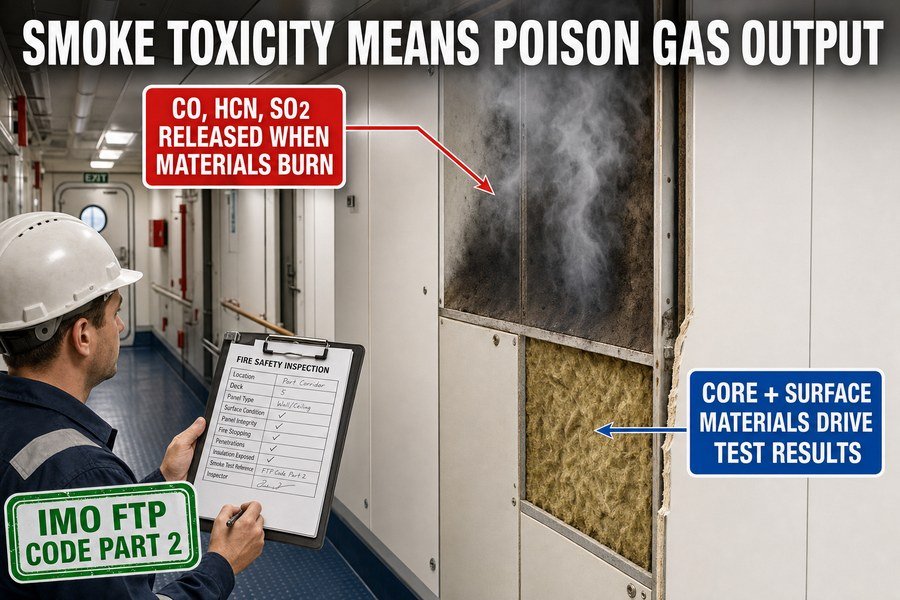
I work as a marine outfitting specialist. I see many buyers focus only on fire ratings like B-15 or A-60. They forget about the smoke. But smoke toxicity is just as important for safety and certification. Shipyards in Europe and the United States will reject your materials if the smoke tests fail. Let me break down what you really need to look for when you source marine wall and ceiling panels from your suppliers.
Which Toxic Gases Do Burning Marine Interior Panels Release?
You worry about invisible dangers on ships. Toxic smoke kills people quickly. Knowing the exact gases produced helps you avoid buying deadly materials for your shipyard projects.
Burning marine interior panels release up to six main toxic gases: Carbon Monoxide (CO), Hydrogen Cyanide (HCN), Hydrogen Chloride (HCl), Hydrogen Bromide (HBr), Hydrogen Fluoride (HF), and Sulfur Dioxide (SO2), alongside Nitrogen Oxides (NOx), depending on the PVC films, adhesives, and core materials used.
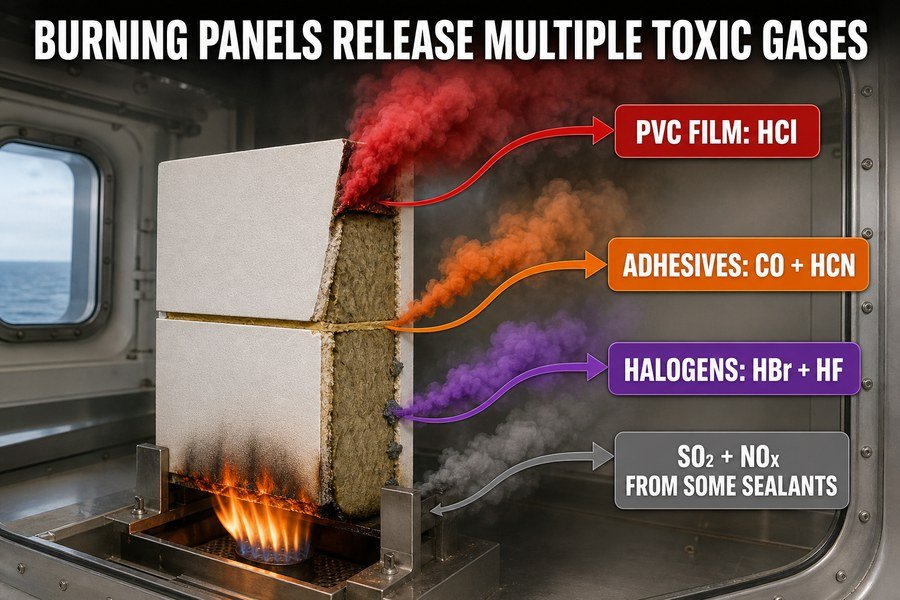
I want you to know exactly what burns inside these panels. The marine interior panels you buy from Asia have different layers. Each layer releases specific gases when a fire starts. We must look at all seven gases mentioned earlier.
Carbon-Based and Cyanide Gas Emissions from Surface Films
Marine panels often use decorative PVC films on the surface. These films give the panel a nice look. But these organic materials produce dangerous gases when they burn. Carbon Monoxide (CO) is the most common gas. Almost all carbon-based materials release CO during a fire. CO stops blood from carrying oxygen.1 Hydrogen Cyanide (HCN) is another deadly gas. Materials containing nitrogen, like certain glues and plastics, release HCN. HCN attacks the nervous system immediately.2 A standard PVC-coated panel can release high levels of both CO and HCN if the manufacturer uses cheap raw materials. You must ask your factory about the quality of their surface films. Good quality films release much less CO and HCN.
Halogen, Sulfur, and Nitrogen Gas Releases from Adhesives and Cores
You also need to care about the hidden materials inside the panel. Halogen gases include Hydrogen Chloride (HCl), Hydrogen Bromide (HBr), and Hydrogen Fluoride (HF). PVC finishes release a large amount of HCl when they melt.3 Manufacturers sometimes add brominated flame retardants to the glues. These retardants release HBr. HF comes from certain fluoropolymer coatings. These three halogen gases burn the eyes and the lungs.4 Next, we have Sulfur Dioxide (SO2) and Nitrogen Oxides (NOx). Some adhesives and rubber sealants contain sulfur and nitrogen. When they burn, they release SO2 and NOx. These gases cause severe choking. You must buy panels that use low-halogen and low-sulfur adhesives.
| Toxic Gas Name | Chemical Formula | Primary Source in Marine Panels | Health Effect on Crew |
|---|---|---|---|
| Carbon Monoxide | CO | Decorative films, organic adhesives | Deprives blood of oxygen |
| Hydrogen Cyanide | HCN | Nitrogen-based plastics, bad glues | Attacks the nervous system |
| Hydrogen Chloride | HCl | PVC surface finishes | Burns eyes and throat |
| Hydrogen Bromide | HBr | Brominated flame retardants | Causes severe breathing issues |
| Hydrogen Fluoride | HF | Fluoropolymer coatings | Corrodes lung tissue |
| Sulfur Dioxide | SO2 | Sulfur-containing sealants | Causes violent coughing |
| Nitrogen Oxides | NOx | Nitrogen-containing resins | Irritates the airway |
How Are Marine Interior Panels Tested for Smoke Toxicity?
You buy blind without proper factory testing. Uncertified panels will fail port inspections. We must look at the exact test methods used to ensure maritime compliance.
Marine interior panels are tested for smoke toxicity strictly according to the IMO FTP Code Part 2, utilizing the ISO 5659-2 standard. Technicians burn a 75mm x 75mm sample inside a sealed 0.5-cubic-meter chamber using 25 kW/m2 and 50 kW/m2 heat fluxes, then analyze the extracted gases using FTIR spectroscopy.
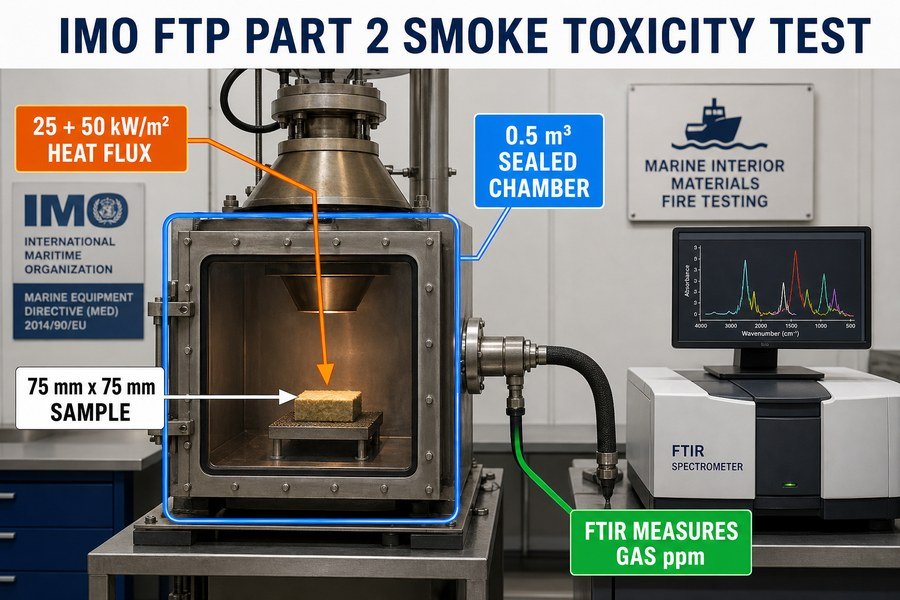
You need to understand the test process to talk confidently with your suppliers. I have watched these tests in marine laboratories. The testing process is very strict and exact. You cannot guess the results.
The Standard Chamber Setup for IMO FTP Code Part 2 Testing
The testing laboratory uses a special machine. The core standard is the IMO FTP Code Part 2. This code uses the ISO 5659-2 testing method. First, technicians cut a piece of your marine panel. They cut it exactly 75 millimeters by 75 millimeters. This small sample represents the whole product. They place this small sample inside a sealed metal box. We call this box the test chamber. The chamber has a volume of exactly 0.5 cubic meters. The technicians use a radiant cone heater to burn the sample. They test the sample at three different heat levels. They use 25 kW/m2 without a pilot flame. They use 25 kW/m2 with a pilot flame. They also use 50 kW/m2 without a pilot flame. This simulates different stages of a real ship fire. The sealed chamber collects all the smoke.
Gas Analysis Techniques Used During ISO 5659-2 Tests
The laboratory must measure the collected smoke. They extract the gas from the chamber. They measure the smoke exactly 10 minutes and 20 minutes after the test starts. Laboratories use a highly advanced tool called FTIR. FTIR stands for Fourier Transform Infrared spectroscopy. The FTIR machine shines infrared light through the gas sample. Different toxic gases absorb light in different ways. The machine reads the light absorption. It calculates the exact amount of each gas. Sometimes, older labs use colorimetric gas detector tubes. These small glass tubes change color when gas touches them. But FTIR is much more accurate and is the modern standard. You should always ask your supplier if their lab uses FTIR.
| Testing Parameter | Exact Requirement | Purpose in Testing |
|---|---|---|
| Testing Standard | IMO FTP Code Part 2 / ISO 5659-2 | Defines legal compliance for ships |
| Sample Size | 75 mm x 75 mm | Standardized piece for burning |
| Chamber Volume | 0.5 cubic meters | Traps all smoke for accurate reading |
| Heat Flux Applied | 25 kW/m2 and 50 kW/m2 | Simulates small and large fires |
| Gas Analysis Tool | FTIR Spectroscopy | Measures exact gas concentrations |
What CO and HCN Limits Apply to Marine Interior Panel Smoke?
High gas levels cause failed shipyard certifications. You cannot sell panels that exceed limits. Let us check the exact legal numbers you must ask your suppliers for.
The IMO FTP Code establishes strict maximum concentration limits for marine panel smoke: Carbon Monoxide (CO) must remain below 1450 ppm, and Hydrogen Cyanide (HCN) must not exceed 140 ppm. Other limits include HCl (600 ppm), HBr (600 ppm), HF (600 ppm), SO2 (120 ppm), and NOx (350 ppm).
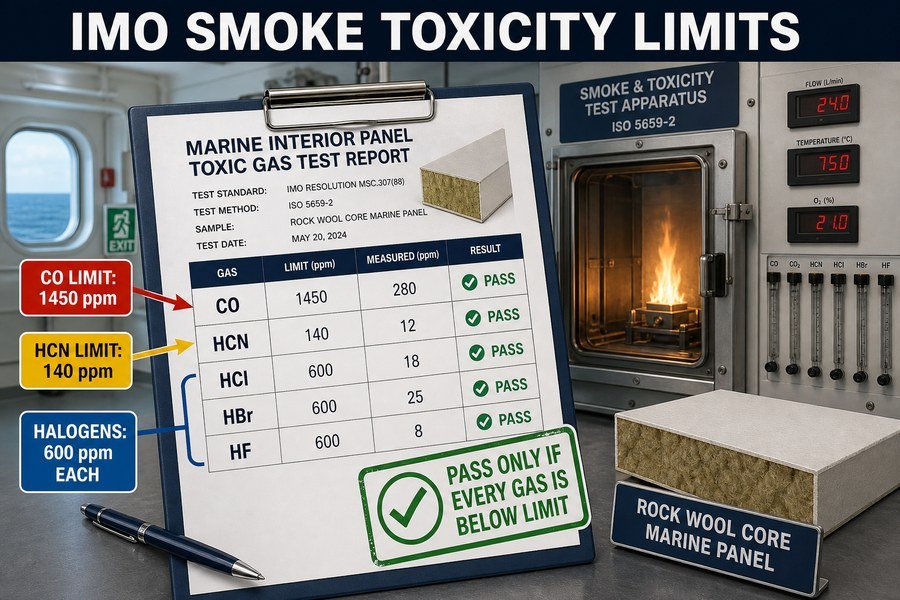
Numbers matter in the ship interior business. I always check the exact ppm (parts per million) numbers on a lab report before I approve a supplier. If a supplier shows you a report with numbers higher than the limits, you must reject the panels.
The IMO FTP Code Limits for Primary Toxic Gases Carbon Monoxide and Hydrogen Cyanide
The International Maritime Organization sets very clear limits.5 The most important limits apply to Carbon Monoxide (CO) and Hydrogen Cyanide (HCN). These two gases kill people the fastest.6 The law says the CO level must never go above 1450 ppm.7 If a panel produces 1500 ppm of CO, it fails the test. You cannot install it on a ship. The limit for HCN is much lower. HCN must stay below 140 ppm.8 HCN is incredibly toxic even in small amounts. A good quality marine panel usually tests well below these limits. For example, a high-quality rockwool panel might only produce 300 ppm of CO and 10 ppm of HCN. You should compare quotes based on these test numbers, not just the final price.
Regulatory Limits for Halogens and Sulfur Compounds in Marine Smoke
The IMO also strictly controls halogens and sulfur. Hydrogen Chloride (HCl) has a limit of 600 ppm. Hydrogen Bromide (HBr) also has a limit of 600 ppm. Hydrogen Fluoride (HF) has a limit of 600 ppm. These gases cause acid burns inside the body. The limit for Sulfur Dioxide (SO2) is very low. It must not exceed 120 ppm. Sulfur Dioxide ruins the lungs quickly. Finally, Nitrogen Oxides (NOx) must stay below 350 ppm. You must check every single gas limit on the test report. A panel can pass the CO test but fail the HCl test. If it fails even one gas limit, the shipyard will not pay you.
| Toxic Gas | IMO FTP Code Maximum Limit | Reason for the Strict Limit |
|---|---|---|
| Carbon Monoxide (CO) | 1450 ppm | Prevents rapid unconsciousness |
| Hydrogen Cyanide (HCN) | 140 ppm | Prevents nervous system shutdown |
| Hydrogen Chloride (HCl) | 600 ppm | Prevents severe eye damage |
| Hydrogen Bromide (HBr) | 600 ppm | Prevents airway burns |
| Hydrogen Fluoride (HF) | 600 ppm | Prevents lung corrosion |
| Sulfur Dioxide (SO2) | 120 ppm | Prevents severe choking |
| Nitrogen Oxides (NOx) | 350 ppm | Prevents respiratory irritation |
Why Does Marine Accommodation Panel Smoke Threaten Crew Evacuation?
A ship fire traps people quickly. Toxic smoke blinds and paralyzes crews in minutes. We must understand how these physical effects stop successful emergency evacuations.
Marine accommodation panel smoke threatens evacuation by causing immediate visual obscuration, severe respiratory irritation, cognitive confusion, and rapid physical incapacitation. Thick black smoke reduces visibility below 0.5 meters, while toxic gases like CO and HCN deprive the brain of oxygen, causing collapse within three to five minutes.
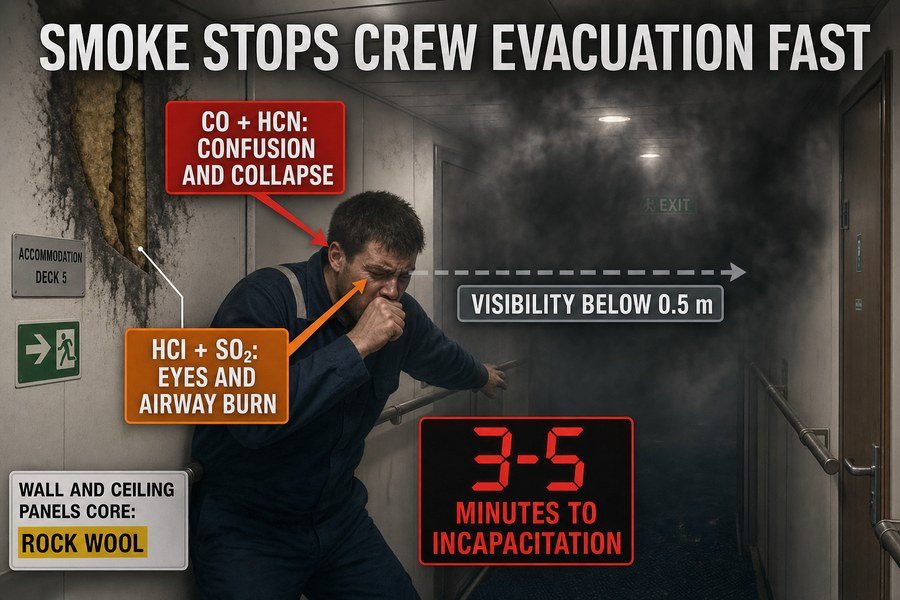
A ship is a closed steel box. When a fire breaks out, the crew cannot just run outside like in a normal building. They must walk through narrow corridors to reach the lifeboats. Bad panels make this impossible.
How Thick Black Smoke Reduces Visibility During Ship Evacuations
The first problem is sight. Burning panels create thick black smoke. This smoke causes visual obscuration. Smoke density is measured by how much light it blocks. In a real ship fire, cheap PVC panels fill the corridor with black smoke in two minutes. The visibility drops below 0.5 meters.9 The crew cannot see the exit signs. They cannot see the doors. They panic. They hit walls and get lost. This wastes valuable time. The IMO FTP Code Part 2 also tests for smoke generation.10 Safe panels produce very thin, light-colored smoke. Good panels allow the crew to see at least 5 meters ahead. You must buy panels that pass the low-smoke density tests.
How Toxic Gas Inhalation Causes Physical Incapacitation of Crews
The second problem is physical health. As the crew tries to escape, they breathe in the toxic gases. This causes severe respiratory irritation. Gases like HCl and SO2 burn their eyes and throats. They cannot keep their eyes open. Then, cognitive confusion starts. CO and HCN deprive the brain of oxygen. The crew members forget where the lifeboats are. They make bad decisions. Finally, rapid physical incapacitation occurs. If the air has more than 1450 ppm of CO, a person will collapse within three to five minutes. They lose muscle control. They fall down and cannot stand back up. The evacuation stops completely. This is why you must provide panels that keep the toxic gas levels low.
| Evacuation Threat | Primary Cause from Smoke | Effect on Evacuation Process | Time to Severe Impact |
|---|---|---|---|
| Visual Obscuration | Black soot from burning PVC | Crew cannot find exits | 1 to 2 minutes |
| Respiratory Irritation | Halogen gases (HCl, HF) | Crew cannot open eyes or breathe | 2 to 3 minutes |
| Cognitive Confusion | Lack of oxygen from CO | Crew makes wrong turns | 3 to 4 minutes |
| Physical Incapacitation | High levels of HCN and CO | Crew collapses in corridors | 3 to 5 minutes |
How Do Core Materials Affect Marine Interior Panel Smoke Toxicity?
Bad core choices ruin your whole project. You face massive delays if panels fail safety tests. The core material directly determines the smoke output volume.
Core materials fundamentally dictate marine panel smoke toxicity. Non-combustible inorganic cores like rockwool and aluminum honeycomb generate zero to trace toxic gases, while combustible organic cores, adhesives, and decorative PVC finishes release heavy concentrations of CO, HCN, and halogens, directly impacting the panel's ability to pass IMO certifications.
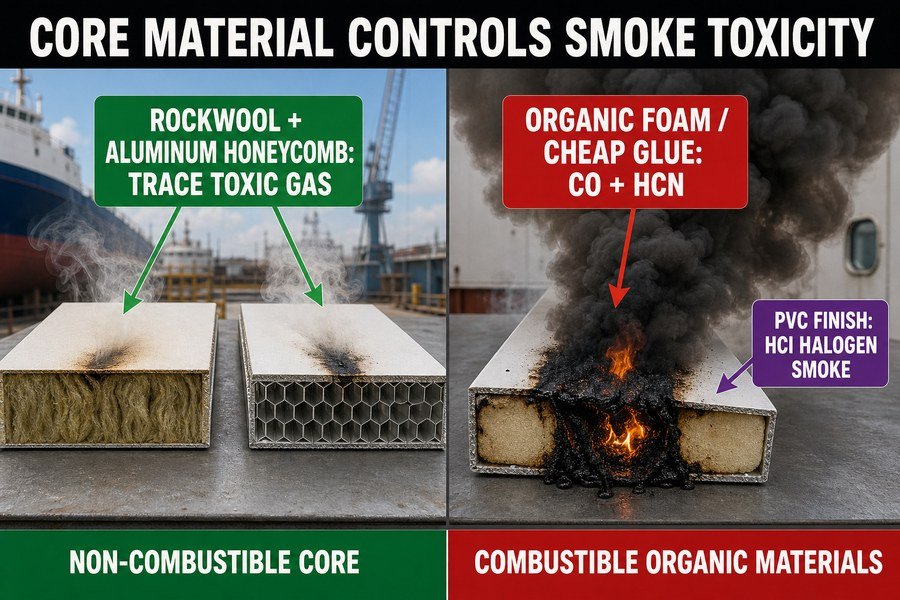
I always inspect the raw materials inside the factory. The outside of the panel looks the same. But the inside makes all the difference. The core material is the heart of the panel. You must know exactly what your supplier puts inside.
Smoke Toxicity Profiles of Rockwool and Aluminum Honeycomb Core Materials
You want to buy panels with non-combustible inorganic cores. Rockwool is the most popular choice. Rockwool is made from melted stone. Stone does not burn. Therefore, pure rockwool generates zero to trace toxic gases. The only smoke comes from the small amount of resin binder holding the rockwool fibers together. A high-quality 50mm rockwool core will easily pass all IMO smoke tests. Aluminum honeycomb is another excellent choice. Aluminum is a metal. It does not release toxic smoke when heated. Both rockwool and aluminum honeycomb are incredibly safe. You should always prefer these core materials for your major shipyard projects in Europe and the US.
The Impact of Organic PVC Finishes and Adhesives on Toxic Gas Release
The danger comes from the organic materials attached to the core. Combustible organic cores, like polyurethane foam11, are terrible for ships. They release heavy concentrations of deadly gases. But even if you use a good rockwool core, you must watch out for the adhesives and finishes. Factories use glue to attach the steel sheets to the rockwool. Cheap glue releases huge amounts of HCN and CO12. You must ask the factory to use high-quality, low-smoke, two-part polyurethane or epoxy adhesives. Next, look at the decorative PVC finishes. Thick PVC films look beautiful but release terrible halogen gases like HCl13. You must ensure the factory uses thin, low-smoke PVC films or baked enamel paint instead.
| Material Type | Material Location | Combustibility | Smoke Toxicity Level |
|---|---|---|---|
| Rockwool | Panel Core | Non-combustible | Very Low |
| Aluminum Honeycomb | Panel Core | Non-combustible | Very Low |
| Polyurethane Foam | Panel Core | Combustible | Very High (Do not use) |
| Standard PVC Film | Surface Finish | Combustible | High (Releases HCl) |
| High-Quality Adhesive | Between steel and core | Combustible | Low to Medium |
What Smoke Toxicity Data Belongs on a Marine Interior Panel Datasheet?
Incomplete documents block your payments. Shipyards reject panels without clear proof. You need to know exactly what test results must appear on the product datasheet.
A compliant marine interior panel datasheet must include the MED/USCG approval mark, a direct reference to the IMO FTP Code Part 2 standard, the exact ISO 5659-2 test results showing maximum gas concentrations in ppm, the specific heat flux conditions applied, and the designated classification of the material.
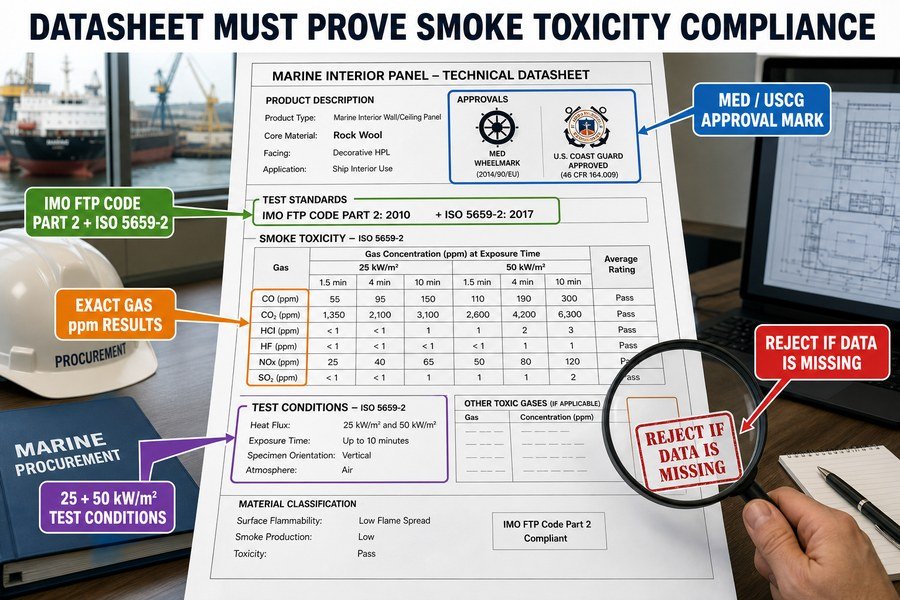
I spend hours checking supplier paperwork. The technical datasheet is your promise to the shipyard. If the datasheet misses important details, the shipyard will doubt your professionalism. You must check the factory's datasheet before you send it to your client.
Essential IMO and MED Certification Marks on Marine Panel Datasheets
First, look for the official approval marks. A marine panel datasheet must clearly show the MED Wheelmark14. MED stands for Marine Equipment Directive. This mark proves the panel is legal for European ships. You might also need the USCG approval mark for American projects. The datasheet must contain a direct reference to the IMO FTP Code Part 2 standard. It cannot just say "fireproof." It must state "Approved according to IMO 2010 FTP Code Part 2." It must also state the designated classification of the material, such as "low flame spread." If these marks and sentences are missing, you must ask the supplier to update the document immediately.
Detailed ISO 5659-2 Test Metrics Required for Shipyard Approval
Second, the datasheet must show the actual test numbers. Shipyard engineers want to see the exact ISO 5659-2 test results. The document must list the maximum gas concentrations in ppm. It should list all seven gases: CO, HCN, HCl, HBr, HF, SO2, and NOx15. It must show the test results next to the IMO limits. The datasheet must also show the specific heat flux conditions applied. It must state that the panel passed under 25 kW/m2 and 50 kW/m2 conditions. A good datasheet gives you confidence. It proves the supplier did the real tests. It proves your products are safe.
| Required Datasheet Information | Why The Shipyard Demands It | Action for Procurement Officer |
|---|---|---|
| MED / USCG Approval Mark | Proves legal compliance for specific regions | Reject panels without this mark |
| IMO FTP Code Part 2 Reference | Proves the correct marine standard was used | Check text exactly |
| Exact ISO 5659-2 Test Results | Proves the panel passed the toxicity test | Verify ppm numbers are below limits |
| Specific Heat Flux Conditions | Proves the lab used correct fire temperatures | Look for 25 kW/m2 and 50 kW/m2 |
| Designated Material Classification | Proves the panel fits the ship's safety plan | Ensure it says "low flame spread" |
Conclusion
Understanding marine panel smoke toxicity, IMO FTP Code limits, and core material impacts ensures you procure safe, compliant products that protect crews and satisfy strict shipyard requirements.
-
"HHS Public Access", https://stacks.cdc.gov/view/cdc/33928/cdc_33928_DS1.pdf?. A toxicology or fire-safety source should support that incomplete combustion of carbon-containing materials produces carbon monoxide and that carbon monoxide impairs oxygen transport by binding hemoglobin. Evidence role: mechanism; source type: government. Supports: Carbon-based materials can produce carbon monoxide in fires, and carbon monoxide prevents blood from carrying oxygen effectively.. ↩
-
"HEALTH EFFECTS - Toxicological Profile for Cyanide - NCBI", https://www.ncbi.nlm.nih.gov/books/NBK600901/. A fire toxicology source should support that hydrogen cyanide can be generated during combustion of nitrogen-containing polymers and that cyanide toxicity disrupts cellular respiration, especially affecting the central nervous system. Evidence role: mechanism; source type: paper. Supports: Nitrogen-containing materials can release hydrogen cyanide during combustion, and HCN has rapid neurotoxic effects.. Scope note: The amount of HCN released depends on the specific polymer, formulation, oxygen availability, and fire conditions, so the source may support the mechanism rather than quantify emissions from these exact panels. ↩
-
"Releases of Fire-Derived Contaminants from Polymer Pipes ...", https://pmc.ncbi.nlm.nih.gov/articles/PMC6958356/. A polymer degradation or fire-safety reference should support that polyvinyl chloride thermally decomposes by dehydrochlorination, releasing hydrogen chloride under fire or high-temperature conditions. Evidence role: mechanism; source type: paper. Supports: PVC surface finishes can release hydrogen chloride during thermal decomposition or fire exposure.. Scope note: The phrase “large amount” is formulation- and test-condition dependent; the source may directly support HCl generation from PVC but not the exact emission level for a given marine panel finish. ↩
-
"Immediately Dangerous to Life or Health (IDLH) Value ...", https://www.cdc.gov/niosh/docs/2025-108/pdfs/2025-108revised062025.pdf. An occupational health or toxicology source should support that hydrogen chloride, hydrogen bromide, and hydrogen fluoride are corrosive or strongly irritating gases that can injure eyes and respiratory tissues. Evidence role: expert_consensus; source type: government. Supports: Hydrogen chloride, hydrogen bromide, and hydrogen fluoride can irritate or burn the eyes and respiratory tract.. Scope note: Sources may discuss each gas separately rather than as a combined group, and injury severity depends on concentration and exposure duration. ↩
-
"What Is the Purpose and Scope of the IMO FTP Code?", https://magellanmarinetech.com/what-purpose-scope-of-imo-ftp-code/. The IMO International Code for Application of Fire Test Procedures (FTP Code), Part 2, specifies smoke and toxicity test criteria for materials used on ships, including maximum permitted gas concentrations. Evidence role: definition; source type: institution. Supports: The International Maritime Organization sets limits for toxic gas emissions from ship interior materials under the FTP Code.. Scope note: The source establishes the regulatory framework and test criteria, but does not assess any particular supplier or panel product. ↩
-
"Cyanide intoxication as part of smoke inhalation - PMC - NIH", https://pmc.ncbi.nlm.nih.gov/articles/PMC3058018/. Fire toxicology literature identifies carbon monoxide and hydrogen cyanide as major toxicants in fire smoke that can cause rapid incapacitation and death through hypoxia-related mechanisms. Evidence role: expert_consensus; source type: paper. Supports: Carbon monoxide and hydrogen cyanide are among the most rapidly dangerous toxic gases produced in fires.. Scope note: This supports the importance and rapid toxicity of CO and HCN in fire smoke, but does not prove that they are always the fastest-acting gases in every fire scenario. ↩
-
"What Is the Purpose and Scope of the IMO FTP Code?", https://magellanmarinetech.com/what-purpose-scope-of-imo-ftp-code/. The IMO FTP Code smoke and toxicity criteria list carbon monoxide with a maximum permitted concentration of 1450 ppm in the specified test method. Evidence role: statistic; source type: institution. Supports: Carbon monoxide must not exceed 1450 ppm under the IMO FTP Code test criteria.. Scope note: This supports the laboratory test limit under the FTP Code; it is not a direct measure of real-fire exposure levels aboard ships. ↩
-
"What Is the Purpose and Scope of the IMO FTP Code?", https://magellanmarinetech.com/what-purpose-scope-of-imo-ftp-code/. The IMO FTP Code toxicity criteria specify a maximum hydrogen cyanide concentration of 140 ppm for the relevant smoke and toxicity test. Evidence role: statistic; source type: institution. Supports: Hydrogen cyanide must stay below 140 ppm under the IMO FTP Code test criteria.. Scope note: The citation verifies the test threshold, not the performance of any individual marine panel material. ↩
-
"Why Do Smoke Toxicity and Density Matter for Marine Wall and ...", https://magellanmarinetech.com/why-smoke-toxicity-and-density-matter-for-marine-wall-ceiling-panels/. A fire-safety or materials study on PVC combustion and smoke optical density would support that PVC-containing materials can produce dense, visibility-reducing smoke under fire conditions; corridor filling times and exact visibility distances remain scenario-dependent because they vary with ventilation, fire size, geometry, and test method. Evidence role: general_support; source type: paper. Supports: PVC panels can generate dense black smoke during fire that rapidly reduces corridor visibility.. Scope note: Contextual support only; the precise two-minute and 0.5-meter figures require a matching experiment or simulation. ↩
-
"What Is the Purpose and Scope of the IMO FTP Code?", https://magellanmarinetech.com/what-purpose-scope-of-imo-ftp-code/. The IMO International Code for Application of Fire Test Procedures, Part 2, specifies smoke and toxicity testing for materials used in ships, supporting the statement that smoke generation is a formal fire-test criterion in maritime regulation. Evidence role: definition; source type: institution. Supports: IMO FTP Code Part 2 includes testing for smoke generation.. ↩
-
"Analysis of Flammability and Smoke Emission of Plastic ... - PMC", https://pmc.ncbi.nlm.nih.gov/articles/PMC10054394/. Fire toxicology studies of polyurethane foam combustion report toxic effluents including carbon monoxide and hydrogen cyanide, supporting the claim that polyurethane foam can present a high smoke-toxicity hazard in fires. Evidence role: mechanism; source type: paper. Supports: Combustible organic cores such as polyurethane foam can release dangerous toxic gases when burning.. Scope note: Gas yields vary substantially with foam formulation, density, ventilation, temperature, and whether combustion is flaming or smoldering. ↩
-
"Analysis of Flammability and Smoke Emission of Plastic ... - PMC", https://pmc.ncbi.nlm.nih.gov/articles/PMC10054394/. Combustion studies of polyurethane and other nitrogen-containing polymer systems identify hydrogen cyanide and carbon monoxide as important toxic fire-effluent gases, supporting concern that adhesive chemistry can affect panel smoke toxicity. Evidence role: mechanism; source type: paper. Supports: Some panel adhesives, especially certain organic or nitrogen-containing systems, can contribute HCN and CO to fire effluent.. Scope note: The evidence would support the gas-generation mechanism, not the word “cheap”; actual emissions depend on adhesive formulation, loading, curing, and fire-test conditions. ↩
-
"Kinetic Study of Polyvinyl Chloride Pyrolysis with ...", https://www.osti.gov/servlets/purl/2352421. Polyvinyl chloride thermal-decomposition and combustion literature describes dehydrochlorination as a major pathway, producing hydrogen chloride gas and supporting the claim that PVC finishes can add acid-gas hazards in fires. Evidence role: mechanism; source type: paper. Supports: PVC surface films can release hydrogen chloride during thermal decomposition or combustion.. Scope note: The amount of HCl released depends on PVC formulation, plasticizers, stabilizers, film thickness, oxygen availability, and fire temperature. ↩
-
"Directive 96/98/EC", https://en.wikipedia.org/wiki/Directive_96/98/EC. European Commission guidance on the Marine Equipment Directive explains that marine equipment covered by the Directive must bear the wheel mark to indicate conformity with applicable EU approval requirements. Evidence role: definition; source type: government. Supports: A marine panel datasheet should show the MED Wheelmark because it indicates conformity for equipment placed on European ships under the Marine Equipment Directive.. Scope note: This supports the regulatory meaning of the mark in the EU context; it does not prove that any specific panel model is compliant without its certificate and declaration of conformity. ↩
-
"What Is the Purpose and Scope of the IMO FTP Code?", https://magellanmarinetech.com/what-purpose-scope-of-imo-ftp-code/. The IMO 2010 FTP Code Part 2 sets smoke and toxicity evaluation criteria that include concentration limits for carbon monoxide, hydrogen cyanide, hydrogen chloride, hydrogen bromide, hydrogen fluoride, sulphur dioxide, and nitrogen oxides. Evidence role: mechanism; source type: institution. Supports: Datasheets should list the ISO 5659-2/IMO FTP Code Part 2 gas concentration results for CO, HCN, HCl, HBr, HF, SO2, and NOx.. Scope note: This supports the listed gases and their regulatory relevance; the exact numerical limits should be checked against the current accepted edition and any flag-state implementation requirements. ↩