You buy marine interior panels for big projects. If panels fail toxic gas tests, European shipyards will reject your entire order. This ruins your profits. Let us fix this.
Marine interior panel toxic gas analysis follows the IMO FTP Code Part 2. It requires burning the panel inside a sealed chamber. We extract the smoke and measure exactly eight toxic gases: CO, CO2, HCl, HBr, HF, HCN, NOx, and SO2, using infrared spectroscopy and specific chemical detection tubes.
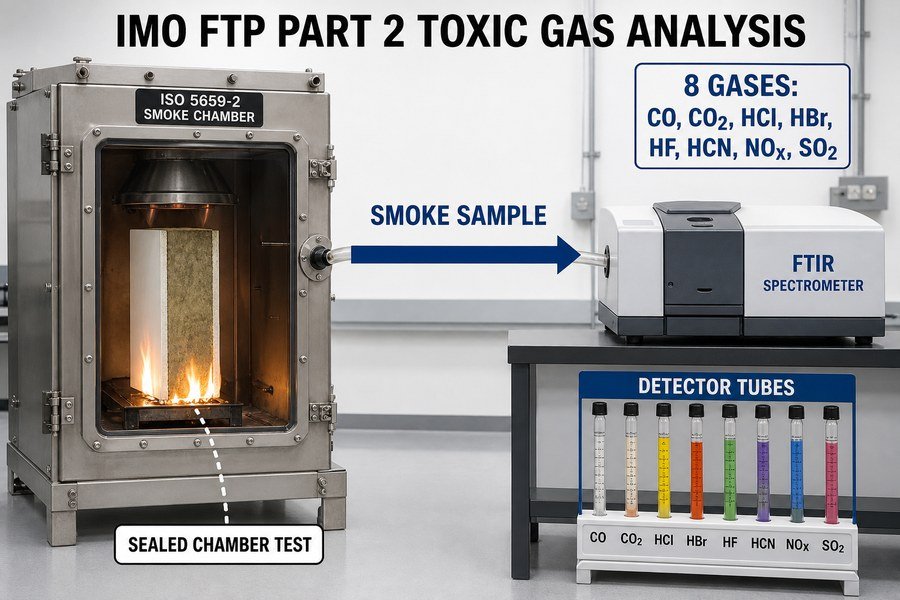
As a marine outfitting specialist at Magellan Marine, I help buyers pass these fire tests every day. Let us look closely at how the laboratories test these gases so you can choose the right materials and keep your shipyard clients happy.
What Instruments Measure Toxic Gas in Marine Interior Panel Tests?
Testing labs cannot guess gas levels. You need accurate data to pass shipyard rules. Using the wrong testing tools gives false results and breaks your supply chain. We use proper instruments.
Labs use two main instruments to measure toxic gas in marine tests: Fourier Transform Infrared (FTIR) spectrometers for continuous real-time multi-gas analysis, and colorimetric gas detector tubes for simple, point-in-time chemical reactions. These two tools guarantee we find all eight IMO-regulated toxic gases during the 20-minute burning test.
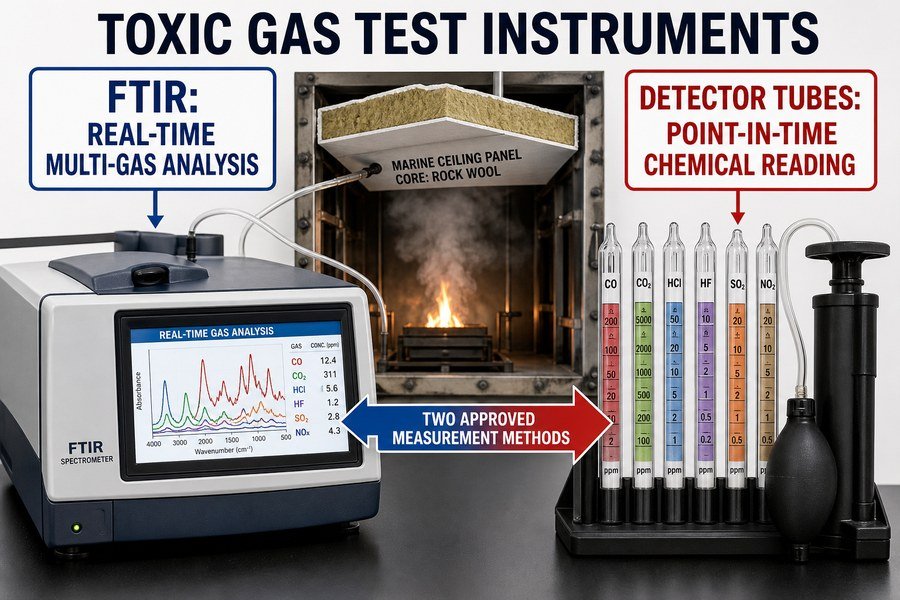
To fully understand these tools, we must look at how each one works during the fire test. Shipyards in the United States and Europe trust labs that use these specific instruments. If your supplier in Asia uses unapproved tools, your certificates will be useless. Here is how the labs measure the gases.
Fourier Transform Infrared (FTIR) Spectrometers for Real-Time Analysis
The FTIR spectrometer is a very advanced and expensive machine. It shines an infrared light beam through the smoke from the burning marine wall panel. Each toxic gas absorbs the light in a different way.1 The machine reads the light changes and calculates the exact amount of gas in parts per million (ppm). According to the ISO 19702 standard, FTIR can measure gas levels every few seconds.2 This provides a continuous graph of the smoke. I visited a top marine testing lab in China last year. Their FTIR machine cost about $50,000. It measures Carbon Monoxide (CO), Carbon Dioxide (CO2), Hydrogen Cyanide (HCN), Sulfur Dioxide (SO2), Nitrogen Oxides (NOx), Hydrogen Chloride (HCl), Hydrogen Bromide (HBr), and Hydrogen Fluoride (HF) all at the same time.3 This is the best tool because it provides exact numbers that strict European shipyards demand.
Colorimetric Gas Detector Tubes for Point-in-Time Checking
Colorimetric gas detector tubes offer a simpler, older method. The IMO FTP Code still allows this method.4 These are small glass tubes filled with a special chemical. When the lab tests your marine ceiling panel, a technician connects the tube to a small pump. The pump pulls exactly 100 milliliters of smoke from the test chamber into the tube. The chemical inside reacts with the target gas and changes color. The length of the color shows the gas concentration. Brands like Dräger or Gastec are very common in this field. A box of 10 tubes usually costs between $60 and $80. Labs use a different tube for each of the eight gases. They do not measure continuously. Instead, they test the smoke at specific minutes during the fire.
| Instrument Type | Main Function | Cost / Investment | Data Output Method |
|---|---|---|---|
| FTIR Spectrometer | Measures all 8 gases simultaneously in real-time | ~$50,000 for machine | Continuous computer graph (ppm) |
| Colorimetric Tubes | Measures one gas per tube via chemical reaction | $60-$80 per 10 tubes | Manual visual reading of color line |
How Are CO, CO2, HBr, HCl, HCN, HF, NOx, and SO2 Quantified in Marine Interior Panel Tests?
You know the eight gases that IMO controls. But how do we turn thick smoke into actual test numbers? If the lab calculates the numbers wrong, your panels lose their certification.
These eight gases are quantified by extracting a smoke sample from the ISO 5659-2 test chamber. CO, CO2, NOx, and SO2 are usually measured optically via FTIR. HCl, HBr, HF, and HCN are quantified by passing the smoke through chemical detector tubes or wet chemical scrubbers to read ppm.
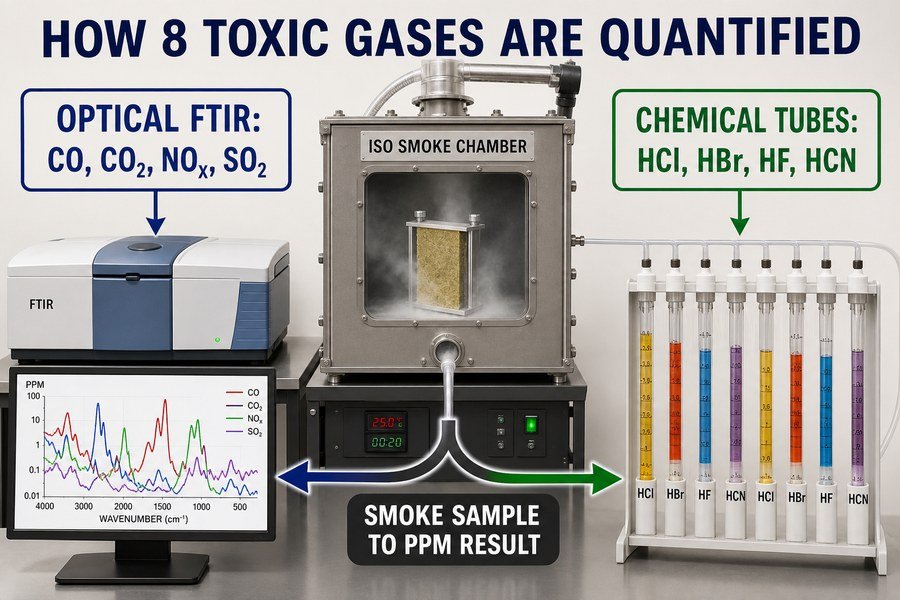
The quantification process splits the eight gases into two groups based on how they behave in the air. As a buyer, you must understand this process. When you read a lab report, you will know exactly how they found the numbers. This helps you discuss quality issues with your factory.
Quantifying Carbon Gases and Oxides (CO, CO2, NOx, SO2)
Carbon monoxide (CO) and carbon dioxide (CO2) appear in large amounts during any fire.5 Nitrogen oxides (NOx) and sulfur dioxide (SO2) depend on the raw materials in your panel. Labs usually quantify these four gases using optical methods.6 The FTIR machine reads the infrared light waves passing through the smoke sample. The computer software uses a calibration library to turn those light waves into a direct parts per million (ppm) number. For example, if your marine wall panel burns and the CO reaches 1000 ppm, the machine plots this on a line graph. The highest point on the graph becomes the official test result. This optical method is very fast and does not require complex chemical mixing by the lab technician.
Quantifying Acidic and Highly Toxic Gases (HCl, HBr, HF, HCN)
Hydrogen chloride (HCl), hydrogen bromide (HBr), hydrogen fluoride (HF), and hydrogen cyanide (HCN) are different. They often come from the plastics, glues, and fire retardants on the surface of your marine ceiling panel.7 These gases are very sticky and highly dangerous. We quantify them using chemical reactions. The pump pulls the smoke into the chemical detector tube. The reaction causes a color stain to move up the glass tube. The technician reads the number printed on the glass where the color stops. For example, if the stain stops at the 50 mark on the HCN tube, the result is 50 ppm. The IMO FTP Code Part 2 requires the lab to record the highest ppm value found during the test.
| Gas Group | Specific Gases | Common Source in Panels | Primary Quantification Method |
|---|---|---|---|
| Carbon & Oxides | CO, CO2, NOx, SO2 | Wood, steel paint, general burning | Optical reading via FTIR (ppm) |
| Acidic & Deadly | HCl, HBr, HF, HCN | PVC films, adhesives, fire retardants | Chemical reaction in detector tubes |
What Toxicity Index Limits Apply to Marine Interior Panels?
A cheap panel price means nothing if the material creates deadly smoke. You must know the exact safety limits. Failing the toxicity index means you cannot sell the product anywhere.
The IMO FTP Code Part 2 sets strict maximum limits for marine interior panels: CO is 1450 ppm, HCl is 600 ppm, HF is 600 ppm, NOx is 350 ppm, HBr is 600 ppm, HCN is 140 ppm, SO2 is 120 ppm, and CO2 is 72000 ppm.
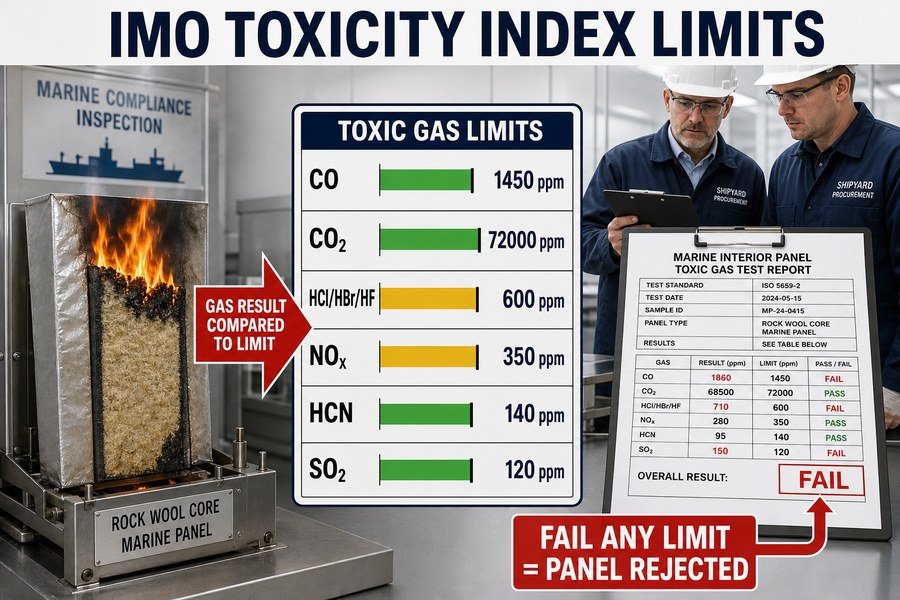
Memorizing these limits will make you a much stronger buyer. When a factory in Asia gives you an old test report, you can instantly check if the numbers pass the current IMO rules. If the numbers are too close to the limit, the factory has poor quality control. Let us break down these specific limits.
Understanding the High-Limit Gases (CO and CO2)
Every fire produces carbon monoxide (CO) and carbon dioxide (CO2).8 The IMO limits for these two gases are high. The limit for CO is 1450 ppm. The limit for CO2 is very high at 72,000 ppm (which is 7.2% of the air). I always tell my buyers not to worry too much about the CO2 limit. Most standard rockwool and steel marine panels pass the CO2 test easily. However, you must watch the CO levels. If you buy cheap PVC-covered panels with poor backing, the CO will jump over 1500 ppm. I saw a factory fail a test because their cheap decorative film pushed the CO to 1600 ppm. They lost a large shipyard contract because of this small mistake.
Strict Limits for Acidic and Deadly Gases (HCN, SO2, NOx, HCl, HBr, HF)
The rules are much tighter for this second group. These gases kill people very quickly.9 The Hydrogen cyanide (HCN) limit is only 140 ppm. The Sulfur dioxide (SO2) limit is 120 ppm. The Nitrogen oxides (NOx) limit is 350 ppm.10 Hydrogen chloride (HCl), Hydrogen bromide (HBr), and Hydrogen fluoride (HF) all share a strict limit of 600 ppm. I once helped a client who used a cheap chemical glue on a marine fire door. During the fire test, the HCN hit 200 ppm, which is a hard fail. We had to change the glue to a water-based adhesive. The new glue dropped the HCN down to 40 ppm. You must always check the glue and PVC film quality to keep these acidic gases low.
| Toxic Gas Name | Chemical Symbol | IMO Maximum Limit (ppm) | Danger Level |
|---|---|---|---|
| Carbon Monoxide | CO | 1450 | High |
| Carbon Dioxide | CO2 | 72,000 | Moderate |
| Hydrogen Chloride | HCl | 600 | Very High (Acidic) |
| Hydrogen Cyanide | HCN | 140 | Extreme (Lethal) |
| Sulfur Dioxide | SO2 | 120 | Extreme |
How Is Gas Sampling Timed During Marine Interior Panel Smoke Tests?
Toxic gas does not come out all at once. The fire grows slowly over time. If the lab takes the air sample at the wrong minute, the test result is completely invalid.
Gas sampling during the ISO 5659-2 smoke test is timed precisely over a 20-minute period. Labs must take continuous gas samples throughout the entire duration. If using manual tube tests, sampling is strictly timed at 10 minutes, 15 minutes, and 20 minutes to find peak toxicity.
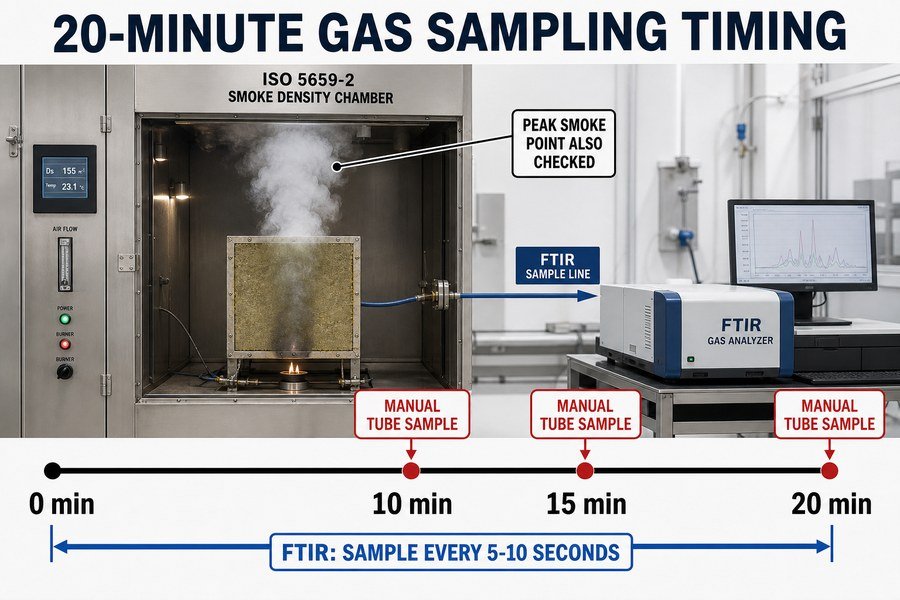
Timing is everything in fire testing. The IMO FTP Code Part 2 sets a very strict clock. The heat must hit the panel for exactly 20 minutes. The lab cannot test the smoke at minute 2 and then stop. Understanding this timing helps you verify if a test report is real or fake.
Continuous Sampling Throughout the 20-Minute Test
The standard test places your marine wall panel inside a sealed box. A radiant heat cone applies exactly 25 kW/m2 or 50 kW/m2 of heat to the panel surface. The test lasts exactly 20 minutes. If the lab uses a modern FTIR machine, it pulls continuous samples. A small pump pulls air from the box every 5 to 10 seconds, from minute 0 to minute 20. This is the best method because it builds a complete picture. A cheap plastic film might release a huge cloud of toxic gas at minute 12, but then stop. If we sample continuously, the computer catches this minute 12 spike. The highest point during those 20 minutes becomes the official toxicity number for your certificate.
Manual Tube Sampling at 10, 15, and 20 Minutes
Many labs still use manual colorimetric tubes. Because tubes cannot test the air continuously, the IMO rules dictate exact sampling times. The technician must manually pump air into the glass tubes at exactly 10 minutes, 15 minutes, and 20 minutes into the test. They must also take a sample when the optical smoke density reaches its highest visual point. This means they test four different times during the burn. The final lab report will list the highest ppm number found among those specific times. If a factory shows you a report that only tested the gas at minute 5, the report is invalid, and European shipyards will reject your marine ceiling panels immediately.
| Sampling Method | Testing Times During 20-Minute Test | Misses Sudden Spikes? |
|---|---|---|
| Continuous (FTIR) | Every 5 to 10 seconds from start to finish | No. Captures all peaks. |
| Manual (Tubes) | Minute 10, Minute 15, Minute 20, and max smoke point | Yes, possible to miss spikes between times. |
Why Measure Multiple Gases Simultaneously for Marine Accommodation Panels?
Ship cabins are small, tight, enclosed spaces. You cannot just test one gas and ignore the rest. A fire produces a complex mix of chemicals that interact dangerously with humans.
We measure multiple gases simultaneously because marine panel fires produce complex chemical mixtures that cause combined toxic effects. Measuring all eight gases at once ensures complete IMO compliance, accurately reflects real ship fire dangers, and prevents a single lethal gas from going unnoticed while others remain low.
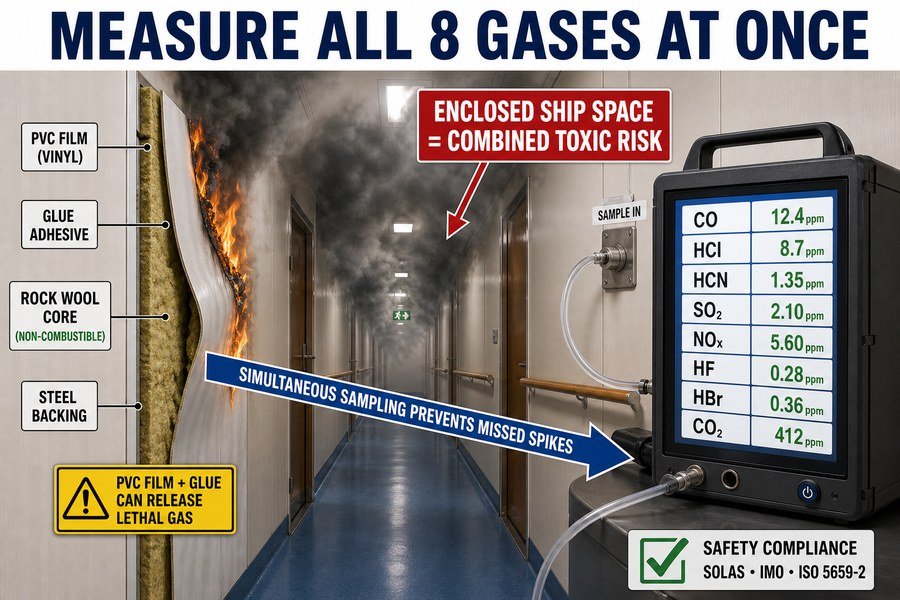
You must provide a safe product. If a fire happens on a ship at sea, people cannot run outside to get fresh air. They are trapped with your wall panels. This is why testing all gases at once is a strict rule11. Let us look at why this complete testing is non-negotiable for shipyard procurement.
Preventing Unnoticed Lethal Gas Spikes
Different raw materials burn at different speeds and release different gases.12 A standard marine wall panel contains a steel sheet, a rockwool core, chemical glue, and a PVC decorative film. When the fire starts, the PVC film might burn first and release HCl at minute 5. Later, the heat reaches the glue layer. This glue might release HCN at minute 12. If the lab does not measure all eight gases simultaneously, they might miss the HCN spike entirely. They might only focus on the CO. By testing all eight gases at the exact same time, we ensure that no single lethal gas goes unnoticed. We guarantee the panel is 100% safe across all chemical reactions.
Reflecting Real Ship Fire Dangers and Combined Toxicity
The rules exist to protect human life. When multiple gases enter a ship corridor, they combine their toxic effects13. Carbon monoxide (CO) makes a sailor dizzy and confused. At the exact same time, Hydrogen chloride (HCl) burns their lungs and eyes so they cannot see the exit door. Testing all gases simultaneously reflects this real-world danger. Shipyards in Europe and the United States demand complete safety data14. They will not buy from you if your certificate only lists two gases. Simultaneous testing gives you a complete and unarguable IMO FTP Code Part 2 certificate. This proves your product quality and makes your marine outfitting business much more profitable and respected.
| Component in Marine Panel | Typical Toxic Gas Released in Fire | Effect on Humans in Enclosed Ship |
|---|---|---|
| PVC Decorative Film | HCl (Hydrogen Chloride) | Severe burning of eyes and lungs |
| Chemical Adhesives | HCN (Hydrogen Cyanide) | Rapid poisoning and death |
| Standard Wood / Paper | CO (Carbon Monoxide) | Dizziness, loss of consciousness |
Conclusion
To sell marine interior panels successfully, you must pass the IMO toxic gas tests. Understanding the testing instruments, strict limits, and exact timing helps you source safer materials and win more shipyard orders.
-
"Infrared Spectroscopy", https://www2.chemistry.msu.edu/faculty/reusch/virttxtjml/spectrpy/infrared/infrared.htm. A spectroscopy reference explains that molecules absorb infrared radiation at characteristic frequencies associated with their vibrational modes, which is the physical basis for identifying gases by FTIR spectra. Evidence role: mechanism; source type: education. Supports: FTIR identifies gases because different gas molecules absorb infrared light in characteristic ways.. Scope note: This supports the general FTIR mechanism, not the performance of any specific fire-test instrument. ↩
-
"Gas Measurement Using FTIR, G C N S and Ion Selective ...", https://www.nist.gov/document/r9701645pdf. ISO 19702 describes FTIR-based sampling and quantitative analysis of fire effluents, including time-resolved measurement of gas concentrations during combustion tests. Evidence role: expert_consensus; source type: institution. Supports: ISO 19702 recognizes FTIR as a method for measuring gas concentrations in fire effluents with frequent time-resolved readings.. Scope note: The standard supports the recognized method and time-resolved nature of FTIR analysis; exact sampling intervals may depend on instrument configuration and test setup. ↩
-
"Feasibility of volcanic CO2, HF, and HCl remote sensing ...", https://ui.adsabs.harvard.edu/abs/2025EGUGA..2710395S/abstract. Technical literature on FTIR analysis of fire effluents reports that the method can quantify multiple combustion gases, including CO, CO2, HCN, NOx, SO2, and acid gases such as HCl, HBr, and HF, from a single sampled gas stream. Evidence role: general_support; source type: paper. Supports: FTIR can measure several fire-effluent gases simultaneously, including the listed toxic and corrosive gases.. Scope note: This supports the multi-gas capability of FTIR in fire-effluent analysis, not the accuracy or calibration status of the specific laboratory instrument described in the article. ↩
-
"Toxicity Test Requirements and Performance Criteria for ...", https://railroads.dot.gov/sites/fra.dot.gov/files/2021-02/Toxicity%20Test%20and%20Performance%20Criteria.pdf. The IMO Fire Test Procedures Code includes smoke and toxicity testing provisions that permit gas concentration determination using detector tubes for specified combustion gas species. Evidence role: historical_context; source type: institution. Supports: The IMO FTP Code permits colorimetric gas detector tubes as an accepted method for smoke toxicity gas measurement.. Scope note: This supports that detector tubes are permitted within the IMO FTP framework, but the exact applicability depends on the specific FTP Code edition, test part, and flag-state or classification-society implementation. ↩
-
"Combustion Products and Their Effects on Life Safety", https://tsapps.nist.gov/publication/get_pdf.cfm?pub_id=900093. Fire-safety literature identifies carbon dioxide and carbon monoxide as common major products of combustion in enclosure fires, with their concentrations depending on fuel chemistry and ventilation conditions. Evidence role: general_support; source type: research. Supports: Carbon monoxide and carbon dioxide are produced in large amounts during fires.. Scope note: This supports the general fire-chemistry claim, but it does not prove that every specific marine panel fire will generate the same quantities. ↩
-
"in-situ monitoring of total-flooding fire tests", https://www.nist.gov/document/r0000278pdf. Standards and fire-testing references describe Fourier-transform infrared spectroscopy and related optical gas-analysis methods as established techniques for measuring combustion gases such as CO, CO2, NOx, and SO2 in smoke or fire effluent. Evidence role: mechanism; source type: institution. Supports: Laboratories commonly use optical methods such as FTIR to quantify CO, CO2, NOx, and SO2 in smoke samples.. Scope note: The source would support FTIR as an accepted method, while actual laboratory practice may vary by test standard, accreditation scope, and equipment. ↩
-
"The Flame-Retardant Mechanisms and Preparation of ... - PMC", https://pmc.ncbi.nlm.nih.gov/articles/PMC8747271/. Polymer-fire toxicology sources associate hydrogen halides with halogenated plastics and flame retardants, and hydrogen cyanide with nitrogen-containing polymers or resins, providing contextual support for linking HCl, HBr, HF, and HCN to panel surface materials. Evidence role: mechanism; source type: paper. Supports: HCl, HBr, HF, and HCN can originate from plastics, adhesives, resins, and flame-retardant materials used in panels.. Scope note: This is contextual support; identifying the exact gas source in a specific panel requires its formulation and fire-test data. ↩
-
"Carbon Cycle: Combustion", https://courses.ems.psu.edu/meteo7/book/export/html/2409. Combustion references explain that carbon-containing fuels can generate carbon dioxide during more complete combustion and carbon monoxide during oxygen-limited or incomplete combustion. Evidence role: mechanism; source type: education. Supports: Fires commonly produce carbon monoxide and carbon dioxide through combustion of carbon-containing materials.. Scope note: This supports the general combustion mechanism, but the word “every” is broader than the evidence because non-carbon fuels and unusual fire conditions may differ. ↩
-
"Toxicological Profile for Cyanide, Draft for Public Comment", https://www.atsdr.cdc.gov/toxprofiles/tp8.pdf. NIOSH and other occupational-health references classify gases such as hydrogen cyanide, sulfur dioxide, nitrogen oxides, and hydrogen halides as acute inhalation hazards, with low immediately dangerous to life or health values for several of them. Evidence role: expert_consensus; source type: government. Supports: HCN, SO2, NOx, HCl, HBr, and HF are dangerous acute inhalation hazards that can rapidly threaten life at sufficient concentrations.. Scope note: This supports the acute toxicity concern in context, but lethality depends on concentration, exposure duration, ventilation, and individual susceptibility. ↩
-
"What Smoke Toxicity and Density Limits Must Marine Wall and ...", https://magellanmarinetech.com/what-smoke-toxicity-density-limits-must-marine-wall-ceiling-panels-meet/. The IMO Fire Test Procedures Code lists maximum toxic gas concentrations for the smoke and toxicity test, including 140 ppm for hydrogen cyanide, 120 ppm for sulfur dioxide, and 350 ppm for nitrogen oxides. Evidence role: definition; source type: institution. Supports: The IMO smoke/toxicity limits are 140 ppm for HCN, 120 ppm for SO2, and 350 ppm for NOx.. Scope note: The citation verifies the IMO test limits; it does not by itself establish product quality or real-fire emission behavior outside the standardized test. ↩
-
"What Is the Purpose and Scope of the IMO FTP Code?", https://magellanmarinetech.com/what-purpose-scope-of-imo-ftp-code/. The IMO 2010 FTP Code, Annex 1, Part 2 sets out smoke and toxicity testing for materials and specifies measurement of toxic combustion gases such as CO, HCl, HBr, HF, HCN, SO2, and NOx during the test. Evidence role: definition; source type: institution. Supports: Marine fire-toxicity testing under IMO FTP Code Part 2 requires measurement of multiple specified toxic gases rather than only one or two gases.. Scope note: This supports the regulatory context for comprehensive toxic-gas measurement, but the official list may not match the article’s later wording of “eight gases” unless a specific laboratory method counts NOx species separately. ↩
-
"Combustion Products and Their Effects on Life Safety", https://tsapps.nist.gov/publication/get_pdf.cfm?pub_id=900093. Fire-science literature describes combustion-product toxicity as dependent on material composition and burning conditions, with different polymers, adhesives, and cellulosic materials generating different yields of gases such as CO, HCl, and HCN. Evidence role: mechanism; source type: research. Supports: Different materials in a marine panel can produce different toxic gases during combustion.. Scope note: This supports the general combustion mechanism, not the exact minute-by-minute sequence described for the example wall panel. ↩
-
"Scale Fire Tests: 1. NFPA 269 / ASTM E 1678", https://nvlpubs.nist.gov/nistpubs/TechnicalNotes/NIST.TN.1760.pdf. ISO 13571 and fire-toxicity research use fractional effective dose and concentration methods to assess incapacitation from mixtures of asphyxiant and irritant fire gases, supporting the concept that simultaneous exposures can produce combined toxic effects. Evidence role: expert_consensus; source type: institution. Supports: Multiple fire gases can have combined toxic effects on exposed people.. Scope note: These models estimate effects under defined exposure assumptions and do not predict every ship-corridor fire scenario directly. ↩
-
"What Is the Purpose and Scope of the IMO FTP Code?", https://magellanmarinetech.com/what-purpose-scope-of-imo-ftp-code/. The EU Marine Equipment Directive and U.S. Coast Guard approval frameworks tie certain shipboard fire-protection and interior materials to SOLAS/IMO FTP Code testing, providing regulatory context for requests for complete fire-test documentation. Evidence role: general_support; source type: government. Supports: European and U.S. marine procurement commonly requires documented compliance with recognized shipboard fire-test standards.. Scope note: These sources establish approval requirements and regulatory context, not a universal rule that every individual shipyard refuses incomplete certificates. ↩