Looking at a marine panel lab report can feel like reading a foreign language. A wrong guess could mean failed shipyard inspections. I will show you exactly how to read them.
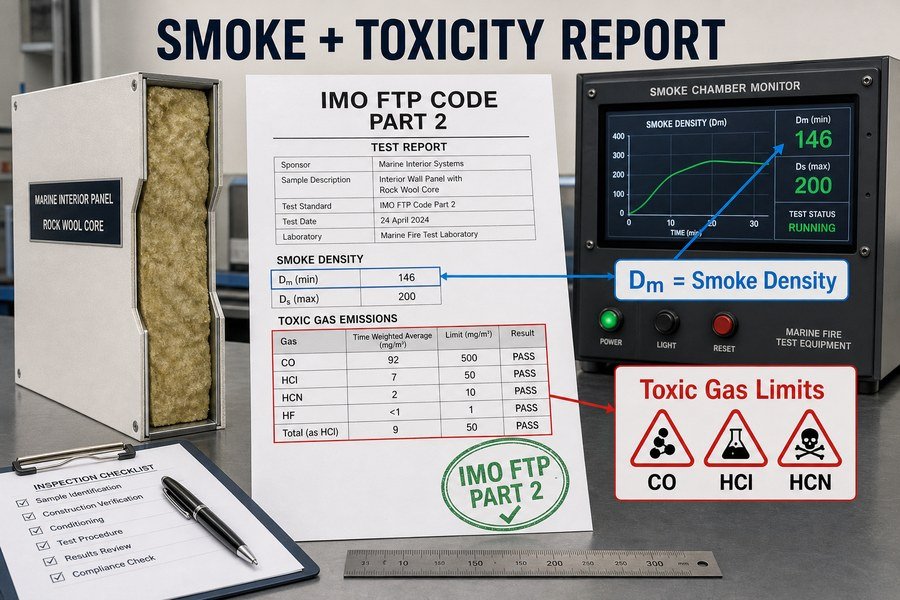
Marine interior panel smoke and toxicity reports are interpreted by evaluating two distinct metrics defined by the IMO FTP Code Part 2: the maximum specific optical density (Dm) for smoke generation, and the concentration limits of toxic gases like CO, HCl, and HCN for toxicity evaluation.
When I first started at a marine outfitting factory, these test reports completely confused me. I saw many pages of data, but I did not know which numbers actually mattered for compliance. Now, as a specialist at Magellan Marine, I read these documents every day to ensure our marine wall panels and ceiling panels meet strict safety rules. Many procurement officers want to buy good quality panels at low prices from Asia. But if you do not understand the test reports, you might buy non-compliant products. This will cause big problems with shipowners. Let us break down the most critical parts of these reports, starting with the most basic value you will see.
What Does the Dm Value Mean on a Marine Interior Panel Report?
Staring at the Dm value and wondering what it means? Misunderstanding this number might lead you to buy non-compliant panels. Here is the simple truth about Dm values.
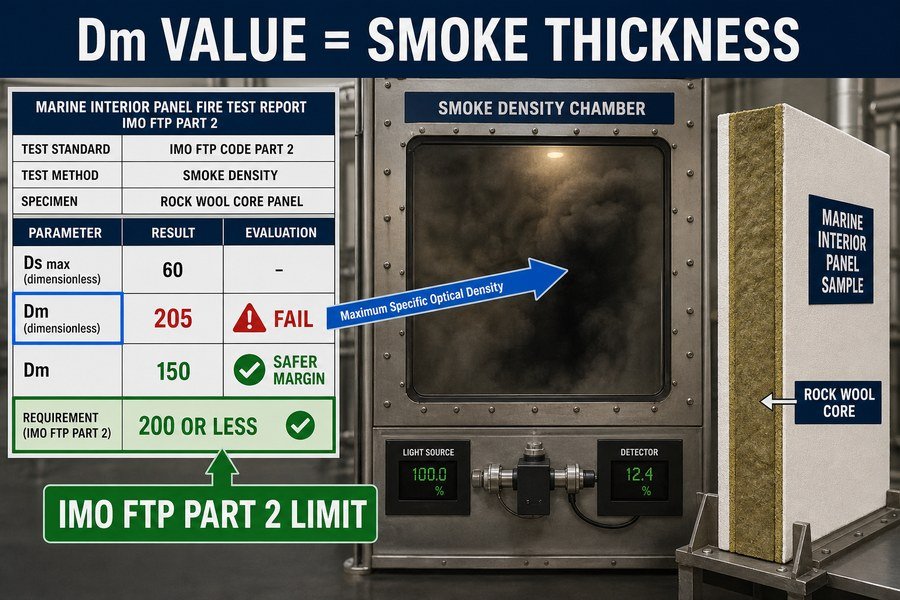
The Dm value on a marine interior panel report represents the maximum specific optical density of smoke. It measures smoke thickness. According to IMO FTP Code Part 2, a compliant panel must have a Dm of 200 or less to ensure escape routes remain visible during a fire.
Understanding the Dm Value in Marine Fire Safety
When you buy a marine wall panel or a marine ceiling panel, the supplier will give you a fire test report. You must look for the "Dm" value. Dm stands for maximum specific optical density. Simply put, it measures how thick and dark the smoke gets when the panel burns. High Dm numbers mean the smoke is very thick. Low Dm numbers mean the smoke is thin and light. During a ship fire, passengers must find the exit. If the smoke is too thick, they cannot see the escape route1. The International Maritime Organization (IMO) wrote the Fire Test Procedures (FTP) Code to prevent this.
According to IMO FTP Code Part 2, the absolute limit for marine interior surface materials is a Dm of 2002. If the report shows a Dm of 205, the panel fails. You cannot use it on the ship. When I help my clients in Europe and the United States, I always check this number first. If a supplier offers a very cheap price but the Dm value is 195, it is very close to the limit. I prefer panels with a Dm of 150 or lower. This gives you a safe margin for quality control.
How IMO FTP Code Part 2 Tests Optical Density
The lab tests the panel using a standard method called ISO 5659-2. The lab puts a small piece of the panel inside a closed box. They heat the panel using a 25 kW/m² radiant heat source. Sometimes they use a small flame, and sometimes they do not. A light beam shines across the box. A sensor measures how much light passes through the smoke.
The lab does this test three times. The report will show the Dm value for each test. Then, it will show the average Dm value. This average number must be 200 or less. If one test is 210, but the average is 190, the panel might still pass, but you should read the report carefully. I always tell my clients to ask for the full report, not just the summary page.
| Metric | Measurement Goal | IMO FTP Code Limit | Meaning for Buyers |
|---|---|---|---|
| Dm Value | Maximum specific optical density (Smoke thickness) | 200 or less | Ensures passengers can see exits in a fire. |
| Test Standard | ISO 5659-2 (Smoke Chamber Test) | N/A | The required lab method to generate the report. |
| Heat Flux | 25 kW/m² | N/A | The strict heat condition applied to the panel. |
| Safety Margin | Distance from the limit | Target < 150 | Lower Dm means better safety and quality control. |
How Is the Toxicity Index Read for Marine Interior Panels?
Toxic gas is the real killer in ship fires. If you cannot read the toxicity index, you risk passenger lives. I will explain how to check these numbers quickly.
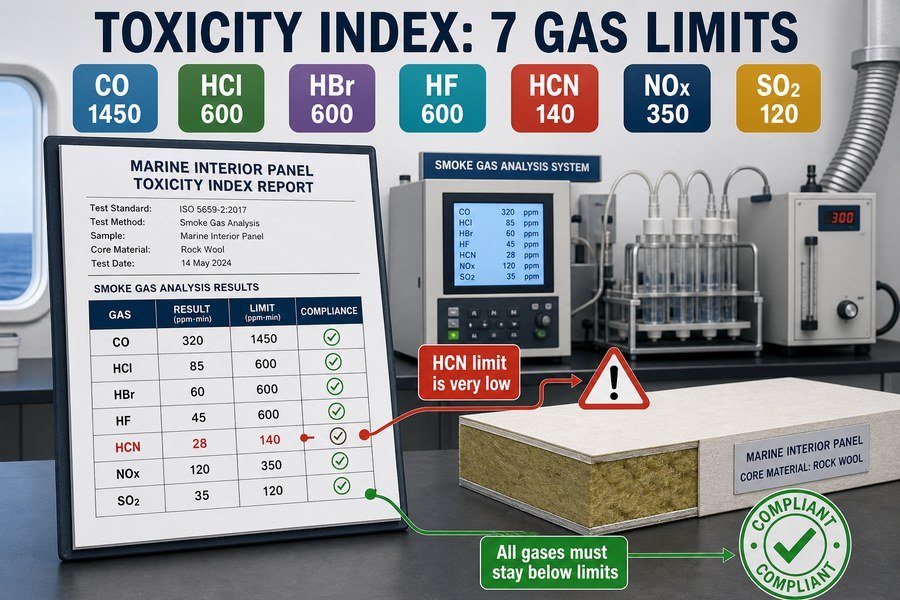
The toxicity index for marine interior panels is read by comparing the panel's emission levels of seven specific gases against the IMO FTP Code limits: Carbon Monoxide (CO), Hydrochloric Acid (HCl), Hydrogen Bromide (HBr), Hydrogen Fluoride (HF), Hydrogen Cyanide (HCN), Nitrous Oxides (NOx), and Sulfur Dioxide (SO2).
Reading Toxic Gas Limits for Marine Wall Panels
When a marine fire door or wall panel burns, it releases gases. Some of these gases are very dangerous. The IMO FTP Code Part 2 identifies seven specific toxic gases that labs must measure. When you read the test report, you will see a list of these seven gases. Next to each gas, you will see a number measured in parts per million (ppm). You must compare the report's number against the IMO limits.
The IMO sets strict maximum limits for each gas. The limit for Carbon Monoxide (CO) is 1450 ppm. Carbon Monoxide is the most common dangerous gas in fires. The limit for Hydrochloric Acid (HCl) is 600 ppm. The limit for Hydrogen Bromide (HBr) is 600 ppm. The limit for Hydrogen Fluoride (HF) is 600 ppm. Hydrogen Cyanide (HCN) is extremely deadly, so its limit is very low at 140 ppm. Nitrous Oxides (NOx) have a limit of 350 ppm. Finally, Sulfur Dioxide (SO2) has a limit of 120 ppm. The panel must stay below the limit for all seven gases.
The Dangers of Hidden Toxic Emissions in Ship Cabins
When you buy marine interior panels from developing countries, the surface finish looks great. The price is competitive. But you cannot see toxicity. During the lab test, the scientists use a tool called FTIR (Fourier Transform Infrared) analysis. They take gas samples from the smoke chamber when the smoke is thickest.
If a panel uses cheap glue or low-quality PVC films3, it will release high levels of HCl or HCN when it burns. I once reviewed a report for a client. The panel had a great Dm smoke value of 120. But the Hydrogen Cyanide (HCN) level was 160 ppm. This was over the 140 ppm limit. The panel failed the IMO test. The client almost bought 5,000 square meters of this failing panel. Always check every single gas on the list.
| Toxic Gas Name | Chemical Formula | IMO FTP Code Part 2 Limit (ppm) | Health Impact in a Fire |
|---|---|---|---|
| Carbon Monoxide | CO | 1450 | Causes unconsciousness and death. |
| Hydrochloric Acid | HCl | 600 | Burns eyes, skin, and breathing paths. |
| Hydrogen Bromide | HBr | 600 | Causes severe breathing problems. |
| Hydrogen Fluoride | HF | 600 | Highly corrosive to lungs and skin. |
| Hydrogen Cyanide | HCN | 140 | Extremely deadly, stops oxygen use in cells4. |
| Nitrous Oxides | NOx | 350 | Damages lung tissue quickly. |
| Sulfur Dioxide | SO2 | 120 | Causes choking and severe coughing. |
What Smoke Figures Qualify Marine Wall Panels for High-Risk Zones?
Need panels for a high-risk area but unsure which numbers matter? Picking standard panels for critical zones can fail surveys. Here is exactly what you need to look for.
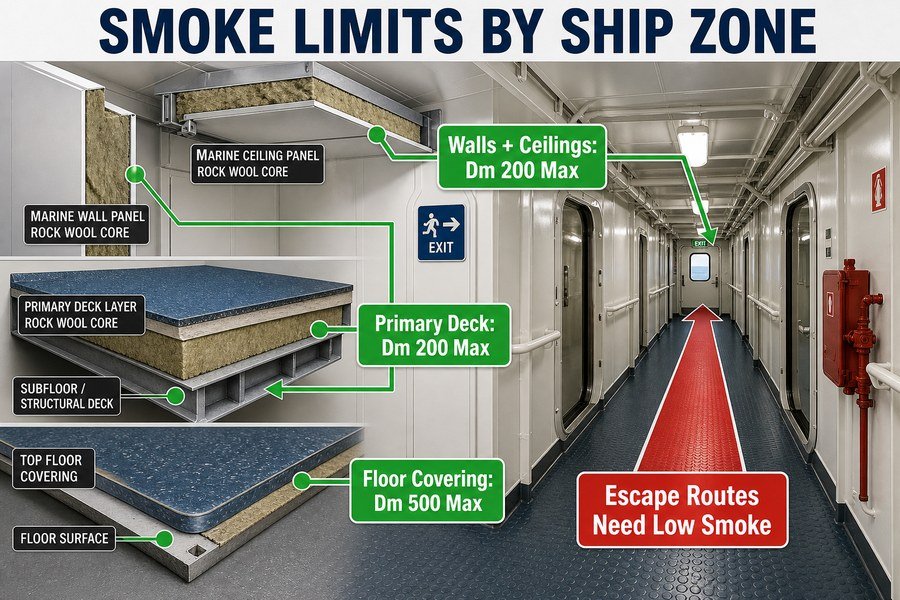
Marine wall panels qualify for high-risk zones when their smoke figures meet the IMO FTP Code Part 2 threshold of a Dm value of 200 or less. However, floor coverings can have a Dm up to 500, while primary deck coverings must not exceed a Dm of 200.
Applying IMO Dm Standards to Different Marine Interior Zones
Not all materials on a ship have the same smoke limits. The IMO FTP Code part 2 gives different Dm rules based on where you install the material. For marine wall panels and marine ceiling panels, the rule is strict. These are classified as surface materials. Their Dm value must be 200 or less.5 This applies to cabins, corridors, and public spaces.
However, floor coverings have a different rule. Floor coverings sit low to the ground. Smoke rises to the ceiling during a fire. Because of this, the IMO allows floor coverings to have a maximum Dm value of 500. This higher number is only for the floor finish, like carpets or PVC flooring. But you must be careful. Primary deck coverings6, which are the leveling compounds under the floor finish, must meet the strict Dm limit of 200. If you buy materials for a complete cabin outfitting project, you must check the right number for the right product.
Why High-Risk Escape Routes Require Strict Smoke Control
High-risk zones include escape routes, stairways, and corridors. These areas must remain clear of smoke for as long as possible. The Dm 200 limit for wall panels ensures that passengers have time to run away. When I work on projects for large European shipyards, they often demand even lower smoke figures. The IMO limit is 200, but a good shipyard might ask for a Dm of 150 or less in their purchasing specification.
They do this because high-risk zones usually have more traffic. If a fire starts in a corridor, the walls will burn. If the walls create too much smoke, the passengers in the cabins cannot find the stairs. When you buy marine wall panels, you should look for reports showing a Dm value well below 200. This proves the factory uses high-quality surface films and fire-resistant core materials like good rock wool.
| Material Type | Installation Location | Maximum IMO Dm Limit | Reason for the Limit |
|---|---|---|---|
| Surface Materials | Walls and Ceilings | 200 | Smoke rises, these areas must stay clear. |
| Primary Deck Coverings | Sub-floor base layers | 200 | Prevent large hidden smoke sources. |
| Floor Coverings | Top layer of the floor | 500 | Smoke stays near ceiling, floor visibility is less critical. |
| High-Risk Specs | Escape Routes | 200 (Often < 150 requested) | Maximum safety for passenger evacuation. |
How Are Combined Smoke and Gas Results Interpreted for Marine Ceiling Panels?
Looking at separate smoke and gas tables can be confusing. Failing to link them means missing the big picture. Here is how to evaluate them together.
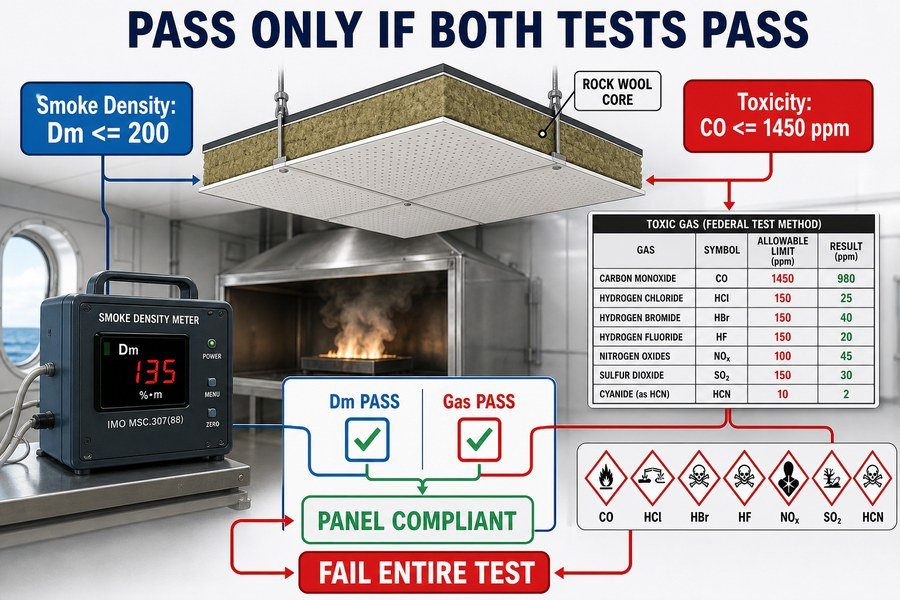
Combined smoke and gas results for marine ceiling panels are interpreted by ensuring both the physical smoke density (Dm ≤ 200) and the chemical toxicity limits (e.g., CO ≤ 1450 ppm) pass simultaneously. A panel failing either metric fails the entire IMO FTP Code Part 2 compliance test.
Evaluating Smoke Density and Toxicity as a Single System
A test report has two main parts. Part one is the smoke density (Dm value). Part two is the toxicity index. You must evaluate them together. They are a single system. A marine ceiling panel only passes the IMO FTP Code Part 2 if it meets both requirements at the same time7. You cannot pass one part and fail the other.
Let me give you a practical example. Imagine you find a marine ceiling panel supplier. The price is very low. You look at the test report. The smoke density Dm is 150. This is lower than the limit of 2008. You might think the panel is great. But then you look at the toxicity section. The Carbon Monoxide (CO) level is 1500 ppm. The limit is 1450 ppm9. The toxicity failed. Therefore, the whole panel fails the IMO test. The panel is illegal to use on a commercial ship. You must check both the physical smoke thickness and the chemical toxicity limits every single time.
Common Reasons for Combined Test Failures in Ceiling Panels
Why do panels fail one part but pass the other? It usually comes down to the materials the factory uses. Marine ceiling panels usually consist of a steel or aluminum sheet, a rock wool core, and a decorative surface film.
If a factory uses a very thick PVC decorative film, the film might burn cleanly without much thick smoke. The Dm value will be low (Dm ≤ 200). However, PVC releases Hydrochloric Acid (HCl) when it burns10. If the PVC is too thick, the HCl level might exceed the 600 ppm limit. The panel passes the smoke test but fails the gas test. On the other hand, if a factory uses cheap adhesive glue to bond the rock wool, the glue might create very thick black smoke. The Dm value goes up to 250. But the glue might not release toxic chemicals. The panel passes the gas test but fails the smoke test. Understanding this helps you talk to suppliers and control product quality.
| Test Section | Metric Evaluated | Limit Requirement | Result | Overall Panel Compliance |
|---|---|---|---|---|
| Smoke Density | Dm Value | ≤ 200 | Passes (e.g., 180) | Needs Gas Test to decide. |
| Toxicity Index | CO, HCl, HCN, etc. | Varies (e.g., CO ≤ 1450) | Passes (e.g., CO 1200) | PASS. Panel is compliant. |
| Smoke Density | Dm Value | ≤ 200 | Passes (e.g., 150) | Needs Gas Test to decide. |
| Toxicity Index | CO, HCl, HCN, etc. | Varies (e.g., HCl ≤ 600) | Fails (e.g., HCl 700) | FAIL. Panel cannot be used. |
What Smoke Data Allows Fair Comparisons Across Marine Interior Panels?
Comparing panel quotes from different suppliers? If you only look at price, you might buy lower safety quality. Here is the data to compare.
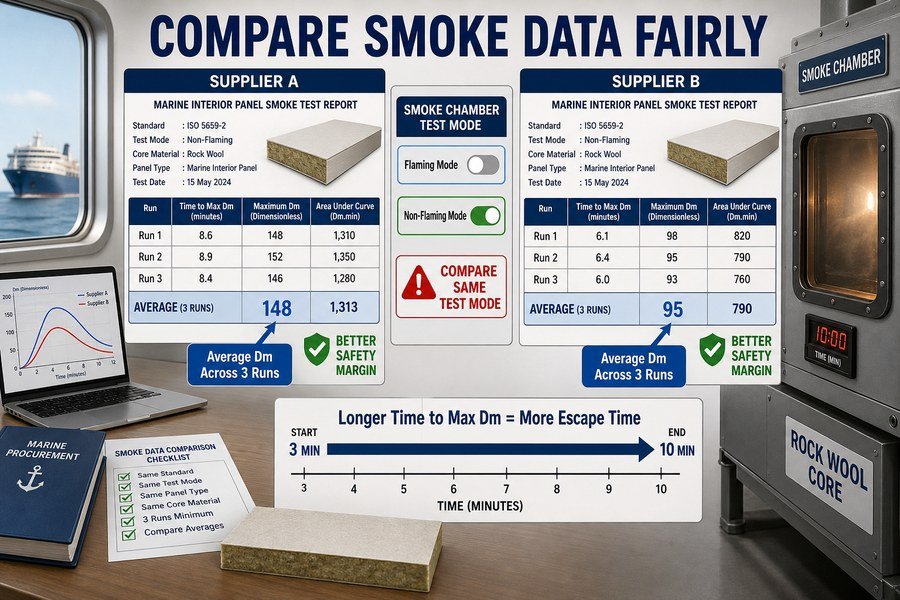
Fair comparisons across marine interior panels require looking at three specific smoke data points: the average Dm value across multiple test runs, the time it takes to reach maximum smoke density, and the specific test mode used (such as flaming or non-flaming conditions under ISO 5659-2).
Comparing Average Dm Values Between Marine Panel Suppliers
When you act as a procurement officer, you receive quotes from multiple suppliers in China or Vietnam. You must compare their test reports fairly. The first data point to check is the average Dm value. As I mentioned before, the lab tests the panel three times. The report shows three individual numbers and one average number.
Do not look at just one good test run. Supplier A might have an average Dm of 180. Supplier B might have an average Dm of 120. Both panels pass the IMO limit of 200. Both panels are legal. But Supplier B offers a much safer product. If the prices are similar, you should always choose the panel with the lower average Dm value. This gives you a better safety margin. If the factory makes a small mistake during mass production, the Dm value might go up slightly. If you start with a Dm of 180, a small mistake pushes it over 200. If you start with 120, you are safe.
The Importance of Test Modes and Time Factors in Smoke Data
The second data point is the time it takes to reach the maximum smoke density. The lab report will show a time value, usually in minutes. If Panel A reaches a Dm of 150 in 3 minutes, and Panel B reaches a Dm of 150 in 10 minutes, Panel B is much better. Panel B gives passengers 7 extra minutes of clear visibility to escape.11
The third data point is the test mode. The ISO 5659-2 standard requires labs to test panels in different ways. They test with a pilot flame (flaming mode) and without a pilot flame (non-flaming mode). Some materials produce more smoke in flaming mode. Other materials produce more smoke in non-flaming mode. The report will show the highest Dm value from all these modes. When you compare two suppliers, make sure you compare the results from the exact same test mode. You cannot compare Supplier A's flaming mode result with Supplier B's non-flaming mode result.
| Comparison Data Point | What It Measures | Why It Matters for Buyers | Best Outcome |
|---|---|---|---|
| Average Dm Value | Average smoke thickness over 3 tests | Shows consistent quality and safety margin. | The lowest number possible (e.g., < 120). |
| Time to Maximum Dm | Speed of smoke generation | Shows how quickly the room fills with smoke. | A longer time (more minutes to escape). |
| Test Mode (Flaming) | Smoke created with an active flame | Different materials react differently to open fire. | Must pass IMO limits in this mode. |
| Test Mode (Non-Flaming) | Smoke created from radiant heat only | Smoldering fires often create the most toxic smoke. | Must pass IMO limits in this mode. |
Conclusion
Interpreting marine interior panel smoke and toxicity reports ensures passenger safety and IMO compliance. By verifying the Dm value and the seven toxic gas limits, you can confidently purchase high-quality panels.
-
"Improving Smoke Alarm Performance - NIST Technical Series Publications"
https://nvlpubs.nist.gov/nistpubs/TechnicalNotes/NIST.TN.1837.pdf. Fire-safety research describes smoke optical density as a determinant of visibility loss, which can impair occupants’ ability to identify exits and navigate during evacuation. Evidence role: mechanism; source type: research. Supports: Thick smoke can reduce visibility enough to make escape routes difficult to see during a ship fire.. Scope note: This supports the general visibility mechanism in fires, not a direct performance result for any specific marine panel. ↩ -
"How Do Smoke Tests Influence Marine Interior Panel Selection?"
https://magellanmarinetech.com/how-smoke-tests-influence-marine-interior-panel-selection/. IMO FTP Code Part 2 specifies smoke-generation performance criteria for shipboard materials and includes a maximum specific optical density criterion of 200 for relevant interior surface material categories. Evidence role: expert_consensus; source type: institution. Supports: IMO FTP Code Part 2 sets a Dm limit of 200 for applicable marine interior surface materials.. Scope note: The exact acceptance criterion should be checked against the material category, application, and FTP Code edition because requirements can differ by product type. ↩ -
"Toxicity of the Pyrolysis and Combustion Products of Poly(Vinyl ..."
https://www.nist.gov/publications/toxicity-pyrolysis-and-combustion-products-polyvinyl-chlorides-literature-assessment. Studies of polyvinyl chloride thermal decomposition report hydrogen chloride as a principal gaseous product released when PVC is heated or burned. Evidence role: mechanism; source type: paper. Supports: PVC-containing surface films can release hydrochloric acid gas when burned.. Scope note: This supports the chemical tendency of PVC to release HCl; it does not prove that any specific marine panel film will exceed IMO FTP Code limits. ↩ -
"Redirecting Intermediary Metabolism to Counteract Cyanide Poisoning"
https://pmc.ncbi.nlm.nih.gov/articles/PMC12153418/. Public-health toxicology references describe hydrogen cyanide as inhibiting cellular respiration by interfering with cytochrome c oxidase, thereby preventing cells from using oxygen effectively. Evidence role: mechanism; source type: government. Supports: Hydrogen cyanide toxicity can kill by blocking cellular oxygen utilization.. ↩ -
"How Do Smoke Tests Influence Marine Interior Panel Selection?"
https://magellanmarinetech.com/how-smoke-tests-influence-marine-interior-panel-selection/. The IMO 2010 FTP Code, Part 2, lists a maximum smoke density criterion of Dm ≤ 200 for qualifying surface materials used in relevant shipboard interior applications. Evidence role: statistic; source type: institution. Supports: Marine wall and ceiling surface materials must meet a Dm limit of 200 or less under the IMO FTP Code Part 2.. Scope note: The criterion applies within the FTP Code’s specified test method and material categories; national or class requirements may add further conditions. ↩ -
"What Is the Purpose and Scope of the IMO FTP Code?"
https://magellanmarinetech.com/what-purpose-scope-of-imo-ftp-code/. The IMO 2010 FTP Code treats primary deck coverings separately from floor coverings and specifies smoke-density criteria for this material category, including a Dm limit of 200 under the Part 2 test. Evidence role: definition; source type: institution. Supports: Primary deck coverings are distinct from floor finishes and must meet the stricter Dm 200 limit.. Scope note: The citation clarifies the regulatory category and limit; it does not determine whether a particular leveling compound is classified as a primary deck covering in a specific build specification. ↩ -
"How Do Smoke Tests Influence Marine Interior Panel Selection?"
https://magellanmarinetech.com/how-smoke-tests-influence-marine-interior-panel-selection/. The IMO FTP Code Part 2 sets acceptance criteria for both smoke density and toxic-gas production in the smoke and toxicity test, supporting the statement that compliance depends on satisfying both parts of the test. Evidence role: definition; source type: institution. Supports: A marine ceiling panel only passes IMO FTP Code Part 2 when it satisfies both the smoke density and toxicity requirements.. Scope note: The source establishes the regulatory test framework; it does not evaluate any specific ceiling panel. ↩ -
"How Do Smoke Tests Influence Marine Interior Panel Selection?"
https://magellanmarinetech.com/how-smoke-tests-influence-marine-interior-panel-selection/. The IMO FTP Code Part 2 smoke and toxicity test specifies a maximum specific optical density criterion, commonly reported as Dm ≤ 200, for relevant shipboard surface materials. Evidence role: statistic; source type: institution. Supports: The smoke density Dm value limit for the relevant IMO FTP Code Part 2 assessment is 200.. Scope note: The applicability of the Dm limit depends on the material category and the edition or implementation of the FTP Code being used. ↩ -
"What Is the Purpose and Scope of the IMO FTP Code?"
https://magellanmarinetech.com/what-purpose-scope-of-imo-ftp-code/. The IMO FTP Code Part 2 toxicity criteria list maximum allowable gas concentrations, including a carbon monoxide threshold of 1450 ppm under the specified test conditions. Evidence role: statistic; source type: institution. Supports: The IMO FTP Code Part 2 toxicity limit for carbon monoxide is 1450 ppm.. Scope note: This supports the stated regulatory threshold, but the measured value depends on the prescribed test apparatus, exposure conditions, and reporting method. ↩ -
"Analysis of toxic effluents released from PVC carpet under different fire ..."
https://pmc.ncbi.nlm.nih.gov/articles/PMC7112043/. Studies of polyvinyl chloride combustion and thermal degradation report the evolution of hydrogen chloride gas, supporting the mechanism by which burning PVC-containing films can contribute to HCl emissions. Evidence role: mechanism; source type: paper. Supports: PVC releases hydrochloric acid or hydrogen chloride when it burns or thermally decomposes.. Scope note: The source supports the general combustion chemistry of PVC; actual HCl levels in a ceiling panel depend on formulation, thickness, additives, and test conditions. ↩ -
"An Analysis of the Performance of Smoke Alarms"
https://tsapps.nist.gov/publication/get_pdf.cfm?pub_id=906889. Fire-safety research shows that smoke production and optical obscuration reduce visibility and can impair evacuation, supporting the general relevance of slower smoke development to escape conditions. Evidence role: mechanism; source type: paper. Supports: A longer time to reach maximum smoke density can improve available visibility conditions for evacuation.. Scope note: A chamber-test time to maximum Dm does not directly prove an equal number of additional minutes of clear visibility in a real passenger space; that would require scenario-specific fire and evacuation modeling. ↩