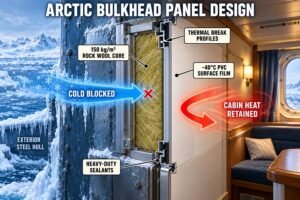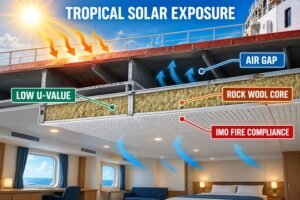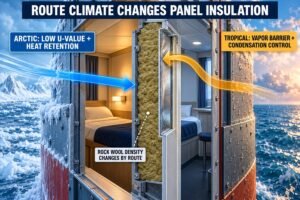
Heavy marine interior panels reduce vessel speed and increase fuel costs. You lose money on every trip. I will show you how to select lightweight panels to solve this problem.
You must specify marine interior panels based on vessel type, fire rating, and core material. Options range from 7.5 kg/m² aluminum honeycomb for fast ferries to 18 kg/m² rockwool panels for commercial ships. Balancing SOLAS fire regulations with vessel payload limits dictates your final panel selection.
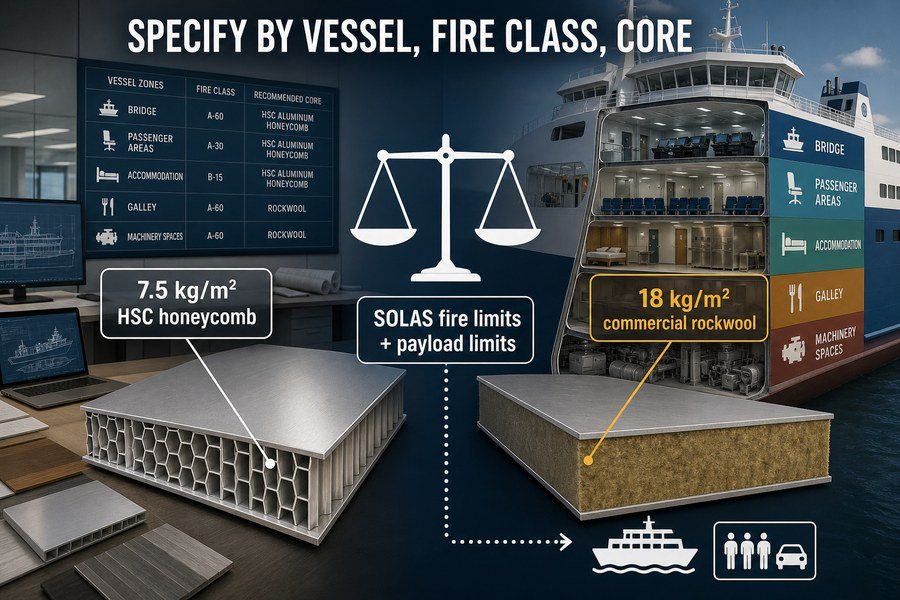
Weight-critical vessels need careful planning. Let us explore the exact details you need to make the right choice.
What Are the Target Weights for HSC Fire-Rated Marine Interior Panels?
High-Speed Craft (HSC) suffer greatly from excess weight. Heavy panels ruin speed compliance. You need specific target weights to meet the HSC Code without failing fire tests.
Target weights for HSC fire-rated marine interior panels depend on their fire class. B-0 panels should weigh under 7.5 kg/m². B-15 panels range from 10 to 12 kg/m². A-30 and A-60 panels generally weigh between 14 and 19 kg/m², utilizing lightweight ceramic or advanced mineral wool cores.
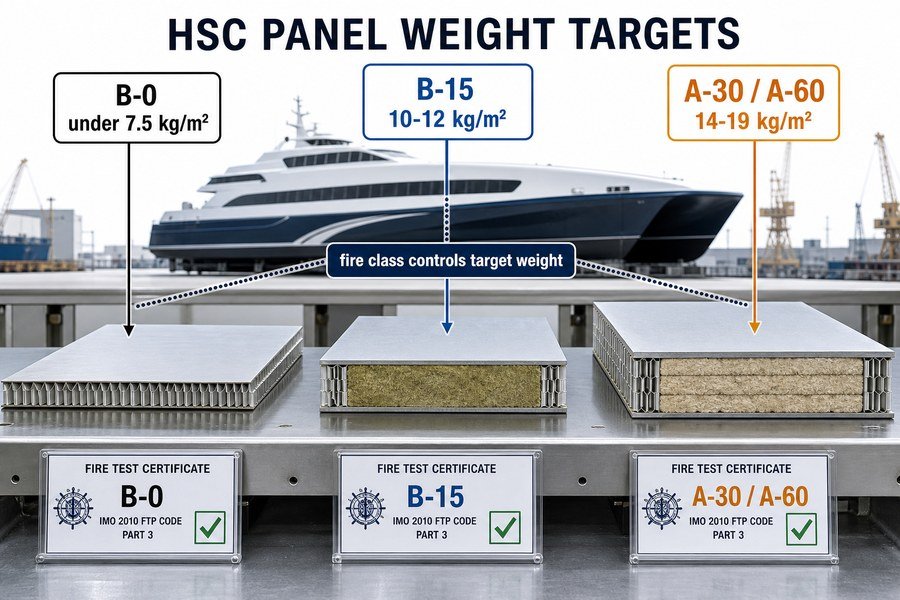
Weight Targets for B-Class HSC Marine Panels
In my years at Magellan Marine, I often see buyers struggle with High-Speed Craft (HSC) weight limits. The International Code of Safety for High-Speed Craft (HSC Code) requires strict weight control. You must use specific panels for these fast ships. For B-0 class bulkheads, you should target a maximum weight of 7.5 kg/m². We usually achieve this weight using aluminum honeycomb cores. For B-15 class panels, the target weight increases. You need more fire insulation to pass the 15-minute fire test. These B-15 panels typically weigh between 10 and 12 kg/m². We use low-density mineral wool or ceramic fiber to keep the weight down while stopping the fire. Buying lighter panels usually costs more. A standard 18 kg/m² B-15 panel might cost $25 per square meter. A lightweight 10 kg/m² B-15 panel can cost $45 per square meter. You must balance your project budget against the strict payload limits of the shipyard.
Weight Targets for A-Class HSC Marine Panels
For A-Class requirements, the weight target goes up significantly. A-30 class panels usually weigh around 14 to 16 kg/m². A-60 panels, which provide 60 minutes of fire resistance, weigh between 16 and 19 kg/m². According to IMO 2010 FTP Code testing standards, these A-Class panels must block intense heat and maintain structural integrity. Manufacturers use advanced ceramic wool or reinforced lightweight rockwool to meet both the IMO fire standards and the HSC weight limits. I always remind my clients to check the classification society certificates. DNV or ABS certificates will list the exact tested panel weight.1 You cannot exceed these numbers during installation.
| Fire Rating Class | Typical Core Material | Target Weight Range (kg/m²) | Estimated Cost per m² (USD) |
|---|---|---|---|
| B-0 Class | Aluminum Honeycomb | 5.5 - 7.5 kg/m² | $35 - $50 |
| B-15 Class | Low-Density Mineral Wool | 10.0 - 12.0 kg/m² | $40 - $60 |
| A-30 Class | Ceramic Fiber / Rockwool | 14.0 - 16.0 kg/m² | $55 - $75 |
| A-60 Class | Advanced Ceramic Wool | 16.0 - 19.0 kg/m² | $65 - $90 |
How Do Marine Interior Panels Impact Vessel Payload Capacity?
Deadweight directly controls how much cargo a ship can carry. Heavy interior walls steal valuable cargo space. Understanding this impact helps you maximize your vessel's profit-making payload.
Marine interior panels impact vessel payload capacity by directly consuming available deadweight. For a typical 50-meter ferry, switching from standard 18 kg/m² panels to lightweight 10 kg/m² panels across 2,000 square meters of outfitting saves 16 metric tons. This directly increases passenger capacity, fuel load, or profitable cargo.
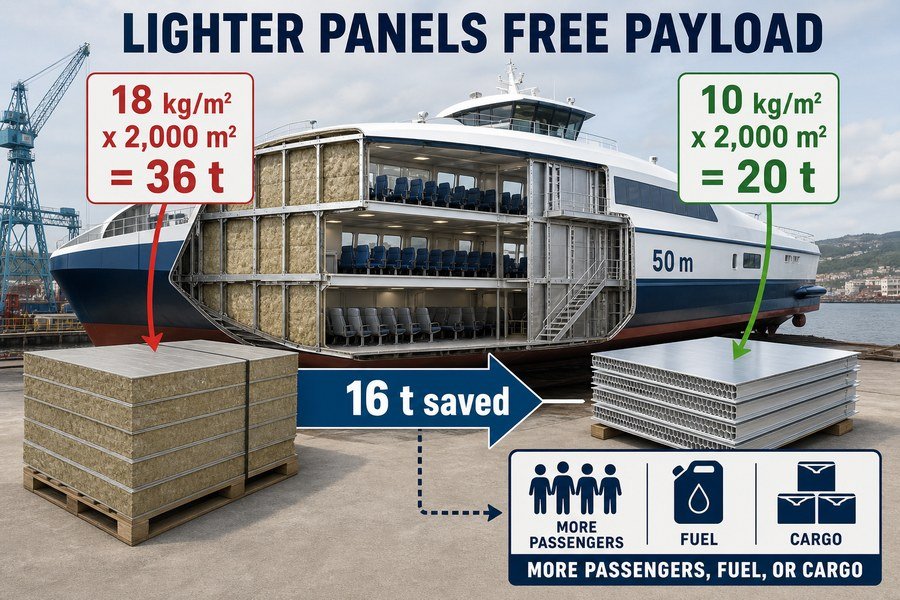
Calculating the Deadweight Consumption of Marine Panels
Every ship has a strict deadweight tonnage (DWT) limit set by its naval architects. Deadweight includes cargo, fuel, passengers, and crew. It does not include the lightweight of the ship.2 However, marine interior panels are part of the ship's lightweight. When you install heavier panels, you increase the lightweight. This directly decreases the available deadweight for your payload. I have helped many shipyards calculate this exact penalty. Let us look at a standard 50-meter passenger ferry. This ferry requires about 2,000 square meters of interior wall and ceiling panels. If you choose standard rockwool panels weighing 18 kg/m², your total panel weight is 36,000 kg, or 36 metric tons. If you switch to lightweight aluminum honeycomb or ceramic core panels weighing 10 kg/m², your total weight drops to 20,000 kg, or 20 metric tons. You just saved 16 metric tons of deadweight.
Converting Saved Panel Weight into Profitable Payload
You can now use this 16 metric tons for profitable payload. According to standard maritime passenger rules, an average passenger with luggage weighs about 100 kg. That means 16 metric tons equals 160 extra passengers. If ticket prices are $20 each, that is $3,200 extra revenue per trip. Alternatively, you can carry 16,000 more liters of marine diesel oil. This increases the sailing range of the vessel significantly. You can take longer routes without refueling. The initial investment in lightweight panels pays off very quickly through increased daily revenue.3
| Outfitting Scenario (2,000 m²) | Panel Weight | Total Outfitting Weight | Payload Gained | Passenger Equivalent |
|---|---|---|---|---|
| Standard Rockwool Panels | 18 kg/m² | 36.0 Metric Tons | 0 Metric Tons (Base) | 0 Passengers |
| Lightweight B-15 Panels | 10 kg/m² | 20.0 Metric Tons | 16.0 Metric Tons | 160 Passengers |
| Ultra-Light B-0 Panels | 7.5 kg/m² | 15.0 Metric Tons | 21.0 Metric Tons | 210 Passengers |
Which Fire-Safe Marine Interior Walls Best Suit Aluminum Vessels?
Aluminum vessels melt at much lower temperatures than steel vessels. Wrong panel choices lead to catastrophic structural failure in a fire. You must select specific fire-safe panels for aluminum hulls.
The best fire-safe marine interior walls for aluminum vessels are lightweight ceramic fiber panels and specialized low-density rockwool panels. You must use panels specifically tested and approved for aluminum bulkheads under IMO Res. MSC.307(88). These panels limit the aluminum core temperature to 200°C during a 60-minute fire test.
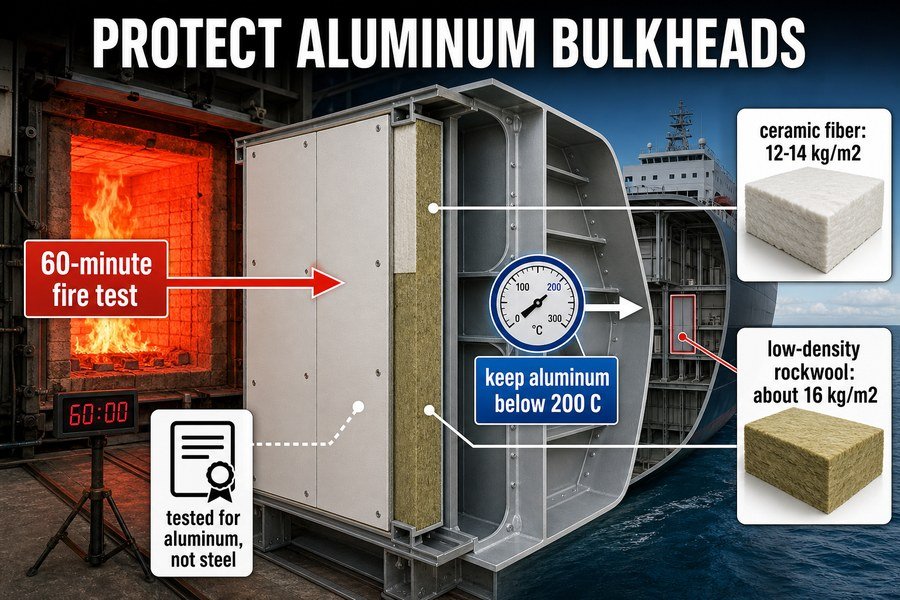
Ceramic Fiber Panels for Aluminum Vessel Bulkheads
Aluminum is a great material for fast ships because it is very light. However, aluminum loses its structural strength at high temperatures. Steel melts at around 1,500°C, but marine-grade aluminum melts at 660°C. More importantly, aluminum loses half of its structural strength at just 200°C. The International Maritime Organization (IMO) understands this extreme danger. IMO Resolution MSC.307(88) dictates strict rules for testing. During a standard fire test, the insulation panel must keep the aluminum bulkhead temperature below 200°C4. You must choose marine interior walls that guarantee this protection. The first excellent choice is ceramic fiber panels. Ceramic fiber has incredible heat resistance and is very light. These panels easily keep the aluminum below 200°C during an A-60 fire test for 60 minutes. They typically weigh around 12 to 14 kg/m² for an A-60 rating on an aluminum deck.
Low-Density Rockwool Panels for Aluminum Ships
The second choice is specialized low-density rockwool panels. Standard rockwool is too heavy for fast aluminum boats. Manufacturers now make advanced rockwool that provides A-60 protection for aluminum bulkheads at about 16 kg/m². Both ceramic fiber and low-density rockwool require special installation methods. You usually need an air gap between the aluminum hull and the panel to provide extra thermal resistance. I always check the Type Approval certificate to ensure the panel was specifically tested on an aluminum deck or bulkhead. A certificate for a steel bulkhead is useless on an aluminum ship.
| Core Material Type | Best For | Typical A-60 Weight (kg/m²) | Max Allowed Aluminum Temp |
|---|---|---|---|
| Ceramic Fiber | Weight-critical fast ferries | 12.0 - 14.0 kg/m² | 200°C |
| Low-Density Rockwool | Standard aluminum yachts | 15.0 - 17.0 kg/m² | 200°C |
| Standard Rockwool | NOT RECOMMENDED | 19.0+ kg/m² (Too Heavy) | 200°C |
How to Balance Weight and Fire Limits for Marine Interior Panels During GA Design?
The General Arrangement (GA) design dictates every fire zone. Poor planning forces you to use heavy A-60 panels everywhere. You can optimize the GA to reduce panel weight significantly.
To balance weight and fire limits during General Arrangement (GA) design, you must minimize high-risk adjacency, use B-Class partitions for low-risk zones, and specify composite panel structures. Strategically separating galleys from passenger areas reduces the need for heavy A-60 bulkheads, allowing lighter B-15 panels for 80% of the interior.
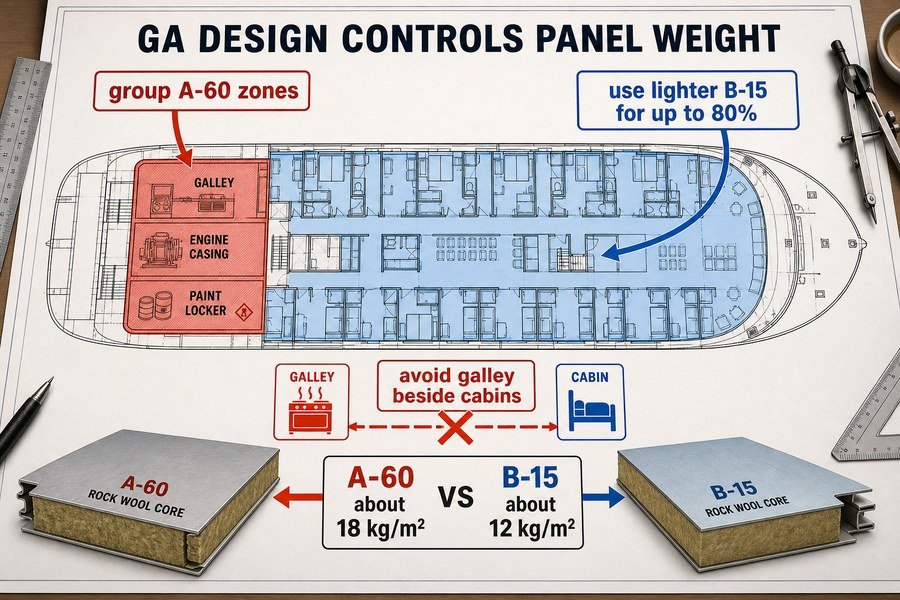
Minimizing High-Risk Adjacency in Ship GA Design
The General Arrangement (GA) plan is the most important drawing for a ship. It shows where every room goes. According to SOLAS Chapter II-2, the fire rating of a bulkhead depends on the rooms it separates. If you put a high-fire-risk room next to a passenger room, you must use a heavy A-60 panel. I always advise shipyards to minimize this high-risk adjacency. You should group high-risk areas together. For example, keep the galley, the engine room casing, and the paint lockers in one section of the ship. This strategic separation means you only need heavy A-60 bulkheads around that specific high-risk block. You avoid spreading heavy panels across the entire vessel.
Utilizing Composite Structures and B-Class Partitions
Once you isolate the high-risk zones, you can optimize the rest of the ship. You can use lighter B-Class partitions for low-risk zones. By separating galleys from passenger sleeping areas, you allow the use of B-15 panels for up to 80% of the ship's interior. A B-15 panel weighs about 12 kg/m², while an A-60 panel weighs around 18 kg/m²5. This saves massive amounts of weight across hundreds of square meters. You can also specify composite panel structures. These composite panels use a thin galvanized steel sheet on one side and a lightweight aluminum sheet on the other. They meet the strict fire test requirements but cut the metal facing weight by 30%. Smart GA design solves weight problems before you even buy the interior materials.
| Adjacency Type (Room vs Room) | Required SOLAS Fire Rating | Typical Panel Weight Required | Design Strategy |
|---|---|---|---|
| Galley vs. Passenger Cabin | A-60 Class | 18 kg/m² | Avoid this layout. High weight penalty. |
| Cabin vs. Cabin | B-15 Class | 12 kg/m² | Standard layout. Moderate weight. |
| Void Space vs. Corridor | B-0 Class | 7.5 kg/m² | Optimize this layout. Best weight savings. |
What Documents Verify Weight and Fire Classes for Lightweight Marine Interior Panels?
Fake or incorrect panel certificates lead to detained ships and failed inspections. You risk losing millions in project delays. You must demand specific, authoritative documents from your panel suppliers.
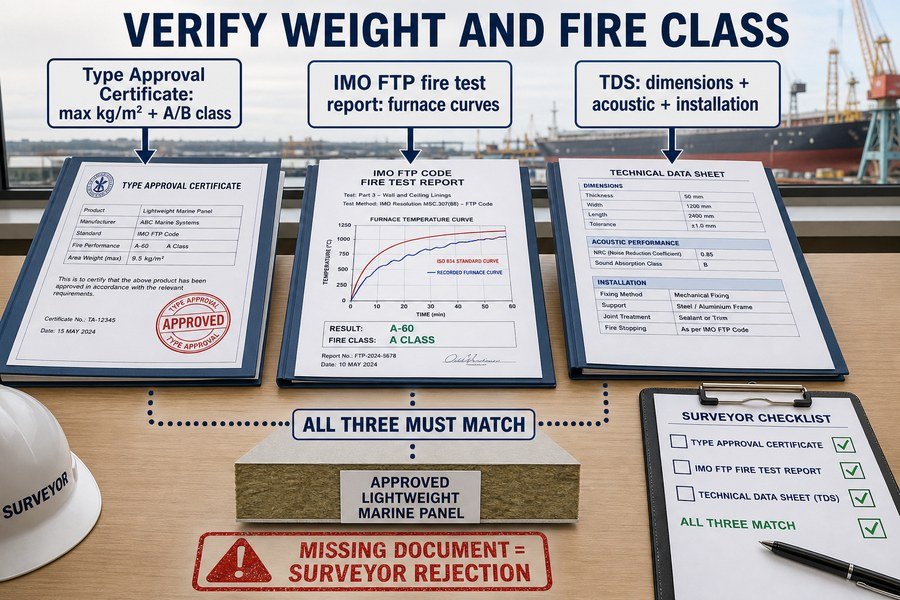
You verify weight and fire classes using three mandatory documents: the Classification Society Type Approval Certificate, the IMO FTP Code Fire Test Report, and the manufacturer's Technical Data Sheet (TDS). These documents confirm the exact kg/m² weight, the fire rating (A-Class or B-Class), and maritime regulatory compliance.
Checking Classification Society Type Approval Certificates
When you buy lightweight marine interior panels, you cannot trust the sales brochure. You must prove the specifications to the marine surveyor. The most critical document is the Classification Society Type Approval Certificate (TAC). Major societies like DNV, ABS, or Lloyd's Register issue this certificate. The TAC clearly states the approved fire rating, such as A-60 or B-156. It also strictly defines the maximum weight of the panel in kg/m² and the maximum thickness. If the panels arrive at the shipyard and weigh more than the TAC allows, the surveyor will reject them immediately. You must ask your supplier for a valid, unexpired TAC before you place any purchase order.
Reviewing IMO FTP Code Fire Test Reports and TDS
The second mandatory document is the IMO FTP Code Fire Test Report. The Type Approval is based directly on this test report. The report details exactly how the panel performed in the fire furnace according to the IMO 2010 FTP Code Part 37. It shows the temperature curves and proves the panel stopped the fire. Finally, you need the manufacturer's Technical Data Sheet (TDS). The TDS provides everyday handling information. It lists the precise dimensions, acoustic ratings like 35 dB sound reduction, and installation guidelines. You must match the weight on the TDS to the weight on the TAC and the delivery packing list. If these three documents do not match perfectly, do not pay the supplier. I always check these papers meticulously for my clients.
| Verification Document | Issuing Authority | Key Information to Check | Consequence of Missing Document |
|---|---|---|---|
| Type Approval Certificate (TAC) | DNV, ABS, LR, etc. | Max kg/m², A/B Fire Class, Expiry Date | Surveyor rejects panels entirely. |
| IMO Fire Test Report | Certified Testing Lab | Furnace temp curves, 2010 FTP compliance | Cannot prove fire safety to authority. |
| Technical Data Sheet (TDS) | Panel Manufacturer | Handling rules, acoustic rating, dimensions | Incorrect installation at shipyard. |
Conclusion
Specifying lightweight marine interior panels requires balancing strict fire regulations with critical payload limits. Always verify weights through official certificates to ensure a safe, profitable, and compliant vessel.
-
"What Does Class Society Type Approval Mean for Marine Wall and ...", https://magellanmarinetech.com/what-class-society-type-approval-mean-for-marine-wall-ceiling-panels/. Classification-society type-approval certificates for marine fire divisions commonly record identifying construction details and approved limitations for the tested product, which can include dimensions and mass-related parameters; this supports the practice of checking certificates for installed-product conformity. Evidence role: case_reference; source type: institution. Supports: Classification society certificates can provide tested product details that should be checked before installation.. Scope note: Certificate contents vary by product and society, so a source may show representative certificate fields rather than a universal requirement that every certificate lists exact panel weight. ↩
-
"(PDF) Estimation Methods for Basic Ship Design", https://www.academia.edu/9376560/Estimation_Methods_for_Basic_Ship_Design. A naval-architecture reference defines deadweight tonnage as the carrying capacity of a vessel, including items such as cargo, fuel, stores, passengers, and crew, and distinguishes it from lightship or lightweight displacement. Evidence role: definition; source type: education. Supports: Deadweight tonnage includes variable loads such as cargo, fuel, passengers, and crew, but excludes the ship’s lightweight.. ↩
-
"Lightweighting Impacts on Fuel Economy, Cost, and ...", https://docs.nlr.gov/docs/fy13osti/57607.pdf. A peer-reviewed economic or life-cycle analysis of lightweighting in ships supports the general proposition that reduced lightweight can improve vessel economics through increased payload capacity or reduced fuel consumption. Evidence role: general_support; source type: paper. Supports: Lightweight panel investments can pay back through additional payload or operational revenue.. Scope note: Such evidence would support the economic mechanism, not the article’s specific payback speed, which depends on panel cost, ticket revenue, utilization, certification limits, and operating profile. ↩
-
"What Is the Purpose and Scope of the IMO FTP Code?", https://magellanmarinetech.com/what-purpose-scope-of-imo-ftp-code/. The IMO 2010 FTP Code adopted by MSC.307(88) specifies fire-test performance criteria for aluminium alloy divisions, including temperature limits intended to preserve the structural core during standard fire exposure; this supports the stated 200°C criterion as a regulatory test requirement, though the exact application depends on the division type and test configuration. Evidence role: definition; source type: institution. Supports: During a standard fire test, insulation for an aluminium bulkhead must keep the aluminium structural temperature below 200°C.. Scope note: The requirement should be verified against the specific FTP Code section for the relevant A-class aluminium bulkhead or deck assembly. ↩
-
"Marine Wall Panel | Reliable Ship Components for Global Buyers", https://magellanmarinetech.com/marine-wall-panel/. A class-society type approval record, technical research paper, or neutral marine engineering reference reporting areal masses for certified B-15 and A-60 marine partition constructions would support these figures as representative examples of the weight difference between fire classes. Evidence role: statistic; source type: institution. Supports: A B-15 panel weighs about 12 kg/m², while an A-60 panel weighs around 18 kg/m².. Scope note: Panel weight varies by manufacturer, core material, facing material, thickness, and certification details, so the figures should be presented as typical examples rather than universal values. ↩
-
"How Does the IMO FTP Code Govern Fire Testing Procedures for Marine ...", https://magellanmarinetech.com/how-does-imo-ftp-code-govern-fire-testing-procedures-for-marine-panels/. The IMO FTP Code and SOLAS fire-safety framework define fire-test procedures and classifications for divisions such as A-class and B-class, including time-rated performance designations used for shipboard fire protection. Evidence role: definition; source type: government. Supports: A TAC can state a panel’s approved marine fire rating, such as A-60 or B-15.. Scope note: The source supports the meaning of the A/B fire-rating framework; the rating of a particular panel still depends on its own certificate and test report. ↩
-
"What Is the Purpose and Scope of the IMO FTP Code?", https://magellanmarinetech.com/what-purpose-scope-of-imo-ftp-code/. The 2010 IMO FTP Code specifies test procedures for fire-resisting divisions, with Part 3 addressing the testing of A, B, and F class divisions used to assess shipboard fire protection performance. Evidence role: mechanism; source type: institution. Supports: The fire test report records how the panel performed under the IMO 2010 FTP Code Part 3 furnace test procedure.. Scope note: This supports the regulatory test basis; it does not by itself prove that any individual panel passed unless linked to that panel’s test report. ↩