
Ship cabins are too noisy, and passengers complain. If you fail the shipyard's noise tests, your project is delayed. I will show you how panel specifications fix this problem.
Thickness adds air gaps for low-frequency control. Mass dictates the baseline Sound Transmission Loss (STL) up to a hard limit. Material choices, like rockwool cores and viscoelastic layers, handle damping and mid-frequency absorption. Together, these three factors determine if your panel meets IMO noise limits.
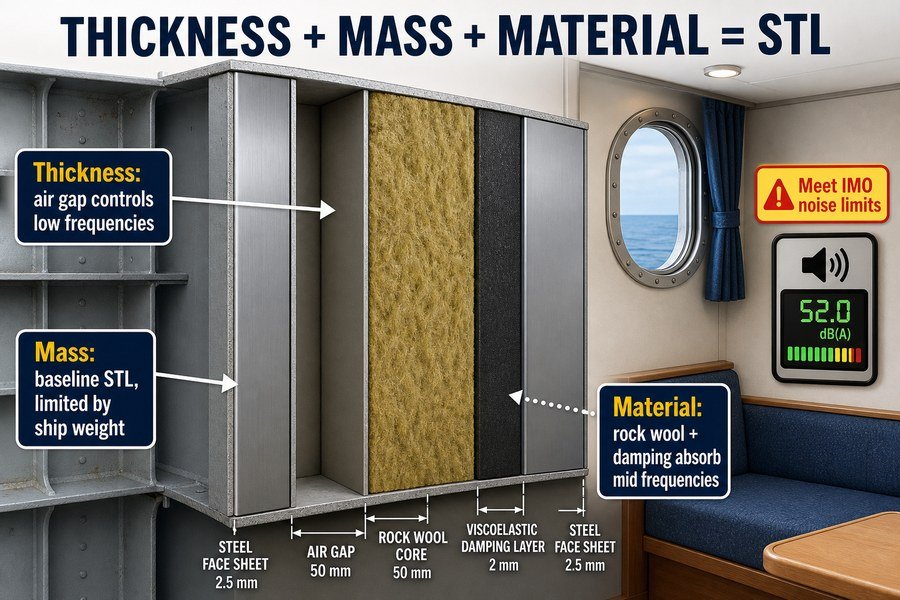
Let us look at the specific rules governing mass, thickness, and materials so you can buy the exact panels you need without spending extra money.
How Does the Mass Law Limit a Marine Interior Panel's Maximum STL?
Adding heavy steel to a ship increases fuel costs. You want to stop noise, but making panels heavier eventually stops working. The mass law explains this limit.
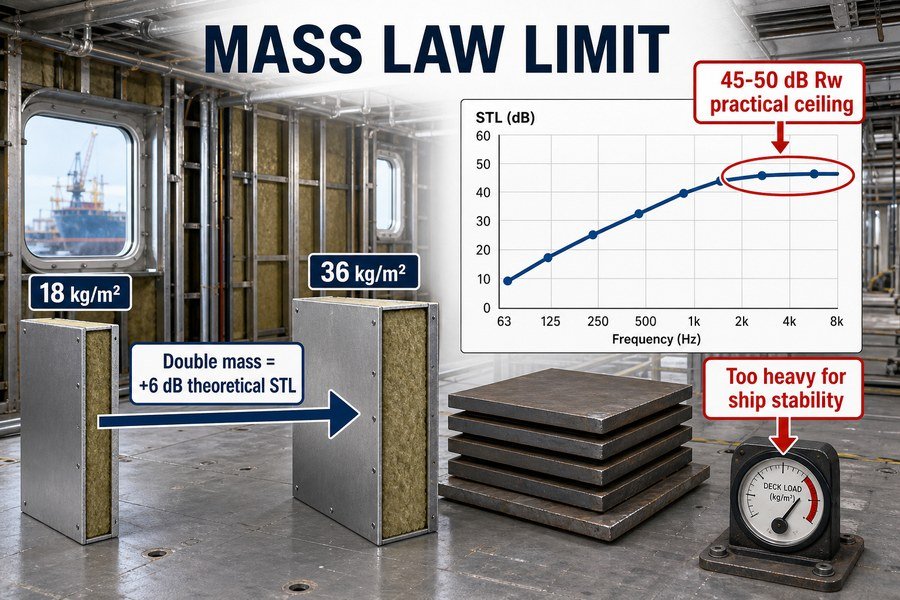
The mass law states that doubling a panel's mass only yields a theoretical 6 dB increase in STL. In reality, marine panels hit a functional limit around 45 dB to 50 dB Rw, because adding enough weight to reach higher ratings would make the ship too heavy to operate.
Understanding the 6 dB Mass Law Rule in Marine Panels
When I started in the marine outfitting factory, a client demanded a 50 dB wall for a small budget. They just asked us to add thicker steel. The resulting panel weighed 40 kg per square meter. The shipyard instantly rejected it. Why? Because they ignored the mass law.
The mass law is a strict acoustic principle. It states that doubling the mass of a partition only gives a 6 dB increase in Sound Transmission Loss (STL)1. According to ISO 140 acoustic testing standards, this is a strict physical rule. Let us look at the real numbers. A standard 50mm marine wall panel weighs about 18 kg per square meter. It achieves an Rw of 35 dB. If you want 41 dB, you must double the mass to 36 kg per square meter. If you want 47 dB, you must double it again to 72 kg per square meter.
Practical Weight Limits for Ship Bulkheads
This creates a huge problem for modern ships. A passenger ferry has thousands of square meters of bulkheads. If you use 72 kg per square meter panels, the ship becomes entirely too heavy. It will burn too much fuel, and it will fail stability tests.2 The IMO SOLAS regulations also have strict structural weight limits for different ship decks.
Therefore, the practical limit for a single, heavy steel-skinned panel is around 45 dB to 50 dB. You cannot just add mass forever to solve noise problems. Furthermore, the mass law works best for low frequencies. If the engine noise is at 100 Hz, adding heavy steel helps. But at 1000 Hz, the mass law has much less impact because other acoustic effects take over. This is why I always tell buyers to look at the whole frequency chart, not just the single Rw number. You must use smart materials, not just heavy materials, to stop noise effectively.
| Panel Weight (kg/m²) | Theoretical STL Gain | Estimated Rw (dB) | Practical Feasibility on Ships |
|---|---|---|---|
| 18 kg/m² | Base Level | 35 dB | Standard (Highly Feasible) |
| 36 kg/m² | + 6 dB | 41 dB | Heavy (Feasible for lower decks) |
| 72 kg/m² | + 12 dB | 47 dB | Extreme (Rarely Feasible) |
| 144 kg/m² | + 18 dB | 53 dB | Impossible (Ship is too heavy) |
Why Doesn't Doubling Marine Interior Panel Thickness Double Its STL?
You might think a 100mm panel stops twice the noise of a 50mm panel. It does not. Buying thicker panels wastes your budget if you ignore acoustics.
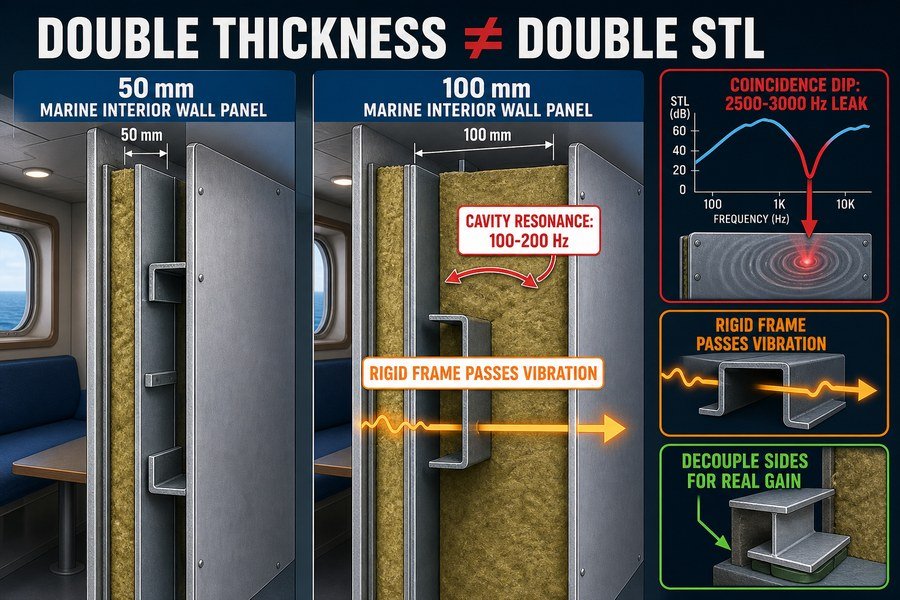
Doubling thickness does not double STL due to coincidence effect dips, cavity resonance, and flanking transmission. While a thicker cavity improves low-frequency performance, structural coupling through the frame still passes sound. You must decouple the sides rather than simply adding more thickness to see real acoustic gains.
The Coincidence Dip Effect in Thick Steel Panels
When clients ask for better noise control, they often ask for much thicker panels. They think a 100mm panel will block twice the noise of a 50mm panel. I always stop them before they waste money. Doubling the thickness does not double the STL3. It usually only adds about 3 to 5 dB of real acoustic isolation.
First, let us look at coincidence effect dips. Every material has a critical frequency where sound waves perfectly match the bending waves of the panel4. For standard 0.6mm galvanized steel skins on marine panels, this dip happens around 2500 Hz to 3000 Hz5. If you just make the panel thicker by extending the steel frame, you do not fix this dip at all. The sound still leaks right through at those specific frequencies, regardless of the panel's total depth.
Cavity Resonance Issues in Double-Wall Marine Panels
Second, thick double-wall panels suffer from cavity resonance. If you have a 100mm thick panel with a large air gap inside, that air acts like a spring6. At low frequencies, typically around 100 Hz to 200 Hz, this air spring resonates. The sound actually amplifies instead of reducing. According to ASTM E90 test methods, a thicker cavity improves very low frequencies, but the resonance point can still cause test failures if the cavity is not properly filled with dense rockwool.
Dealing with Structural Coupling in Panel Frames
Finally, we have flanking transmission and structural coupling. If the front steel skin connects directly to the back steel skin through a rigid steel frame, sound travels straight through the metal. The thickness of the rockwool does not matter because the sound simply bypasses the core. You must physically decouple the sides. A 50mm panel with a disconnected, floating Z-profile frame will block more noise than a massive 100mm panel with a solid U-profile frame.
| Panel Thickness | Structural Frame Type | Potential Acoustic Issues | Expected Rw Rating |
|---|---|---|---|
| 50mm | Solid U-Profile | High structural coupling | 33 - 35 dB |
| 100mm | Solid U-Profile | Coincidence dip, cavity resonance | 36 - 38 dB |
| 50mm | Decoupled Z-Profile | Break in flanking transmission | 42 - 44 dB |
| 100mm | Decoupled Z-Profile | High low-frequency control | 46 - 48 dB |
How Does Core Density Correlate with Marine Interior Panel Rw?
Choosing the wrong rockwool density means your fire doors and walls will fail acoustic tests. Too light or too heavy, and the noise passes right through.
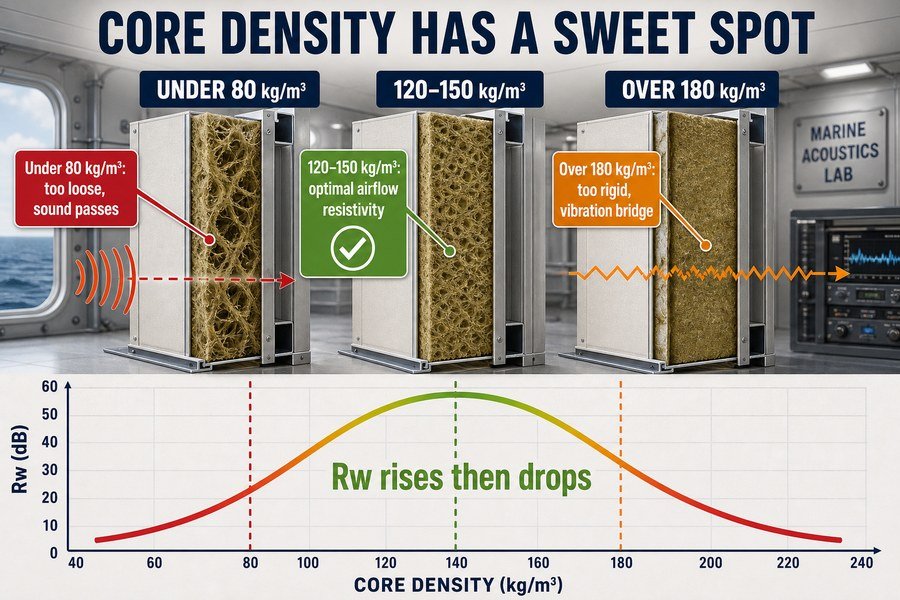
Core density correlates with Rw in a bell curve. Low densities under 80 kg/m³ lack the mass to block sound. Optimal densities between 120 kg/m³ and 150 kg/m³ provide perfect airflow resistivity. Extremely high densities over 180 kg/m³ become too rigid, acting as a solid bridge for vibrations.
Acoustic Failures in Low-Density Rockwool Cores (Under 80 kg/m³)
Rockwool is the most common core material in marine outfitting. But not all rockwool is the same. The core density directly controls the Sound Transmission Class (STC) and Rw ratings7. The relationship is a bell curve, not a straight upward line.
I see many buyers try to save money by buying low-density rockwool. If you use a core density under 80 kg per cubic meter, the panel will fail the acoustic test. These low densities lack the physical mass to block strong sound waves. The airflow resistivity is too low, meaning air and sound pass right through the loose rockwool fibers. For marine fire doors or VIP cabins, using this light density is a massive disaster that requires total replacement.
The Sweet Spot of Airflow Resistivity (120 to 150 kg/m³)
The optimal density sits directly between 120 kg per cubic meter and 150 kg per cubic meter. At this specific density, the mineral wool has the perfect airflow resistivity. Sound waves enter the rockwool, and friction against the tight fibers turns the sound energy into tiny amounts of heat8. Based on my factory experience testing panels to IMO A-60 standards, a 150 kg per cubic meter core provides the absolute best balance of fire protection and noise reduction.
Why Extreme Density Cores (Over 180 kg/m³) Transmit Vibration
However, you cannot just buy the heaviest rockwool available and expect better results. If you use extremely high densities over 180 kg per cubic meter, the acoustic performance actually drops.9 The rockwool becomes entirely too hard and rigid. It stops acting like a soft, absorbing sponge and starts acting like a solid bridge. Vibrations travel straight from the front skin, through the hard rockwool, to the back skin. The price difference is also important. A 100 kg/m³ core costs around $12 per square meter, while a 150 kg/m³ core costs about $18 per square meter. This $6 difference is very small compared to failing an expensive shipyard inspection.
| Rockwool Density | Airflow Resistivity | Acoustic Behavior | Cost per m² (Approx.) |
|---|---|---|---|
| 60 kg/m³ | Too Low | Sound passes through freely | $8 - $10 |
| 100 kg/m³ | Moderate | Basic absorption | $12 - $14 |
| 150 kg/m³ | Optimal | Perfect friction and absorption | $18 - $20 |
| 200 kg/m³ | Too High | Acts as a rigid vibration bridge | $25 - $28 |
Why Can Equally Thick Marine Interior Panels Have Completely Different Rw Ratings?
Two 50mm panels sit on your desk. They look identical. Yet, one blocks 35 dB and the other blocks 44 dB. The secret is completely inside.
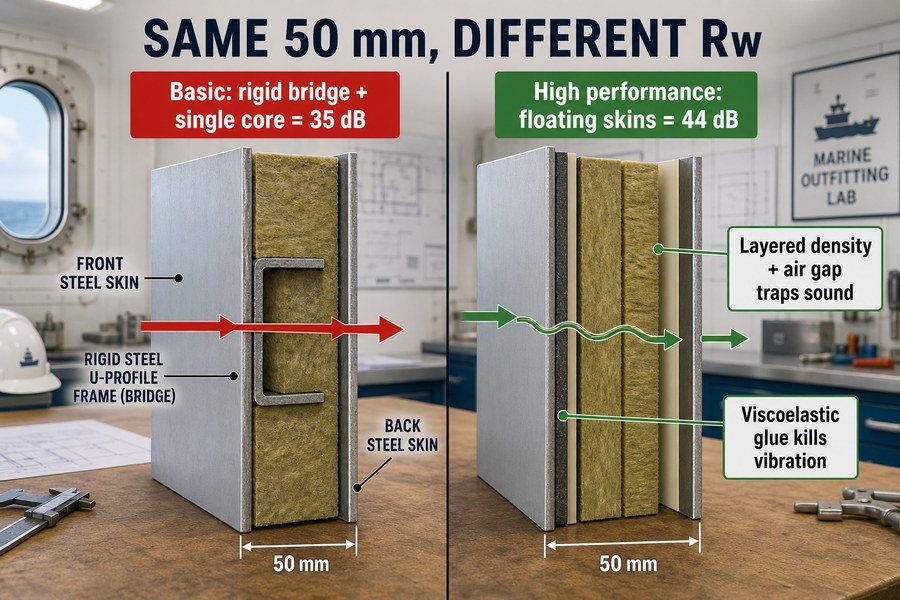
Identically thick panels yield different Rw ratings based on four factors: mechanical decoupling, skin material density, core structure composition, and the presence of internal damping. A 50mm panel with floating skins and viscoelastic glue drastically outperforms a 50mm panel with rigid steel skins glued directly to standard rockwool.
The Role of Mechanical Decoupling in Marine Wall Systems
If you look at two standard 50mm marine wall panels on a table, they look totally identical from the outside. But in a certified acoustic lab, one achieves an Rw of 35 dB, and the other hits 44 dB. The price is also different. The basic panel costs $25 per square meter, while the high-performance panel costs $45 per square meter. Four hidden factors cause this massive difference.
The first major factor is mechanical decoupling10. The 35 dB panel uses a single piece of rigid steel to connect the front and back faces. Sound travels easily across this metal bridge. The 44 dB panel uses a separated frame system. The front and back skins never touch each other directly. This breaks the vibration path completely.
How Skin Materials and Internal Damping Alter Performance
The second factor is skin material density. Most standard panels use 0.6mm galvanized steel. High-acoustic panels might use 0.8mm steel or a heavy, dense PVC laminate on top of the steel. Heavier skins reflect more low-frequency sound right at the surface.11
The third factor is the core structure composition. A basic panel just has a solid, single block of rockwool. An advanced acoustic panel uses multiple layers. It might have a layer of 120 kg/m³ rockwool, a 2mm air gap, and then a layer of 150 kg/m³ rockwool. These changing densities confuse the sound waves and trap them inside the panel.
The final factor is internal damping. Standard panels glue the steel directly to the rockwool using basic polyurethane adhesive. Acoustic panels use a thick viscoelastic glue layer12. This soft glue acts like a shock absorber between the hard steel and the rockwool core, killing vibrations instantly.
| Construction Feature | Basic 50mm Panel | High-Performance 50mm Panel | Resulting Acoustic Impact |
|---|---|---|---|
| Mechanical Frame | Solid U-Profile | Floating Z-Profile | Stops structural flanking |
| Skin Material | 0.6mm Steel | 0.8mm Steel + Heavy Film | Reflects low frequencies |
| Core Structure | Single 100kg/m³ block | Layered densities + Air gap13 | Traps sound waves |
| Internal Adhesive | Standard Polyurethane | Viscoelastic Damping Glue | Absorbs skin vibrations |
How Does Constrained Layer Damping (CLD) Boost Marine Interior Panel STL?
Vibrations travel fast through hard steel. When the ship engine runs, standard panels rattle and drone. Constrained Layer Damping stops this noise at the molecular level.
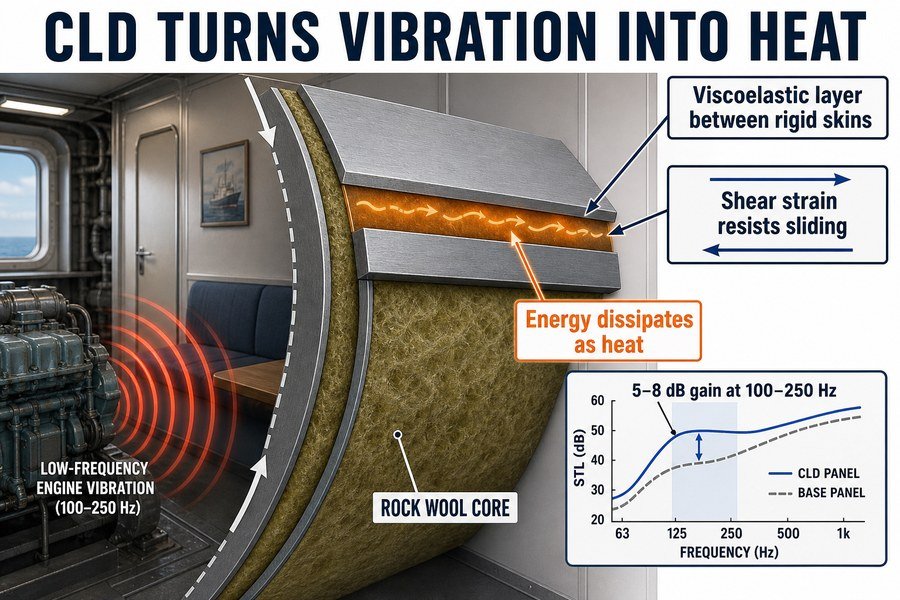
Constrained Layer Damping (CLD) boosts STL by sandwiching a viscoelastic layer between rigid skins. As sound bends the panel, this core undergoes shear strain, converting mechanical vibration energy into a small amount of heat. This dramatically shifts the coincidence frequency and improves low-frequency sound transmission loss.
Converting Vibration Energy to Heat via Shear Strain
When a large ship engine runs, it creates intense low-frequency vibrations. These vibrations travel through the steel decks and go straight into the cabin walls. Standard marine panels will vibrate and hum constantly. This makes the cabin very noisy and ruins passenger sleep. Constrained Layer Damping (CLD) fixes this specific problem.
CLD is a highly effective acoustic treatment method. It involves sandwiching a soft viscoelastic layer directly between two rigid skins.14 In marine outfitting, this usually means a layer of steel, a 1mm or 2mm layer of viscoelastic polymer, and another layer of steel.
When low-frequency sound hits this panel, the panel naturally bends. As it bends, the two rigid steel skins slide slightly against each other. This creates massive shear strain inside the soft viscoelastic core. The polymer heavily resists this sliding motion. As it resists, it converts the mechanical vibration energy into a tiny amount of heat.15 The vibration dies very quickly before it can become airborne sound inside the cabin.
Shifting the Coincidence Frequency with Viscoelastic Polymers
This process dramatically shifts the coincidence frequency of the entire panel.16 Standard steel has a coincidence frequency that lets annoying mid-range noise pass through very easily. The CLD polymer changes the stiffness of the panel without adding too much heavy mass. This pushes the coincidence frequency safely out of the critical human hearing range.
According to ISO 717-1 acoustic tests, a standard steel skin has a damping loss factor of about 0.01. A steel skin with CLD treatment has a loss factor of 0.10 to 0.15.17 This means the CLD panel stops low-frequency engine drone much better, usually adding 5 to 8 dB of real performance in the difficult 100 Hz to 250 Hz range.
| Acoustic Property | Standard Steel Panel | CLD Treated Panel | Benefit to Ship Cabin |
|---|---|---|---|
| Damping Loss Factor | ~0.01 | 0.10 - 0.15 | Stops panel rattling |
| Low-Frequency (100Hz) | Poor | Excellent | Blocks engine drone |
| Energy Conversion | Sound to Sound | Vibration to Heat | Kills noise at the source |
| Coincidence Frequency | In hearing range | Shifted outward | Reduces mid-range leaks |
How Does Decorative PVC Surface Film Impact Marine Wall Panel High-Frequency Reflection?
You picked a nice wood-grain PVC film for your cabin walls. But now the cabin sounds like an echo chamber. The surface finish changes everything.
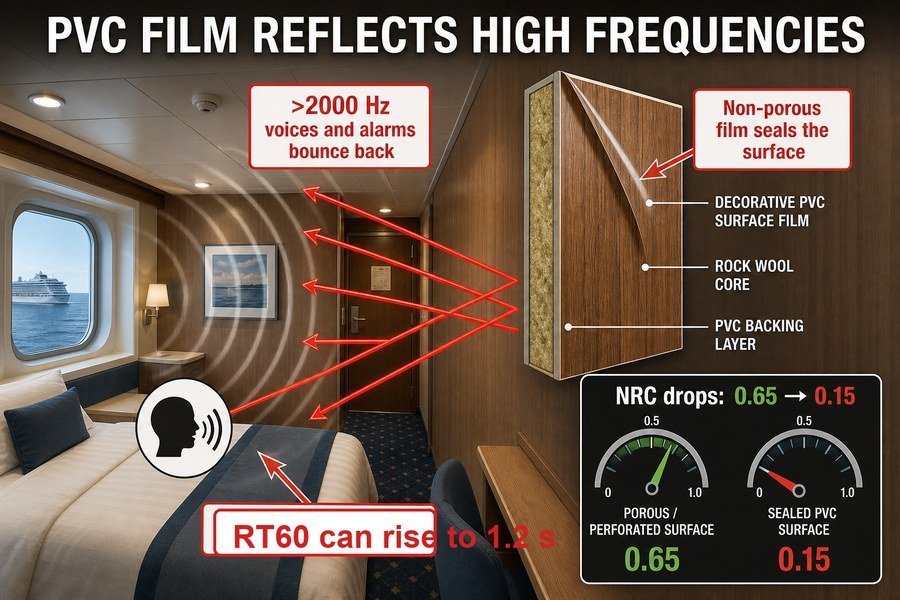
Decorative PVC surface films impact high-frequency reflection by creating a hard, non-porous barrier. This seals the panel surface, preventing sound waves above 2000 Hz from entering the absorptive core. Consequently, PVC films increase the room's reverberation time, making high-pitched sounds like voices and alarms echo more intensely.
Sealing Panel Porosity with Non-Porous PVC Barriers
When buyers order marine wall panels, they always care deeply about the surface finish. A decorative PVC surface film makes the cabin look exactly like real wood or marble. But this plastic film changes how the room sounds entirely. It directly impacts high-frequency reflection.
A bare rockwool panel absorbs sound very well.18 Even a perforated steel panel allows sound to pass freely through the holes and enter the soft core. However, when you glue a solid decorative PVC surface film completely over the steel, you create a hard, non-porous barrier.19 This completely seals the panel's natural porosity.
Because the surface is completely sealed, sound waves can no longer enter the absorptive rockwool core. For low frequencies under 500 Hz, this is not a big problem because long, powerful waves can bend the whole panel. But for frequencies above 2000 Hz, like human voices, alarms, and clinking glasses, the sound hits the hard PVC and bounces right back into the cabin.20
Managing Reverberation Times for Frequencies Above 2000 Hz
This reflection greatly increases the room's reverberation time (RT60). The reverberation time is how long it takes for a sound to fade away entirely. A cabin with porous surfaces might have a short, comfortable reverberation time of 0.4 seconds. The Noise Reduction Coefficient (NRC) is high.
If you cover all walls in hard PVC film, the NRC drops from 0.65 to 0.15 at 2000 Hz. The reverberation time can jump to 1.2 seconds.21 The room will sound like an empty bathroom. Voices will echo, and passengers will feel very uncomfortable. To fix this, you must add soft carpets or acoustic ceiling tiles to balance the hard PVC walls.
| Surface Material | Surface Type | NRC at 2000 Hz (Approx.) | Expected Reverberation Impact |
|---|---|---|---|
| Bare Rockwool | Highly Porous | 0.95 | Very low echo (Dead room) |
| Perforated Steel | Semi-Porous | 0.65 | Low echo (Comfortable) |
| Painted Steel | Hard Barrier | 0.20 | High echo (Loud room) |
| Solid PVC Film | Hard Barrier | 0.15 | Severe echo (Requires carpets) |
Conclusion
Thickness, mass, and materials control panel acoustics. Balance weight limits, rockwool density, internal damping, and surface films to meet IMO noise standards without busting your procurement budget.
-
"[PDF] Ultrasonic, Normal-Incidence Insertion Loss through Common ...", https://physics.byu.edu/docs/thesis/269. A building-acoustics or engineering acoustics source should support that the ideal mass law predicts an approximately 6 dB increase in transmission loss for each doubling of surface mass, assuming a limp, homogeneous barrier away from resonance and coincidence regions. Evidence role: mechanism; source type: education. Supports: Doubling the mass of a partition only gives about a 6 dB increase in Sound Transmission Loss.. Scope note: This is an idealized rule of thumb; real panels can deviate because of stiffness, damping, boundary conditions, leakage, and coincidence effects. ↩
-
"Lightweighting in the automotive industry as a measure for energy ...", https://pmc.ncbi.nlm.nih.gov/articles/PMC11046240/. A naval-architecture or maritime-transport source should support that added structural weight increases displacement and can affect fuel consumption and stability margins in ships. Evidence role: general_support; source type: education. Supports: Excessive bulkhead weight can increase fuel consumption and reduce or compromise ship stability margins.. Scope note: Such a source would support the general relationship between added weight, fuel use, and stability, but not prove that the example panel weights would necessarily cause a specific ferry to fail stability tests. ↩
-
"[PDF] Ultrasonic, Normal-Incidence Insertion Loss through Common ...", https://physics.byu.edu/docs/thesis/269. Classical acoustic mass-law models describe sound transmission loss as increasing logarithmically with surface density, so doubling panel mass or thickness produces an incremental decibel increase rather than a proportional doubling of STL. Evidence role: mechanism; source type: education. Supports: Doubling panel thickness does not double sound transmission loss.. Scope note: Mass-law support is contextual because real steel sandwich panels can deviate from ideal limp-panel behavior due to stiffness, coincidence, frame coupling, and cavity effects. ↩
-
"[PDF] Extraction of plate bending stiffness from coincidence angles of ...", https://physics.byu.edu/docs/publication/2624. Acoustics references define coincidence or critical frequency as the frequency at which the airborne sound wavelength projected along a panel matches the panel’s bending wavelength, increasing sound radiation and reducing transmission loss. Evidence role: definition; source type: education. Supports: A material panel has a critical frequency where airborne sound couples efficiently with bending waves in the panel.. Scope note: This supports the physical definition of the coincidence effect, not the exact critical frequency of the specific marine panel described. ↩
-
"[PDF] Extraction of plate bending stiffness from coincidence angles of sound ...", https://physics.byu.edu/docs/publication/2624. Published plate-acoustics formulas relate the critical frequency of thin plates to thickness, density, Young’s modulus, and Poisson’s ratio; applying typical steel properties to a 0.6 mm steel sheet gives a kilohertz-range coincidence frequency broadly consistent with a 2.5–3 kHz estimate. Evidence role: mechanism; source type: paper. Supports: Standard 0.6 mm galvanized steel skins on marine panels have a coincidence dip around 2500 Hz to 3000 Hz.. Scope note: The support is calculation-based and contextual unless the cited source gives measured data for the same galvanized steel skin and marine-panel construction. ↩
-
"[PDF] Investigation of transmission loss through double wall structures with ...", https://ir.library.louisville.edu/cgi/viewcontent.cgi?referer=&httpsredir=1&article=2758&context=etd. Mass-air-mass resonance theory for double-leaf partitions treats the enclosed air cavity as an elastic spring between the two panels, producing a low-frequency resonance that can reduce transmission loss near the resonance frequency. Evidence role: mechanism; source type: education. Supports: In a thick double-wall panel, the air gap behaves like a spring and can create low-frequency cavity resonance.. Scope note: This supports the general mechanism; the stated 100–200 Hz range depends on panel mass, cavity depth, absorption, and construction details. ↩
-
"[PDF] studies and research regarding sound reduction materials", https://digitalcommons.calpoly.edu/context/theses/article/2263/viewcontent/STUDIES_AND_RESEARCH_REGARDING_SOUND_REDUCTION_MATERIALS_WITH_THE_PURPOSE_OF_REDUCING_SOUND_POLLUTION.pdf. Acoustics studies of mineral-wool-filled panels show that core density, airflow resistivity, and panel construction influence sound transmission loss metrics such as STC and Rw. Evidence role: general_support; source type: paper. Supports: Core density is an important factor affecting STC and Rw ratings in rockwool-cored panels.. Scope note: The support is contextual because STC and Rw depend on the full panel assembly, not core density alone. ↩
-
"Down-film as a new non-frame porous material for sound ...", https://pmc.ncbi.nlm.nih.gov/articles/PMC11109236/. Standard porous-absorber theory explains that viscous and thermal losses in fibrous materials dissipate incident acoustic energy as heat as air oscillates through the pore structure. Evidence role: mechanism; source type: education. Supports: Fibrous rockwool absorbs sound partly by converting acoustic energy into heat through viscous and thermal losses in the pore network.. Scope note: This supports the physical mechanism of absorption, not the specific optimal density range claimed in the article. ↩
-
"Providing an optimal porous absorbent pattern to reduce mid ...", https://pmc.ncbi.nlm.nih.gov/articles/PMC6277340/. Research on porous absorbers and sandwich panels reports that excessive stiffness or flow resistivity can reduce absorption or increase structural coupling, so maximum density is not necessarily optimal for acoustic performance. Evidence role: mechanism; source type: paper. Supports: Very high-density rockwool cores can reduce acoustic performance by increasing rigidity or structural coupling in some panel assemblies.. Scope note: The cited evidence would support the principle of diminishing or reduced acoustic benefit at high density; the 180 kg/m³ cutoff requires product- and assembly-specific measurements. ↩
-
"[PDF] An Exploration of Architectural Acoustics and Design in Commercial ...", https://digitalcommons.csumb.edu/cgi/viewcontent.cgi?article=2359&context=caps_thes_all. Building-acoustics literature describes decoupled double-leaf constructions as mass–spring–mass systems that reduce direct structural vibration transfer between faces, supporting the article’s explanation that separated frames can improve sound insulation. Evidence role: mechanism; source type: education. Supports: Mechanical decoupling improves acoustic performance by interrupting vibration paths between the two faces of a wall panel.. Scope note: This supports the acoustic mechanism generally; it does not verify the stated Rw values or any specific marine panel design. ↩
-
"[PDF] Ultrasonic, Normal-Incidence Insertion Loss through Common ...", https://physics.byu.edu/docs/thesis/269. The acoustic mass law states that, for idealized single-leaf barriers, transmission loss generally increases with surface density and frequency, providing context for why thicker or denser skins can improve airborne sound insulation. Evidence role: mechanism; source type: education. Supports: Increasing the surface mass of panel skins can improve sound insulation, including at lower frequencies.. Scope note: Mass law is an idealized model and does not by itself prove the performance of composite marine panels or establish reflection as the only mechanism. ↩
-
"Noise and vibration level reduction by covering metal structures with ...", https://ntrs.nasa.gov/citations/19740020289. Research on constrained-layer damping shows that viscoelastic interlayers dissipate vibrational energy through shear deformation, supporting the claim that a soft adhesive layer can reduce vibration in panel skins. Evidence role: mechanism; source type: paper. Supports: A viscoelastic adhesive layer can damp panel vibrations and thereby contribute to acoustic performance.. Scope note: The evidence supports vibration reduction, not instantaneous elimination of vibration or a particular adhesive’s acoustic rating. ↩
-
"[PDF] Acoustic Absorption in Porous Materials", https://ntrs.nasa.gov/api/citations/20110011143/downloads/20110011143.pdf. Studies of porous absorbers report that material density or flow resistivity and backing air cavities affect absorption spectra, and that multilayer arrangements can broaden absorption under some conditions, contextualizing the use of varied-density rockwool and an air gap. Evidence role: mechanism; source type: paper. Supports: Layered mineral wool densities and an air gap can influence acoustic absorption within a panel.. Scope note: This is contextual support for absorption behavior, not direct evidence that the specified 120 kg/m³ and 150 kg/m³ rockwool layers with a 2 mm gap raise the panel’s Rw. ↩
-
""Finite Element Analysis of Structures with Constrained Viscoelastic ...", https://digitalcommons.odu.edu/mae_etds/450/. A technical reference on constrained-layer damping describes the method as a viscoelastic layer bonded between a base structure and a constraining layer, providing definitional support for the sandwich construction described here. Evidence role: definition; source type: research. Supports: CLD consists of a viscoelastic layer placed between rigid layers or skins.. ↩
-
"(PDF) The Analysis and Design of Constrained Layer Damping ...", https://www.academia.edu/30284667/The_Analysis_and_Design_of_Constrained_Layer_Damping_Treatments. A peer-reviewed or university acoustics source on viscoelastic damping explains that cyclic shear deformation in a viscoelastic layer dissipates mechanical vibration energy as heat, supporting the physical mechanism described here. Evidence role: mechanism; source type: paper. Supports: A viscoelastic CLD core dissipates vibration energy as heat when it is sheared.. Scope note: This supports the general damping mechanism; the amount of heat produced in a specific marine panel depends on material properties, temperature, frequency, and panel geometry. ↩
-
"[PDF] Extraction of plate bending stiffness from coincidence angles of sound ...", https://physics.byu.edu/docs/publication/2624. An acoustics reference on panel sound transmission and coincidence frequency can support the relationship between panel stiffness, mass, damping, and coincidence effects in sound insulation. Evidence role: mechanism; source type: education. Supports: Changing the mechanical properties of a panel with viscoelastic layers can affect its coincidence-frequency behavior.. Scope note: Such sources may show that material and structural changes alter coincidence behavior, but may not directly prove that the specific CLD configuration described here 'dramatically' shifts the frequency without product-specific test data. ↩
-
"[PDF] Vibro-acoustical analysis and design of a multiple-layer constrained ...", https://digitalcommons.mtu.edu/cgi/viewcontent.cgi?article=1382&context=etds. Laboratory measurements or a peer-reviewed study of constrained-layer damping on steel panels can document typical damping loss factors for treated steel and provide context for the stated 0.10–0.15 range. Evidence role: statistic; source type: paper. Supports: CLD-treated steel panels can have damping loss factors in the approximate range of 0.10 to 0.15.. Scope note: Loss factor values vary with polymer formulation, layer thickness, temperature, frequency, and boundary conditions, so a cited range should be presented as test-context dependent rather than universal. ↩
-
"Acoustic absorption and thermal insulation of wood panels", https://bioresources.cnr.ncsu.edu/resources/acoustic-absorption-and-thermal-insulation-of-wood-panels-influence-of-porosity/. Standard acoustics references describe mineral wool/rockwool as a porous absorber whose open fibrous structure dissipates incident sound energy, supporting its use for broadband sound absorption in building panels. Evidence role: mechanism; source type: education. Supports: Bare rockwool panels are effective sound absorbers because their porous fibrous structure dissipates sound energy.. Scope note: Absorption performance depends on density, thickness, air gap, facing material, and mounting conditions, so the source supports the general mechanism rather than a specific panel rating. ↩
-
"[PDF] Acoustic Absorption in Porous Materials", https://ntrs.nasa.gov/api/citations/20110011143/downloads/20110011143.pdf. Acoustics literature on porous absorbers notes that impermeable or non-porous facings reduce the ability of airborne sound to enter the porous layer, supporting the claim that a continuous PVC film can act as an acoustic barrier over an absorptive core. Evidence role: mechanism; source type: paper. Supports: A continuous solid PVC film over a panel can block air movement into the porous core and reduce sound absorption.. Scope note: The source would establish the general effect of impermeable facings; the exact impact of a particular PVC film depends on thickness, stiffness, bonding, perforation pattern, and installation details. ↩
-
"[PDF] Acoustics of Small Rooms, Home Listening Rooms, Recording Studios", https://courses.physics.illinois.edu/phys406/sp2017/Lecture_Notes/P406POM_Lecture_Notes/P406POM_Lect10_Part2.pdf. Room-acoustics references explain that hard, smooth, non-porous surfaces generally have low absorption and high reflection at mid and high frequencies, providing contextual support for the claim that a solid PVC surface can reflect higher-frequency cabin sounds. Evidence role: general_support; source type: education. Supports: Hard, non-porous surfaces tend to reflect mid- and high-frequency sound rather than absorb it.. Scope note: The cited source may not test marine PVC wall films specifically, and reflection will vary with surface geometry, backing construction, and incidence angle. ↩
-
"[PDF] acoustic absorption of structural membranes - UPC Commons", https://upcommons.upc.edu/bitstreams/502601a9-62d2-4307-984c-b201c751d240/download. Laboratory sound-absorption data and Sabine reverberation theory can support the relationship between lower absorption coefficients and longer reverberation time, while providing a basis for comparing porous or perforated surfaces with hard-faced barriers. Evidence role: statistic; source type: paper. Supports: Reducing surface absorption from porous/perforated panels to hard PVC-faced panels can substantially increase reverberation time.. Scope note: The exact NRC and RT60 figures in the article require panel-specific laboratory measurements and room dimensions; general sources can support the trend but not verify these precise values unless matching test reports are found. ↩