Are you buying expensive marine wall panels, but shipyards still complain about cabin noise? You might be treating the wrong problem. Identifying the noise path first saves your profit margin.
Identifying marine noise paths first ensures you buy the correct materials. Cabin noise comes from two paths: airborne waves and structure-borne vibrations. Skipping this diagnosis causes procurement officers to buy heavy acoustic panels that fail to block structural vibrations, leading to failed inspections and wasted budgets.
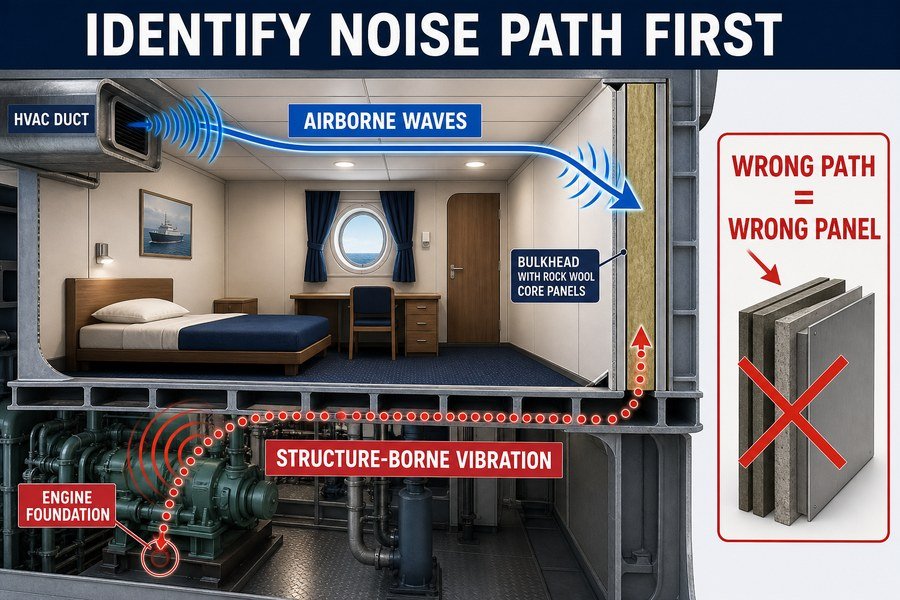
When you do not know how noise enters a cabin, you are just guessing with your budget. Let us look closely at how misjudging these paths destroys interior outfitting projects.
How Does Misdiagnosing Cabin Noise Lead to Incorrect Marine Interior Panel Procurement?
You hear loud noise in the cabin and immediately order thicker panels. But the noise remains. This quick reaction is the fastest way to ruin a procurement budget.
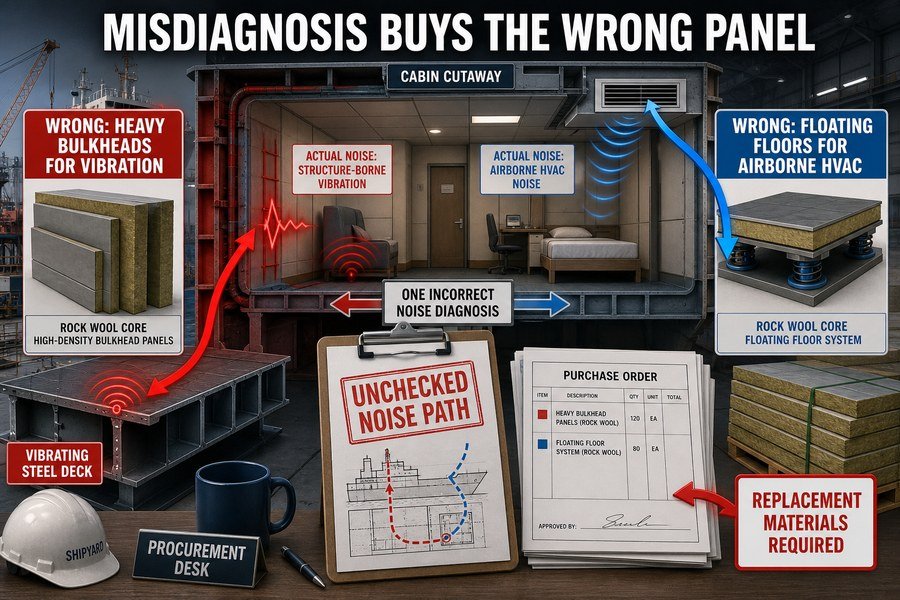
Misdiagnosing cabin noise leads to buying the wrong marine panels in two ways: purchasing dense acoustic bulkheads for structure-borne vibrations, or buying expensive floating floors for simple airborne HVAC noise. Both errors fail to stop the specific noise path, forcing you to buy replacement materials.
To understand why this happens, we must look at how sound actually travels on a ship. When I worked at the factory, I saw many buyers make these exact two mistakes. They bought good products, but they bought them for the wrong reasons. The International Maritime Organization (IMO) has strict rules under IMO MSC.337(91) regarding noise limits on ships. For example, standard cabins must stay below 60 dB(A)1. If you fail to meet this, the shipyard will reject your interior work.
Procuring Dense Acoustic Bulkheads for Structure-Borne Vibrations
The first common error is buying dense, heavy acoustic wall panels to solve structure-borne vibrations. Structure-borne noise comes from the main engine or propellers. The vibration travels directly through the steel hull and deck.2 If the shipyard complains about a humming sound in a lower-deck cabin, many procurement officers simply buy a 50mm thick rockwool marine wall panel instead of a standard 25mm panel. This thick panel costs around $45 to $55 per square meter in China. However, a thick wall panel does not stop floor vibrations. The vibration simply travels under the wall and shakes the furniture and ceiling. You spend double the money on the wall, but the 60 dB(A) noise limit still fails.
Purchasing Expensive Floating Floors for Airborne HVAC Noise
The second common error is the exact opposite. Sometimes, the noise is just airborne wave noise coming from an air conditioning duct (HVAC) or a loud neighboring room. This is airborne noise. Instead of buying a simple sound-absorbing ceiling panel or a better marine fire door with acoustic seals, the buyer panics. They order a full floating floor system. A floating floor isolates the deck3, but it costs between $80 and $120 per square meter. It is totally useless for blocking noise that travels through the air from an air vent. You waste a huge amount of money to fix a problem that a $30 ceiling panel could have solved.
| Noise Diagnosis Error | Actual Noise Source | Incorrect Product Procured | Wasted Cost (Approximate per Sqm) | Correct Product Needed |
|---|---|---|---|---|
| Misjudging Vibration | Main Engine (Structure-borne) | 50mm Dense Acoustic Wall Panel | $45 - $55 | Damping Tiles / Floating Floor |
| Misjudging Air Waves | HVAC Vent (Airborne) | Full Floating Floor System | $80 - $120 | Acoustic Ceiling / Door Seals |
Why Does Treating Structure-Borne Noise With Airborne Marine Bulkheads Waste Project Budgets?
You spend thousands on high-rating airborne bulkheads. The sea trial fails anyway. Why? Because you put a wall in front of a vibration that travels under the floor.
Treating structure-borne noise with airborne bulkheads wastes budgets through three paths: paying a 40% premium for heavy rockwool cores, increasing fuel costs due to dead weight, and requiring total removal to install correct vibration dampeners. Standard airborne panels simply cannot stop vibrations traveling through the steel deck.
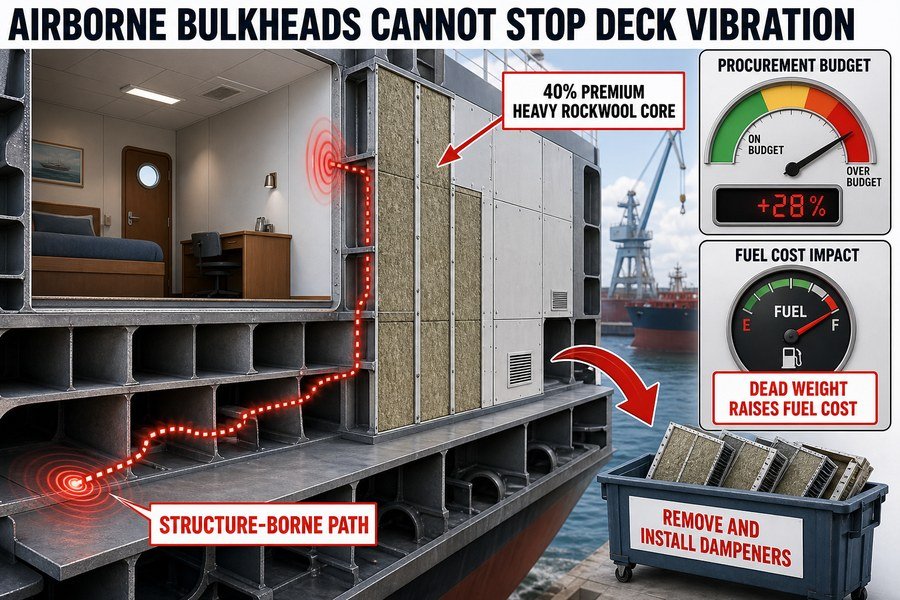
When you undertake an interior decoration project for a large shipyard in Europe or the United States, your profit depends on strict budget control. If you use an airborne panel to stop a structural vibration, you lose money in three specific ways. Shipyards will strictly follow ISO 6954 guidelines for measuring vibration on ships. If the floor is shaking, an airborne panel on the wall does absolutely nothing to help.
Wasting Money on Premium Rockwool Cores
The first path of waste is the direct material cost. Standard B-15 class marine wall panels (usually 25mm thick) cost about $25 to $30 per square meter from Asian suppliers. High-acoustic airborne panels (often 50mm thick with double-density rockwool) cost around $45 to $55 per square meter. This is almost a 40% to 50% price premium. If you buy 2,000 square meters for a passenger ship block, you waste up to $50,000 buying premium cores that will never stop the steel deck from vibrating. The noise simply bypasses the expensive panel.
Hidden Fuel Costs and Mandatory Rework Labor
The second path of waste is dead weight. High-acoustic airborne panels weigh about 18 to 22 kg per square meter. Standard panels weigh around 12 to 14 kg. Adding an extra 8 kg per square meter across a whole ship adds tons of dead weight. Shipyards in Europe hate this because it increases the ship's fuel consumption over its lifetime4.
The third path is the worst: mandatory rework. When the ship fails the sea trial, the shipyard will force you to fix it. You have to pay laborers to tear down the expensive airborne panels. In European shipyards, labor costs can exceed $50 to $70 per hour. After tearing the walls down, you must buy and install the correct materials, like viscoelastic damping tiles directly on the steel deck (costing $30-$40 per sqm). You pay for the wrong material, you pay for the removal labor, and you pay for the new material. This totally destroys your project profit.
| Factor of Wasted Budget | Cost of Standard Panel | Cost of Incorrect Airborne Panel | Total Wasted Impact |
|---|---|---|---|
| Material Cost Premium | $25 - $30 / sqm | $45 - $55 / sqm | Over $20 extra per sqm |
| Weight Penalty (Fuel) | 12 - 14 kg / sqm | 18 - 22 kg / sqm | 6 - 8 extra kg per sqm |
| Rework Labor (EU Yard) | $0 (if done right) | $50 - $70 / hour | Thousands in lost man-hours |
What Early Diagnosis Steps Prevent Rework of Marine Accommodation Panels?
Rework kills your profit margin. If the shipyard tears down your panels, you pay for it. You must find the real noise problem before you place an order.
Preventing panel rework requires three early diagnosis steps: source identification to locate engines or HVACs, path mapping to distinguish between airborne waves and structural transmission, and baseline acoustic measurement using decibel meters. Completing these three steps guarantees your marine panels match the shipyard's specific noise challenges.
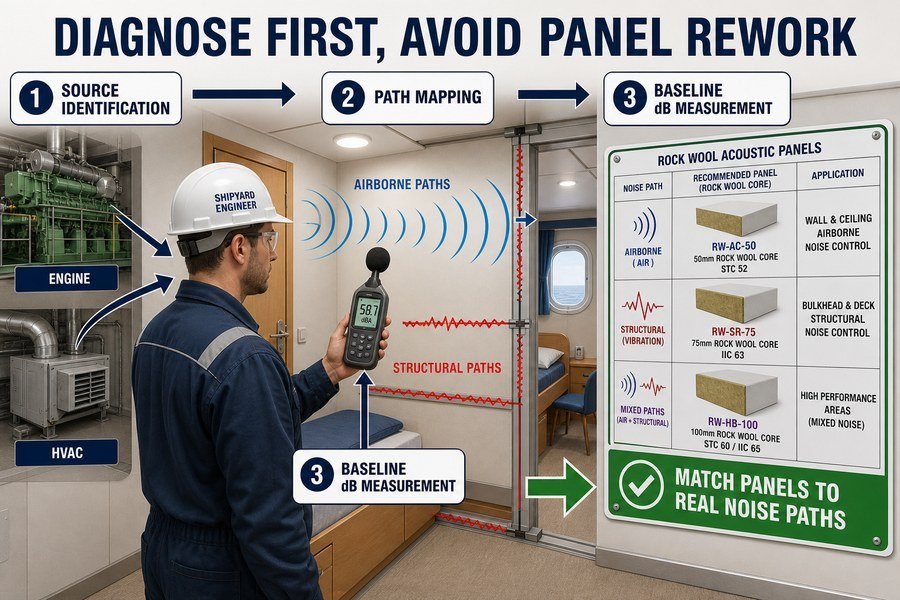
To survive in the ship interior business, you cannot just look at the shipyard's basic drawings and order standard panels. You must ask the shipyard for their acoustic data. If they do not have it, you must insist they do an early diagnosis. I always tell my clients to follow a strict three-step process before they sign any purchase orders with factories in China or Vietnam.
Step 1 and Step 2: Source Identification and Path Mapping
The first step is source identification. You must know exactly what is making the noise. Is it the main diesel engine, a bow thruster, the ventilation fans, or the exhaust pipes? Engine noises usually create very low-frequency vibrations (between 31.5 Hz and 125 Hz).5 Ventilation fans usually create mid-to-high frequency airborne noises (500 Hz to 2000 Hz).6
The second step is path mapping. Once you know the source, you trace how the noise reaches the cabin. Does it travel through the air duct directly into the room? That is an airborne path. Does the engine shake the steel hull, and the hull shakes the cabin floor? That is a structure-borne path. If it is an airborne path, you buy sound-insulating marine ceiling panels and B-Class fire doors with heavy bottom seals. If it is a structure-borne path, you buy floating floors and elastic shock mounts for the walls.
Step 3: Baseline Acoustic Measurement Using Decibel Meters
The third step is baseline measurement. You cannot rely on human ears. You must ask the shipyard for a baseline test using a Type 1 sound level meter, as required by IEC 61672 standards7. The shipyard engineers must measure the raw noise level inside the bare steel cabin before you install any panels. If the bare room measures 85 dB(A) and the IMO requirement is 60 dB(A), you know your panel system must provide at least a 25 dB(A) reduction. You then take this specific number to your supplier in Asia. You ask the supplier for laboratory test reports showing their panels achieve a Sound Reduction Index (Rw) of at least 30 dB to give yourself a safe margin.
| Diagnosis Step | Action Required | Tools or Data Needed | Purpose for Procurement |
|---|---|---|---|
| 1. Source Identification | Locate the machine making the noise | Ship general arrangement plan | Identifies frequency range (Hz) |
| 2. Path Mapping | Trace if it travels via air or steel | Structural drawings | Decides panel type (wall vs floor) |
| 3. Baseline Measurement | Measure bare steel room noise | Type 1 decibel meter | Sets exact dB reduction target |
Why Do Marine Interior Panel Warranty Disputes Often Stem From Incorrect Noise Diagnosis?
The shipyard tells you your panels are defective because the cabin is too loud. You know the panels are good. This argument happens constantly in ship interior projects.
Warranty disputes stem from incorrect noise diagnosis for two reasons: shipyards blame panel failure when the real issue is flanking noise bypassing the bulkhead, and procurement officers buy standard panels that do not match the specific low-frequency vibration reality. Both situations create deadlocks over who pays.
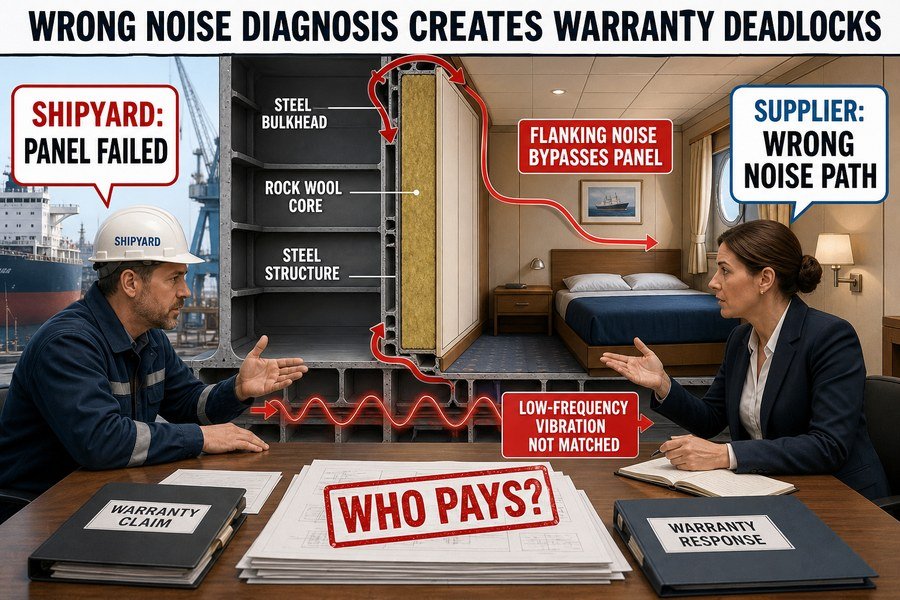
When a ship fails its final acoustic test, no one wants to pay for the fix. The shipyard wants you, the interior contractor, to pay. You want the Chinese panel supplier to pay. This creates a terrible warranty dispute. In my experience, the marine panels themselves are rarely broken. The problem almost always comes back to how the noise was diagnosed at the start.
Blaming Panel Failure When Flanking Noise is the Real Issue
The first major reason for disputes is flanking noise. Flanking noise happens when sound finds a weak path around your good wall panel.8 Imagine you buy a very high-quality marine wall panel with a laboratory rating of Rw 35 dB. You install it perfectly. But the shipyard leaves a gap between the ceiling and the steel deck above it. Sound travels over your wall, through the gap, and into the next room. The shipyard measures the room and gets a bad result. They immediately claim your panels are defective and demand a warranty replacement.
This is a false diagnosis. The panel did not fail; the installation environment failed. Flanking paths can easily reduce a wall's real-world noise reduction by 5 to 10 dB.9 To protect yourself, you must ask for an acoustic diagnosis that checks the whole room, including joints, ceilings, and floors. If you do not point out the flanking path, the shipyard will force you to eat the cost.
Mismatch Between Standard Panel Specs and Low-Frequency Vibrations
The second reason is a frequency mismatch. When you buy a panel, the supplier gives you a certificate showing an Rw value, like Rw 32 dB. However, this number is an average across many frequencies.10 Marine engines produce very strong low-frequency noise, often below 100 Hz. Standard standard wall panels are very bad at blocking low-frequency noise. They might block 40 dB of high-frequency talking, but only 15 dB of low-frequency engine humming.
If the initial diagnosis did not specify that the problem was low-frequency engine noise, you will buy a standard panel. When the sea trial happens, the engine hums, the room fails, and you blame the supplier. But the supplier will refuse the warranty claim. They will say, "Our panel meets the Rw 32 dB standard; you just didn't tell us you needed low-frequency protection." You are left paying for the mistake.
| Source of Warranty Dispute | Shipyard's Claim | The Real Acoustic Cause | Who Loses Money |
|---|---|---|---|
| Flanking Noise Paths | "Your panels do not block the noise." | Sound goes over the ceiling or under the floor. | The interior contractor (You) |
| Low-Frequency Mismatch | "Your panels are defective." | Panels are for high-frequency; engine is low-frequency. | The interior contractor (You) |
How Does Accurate Noise Path Identification Reduce Marine Accommodation Panel Installation Costs?
Good procurement is not just about finding the lowest price per square meter. It is about buying exactly what you need. Accurate diagnosis directly lowers your total bill.
Accurate noise path identification reduces installation costs in three ways: it prevents the purchase of overly thick bulkheads, avoids the unnecessary use of expensive secondary isolation mounts, and eliminates the labor costs of post-installation tear-downs. You only buy and install the exact materials the ship needs.

When you control the procurement for a ship interior, every dollar matters. Many buyers try to save money by negotiating hard with suppliers. But you can save much more money by simply buying smarter. If you know exactly how the noise moves, you stop buying things you do not need.11 Accurate diagnosis is the best cost-saving tool you have.
Preventing the Purchase of Overly Thick Bulkheads and Mounts
First, accurate diagnosis stops you from over-buying materials. If a test proves that the noise in a cabin is only 65 dB(A) from a nearby fan, and you need to get it down to 60 dB(A), you only need a 5 dB drop. You can safely buy standard 25mm B-15 marine wall panels12 for $25 per square meter. If you did not have this exact diagnosis, you might panic and buy 50mm high-acoustic panels for $45 per square meter just to be safe. On a small 500-square-meter project, knowing the exact path saves you $10,000 in material costs immediately.
Second, it stops you from buying unnecessary secondary isolation mounts. When buyers are scared of vibrations, they often buy rubber shock mounts for the wall profiles. These mounts cost about $8 to $15 each, and a whole room might need 50 of them. If the diagnosis shows the noise is purely airborne, you do not need rubber mounts at all.13 You can screw the standard U-profiles directly to the steel deck. This saves money on parts and saves your workers hours of complicated installation time.
Eliminating the Labor Costs of Post-Installation Tear-Downs
Third, it completely eliminates tear-down labor. As I mentioned earlier, European and US shipyards charge massive fees for delays14. If you install the wrong panel because you guessed the noise path, you have to remove it. Removing a fully installed cabin (walls, ceilings, and doors) takes two workers about three full days. That is 48 hours of labor. At $50 an hour, that is $2,400 wasted just to tear down one room. And that does not include the cost of throwing away the damaged panels. By identifying the path first, you install it right the first time, keeping your installation budget exactly as planned.
| Accurate Diagnosis Benefit | Action Avoided | Estimated Cost Savings |
|---|---|---|
| Buying Correct Thickness | Avoid upgrading from 25mm to 50mm panels blindly. | ~$15 - $20 saved per square meter |
| Dropping Shock Mounts | Avoid using rubber mounts for airborne noise. | ~$400 - $750 saved per cabin |
| No Tear-Down Labor | Avoid removing failed panels after sea trials. | ~$2,400 saved per cabin in labor |
Conclusion
Identifying noise paths before buying marine panels prevents wasted budgets, avoids warranty disputes, and stops expensive rework. Always diagnose the exact noise source to ensure a profitable outfitting project.
-
"How Do Marine Interior Panel STL Ratings Meet IMO Noise ...", https://magellanmarinetech.com/how-marine-interior-panel-stl-ratings-meet-imo-noise-regulations/. The IMO noise code lists a 60 dB(A) limit for cabins and hospitals under specified measurement conditions, supporting the stated cabin threshold. Evidence role: statistic; source type: institution. Supports: Standard ship cabins are subject to a 60 dB(A) noise limit under the IMO noise code.. Scope note: The limit is category- and condition-specific and should not be generalized to every vessel space or operating condition. ↩
-
"(PDF) Ship vibration and noise: Some topical aspects ^", https://www.academia.edu/5839563/Ship_vibration_and_noise_Some_topical_aspects_. Naval and marine acoustics literature describes structure-borne sound as vibration transmitted through a vessel’s solid structures, including hull and deck members, before radiating as audible noise in compartments. Evidence role: mechanism; source type: paper. Supports: Engine or propeller vibration can propagate through a ship’s steel structure rather than only through air.. Scope note: This supports the physical transmission mechanism generally; the dominant path in a specific cabin requires measurement or a ship-specific vibration analysis. ↩
-
"A Constrained Layer Damping Perspective on Floating Floor ...", https://pmc.ncbi.nlm.nih.gov/articles/PMC13363800/. Building and marine acoustics sources describe floating floors as resiliently supported floor systems used to reduce vibration or impact/structure-borne sound transmission through a deck or slab. Evidence role: definition; source type: research. Supports: Floating floors are primarily deck-isolation systems for reducing structure-borne or impact sound transmission.. Scope note: This establishes the intended acoustic function of floating floors; it does not by itself prove that a given floating floor cannot affect any airborne flanking path in a specific installation. ↩
-
"Energy efficiency design index baselines for ships of Bangladesh ...", https://pmc.ncbi.nlm.nih.gov/articles/PMC9586914/. Naval architecture and maritime energy-efficiency literature explains that increased vessel displacement or deadweight generally increases resistance and required propulsion energy, thereby increasing fuel consumption for a given operating profile. Evidence role: mechanism; source type: paper. Supports: Adding dead weight to a ship can increase lifetime fuel consumption.. Scope note: This supports the direction of the effect, not the exact lifetime fuel penalty for the panel-weight example, which depends on vessel design, route, speed, and operating conditions. ↩
-
"Underwater noise from three types of offshore wind turbines", https://users.ece.utexas.edu/~ling/1A_EU3.pdf. A marine-noise or ship-acoustics source should support that propulsion machinery commonly produces low-frequency structure-borne and airborne components in the 31.5–125 Hz octave-band range. Evidence role: general_support; source type: paper. Supports: Marine diesel engines usually create low-frequency vibration/noise components between 31.5 Hz and 125 Hz.. Scope note: The cited frequency range may vary by engine type, mounting, vessel size, and operating condition. ↩
-
"Improving compactness for active noise control of a small ...", https://anexlabshs.web.illinois.edu/wp-content/uploads/2021/11/2007-Monson-et-al.pdf. An acoustics or HVAC noise reference should support that fan-generated airborne noise often has significant components in mid-frequency octave bands such as 500–2000 Hz. Evidence role: general_support; source type: education. Supports: Ventilation fans usually generate mid-to-high frequency airborne noise in the 500 Hz to 2000 Hz range.. Scope note: Fan noise spectra depend on fan type, speed, duct geometry, and installation conditions, so the source supports a typical tendency rather than a fixed range for all fans. ↩
-
"Sound level meter - Wikipedia", https://en.wikipedia.org/wiki/Sound_level_meter. IEC 61672 defines performance specifications for sound level meters, including Class/Type 1 precision instruments used for more stringent acoustic measurements. Evidence role: definition; source type: institution. Supports: IEC 61672 standards specify Type/Class 1 sound level meter requirements for precise acoustic measurement.. Scope note: IEC 61672 specifies instrument performance classes; whether Type/Class 1 is legally required for a particular ship test depends on the applicable regulation or measurement protocol. ↩
-
"Sound reduction index - Wikipedia", https://en.wikipedia.org/wiki/Sound_reduction_index. Acoustics references define flanking transmission as sound transfer through indirect paths around a separating element, supporting the distinction between panel performance and room-level transmission paths. Evidence role: definition; source type: encyclopedia. Supports: Flanking noise is sound that bypasses an otherwise effective wall panel through weak indirect paths.. ↩
-
"A case study of flanking transmission through double structures", https://www.sciencedirect.com/science/article/abs/pii/S0003682X0000061X. Field-acoustics studies and guidance on flanking transmission report that indirect transmission paths can materially reduce apparent sound insulation compared with laboratory ratings, with losses on the order of several decibels; the cited source should be used to substantiate the 5–10 dB range specifically if it reports comparable assemblies or field measurements. Evidence role: statistic; source type: paper. Supports: Flanking paths can reduce real-world wall noise reduction by about 5 to 10 dB.. Scope note: The exact decibel loss depends on construction details, junctions, room geometry, and measurement method, so evidence may support the range only contextually unless it studies similar marine interiors. ↩
-
"Sound reduction index - Wikipedia", https://en.wikipedia.org/wiki/Sound_reduction_index. Standards-based descriptions of the weighted sound reduction index explain that Rw is a single-number rating derived from frequency-dependent sound reduction measurements, supporting the point that one Rw value summarizes performance across a frequency spectrum. Evidence role: definition; source type: institution. Supports: An Rw value summarizes a panel’s sound insulation performance across multiple frequency bands.. Scope note: Rw is not a simple arithmetic average; it is calculated by fitting a reference curve under ISO 717-1, so the citation should be phrased as supporting the single-number summary concept rather than the word 'average' literally. ↩
-
"[PDF] industrial noise control manual - CDC Stacks", https://stacks.cdc.gov/view/cdc/5778/cdc_5778_DS1.pdf. Noise-control guidance commonly frames mitigation in terms of identifying the source, transmission path, and receiver, supporting the article’s claim that diagnosis can prevent unnecessary treatments. Evidence role: mechanism; source type: government. Supports: Accurate identification of noise transmission paths helps buyers avoid unnecessary acoustic materials or treatments.. Scope note: This supports the engineering rationale, not the article’s specific dollar savings. ↩
-
"Are Marine Fire Divisions the Same as Marine Panel Ratings?", https://magellanmarinetech.com/are-marine-fire-divisions-same-as-marine-panel-ratings/. IMO/SOLAS fire-safety rules define B-class divisions, including B-15, as recognized shipboard bulkhead or panel classifications, supporting the use of B-15 as a marine interior specification category. Evidence role: definition; source type: institution. Supports: B-15 is a recognized marine panel or bulkhead classification used in ship interiors.. Scope note: This would support the regulatory meaning of B-15, not the stated 25 mm thickness, acoustic performance, or price. ↩
-
"Vibration Isolation for Noise Control in Residential ...", https://docs.lib.purdue.edu/cgi/viewcontent.cgi?article. Marine and building-acoustics references distinguish airborne noise from structure-borne vibration and identify resilient mounts as controls for vibration or structure-borne transmission, supporting the principle that mounts are unnecessary when the relevant path is only airborne. Evidence role: mechanism; source type: research. Supports: Rubber or resilient mounts are mainly justified for structure-borne vibration paths, not purely airborne noise paths.. Scope note: The statement should still be limited by project-specific structural, fire, and vibration requirements. ↩
-
"Uncle Sam's Right to Damages for Delay in the ...", https://digitalcommons.law.scu.edu/cgi/viewcontent.cgi?article=2484&context=lawreview. Studies and contract analyses of shipbuilding projects describe delay costs and liquidated-damages clauses for late delivery, supporting the claim that schedule slippage can create substantial financial exposure in shipyard work. Evidence role: general_support; source type: paper. Supports: Shipyard delays can impose substantial financial charges or penalties.. Scope note: Such sources may establish that delay penalties can be significant, but they may not quantify fees for every European or US shipyard. ↩