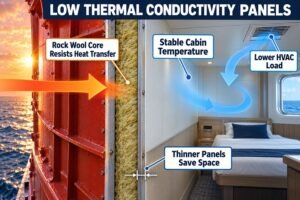
High noise on ships causes crew fatigue and fails inspections. I see many projects struggle here. Using panels with the correct STL ratings solves this and passes IMO checks easily.
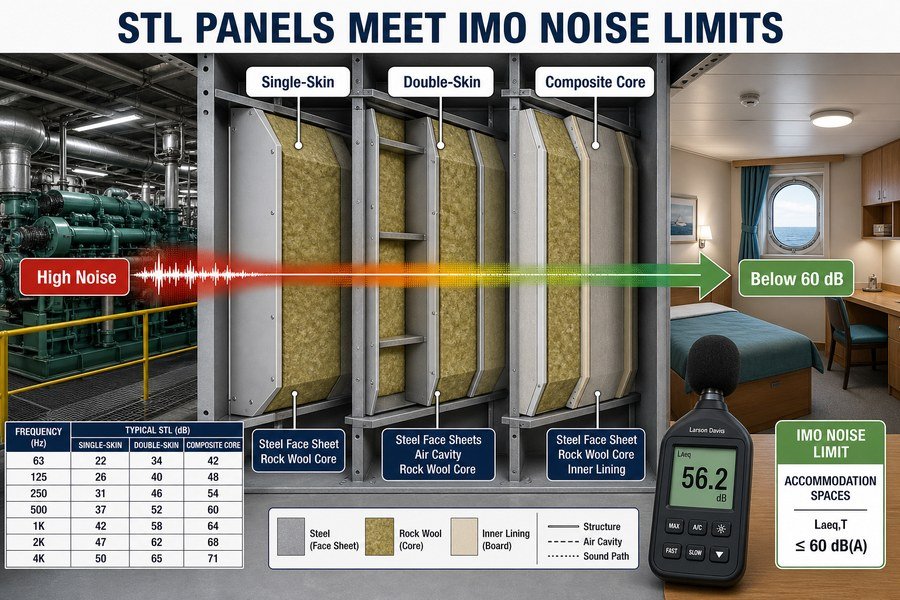
Marine interior panel STL (Sound Transmission Loss) ratings meet IMO regulations by providing specific decibel reductions across frequency bands. To achieve this, builders use three panel configurations: single-skin, double-skin, and composite core panels, which collectively ensure cabin noise stays below the mandatory 60 dB limit.
Now, let us look at the specific rules for marine panels and how we apply them in real shipyard projects.
How Do Marine Interior Panel Rw Ratings Ensure IMO Res.MSC.337(91) Compliance?
IMO Res.MSC.337(91) rules are strict. Failing them means expensive rework. We use specific Rw (Weighted Sound Reduction Index) ratings to meet these exact compliance targets every time.
Marine interior panel Rw ratings ensure IMO Res.MSC.337(91) compliance by acting as standardized acoustic barriers. They achieve compliance through three specific mechanisms: blocking airborne noise transmission, dampening structural vibrations, and maintaining consistent acoustic performance across the required 31.5 Hz to 8000 Hz frequency ranges.
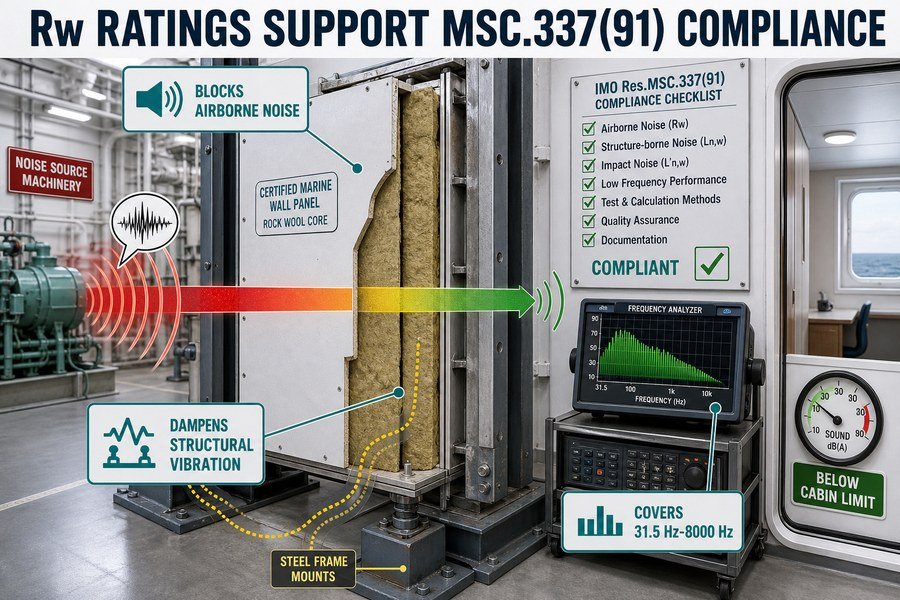
Understanding these three mechanisms helps you buy the exact panel you need without overpaying for unnecessary specifications. Let us break down how Rw ratings do this work.
Mechanism 1: Blocking Airborne Noise Transmission with High Rw Panels
The first way panels ensure compliance is by blocking airborne noise. This is the noise that travels through the air, like people talking or machinery humming. According to IMO Res.MSC.337(91), which applies to ships over 1,600 Gross Tonnage (GT), airborne noise must be heavily reduced before it enters living spaces. A standard 50mm marine wall panel filled with rockwool typically has an Rw rating of 30 dB to 33 dB1. This means it blocks 30 to 33 decibels of airborne sound. When you buy a panel with a certified Rw rating, you know exactly how much airborne noise it will block. If the engine casing emits 90 dB of noise, a 33 dB Rw panel ensures only 57 dB reaches the cabin, safely keeping you under the IMO 60 dB limit for sleeping quarters.
Mechanism 2: Dampening Structural Vibrations to Meet IMO Rules
The second mechanism is dampening structural vibrations. Ships are made of steel. Engines and propellers cause the steel to vibrate. These vibrations turn into noise inside the cabin.2 High Rw panels, especially double-skin panels with air gaps or acoustic dampening glue, absorb these vibrations. The steel frame transfers vibration to the panel face. If the panel has a rigid core, it can vibrate and create sound. But a well-designed panel with high-density rockwool (typically 120 kg/m3 to 150 kg/m3) absorbs the physical energy. This stops the panel from acting like a speaker. The Rw rating accounts for this energy absorption.3 This is why you must check the density of the rockwool core when you review a supplier quote.
Mechanism 3: Maintaining Acoustic Performance Across Frequency Ranges
The third mechanism is handling different sound frequencies. Ship noise is not just one sound. It is a mix of low rumbles from the main engine and high whines from ventilation fans. IMO requires acoustic testing across a wide frequency range, from 31.5 Hz up to 8000 Hz. The Rw rating is a single number, but it is calculated from this entire range. Standard panels are good at blocking high frequencies. However, low-frequency noise (like engine rumble below 250 Hz) is very hard to stop. To ensure compliance, composite core panels use heavy mass layers, like a 1mm or 2mm galvanized steel sheet buried inside the rockwool. This extra mass stops the low frequencies, ensuring the panel passes the strict frequency curve required by international testing labs.
| Compliance Mechanism | Target Noise Source | Key Panel Material Feature | Typical Rw Rating Impact |
|---|---|---|---|
| Blocking Airborne Noise | Speech, alarms, open machinery | High-density rockwool surface | + 30 dB to 35 dB |
| Dampening Vibrations | Hull vibrations, engine mounts | Acoustic glue, structural decoupling | + 3 dB to 5 dB |
| Managing Frequencies | Low-end engine rumble, high HVAC whine | Internal heavy mass layers (steel sheet) | + 5 dB to 8 dB |
Choosing the right panel mechanism saves your budget. You do not need expensive mass-layer panels for simple office partitions.
Which IMO Noise Limits Dictate Marine Interior Panel Selection by Zone?
Choosing one panel for the whole ship is a costly mistake. Different zones have different noise rules. You must match the panel to the specific zone limit.
IMO noise limits dictate panel selection across four distinct ship zones: sleeping cabins (60 dB), hospitals (60 dB), offices (65 dB), and engine control rooms (75 dB). Selecting the right panel requires matching its sound reduction capacity to the specific decibel limit of each functional area.
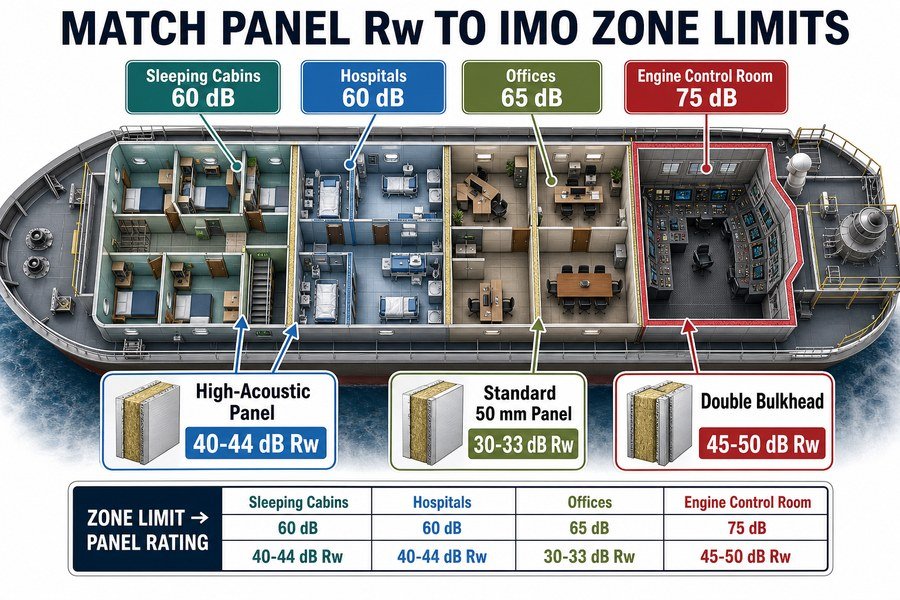
You can save a lot of money by buying thinner panels for quiet areas and only buying premium acoustic panels for loud areas. Let us look at these four zones.
Selecting Marine Panels for High-Standard Cabins and Hospitals (60 dB)
The IMO sets the strictest limits for sleeping cabins and hospitals. The limit is 60 dB. This is because crew members need proper rest, and patients need a quiet space to recover. For these two zones, you must use high-quality marine panels. If the cabin is next to a noisy area like a galley or a public room, a standard 50mm panel is not enough. You will need a high-acoustic 50mm panel or a 75mm double-layer system. A high-acoustic panel often has an Rw rating of 42 dB to 44 dB. This costs more, usually 20% to 30% more than standard panels. But it is necessary. I always tell my clients to never buy cheap panels for sleeping cabins and hospitals. Failing the noise test here is the most common reason ships fail their final inspections.
Selecting Marine Panels for Offices and Workspaces (65 dB)
Offices and general workspaces have a slightly higher limit of 65 dB. This 5 dB difference is huge for your budget. You do not need the premium acoustic panels here unless the office is right next to the main engine room. For a standard office area in the superstructure, you can use basic 50mm rockwool wall panels. These usually have an Rw rating of 30 dB. These panels are cheaper, lighter, and easier to install. When I help procurement officers build their purchasing lists, I always separate the office panels from the cabin panels. Buying standard 50mm panels for the 65 dB zones keeps your overall material costs very competitive.
Choosing Marine Panels for Engine Control Rooms (75 dB)
The Engine Control Room (ECR) has a limit of 75 dB. This sounds high, but the ECR is located inside the engine room, which can have noise levels of 110 dB4. This means the walls of the ECR must block a massive 35 dB of noise. This is the hardest zone to out-fit. You must cover the four sides of the ECR with the thickest, highest-rated panels available. We usually use a double-bulkhead system5. This means installing two rows of panels with a 50mm air gap between them. The combined Rw rating of this setup can reach 50 dB. You also need to ensure the marine fire doors match this rating6. A good acoustic fire door for an ECR will cost much more than a standard cabin door, but it is the only way to meet the 75 dB limit.
| IMO Ship Zone | IMO Noise Limit (dB) | Recommended Panel Configuration | Target Panel Rw Rating |
|---|---|---|---|
| Sleeping Cabins | 60 dB | High-acoustic 50mm panel with steel insert | 40 dB to 44 dB |
| Hospitals | 60 dB | High-acoustic 50mm panel with steel insert | 40 dB to 44 dB |
| Offices | 65 dB | Standard 50mm rockwool panel | 30 dB to 33 dB |
| Engine Control Room | 75 dB | Double-layer bulkhead system with air gap | 45 dB to 50 dB |
By matching the exact panel type to the four IMO zones, you control your costs and pass the inspections at the same time.
Why Is Marine Interior Panel STL Critical for IMO Onboard Noise Surveys?
Onboard noise surveys are stressful. If noise leaks, you fail the test. The STL of your panels directly controls the outcome of these mandatory surveys.
Marine interior panel STL is critical for IMO onboard noise surveys because it controls the three main survey failure points: adjacent cabin crosstalk, machinery noise penetration, and HVAC system noise flanking. Proper STL ensures survey meters read below legal limits during sea trials.
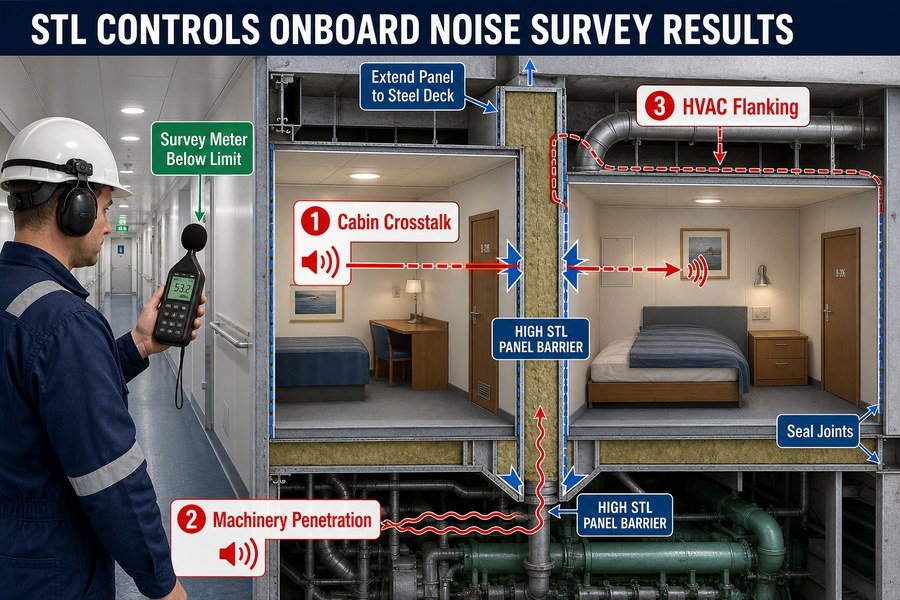
During the sea trial, inspectors use calibrated meters to test every room. If you do not plan for these three failure points, the survey will fail.
Preventing Adjacent Cabin Crosstalk During Noise Surveys
The first major failure point in a noise survey is adjacent cabin crosstalk. This happens when two sleeping cabins share a single wall. One cabin might have a radio playing, and the noise bleeds into the next cabin. IMO inspectors often test for speech privacy between cabins. If the dividing panel has a low STL rating, the sound passes right through. To fix this, you must use a panel that meets the specific Rw requirement for cabin-to-cabin walls. A standard 50mm panel with 30 dB Rw is often too weak if there are gaps at the top or bottom. We solve this by using panels with tight tongue-and-groove joints and sealing the edges with acoustic sealant. This ensures the STL rating holds up in real life, not just in the lab.
Stopping Machinery Noise Penetration in Sea Trials
The second failure point is machinery noise penetration. During the noise survey, the ship must operate at 80% of its Maximum Continuous Rating (MCR)7. This means the engines are running hard and very loud. If the wall panels between the machinery space and the living space have poor STL, the low-frequency engine rumble will penetrate the cabin. Inspectors measure this low-frequency noise carefully. Standard rockwool cannot stop this rumble. As I mentioned before, you need mass8. The STL of the panel must be high in the lower frequency bands. If you buy a panel just because it is cheap, it will fail here. Upgrading to a panel with a 1mm steel core layer increases the cost by maybe $10 per square meter, but it guarantees you pass this critical sea trial test.
Managing HVAC System Noise Flanking with High STL Panels
The third failure point is HVAC system noise flanking. Flanking noise does not go through the panel directly. It goes around it. Sound travels through the air conditioning ducts or the gap above the ceiling. You can buy a very expensive wall panel with an Rw of 45 dB, but if the noise goes over the top of the wall through the ceiling space, the survey meter will read a failure. The panel's STL is still critical here. You must ensure the high STL wall panel extends all the way to the steel deck above. Do not stop the wall panel at the ceiling level. By building the wall panel up to the true steel roof, you block the HVAC flanking path. This creates a complete acoustic box that passes the noise survey.
| Survey Failure Point | Cause of Failure during Sea Trial | STL Solution and Panel Fix |
|---|---|---|
| Cabin Crosstalk | Sound leaking through shared cabin walls | Use acoustic sealants on tongue-and-groove joints |
| Machinery Penetration | Engine rumble passing through lower decks | Use panels with heavy steel mass layers |
| HVAC Flanking | Noise traveling over walls in ceiling void | Extend high STL panels to the solid steel deck |
Understanding how inspectors test these three points helps you install the panels correctly the first time.
Can Low-Rw Marine Interior Panels Cause Port State Control Failures?
Saving money on cheap panels is tempting. But cheap panels let noise through. This can lead directly to Port State Control (PSC) stopping your ship.
Low-Rw marine interior panels can cause Port State Control failures through three distinct violation types: crew welfare complaints, failed spot-check noise measurements, and non-compliant safety management system audits. These failures result in official deficiency codes, voyage delays, or complete vessel detentions.
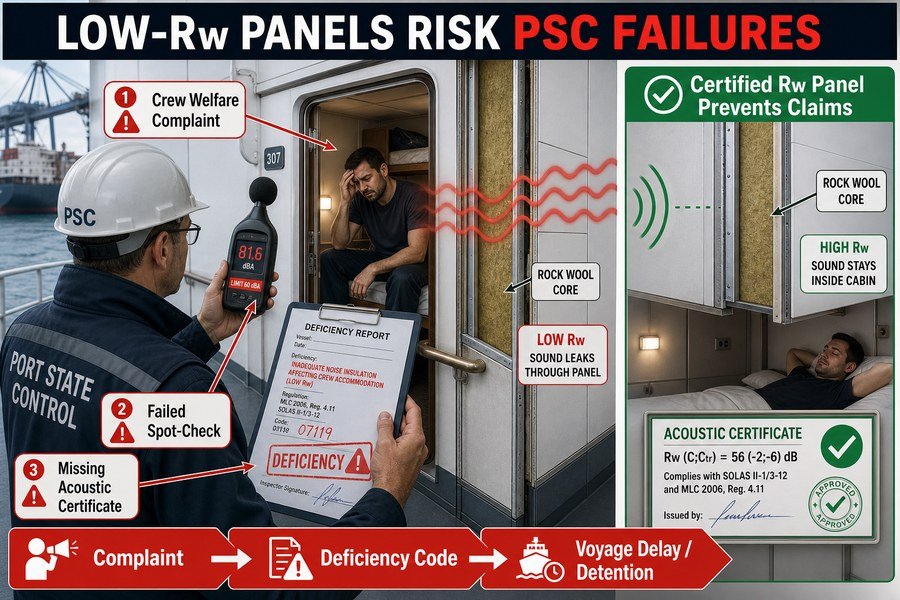
A PSC detention is a nightmare for ship owners. Let us look at how these three violations happen and how much they cost.
How Crew Welfare Complaints Trigger PSC Inspections
The first violation type starts with the crew. The Maritime Labour Convention (MLC 2006) protects crew health and welfare9. If you use low-Rw panels in the sleeping cabins, the crew cannot sleep because of the noise. Fatigued crew members can make official complaints to port authorities. When a ship docks in a port in Europe or the US, Port State Control inspectors take crew complaints very seriously. A single complaint about loud cabins will trigger a full inspection. If the inspector finds the cabin noise is above 60 dB, they will write an official deficiency. This is bad for your shipyard's reputation. The shipyard is blamed for buying poor materials. Always buy panels with verified lab certificates to prove you protected the crew's welfare.
Failed Spot-Check Noise Measurements Leading to Detentions
The second violation type is a failed spot-check. During a standard PSC inspection, inspectors might carry portable decibel meters. They walk through the corridors and engine control rooms. If they hear excessive noise, they do a spot-check. If the reading is over the IMO limit, the ship gets a deficiency code. If the noise is so loud that it threatens the safety of the crew or stops them from hearing alarms, PSC can detain the ship. A vessel detention means the ship cannot leave the port. This costs the ship owner a massive amount of money. Port fees and lost charter rates can cost between $10,000 and $30,000 per day10. To prevent this, never compromise on the Rw ratings of your doors and panels in high-risk zones.
Non-Compliant Audits and PSC Deficiency Codes
The third violation type happens during paperwork audits. PSC inspectors check the ship's Safety Management System (SMS) and construction certificates. They want to see the type-approval certificates for the interior panels. If you bought cheap panels from a supplier that does not have official marine acoustic test reports, the inspector will issue a non-compliance deficiency. You must buy panels from suppliers who test their products in certified labs. The Rw rating must be printed on the official certificate. I help many buyers check these documents before they pay the deposit. Having the right paperwork stops PSC from looking deeper into your ship's construction.
| PSC Violation Type | Trigger for Inspection | Potential Financial Impact |
|---|---|---|
| Crew Welfare Complaint | Crew cannot sleep due to noise | Bad reputation, targeted inspections |
| Failed Spot-Check | Inspector meter reads above limit | Vessel detention, $10k-$30k per day |
| Non-Compliant Audit | Missing acoustic test certificates | Deficiency codes, fines |
Buying compliant panels protects the ship owner from these huge fines and keeps your interior outfitting business safe from claims.
How Is Required Marine Wall Panel Rw Calculated Using IMO Limits?
Guessing panel thickness wastes money. You need exact math to buy the right product. Calculating the required Rw involves a simple but strict formula.
The required marine wall panel Rw is calculated using a three-step formula: identifying the source room noise level, subtracting the IMO target limit for the receiving room, and adding a 5 dB safety margin for flanking transmission. This determines the exact acoustic rating needed.
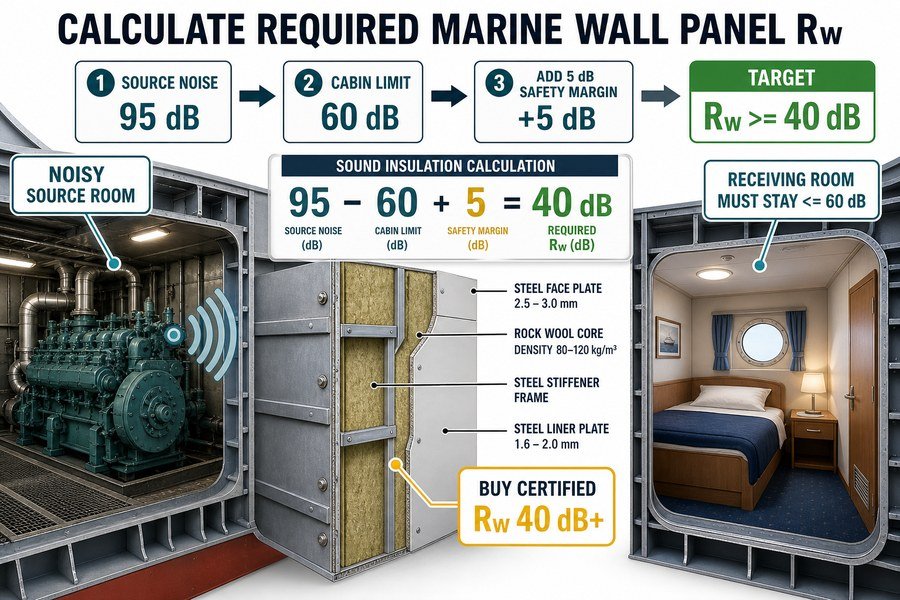
Let me show you how to use these three steps. I use this exact calculation every week to quote the right panels for my clients.
Step 1: Identifying the Source Room Noise Level
The first step is to find out how loud the source room is. The source room is the noisy area next to the wall you are building. You need the estimated noise level in decibels (dB). Ship designers calculate this during the design phase. Let us say you are building a wall next to the engine casing. The design data shows the engine casing produces 95 dB of noise. This 95 dB is your starting number. If you are building a wall next to a public dining room, the source noise might only be 75 dB. You must get these numbers from the shipyard's acoustic engineer before you place an order. You cannot guess this number.
Step 2: Subtracting the IMO Target Limit for the Receiving Room
The second step is looking at the receiving room. This is the room you want to protect. Let us say the receiving room is a sleeping cabin. As we learned earlier, the IMO limit for a sleeping cabin is 60 dB. Now you do the math. You take the source room noise (95 dB) and subtract the receiving room limit (60 dB). The difference is 35 dB. This means the wall panel must block at least 35 dB of sound just to meet the bare minimum legal requirement. If your receiving room was an office (65 dB limit), the difference would only be 30 dB. This simple subtraction tells you the baseline requirement for your wall.
Step 3: Adding the 5 dB Safety Margin for Flanking Transmission
The third step is adding a safety margin. In a laboratory, a panel might block 35 dB perfectly. But a ship is not a lab. In real life, sound leaks through the deck, the ceiling, and the door frames. This is called flanking transmission.11 Because of flanking, a panel installed on a ship will always perform worse than it did in the lab. The industry standard is to add a 5 dB safety margin to your calculation.12 So, you take your baseline requirement of 35 dB and add 5 dB. Your final target is 40 dB. You must buy a marine panel with a certified Rw rating of 40 dB or higher to guarantee you will pass the sea trial.
| Calculation Step | Example Values (Engine Casing to Cabin) | Action Required |
|---|---|---|
| 1. Identify Source Noise | Engine Casing = 95 dB | Get data from shipyard engineer |
| 2. Subtract Target Limit | Cabin Limit = 60 dB (95 - 60 = 35 dB) | Check IMO Res.MSC.337(91) tables |
| 3. Add 5 dB Safety Margin | 35 dB + 5 dB = 40 dB target Rw | Purchase panel with >= 40 dB Rw |
Using this three-step formula guarantees you buy panels that work, without spending extra money on massive ratings you do not need.
Which IMO Guidelines Dictate Marine Interior Panel Acoustic Requirements?
Following the wrong rulebook ruins projects. You must know exactly which documents apply. Two main IMO guidelines control everything about panel acoustics.
Marine interior panel acoustic requirements are dictated by two primary IMO guidelines: IMO Resolution MSC.337(91) for mandatory noise level limits, and SOLAS Chapter II-1 for structural integration. Together, these two frameworks define both the acoustic targets and the testing methods for all certified interior materials.
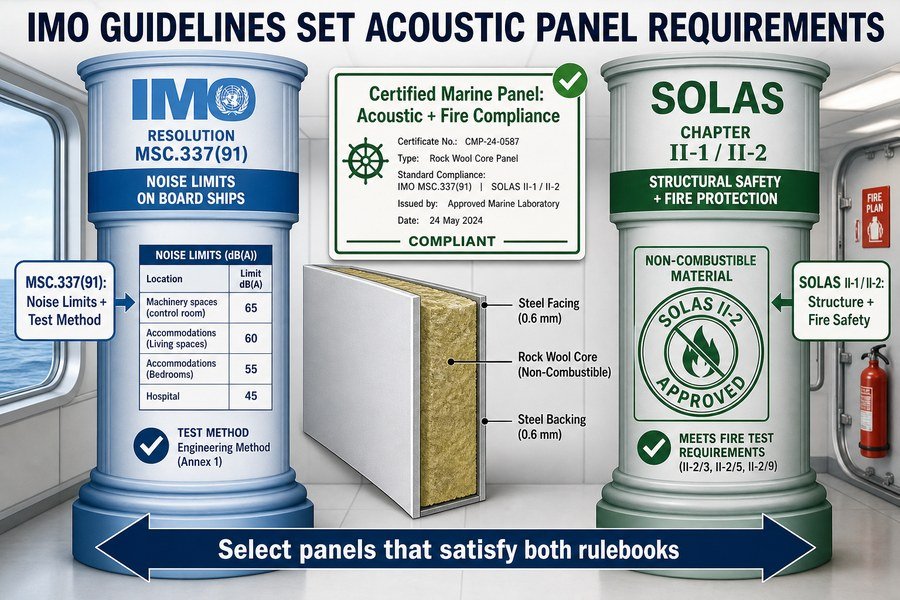
When you talk to a supplier, you must ask if their panels comply with these two specific documents. Let us review what each guideline does.
Guideline 1: IMO Resolution MSC.337(91) for Noise Limits
IMO Resolution MSC.337(91) is the "Code on Noise Levels on Board Ships". This is the most important document for acoustics. It came into force on July 1, 2014. It is mandatory for all new ships of 1,600 Gross Tonnage (GT) and above. This is the document that lists the specific decibel limits we discussed, like 60 dB for cabins and 75 dB for control rooms. It also dictates how the acoustic meters must be calibrated and exactly how the sea trials must be run13. When a marine wall panel supplier gives you an acoustic certificate, the certificate must prove the panel helps the vessel meet the standards of MSC.337(91). If the supplier does not know this code, do not buy from them.
Guideline 2: SOLAS Chapter II-1 for Structural Integration
The second guideline is SOLAS (Safety of Life at Sea). Specifically, SOLAS Chapter II-1 handles construction and structure. While MSC.337(91) cares about the noise, SOLAS cares about how the panel is built into the ship. You cannot just use any acoustic material. The material must be non-combustible and meet fire safety rules. For example, if you need a high-Rw panel (like 45 dB) for an Engine Control Room, you might want to use heavy rubber inside the panel to block noise. But SOLAS Chapter II-2 (Fire protection) bans toxic, flammable rubber on bulkheads. You must achieve your acoustic targets using SOLAS-approved materials, like marine-grade rockwool and steel. The acoustic requirement never overrides the fire safety requirement. The two guidelines must work together.
| IMO Guideline | Primary Focus Area | Impact on Panel Selection |
|---|---|---|
| IMO Res.MSC.337(91) | Noise levels and testing limits | Defines required dB limits for each zone |
| SOLAS Chapter II-1 & II-2 | Structure and Fire Safety | Requires materials to be non-combustible |
Knowing these two guidelines proves to your shipyard clients that you are a true professional who understands marine regulations.
Conclusion
Understanding IMO noise regulations and STL ratings is vital for ship interiors. Choosing the correct panel Rw prevents failed surveys, ensures crew safety, and keeps your shipyard projects profitable.
-
"How to choose the right marine wall panels for marine interior projects?", https://magellanmarinetech.com/how-choose-right-marine-wall-panels-for-marine-interior-projects/. Independent acoustic test reports or type-approval documentation for comparable 50 mm mineral-wool marine sandwich panels can substantiate that measured weighted sound reduction indices commonly fall near the low-30 dB range. Evidence role: statistic; source type: institution. Supports: A standard 50 mm rockwool-filled marine wall panel typically has an Rw rating of about 30–33 dB.. Scope note: The support would be contextual because Rw varies by facing thickness, joints, installation method, core density, and test standard. ↩
-
"[PDF] Vessel-Generated Underwater Radiated Noise Comparison Study ...", https://www.maritime.dot.gov/sites/marad.dot.gov/files/2024-11/NCE%20REPORT%202024-079%20MARAD%20Vessel-Generated%20Underwater%20Radiated%20Noise%20Comparison%20Study%20%28Tugs%29%20Rev%200.pdf. Research on ship noise and vibration describes propulsion machinery, propellers, and hull structures as sources and transmission paths for structure-borne vibration that can radiate as airborne noise in accommodation spaces. Evidence role: mechanism; source type: paper. Supports: Ship engines and propellers excite steel structures, and those vibrations can become cabin noise.. Scope note: The source would support the general mechanism, while the magnitude depends on the vessel design, isolation mounts, hull structure, and installation details. ↩
-
"Sound reduction index", https://en.wikipedia.org/wiki/Sound_reduction_index. ISO 717-1 defines Rw as a weighted sound reduction index derived from frequency-dependent airborne sound insulation measurements, so material damping and absorption can influence measured transmission loss but are not separately quantified by the Rw value. Evidence role: definition; source type: institution. Supports: Rw reflects measured airborne sound insulation behavior of a building element, including effects that influence transmission loss.. Scope note: This contextualizes the statement but does not directly prove that Rw accounts for structure-borne vibration damping; Rw is primarily an airborne sound insulation metric. ↩
-
"[PDF] A SNAPSHOT OF NOISE AND WORKER EXPOSURES", https://stacks.cdc.gov/view/cdc/226938/cdc_226938_DS1.pdf. Peer-reviewed studies and occupational-noise surveys of ship machinery spaces report engine-room sound levels that can approach or exceed 100–110 dB(A), supporting the plausibility of the stated 110 dB figure. Evidence role: statistic; source type: paper. Supports: Ship engine rooms can have noise levels around 110 dB.. Scope note: Actual engine-room levels vary by vessel type, engine load, measurement position, insulation, and maintenance condition. ↩
-
"How to Balance Acoustic Insulation and Structural Thickness in Retrofit ...", https://magellanmarinetech.com/how-balance-acoustic-insulation-and-structural-thickness-retrofit-marine-panels/. Building- and ship-acoustics literature shows that double-leaf partitions with separated masses, an air cavity, and absorbent material can provide greater sound transmission loss than a single panel, supporting the acoustic rationale for a double-bulkhead enclosure. Evidence role: mechanism; source type: research. Supports: A double-bulkhead system with an air gap is used to achieve higher sound insulation in high-noise zones.. Scope note: This supports the mechanism generally; the exact 50 mm gap and claimed Rw performance require tested assembly data for the specific panel system. ↩
-
"How to choose the right marine fire door for different ship compartments?", https://magellanmarinetech.com/how-to-choose-right-marine-fire-door-for-different-ship-compartments/. Acoustic-design guidance explains that the overall sound insulation of a partition is limited by weak elements such as doors, seals, and penetrations, supporting the requirement for doors to have acoustic performance comparable to the surrounding bulkhead. Evidence role: expert_consensus; source type: institution. Supports: Marine fire doors in an ECR enclosure should have an acoustic rating compatible with the surrounding wall system.. Scope note: The source may establish the general weak-link principle rather than a marine-specific fire-door rating for the exact ECR assembly. ↩
-
"A ship noise rating system for underwater vessel noise reduction ...", https://pubmed.ncbi.nlm.nih.gov/41844077/. The IMO Code on Noise Levels on Board Ships prescribes operating conditions for noise measurements during trials, including engine power conditions tied to maximum continuous rating, supporting the reference to MCR-based testing. Evidence role: historical_context; source type: institution. Supports: Shipboard noise measurements during sea trials are commonly conducted under specified operating conditions such as a percentage of maximum continuous rating.. Scope note: Actual trial conditions can vary with vessel type, propulsion arrangement, and the applicable survey procedure. ↩
-
"Analytic Modeling of Sound Transmission through Membrane ...", https://composites.usc.edu/analytic-modeling-of-sound-transmission-through-membrane-type-acoustic-metamaterials/. Acoustics texts describe the mass law of sound insulation, under which heavier barrier constructions generally provide higher airborne sound transmission loss, supporting the mechanism behind using mass to reduce machinery-noise penetration. Evidence role: mechanism; source type: education. Supports: Improving low-frequency machinery-noise isolation generally requires barrier mass and adequate sound transmission loss rather than absorption alone.. Scope note: Mass law is a general acoustic principle and does not by itself prove that any specific panel assembly will pass a sea-trial noise test. ↩
-
"Maritime Labour Convention - Wikipedia", https://en.wikipedia.org/wiki/Maritime_Labour_Convention. The ILO’s Maritime Labour Convention, 2006 establishes minimum international standards for seafarers’ living and working conditions, including accommodation, occupational safety, health protection, and welfare provisions. Evidence role: definition; source type: institution. Supports: The Maritime Labour Convention (MLC 2006) protects crew health and welfare.. ↩
-
"Demurrage and detention: from operational challenges ... - PMC", https://pmc.ncbi.nlm.nih.gov/articles/PMC10026217/. Studies and maritime guidance on port State control detention describe detention as causing direct port-related costs and indirect commercial losses from off-hire time or delayed voyages; published estimates vary substantially by vessel type, market conditions, and duration of detention. Evidence role: statistic; source type: paper. Supports: PSC detention can impose daily costs through port charges and lost charter revenue in the range claimed or in comparable ranges.. Scope note: A source may support the general cost categories or comparable detention-cost ranges, but the exact US$10,000–30,000 daily figure is market-dependent and may not apply to all vessel classes. ↩
-
"Flanking transmission", https://en.wikipedia.org/wiki/Flanking_transmission. Acoustics standards and building-acoustics references define flanking transmission as sound reaching a receiving room through indirect structural or airborne paths rather than only through the separating element. Evidence role: definition; source type: paper. Supports: Sound leakage through adjacent structures such as decks, ceilings, and frames is called flanking transmission.. Scope note: Most formal explanations are from building acoustics; the physical mechanism is applicable to ships, but ship-specific construction details may differ. ↩
-
"Flanking transmission", https://en.wikipedia.org/wiki/Flanking_transmission. Marine-acoustics and noise-control guidance commonly notes that field performance can be lower than laboratory sound-insulation ratings because of flanking paths and installation conditions, which is why design margins are often applied. Evidence role: expert_consensus; source type: institution. Supports: A 5 dB safety margin is commonly added to account for flanking transmission and installation losses.. Scope note: A universal 5 dB margin may not be mandated by IMO; support is likely to be contextual guidance rather than a single binding industry standard. ↩
-
"(PDF) Noise report onboard of cargo vessel - Academia.edu", https://www.academia.edu/83354366/Noise_report_onboard_of_cargo_vessel. MSC.337(91) includes procedures for noise-level measurement on board ships, including instrumentation requirements, calibration practices, and conditions for measurements during sea trials. Evidence role: mechanism; source type: institution. Supports: MSC.337(91) dictates calibration requirements for acoustic meters and procedures for sea-trial noise measurements.. Scope note: The source supports that the code prescribes measurement procedures; it may not use the article’s informal wording that the trials are specified 'exactly.' ↩