Are you buying marine interior panels? Confusing acoustic ratings can ruin your ship interior project. Knowing the difference between ISO and ASTM standards is the only way to avoid costly rework.
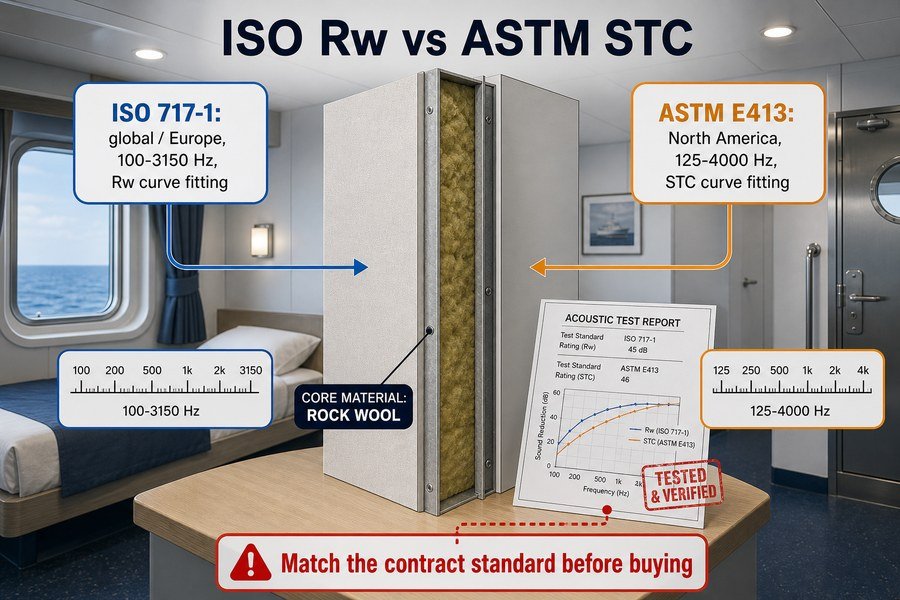
ISO (Rw) and ASTM (STC) are acoustic standards for marine interior panels that differ in origin, testing frequency ranges, and curve-fitting methods. ISO 717-1 (Rw) is favored globally and by European shipyards, while ASTM E413 (STC) is standard in North America, measuring from 100-3150 Hz and 125-4000 Hz respectively.
Let me explain how to read these acoustic reports so you do not buy the wrong panels and lose money on your next shipyard project.
Which ISO Standards Define STL Testing for Marine Interior Panels?
Are your suppliers sending you random acoustic certificates? If you cannot verify the exact ISO standards, you risk failing shipyard inspections and losing your profits.
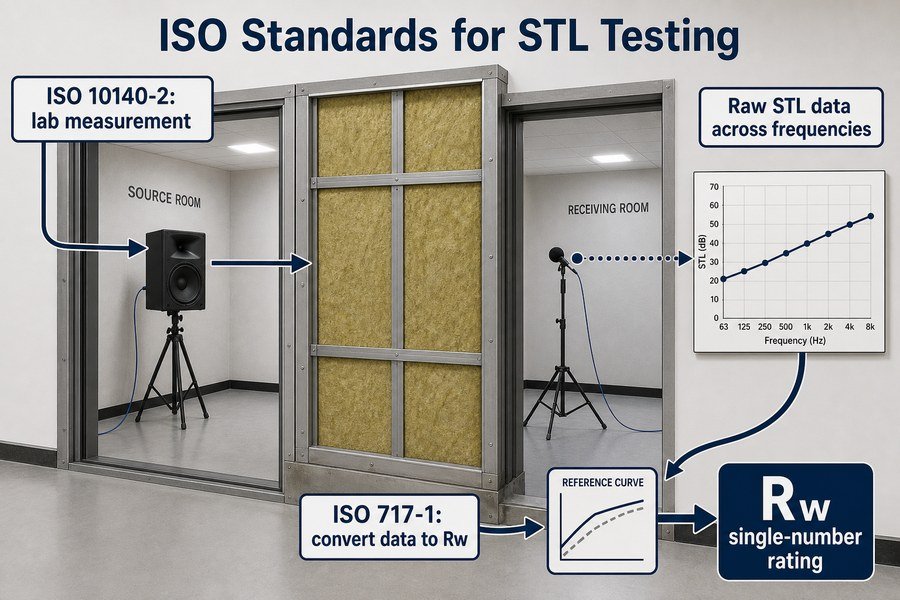
Two critical ISO standards define Sound Transmission Loss (STL) testing for marine interior panels: ISO 10140-2 governs the laboratory measurement procedures for airborne sound insulation, while ISO 717-1 provides the rating method to convert these measured frequencies into a single-number value, known as the Weighted Sound Reduction Index (Rw).
As someone who has worked in a marine outfitting factory, I see many buyers get confused when they ask for a sound rating. A supplier gives them a piece of paper, but the buyer does not know what the numbers mean. You must know the two exact ISO standards that work together to create a valid acoustic report. You cannot have one without the other.
Understanding the Laboratory Measurement Standard ISO 10140-2
The first standard is ISO 10140-2. This is the rule book for how the testing laboratory physically measures the sound. When a factory sends a 50mm thick rock wool marine wall panel to the lab, the lab puts the panel between two rooms. One room has a loud speaker, and the other room has a microphone. ISO 10140-2 tells the lab exactly how to measure the sound that passes through the panel.1 The lab must test specific frequencies, from low pitches to high pitches.2 The test measures the sound block at every frequency point. But this test only gives raw data. It does not give you the final simple number that your shipyard client asks for.
Calculating the Single-Number Rating with ISO 717-1
This is why you need the second standard, ISO 717-1. Shipyards do not want to read a chart with 20 different data points. They want one number. ISO 717-1 is the math formula that takes the raw data from ISO 10140-2 and turns it into one number.3 We call this number Rw. For a standard marine cabin bulkhead, the IMO (International Maritime Organization) usually requires an Rw of at least 35 dB. ISO 717-1 compares the test data to a reference curve at 500 Hz to calculate this final Rw number. If your supplier only shows you a test report without mentioning both ISO 10140-2 and ISO 717-1, the report is incomplete.
| Standard Name | Main Function in Acoustic Testing | Output Result |
|---|---|---|
| ISO 10140-2 | Defines physical laboratory test methods and setup | Raw sound transmission loss data across frequencies |
| ISO 717-1 | Defines the mathematical calculation method | Single-number rating (Rw) in decibels (dB) |
How Do ISO (Rw) and ASTM (STC) Differ for Marine Interior Panels?
Mixing up Rw and STC numbers is a very common mistake. If you buy a panel based on STC when the shipyard wants Rw, your panels will be rejected.
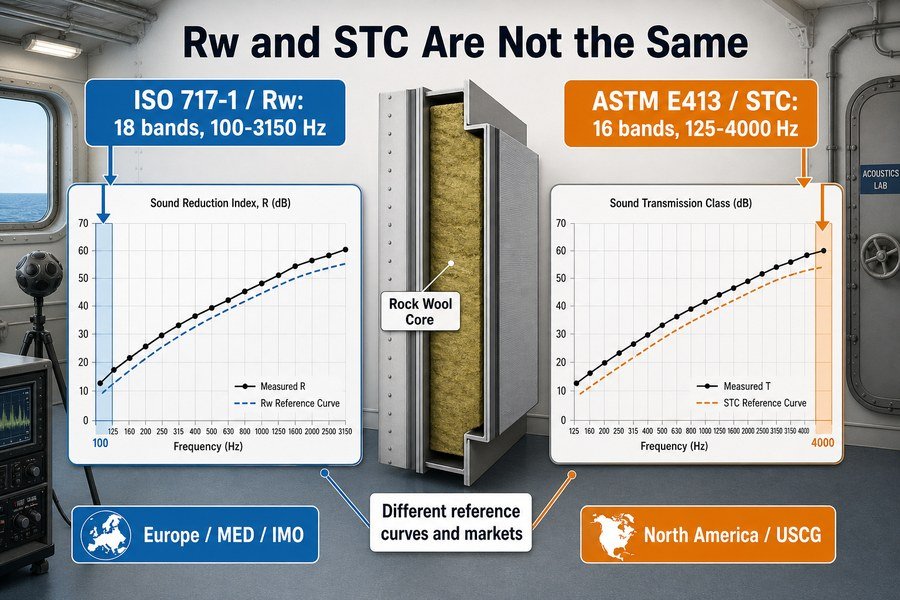
ISO (Rw) and ASTM (STC) differ in three main ways: testing frequency ranges, reference curves, and target markets. ASTM E413 (STC) measures 16 frequencies from 125 Hz to 4000 Hz for the US market. ISO 717-1 (Rw) measures 18 frequencies from 100 Hz to 3150 Hz for global/European markets.
I have seen procurement officers buy cheap marine ceiling panels from Asia because the STC number looked high. But when the European shipyard tested the ship, the panels failed. You must understand the three specific differences between ISO (Rw) and ASTM (STC) so you can make the right purchasing choices.
Analyzing the Testing Frequency Range Differences
The first difference is the frequency range. ASTM standards focus on a range from 125 Hz up to 4000 Hz. This uses 16 frequency points. ISO standards measure from 100 Hz to 3150 Hz. This uses 18 frequency points. This difference is very important for ships. Ships have massive diesel engines that make low-frequency noise.4 Because ISO starts at 100 Hz, it measures lower sounds than ASTM. A panel might block high sounds very well but fail to block low engine rumbles.
Exploring Reference Curves and Target Markets
The second difference is the curve-fitting math. Both standards use a reference curve to find the final single number. But their rules for bad performance are different. ASTM E413 does not allow any single frequency to fall more than 8 dB below the curve. ISO 717-1 is a bit different. ISO focuses on the average bad performance, limiting total unfavorable deviations to 32 dB across the curve.
The third difference is the target market. ASTM is an American standard. If you are outfitting a ship for a United States Coast Guard (USCG) project, the shipyard will ask for STC. ISO is an international standard. If you are selling to shipyards in Europe or working on a ship with a MED (Marine Equipment Directive) Wheelmark, you must use ISO Rw. You cannot sell an STC panel to an ISO project.
| Feature | ISO 717-1 (Rw Rating) | ASTM E413 (STC Rating) |
|---|---|---|
| Frequency Range | 100 Hz to 3150 Hz | 125 Hz to 4000 Hz |
| Number of Test Bands | 18 frequency bands | 16 frequency bands |
| Primary Market | Europe, Asia, International (MED/IMO) | North America (USCG) |
| Low Frequency Focus | Better (Includes 100 Hz) | Weaker (Starts at 125 Hz) |
Why Is Comparing STC to Rw Dangerous for Marine Interior Panel Procurement?
Have you ever tried to guess the Rw rating from an STC report? This blind guessing can cause your entire cabin outfitting project to fail acoustic tests.
Comparing STC directly to Rw is dangerous because they treat low-frequency engine noise differently, calculate deviations differently, and carry separate legal certifications. An STC 35 panel might only achieve an Rw 33 rating. Converting them directly can lead to failed sea trials, rejected deliveries, and severe financial penalties.
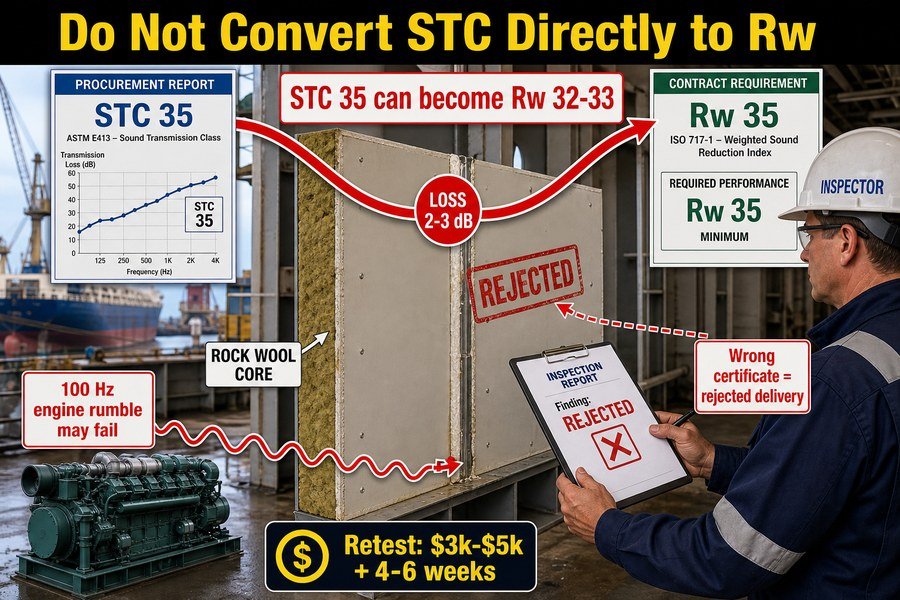
Some sales people in factories will tell you that STC and Rw are the same thing. They will say, "Our panel is STC 35, so it is also Rw 35. You can buy it safely." Do not listen to them. As a former factory worker, I know this is a lazy sales trick. Comparing STC directly to Rw is extremely dangerous for your business and will cause you to lose money. Let us break down the three reasons why you must never treat them as equals.
The Hidden Danger of Low-Frequency Engine Noise Handling
The biggest physical danger is low-frequency noise. Marine environments have heavy vibrations from generators and propellers. As we discussed, ISO tests down to 100 Hz. ASTM stops at 125 Hz. If a panel is rated STC 35, it might completely fail to block a 100 Hz sound. But the ISO test will catch this failure. Therefore, a panel that scores an STC 35 might drop down to an Rw 32 or Rw 33. If your shipyard contract requires exactly Rw 35 to meet IMO Resolution A.468(XII) cabin noise limits (which restricts noise to 60 dB(A)), a direct STC conversion will cause your finished cabin to be too noisy.
Calculation Deviations and Legal Certification Risks
The second danger is the math. ASTM and ISO use different rules for calculating deviations. You cannot use a math formula to change STC to Rw. The third danger is the law. Acoustic reports are legal documents. A European shipyard inspector from a classification society like DNV or Bureau Veritas will only look at the exact legal standard written in the contract. If they ask for ISO, and you give an ASTM report, they will reject it instantly. It does not matter if the numbers look similar. A new lab test in Europe costs around $3,000 to $5,000 and takes four to six weeks. This delay will ruin your profit margin and destroy your relationship with the shipyard.
| Risk Area | Why STC Cannot Replace Rw | Financial Impact of Mistake |
|---|---|---|
| Low Frequencies | STC misses the 100 Hz engine noise band | Panel fails onboard noise test |
| Math Calculations | Different rules for curve deviations | True acoustic performance is lower than expected |
| Legal Compliance | Inspectors only accept contract-specified standards | $3,000 to $5,000 for re-testing, 4-6 weeks delay |
How Do Regional Rules Determine the Required Marine Interior Panel Test Standard?
You cannot just pick a standard you like. Shipyards follow strict regional laws, and missing these rules means your panels will never board the ship.
Regional rules determine the test standard based on the vessel's registration and operating area. European and international vessels governed by IMO and the Marine Equipment Directive (MED) mandate ISO (Rw) standards. United States Coast Guard (USCG) regulated vessels operating in North America primarily require ASTM (STC) standards.
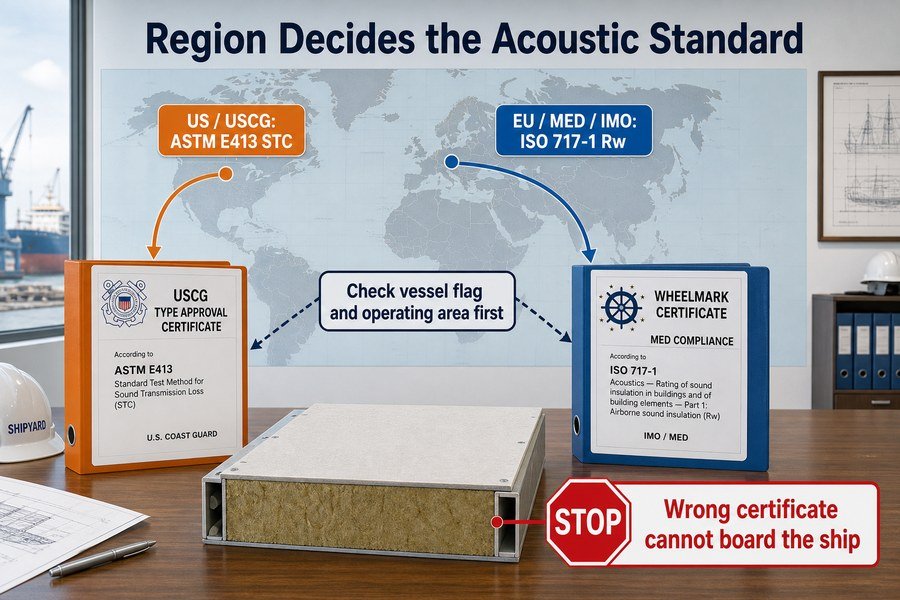
When you buy marine interior wall panels, you are not just buying wood and metal. You are buying compliance. If you buy a cheap panel with the wrong certificate, the panel is useless trash. The ship's flag and the region where the ship sails will dictate exactly which test standard you must provide. You must always check the regional rules before you place an order with an Asian factory.
Marine Equipment Directive (MED)5 Requirements for European Shipyards
If you are doing interior outfitting for a large shipyard in Europe, you must follow the Marine Equipment Directive (MED). The MED is the law for all ships registered in the European Union. Products that pass MED rules get a special stamp called the Wheelmark6. To get the Wheelmark for a fire door or a wall panel, the product must pass acoustic and fire tests using ISO standards. For example, the IMO SOLAS code requires strict noise control. European shipyards will strictly demand an ISO 717-1 Rw rating report from an approved lab. A typical passenger cabin bulkhead must hit Rw 35 dB. If you bring an American ASTM report to a German shipyard, they will tell you to take your panels away.
United States Coast Guard (USCG) Preferences for North American Projects
On the other hand, if you are buying panels to outfit a ship built in the United States, or a ship flying the US flag, you deal with the United States Coast Guard (USCG). The USCG relies heavily on American standards. They will ask for ASTM E90 (the lab test) and ASTM E413 (the STC rating)7. Standard marine partitions in the US market usually require a rating between STC 32 and STC 40. Before you negotiate the price with a supplier in China or Vietnam, you must ask your client: "Where is this ship registered?" This one question will save you from buying the wrong product.
| Regulatory Body | Governing Region | Required Acoustic Standard | Common Application |
|---|---|---|---|
| MED (Wheelmark) | European Union / Global | ISO 717-1 (Rw) | Passenger cruise ship cabins |
| IMO SOLAS | International Waters | ISO 717-1 (Rw) | Commercial vessel crew quarters |
| USCG | United States / North America | ASTM E413 (STC) | US-flagged workboats and ferries |
What Specimen Size Ensures Valid ISO Acoustic Testing for Marine Interior Panels?
Did you know a small panel test can fake a good acoustic score? Using the wrong sample size makes the test invalid and the certificate useless.
Valid ISO 10140-2 acoustic testing for marine interior panels requires a specific specimen size, typically between 10 square meters and 12 square meters for walls, with a minimum side length of 2.4 meters. This size accurately reflects real-world ship cabin dimensions and minimizes testing errors from edge effects.
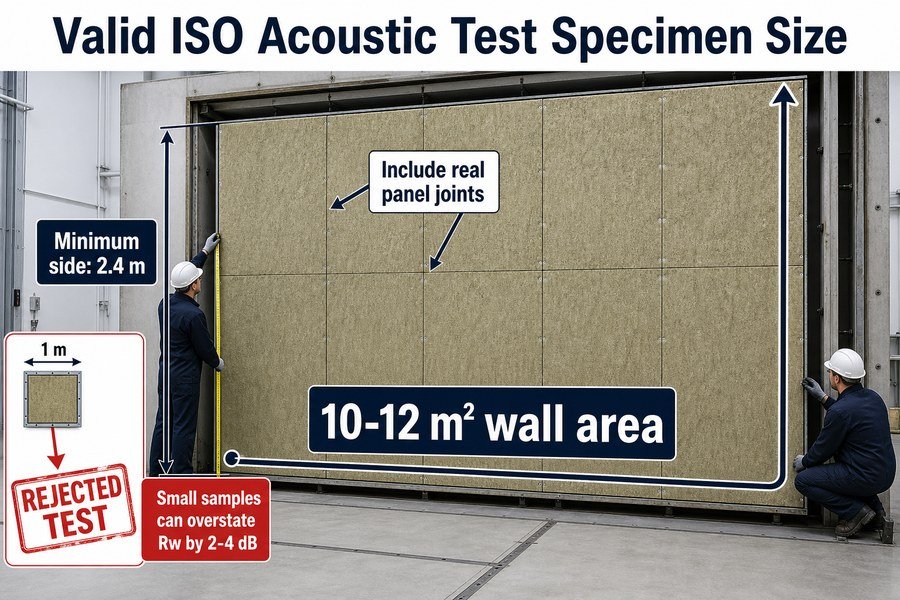
I always check the laboratory test report carefully. Sometimes, a factory will send me a report that says their 50mm wall panel has an amazing Rw of 45 dB. But when I read the details, I see they only tested a tiny piece of the panel. This is a trick. To get a valid ISO rating, the test specimen must be very large. If the sample size is wrong, the certificate is invalid, and the shipyard will reject it.
Specifying the Standard 10 to 12 Square Meter Specimen Size
According to ISO 10140-2, the lab must test a large wall. For marine bulkheads, the standard size is between 10 square meters and 12 square meters8. Why is it so big? Because sound behaves differently on a small scale. If you test a small 1 meter by 1 meter panel, the edges hold the panel very tight. This makes the panel stiff. A stiff panel vibrates less and blocks sound better. Testing a small sample can artificially increase the Rw score by 2 to 4 dB9. ISO requires the 10 to 12 square meter size to stop factories from faking good scores.
Minimizing Edge Effects and Ensuring Real-World Cabin Accuracy
The standard also requires a minimum side length of 2.4 meters10. This height requirement is very practical. Real marine panels in a ship are usually 0.6 meters wide and 2.1 to 2.4 meters tall. You cannot make a 10 square meter wall out of one single piece of metal. You must join many panels together. This is the most important part of the test. Sound usually leaks through the joints where two panels connect.11 By testing a massive 2.4-meter-tall wall, the lab tests the real-world joints. A test on a single, small, seamless piece of metal is a lie. Real ships have joints, so the test must have joints.
| Test Specimen Parameter | ISO 10140-2 Requirement | Reason for Requirement |
|---|---|---|
| Total Area | 10 to 12 square meters | Prevents artificial stiffness from edge effects |
| Minimum Side Length | 2.4 meters | Matches actual ship cabin heights |
| Construction | Must include standard joints | Tests sound leakage at connection points |
Why Verify the ISO Edition Year on Marine Interior Panel Test Reports?
Old test reports are a hidden trap. Submitting an outdated acoustic certificate to a strict shipyard will get your products rejected instantly.
Verifying the ISO edition year on marine interior panel test reports is crucial because standards update every few years, testing methodologies change, and shipyards reject outdated certifications. An old report, like ISO 717-1:1996 instead of ISO 717-1:2020, invalidates your product compliance and causes project delays.
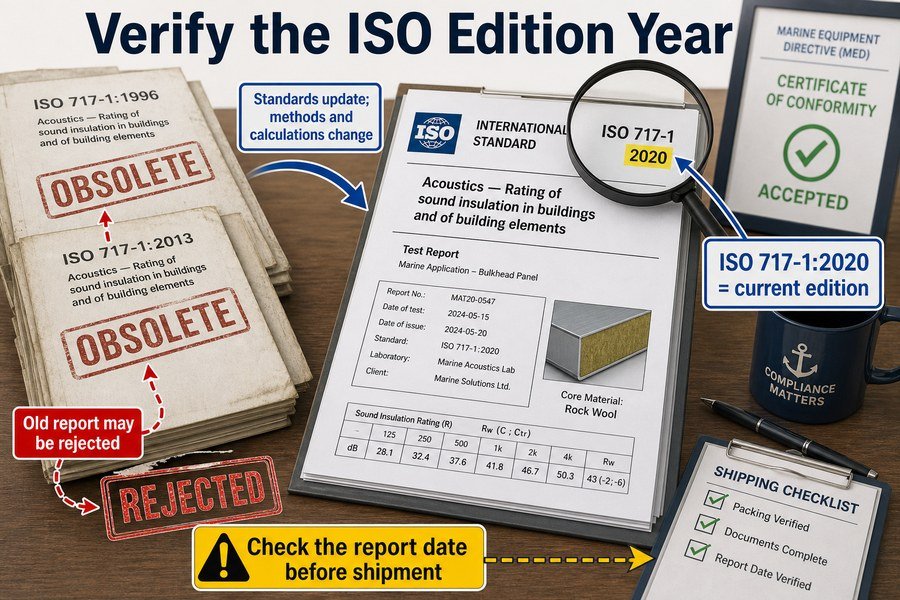
A good procurement officer must act like a detective. When an Asian supplier sends you a test report for a marine fire door or a ceiling panel, look at the top right corner. You will see the standard name, like ISO 717-1. But right next to it, there is a year. The year is the edition. I have seen buyers purchase containers of materials based on reports from 15 years ago. When the materials arrived in Europe, the shipyard inspector threw the reports in the trash. You must verify the edition year.
Tracking Changes in Testing Methodologies Across ISO Editions
ISO standards do not stay the same forever. Committees update them to reflect new science.12 For example, ISO 717-1 had an edition in 1996. It was updated in 2013, and updated again in 2020 (ISO 717-1:2020). When the year changes, the testing methodologies and math change. Newer versions often adjust how low-frequency correction terms are applied. A marine panel that barely passed the test in 1996 might completely fail the rules of the 2020 edition. If the math changes, the old score is no longer true.
Preventing Shipyard Rejections Due to Outdated Certifications
Shipyards employ classification societies like DNV or Lloyd's Register to inspect the ship.13 These inspectors are very strict. Their rulebooks require all materials to meet the latest standards. If your factory provides a test report from 2013, but the current standard is 2020, the inspector will reject your marine panels. They will force you to pay for a brand new lab test. A new test costs over $3,000 and takes at least a month to schedule and complete. This delay will stall the entire cabin outfitting process. Always tell your suppliers that you only accept test reports based on the most current ISO edition year.
| ISO Standard Edition | Current Status | Risk if Submitted to Shipyard |
|---|---|---|
| ISO 717-1:1996 | Obsolete | Instant rejection, fails modern compliance |
| ISO 717-1:2013 | Outdated | High risk of rejection by strict inspectors |
| ISO 717-1:2020 | Current / Active | Fully accepted by global classification societies |
Conclusion
Mastering the differences between ISO (Rw) and ASTM (STC) ensures your marine interior panels pass shipyard inspections, saving you money, preventing delays, and building strong client trust.
-
"Sound insulation dataset of 30 wooden and 8 concrete floors ...", https://pmc.ncbi.nlm.nih.gov/articles/PMC10365936/. ISO 10140-2 specifies laboratory procedures for measuring airborne sound insulation of building elements, providing the methodological basis for sound transmission measurements through panels or partitions. Evidence role: definition; source type: institution. Supports: ISO 10140-2 defines the laboratory measurement method for sound passing through a panel.. Scope note: The standard is written for building elements generally; its application to marine wall panels is an industry use rather than the standard’s sole scope. ↩
-
"Airborne sound insulation performance of lightweight double ...", https://pmc.ncbi.nlm.nih.gov/articles/PMC11666719/. Laboratory airborne sound insulation standards report sound reduction across standardized frequency bands, which supports the statement that the measurement is frequency-dependent rather than a single direct reading. Evidence role: mechanism; source type: education. Supports: ISO-style airborne sound insulation tests measure performance across specified frequency bands.. Scope note: A secondary educational or standards summary may describe the frequency-band method without reproducing all proprietary ISO procedural details. ↩
-
"Analysis between weighted sound reduction index according to ISO ...", https://www.academia.edu/21437199/Analysis_between_weighted_sound_reduction_index_according_to_ISO_717_1_and_indices_according_to_ISO_16717_1. ISO 717-1 defines single-number quantities for rating airborne sound insulation from frequency-dependent measurement data, including the weighted sound reduction index Rw. Evidence role: definition; source type: institution. Supports: ISO 717-1 converts frequency-dependent airborne sound insulation data into a single-number rating such as Rw.. Scope note: The source supports the rating method and terminology; it may not specifically mention every upstream laboratory standard used to generate the input data. ↩
-
"[PDF] Vessel-Generated Underwater Radiated Noise Comparison Study ...", https://www.maritime.dot.gov/sites/marad.dot.gov/files/2024-11/NCE%20REPORT%202024-079%20MARAD%20Vessel-Generated%20Underwater%20Radiated%20Noise%20Comparison%20Study%20%28Tugs%29%20Rev%200.pdf. Marine-acoustics studies identify diesel propulsion engines and associated machinery as important contributors to low-frequency and structure-borne noise on ships, providing context for why low-frequency insulation performance matters. Evidence role: mechanism; source type: paper. Supports: Diesel engines and machinery on ships generate significant low-frequency noise relevant to acoustic-panel performance.. Scope note: This supports the general mechanism of shipboard low-frequency noise, not the noise profile of every vessel or the failure of any specific ceiling panel. ↩
-
"Directive 96/98/EC - Wikipedia", https://en.wikipedia.org/wiki/Directive_96/98/EC. Directive 2014/90/EU establishes harmonized EU conformity-assessment requirements for specified marine equipment placed on board ships flying the flag of an EU Member State. Evidence role: definition; source type: government. Supports: European shipyard projects involving covered marine equipment must consider Marine Equipment Directive requirements for EU-flagged ships.. Scope note: The directive applies to covered marine equipment, not necessarily every material or furnishing used in a ship interior. ↩
-
"Directive 96/98/EC", https://en.wikipedia.org/wiki/Directive_96/98/EC. Official EU guidance describes the wheel mark as the conformity marking affixed to marine equipment that has undergone the required conformity-assessment procedure under the Marine Equipment Directive. Evidence role: definition; source type: government. Supports: Products compliant with the Marine Equipment Directive receive the Wheelmark conformity marking.. Scope note: The marking confirms conformity-assessment status for covered equipment, but it does not independently describe the product’s acoustic or fire-performance level. ↩
-
"[PDF] Determination of Sound Transmission Class (STC)", https://www.montana.edu/rmaher/eele417_fl14/Determination_of_STC.pdf. ASTM E90 defines a laboratory method for measuring airborne sound transmission loss of building partitions, while ASTM E413 defines the sound transmission class rating calculated from such measurements. Evidence role: definition; source type: institution. Supports: ASTM E90 and ASTM E413 are the relevant ASTM standards for laboratory sound-transmission testing and STC rating terminology.. Scope note: These standards explain the E90/STC testing framework, but a separate USCG rule or project specification would be needed to show that they are required for a particular US-flagged vessel project. ↩
-
"Sound insulation dataset of 30 wooden and 8 concrete floors ...", https://pmc.ncbi.nlm.nih.gov/articles/PMC10365936/. ISO 10140 laboratory airborne-sound-insulation test procedures specify large wall test openings/specimens on the order of 10 m² for wall assemblies, supporting the stated scale requirement for valid laboratory ratings. Evidence role: definition; source type: institution. Supports: For marine bulkhead acoustic testing under ISO 10140, the wall specimen should be a large assembly of roughly 10 to 12 square meters.. Scope note: The exact dimensional requirement may be stated in ISO 10140 facility or specimen-arrangement sections rather than only in ISO 10140-2, and may vary by test configuration. ↩
-
"Influence of Specimen Size and Test-Opening Geometry ...", https://pubmed.ncbi.nlm.nih.gov/42451325/. Research on laboratory sound-insulation measurements shows that specimen mounting, boundary conditions, and edge constraints can change measured transmission loss and single-number ratings, providing a technical basis for concern about small or over-constrained specimens. Evidence role: mechanism; source type: paper. Supports: Testing a small, tightly constrained panel can make the measured Rw rating higher than it would be for a full-size assembly.. Scope note: A source may demonstrate the direction and mechanism of measurement bias without confirming the exact 2–4 dB range for every panel type. ↩
-
"Airborne sound insulation performance of lightweight double ...", https://pmc.ncbi.nlm.nih.gov/articles/PMC11666719/. ISO 10140 test-arrangement guidance for building elements gives minimum dimensions for wall specimens/test openings, supporting the need for a full-height specimen rather than a small panel coupon. Evidence role: definition; source type: institution. Supports: The standard requires a minimum side length of 2.4 meters for the tested wall specimen.. Scope note: This supports the dimensional requirement in the laboratory standard; it does not by itself prove that the dimension was chosen specifically for marine cabin heights. ↩
-
"Airborne sound insulation performance of lightweight double ...", https://pmc.ncbi.nlm.nih.gov/articles/PMC11666719/. Acoustics literature on partition and façade sound insulation identifies joints, gaps, and connections as common paths for sound transmission and leakage, supporting the need to test assembled panels with their normal connections. Evidence role: mechanism; source type: paper. Supports: Panel joints can be important sound-leakage paths, so acoustic testing should include representative joints.. Scope note: This provides general acoustic support for joint leakage; the severity depends on the specific joint design, seals, installation quality, and frequency range. ↩
-
"[PDF] A Review of U.S. Participation in the International Organization for ...", https://www.nist.gov/document/review-us-participation-iso-and-iec. ISO describes standards as consensus documents developed and reviewed by technical experts, with periodic review used to determine whether a standard should be confirmed, revised, or withdrawn. Evidence role: general_support; source type: institution. Supports: ISO standards are periodically updated by committees to reflect changes in technical knowledge and practice.. Scope note: This supports the general revision mechanism, not the specific scientific reasons for any single ISO 717-1 revision. ↩
-
"Ship classification society", https://en.wikipedia.org/wiki/Ship_classification_society. International maritime sources describe classification societies as organizations that set and verify technical standards for ships through plan review, survey, and certification activities. Evidence role: definition; source type: institution. Supports: Classification societies such as DNV and Lloyd’s Register inspect and certify ships against technical standards.. Scope note: This supports the role of classification societies in ship inspection and certification generally, but not the inspection practice of every individual shipyard. ↩