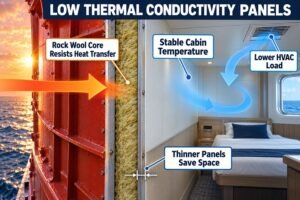
High noise levels on ships cause crew fatigue and ruin passenger comfort. The solution is choosing marine wall and ceiling panels based on the specific cabin use.
Cabin use dictates acoustic panel requirements based on IMO MSC.337(91) rules. Sleeping and medical cabins require maximum sound reduction panels (Rw ≥ 45-50 dB). Public spaces need moderate reduction panels (Rw ≥ 35 dB). Workspaces like galleys require structural isolation panels rather than soft sound-absorbing wall panels.
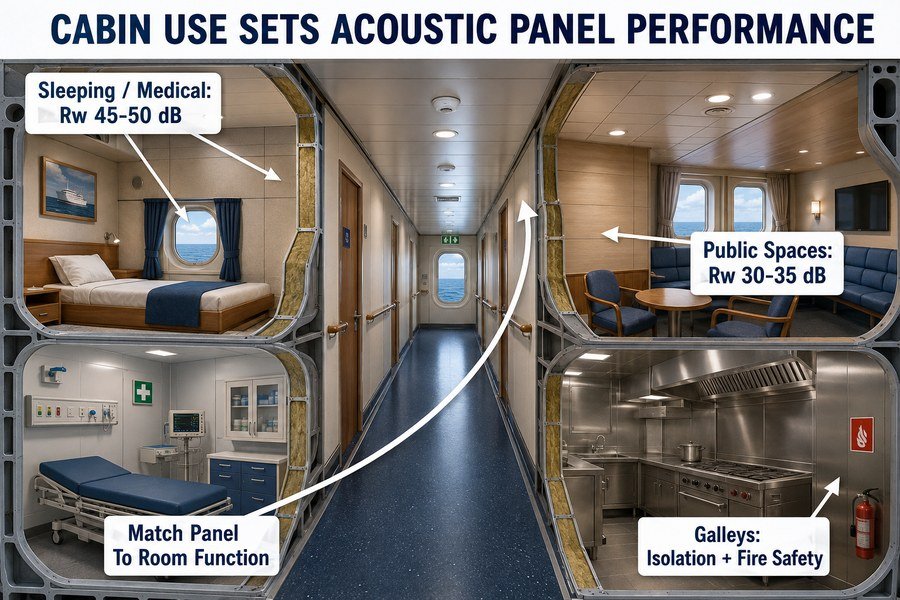
Let us look at how different cabin types change what you must buy for your ship interior projects.
How Do Marine Sleeping Cabin Noise Limits Differ From Public Space Limits?
Crew members complain about lack of sleep due to engine noise. You must buy the right acoustic panels to stop this problem.
Sleeping cabins require strict noise limits of 60 dB(A) for crew and 50 dB(A) for passengers, needing panels with a Sound Reduction Index (Rw) of 45-50 dB. Public spaces allow 65 dB(A), requiring only standard marine panels with Rw 30-35 dB to achieve acoustic compliance.
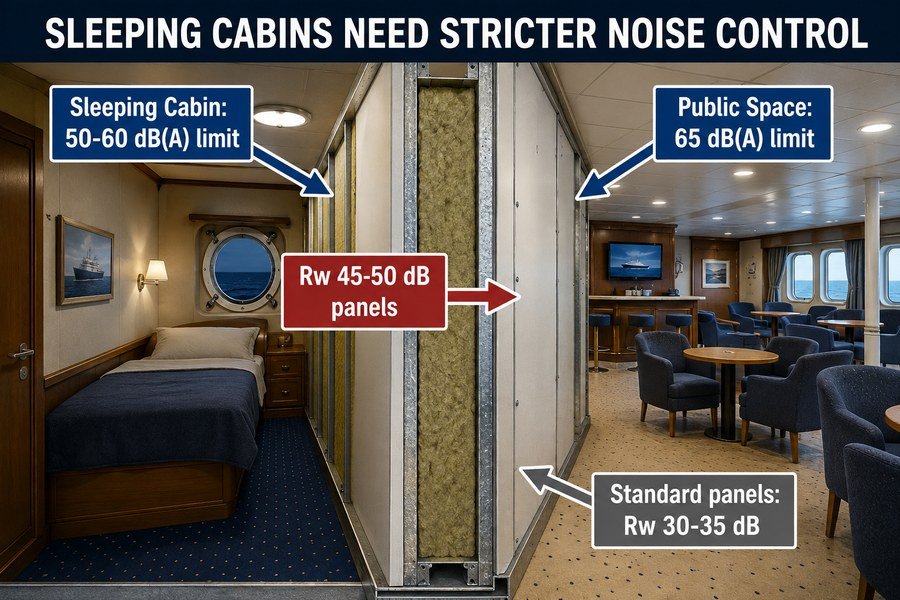
I see many buyers fail their noise tests because they do not understand the rules. The IMO MSC.337(91) code sets very clear numbers for ship noise. You must meet these numbers, or the shipyard will not accept your interior project.
Acoustic Panel Requirements for Marine Sleeping Cabins
A sleeping cabin must be quiet. The IMO rule says crew sleeping cabins must not exceed 60 dB(A). Passenger sleeping cabins must not exceed 50 dB(A). To reach these numbers, you cannot use basic wall panels. You must buy high-acoustic marine wall panels. These panels use high-density rockwool cores. The rockwool density must be between 120 kg/m3 and 150 kg/m3. The panel itself must have an Rw rating of 45 dB to 50 dB1.
These panels cost more money. A standard 50mm marine panel costs about $18 to $22 per square meter. A high-acoustic 50mm panel with Rw 45 dB costs about $35 to $40 per square meter. You must plan your purchase budget around these specific prices. If you buy the cheap $18 panels for sleeping cabins, the noise will leak through.
Acoustic Panel Requirements for Marine Public Spaces
Public spaces are different. These rooms include lounges, dining rooms, and lobbies. The IMO rule allows these rooms to reach 65 dB(A). People talk and walk in these rooms, so they are naturally loud. Because the noise limit is higher, you do not need expensive acoustic panels.
You can use standard marine wall panels here. A standard panel with a 100 kg/m3 rockwool core will give you an Rw rating of 30 dB to 35 dB. This is enough to pass the inspection for public spaces. You save money by using these $18 to $22 panels in large public areas.
| Feature | Sleeping Cabins | Public Spaces |
|---|---|---|
| IMO Noise Limit | 50 - 60 dB(A) | 65 dB(A) |
| Panel Core Density | 120 - 150 kg/m3 | 100 kg/m3 |
| Panel Rw Rating | 45 - 50 dB | 30 - 35 dB |
| Estimated Cost | $35 - $40 / m2 | $18 - $22 / m2 |
Why Do Ship Medical Cabins Require Lower Noise Levels Than Standard Cabins?
Sick crew members cannot recover in a noisy room. A loud hospital cabin causes stress and slows down the healing process.
Medical cabins require a strict noise limit of 60 dB(A). Standard cabins share this limit, but medical rooms also require specialized anti-vibration mounts to stop structural vibration and heavy composite panels (Rw ≥ 45 dB) to stop airborne noise from entering the room.
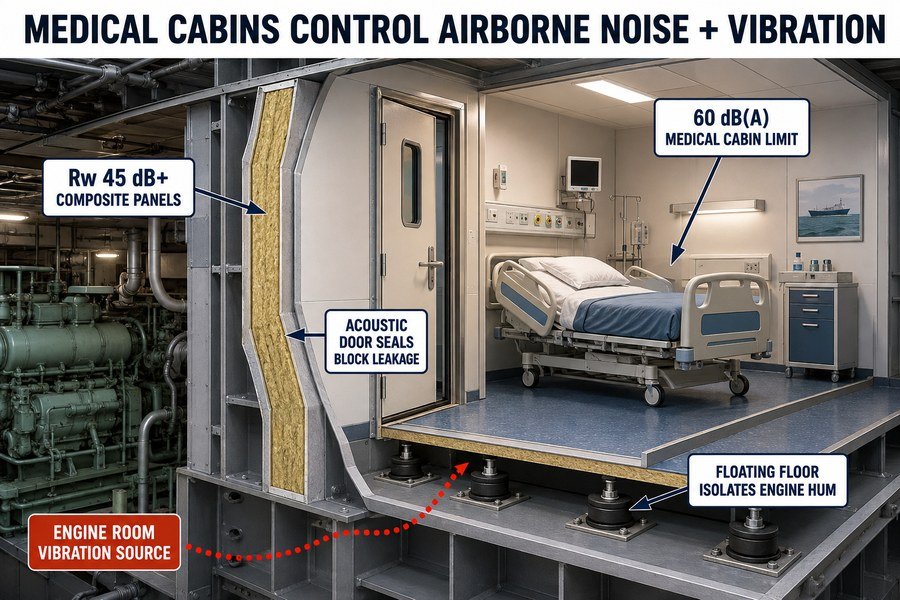
Medical cabins on a ship are very special rooms. You must protect the patients inside from two things: airborne noise and structural vibration. If you only stop the airborne noise, you will still fail the medical cabin requirements.
Airborne Noise Rules for Ship Medical Cabins
Airborne noise is the sound that travels through the air. Examples are people talking or loud machines in the next room. The IMO MSC.337(91) rule caps medical cabin noise at 60 dB(A). Doctors need a quiet space to hear heartbeats2 and talk to patients.
To stop airborne noise, you must buy heavy composite wall panels. I always recommend 50mm double-skin panels for medical rooms. These panels have an Rw rating of 45 dB or higher. You must also buy high-quality marine fire doors with acoustic seals. A standard B-15 fire door will leak sound. You need a B-15 acoustic door with an Rw 35 dB rating. This acoustic door usually costs around $450, while a normal B-15 door costs around $250.
Structural Vibration Rules for Ship Medical Cabins
Structural vibration is the sound that travels through the steel deck of the ship. The main engine causes this vibration. You cannot stop vibration with wall panels alone. You must use anti-vibration mounts for the medical cabin.
We call this a floating floor system. You place rubber or mineral wool isolators3 on the steel deck before you install the floor panels. You also use flexible rubber joints to connect the wall panels to the ceiling. A standard cabin floor costs about $30 per square meter. A floating floor for a medical cabin costs about $75 to $90 per square meter. You must pay this extra cost to meet the medical cabin standards.
| Requirement Type | Solution for Medical Cabins | Target Performance | Estimated Cost |
|---|---|---|---|
| Airborne Noise | 50mm double-skin panels | Rw ≥ 45 dB | $35 - $40 / m2 |
| Door Leakage | B-15 acoustic door | Rw 35 dB | $450 / unit |
| Structural Vibration | Floating floor with rubber isolators | Isolate engine hum | $75 - $90 / m2 |
How Do Marine Recreation Room Noise Targets Compare to Sleeping Cabin Targets?
Recreation rooms generate loud noises from televisions and games. This noise will wake up people in nearby sleeping cabins.
Recreation rooms allow higher internal noise limits of 65 dB(A) compared to sleeping cabins' 60 dB(A). However, you must use double-skin partition panels (Rw ≥ 45 dB) and perforated ceiling panels (NRC 0.6) to stop noise from leaking into adjacent sleeping areas.
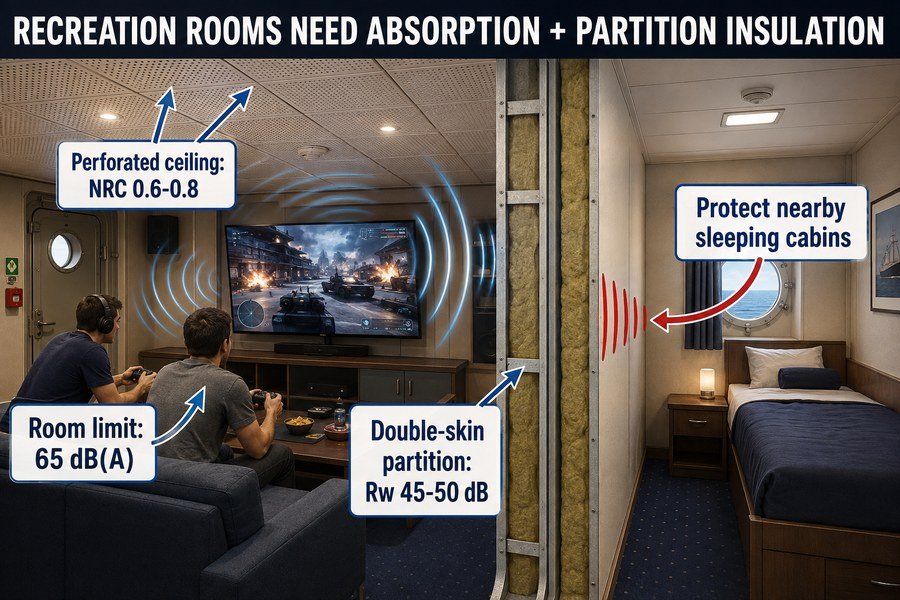
When you buy materials for a recreation room, you face a double problem. The room itself is loud, and it is often placed next to quiet sleeping cabins. You must control the noise inside the room and stop the noise from leaving the room.
Internal Noise Limits for Marine Recreation Rooms
The IMO allows a recreation room to reach 65 dB(A). Crew members play music, watch movies, and talk loudly here. The problem inside the room is echo. Hard flat wall panels make the echo worse.
To fix this, you must use perforated marine ceiling panels. A perforated panel has small holes in the metal surface. Behind the holes, there is a black acoustic tissue and rockwool. This design absorbs the sound inside the room.4 You look for a Noise Reduction Coefficient (NRC) of 0.6 to 0.8. Standard plain ceiling panels cost about $15 per square meter. Perforated ceiling panels cost about $22 to $25 per square meter. This small price increase makes the recreation room much more comfortable to use.
Partition Panel Requirements Between Recreation and Sleeping Cabins
The wall between the recreation room and the sleeping cabin is very important. This wall is called the partition bulkhead. You cannot use a standard Rw 30 dB panel here. The loud movie noise will pass right through it.
You must buy a double-skin partition panel. This panel uses two steel skins separated by an air gap and thick rockwool. It must have an Rw rating of 45 dB to 50 dB5. If you do not use this thick panel, the shipyard will fail the cabin test. I always remind buyers to check the joint profiles too. You must seal the panel joints with acoustic sealant6. A tube of marine acoustic sealant costs about $8. One tube seals about 5 meters of joints. You must not skip this step.
| Acoustic Challenge | Required Product | Performance Metric | Price Range |
|---|---|---|---|
| Internal Echo | Perforated Ceiling Panels | NRC 0.6 - 0.8 | $22 - $25 / m2 |
| Partition Leakage | Double-Skin Bulkhead Panel | Rw 45 - 50 dB | $35 - $40 / m2 |
| Joint Leakage | Marine Acoustic Sealant | Fills air gaps | $8 / tube |
Why Do Marine Galley and Mess Room Noise Limits Differ From Cabin Targets?
Kitchen equipment and metal pots make galleys the loudest rooms on the ship. Mess rooms also get noisy during daily meal times.
Galleys allow maximum noise limits of 75 dB(A) due to heavy equipment, while mess rooms allow 65 dB(A). Unlike sleeping cabins, galley panels prioritize fire safety (A-60) and stainless steel surfaces over acoustic absorption, relying on distance to protect sleeping cabins.
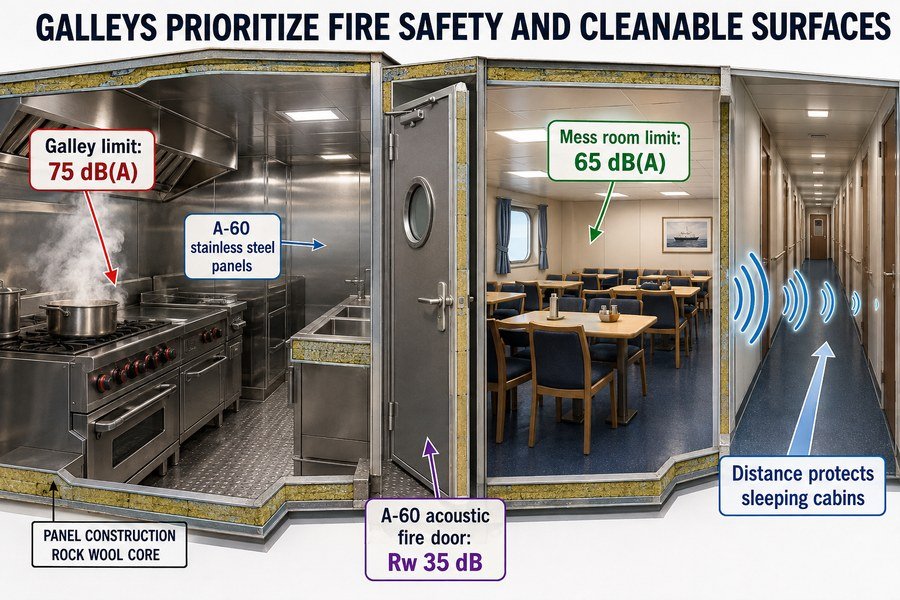
The galley and the mess room are work areas. You cannot use the same rules for these rooms that you use for sleeping cabins. The materials you buy for the galley must focus on safety and cleaning first, and noise second.
Noise and Panel Rules for Marine Galleys
The galley is the ship kitchen. The IMO rule allows the galley to reach 75 dB(A). This is very loud. But you cannot use soft acoustic panels to absorb this noise. Galley walls get covered in grease, water, and food.7 You must use stainless steel marine wall panels.
Stainless steel panels reflect sound, so they do not help lower the noise inside the room. But they are easy to wash. Also, galleys have a high fire risk. You must use A-60 fire-rated panels for the galley walls. An A-60 stainless steel panel is heavy and expensive. It costs about $65 to $80 per square meter. Because the panels reflect sound, the shipyard protects the sleeping cabins by placing the galley far away from the bedrooms. You rely on physical distance, not just wall panels.
Noise and Panel Rules for Marine Mess Rooms
The mess room is the dining room for the crew. It sits right next to the galley. The IMO limit for the mess room is 65 dB(A).
Because the mess room is next to the loud galley, the door between them is critical. You must buy an A-class acoustic fire door. An A-60 door with an Rw 35 dB rating will block the galley noise from entering the mess room. This door usually costs around $800 to $1,200. For the mess room walls, you can use standard PVC-coated galvanized steel panels. You do not need stainless steel here. Standard panels (Rw 30 dB) at $18 per square meter will work perfectly for the mess room.
| Room Type | IMO Noise Limit | Required Panel Surface | Fire Rating | Cost Estimate |
|---|---|---|---|---|
| Galley | 75 dB(A) | Stainless Steel | A-60 | $65 - $80 / m2 |
| Mess Room | 65 dB(A) | PVC Coated Steel | B-15 | $18 - $22 / m2 |
| Galley Door | N/A | Painted Steel | A-60 (Rw 35) | $800 - $1,200 / unit |
How Does Cabin Type Affect the Acoustic Requirements for Marine Bulkhead Panels?
Buying the same bulkhead panel for the whole ship wastes your money. You must match the panel to the specific cabin function.
Cabin type determines bulkhead acoustic requirements in three ways: sleeping cabins need high sound insulation panels (Rw 45 dB), machinery spaces need fire-rated sound barriers (Rw 50 dB), and wet units need moisture-proof panels (Rw 30 dB). Buying based on these three needs controls your budget.
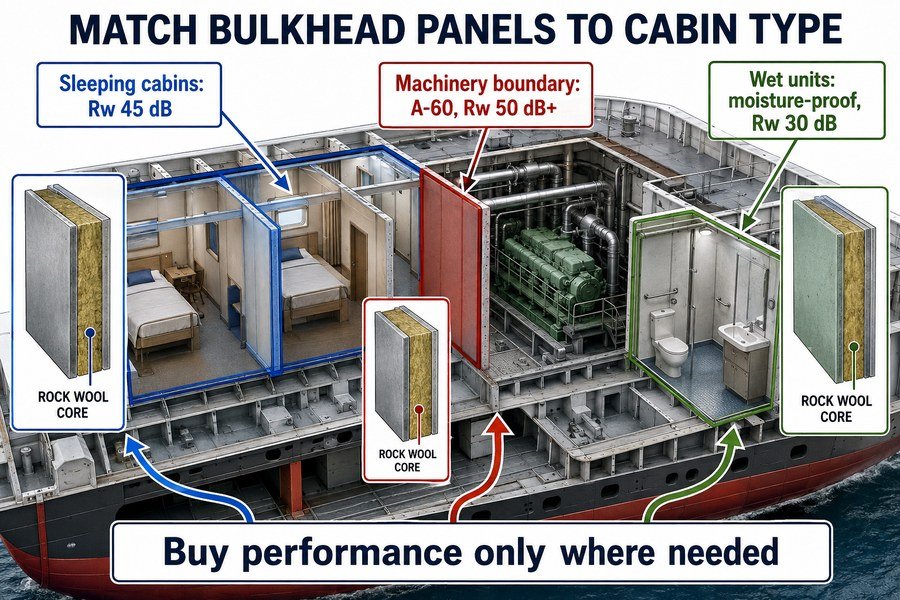
I help many procurement officers save money. The secret is simple: do not over-buy. You must look at the ship drawing and separate the cabins into three main types. Then, you buy three different types of bulkhead panels.
High Sound Insulation Panels for Sleeping Cabins
As we discussed, sleeping cabins require high acoustic performance. You buy Rw 45 dB panels for the walls between two sleeping cabins. This stops crew members from hearing each other. You spend the higher price of $35 to $40 per square meter only where you need it.
Fire-Rated Sound Barriers for Machinery Spaces
The wall between a cabin and the engine room is the most important wall on the ship. The engine room is deafening. The IMO says the engine room can be 110 dB(A). You must block this noise before it hits the cabin. You must buy an A-60 fire-rated sound barrier.8 This is a very thick panel, often 100mm thick. It provides an Rw rating of 50 dB or more. These panels cost about $90 to $110 per square meter. You only buy these panels for the exact boundary line next to the machinery spaces.
Moisture-Proof Panels for Wet Units
Wet units are the bathrooms inside the cabins. The noise inside a wet unit is just the shower and the toilet. The IMO limit for sanitary spaces is 60 dB(A). You do not need high acoustic panels here.
Instead, you need moisture-proof panels. You buy thin, 25mm marine wall panels with an Rw rating of just 30 dB. The rockwool inside must be packed in plastic film so it does not absorb water. These 25mm panels cost about $15 to $17 per square meter. By using these cheap panels for the bathrooms, you balance out the high cost of the engine room panels. This is how you control your project profit.
| Cabin / Area Type | Primary Panel Requirement | Rw Target | Typical Price |
|---|---|---|---|
| Sleeping Cabins | High Sound Insulation | Rw 45 dB | $35 - $40 / m2 |
| Machinery Spaces | Fire-Rated Sound Barrier | Rw ≥ 50 dB | $90 - $110 / m2 |
| Wet Units | Moisture-Proof Core | Rw 30 dB | $15 - $17 / m2 |
Conclusion
Choosing the right marine panels for each cabin type helps you meet strict IMO noise rules, saves your money, and ensures crew comfort. Buy smart and your interior projects will succeed.
-
"How to Match a Marine Accommodation Panel System to the ...", https://magellanmarinetech.com/how-match-marine-accommodation-panel-system-to-the-correct-noise-path/. Acoustics literature defines the weighted sound reduction index, Rw, as a laboratory measure of airborne sound insulation for building or partition elements and shows that higher Rw values correspond to greater airborne sound attenuation; this supports the relevance of specifying Rw for marine cabin partitions. Evidence role: mechanism; source type: paper. Supports: Marine sleeping cabin panels need substantially higher airborne sound insulation, expressed as an Rw rating, to help meet lower cabin noise limits.. Scope note: This source would support the acoustic meaning of Rw and its relationship to sound insulation, but it would not by itself prove that 45-50 dB is mandatory or sufficient for every ship cabin installation. ↩
-
"Design and Comparative Performance of a Robust Lung ...", https://pmc.ncbi.nlm.nih.gov/articles/PMC8374873/. Clinical studies on cardiac auscultation report that ambient noise can reduce clinicians' ability to perceive heart sounds and murmurs, supporting the need for quiet examination conditions. Evidence role: expert_consensus; source type: paper. Supports: Doctors need a quiet space to hear heartbeats and communicate with patients.. Scope note: The evidence concerns medical listening performance in general clinical settings and does not by itself establish a ship-specific cabin noise limit. ↩
-
"A Constrained Layer Damping Perspective on Floating Floor ...", https://pmc.ncbi.nlm.nih.gov/articles/PMC13363800/. Acoustic engineering references describe floating floors as floor layers separated from the structural slab or deck by resilient materials such as rubber, springs, or mineral wool to reduce impact and structure-borne sound transmission. Evidence role: definition; source type: education. Supports: A floating floor system uses resilient isolators, such as rubber or mineral wool, between the steel deck and floor panels to reduce vibration transmission.. Scope note: This supports the concept and materials used in floating floors generally; actual isolation performance depends on system design, loading, and installation quality. ↩
-
"Exploring the acoustic potential of 3D printed micro-perforated ...", https://pmc.ncbi.nlm.nih.gov/articles/PMC11004209/. Acoustics research on perforated facings backed by porous absorbers explains that sound energy entering the perforations is dissipated in the backing material and cavity, supporting the stated absorption mechanism. Evidence role: mechanism; source type: paper. Supports: A perforated metal panel with acoustic tissue and rockwool backing absorbs sound inside the room.. Scope note: The actual absorption depends on hole size, perforation ratio, air cavity depth, backing material, and installation details. ↩
-
"How to Match a Marine Accommodation Panel System to the ...", https://magellanmarinetech.com/how-match-marine-accommodation-panel-system-to-the-correct-noise-path/. Marine habitability and building-acoustics guidance commonly treats higher weighted sound reduction values as necessary where noisy communal spaces adjoin sleeping areas, providing contextual support for an Rw range around 45-50 dB. Evidence role: expert_consensus; source type: institution. Supports: The partition between a recreation room and a sleeping cabin should have an Rw rating of 45 dB to 50 dB.. Scope note: A source may support the range as design guidance rather than as a universal statutory requirement for every vessel or flag state. ↩
-
"Study on sound insulation performance of walls in traditional ...", https://pmc.ncbi.nlm.nih.gov/articles/PMC12979663/. Building-acoustics literature shows that small gaps and unsealed joints can substantially reduce the effective sound insulation of partitions by allowing airborne leakage paths. Evidence role: mechanism; source type: research. Supports: Panel joints should be sealed with acoustic sealant to prevent sound leakage.. Scope note: The source would support the importance of sealing joints generally; the exact sealant type and quantity required are installation-specific. ↩
-
"Food - Guide to Ship Sanitation - NCBI Bookshelf - NIH", https://www.ncbi.nlm.nih.gov/books/NBK310826/. Food-safety and ship-sanitation guidance describes galley food-preparation areas as wet, washable environments where surfaces must resist contamination and be readily cleanable, providing contextual support for using nonporous washable wall finishes. Evidence role: general_support; source type: government. Supports: Marine galley walls are exposed to grease, water, and food residues and therefore require cleanable surfaces.. Scope note: Such guidance supports the hygiene rationale for cleanable surfaces but may not mandate stainless steel wall panels specifically for all marine galleys. ↩
-
"How to choose the right marine fire door for different ship ...", https://magellanmarinetech.com/how-to-choose-right-marine-fire-door-for-different-ship-compartments/. SOLAS Chapter II-2 and the IMO Fire Test Procedures Code define A-class divisions, including A-60 insulation performance, and require fire-resisting separation for machinery-space boundaries in relevant ship arrangements; the exact rating is determined by the vessel's approved fire-control design and applicable class rules. Evidence role: definition; source type: institution. Supports: A-60 fire-rated divisions are relevant for boundaries involving machinery spaces.. Scope note: Supports the regulatory meaning and common use of A-60 divisions, but the article's absolute "must buy" claim depends on the specific ship layout and governing rules. ↩