Are crew complaints about engine noise ruining your interior projects? Choosing the wrong marine panels causes failed inspections. Let me show you the hidden noise errors you must avoid.
Marine panel selection mistakes stem from three core cabin noise errors: applying universal noise targets across different zones, misreading structural-borne versus airborne noise limits, and ignoring specific acoustic ratings for mixed-use accommodations, leading to non-compliant, noisy vessel interiors under IMO regulations.
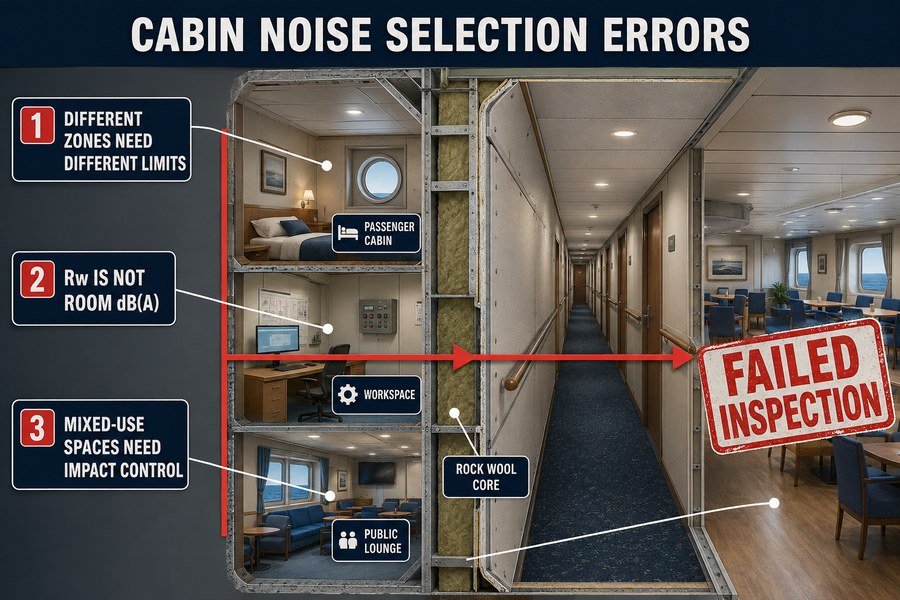
When you buy marine wall and ceiling panels, getting the fire rating right is easy. But getting the acoustic rating right is where I see most buyers waste money.
Why Does a Universal Cabin Noise Target Cause Marine Panel Failures?
Do you buy the same 45dB acoustic panels for the whole ship? This one-size-fits-all habit wastes your budget and causes major sea trial failures.
Using a universal cabin noise target causes marine panel failures because IMO regulations mandate different limits: 60 dB(A) for workspaces, 55 dB(A) for passenger cabins, and 65 dB(A) for public spaces. Applying one rating means under-protecting noisy zones and over-spending on quiet zones.
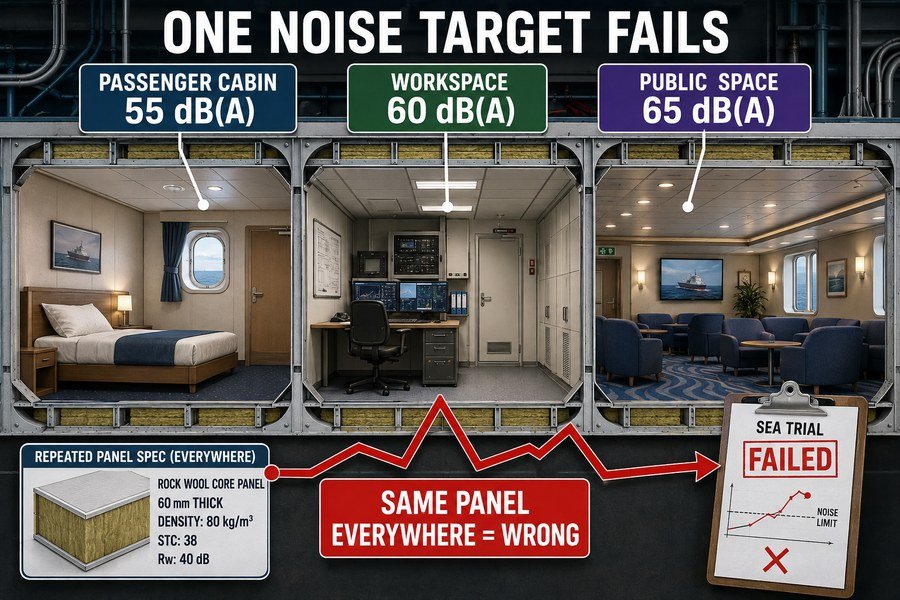
Many buyers think they can simplify their purchasing by choosing one acoustic panel for the entire ship. This is a big mistake. You cannot use the same panel for every room. I will explain why this causes failures and wastes money.
IMO Resolution MSC.337(91) Noise Limits for Workspaces
The International Maritime Organization (IMO) publishes strict rules for ship noise. The rule is called IMO Resolution MSC.337(91). This rule sets specific noise limits for different spaces on a ship. For workspaces, such as the engine control room or the navigation bridge, the maximum allowed noise level is 60 dB(A). These areas are very close to loud machinery. If you use a basic panel designed for a quiet room, the noise in the workspace will exceed 60 dB(A). The ship will fail the inspection. You must buy heavy acoustic panels with a Sound Reduction Index (Rw)1 of at least 40 dB for these workspaces. These heavy panels usually cost around $35 to $45 per square meter.
IMO Resolution MSC.337(91) Noise Limits for Living Quarters and Public Spaces
The IMO rules for passenger cabins and public spaces are different. Passenger cabins must be very quiet. The limit for a standard passenger cabin is 55 dB(A). However, public spaces, like dining rooms or lounges, allow more noise. The limit for public spaces is 65 dB(A). If you buy the expensive $45 heavy acoustic panel for a public space, you waste a lot of money. A standard 50mm rockwool panel costs about $20 per square meter. This standard panel is perfectly fine for a public space. I once helped a client who bought high-acoustic panels for a whole deck. We changed the order to match the specific IMO limits for each room. He saved $15,000 on one vessel just by buying standard panels for the public spaces.
| Ship Zone Type | IMO MSC.337(91) Noise Limit | Required Panel Rw Range | Estimated Panel Price per SQM |
|---|---|---|---|
| Passenger Cabins | 55 dB(A) | 30 dB to 35 dB | $20 - $25 |
| Workspaces | 60 dB(A) | 35 dB to 40 dB | $25 - $35 |
| Public Spaces | 65 dB(A) | 25 dB to 30 dB | $18 - $20 |
How Does Misreading Cabin Noise Limits Lead to Under-Rated Marine Bulkhead Panels?
Are you matching the panel's test report exactly to the room's noise limit? This common mistake leaves you with cabins that are too loud.
Misreading cabin noise limits leads to under-rated marine bulkhead panels because buyers confuse the room's total noise limit (e.g., 55 dB) with the panel's Sound Reduction Index (Rw). You must calculate the noise source (e.g., 85 dB) minus the room limit to find the true required panel Rw (30 dB).
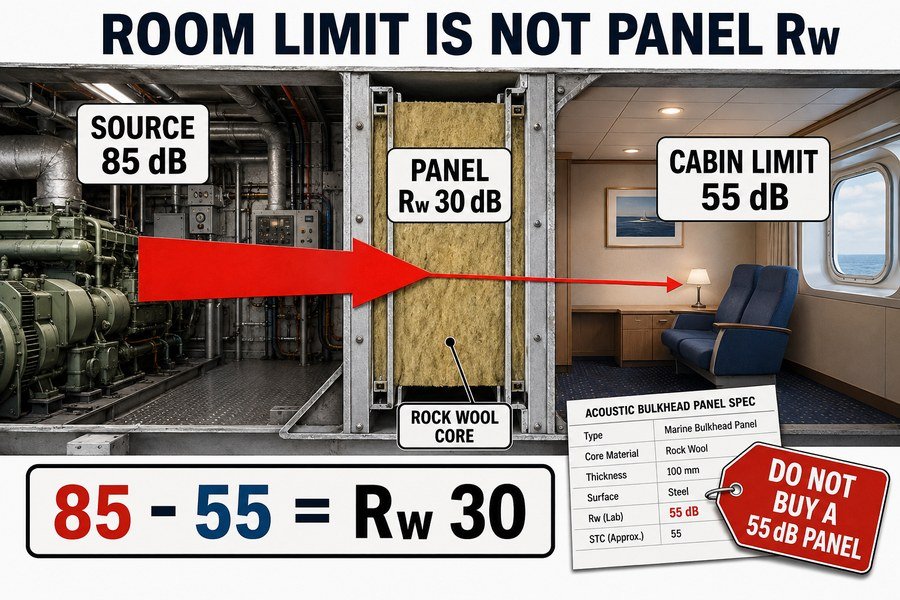
I see buyers make this mathematical error every week. They look at the IMO rule, they see a number, and they ask me for a panel with that exact number. This shows a basic misunderstanding of how acoustic physics work on a ship.
Understanding the Sound Reduction Index (Rw) of Marine Panels
Every marine panel has a Sound Reduction Index. We call this the Rw value. The Rw value tells you how much noise the panel blocks.2 It does not tell you the noise level inside the room. For example, a standard 50mm marine wall panel has an Rw of 30 dB.3 This means if 80 dB of noise hits one side of the panel, only 50 dB comes out the other side. Many buyers look at a cabin noise limit of 55 dB and ask suppliers for a "55 dB panel". A panel with an Rw of 55 dB is basically a thick steel wall with heavy insulation. It requires a double-skin setup with air gaps and costs over $70 per square meter. You almost never need an Rw 55 dB panel for standard marine outfitting.
Calculating the Actual Rw Needed from the Noise Source
To buy the right panel, you must do a simple calculation. You take the source noise and subtract the target cabin limit. The result is your required panel Rw. Let me give you a clear example. The engine room produces 85 dB of noise. The passenger cabin next to it has a legal limit of 55 dB. You subtract 55 from 85. The answer is 30. You need a panel that stops 30 dB of noise. You need a panel with an Rw of 30 dB. This panel costs about $20 per square meter. You do not need a 55 dB panel. If you make this calculation error, you will either buy panels that are too weak (and fail inspections) or buy panels that are far too heavy and expensive. Always ask the shipyard for the noise source level before you buy the interior panels.
| Noise Source Area | Target Cabin Limit | Calculation (Source - Target) | Actual Panel Rw Needed |
|---|---|---|---|
| Engine Room (85 dB) | Passenger Cabin (55 dB) | 85 - 55 | 30 dB |
| Generator Room (90 dB) | Workspace (60 dB) | 90 - 60 | 30 dB |
| Lounge Area (75 dB) | Crew Cabin (60 dB) | 75 - 60 | 15 dB |
What Happens When Marine Panels Are Specified Without Checking Cabin Noise Categories?
Have you ever installed expensive panels only to find the crew still cannot sleep? Skipping the noise category check leads to exactly this disaster.
When marine panels are specified without checking cabin noise categories, you face three severe consequences: regulatory failure during SOLAS sea trials, crew health issues like hearing damage, and expensive post-installation rework requiring additional floating floors or heavy viscoelastic damping layers.
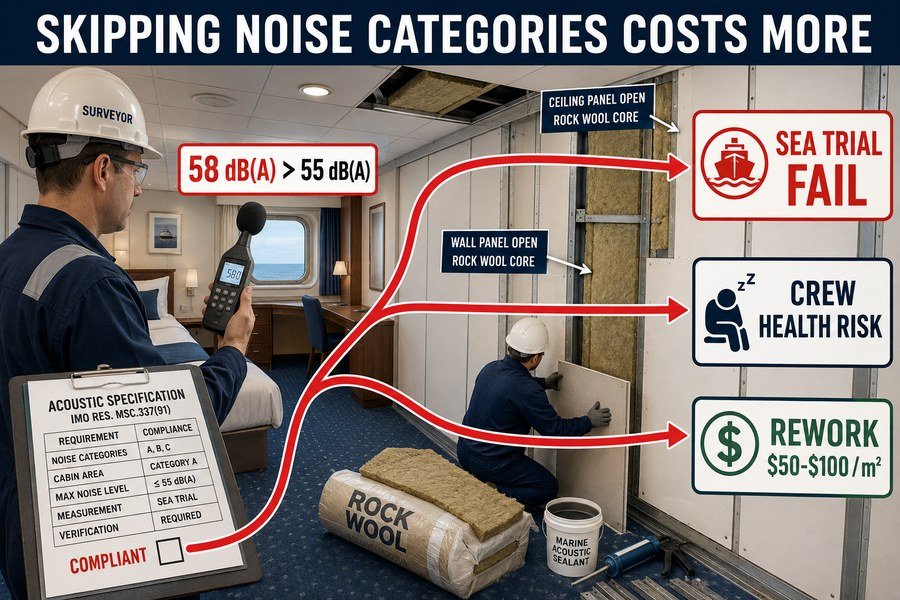
Skipping the acoustic check is dangerous. You cannot fix acoustic problems with a quick coat of paint. Once the panels are installed, the mistakes become permanent or very expensive to fix. Let me break down the three main consequences of this error.
Regulatory Sea Trial Failures Under SOLAS
The first consequence is failing the sea trial. The Safety of Life at Sea (SOLAS) convention requires strict noise testing. When the ship is finished, surveyors from classification societies like DNV or Lloyd's Register come on board. They bring expensive sound level meters. They turn on the engines and measure the noise in every room. If the noise category requires 55 dB(A) and the meter reads 58 dB(A), you fail. The classification society will not issue the passenger ship safety certificate. The ship cannot sail. You cannot argue with the sound meter. I have seen interior contractors lose their final project payments because the ship failed this test.
Health Risks and Costly Rework for Acoustic Failures
The second consequence involves human health. IMO rules exist to protect human ears. Exposure to noise levels above 85 dB(A) for 8 hours causes permanent hearing damage. Even constant noise at 65 dB(A) in a sleeping cabin causes extreme stress and fatigue for the crew4.
The third consequence is the financial cost of rework. If you fail the sea trial, you must fix it. You cannot just add another thin panel. You must tear down the ceiling panels and wall panels. You usually have to buy and install heavy viscoelastic damping materials. These materials stick to the steel bulkhead to stop vibrations. Buying and installing these fix-it materials costs between $50 and $100 per square meter. It also delays the ship delivery by weeks. You pay penalties to the shipyard for every day you are late. Checking the noise categories first saves you from this nightmare.
| Consequence of Error | Direct Impact on Project | Financial Cost Estimate |
|---|---|---|
| Regulatory Failure | No safety certificate, ship cannot sail | Loss of final project payment (20-30%) |
| Health Issues | Crew fatigue, hearing damage | Legal liabilities, poor company reputation |
| Post-Installation Rework | Tearing down panels, adding damping | $50 - $100 per square meter + delay penalties |
How to Verify a Marine Panel Truly Meets Its Cabin Noise Performance Level?
Do you trust the supplier's word on acoustic performance? False claims will cost you the whole project. You must verify the numbers yourself.
To verify a marine panel truly meets its cabin noise performance level, you must check three specific documents: an ISO 10140 laboratory acoustic test report, a Type Approval Certificate from a recognized classification society, and the actual rockwool core density, which must be at least 120 kg/m³.
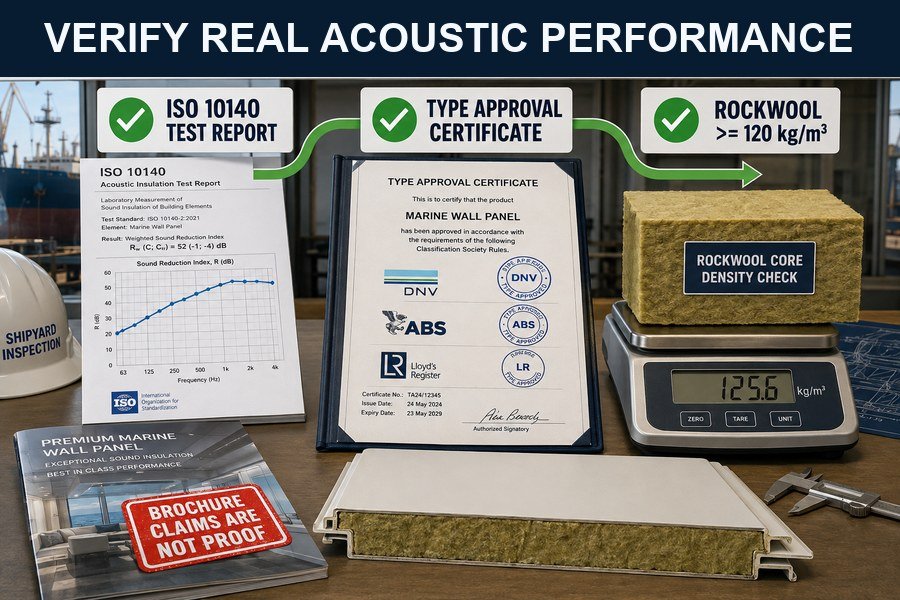
Many suppliers lie about acoustic performance. They know that buyers cannot test the panels in their office. They put fake numbers on their brochures. As an outfitting specialist, I never believe a brochure. I check three specific things to prove the panel actually works.
Checking ISO 10140 Laboratory Acoustic Test Reports
First, you must ask for the ISO 10140 laboratory acoustic test report5. This is the international standard test for sound insulation. (Some older reports use the name ISO 140, but ISO 10140 is the current standard). This report is a multi-page document from an independent testing lab. It shows a graph of the panel's performance across different sound frequencies, from 100 Hz up to 3150 Hz. The report gives you the official Rw value. If the supplier only gives you a one-page paper with a single number, do not trust them. You need the full frequency graph to prove the lab actually tested the panel.
Verifying Class Society Certificates and Rockwool Density
Second, you must check the Type Approval Certificate. This certificate comes from a classification society like DNV, ABS, or Bureau Veritas. This certificate proves the panel is approved for marine use. It lists the fire rating (like B-15) and usually lists the acoustic Rw rating.
Third, you must check the rockwool core density. This is the most practical check. Acoustic performance comes from mass. Heavy panels block more noise.6 A cheap panel uses rockwool with a density of 80 kg/m³. This low density fails noise tests. For decent acoustic performance (Rw 30 dB), the rockwool density must be at least 120 kg/m³. If you need higher performance (Rw 35 dB), the density must be 150 kg/m³. Always ask the supplier to write the rockwool density on the proforma invoice. If they deliver lighter panels, you have the right to reject the cargo.
| Verification Item | What to Look For | Why It Matters |
|---|---|---|
| ISO 10140 Test Report | Full frequency graph (100Hz to 3150Hz) | Proves the panel was actually tested in a real lab |
| Type Approval Certificate | DNV, ABS, or BV stamp with Rw value | Proves the panel meets international marine standards |
| Rockwool Core Density | Minimum 120 kg/m³ on the invoice | Ensures the panel has enough physical mass to block noise |
Why Do Mixed-Use Marine Accommodations Need Different Panel Acoustic Ratings?
Do you build a gym next to a sleeping cabin using the same wall panels? This layout mistake will ruin the passengers' experience.
Mixed-use marine accommodations need different panel acoustic ratings because adjacent spaces transfer two distinct noise types: airborne noise (voices) and structure-borne noise (gym weights). High-impact zones require floating floors and double-skin panels (Rw > 45 dB), while standard cabins only need single-skin panels (Rw ~ 30 dB).
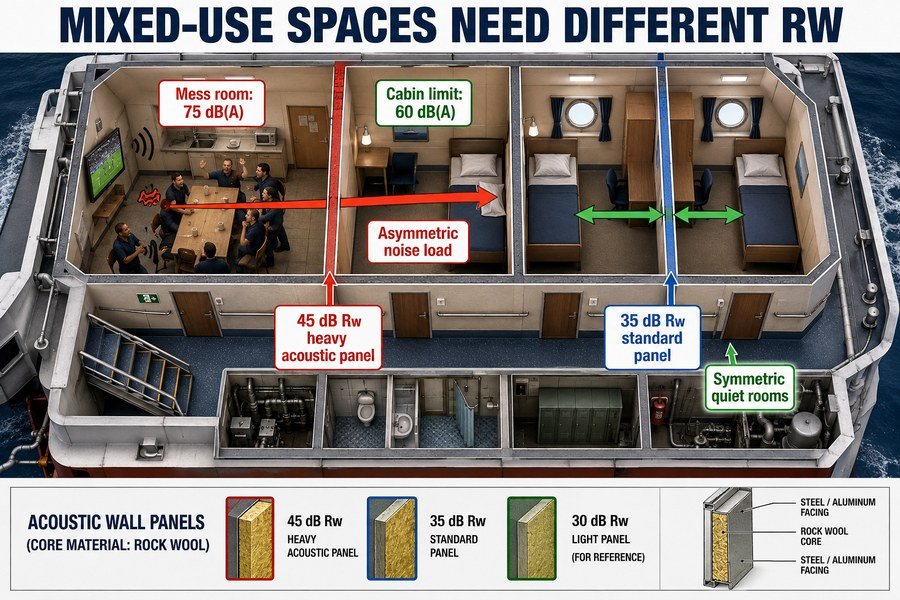
Ship space is very tight.7 Naval architects put gyms, bars, and sleeping cabins right next to each other. This creates a huge acoustic problem. You must understand how noise moves to pick the right panels for these mixed-use areas.
Blocking Airborne Noise in Standard Passenger Cabins
The first type of noise is airborne noise. This is noise that travels through the air. Examples include people talking, music playing, or a television. This noise hits the wall panel directly. For standard passenger cabins next to a quiet corridor, airborne noise is the only problem. You can block airborne noise easily. A standard 50mm single-skin composite panel stops this noise well. This panel gives you an Rw of about 30 to 35 dB. It is lightweight, easy to install, and costs only $20 to $25 per square meter.
Stopping Structure-Borne Noise in High-Impact Zones
The second type of noise is structure-borne noise. This is the dangerous one. Structure-borne noise happens when something hits the ship's steel structure. Examples include heavy gym weights dropping on the floor, or engine vibrations shaking the steel deck. This vibration travels through the steel and turns into noise inside the cabin. A standard panel cannot stop this. For high-impact zones, you must use decoupled systems. You need a floating floor. For the walls, you need double-skin bulkhead panels. A double-skin panel uses two separate 25mm panels with a 20mm air gap between them. The air gap stops the vibration from crossing over. These double-skin setups provide an Rw of 45 to 50 dB. They are expensive, costing $50 to $65 per square meter. I always tell my clients to spend their money only on the partition wall between the loud zone and the quiet zone. Use cheap single-skin panels for the other walls. This keeps your quality high and your budget low.
| Noise Type | Common Sources | Panel Type Required | Estimated Cost |
|---|---|---|---|
| Airborne Noise | Voices, Music, TV | Single-skin panel (50mm, Rw 30-35 dB) | $20 - $25 / sqm |
| Structure-Borne Noise | Gym weights, Engine vibration | Double-skin panel with air gap (Rw 45-50 dB) | $50 - $65 / sqm |
Conclusion
Selecting marine panels requires accurate acoustic calculations, not just fire ratings. By matching the right panel Rw to the specific room's noise limits, you ensure quality and save budget.
-
"Analysis between weighted sound reduction index according to ISO ...", https://www.academia.edu/21437199/Analysis_between_weighted_sound_reduction_index_according_to_ISO_717_1_and_indices_according_to_ISO_16717_1. Acoustics standards and building-acoustics references define the weighted sound reduction index, Rw, as a single-number rating of airborne sound insulation, supporting the use of Rw as a panel-performance metric. Evidence role: definition; source type: education. Supports: Ship acoustic panels can be specified using Sound Reduction Index (Rw), and higher Rw values indicate stronger airborne sound insulation performance.. Scope note: Such sources define and contextualize Rw but do not by themselves prove that a particular ship workspace requires panels of at least 40 dB Rw. ↩
-
"Sound reduction index - Wikipedia", https://en.wikipedia.org/wiki/Sound_reduction_index. A standard acoustics reference or ISO 717 summary supports that the weighted sound reduction index, Rw, is a single-number laboratory rating of airborne sound insulation for a building element, expressed in decibels. Evidence role: definition; source type: institution. Supports: Rw indicates the sound-insulating performance of a panel rather than the final noise level inside a room.. Scope note: Rw is measured under standardized laboratory conditions and does not by itself predict the actual receiving-room sound pressure level on board a vessel. ↩
-
"How Does Installation Affect Marine Wall Panel STL? - Magellan ...", https://magellanmarinetech.com/how-installation-affect-marine-wall-panel-stl/. A laboratory test report, classification document, or research source for marine sandwich/accommodation panels can support that some 50 mm marine wall panel constructions have weighted sound reduction indices around 30 dB. Evidence role: general_support; source type: research. Supports: A typical 50 mm marine wall panel may have an Rw value of about 30 dB.. Scope note: The value is construction-specific; core material, skins, joints, mounting, and test method can produce different Rw results for panels of the same nominal thickness. ↩
-
"Noise and sleep on board vessels in the Royal Norwegian Navy - PMC", https://pmc.ncbi.nlm.nih.gov/articles/PMC4918679/. WHO and environmental-noise research link nighttime noise exposure with sleep disturbance and related health effects, providing contextual support for the claim that sustained cabin noise can contribute to fatigue and stress. Evidence role: expert_consensus; source type: institution. Supports: Sustained noise in sleeping areas can impair sleep and contribute to stress or fatigue.. Scope note: Such sources generally address sleep disturbance and health risk from environmental noise broadly; they may not directly prove the intensity of effects for maritime crew at exactly 65 dB(A). ↩
-
"Sound insulation dataset of 30 wooden and 8 concrete floors ...", https://pmc.ncbi.nlm.nih.gov/articles/PMC10365936/. ISO 10140 is the international laboratory measurement standard for determining airborne sound insulation of building elements under controlled test conditions. Evidence role: definition; source type: institution. Supports: ISO 10140 is the relevant international laboratory test standard for sound insulation reports.. Scope note: The standard establishes the laboratory method; it does not by itself verify the authenticity of any supplier’s individual report. ↩
-
"Sound transmission properties of mineral-filled high-density ...", https://bioresources.cnr.ncsu.edu/resources/sound-transmission-properties-of-mineral-filled-high-density-polyethylene-hdpe-and-wood-hdpe-composites/. The mass law of sound insulation states that, for a single homogeneous barrier in the stiffness-controlled range, sound transmission loss generally increases as surface mass increases. Evidence role: mechanism; source type: education. Supports: Heavier panels generally provide greater airborne sound insulation because increased surface mass reduces sound transmission.. Scope note: This is a general acoustic principle; actual panel performance also depends on construction, sealing, stiffness, cavities, core material, and flanking transmission. ↩
-
"Naval Architecture | SUNY Maritime College", https://www.sunymaritime.edu/program/naval-architecture. A naval-architecture or ship-design source should document that ship layouts are constrained by limited volume, weight, safety zones, and operational requirements, providing context for why dissimilar accommodation and amenity spaces may be placed close together. Evidence role: general_support; source type: education. Supports: Shipboard space constraints force naval architects to place different passenger-use areas close together.. Scope note: This would support the general design constraint rather than prove that gyms, bars, and cabins are always adjacent on specific vessels. ↩