Shipowners demand quieter cabins, making standard panels obsolete. Losing bids because your noise limits fall short hurts your profits. Here is how upgraded requirements change the panel standards.
Owner requirements raise cabin noise standards by enforcing strict contractual limits (often 5 to 10 dB lower than IMO codes), demanding voluntary comfort class notations (like DNV SILENT or Lloyd's Register CAC), and mandating high-acoustic-reduction marine panels to ensure premium passenger and crew comfort.
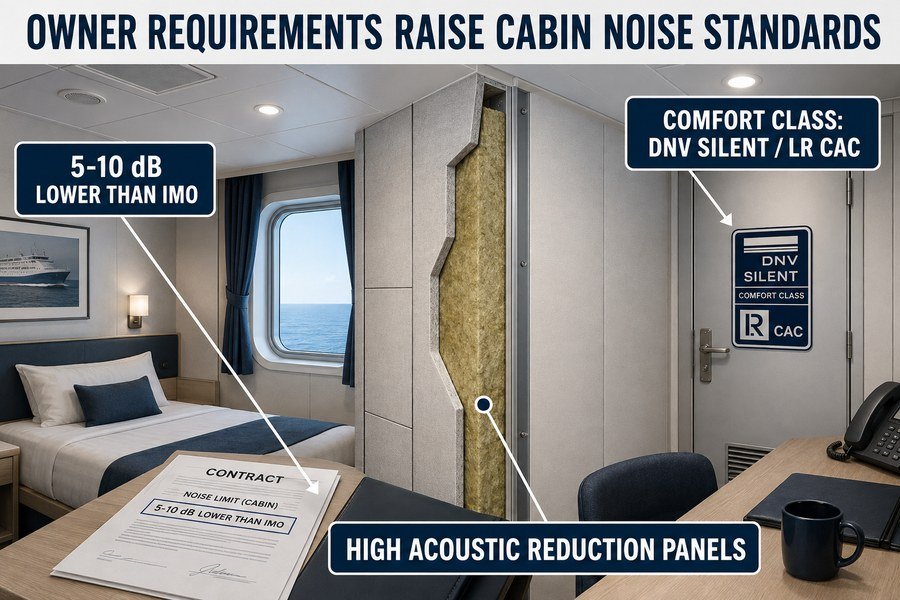
Let us look closer at the specific reasons why shipowners push for these stricter limits.
Why Do Some Marine Projects Specify Cabin Noise Limits Stricter Than Regulations?
Meeting basic IMO rules is not enough today. If crews suffer fatigue or passengers complain about noise, the ship loses its value. Here is why projects demand more.
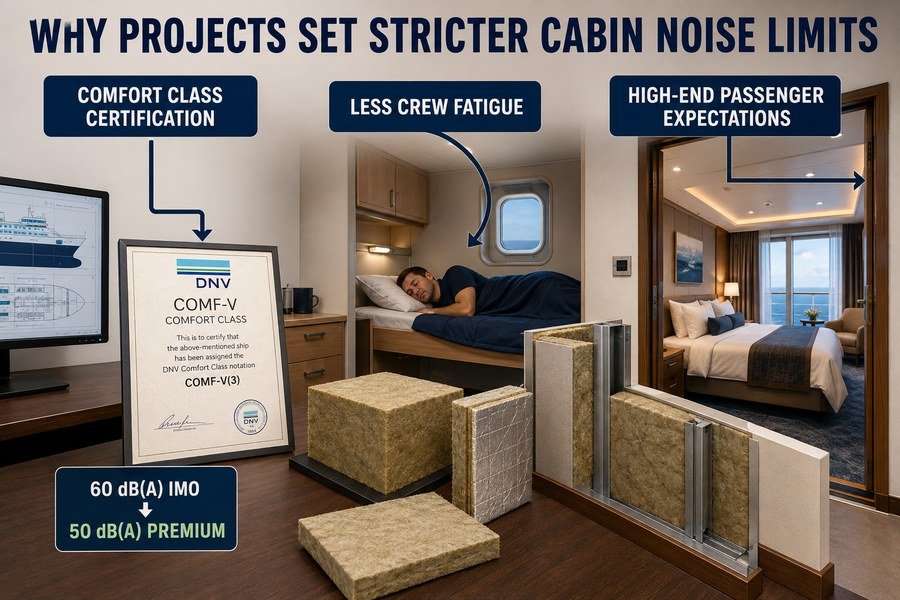
Marine projects specify stricter cabin noise limits for three main reasons: to secure voluntary comfort class certifications (improving charter rates), to reduce crew fatigue (enhancing safety and retention), and to meet high-end passenger expectations on luxury cruise ships or specialized offshore vessels.
As a marine outfitting specialist, I often see shipyards struggle when shipowners demand noise levels far below the mandatory limits. Standard regulations, like the International Maritime Organization (IMO) MSC.337(91) code, set the absolute legal baseline for safety. But this baseline is often too loud for modern commercial expectations. You must understand the three specific reasons why owners push these limits lower.
Driving Charter Rates with Voluntary Comfort Class Certifications
The first reason is voluntary comfort class certifications. Classification societies like DNV offer the COMF-V notation, and Lloyd's Register offers the CAC (Crew Accommodation Comfort) notation. Shipowners want these certifications because a certified quiet ship commands higher daily charter rates. For example, the IMO MSC.337(91) code allows up to 60 dB(A) for standard crew cabins. But to get the top DNV COMF-V(1) rating, the cabin noise must not exceed 50 dB(A). That 10 dB(A) difference is massive. It means the acoustic energy inside the room is cut in half. Owners will happily pay a premium for better marine wall panels if it secures a comfort class notation that makes their vessel more profitable over the next twenty years.
Reducing Crew Fatigue and Meeting Passenger Expectations
The second reason is crew fatigue. High noise levels ruin sleep quality. According to safety studies by the IMO, crew fatigue is a leading cause of maritime accidents1. Lowering the noise limit from 60 dB(A) to 50 dB(A) helps crews sleep better, which improves safety and helps shipowners retain good sailors.
The third reason applies to passenger ships. Luxury cruise ships and high-end offshore vessels must meet high passenger expectations. A passenger paying $5,000 for a cruise ticket will not accept a cabin that sounds like an engine room. To keep ticket sales high, owners mandate ultra-quiet acoustic environments, forcing procurement teams to source high-performance marine outfitting materials instead of basic standard panels.
| Reason for Strict Limits | Beneficiary | Resulting Action Required by Shipyard |
|---|---|---|
| Voluntary Comfort Class (e.g., DNV COMF-V) | Shipowners (Higher charter rates) | Upgrade to high Rw-rated wall and ceiling panels |
| Crew Fatigue Reduction | Crew (Safety and retention) | Increase core material density in cabin partitions |
| High-End Passenger Expectations | Passengers (Cruise/Offshore comfort) | Install floating floors and premium acoustic doors |
How Does a Lower Contractual Cabin Noise Target Affect Marine Panel Selection?
A lower noise target instantly limits your material choices. Buying standard panels will lead to failed acoustic tests. Here is how it changes your panel selection.
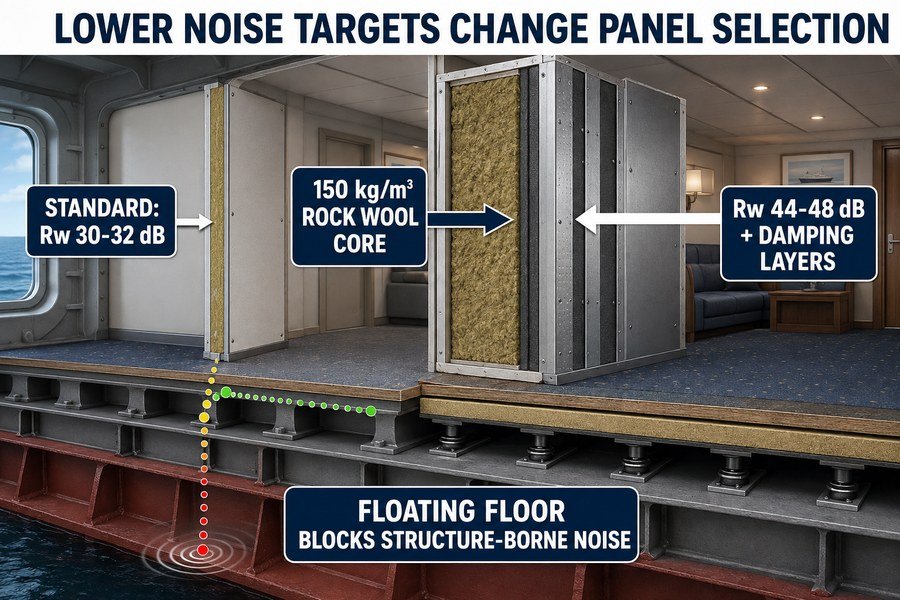
A lower contractual cabin noise target affects marine panel selection by requiring higher Sound Reduction Indices (Rw values), mandating thicker rock wool core densities (up to 150 kg/m³), introducing damping layers or perforated surfaces, and necessitating floating floor systems to block structure-borne noise.
When you sign a contract with a lower cabin noise target, you cannot just buy the cheapest B-15 marine wall panel on the market. The acoustic physics will not allow it. I always tell my clients that dropping the target noise level by even 3 dB(A)2 requires a complete change in panel specifications. You must look at four specific technical changes to meet these tough requirements.
Upgrading Sound Reduction Indices (Rw) and Rock Wool Densities
First, you must select panels with higher Sound Reduction Indices (Rw). Standard marine composite panels usually offer an Rw value between 30 dB and 32 dB3. If your contract requires a low noise target, you need panels tested to an Rw of 44 dB to 48 dB.
Second, to reach these higher Rw values, the rock wool density inside the panel must change. Standard marine panels use a rock wool core density of around 100 kg/m³ to 120 kg/m³. For enhanced acoustic control, you must buy panels with a rock wool density of at least 150 kg/m³. The heavier, denser core does a much better job of absorbing low-frequency engine rumbles.
Adding Damping Layers and Floating Floors for Structure-Borne Noise
Third, you must introduce damping layers. Sound travels through the steel skins of the panel. Premium acoustic panels feature a visco-elastic damping layer glued between two thin steel sheets4. This constrained layer damping converts vibration energy into heat. Sometimes, panels also use perforated steel surfaces on one side to absorb sound rather than reflect it.
Fourth, you must use floating floor systems. You can have the best wall panels in the world, but if the floor vibrates, the cabin will be loud. Floating floors place the top deck layer on top of dense mineral wool5 (often 140 kg/m³ to 200 kg/m³), disconnecting the cabin from the steel deck of the ship. This prevents structure-borne noise from traveling up into your carefully selected wall panels.
| Panel Component | Standard Noise Target Requirement | Strict Contractual Noise Target Requirement |
|---|---|---|
| Sound Reduction Index (Rw) | 30 dB to 32 dB | 44 dB to 48 dB |
| Rock Wool Core Density | 100 kg/m³ to 120 kg/m³ | 150 kg/m³ minimum |
| Panel Steel Skin | Standard 0.6mm galvanized steel | Visco-elastic damping steel layers |
| Deck System | Standard leveling compound | Floating floor on 140-200 kg/m³ mineral wool |
What Cabin Comfort Noise Levels Are Common in Premium Marine Accommodations?
You might wonder what "premium" actually means in numbers. Guessing the decibel limit causes costly rework later. Here are the exact noise levels you need.
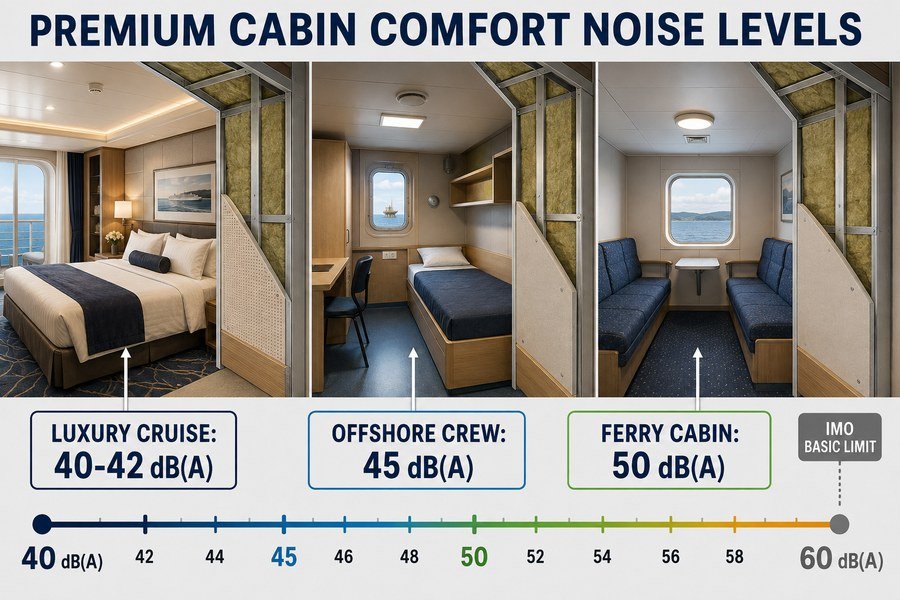
Cabin comfort noise levels in premium marine accommodations commonly range from 40 dB(A) to 50 dB(A). Specifically, luxury cruise passenger cabins target 40-42 dB(A), premium offshore crew cabins target 45 dB(A), and standard passenger cabins on modern ferries aim for 50 dB(A).
When you buy materials for ship interior decoration, you must know the exact number you are trying to hit. "Quiet" is not a specification. Decibels are specifications. Throughout my years working at Magellan Marine, I have seen many buyers purchase standard materials because they did not know the exact numerical targets required for different premium vessels. You must know these three specific cabin comfort noise levels.
Target Noise Levels for Luxury Cruise Passenger Cabins
The first target applies to luxury cruise ships. This is the strictest category in the maritime industry. For a premium cruise ship, the passenger cabin noise level target is typically between 40 dB(A) and 42 dB(A)6. To put this into perspective, a quiet library is around 40 dB(A). According to DNV's COMF-V voluntary guidelines, reaching this level requires extreme attention to detail. Every marine wall panel, marine ceiling panel, and marine fire door must be heavily insulated. The HVAC air conditioning systems must also be fitted with sound attenuators, because air rushing through standard vents will easily push the room noise above 42 dB(A).
Target Noise Levels for Offshore Crew Cabins and Ferries
The second target applies to premium offshore vessels, like wind farm service operation vessels (SOVs). These ships have high-value engineering crews that work long, hard shifts. The target noise level for their cabins is usually 45 dB(A).7 This is still 15 dB(A) lower than the IMO standard of 60 dB(A), meaning the environment is perceived as more than twice as quiet.
The third target applies to modern passenger ferries, like Ro-Pax vessels in Europe. These cabins are used for overnight trips. The standard target here is 50 dB(A).8 While not as strict as a luxury cruise, a 50 dB(A) limit still requires acoustic sandwich panels and specialized door seals that drop-down automatically to block noise from the corridors.
| Vessel Type | Passenger / Crew Type | Target Cabin Noise Level (dB(A)) | Acoustic Challenge Level |
|---|---|---|---|
| Luxury Cruise Ship | High-paying passengers | 40 - 42 dB(A) | Extreme |
| Premium Offshore Vessel (SOV) | Specialized engineering crew | 45 dB(A) | High |
| Modern Passenger Ferry (Ro-Pax) | Overnight travelers | 50 dB(A) | Moderate |
| Standard Cargo Ship (IMO limit) | General crew | 60 dB(A) | Basic |
How to Justify Premium Marine Acoustic Panels Against Tightened Cabin Noise Limits?
Premium acoustic panels cost more upfront. When shipyards push back on your prices, you must prove the value. Here is how to justify the higher cost.
You can justify premium marine acoustic panels by demonstrating three factors: avoidance of costly post-installation acoustic rework, guaranteed compliance with strict comfort class notations that increase vessel charter rates, and a reduction in overall panel weight when using advanced, high-performance acoustic materials.
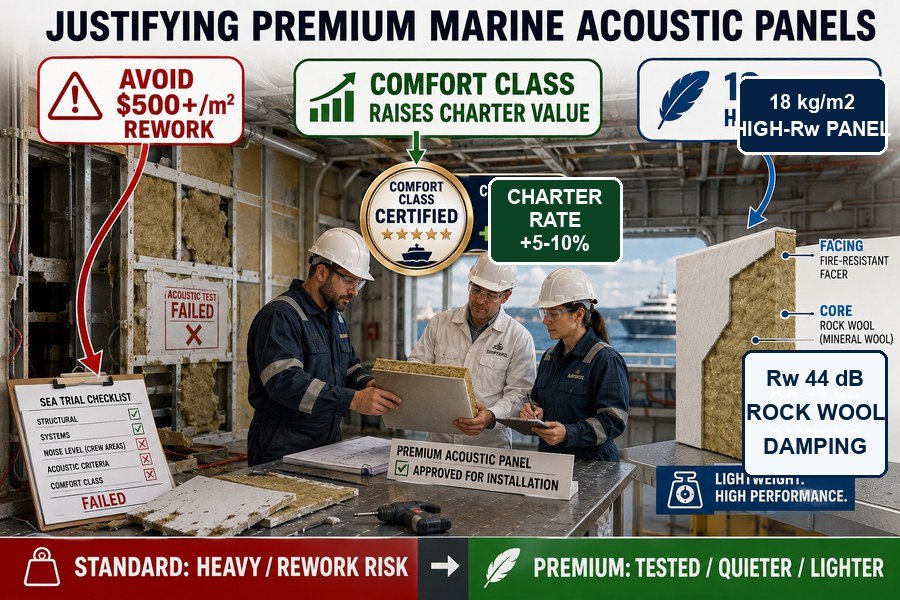
As a procurement officer, your main goal is to balance quality and price. When you buy premium acoustic panels from Asia, the price will be higher than standard panels. Your shipyard client might ask why they should spend this extra money. You need strong, factual arguments to defend your purchase. You can easily justify the price by focusing on three clear financial and operational benefits.
Avoiding Costly Acoustic Rework and Securing Comfort Class
First, you must highlight the cost of rework. If you install standard panels and the ship fails the final acoustic sea trial, the shipyard must fix it. Tearing down installed marine wall panels, adding more insulation, and rebuilding the cabin is a nightmare. Rework costs can easily exceed $500 per square meter9, plus the cost of delaying the ship's delivery. Buying premium panels upfront acts as cheap insurance against this massive risk.
Second, you must explain the value of comfort class compliance. As I mentioned earlier, notations like DNV SILENT or COMF-V directly increase the ship's daily charter rate. A vessel with premium acoustic ratings can often charge 5% to 10% more per day10. The extra $20 or $30 per square meter you spend on premium panels pays for itself in the first few months of the ship's operation.
Achieving Weight Reduction with Advanced Acoustic Materials
Third, you must talk about weight reduction. In the past, the only way to block sound was to make the bulkhead very heavy, often exceeding 25 kg/m². Heavy ships burn more fuel and carry less cargo. Today, advanced acoustic panels use smart damping layers and multi-density rock wool. These premium materials can achieve an Rw of 44 dB while weighing only 18 kg/m²11. When you outfit a ship with thousands of square meters of paneling, saving 7 kilograms per square meter removes tons of dead weight from the vessel. This fuel saving is a massive selling point for the shipyard and the owner.
| Justification Factor | Standard Marine Panels | Premium Acoustic Panels | Financial Benefit to Shipyard/Owner |
|---|---|---|---|
| Post-Installation Rework Risk | High (Often fail sea trials) | Very Low (Lab-tested Rw values) | Avoids $500+/m² in rebuild costs and delays |
| Comfort Class Compliance | Fails DNV COMF-V requirements | Meets or exceeds COMF-V limits | Increases daily charter rates by 5% to 10% |
| Overall Panel Weight | Heavy (Often >25 kg/m² for high Rw) | Optimized (Approx. 18 kg/m² for high Rw) | Saves fuel and increases cargo capacity |
How Do Enhanced Cabin Comfort Targets Change Marine Bulkhead and Ceiling Panel Requirements?
Upgrading comfort targets changes every piece of your outfitting order. Overlooking these changes leads to supplier mismatch. Here is what changes for bulkheads and ceilings.
Enhanced cabin comfort targets change marine bulkhead and ceiling panel requirements by mandating dual-layer acoustic bulkheads (often with 50mm air gaps), acoustic perforated ceiling panels with sound-absorbing felt (NRC > 0.70), and specialized elastic anti-vibration mountings for all ceiling suspension systems.
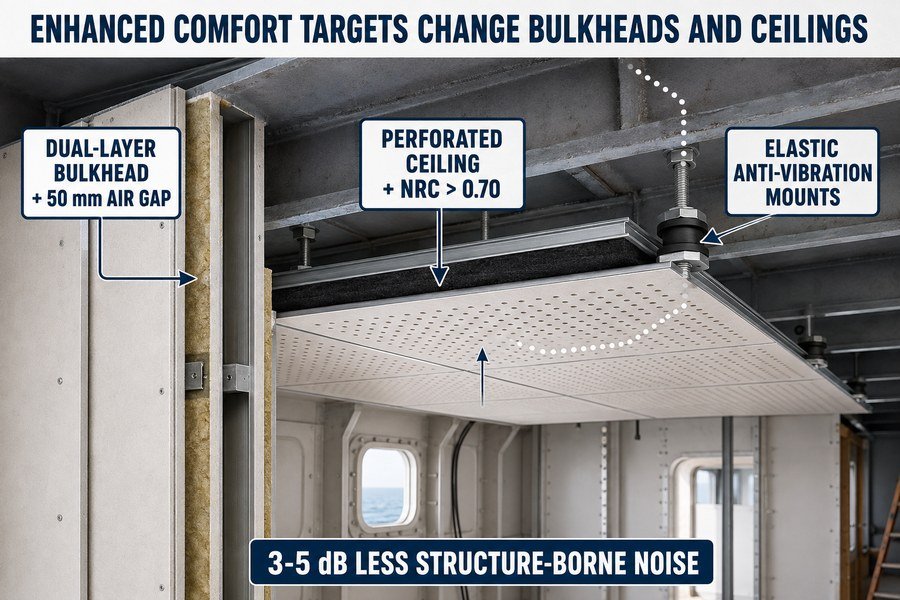
When the contractual noise target drops, you cannot just buy a thicker panel and hope for the best. The entire installation system changes. If you just send your standard purchase order to a supplier in China or Vietnam, you will receive the wrong materials. You must update your technical requirements to include three specific mandates.
Mandating Dual-Layer Acoustic Bulkheads for Cabin Partitions
First, the bulkhead requirement changes from single-layer to dual-layer partitions. A standard 50mm thick marine wall panel might give you an Rw of 32 dB.12 To hit the 50 dB acoustic targets required by premium owners, you must build a double-wall system. This means installing two 25mm or 50mm panels with a physical air gap between them, often a 50mm air gap. The air gap breaks the sound wave. You must order the correct floor tracks and top profiles to support this dual-layer system, as standard single-track profiles will no longer work.
Implementing Perforated Ceilings and Elastic Suspension Systems
Second, your ceiling panel requirements change. Standard marine ceiling panels have a smooth steel surface. Sound bounces off them, creating echoes that raise the decibel level in the cabin. Enhanced comfort targets mandate acoustic perforated ceiling panels. These panels have tiny holes punched into the steel, backed by black sound-absorbing felt or a thin layer of mineral wool. You should specify a Noise Reduction Coefficient (NRC) of greater than 0.70. This ensures the ceiling absorbs the sound rather than reflecting it.
Third, the ceiling suspension system must change. Standard metal hangers transfer vibration from the steel deck straight into the ceiling panels. You must mandate specialized elastic anti-vibration mountings. These mountings use rubber or silicone inserts to hang the ceiling rails. They break the mechanical connection, effectively lowering transmitted structure-borne noise by 3 to 5 dB.
| Material Category | Standard Requirement | Enhanced Cabin Comfort Requirement | Key Performance Metric |
|---|---|---|---|
| Bulkhead Partitions | Single 50mm panel | Dual-layer panels with a 50mm air gap | Rw > 50 dB |
| Ceiling Panels | Smooth steel surface | Perforated steel with sound-absorbing felt | NRC > 0.70 |
| Ceiling Suspension | Rigid metal hangers | Elastic anti-vibration mountings (rubber/silicone) | 3-5 dB reduction in structure noise |
Conclusion
Strict owner requirements push cabin noise limits far below basic IMO standards. Meeting these demands requires premium acoustic panels, specific rock wool densities, and smart installation methods to ensure comfort.
-
"Factors affecting seafarers' fatigue: a scoping review - PMC", https://pmc.ncbi.nlm.nih.gov/articles/PMC12358462/. IMO and maritime-safety research on seafarer fatigue identify fatigue as a significant contributor to accident risk through impaired alertness, decision-making, and performance. Evidence role: expert_consensus; source type: institution. Supports: Crew fatigue is a leading cause of maritime accidents.. Scope note: Such sources generally establish fatigue as a major risk factor, but the phrase “leading cause” may vary by accident dataset and definition. ↩
-
"Physics 4060, Acoustics Laboratory - HyperPhysics", http://hyperphysics.phy-astr.gsu.edu/hbase/Ph4060/p406i.html. Acoustics references explain that decibels are logarithmic and that a 3 dB change corresponds to approximately a doubling or halving of sound energy, supporting the claim that small numerical changes in dB(A) can require materially different acoustic design measures. Evidence role: mechanism; source type: education. Supports: A 3 dB(A) reduction is acoustically significant enough to affect material and design choices.. Scope note: This supports the physical significance of a 3 dB change, but not the article’s stronger assertion that every 3 dB contractual reduction necessarily requires a complete panel specification change. ↩
-
"How to choose the right marine wall panels for marine interior ...", https://magellanmarinetech.com/how-choose-right-marine-wall-panels-for-marine-interior-projects/. Published acoustic test data or classification documentation for marine partition panels can be used to substantiate the typical Rw range reported for standard B-15 or composite marine wall panels. Evidence role: statistic; source type: institution. Supports: Standard marine composite panels usually have Sound Reduction Index values around 30–32 dB.. Scope note: The range may vary by panel construction, testing standard, installation details, and manufacturer, so the citation should be treated as representative rather than universal. ↩
-
"[PDF] Passive Viscoelastic Constrained Layer Damping Application for a ...", https://vtechworks.lib.vt.edu/bitstream/handle/10919/35350/Thesis_CraigGallimore_Rev1.pdf. Technical literature on constrained-layer damping describes a viscoelastic layer bonded between stiff face sheets as a method for dissipating flexural vibration energy in panels, supporting the stated mechanism for reducing structure-borne sound transmission. Evidence role: mechanism; source type: paper. Supports: Viscoelastic constrained-layer damping in steel panel assemblies can reduce vibration transmission by dissipating vibrational energy.. Scope note: The source would support the damping principle generally; the actual acoustic gain depends on the panel geometry, adhesive, steel thickness, temperature, and excitation frequency. ↩
-
"What Panel Design Features Target Structure-Borne Noise on ...", https://magellanmarinetech.com/what-panel-design-features-target-structure-borne-noise-on-ships/. Ship noise-control guidance and building-acoustics literature describe floating floors as resiliently supported floor systems that reduce structure-borne sound transmission by decoupling the walking surface from the structural deck or slab. Evidence role: mechanism; source type: institution. Supports: Floating floor systems reduce structure-borne noise by resiliently separating the finished floor from the ship’s steel deck.. Scope note: This supports the acoustic principle of resilient decoupling; it does not by itself verify the specific mineral-wool density range cited in the article. ↩
-
"Decibel Level Comparison Chart", https://ehs.yale.edu/resource/decibel-level-comparison-chart. A DNV comfort-class rule or comparable classification-society notation can substantiate that premium passenger-cabin comfort criteria use low A-weighted noise limits in the low-40 dB range. Evidence role: general_support; source type: institution. Supports: For a premium cruise ship, the passenger cabin noise level target is typically between 40 dB(A) and 42 dB(A).. Scope note: Such rules support the plausibility of the stated target range but may not prove that every luxury cruise project adopts exactly 40–42 dB(A). ↩
-
"Analysis of noise on board a ship during navigation and ...", https://www.academia.edu/14207004/Analysis_of_noise_on_board_a_ship_during_navigation_and_manoeuvres. A maritime comfort or habitability standard for offshore vessels can support 45 dB(A) as a recognized enhanced cabin-noise criterion for crew accommodation. Evidence role: general_support; source type: institution. Supports: Premium offshore vessel crew cabins usually target a noise level of 45 dB(A).. Scope note: The source would show that 45 dB(A) is an accepted design target under certain comfort notations, not that it is universal across all offshore SOV projects. ↩
-
"Analysis of noise on board a ship during navigation and ...", https://www.academia.edu/14207004/Analysis_of_noise_on_board_a_ship_during_navigation_and_manoeuvres. Published ferry or passenger-ship comfort criteria can document 50 dB(A) as a commonly used cabin noise design limit for overnight passenger accommodation. Evidence role: general_support; source type: institution. Supports: Modern overnight passenger ferry cabins commonly use a 50 dB(A) noise target.. Scope note: The evidence would establish 50 dB(A) as a recognized target in some standards or projects, not as a mandatory European Ro-Pax requirement in all cases. ↩
-
"Can Ordinary Decorative Panels Be Used Onboard SOLAS ...", https://magellanmarinetech.com/can-ordinary-decorative-panels-used-onboard-solas-regulated-vessels/. A peer-reviewed shipbuilding rework cost study quantifies rework as a contributor to construction cost and schedule overruns, providing context for the expense of late acoustic remediation. Evidence role: statistic; source type: paper. Supports: Late acoustic remediation after failed sea trials can cost more than $500 per square meter and cause delivery delays.. Scope note: This would not verify the specific $500/m² threshold unless the source reports area-based accommodation or outfitting rework costs. ↩
-
"Seafarers' Perception and Attitudes towards Noise Emission on Board ...", https://pmc.ncbi.nlm.nih.gov/articles/PMC8296330/. A maritime economics or passenger-comfort study reporting observed charter, fare, or asset-value premiums associated with certified noise-and-vibration comfort supports the revenue-premium claim. Evidence role: statistic; source type: paper. Supports: A vessel with premium acoustic ratings can often charge 5% to 10% more per day.. Scope note: Results may apply only to a particular vessel segment or market; evidence on comfort preferences alone does not prove a 5–10% charter-rate premium. ↩
-
"How to choose the right marine wall panels for marine interior ...", https://magellanmarinetech.com/how-choose-right-marine-wall-panels-for-marine-interior-projects/. Laboratory sound-insulation measurements under ISO 10140 and ISO 717 showing an Rw value near 44 dB for a lightweight multilayer partition support the stated performance-to-weight benchmark. Evidence role: statistic; source type: research. Supports: Advanced acoustic panels can achieve an Rw of 44 dB while weighing about 18 kg/m².. Scope note: The result applies to the tested assembly only; onboard performance can differ because of installation quality and flanking transmission. ↩
-
"How to choose the right marine wall panels for marine interior ...", https://magellanmarinetech.com/how-choose-right-marine-wall-panels-for-marine-interior-projects/. Laboratory sound-insulation data for marine accommodation panels can be used to contextualize typical weighted sound reduction index values for 50 mm-class panels, including results in the low-30 dB range. Evidence role: statistic; source type: research. Supports: A standard 50mm thick marine wall panel might give an Rw of about 32 dB.. Scope note: Rw varies by panel core, facing material, joints, mounting details, and test standard, so a source can support this only as a representative value rather than a universal rating. ↩