Are confusing noise specs causing your marine panel orders to fail yard inspections? I know this frustration well. Let us solve this together and protect your project profits.
To read a cabin noise spec correctly before ordering marine panels, you must check three complete areas: the required decibel (dB) limits for different rooms, the governing standard (IMO or owner-specific), and the required acoustic reduction index (Rw) documentation for the wall and ceiling panels.
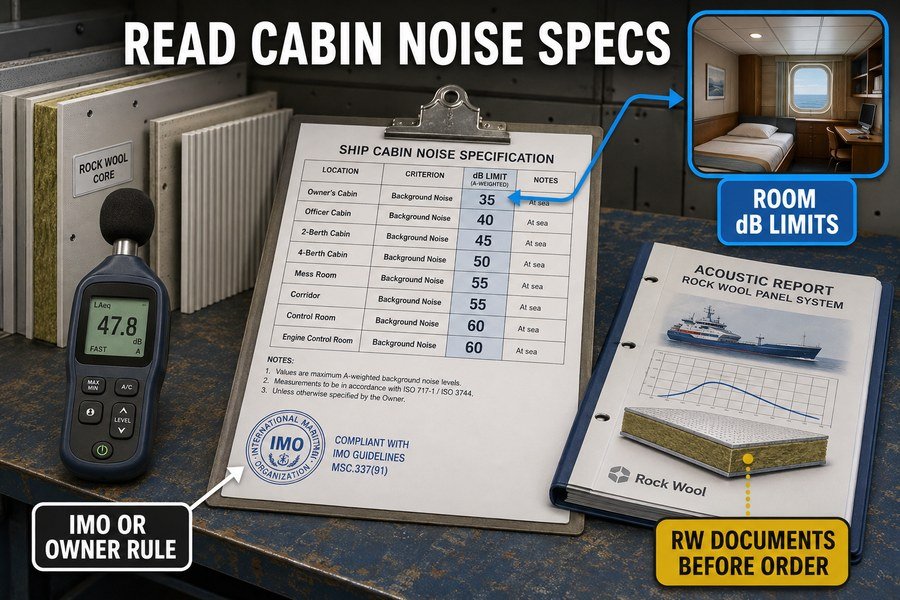
I remember looking at my first ship interior spec sheet in the factory and feeling completely lost. There were so many numbers and codes. Over the years, I learned that missing a small detail in the noise requirements can ruin an entire project. If you buy panels that do not block enough sound, the shipyard will reject them. You will lose money and waste time. Let us break down exactly how to check these specifications step by step so you can order with confidence.
What Noise Values Must Be Confirmed Before Selecting Marine Bulkhead Panels?
Are you guessing which panels to buy because the numbers look similar? Buying the wrong panel will cost you both time and money during yard testing.
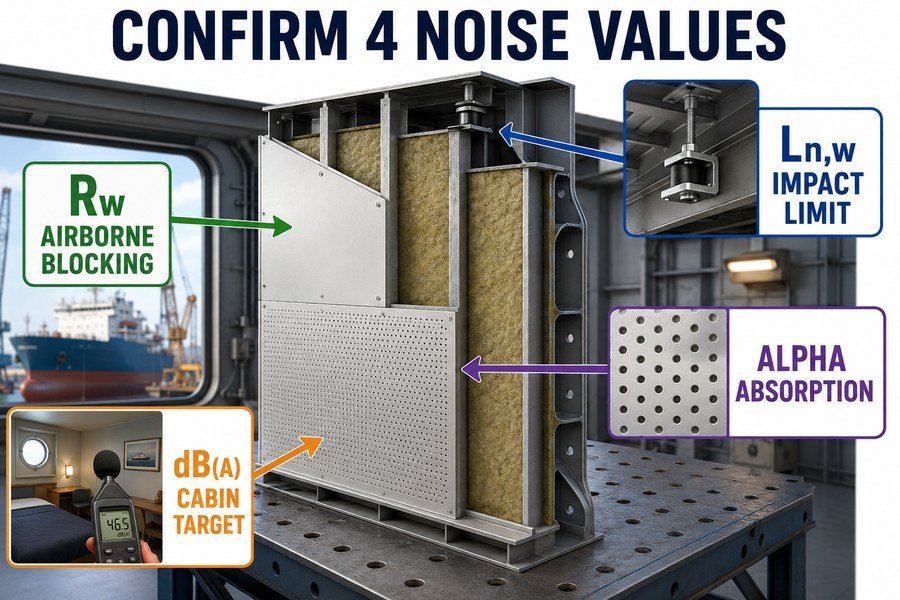
Before selecting marine bulkhead panels, you must confirm four specific noise values: airborne sound insulation (Rw), impact sound insulation (Ln,w), absorption coefficient (alpha), and the target ambient noise limit (dB(A)) for the specific cabin. These four values dictate the exact core material and thickness needed.
Confirming Airborne (Rw) and Impact (Ln,w) Sound Insulation Values
When you read a noise spec, the first value you must find is the airborne sound insulation index. We call this the Rw value. The Rw value tells you how much noise the marine wall panel can block. For example, a standard 50mm rockwool core panel usually has an Rw value between 33 dB and 35 dB1. If the room is next to an engine casing, the spec will ask for a higher Rw value, perhaps 45 dB. You cannot use a standard panel here. You will need a special double-skin panel or a panel with a heavy steel sheet inside. I always check the Rw value first.
The second value is the impact sound insulation, or Ln,w. You usually see this value for floors, but sometimes it applies to ceilings under noisy areas. This number measures how much sound passes through when something hits the deck above. A lower Ln,w value means better insulation. For standard marine ceilings, you want an Ln,w limit below 65 dB according to many yard standards. If the spec lists an Ln,w value, you must tell your supplier to provide ceiling panels with anti-vibration hangers.
Checking Absorption (Alpha) and Ambient Noise (dB(A)) Limits
The third value is the absorption coefficient, written as alpha (α). This value is very important for public spaces and engine control rooms. Alpha measures how much sound the panel surface absorbs instead of reflecting back into the room. The value goes from 0 to 1.0. A flat steel panel has an alpha of 0.1. A perforated ceiling panel with acoustic fleece has an alpha of 0.6 or 0.7. If the spec asks for an alpha of 0.6, you must buy perforated panels.
The fourth and most basic value is the target ambient noise limit in dB(A). This is the total noise allowed inside the finished cabin. Under IMO Resolution MSC.337(91), the maximum noise limit for a standard crew cabin is 60 dB(A). For hospitals on the ship, it is 55 dB(A).2 You must know this final target. If you know the cabin target is 60 dB(A), and the noise outside the room is 90 dB(A), you know your panel must bridge that 30 dB gap. You cannot buy panels until you confirm all four of these exact numbers.
| Noise Value Type | Symbol | Typical Range / Limit | What It Dictates For Your Order |
|---|---|---|---|
| Airborne Sound | Rw | 30 dB to 45 dB | Wall panel core density and steel thickness |
| Impact Sound | Ln,w | < 65 dB | Ceiling suspension systems and floor layers |
| Absorption | Alpha (α) | 0.1 to 0.8 | Panel surface type (flat vs. perforated) |
| Ambient Noise | dB(A) | 45 dB to 60 dB | The final target goal for the entire room |
How to Check if a Marine Project Noise Spec Follows IMO or Owner Standards?
Worried that your panels meet basic rules but fail the shipyard's strict demands? Ignoring the source of the standard is a very common and expensive mistake.
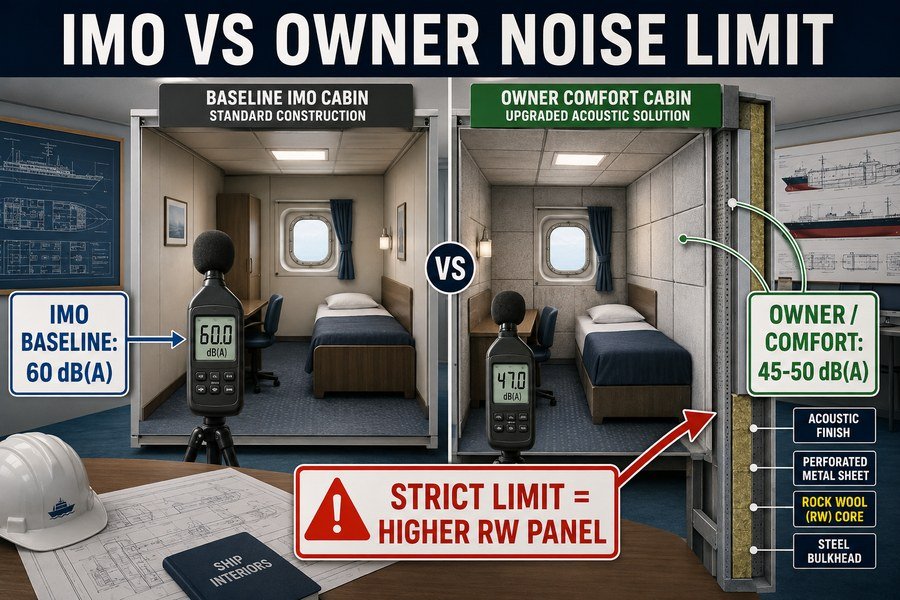
To check if a project noise spec follows IMO or owner standards, look at the required limit for standard passenger cabins: 60 dB(A) indicates the baseline IMO MSC.337(91) standard, while limits between 45 dB(A) and 50 dB(A) indicate stricter private owner standards or Comfort Class notations.
Identifying Baseline IMO MSC.337(91) Standards for Passenger Cabins
When you receive a project specification, you must look at the standard passenger cabins or crew cabins first. If the spec says the cabin noise limit is 60 dB(A)3, you are looking at the standard IMO rules. Specifically, this is IMO Resolution MSC.337(91), which became mandatory for ships built after July 2014.
This is the basic legal limit for safe sailing. Meeting a 60 dB(A) limit is usually very easy. You can use standard 50mm marine wall panels with an Rw of 33 dB. I tell my clients that if the project only requires IMO standards, they do not need to buy expensive high-acoustic panels. You can save money here. Your normal suppliers in Asia can easily meet this requirement with their standard B-15 or B-0 panels. You just need to make sure the supplier has basic certification.
Spotting Stricter Owner and Comfort Class Standards
However, things change completely if you see passenger cabin limits of 45 dB(A), 48 dB(A), or 50 dB(A)4. When you see these low numbers, the project does not just follow IMO rules. It follows strict private owner requirements or a special class notation like DNV Comfort Class V(1) or V(2).
This is a huge warning sign. A 45 dB(A) limit is very quiet. To reach this, a standard 33 dB Rw panel will fail. You will need panels with an Rw of 40 dB to 44 dB5. These panels cost much more. They use denser rockwool, thicker steel plates, or even special sound-damping layers inside. In my experience at the factory, many buyers lose money because they quote the project using standard IMO panels, but the shipyard actually wants DNV Comfort Class panels. Always check the cabin limit first. If it is 50 dB(A) or below, you must send the exact spec to your supplier and ask for high-acoustic panels.
| Standard Type | Passenger Cabin Limit | Panel Rw Requirement | Cost Impact |
|---|---|---|---|
| IMO MSC.337(91) | 60 dB(A) | 33 dB to 35 dB | Standard market price |
| DNV Comfort Class V(3) | 55 dB(A) | 37 dB to 39 dB | Medium price increase |
| DNV Comfort Class V(2) | 50 dB(A) | 40 dB to 42 dB | High price increase |
| Luxury Owner / V(1) | 45 dB(A) | 43 dB to 45+ dB | Very high price increase |
What Acoustic Documentation Proves a Marine Panel Meets Cabin Noise Requirements?
Do you fear the shipyard will reject your panels because the paperwork is wrong? Without the right test reports, even the best panels are useless.
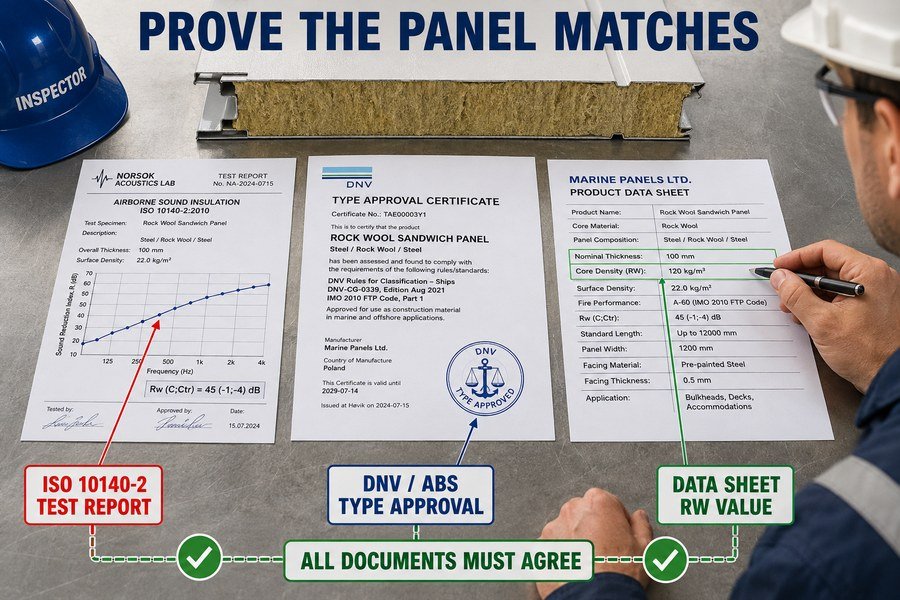
To prove a marine panel meets cabin noise requirements, you must provide three complete documents: a valid laboratory acoustic test report (ISO 10140-2), a Type Approval certificate from a classification society (like DNV or ABS), and a clear product data sheet stating the exact Rw value.
Securing the Laboratory Acoustic Test Report (ISO 10140-2)
The most important document you need from your supplier is the laboratory acoustic test report. A good supplier will have a report from a certified testing center. You must look at the report and check the test standard. The correct international standard for testing marine panels is ISO 10140-2 (or the older ISO 140-3)6.
I always check the size of the test sample on the report. According to the rules, the tested panel area must be about 10 square meters7. If the supplier shows you a report where they only tested a small 1 square meter piece, the yard will reject it. Small samples do not show how the panel joints leak sound8. The test report will show a curve on a graph and state the final Rw value. If the spec asks for Rw 38 dB, this lab report is the only way to prove your panel can do it.
Verifying Type Approval and Product Data Sheets
The second document you need is the Type Approval certificate. This certificate comes from marine class societies like DNV, Lloyd's Register, or ABS. While the Type Approval mainly proves the fire rating (like B-15 or A-60)9, many modern certificates also list the tested Rw value. The shipyard inspector will always ask for this certificate.
The third document is the supplier's product data sheet. This sounds simple, but it causes many problems. The product data sheet must perfectly match the lab report and the Type Approval. If the lab report says the panel is 50mm thick with a rockwool density of 120 kg/m3, the data sheet must say exactly the same thing. I have seen shipyards stop a project because the data sheet said 100 kg/m3 but the test report said 120 kg/m3. You must put all three documents on your desk and compare them side by side. They must all tell the exact same story before you send them to the shipyard.
| Document Name | Who Issues It | What You Must Check | Why You Need It |
|---|---|---|---|
| Acoustic Test Report | Certified Lab (e.g., SGS) | ISO 10140-2 standard, 10m2 test size, exact Rw value | Proves actual sound blocking ability |
| Type Approval Cert | Class Society (DNV, ABS) | Matches panel name, shows fire class and Rw | Legal requirement to install on a ship |
| Product Data Sheet | Panel Manufacturer | Thickness and core density match the lab report | Yard uses it for daily installation checks |
How to Match a Supplier's Marine Panel Acoustic Data to Cabin Noise Limits?
Are you struggling to compare what the supplier offers with what the spec needs? A bad match will lead to failed sea trials and massive rework.
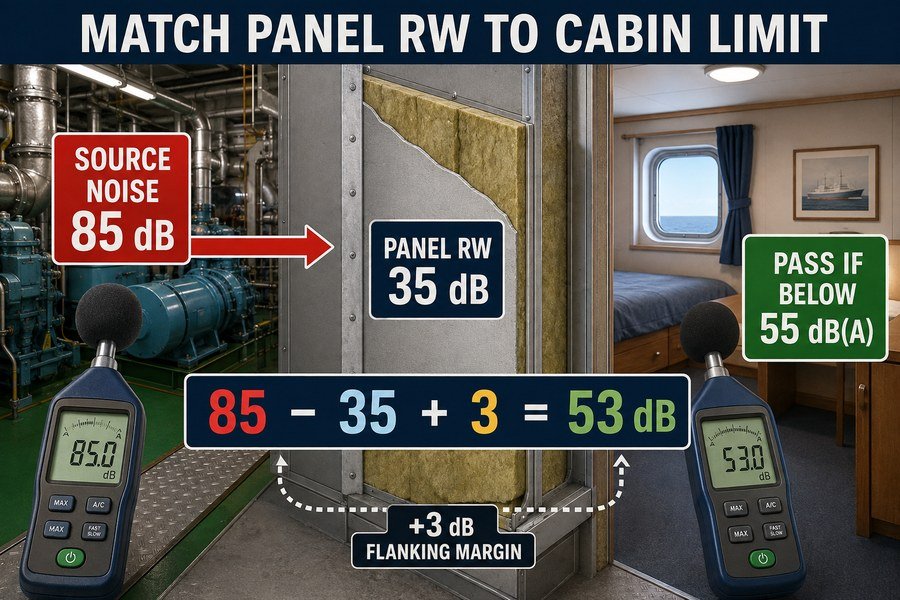
To match a supplier's marine panel acoustic data to cabin noise limits, you must calculate three things: subtract the panel's Rw rating from the noise source, add a 3 dB safety margin for flanking transmission, and ensure the final predicted cabin level is below the required dB(A) limit.
Calculating the Panel's Sound Reduction Capability
When you have the supplier's data, you must do a basic calculation. You need to know the noise level on the loud side of the wall. Let us say a cabin is next to a machinery space. The noise in the machinery space is 85 dB. This is your starting point.
Now, look at the supplier's panel data. The supplier offers a panel with an Rw of 35 dB10. You subtract the panel's Rw from the source noise. So, 85 dB minus 35 dB equals 50 dB. This means 50 dB of noise will pass through the wall into the cabin. If the project specification says the cabin noise limit is 55 dB(A), you might think you are safe because 50 dB is less than 55 dB. However, in the ship outfitting business, this simple math is never enough. You cannot stop here.
Adding Safety Margins for Real-World Installation
In a laboratory, the test panel is perfectly sealed. On a real ship, noise travels through the steel deck, through the ceiling profiles, and through the air conditioning ducts. We call this flanking transmission.11
Because of flanking transmission, I always teach buyers to add a 3 dB safety margin to their calculation. Let us go back to our example. The noise passing through the wall is 50 dB. Now, add the 3 dB safety margin. The true expected noise in the cabin is 53 dB. Compare 53 dB to the project limit of 55 dB(A). Since 53 dB is still below 55 dB(A), the supplier's panel is a good match. But if the source noise was 90 dB, the math would be: 90 - 35 = 55. Add 3 dB margin = 58 dB. This would fail the 55 dB(A) limit. In that case, you must ask the supplier for a 40 dB Rw panel. Always do this simple math before you place an order.
| Calculation Step | Example Data | Action / Formula | Result |
|---|---|---|---|
| 1. Find Source Noise | Machinery Space | Read from yard spec | 85 dB |
| 2. Subtract Panel Rw | Panel Rw is 35 dB | 85 dB - 35 dB | 50 dB |
| 3. Add Safety Margin | Flanking noise | 50 dB + 3 dB | 53 dB |
| 4. Compare to Target Limit | Cabin limit is 55 dB(A) | Is 53 dB < 55 dB? | Match is successful. Order panel. |
How to Spot Gaps Between Cabin Noise Targets and Supplied Marine Panel Ratings?
Afraid you will only discover a noise issue after the walls are installed? Spotting the gaps early is the only way to protect your profit margin.
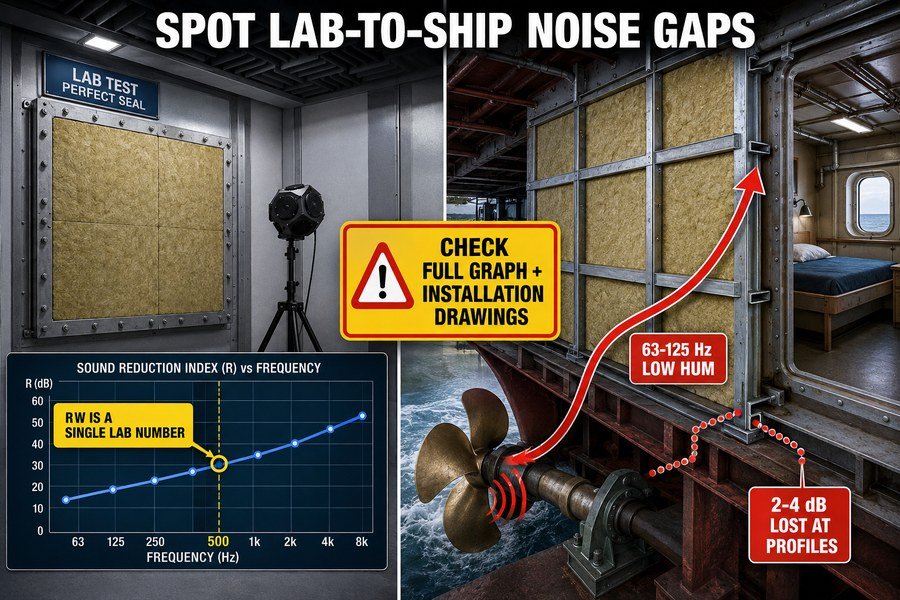
To spot gaps between cabin noise targets and supplied marine panel ratings, you must check two critical mismatches: testing frequency differences (laboratory 500 Hz vs. real ship frequencies) and installation profile differences (where laboratory sealant gaps do not match the actual ship's steel structure connections).
Identifying Frequency Discrepancies in Test Reports
The biggest hidden gap in noise specs is frequency. The Rw rating is a single number. Laboratories calculate this single number by looking at a reference curve at 500 Hz. But ship noise is not just 500 Hz.
Ship engines and propellers create low-frequency noise, usually around 63 Hz, 125 Hz, or 250 Hz.12 Standard marine panels are very bad at blocking low-frequency noise. A panel might block 40 dB at 1000 Hz, but only block 15 dB at 125 Hz. If the cabin is located directly above the propeller, low-frequency noise will be the main problem. You must look at the full frequency graph in the supplier's test report, not just the single Rw number. If you see a big drop in performance at 125 Hz, and the cabin is in a low-frequency area, you have found a massive gap. You will fail the sea trial. You must switch to a heavier panel.
Recognizing Installation and Structural Profile Differences
The second gap is how the panel connects to the ship. When a supplier tests a panel in the lab, they put heavy acoustic putty and sealant all around the edges. They seal every tiny hole perfectly.
On your project, the installation workers will put the panels into standard steel U-profiles on the deck. They do not use perfect laboratory sealant. Sound will leak through the bottom U-profile and the top ceiling angles. This is a huge gap between the rating and reality. To fix this gap, you must look at the shipyard's installation drawings. If the yard uses standard hard steel profiles without any rubber isolation strips, the panel will lose at least 2 to 4 dB of its rated performance13. You must spot this gap early. If the structure is bad, you must buy a panel with a higher Rw rating to cover the loss from the bad profiles.
| Gap Type | Laboratory Condition | Real Ship Condition | Impact on Final Noise |
|---|---|---|---|
| Frequency Gap | Rw based on 500 Hz average | Propellers create heavy 63-125 Hz noise | Panel fails to block low hums; cabin is too loud. |
| Installation Gap | Edges sealed with heavy putty | Panels sit in bare steel U-profiles | Sound leaks under the wall; loses 2-4 dB rating. |
What to Ask a Marine Panel Supplier When a Cabin Noise Limit Is Unclear?
Do vague noise specs from the yard leave you guessing when you talk to suppliers? Asking the wrong questions will result in buying the wrong materials.
When a cabin noise limit is unclear, you must ask the marine panel supplier three exact questions: what is the tested Rw value for this specific thickness, does the test report include the joining profiles, and can you provide recent sea trial data for similar ship projects?

Clarifying the Tested Rw Value and Specific Thickness
When the yard specification is vague, you must be very direct with your supplier. The first question you must ask is: "What is the exact tested Rw value for the specific thickness I am buying14?"
Suppliers love to send marketing brochures. A brochure might say "Acoustic Panels: up to 45 dB." But that 45 dB rating might only be for a special 75mm double-wall panel. If you are buying a standard 25mm partition panel, the Rw value might only be 28 dB. I always force the supplier to give me the number for the exact item I am paying for. Do not accept a general range. If the supplier cannot give you a specific number for a 50mm panel with 120 kg/m3 density, do not buy from them.
Confirming Joining Profiles and Past Project Data
The second question is about joints: "Does your test report include the standard joining profiles?15" Marine panels connect to each other using tongue and groove joints or steel splines. These joints are weak points for noise. If the supplier tested a solid wall without any joints, the test report is useless. The report must state that the test wall included standard vertical joints. A panel with bad joints can drop 5 dB in performance.16
The third question is: "Can you provide recent sea trial data for similar ship projects?" Test reports are just paper. Sea trials are reality. If you ask a supplier in Asia for sea trial data from the last two years, a good supplier will show you records where their panels passed yard noise tests on real ships. If they cannot show you any real project data, they are just a factory making steel boxes, not a true marine outfitting expert. Ask these questions to protect yourself.
| Question You Must Ask | Bad Supplier Answer (Danger) | Good Supplier Answer (Safe) |
|---|---|---|
| What is the Rw for this exact thickness? | "Our panels can reach up to 44 dB." | "This 50mm panel is officially tested at 34 dB." |
| Does the test include joining profiles? | "We tested a solid flat surface." | "Yes, the 10m2 test wall included standard spline joints." |
| Do you have recent sea trial data? | "We only have lab reports." | "Yes, here is the sea trial pass record from a 2025 project." |
Conclusion
Reading cabin noise specs correctly saves you time and protects your project profits. Always check the exact dB rules, demand the right test reports, calculate real-world margins, and ask your suppliers hard questions.
-
"The intrinsic fire and acoustic capabilities of rock wool core in ...", https://magellanmarinetech.com/what-determines-intrinsic-fire-acoustic-capability-of-rock-wool-core-marine-accommodation-panels/. Laboratory or technical research data on mineral-wool sandwich panels can document that comparable 50 mm insulated metal panel assemblies often achieve weighted sound reduction indices in the low-to-mid 30 dB range. Evidence role: statistic; source type: paper. Supports: A standard 50 mm rockwool core panel usually has an Rw value between 33 dB and 35 dB.. Scope note: Rw varies with steel skin thickness, core density, joints, and test standard, so the source would support this as a typical range for comparable assemblies rather than a universal marine-panel value. ↩
-
"What Are Cabin Noise Level Standards on Ships?", https://magellanmarinetech.com/what-are-cabin-noise-level-standards-on-ships/. IMO Resolution MSC.337(91), the Code on Noise Levels on Board Ships, lists maximum A-weighted sound pressure levels for accommodation and medical spaces, including 60 dB(A) for cabins and 55 dB(A) for hospitals. Evidence role: statistic; source type: institution. Supports: IMO Resolution MSC.337(91) sets maximum shipboard noise limits of 60 dB(A) for standard crew cabins and 55 dB(A) for hospitals.. ↩
-
"What Are Cabin Noise Level Standards on Ships?", https://magellanmarinetech.com/what-are-cabin-noise-level-standards-on-ships/. The IMO Code on Noise Levels on Board Ships adopted by MSC.337(91) lists 60 dB(A) as the maximum noise level for cabins and hospitals in the accommodation-space table; this supports the stated baseline cabin limit but not any conclusion about panel selection by itself. Evidence role: statistic; source type: institution. Supports: Under the standard IMO rules, the passenger or crew cabin noise limit is 60 dB(A).. Scope note: The source supports the regulatory noise limit for specified spaces, not the acoustic performance of a particular wall-panel system. ↩
-
"What Are Cabin Noise Level Standards on Ships?", https://magellanmarinetech.com/what-are-cabin-noise-level-standards-on-ships/. DNV comfort-class rules publish lower accommodation and cabin noise criteria than the IMO baseline for higher comfort notations, providing context for why limits around 45–50 dB(A) indicate a stricter comfort requirement; the rules do not prove that every project using these limits is formally classed by DNV. Evidence role: definition; source type: institution. Supports: Passenger cabin limits of 45 dB(A), 48 dB(A), or 50 dB(A) are stricter than IMO baseline requirements and may reflect owner requirements or comfort-class notation.. Scope note: This supports the association with comfort-class criteria, but private owner specifications may adopt similar limits independently. ↩
-
"How Do Marine Interior Panel STL Ratings Meet IMO Noise ...", https://magellanmarinetech.com/how-marine-interior-panel-stl-ratings-meet-imo-noise-regulations/. Building- and ship-acoustics literature on weighted sound reduction index explains that higher Rw partitions provide greater airborne sound insulation and are used when lower receiving-room noise levels are required; this supports the engineering rationale but not a universal 40–44 dB requirement for every vessel layout. Evidence role: mechanism; source type: paper. Supports: Achieving a 45 dB(A) cabin limit may require higher-acoustic panels with an Rw of about 40 dB to 44 dB rather than standard 33 dB Rw panels.. Scope note: Exact Rw requirements depend on source levels, cabin geometry, flanking transmission, penetrations, installation quality, and the calculation method used. ↩
-
"Sound insulation dataset of 30 wooden and 8 concrete floors ...", https://pmc.ncbi.nlm.nih.gov/articles/PMC10365936/. ISO 10140-2 specifies laboratory measurement procedures for airborne sound insulation of building elements, and ISO 140-3 is its earlier predecessor; this supports the acoustic-test-standard reference but does not by itself establish a marine-specific acceptance rule. Evidence role: definition; source type: institution. Scope note: The standard is a general laboratory acoustics standard for building elements; marine acceptance may also depend on class-society or shipyard specifications. ↩
-
"Sound insulation dataset of 30 wooden and 8 concrete floors ...", https://pmc.ncbi.nlm.nih.gov/articles/PMC10365936/. ISO 10140 test-facility guidance and related acoustic-testing references describe large wall test openings of roughly 10 m² for airborne sound-insulation measurements; this supports the stated order of magnitude, though exact specimen dimensions depend on the applicable ISO part and laboratory aperture. Evidence role: general_support; source type: institution. Scope note: The source may support a typical or minimum test-opening size rather than every shipyard’s rejection policy. ↩
-
"Study on sound insulation performance of walls in traditional ...", https://pmc.ncbi.nlm.nih.gov/articles/PMC12979663/. Architectural-acoustics research and guidance show that gaps, joints, and air leaks can reduce measured airborne sound insulation, supporting the mechanism that a small specimen may miss joint-related leakage effects; this is contextual support rather than proof of a specific panel-test rejection rule. Evidence role: mechanism; source type: paper. Scope note: The evidence supports the acoustical mechanism of leakage through joints and gaps, not the specific administrative decision of a shipyard. ↩
-
"What Is the Purpose and Scope of the IMO FTP Code?", https://magellanmarinetech.com/what-purpose-scope-of-imo-ftp-code/. IMO/SOLAS fire-test provisions classify ship divisions using A- and B-class ratings such as A-60 and B-15, supporting the statement that marine type-approval documentation commonly addresses fire performance; it does not prove that every certificate also includes acoustic Rw values. Evidence role: definition; source type: government. Scope note: The support concerns marine fire classification and type approval, not the acoustic content of all certificates. ↩
-
"Sound reduction index - Wikipedia", https://en.wikipedia.org/wiki/Sound_reduction_index. A standards or acoustics reference defines Rw as a single-number weighted sound reduction index derived from laboratory airborne sound-insulation measurements, supporting its use as a panel rating. Evidence role: definition; source type: institution. Scope note: The definition supports what Rw measures, but it does not by itself prove the installed performance of a specific marine panel. ↩
-
"How Do Flanking Paths Defeat Marine Acoustic Panel Systems?", https://magellanmarinetech.com/how-flanking-paths-defeat-marine-acoustic-panel-systems/. Building and ship acoustics literature defines flanking transmission as sound reaching a receiving space through indirect structural or service paths rather than only through the separating partition, supporting the listed deck, ceiling, and duct routes as plausible mechanisms. Evidence role: definition; source type: paper. Scope note: The source may describe general building-acoustics principles; the exact flanking paths and their magnitude on a given ship require project-specific assessment. ↩
-
"Vessel-Generated Underwater Radiated Noise ...", https://www.maritime.dot.gov/sites/marad.dot.gov/files/2024-11/NCE%20REPORT%202024-079%20MARAD%20Vessel-Generated%20Underwater%20Radiated%20Noise%20Comparison%20Study%20%28Tugs%29%20Rev%200.pdf. Marine noise studies commonly identify diesel engines, machinery, and propeller-related sources as important contributors to low-frequency shipborne noise, including octave or one-third-octave bands in the tens to hundreds of hertz range. Evidence role: general_support; source type: paper. Scope note: The cited source may support the low-frequency range generally rather than proving that every ship has dominant noise exactly at 63, 125, or 250 Hz. ↩
-
"How Do Flanking Paths Defeat Marine Acoustic Panel Systems?", https://magellanmarinetech.com/how-flanking-paths-defeat-marine-acoustic-panel-systems/. Research and technical guidance on sound insulation testing note that installation details, edge sealing, rigid connections, and flanking paths can reduce in-situ sound insulation relative to laboratory ratings. Evidence role: mechanism; source type: research. Scope note: The general mechanism is well supported, but the specific 2–4 dB loss range may vary by joint design, workmanship, and test configuration. ↩
-
"Sound insulation dataset of 30 wooden and 8 concrete floors ...", https://pmc.ncbi.nlm.nih.gov/articles/PMC10365936/. Standards for weighted sound reduction index testing define Rw as a rating derived from a tested construction under specified laboratory conditions, supporting the need to match the cited value to the exact panel configuration rather than to a product family; this does not by itself prove any supplier’s stated value. Evidence role: definition; source type: institution. Scope note: Supports the principle that Rw is configuration-specific, not the example values in the article. ↩
-
"Sound insulation dataset of 30 wooden and 8 concrete floors ...", https://pmc.ncbi.nlm.nih.gov/articles/PMC10365936/. Laboratory sound-insulation standards require the tested specimen and its mounting or installation conditions to be documented, which supports checking whether the tested marine panel assembly included normal joining profiles; the standard may not require every commercial joint type to be tested. Evidence role: expert_consensus; source type: institution. Scope note: Supports the need to document test configuration, but not the article’s specific procurement rule for all marine panels. ↩
-
"Study on sound insulation performance of walls in traditional ...", https://pmc.ncbi.nlm.nih.gov/articles/PMC12979663/. Studies of sound insulation in partitions show that gaps, joints, and acoustic leakage paths can reduce measured sound reduction by several decibels, providing contextual support for a possible 5 dB loss; the exact reduction depends on joint geometry, sealing, frequency range, and panel construction. Evidence role: statistic; source type: paper. Scope note: Contextual support for the magnitude of loss, not direct proof that every bad marine-panel joint causes a 5 dB reduction. ↩