Shipyard noise complaints cost you money and ruin reputations. You need quiet cabins, but random panels fail acoustic tests. I will show you how panel structure actually stops noise.
Marine interior panel sound insulation is dictated by four structural factors: total mass, core material density, layer decoupling, and panel thickness. Together, these elements determine the Weighted Sound Reduction Index (Rw), effectively blocking noise from engine rooms and adjacent cabins to meet strict SOLAS noise limits.
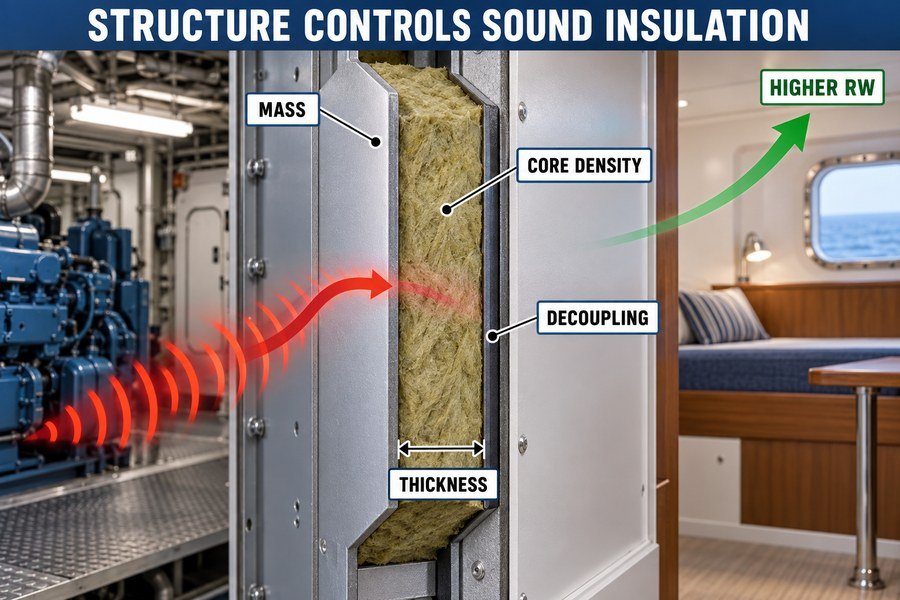
Let us break down exactly how these structural choices affect your noise reduction and your purchasing budget.
Which Structural Variables Control a Marine Bulkhead's Sound Transmission Loss?
Buying bulkheads blindly leads to failed sea trials. If you do not know what stops sound, you waste money. Here are the variables that matter.
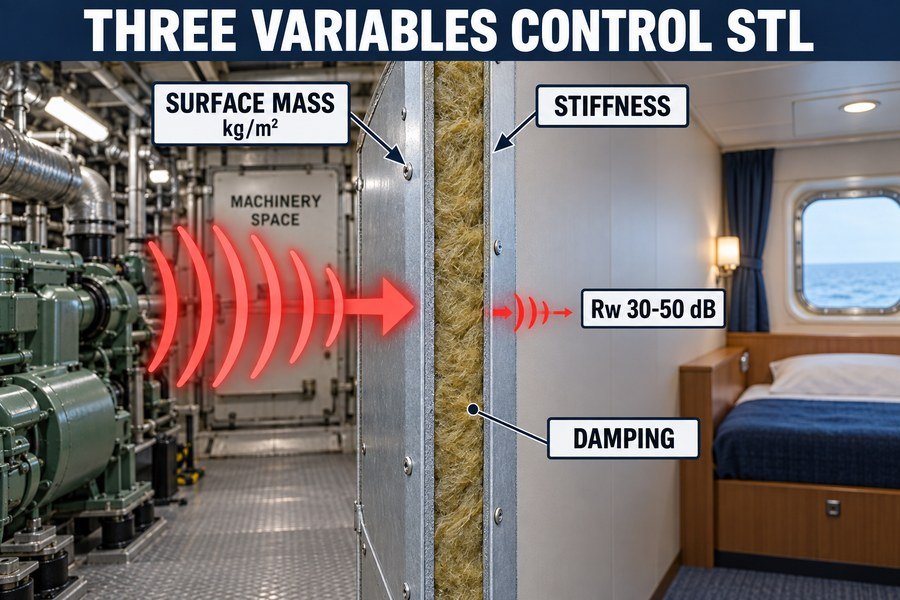
A marine bulkhead's sound transmission loss is controlled by three main variables: surface mass (kg/m²), structural stiffness, and internal damping. These three factors interact to achieve Rw ratings from 30 dB to 50 dB according to ISO 717-1 acoustic testing standards.
Surface Mass and Its Role in Sound Transmission Loss
When I help my clients buy marine panels, I always check the surface mass1 first. Surface mass is the weight of the panel per square meter. We measure this in kg/m². Heavy materials block sound much better than light materials. A standard 50mm marine wall panel with 0.6mm galvanized steel skins has a surface mass of about 18 kg/m². This surface mass gives you a basic sound transmission loss of around 35 dB. If your client requires better sound insulation near a generator room, we must increase this mass. You cannot just guess the result. The acoustic mass law shows that every time you double the surface mass, the sound transmission loss increases by 5 to 6 decibels (dB)2. For example, increasing the steel skin thickness from 0.6mm to 1.2mm will increase the panel weight to about 27 kg/m². This change will push your panel's sound rating closer to 40 dB. The price for this upgrade is usually 4 to 6 USD per square meter. This is a very cheap way to meet strict noise rules.
Structural Stiffness and Internal Damping Effects
You cannot rely on mass alone. We also must control structural stiffness and internal damping. Structural stiffness comes from the hard steel skins and the glue used inside the panel. A stiff panel can vibrate loudly at specific sound frequencies3. This vibration lets noise pass straight into the cabin. We solve this vibration problem with internal damping. Internal damping absorbs the vibration energy inside the panel. For marine panels, we always use rockwool as the internal damping material. I recommend rockwool with a density of 120 kg/m³ to 150 kg/m³ for good damping. The soft rockwool sits directly between the stiff steel skins. The rockwool stops the hard steel skins from vibrating. The rockwool turns the sound energy into tiny amounts of heat. You need surface mass to block the initial sound wave, stiffness to hold the panel straight, and damping to kill the vibrations. All three variables must work together.
| Structural Variable | Component Example | Typical Value Range | Impact on Sound Transmission Loss (Rw) |
|---|---|---|---|
| Surface Mass | Galvanized Steel Skins | 15 kg/m² to 25 kg/m² | High impact. Doubling mass adds 5-6 dB. |
| Structural Stiffness | Steel thickness and PU Glue | 0.6mm to 1.0mm thickness | Causes resonance dips if not damped properly. |
| Internal Damping | Rockwool Core | 120 kg/m³ to 150 kg/m³ | Absorbs vibrations. Increases Rw by 3-5 dB. |
Why Does Nominal Thickness Poorly Predict a Marine Interior Panel's True Acoustic Insulation?
You might think thicker panels always block more noise. This false belief ruins your budget and ship designs. Thickness alone does not equal good sound insulation.
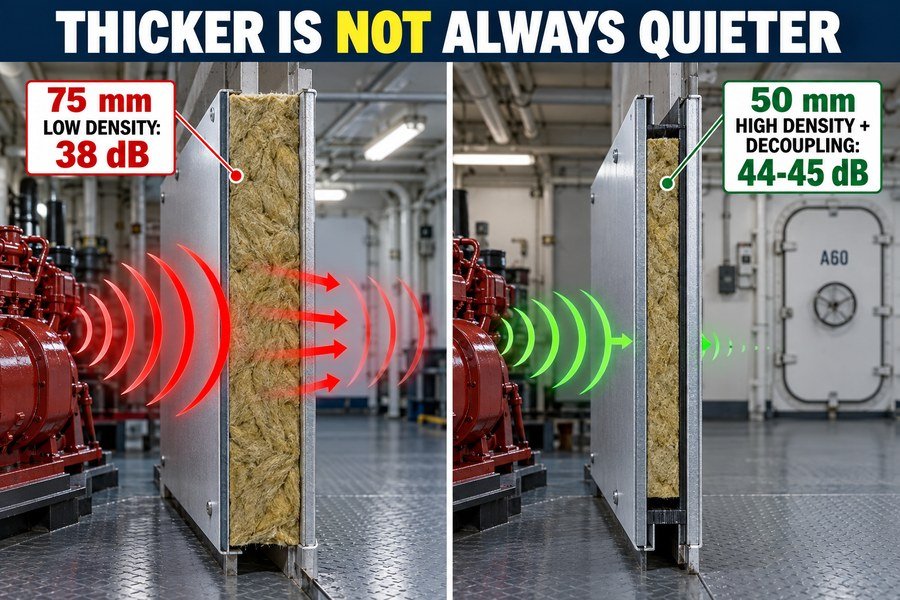
Nominal thickness poorly predicts acoustic insulation because sound reduction depends on the combination of mass, core density, and multi-layer decoupling, rather than just total depth. A 50mm double-skin panel with a 150 kg/m³ rockwool core often outperforms a solid 75mm low-density panel.
The Flaw of Relying Solely on Nominal Panel Thickness
Many buyers make a simple mistake. They look at a 75mm panel and assume it is quieter than a 50mm panel. This is wrong. Nominal thickness is just the physical depth of the product. Sound waves do not care about empty space. They care about physical obstacles. If a factory sells you a 75mm panel filled with cheap, low-density foam, the sound will travel right through it. The thickness tricks your eyes, but it does not stop the noise. In my experience, a standard 50mm marine panel with 0.6mm steel skins costs about 22 USD per square meter. A poorly designed 75mm panel might cost 30 USD per square meter but provide worse sound insulation. You must look at the mass and the core density, not just the ruler measurement.4 A thick panel with low mass is just a large drum that transmits noise.
Core Density and Multi-Layer Decoupling Outperform Total Depth
True acoustic insulation comes from core density and multi-layer decoupling. Core density tells us how much material is actually packed inside the panel. A 50mm panel with a 150 kg/m³ rockwool core packs a huge amount of fibers into a small space. These tight fibers trap the sound waves. Next, we use multi-layer decoupling. Decoupling means separating the hard surfaces so sound cannot travel directly through them.5 Instead of a thick single panel, we can use two thin layers of 25mm rockwool separated by a 1mm air gap or a damping sheet. This decoupling forces the sound wave to change mediums multiple times. Sound loses energy every time it hits a new layer. By using heavy mass, high core density, and smart multi-layer decoupling, we can make a 50mm panel achieve an Rw of 44 dB6. The 75mm low-density panel might only reach 38 dB. You save space on the ship and get better results.
| Panel Specification | Nominal Thickness | Core Density | Multi-Layer Decoupling | Tested Acoustic Rating (Rw) |
|---|---|---|---|---|
| Standard Single Core | 75 mm | 80 kg/m³ | None | 38 dB |
| High-Density Standard | 50 mm | 150 kg/m³ | None | 42 dB |
| Decoupled Double Core | 50 mm | 120 kg/m³ | Yes (Internal damping sheet) | 45 dB |
How Does Surface Mass Affect Airborne Sound Reduction in a Marine Bulkhead?
Airborne noise from voices and televisions travels fast. Lightweight panels let this noise through easily. You must understand mass to stop airborne sound.
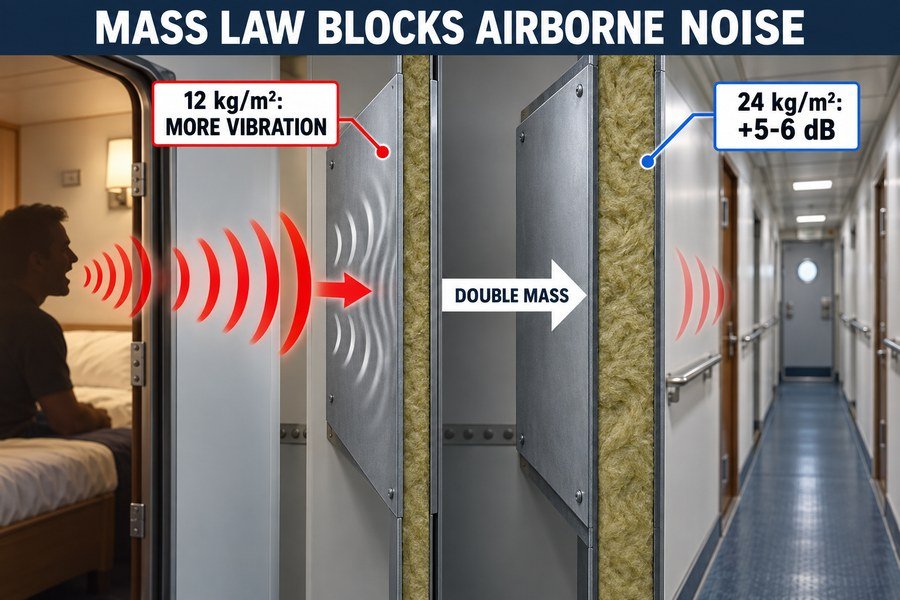
Surface mass directly controls airborne sound reduction through the Mass Law, where doubling the panel's weight per square meter increases noise reduction by about 5 to 6 dB. Increasing a bulkhead's surface mass from 12 kg/m² to 24 kg/m² significantly cuts mid-to-high frequency airborne noise.
The Mass Law Principle in Marine Bulkhead Design
Airborne sound reduction is all about fighting the energy of sound waves in the air. When people talk loudly in a cabin, their voices create airborne sound waves. These waves hit the bulkhead. If the bulkhead is light, the air pressure easily pushes the wall. The wall vibrates and creates the exact same sound in the next room. This is why light walls fail privacy tests. We use the Mass Law to solve this. The Mass Law is a physics rule. It says that heavy objects are harder to move than light objects. If you double the weight of your bulkhead, the sound waves have a much harder time pushing it. The rule is very specific. Every time you double the weight per square meter, you get a 5 to 6 decibel (dB) increase in sound reduction.7 A 5 dB drop means the noise sounds almost half as loud to the human ear.8
Upgrading Surface Mass for Mid-to-High Frequency Noise
The Mass Law works extremely well for mid-to-high frequency airborne noise.9 Human voices, televisions, and small tools create mid-to-high frequency noise. This noise ranges from 500 Hz to 2000 Hz.10 If your client complains about hearing people talk in the next cabin, you must increase the surface mass. Let us look at real numbers. A standard B-15 class bulkhead has 0.6mm steel skins. Its surface mass is about 15 kg/m². It gives about 33 dB of airborne sound reduction. We can upgrade the steel skins to 1.0mm thickness. This increases the total surface mass to about 22 kg/m². Because we almost doubled the mass of the steel, the sound reduction jumps to about 38 dB. This 5 dB improvement completely blocks normal human speech. The cost for this 1.0mm steel upgrade is usually only 3 to 5 USD extra per square meter. It is the cheapest and most reliable way to improve airborne sound reduction.
| Bulkhead Steel Skin Thickness | Total Surface Mass | Estimated Airborne Sound Reduction (Rw) | Cost Impact (USD/m²) |
|---|---|---|---|
| 0.5 mm / 0.5 mm | ~12.5 kg/m² | 31 dB | Base Price |
| 0.6 mm / 0.6 mm | ~15.0 kg/m² | 33 dB | + 1.00 USD |
| 0.8 mm / 0.8 mm | ~18.5 kg/m² | 36 dB | + 2.50 USD |
| 1.0 mm / 1.0 mm | ~22.0 kg/m² | 38 dB | + 4.00 USD |
Can a Marine Ceiling's Rw Rating Be Estimated Solely from Its Core Material?
Core materials are important, but they do not act alone. Guessing an acoustic rating from just the core leads to failed ship inspections.
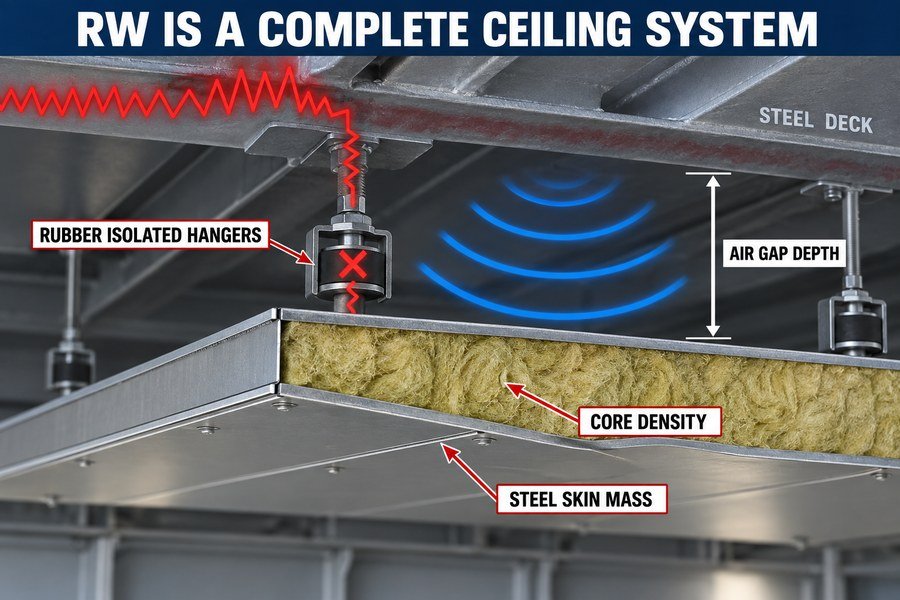
A marine ceiling's Rw rating cannot be estimated solely from its core material because the final rating requires four components: core density, outer skin thickness, suspension system type, and air gap depth. The complete assembly dictates the final acoustic performance, not just the raw rockwool.
Why Core Density and Outer Skin Thickness Must Work Together
Many people ask me if a 150 kg/m³ rockwool ceiling panel will automatically give them a 45 dB rating. I always tell them no. You cannot estimate the Rw rating from the core material alone. The core density is important, but it only absorbs sound. It does not block sound. You need the outer skin thickness to block the sound. The core density and the outer skin thickness are the first two components of a ceiling system. If you use a heavy 150 kg/m³ core but cover it with a very thin 0.4mm aluminum skin, the sound will easily pass through the weak skin. The sound will bypass the core entirely. You must use at least a 0.6mm galvanized steel outer skin to create enough mass. A ceiling panel with a good core density and a thick outer skin is the foundation of acoustic control. But the panel itself is still only half of the story.
The Impact of Suspension Systems and Air Gaps on Ceiling Acoustics
To get the true Rw rating, you must include the suspension system type and the air gap depth. These are the third and fourth components. Marine ceilings hang from the steel deck above. If you use rigid metal Z-profiles for your suspension system type, the vibration from the deck above travels straight down the metal into the ceiling panel.11 This ruins the Rw rating. We use anti-vibration hangers with rubber isolators instead. These soft hangers stop the vibration transfer. Finally, the air gap depth changes everything. The air gap is the empty space between the ceiling panel and the steel deck. A 50mm air gap depth traps some sound. A 100mm air gap depth traps much more sound, especially low-frequency engine noise.12 When a laboratory tests a ceiling for its Rw rating, they test the core, the skins, the hangers, and the air gap together as one complete system. You must install it exactly the same way on the ship.
| Ceiling System Component | Poor Acoustic Choice | High Acoustic Choice | Effect on Overall Ceiling Rw Rating |
|---|---|---|---|
| Core Density | 80 kg/m³ glass wool | 150 kg/m³ rockwool | Adds internal damping and mass. |
| Outer Skin Thickness | 0.4 mm Aluminum | 0.7 mm Galvanized Steel | Blocks direct noise transmission. |
| Suspension System Type | Rigid Steel Z-Profile | Rubber Isolated Hangers | Stops structure-borne vibration. |
| Air Gap Depth | 25 mm gap | 150 mm gap | Greatly improves low-frequency reduction. |
How Does Layer Arrangement Shape a Marine Interior Sandwich Panel's Sound Insulation Curve?
Putting materials in the wrong order wastes their acoustic potential. A bad arrangement lets specific noise frequencies pass right through your panels.
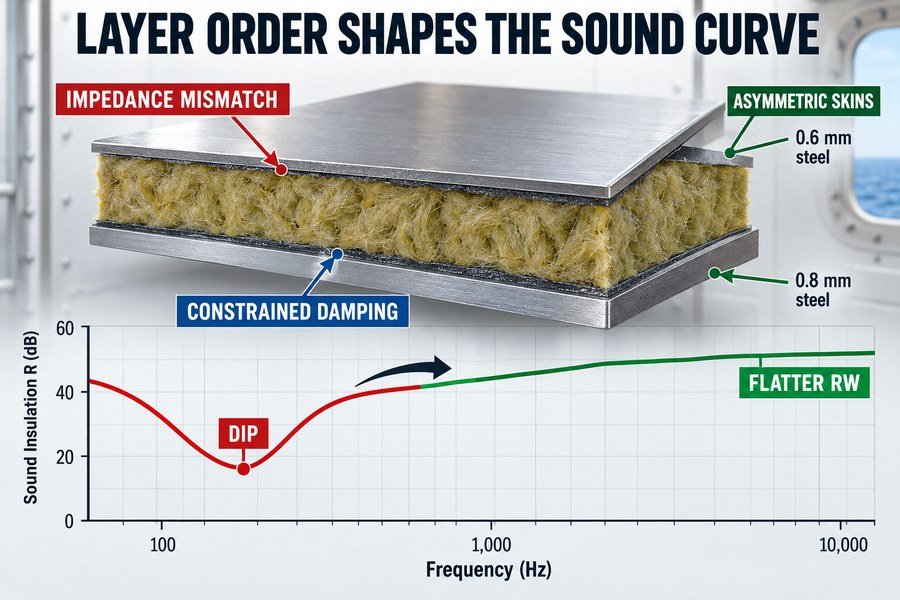
Layer arrangement shapes the sound insulation curve by using three mechanisms: impedance mismatch, asymmetric skin thicknesses, and constrained layer damping. Placing a high-density core between two different steel thicknesses shifts resonance frequencies, drastically improving low-frequency noise reduction without adding extra weight.
Using Impedance Mismatch in Panel Layering
The way you arrange the layers inside a panel changes how the panel handles different sound frequencies. The first mechanism we use is called impedance mismatch. Acoustic impedance is how much a material resists sound. Steel has a very high acoustic impedance. Air and soft rockwool have a very low acoustic impedance. When sound waves travel through materials with the same impedance, they move easily. But when sound waves hit a layer with a totally different impedance, the sound wave bounces back13. We arrange sandwich panels to create maximum impedance mismatch. We place a soft, low-impedance rockwool core directly between two hard, high-impedance steel skins. The sound hits the steel, bounces, enters the soft core, and then hits the second steel skin and bounces again. This layer arrangement forces the sound to lose energy at every boundary.
Asymmetric Skin Thicknesses and Constrained Layer Damping
The next two mechanisms are asymmetric skin thicknesses and constrained layer damping. Usually, factories make panels with symmetric skins, like 0.6mm steel on both sides. This is a problem. Both sides vibrate at the exact same frequency. This creates a "dip" in the sound insulation curve, letting a specific noise through.14 We fix this by using asymmetric skin thicknesses. We use a 0.6mm skin on one side and a 0.8mm skin on the other side. Because the thicknesses are different, the two sides vibrate at different frequencies. This completely removes the dip in the sound curve. Finally, we use constrained layer damping. We add a thin layer of viscoelastic glue between the steel and the rockwool. When the steel tries to bend, the glue stretches and absorbs the bending energy. This constrained layer damping is amazing for stopping low-frequency engine noise.15 Using these three mechanisms gives you a perfect sound curve without buying a heavier panel.
| Layer Arrangement Strategy | Design Example | Primary Mechanism | Effect on Sound Insulation Curve |
|---|---|---|---|
| Standard Symmetric | 0.6mm Steel + Rockwool + 0.6mm Steel | Basic Mass Law | Creates a deep resonance dip at critical frequencies. |
| Asymmetric Skins | 0.6mm Steel + Rockwool + 0.8mm Steel | Break Resonance | Flattens the curve, improving overall Rw by 2-3 dB.16 |
| Constrained Damping | Steel + Viscoelastic Glue + Rockwool + Steel | Absorbs Bending | Greatly improves low-frequency (100Hz - 250Hz) noise reduction. |
What Construction Details Must Be Documented to Justify a Marine Accommodation Panel's Target Rw?
Surveyors will reject your panels if the paperwork is wrong. Missing details mean costly delays and zero compliance for your project.
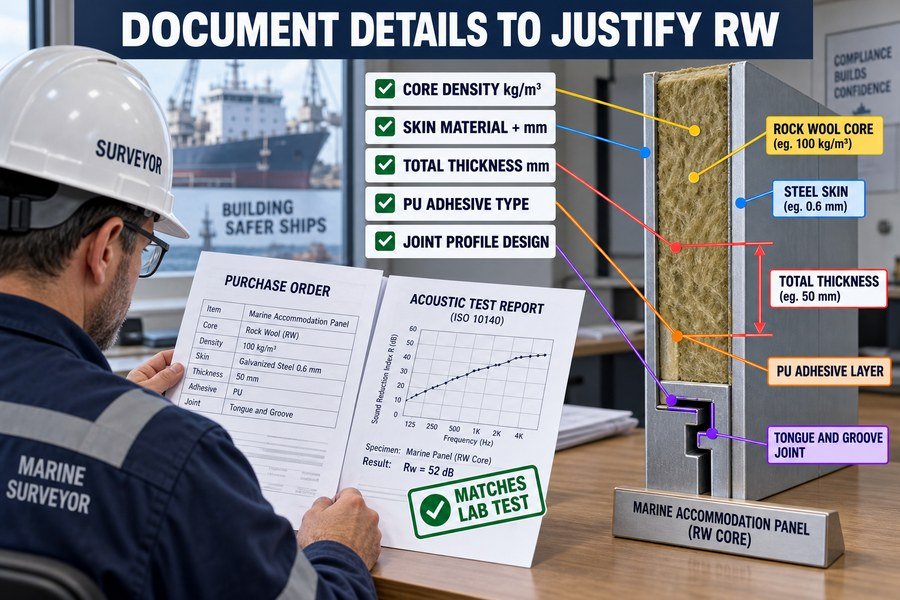
To justify a marine accommodation panel's target Rw, five construction details must be documented: core density (kg/m³), skin sheet material and thickness (mm), total panel thickness (mm), adhesive type, and joint profile design. These details ensure the manufactured panel perfectly matches the certified laboratory acoustic test reports.
Core, Skin, and Thickness Specifications for Acoustic Documentation
When you buy marine accommodation panels, you must ask the supplier for an acoustic test report from an official laboratory. But the report is only valid if the panels you buy match the panels in the report exactly17. The surveyor will check your documentation. You must clearly document the first three details: core density, skin sheet material and thickness, and total panel thickness. Your purchase order and the factory drawings must state the core density in kg/m³. If the test report says 150 kg/m³, your documents must say 150 kg/m³. Next, document the skin sheet material and thickness in millimeters. You must write "0.6mm Galvanized Steel," not just "Steel." The material type changes the mass18. Finally, document the total panel thickness in millimeters. A 50mm panel and a 25mm panel have totally different acoustic results19. If these three physical numbers on your shipping documents do not match the lab report, the surveyor will reject the entire batch.
The Role of Adhesive and Joint Profiles in Laboratory Certification
The last two details are usually forgotten, but they cause many failures. You must document the adhesive type and the joint profile design. The adhesive type is the glue that holds the panel together. You cannot just write "glue." The laboratory tests a specific glue, usually a two-component polyurethane (PU) glue applied at 200 grams per square meter. This glue adds mass and acts as a damping layer. If the factory uses a cheap, thin glue to save money, the acoustic rating will drop. Your documents must state the adhesive type and weight. Lastly, you must document the joint profile design. Panels connect together using joints. If you use a simple flat joint, sound leaks through the cracks. Acoustic panels use a tight tongue-and-groove joint profile or an H-profile packed with ceramic fiber. The exact joint profile design used in the lab test must be drawn on your installation plans. Documenting these five details protects your money and guarantees compliance.
| Required Construction Detail | How It Must Be Documented | Why Surveyors Check It |
|---|---|---|
| Core Density (kg/m³) | 150 kg/m³ Rockwool | Ensures internal damping matches the lab test. |
| Skin Material & Thickness | 0.6mm Galvanized Steel | Verifies the panel meets the required surface mass. |
| Total Panel Thickness | 50 mm Total Depth | Confirms the physical size and cavity volume. |
| Adhesive Type | 200 g/m² PU Glue | Proves structural stiffness and constrained damping. |
| Joint Profile Design | Tongue-and-groove joint | Ensures no sound leaks between the installed panels. |
Conclusion
To get the best price and pass strict acoustic inspections, you must understand mass, core density, and layer decoupling. Control these specific structural details on your purchase orders, and you will buy high-quality, quiet panels every time.
-
"[PDF] ENGINEERING ACOUSTICS EE 363N", http://majdalani.eng.auburn.edu/courses/08_aeroacoustics/enotes_ac2_Engineering_Acoustics_Penic.pdf. A standard acoustics reference defining surface mass or mass per unit area supports the use of kg/m² as the relevant panel property in sound-insulation calculations. Evidence role: definition; source type: education. Supports: Surface mass is the weight of the panel per square meter and is measured in kg/m².. ↩
-
"[PDF] Ultrasonic, Normal-Incidence Insertion Loss through Common ...", https://physics.byu.edu/docs/thesis/269. A building-acoustics source on the mass law supports that, above resonance and below coincidence effects, transmission loss increases by approximately 6 dB for each doubling of surface mass or frequency. Evidence role: mechanism; source type: education. Supports: The acoustic mass law shows that every time surface mass doubles, sound transmission loss increases by about 5 to 6 dB.. Scope note: The mass-law relationship is an idealized estimate and may not hold near panel resonance, coincidence frequencies, flanking paths, or for multilayer composite panels. ↩
-
"Sound Transmission Loss of a Panel Backed by a Small ...", https://www.academia.edu/30078653/Sound_Transmission_Loss_of_a_Panel_Backed_by_a_Small_Enclosure_LOW_FREQUENCY_NOISE_VIBRATION_AND_ACTIVE_CONTROL_Sound_Transmission_Loss_of_a_Panel_Backed_by_a_Small_Enclosure. A structural-acoustics or building-acoustics source on panel resonance supports that panels have natural frequencies at which vibration amplitudes can increase and reduce sound-insulation performance. Evidence role: mechanism; source type: paper. Supports: Structural stiffness can produce resonance behavior in panels, allowing greater sound transmission at specific frequencies.. Scope note: The source would support the general resonance mechanism; the exact frequencies and severity depend on panel dimensions, boundary conditions, materials, and mounting details. ↩
-
"[PDF] Sound Transmission Loss of Composite Sandwich Panels", https://etd.auburn.edu/bitstream/10415/1702/3/Ran%20Zhou_Dissertation.pdf. Building-acoustics references describe sound transmission loss as depending on surface mass, stiffness, damping, and construction details, supporting the point that nominal thickness alone is not a reliable predictor of insulation performance. Evidence role: expert_consensus; source type: education. Supports: Panel sound insulation depends on mass, density, and construction, not only nominal thickness.. Scope note: This supports the general acoustic principle, not the specific 50 mm and 75 mm product comparison in the article. ↩
-
"[PDF] Evaluating Airborne Sound Insulation in Dwellings Constructed with ...", https://dau.url.edu/bitstream/handle/20.500.14342/5737/25%20-%20Scoczynski%20Ribeiro%2C%20Arnela%2C%20Braz-C%C3%A9sar%2C%20Bosse%2C%20Silvestro%2C%20Gidr%C3%A3o%2C%20Kempka%2C%20Silva%2C%20Buildings%202024%2C%2014%2C%20813%20%282024%29.pdf?sequence=1&isAllowed=y. Acoustics literature on double-leaf partitions describes how separating leaves with an air cavity or resilient layer can reduce direct vibration transmission and alter the mass–air–mass resonance behavior of an assembly. Evidence role: mechanism; source type: education. Supports: Decoupling hard panel faces can reduce direct structure-borne sound transmission in layered assemblies.. Scope note: The benefit depends on cavity depth, resilient connections, damping, and resonance frequency; a small gap or poorly bridged assembly may not improve performance at all frequencies. ↩
-
"How to Compare Acoustic Data Across Marine ...", https://magellanmarinetech.com/how-compare-acoustic-data-across-marine-accommodation-panel-suppliers/. An accredited laboratory report using ISO 10140 measurement procedures and ISO 717 rating methods would document the weighted sound reduction index for the exact panel assembly, directly supporting the stated Rw value. Evidence role: statistic; source type: institution. Supports: A specific 50 mm panel assembly can achieve an Rw of 44 dB.. Scope note: General standards or acoustics papers can define Rw and test methodology, but they cannot verify this exact 44 dB claim without a test report for the same materials, dimensions, and construction. ↩
-
"A Comparative Study of Sound Transmission Loss Provided by ...", https://www.academia.edu/99904089/A_Comparative_Study_of_Sound_Transmission_Loss_Provided_by_Glass_Acrylic_and_Polycarbonate. An architectural-acoustics reference states that, in the mass-controlled region of a single-leaf partition, sound transmission loss increases by roughly 6 dB for each doubling of surface density. Evidence role: mechanism; source type: education. Supports: Doubling the bulkhead surface mass increases airborne sound reduction by about 5 to 6 dB under mass-law conditions.. Scope note: This idealized mass-law relation is affected by stiffness, damping, mounting details, resonance, and coincidence effects in real bulkheads. ↩
-
"Physics 4060, Acoustics Laboratory - HyperPhysics", http://hyperphysics.phy-astr.gsu.edu/hbase/Ph4060/p406i.html. Psychoacoustic references commonly report that perceived loudness changes approximately nonlinearly with sound level, with a 10 dB change often used as a rough doubling or halving of perceived loudness. Evidence role: expert_consensus; source type: research. Supports: A reduction in decibels corresponds to a perceptual reduction in loudness, though the article’s specific 5 dB-to-half-loudness wording needs verification or qualification.. Scope note: This contextual evidence may not directly support the article’s exact 5 dB claim; perceived loudness depends on frequency, level, spectrum, and listener conditions. ↩
-
"[PDF] Sound transmission loss characteristics of sandwich panel ...", https://bulldog2.redlands.edu/fac/julie_rathbun/physclasses/sound.pdf. Acoustics literature describes the mass law as applying most clearly in the mass-controlled frequency region of a partition, above low-frequency resonance and apart from coincidence effects. Evidence role: mechanism; source type: paper. Supports: Mass-law behavior is most applicable to airborne sound transmission at frequencies where the partition is mass-controlled.. Scope note: The source would support the general frequency-dependent mechanism, not prove that every marine bulkhead design performs “extremely well” across all mid-to-high frequencies. ↩
-
"[PDF] Evaluating the role of spectral and envelope characteristics in the ...", https://www.utdallas.edu/~assmann/hcs6367/krause_braida09.pdf. Speech-acoustics sources show that important components of spoken voice and speech intelligibility occupy the several-hundred-hertz to several-kilohertz range, including much of the 500–2000 Hz band. Evidence role: general_support; source type: education. Supports: Human voice noise relevant to cabin privacy often lies in the mid-frequency range around 500–2000 Hz.. Scope note: This supports the range as a useful simplified band for speech-related noise, but human speech also contains fundamental frequencies below 500 Hz and intelligibility cues above 2000 Hz. ↩
-
"Study on Dynamic Characteristics of Resilient Mount Under ...", https://pmc.ncbi.nlm.nih.gov/articles/PMC11509879/. A source on structure-borne sound should support that rigid mechanical connections can transmit vibration between building or ship structures, while resilient mounts or isolators reduce vibration transmission by decoupling the connected elements. Evidence role: mechanism; source type: research. Supports: Rigid metal suspension members can transmit vibration from the deck to the ceiling panel, reducing acoustic isolation.. Scope note: This supports the vibration-isolation mechanism generally; the exact effect of a Z-profile in a specific ceiling depends on geometry, loading, installation, and test conditions. ↩
-
"Airborne sound insulation performance of lightweight double ...", https://pmc.ncbi.nlm.nih.gov/articles/PMC11666719/. An acoustics source should support that cavity depth and air space can influence the sound transmission loss of double-panel or suspended-ceiling systems, with larger cavities often improving low-frequency performance when combined with suitable linings and decoupling. Evidence role: mechanism; source type: paper. Supports: Increasing the air gap in a suspended ceiling or double-panel system can improve sound reduction, particularly at lower frequencies under appropriate system conditions.. Scope note: The statement is directionally supported, but the term “traps” is informal and the magnitude of improvement depends on panel mass, cavity absorption, structural connections, and resonance frequency. ↩
-
"[PDF] Lecture 9: Reflection, Transmission and Impedance", https://schwartz.scholars.harvard.edu/file_url/141. A technical source on acoustic impedance and reflection coefficients supports that sound reflection at a boundary increases with the acoustic-impedance contrast between two media. Evidence role: mechanism; source type: education. Supports: A large acoustic-impedance mismatch between adjacent layers causes part of an incident sound wave to be reflected.. Scope note: This support is strongest for idealized plane-wave interfaces; real sandwich panels also involve damping, bending waves, mounting conditions, and frequency-dependent effects. ↩
-
"Sound Transmission Loss of Composite Sandwich Panels", https://etd.auburn.edu/bitstream/10415/1702/3/Ran%20Zhou_Dissertation.pdf. Building-acoustics literature on double-leaf or sandwich panels describes resonance and coincidence effects that can produce reductions, or dips, in sound transmission loss at particular frequencies. Evidence role: mechanism; source type: paper. Supports: Symmetric panel constructions can exhibit resonance-related dips in their sound-insulation curves.. Scope note: The wording in the article is simplified: matching skin thickness can contribute to coupled resonances, but the exact dip frequency and depth depend on panel dimensions, core stiffness, damping, boundary conditions, and installation. ↩
-
"Damped Windows for Aircraft Interior Noise Control", https://ntrs.nasa.gov/api/citations/20040086707/downloads/20040086707.pdf. Research on constrained-layer damping supports that a viscoelastic layer bonded to a vibrating plate dissipates bending vibration energy as heat, which can reduce structure-borne sound radiation. Evidence role: mechanism; source type: research. Supports: Constrained-layer damping can reduce low-frequency vibration and associated noise by dissipating bending energy in a viscoelastic layer.. Scope note: General constrained-layer damping sources may not directly prove performance against engine noise in this exact panel design; effectiveness depends on the viscoelastic material, temperature, layer thickness, frequency range, and installation. ↩
-
"Investigation of Sound Transmission Loss Through ...", https://www.academia.edu/58114441/Investigation_of_Sound_Transmission_Loss_Through_Sandwich_Panel_with_Foam_Core. Comparative measurements or modeling studies of sandwich panels with unequal facings can support that asymmetric skins may improve single-number sound-insulation ratings by a small number of decibels by shifting resonances and coincidence effects. Evidence role: statistic; source type: paper. Supports: Using asymmetric steel skin thicknesses can improve overall Rw by about 2–3 dB.. Scope note: The specific 2–3 dB improvement should be treated as configuration-dependent rather than universal unless the cited study uses the same materials, thicknesses, and test method. ↩
-
"What Does Class Society Type Approval Mean for Marine Wall ...", https://magellanmarinetech.com/what-class-society-type-approval-mean-for-marine-wall-ceiling-panels/. Laboratory sound-insulation standards such as ISO 10140 require the tested specimen and its mounting conditions to be described because measured acoustic performance applies to that tested construction rather than to materially different assemblies. Evidence role: expert_consensus; source type: institution. Supports: An acoustic test report is applicable only when the supplied panels match the construction tested in the laboratory.. Scope note: This supports the principle that acoustic reports are specimen-specific; it may not by itself prove a particular marine surveyor’s acceptance rule. ↩
-
"Sound transmission class", https://en.wikipedia.org/wiki/Sound_transmission_class. Acoustics references describe the mass law of sound insulation, under which a panel’s surface density is a major determinant of airborne sound transmission loss; therefore changing the skin material or thickness can change the measured acoustic result. Evidence role: mechanism; source type: education. Supports: Skin material and thickness matter because they change surface mass, which affects sound transmission loss.. Scope note: Mass law is a general acoustic principle and does not predict the exact performance of a specific marine sandwich panel without testing. ↩
-
"Investigation of Sound Transmission Loss Through ...", https://www.academia.edu/58114441/Investigation_of_Sound_Transmission_Loss_Through_Sandwich_Panel_with_Foam_Core. Research on sandwich and multilayer acoustic panels shows that geometry, including core thickness and cavity depth, influences resonance behavior and sound transmission loss, so panels with different total thicknesses cannot be assumed to have the same acoustic rating. Evidence role: mechanism; source type: paper. Supports: Total panel thickness affects acoustic performance, so a 50 mm panel and a 25 mm panel may produce different acoustic test results.. Scope note: The source would support thickness as an influential parameter, not necessarily quantify the difference between 25 mm and 50 mm for every product design. ↩