Passenger complaints about noise ruin reputations. Failed noise inspections halt shipyard deliveries. I use the acoustic mass law to design quiet, compliant marine cabins without wasting your budget.
The acoustic mass law states that a marine bulkhead's sound transmission loss increases by 6 dB for every doubling of its mass or sound frequency. It governs the entire design process, covering single-layer steel structures, double-skin interior wall panels, ceiling boards, and floating floors used in commercial shipbuilding.
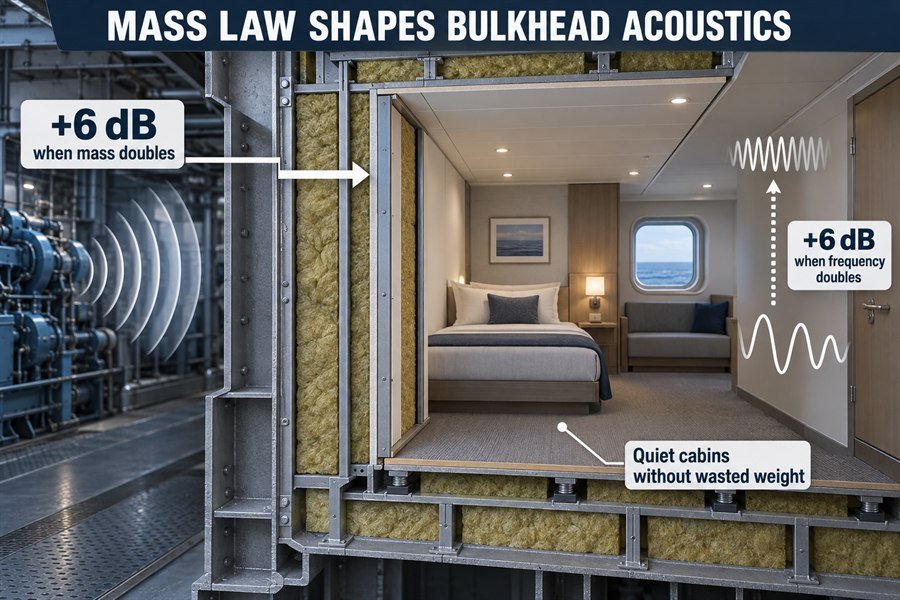
Understanding this simple physics rule changed my career. Let me show you how we apply it daily to balance cost, weight, and strict shipyard noise regulations.
How Does the Mass Law Apply to Single-Layer Marine Steel Bulkheads?
Bare steel bulkheads transmit engine noise easily. This makes crew spaces unlivable. We apply mass law to calculate the exact steel thickness needed for baseline noise reduction.
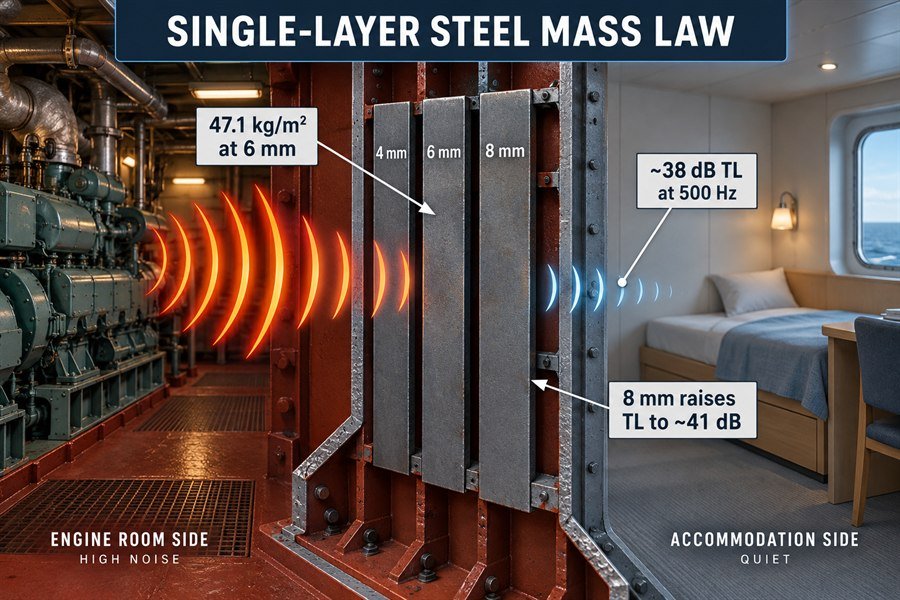
The mass law dictates that a single-layer steel bulkhead's transmission loss (TL) depends entirely on its surface weight and the sound frequency. A standard 6mm marine steel plate (47.1 kg/m²) provides roughly 38 dB of sound reduction at 500 Hz, while an 8mm plate (62.8 kg/m²) provides around 41 dB.
Calculating Surface Weight for Steel Bulkheads
As a marine outfitting specialist, I always start my acoustic design with the raw ship structure. Shipyards usually build structural bulkheads out of mild steel. According to standard material engineering properties, marine steel has a density of about 7,850 kg/m³1. If a shipyard gives me a 6mm thick steel deck or bulkhead, I calculate its surface weight as 47.1 kg/m² (7.85 multiplied by 6). If the shipyard upgrades to an 8mm steel plate for structural safety reasons, the surface mass becomes 62.8 kg/m². The mass law tells us that heavier objects are much harder for sound waves to vibrate.2 This bare steel calculation is the very first step in our acoustic design before we even look at purchasing interior wall panels.
Predicting Transmission Loss in Single-Layer Steel
I use the theoretical mass law equation to predict sound reduction. Based on ISO 717-1 standard acoustic conditions, the formula is TL = 20 log(mass * frequency) - 47 dB. At a typical human vocal frequency of 500 Hz, the 6mm steel plate yields about 38 dB of sound reduction. When we move to the heavier 8mm steel plate, the mass increases, pushing the transmission loss to roughly 41 dB. You can see we gained 3 dB. However, adding 2mm of raw steel adds massive weight to the entire ship. This extra weight ruins fuel efficiency. This is exactly why we cannot just use thicker raw steel to meet the strict 50 dB acoustic limits required by IMO (International Maritime Organization) regulations for sleeping cabins. We must rely on smart, lightweight interior panels instead.
| Marine Steel Thickness | Calculated Surface Mass | Estimated Transmission Loss at 500 Hz | Practical Shipyard Application |
|---|---|---|---|
| 4 mm | 31.4 kg/m² | ~35 dB | Light interior partitions, non-load bearing |
| 6 mm | 47.1 kg/m² | ~38 dB | Standard accommodation deck bulkheads |
| 8 mm | 62.8 kg/m² | ~41 dB | Heavy structural bulkheads near machinery |
| 10 mm | 78.5 kg/m² | ~43 dB | Engine room boundaries |
Why Does Doubling a Marine Interior Panel's Mass Increase Sound Insulation by Only Fixed Decibels?
Adding thicker rockwool seems like a cheap fix. But heavy panels drive up shipping costs. You only get a rigid 6 dB gain when you double the mass.
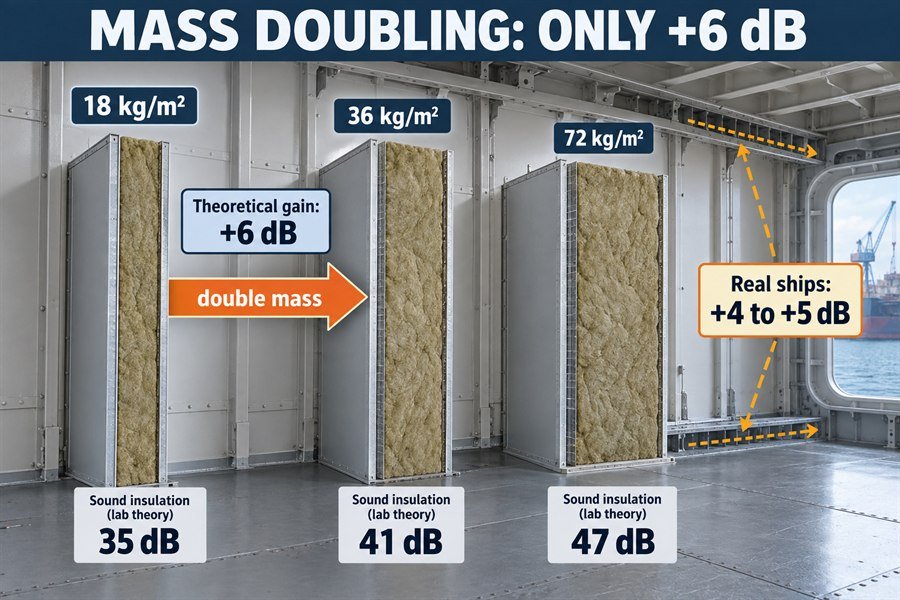
According to logarithmic acoustic physics, doubling a marine interior panel's mass or the sound frequency yields exactly a 6 dB increase in theoretical sound insulation. In practical ship applications, flanking noise and structural flanking paths reduce this real-world gain to just 4 to 5 dB per mass doubling.
The 6 dB Theoretical Limit for Panel Mass Doubling
I learned a hard commercial lesson early in my career. A shipyard client wanted to jump from a 35 dB noise rating to a 45 dB noise rating. The purchasing team asked me to just make our standard 50mm wall panel twice as heavy. I had to explain the acoustic math. The mass law operates on a logarithmic scale. If a standard 50mm composite marine wall panel weighs 18 kg/m² and provides 35 dB of insulation at 500 Hz, doubling its mass to 36 kg/m² will only add 6 dB theoretically3. The new heavy panel will reach 41 dB, not 45 dB. You would have to double the mass again to a massive 72 kg/m² to reach 47 dB. This rapidly makes the panels far too heavy for standard European shipyard requirements. It also drastically drives up your sea freight costs when purchasing from Asian factories.
Real-World 4 to 5 dB Practical Gain on Ships
The 6 dB mathematical rule only exists in perfect laboratory conditions under ISO 10140-2 testing4. On a real working ship, the actual acoustic gain is much lower. Sound vibrations travel through the metal floor profiles, the bare steel deck, and the ceiling tracks. We call this structural flanking transmission5. Because of these sound leaks in the ship's architecture, doubling the mass of your marine fire doors or wall panels usually only gives you a practical, real-world increase of 4 to 5 dB. Instead of buying extremely heavy, single-layer solid panels, I always advise smart procurement officers to use a double-skin panel system with an air gap6. An air gap breaks the mass law curve entirely. It gives you much better acoustic performance at a lower material price and a lower shipping weight.
| Mass Doubling Stage | Panel Surface Mass | Theoretical ISO Lab Gain | Practical Shipyard Gain | Acoustic Result |
|---|---|---|---|---|
| Base Panel | 18 kg/m² | Base 35 dB | Base 35 dB | Standard cabin noise |
| First Doubling | 36 kg/m² | + 6 dB (41 dB) | + 4 to 5 dB (39-40 dB) | Noticeable improvement |
| Second Doubling | 72 kg/m² | + 6 dB (47 dB) | + 4 to 5 dB (43-45 dB) | Too heavy for practical use |
Where Does the Coincidence Dip Appear in a Marine Accommodation Bulkhead's Transmission Loss Curve?
Some wall panels pass overall acoustic tests but fail at specific pitches. This happens due to the coincidence effect. It creates a massive hole in your soundproofing barrier.
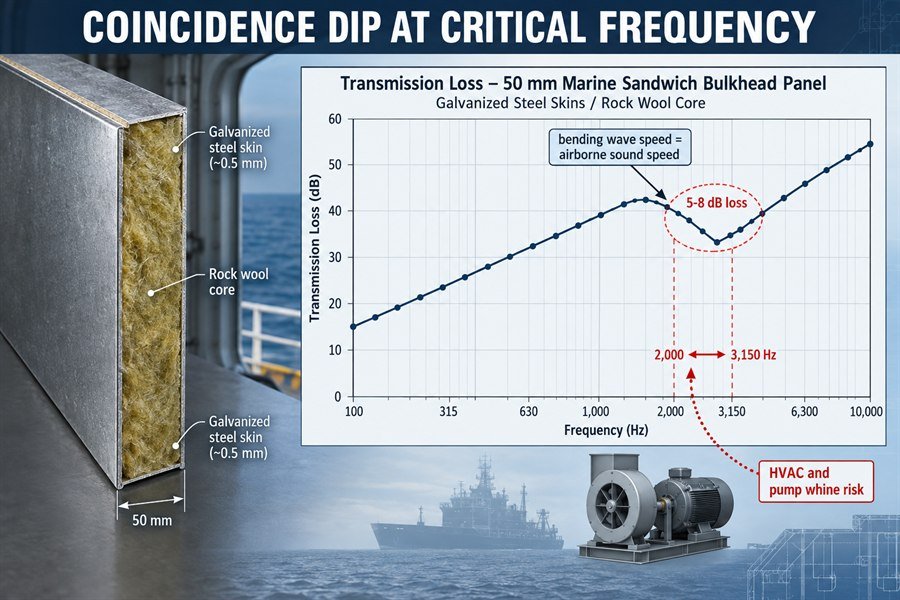
The coincidence dip appears in a marine bulkhead's transmission loss curve at the critical frequency, where the bending wave speed matches the airborne sound wave speed. For a 50mm marine sandwich panel, this dip usually occurs in the mid-to-high frequency range between 2,000 Hz and 3,150 Hz.
Defining the Critical Frequency in Marine Bulkheads
Let me explain the coincidence effect simply. When airborne sound hits a panel at a certain angle, it creates bending waves inside the actual panel material. If the physical speed of this internal bending wave exactly matches the speed of the sound traveling in the air (which is about 343 meters per second), the panel suddenly stops blocking the sound. It actually helps push the sound energy through to the next cabin. This specific failure point is called the critical frequency7. When we look at an official laboratory test report for a marine wall panel, we see a sharp, sudden drop in sound insulation at this exact frequency point. We call this drop the coincidence dip8. It breaks the steady upward climbing line of the standard mass law.
Locating the Coincidence Dip for 50mm Sandwich Panels
I always check the high-frequency data very carefully when reviewing acoustic certificates from Asian suppliers. For a standard 50mm thick marine sandwich panel made with 0.6mm galvanized steel skins and a standard rockwool core, the coincidence dip typically appears in the frequency band between 2,000 Hz and 3,150 Hz9. At these specific frequencies, the panel might lose 5 to 8 dB of its insulation capability. This range is critical. It covers the annoying high-pitched whine of certain ship water pumps and HVAC ventilation fans. To fix this problem, I tell my clients to use panels constructed with constrained layer damping10. Alternatively, I suggest using different steel skin thicknesses on each side of the panel (like 0.6mm on the front and 0.8mm on the back) to shift and soften this coincidence dip.
| Frequency Band | Standard 50mm Panel Acoustic Behavior | Reason for Behavior |
|---|---|---|
| 100 Hz - 500 Hz | Steady increase in transmission loss | Follows standard mass law |
| 500 Hz - 1,500 Hz | Continued steady increase | Follows standard mass law |
| 2,000 Hz - 3,150 Hz | Sharp 5 to 8 dB drop in performance | Coincidence dip (Critical Frequency) |
| 4,000 Hz and above | Recovery and steady increase | Post-critical frequency recovery |
How Does Structural Stiffness Shift a Marine Bulkhead's Critical Frequency?
Stiff panels feel strong, but they can ruin your acoustic rating. High stiffness shifts acoustic failures into frequency ranges where human ears are highly sensitive.
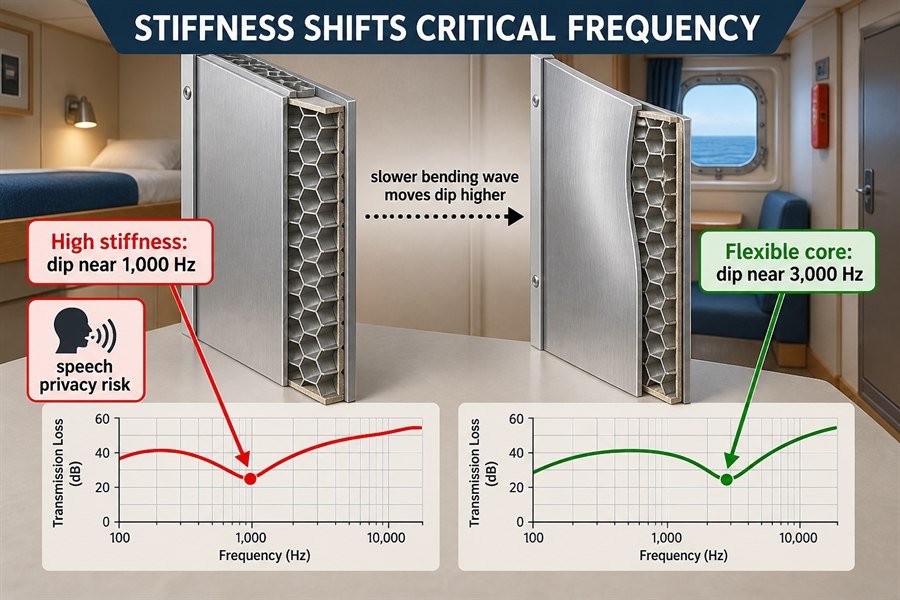
Structural stiffness shifts a marine bulkhead's critical frequency inversely; increasing panel stiffness moves the coincidence dip to lower frequencies, while decreasing stiffness (making the panel more flexible) shifts the critical frequency higher. A stiffer composite panel might drop at 1,000 Hz, whereas a flexible panel drops at 3,000 Hz.
The Impact of High Stiffness on Lower Frequencies
Stiffness and mass work against each other in marine acoustic design. If you make a marine wall panel very stiff by using thick steel plates, rigid aluminum honeycombs, or hard structural glue, sound travels through the material much faster. According to basic acoustic physics, a faster internal bending wave means the critical frequency drops down to a lower number11. For example, if I test a very stiff aluminum honeycomb-core marine panel, its coincidence dip often shifts down to around 1,000 Hz12. This is a huge commercial problem. The 1,000 Hz frequency is right in the middle of human speech. If the panel fails here, people in the next cabin will hear every conversation clearly. The European shipyard will reject the entire installation, and you will lose your profit margin.
Using Flexible Materials to Push Critical Frequencies Higher
I always look for clever ways to increase panel mass without increasing panel stiffness. This is exactly why we use flexible materials inside the core. If we keep the panel interior flexible, the bending wave moves very slowly. This slow movement pushes the critical frequency much higher up the scale. A standard flexible rockwool panel with thin steel skins will have its coincidence dip up around 3,000 Hz. Human hearing is much less sensitive at these high pitches. Furthermore, typical ship engine noise has less acoustic energy at 3,000 Hz13. By carefully controlling the stiffness of the adhesive glue and the steel skin during the manufacturing process in China, we can optimize the panel for the best price-to-performance ratio. You get high quality without failing the speech privacy tests.
| Core Material Type | Structural Stiffness Level | Typical Critical Frequency | Acoustic Impact on Passengers |
|---|---|---|---|
| Aluminum Honeycomb | Very High (Rigid) | ~1,000 Hz | High risk of failing human speech privacy tests |
| High-Density Polyurethane | Medium-High | ~2,000 Hz | Moderate risk for mechanical whine noise |
| Standard Marine Rockwool | Low (Flexible) | ~3,000 Hz | Low risk, outside of main human speech bands |
How Does Core Density Influence a Marine Ceiling's Mass-Controlled Sound Insulation?
Choosing the right ceiling core density saves money and weight. Too light, and you fail the noise test. Too heavy, and you waste shipping costs.
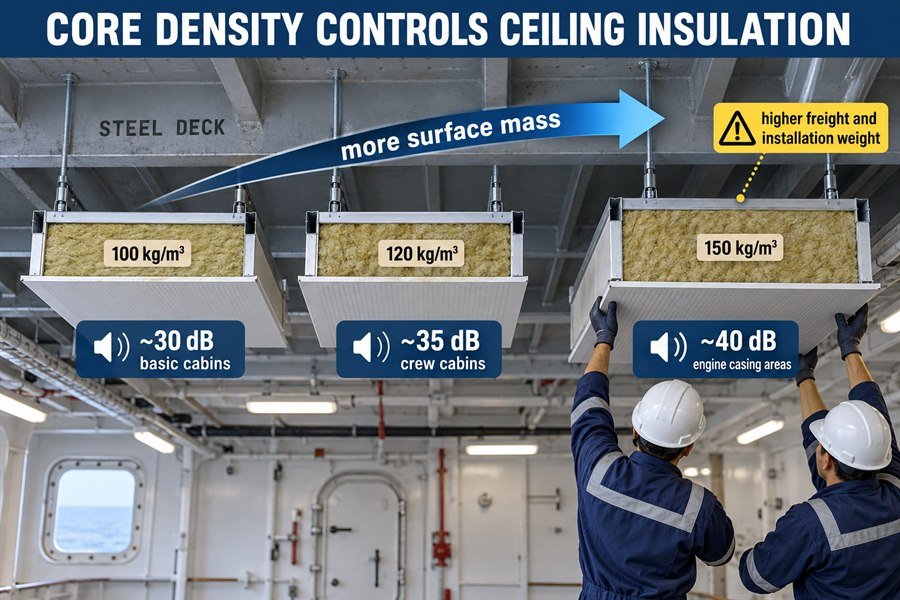
Core density dictates the overall surface mass of a marine ceiling, directly improving mass-controlled sound insulation. Standard ceilings use 100 kg/m³ rockwool for basic 30 dB insulation, 120 kg/m³ for standard 35 dB applications, and 150 kg/m³ high-density cores to achieve 40 dB in high-noise engine casing areas.
Standard Density Cores for Basic Marine Ceilings
The core of a marine ceiling panel is almost always mineral wool or rockwool14. This core material provides the necessary mass to block sound traveling down from the steel deck above. According to the mass law15, the heavier the core, the better the overall sound insulation. For basic passenger cabins or public corridors, I typically source ceiling panels with a 100 kg/m³ rockwool density. A standard 25mm thick ceiling panel with this exact density will generally yield around 30 dB of sound reduction according to ISO 140-3 laboratory testing. This 100 kg/m³ option is cheap, very lightweight, and perfect for areas without severe mechanical noise issues. It keeps your purchasing costs low while meeting basic classification society rules.
Upgrading to High-Density Cores for Critical Noise Areas
When we outfit spaces directly above the noisy engine room or under a busy disco deck, we must increase the ceiling mass. We do this by increasing the rockwool core density. Moving up to a 120 kg/m³ rockwool core raises the acoustic performance to around 35 dB. This is the standard acoustic requirement for most commercial ship crew cabins. For extreme noise areas, I recommend a 150 kg/m³ high-density core. This heavy core pushes the sound insulation closer to 40 dB. However, as a professional buyer, you must be careful. A 150 kg/m³ core is much heavier. It increases your sea freight costs from Asia significantly. It also makes manual installation by workers in the shipyard much harder and slower. You must balance the acoustic need with your project budget and installation timeline.
| Rockwool Core Density | Typical Ceiling Thickness | Estimated Sound Insulation (ISO 140-3) | Best Shipyard Application Area |
|---|---|---|---|
| 100 kg/m³ | 25 mm | ~30 dB | General corridors, standard passenger cabins |
| 120 kg/m³ | 25 mm | ~35 dB | Crew cabins, officers' quarters |
| 150 kg/m³ | 25 mm or 50 mm | ~40 dB | Areas directly above engine rooms or thrusters |
Conclusion
The mass law is the foundation of marine acoustic design. By balancing steel thickness, panel mass, core density, and stiffness, you secure shipyard approvals and heavily control your purchasing costs.
-
"[PDF] Chapter 9 1. Locate the centroid (x, ӯ) of the area. 2. The steel plate ...", https://info.montgomerycollege.edu/_documents/faculty/chou/enes102/hw5.pdf. Engineering materials references commonly list carbon or mild steel density at approximately 7.85 g/cm³, equivalent to 7,850 kg/m³, supporting the density used for the surface-mass calculation. Evidence role: definition; source type: education. Supports: Marine steel has a density of about 7,850 kg/m³.. Scope note: This value is a typical engineering approximation; actual marine steel grades vary slightly by alloy composition. ↩
-
"[PDF] Ultrasonic, Normal-Incidence Insertion Loss through Common ...", https://physics.byu.edu/docs/thesis/269. Architectural-acoustics references describe the mass law of sound insulation, under which transmission loss for a single homogeneous barrier increases with surface mass and frequency, supporting the general mechanism stated here. Evidence role: mechanism; source type: paper. Supports: Heavier single-layer barriers are generally harder for airborne sound to vibrate and therefore provide greater transmission loss.. Scope note: Mass law is an idealized approximation and does not account for stiffness, damping, coincidence effects, flanking transmission, or panel mounting conditions. ↩
-
"[PDF] Ultrasonic, Normal-Incidence Insertion Loss through Common ...", https://physics.byu.edu/docs/thesis/269. The source explains the acoustic mass law for single homogeneous panels, under which transmission loss increases by about 6 dB for each doubling of surface mass at a fixed frequency. Evidence role: mechanism; source type: education. Supports: Doubling the surface mass of a panel theoretically increases airborne sound insulation by about 6 dB.. Scope note: This supports the theoretical mass-law relationship, not the specific 18 kg/m² panel example or its measured 35 dB rating. ↩
-
"Sound insulation dataset of 30 wooden and 8 concrete floors ...", https://pmc.ncbi.nlm.nih.gov/articles/PMC10365936/. ISO 10140-2 specifies laboratory methods for measuring airborne sound insulation of building elements, providing the controlled test context in which panel sound-reduction ratings are commonly established. Evidence role: definition; source type: institution. Supports: ISO 10140-2 is a laboratory testing framework for airborne sound insulation rather than a field-installation performance guarantee.. Scope note: The standard defines laboratory measurement procedures; it does not by itself prove that any particular shipboard installation will perform as tested. ↩
-
"[PDF] Review of Modelling and Prediction Methods for Flanking ...", https://upcommons.upc.edu/bitstreams/61ecb1e5-2d31-4e5a-9331-36438f565f22/download. The source describes flanking transmission as sound or vibration energy that bypasses the separating element through adjoining structures, which can reduce the apparent sound insulation measured in real buildings or installations. Evidence role: mechanism; source type: paper. Supports: Sound can bypass wall or door panels through connected structural paths, reducing practical acoustic performance compared with isolated laboratory measurements.. Scope note: Most neutral sources discuss buildings generally; the same mechanism is contextually applicable to ships but may not quantify the exact 4-5 dB loss claimed here. ↩
-
"The use of acoustically tuned resonators to improve the sound ...", https://ui.adsabs.harvard.edu/abs/1986uatr.rept.....M/abstract. The source explains that double-leaf or double-panel constructions separated by an air cavity can achieve higher sound insulation than a single panel of comparable mass by introducing mass-air-mass behavior and reducing direct transmission over parts of the frequency range. Evidence role: mechanism; source type: research. Supports: A double-skin panel with an air gap can improve acoustic performance relative to simply increasing the mass of a single-layer panel.. Scope note: This supports the acoustic principle of double-skin construction; it does not directly verify lower material price or shipping weight for a specific marine product. ↩
-
"[PDF] Sound Transmission Loss of Composite Sandwich Panels", https://etd.auburn.edu/bitstream/10415/1702/3/Ran%20Zhou_Dissertation.pdf. A standard architectural-acoustics or engineering-acoustics reference should be cited to define critical frequency as the frequency at which a panel's bending-wave speed corresponds to the trace wavelength of airborne sound, producing reduced sound transmission loss near coincidence. Evidence role: definition; source type: education. Supports: The specific failure point where airborne sound couples efficiently to bending waves in a panel is called the critical frequency.. Scope note: This supports the general physical definition; the exact severity of the dip depends on panel construction, damping, mounting, and angle of incidence. ↩
-
"[PDF] Sound transmission loss characteristics of sandwich panel ...", https://bulldog2.redlands.edu/fac/julie_rathbun/physclasses/sound.pdf. An acoustics text or peer-reviewed review should be cited showing that sound transmission loss in plates often follows mass-law trends except near the critical-frequency region, where coincidence can cause a measurable dip in insulation performance. Evidence role: mechanism; source type: paper. Supports: A sharp drop in sound insulation at the critical-frequency region is called the coincidence dip and interrupts the mass-law increase in transmission loss.. Scope note: The source would substantiate the general behavior of plates and panels, not necessarily the exact dip magnitude for this marine sandwich panel. ↩
-
"How to Compare Acoustic Data Across Marine Accommodation ...", https://magellanmarinetech.com/how-compare-acoustic-data-across-marine-accommodation-panel-suppliers/. A laboratory report, classification dataset, or peer-reviewed study on steel-faced mineral-wool sandwich panels should be cited to show that panels with similar thickness and steel skins exhibit a coincidence-related transmission-loss reduction in the 2-3.15 kHz one-third-octave bands. Evidence role: case_reference; source type: paper. Supports: For a standard 50 mm marine sandwich panel with 0.6 mm galvanized steel skins and a rockwool core, the coincidence dip typically appears between 2,000 Hz and 3,150 Hz.. Scope note: Unless the source tests the same 50 mm panel build-up and mounting conditions, it provides contextual support rather than direct verification of this exact frequency range. ↩
-
"Experimental adaptive control of sound radiation from a panel into ...", https://ui.adsabs.harvard.edu/abs/1996SMaS....5..649P/abstract. A vibration-acoustics source should be cited showing that constrained-layer damping increases structural damping in panels and can reduce resonant or coincidence-related transmission peaks/dips by dissipating bending-wave energy. Evidence role: mechanism; source type: research. Supports: Using constrained layer damping can help reduce the acoustic performance loss associated with a panel's coincidence dip.. Scope note: This supports the mitigation principle; the amount of improvement for a marine bulkhead must be confirmed by tests for the specific construction. ↩
-
"[PDF] Sound Transmission Loss of Composite Sandwich Panels", https://etd.auburn.edu/bitstream/10415/1702/3/Ran%20Zhou_Dissertation.pdf. A standard acoustics text or peer-reviewed vibroacoustics paper can support the inverse relationship between bending-wave speed/wavelength coincidence and a panel's critical frequency in airborne sound transmission. Evidence role: mechanism; source type: paper. Supports: Increasing panel stiffness can increase bending-wave speed and lower the critical or coincidence frequency.. Scope note: The source will support the physical mechanism generally; the exact critical frequency depends on panel geometry, boundary conditions, material properties, and construction details. ↩
-
"MS Word Template for Inter-Noise 2006 conference", https://ntrs.nasa.gov/api/citations/20080014202/downloads/20080014202.pdf. Experimental or modeling studies of sandwich and honeycomb panels can document that high-stiffness lightweight cores may place coincidence-related transmission-loss dips in the speech-frequency range, with reported frequencies varying by panel design. Evidence role: case_reference; source type: paper. Supports: Very stiff aluminum honeycomb-core panels can have a coincidence dip around 1,000 Hz under some constructions.. Scope note: The evidence is likely to be design-specific and may not prove that all aluminum honeycomb-core marine panels exhibit a dip near 1,000 Hz. ↩
-
"Ship noise extends to frequencies used for echolocation by ...", https://pmc.ncbi.nlm.nih.gov/articles/PMC4800784/. Measurements of shipboard or marine diesel-engine noise spectra can support the general observation that machinery noise is often dominated by low-frequency components and tends to decrease at higher frequencies such as 3 kHz. Evidence role: statistic; source type: paper. Supports: Ship engine noise commonly has lower acoustic energy at 3,000 Hz than at lower frequencies.. Scope note: Noise spectra vary by vessel type, engine speed, mounting, insulation, and measurement location, so the source should be treated as contextual rather than proof for every ship installation. ↩
-
"How to choose the right marine wall panels for marine interior ...", https://magellanmarinetech.com/how-choose-right-marine-wall-panels-for-marine-interior-projects/. A technical or classification source on ship accommodation panels supports that mineral-wool cores are commonly used in marine ceiling and lining constructions because they combine non-combustibility with acoustic absorption properties. Evidence role: general_support; source type: institution. Supports: The core of a marine ceiling panel is almost always mineral wool or rockwool.. Scope note: This would support mineral wool as a common core material, but may not prove that it is used in 'almost always' all marine ceiling panels across suppliers and vessel types. ↩
-
"[PDF] Sound Transmission Loss of Composite Sandwich Panels", https://etd.auburn.edu/bitstream/10415/1702/3/Ran%20Zhou_Dissertation.pdf. Acoustics references describe the mass law for sound insulation, under which transmission loss for a single homogeneous barrier generally increases with surface mass and frequency. Evidence role: mechanism; source type: education. Supports: According to the mass law, the heavier the core, the better the overall sound insulation.. Scope note: The mass law applies most directly to simple single-leaf barriers; sandwich panels with mineral-wool cores, facings, air gaps, and mounting details may deviate from the ideal relationship. ↩