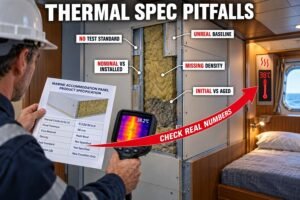
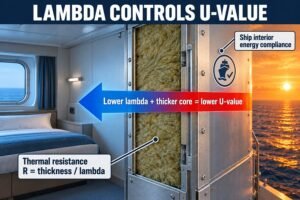
Choosing marine panels is hard. Pick the wrong one, and your cabins get too hot. I will show you why heat moves differently through marine panels.
Thermal conductivity differs across non-combustible marine panels due to five distinct factors: trapped air volume, material density, core structure types, porosity levels, and internal fiber orientation. These physical traits dictate how effectively a panel blocks heat transfer per IMO regulations.
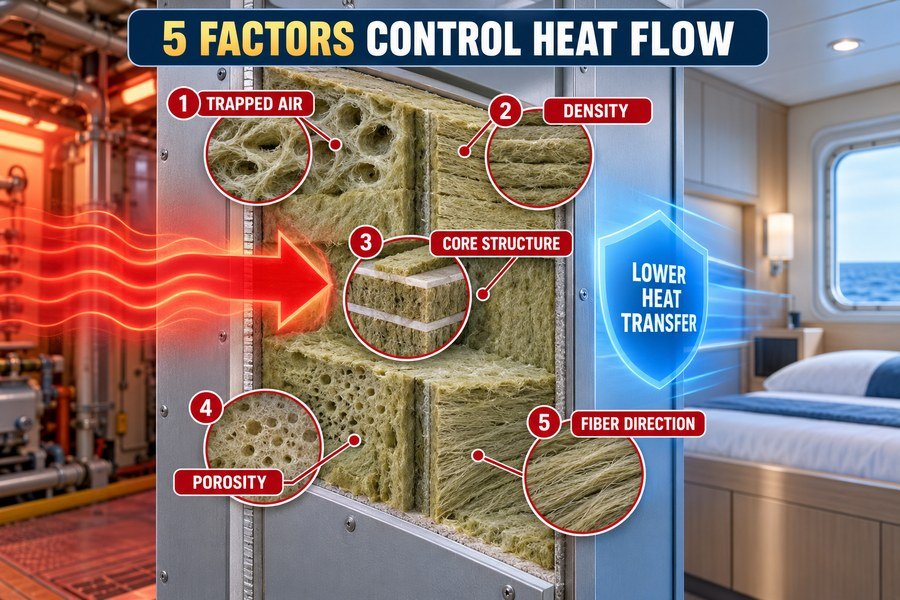
Let us look at each factor so you can buy the right panels for your shipyard projects and keep costs low without losing quality.
Why Does Trapped Air Lower Marine Rock Wool Panel Thermal Conductivity?
Heat passes quickly through solid metal. Your ship cabins need insulation. Trapped air blocks this heat, keeping cabins comfortable and meeting strict shipyard rules.
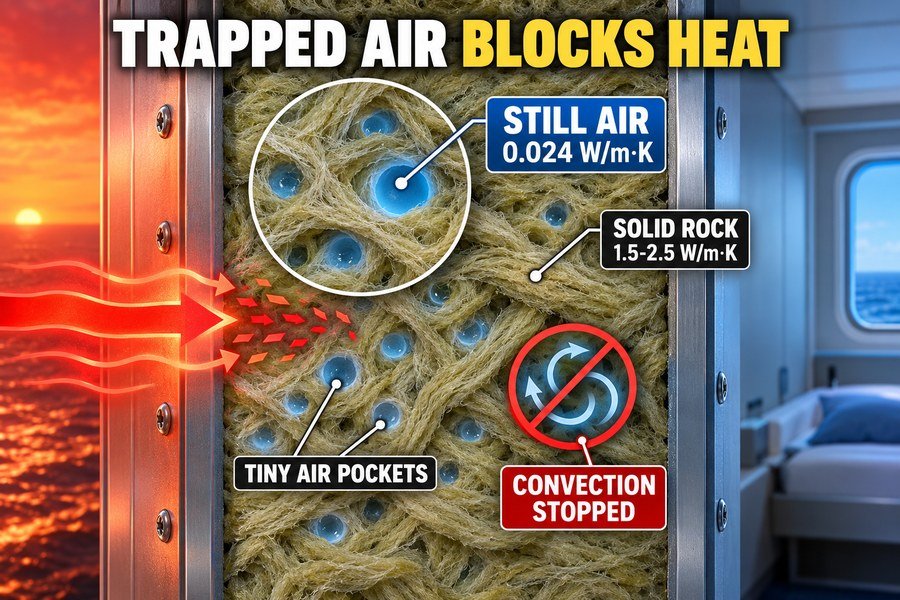
Trapped air lowers rock wool panel thermal conductivity because still air is a very poor heat conductor (0.024 W/m·K) compared to solid rock. The wool creates millions of tiny air pockets that stop convection and block conductive heat flow completely.
The Science of Still Air in Marine Rock Wool Panels
To understand heat transfer, we must look at the numbers. Air is a very bad heat conductor. According to the ASHRAE Handbook, still air has a thermal conductivity (lambda value) of about 0.024 W/m·K at 20°C1. On the other hand, the solid basalt rock used to make rock wool has a lambda value of about 1.5 to 2.5 W/m·K2. Solid rock moves heat quickly. When factories melt this rock and spin it into thin fibers, they create a new structure. These thin fibers cross over each other. They hold millions of tiny air spaces inside the panel. Because the air is trapped and cannot move, it stops the heat from traveling from one side of the panel to the other.
Preventing Convection Inside Marine Insulation
Heat moves in different ways. If air moves, it carries heat with it. This process is called convection. The rock fibers in marine panels are very close together. They hold the air so tight that it stays completely still. A standard marine rock wool panel with a density of 120 kg/m³ is actually made of about 95% air and only 5% solid rock fiber. This huge volume of air makes the panel a great heat shield. I remember testing panels during my early days at the factory. If the panels were packed too loose, the air pockets were too big. The air started moving inside the panel, and the outside of the panel got hot very fast. Trapping the air is the most important step for blocking heat.
Stopping Conductive Heat Flow Completely
Conduction is heat moving through solid touch. Because 95% of the panel is air, there is very little solid rock for the heat to touch. The heat tries to move along a fiber, but the fiber ends and hits an air pocket. The heat stops. The combination of still air and broken solid paths gives high-quality marine rock wool a total lambda value of around 0.035 W/m·K3.
| Material Type | Thermal Conductivity (Lambda in W/m·K) | Heat Transfer Method | Marine Application Suitability |
|---|---|---|---|
| Solid Basalt Rock | 1.5 - 2.5 | Fast Conduction | Not usable for insulation |
| Still Air | 0.024 | None (when fully trapped) | Core principle of insulation |
| Marine Rock Wool (120 kg/m³) | 0.035 | Blocked Conduction & Convection | Excellent for A-60 / B-15 Class panels |
Why Balance Density and Lambda Value in Weight-Sensitive Marine Ceiling Panels?
Heavy ceiling panels make ships burn more fuel. But light panels might fail fire tests. You must balance panel weight with good heat blocking.
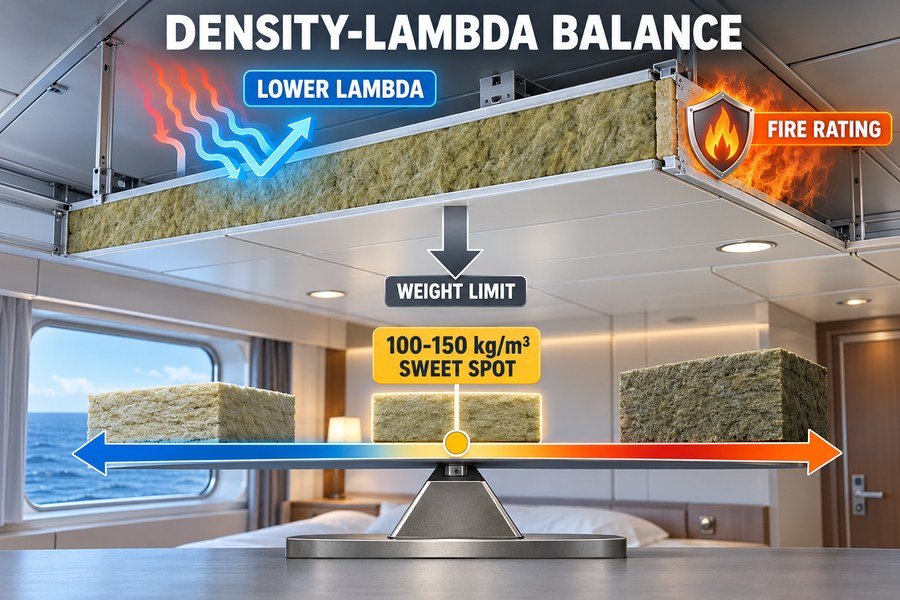
Balancing density and lambda value requires optimizing three variables: weight limits, thermal performance, and fire rating. Increasing density lowers heat transfer by blocking radiation, but adding too much weight increases ship fuel costs. The ideal balance is typically 100-150 kg/m³ for ceilings.
How Density Changes Marine Ceiling Panel Thermal Performance
Density means how much material is packed into a space. We measure it in kilograms per cubic meter (kg/m³). If the density is too low, like 50 kg/m³, the air pockets are too big. Heat can pass through the panel as invisible light, which is called thermal radiation. If the density is too high, like 200 kg/m³, there are too many solid fibers. These solid fibers conduct heat directly. There is a sweet spot. According to Rockwool Marine testing data, you get the lowest lambda value (about 0.034 W/m·K) when the density is between 100 kg/m³ and 150 kg/m³4.
Managing Weight Limits for Shipyard Projects
Weight is a big deal for shipyards. Light ships use less fuel and cost less to run. A standard 50mm thick marine ceiling panel at 100 kg/m³ weighs 5 kg per square meter. If you buy a heavy 150 kg/m³ panel, it weighs 7.5 kg per square meter. Imagine a large cruise ship with 10,000 square meters of ceiling space. Using the heavier panel adds 25,000 extra kilograms to the top of the ship. This extra weight ruins the ship's center of gravity5. You must pick the lighter 100 kg/m³ option to save weight, as long as it meets safety rules. I have seen procurement teams buy heavy panels just because they were cheap, but the shipyard rejected them for being too heavy.
Ensuring Fire Rating Approvals Under IMO Rules
Fire rating is the final variable you must balance. All passenger ships must follow the IMO FTP Code. A B-15 class ceiling panel must stop a fire for 15 minutes without the dark side getting too hot. Even if a 50 kg/m³ panel is very light, it will burn through too fast. The 100-150 kg/m³ density range provides enough solid rock to survive a fire while trapping enough air to stop the heat.
| Panel Density (kg/m³) | Lambda Value (W/m·K) | Weight for 50mm Panel (kg/m²) | Typical Fire Rating Capability |
|---|---|---|---|
| Low (50 kg/m³) | 0.045 | 2.5 | C-Class (Fails fire tests) |
| Medium (100 kg/m³) | 0.034 | 5.0 | B-15 Class Ceilings |
| High (150 kg/m³) | 0.036 | 7.5 | A-30 / A-60 Class Bulkheads |
| Very High (200 kg/m³) | 0.042 | 10.0 | Too heavy for standard ceilings |
Aluminum Honeycomb vs. Rock Wool: How Do Marine Bulkhead Panels Transfer Heat?
Choosing between honeycomb and rock wool is tough. Pick the wrong core, and your cabins become ovens. Let us compare how these panels handle heat.
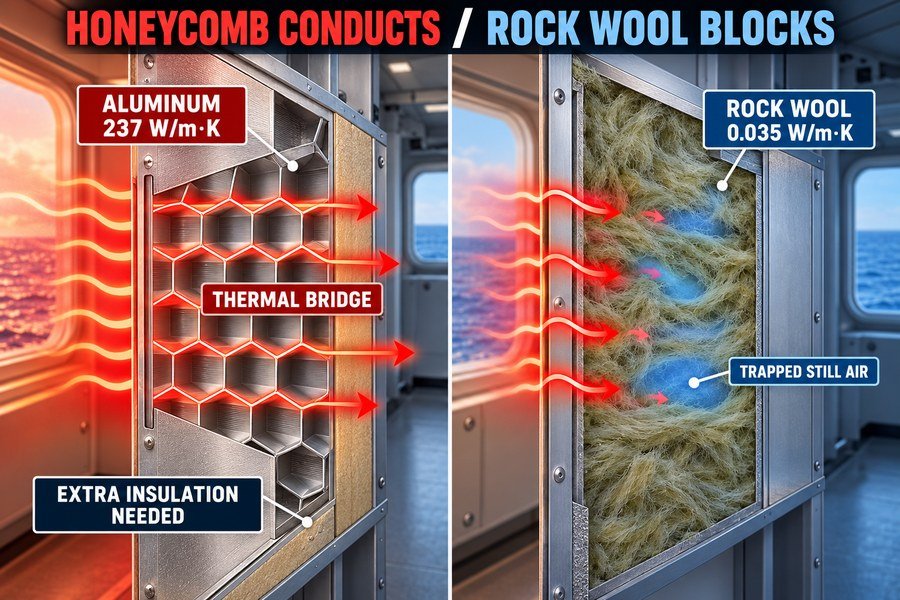
Aluminum honeycomb transfers heat quickly through solid metal walls via conduction, while rock wool blocks heat using trapped still air. Because aluminum has a high thermal conductivity (237 W/m·K) compared to rock wool (0.035 W/m·K), honeycomb panels require extra insulation for temperature control.
Heat Conduction in Aluminum Honeycomb Marine Panels
Aluminum is a metal. Metals move heat very fast. The thermal conductivity of pure aluminum is about 237 W/m·K based on MatWeb material data. An aluminum honeycomb panel has a core shaped like bee hives. These shapes are made of solid aluminum foil. Heat travels directly along these continuous metal walls from the hot side to the cold side. This direct path is called a "thermal bridge." Because heat flows so easily, these panels do not stop heat well. They are very light and strong, which is great for fast ferries. However, they are rated C-Class under SOLAS. This means they offer zero fire resistance and zero heat resistance. You will need separate AC systems to keep the cabin cool.
Heat Blocking in Rock Wool Marine Bulkhead Panels
Rock wool panels work in a completely different way. They use mineral fibers to break up the heat path. Instead of solid metal walls, heat hits thousands of broken rock fibers and trapped air pockets. The lambda value of a rock wool core is about 0.035 W/m·K6. This means rock wool is nearly 7,000 times better at stopping heat transfer than solid aluminum. If you need an A-60 or B-15 rated bulkhead, you must use rock wool or add rock wool behind the honeycomb.
Choosing the Right Panel for Real World Applications
I always tell buyers to look at the project rules first. If the shipyard needs fire control and temperature comfort for a passenger cruise ship, never use bare aluminum honeycomb. But if you are building an interior partition on a small, fast patrol boat where weight is the only thing that matters, honeycomb is fine. You just have to know that honeycomb will transfer the heat straight through the wall.
| Core Material | Thermal Conductivity | Heat Transfer Method | Structural Weight | Standard SOLAS Fire Class |
|---|---|---|---|---|
| Aluminum Honeycomb | ~ 237 W/m·K (solid metal) | Direct Conduction | Very Light | C-Class (No fire rating) |
| Marine Rock Wool | ~ 0.035 W/m·K | Blocked by trapped air | Medium to Heavy | B-0 to A-60 Class |
How Does Porosity Cut Thermal Conductivity in Non-Combustible Marine Interior Panels?
Solid materials let heat pass easily. This ruins cabin comfort. Adding tiny holes, or porosity, solves this by turning the panel into a heat shield.
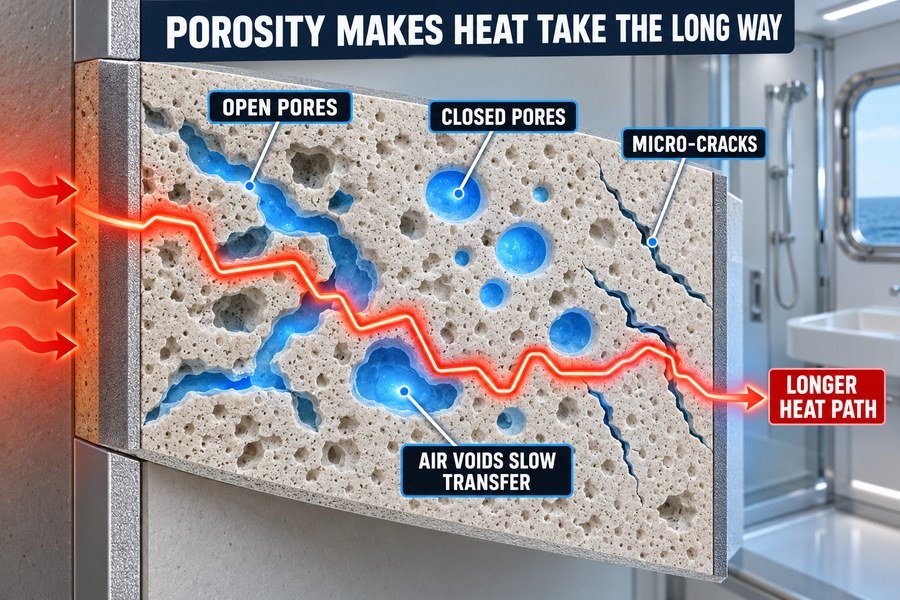
Porosity cuts thermal conductivity by replacing solid material with three types of tiny air voids: open pores, closed pores, and micro-cracks. These void spaces force heat to take a longer path and use the low conductivity of air to slow heat transfer.
The Heat Blocking Power of Open and Closed Pores
Porosity simply means having tiny holes inside a solid material. We divide these holes into open pores and closed pores. Closed pores are the best for stopping heat. They are like tiny bubbles fully trapped inside the panel material. They trap air completely so the air cannot move at all. Open pores are connected to each other. They let a little air flow, but they still block heat much better than a solid rock block7. Calcium silicate panels, which we often use in wet marine areas like ship bathrooms, rely heavily on this porosity. A solid calcium block has a very high lambda value. But a porous calcium silicate marine panel has a much lower lambda value, usually around 0.09 W/m·K8 according to Skamol technical data.
How Micro-Cracks Lengthen the Heat Transfer Path
Micro-cracks are the third type of void. These are tiny splits inside the panel structure. Heat likes to travel fast in a straight line. When heat travels through the panel and hits an open pore, a closed pore, or a micro-crack, it cannot cross the empty space easily. It must go around the hole. This makes the heat travel in a zigzag line. In engineering, we call this increasing the "tortuosity" or the path length9. A longer path means heat takes much more time to cross the panel from the hot side to the cool cabin side.
Controlling Porosity for Marine Panel Strength
You must be careful with porosity. If a panel has too many holes, it gets weak. It might break during sea shipping from China to Europe. The factory must control the porosity perfectly. Usually, creating a panel with 60% to 70% void space gives great heat blocking. It also keeps the panel strong enough so shipyard workers will not snap it when they screw it into the steel bulkhead profiles.
| Void Type | Description | Impact on Heat Transfer Path | Effect on Panel Strength |
|---|---|---|---|
| Closed Pores | Trapped air bubbles | Excellent (Stops convection) | Maintains good strength |
| Open Pores | Connected air channels | Good (Increases path length) | Weakens panel slightly |
| Micro-cracks | Tiny structural splits | Good (Forces zigzag path) | Weakens panel if too large |
How Does Fiber Orientation Affect Marine Accommodation Panel Lambda Values?
Most buyers only look at panel density. They forget fiber direction. If fibers point the wrong way, heat leaks through and your ship fails inspection.
Fiber orientation affects lambda values because heat travels faster along a fiber than across it. Marine panels use two main orientations: parallel to the surface (which lowers thermal conductivity) and perpendicular to the surface (which increases strength but allows 20% more heat transfer).

Heat Transfer in Parallel Fiber Marine Panels
During manufacturing, fibers can lie flat against the wide face of the panel. This is called parallel orientation. Imagine you are trying to walk through a forest where all the trees have fallen across your path. It takes a long time. Heat acts the same way. The heat wants to go straight through the panel from the hot engine room to the cold sleeping cabin. When fibers lie flat, the heat must cross through many layers of solid fibers and air gaps. This acts like a very strong wall against heat. For a standard 120 kg/m³ rock wool panel, parallel fibers give a great lambda value of about 0.034 W/m·K based on Paroc Marine insulation data. This is the absolute best choice for stopping heat and passing strict fire tests.
The Strength Trade-Off with Perpendicular Fibers
Sometimes, factories need to make a very rigid panel. They cut the rock wool into thin strips, turn them 90 degrees, and glue them inside the panel. Now the fibers point straight from the hot side to the cold side. This is perpendicular orientation. Shipyards like this because it makes the panel very stiff and flat10. But there is a huge problem. Heat travels along a fiber like a fast car on a highway11. Because the fibers point straight through the wall, the heat moves much faster. The lambda value goes up by about 10% to 20%, reaching around 0.041 W/m·K.
Choosing the Right Orientation for Your Shipyard Projects
I once saw a shipyard fail a critical IMO heat test because they bought panels with perpendicular fibers for a fire wall. They wanted a flat wall, but they sacrificed fire safety. If you need maximum fire and heat safety, you must choose parallel fibers. If you need a very rigid wall that will not bend when passengers lean on it, and the room does not require strict heat control, choose perpendicular fibers. Knowing this detail helps you avoid buying the wrong product.
| Fiber Orientation | Lambda Value (120 kg/m³) | Heat Path | Panel Strength / Stiffness | Best Shipyard Application |
|---|---|---|---|---|
| Parallel (Flat) | ~ 0.034 W/m·K | Slow (Crosses many layers) | Standard | High fire-risk bulkheads (A-60) |
| Perpendicular | ~ 0.041 W/m·K | Fast (Direct highway) | Very High | Rigid partition walls (C-Class) |
Conclusion
Knowing how air, density, core type, porosity, and fibers control heat helps you buy the right panels. This saves your shipyard money and ensures passing strict safety checks.
-
"Thermal Conductivity", http://hyperphysics.phy-astr.gsu.edu/hbase/Tables/thrcn.html. Thermophysical-property references report the thermal conductivity of dry air near room temperature at approximately 0.024-0.026 W/m·K, supporting the stated order of magnitude for still air. Evidence role: statistic; source type: institution. Supports: Still air has a thermal conductivity of about 0.024 W/m·K at 20°C. Scope note: The value depends on temperature, pressure, humidity, and whether the air is truly quiescent. ↩
-
"United States Department of the Interior U. S. Geological Survey", https://pubs.usgs.gov/of/1979/0356/report.pdf. Geological and engineering-property references list basalt thermal conductivity values broadly in the low single-digit W/m·K range, consistent with the article's 1.5-2.5 W/m·K estimate for solid basalt. Evidence role: statistic; source type: education. Supports: Solid basalt rock has a thermal conductivity of about 1.5 to 2.5 W/m·K. Scope note: Basalt conductivity varies with mineral composition, porosity, moisture, and measurement temperature, so the cited range should be treated as approximate rather than universal. ↩
-
"Determination of Thermal Properties of Mineral Wool ... - PMC", https://pmc.ncbi.nlm.nih.gov/articles/PMC10488771/. Published material data for stone wool/mineral wool insulation commonly report thermal conductivity near 0.033-0.040 W/m·K, supporting the article's approximate 0.035 W/m·K value for high-quality rock wool insulation. Evidence role: statistic; source type: paper. Supports: High-quality marine rock wool has a total thermal conductivity around 0.035 W/m·K. Scope note: Thermal conductivity varies by product density, temperature, moisture content, orientation, and test standard; the source may support the material class rather than this exact marine panel construction. ↩
-
"Determination of Thermal Properties of Mineral Wool ... - PMC", https://pmc.ncbi.nlm.nih.gov/articles/PMC10488771/. Independent studies of fibrous mineral-wool insulation describe a density-dependent thermal conductivity curve in which radiative transfer dominates at low density and solid conduction increases at higher density, creating an intermediate density range with lower effective conductivity. Evidence role: mechanism; source type: paper. Supports: Marine mineral-wool ceiling panels can have their lowest thermal conductivity at an intermediate density range around 100-150 kg/m³. Scope note: This supports the physical mechanism and general density trend for mineral wool; it may not verify the exact 0.034 W/m·K value or the specific Rockwool Marine product range. ↩
-
"Chapter 2 - Review of Intact Statical Stability", https://www.usna.edu/NAOE/_files/documents/Courses/EN455/EN455_Chapter2.pdf. Ship-stability references explain that weights added high in a vessel raise the vertical center of gravity and can reduce metacentric height, thereby affecting stability margins. Evidence role: mechanism; source type: education. Supports: Adding significant weight high in a ship can adversely affect the vessel's center of gravity and stability. Scope note: This supports the stability mechanism, but the word "ruins" would require vessel-specific stability calculations to prove for the example ship. ↩
-
"Determination of Thermal Properties of Mineral Wool ... - PMC", https://pmc.ncbi.nlm.nih.gov/articles/PMC10488771/. Published mineral-wool insulation data commonly report thermal conductivity values around 0.03-0.04 W/m·K, consistent with a representative rock-wool lambda value of about 0.035 W/m·K. Evidence role: statistic; source type: paper. Supports: A rock wool core can have a lambda value of about 0.035 W/m·K. Scope note: The value is representative rather than universal; density, binder content, temperature, moisture, and product certification can shift the declared lambda value. ↩
-
"THERMAL PROPERTIES OF ROCKS", https://pubs.usgs.gov/of/1988/0441/report.pdf. Reference data on thermal conductivity show that common rocks generally conduct heat far more readily than air-filled porous insulating materials, which supports the broad comparison between porous panels and dense rock. Evidence role: general_support; source type: institution. Supports: Open-pore porous materials can have much lower thermal conductivity than dense rock-like solids. Scope note: This is a contextual comparison; exact performance depends on the rock type, panel composition, density, moisture content, and temperature. ↩
-
"1.0 mm Stainless Steel 2.0 cm Calcium Silicate ...", http://courses.washington.edu/mengr331/hw/hw2_sol.pdf. Independent materials references for calcium silicate insulation report thermal conductivity values in the same order of magnitude, supporting the statement that porous calcium silicate panels can have lambda values near 0.09 W/m·K. Evidence role: statistic; source type: institution. Supports: Porous calcium silicate insulation commonly has a thermal conductivity around 0.09 W/m·K under specified conditions. Scope note: Reported values vary with density, temperature, moisture, test method, and product grade; the source would not independently verify a specific vendor's marine panel. ↩
-
"Tortuosity in Porous Media: A Critical Review Review & ...", https://www.academia.edu/29739580/Tortuosity_in_Porous_Media_A_Critical_Review_Review_and_Analysis. Porous-media literature defines tortuosity as the increased, non-straight transport path through a porous structure and relates it to effective transport properties such as diffusion or thermal conduction, supporting the terminology used here. Evidence role: definition; source type: paper. Supports: Obstacles such as pores and micro-cracks increase the effective path length for heat flow, a concept known as tortuosity. Scope note: A general tortuosity source supports the concept but may not directly quantify heat transfer in this specific marine calcium silicate panel. ↩
-
"Physical Properties of Mineral Fibers Depending on the ... - PMC", https://pmc.ncbi.nlm.nih.gov/articles/PMC8538482/. Technical studies of mineral-wool lamella boards report that orienting fibers perpendicular to the panel face can improve mechanical properties such as compressive strength or dimensional stability compared with conventional fiber orientation. Evidence role: mechanism; source type: paper. Supports: Perpendicular or lamella-style fiber orientation can increase panel rigidity and flatness-related mechanical performance. Scope note: The evidence supports the mechanical principle for mineral-wool lamella products, not necessarily every glued marine panel design. ↩
-
"Temperature Fibrous Insulations: Theory and Experimental ...", https://ntrs.nasa.gov/api/citations/20100024499/downloads/20100024499.pdf. Research on fibrous insulation describes anisotropic heat transfer in fiber networks, with effective thermal conductivity depending on the alignment of fibers relative to the direction of heat flow. Evidence role: mechanism; source type: paper. Supports: Heat transfer is faster when fibers are aligned with the direction of heat flow than when heat must cross the fiber network. Scope note: Such studies support the physical mechanism generally, but may not quantify the exact effect in this specific marine panel construction. ↩