High cabin noise leads to tired crews and rejected sea trials. Finding the real source of the noise is the first step before you buy expensive panels.
To diagnose the dominant noise path before selecting panels, you must classify the noise as either airborne (traveling through air gaps) or structure-borne (vibrating through the steel deck). Using vibration meters and sound level meters helps pinpoint the exact source and dictates whether you need sound insulation or damping materials.
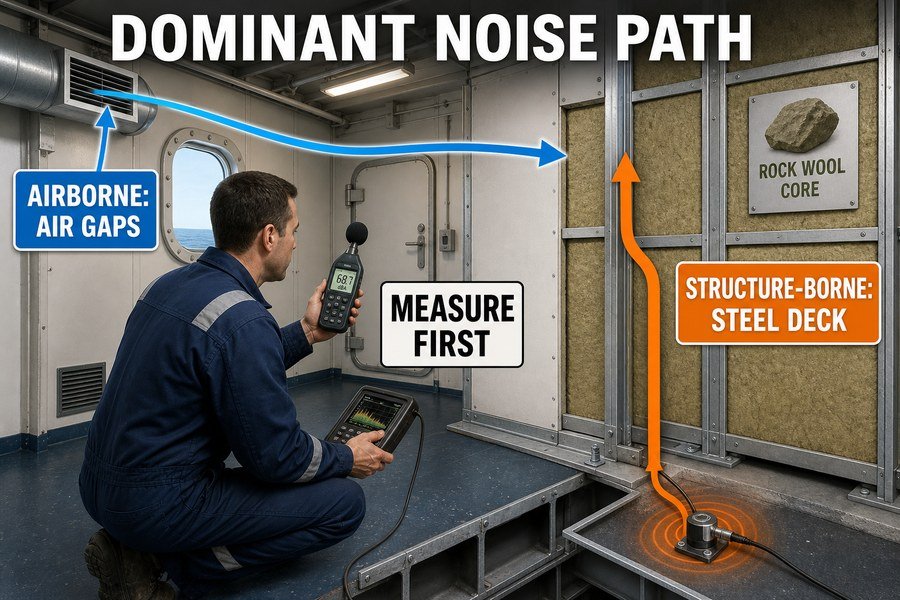
I have seen many outfitting projects fail because buyers guessed the noise source. They buy thick panels, but the cabin stays loud. You must test the ship first.
How to Determine If Cabin Noise Is Airborne or Structure-Borne Before Ordering Marine Interior Panels?
Buying A-60 acoustic panels will not stop engine vibrations. If you guess the noise path wrongly, you waste money and fail shipyard noise limits.
You determine the noise type by comparing sound pressure levels (dB) in the air with structural vibration levels (mm/s) on the bare steel deck. High room noise with low deck vibration indicates airborne noise. High deck vibration that matches room frequencies proves structure-borne noise is the dominant issue.
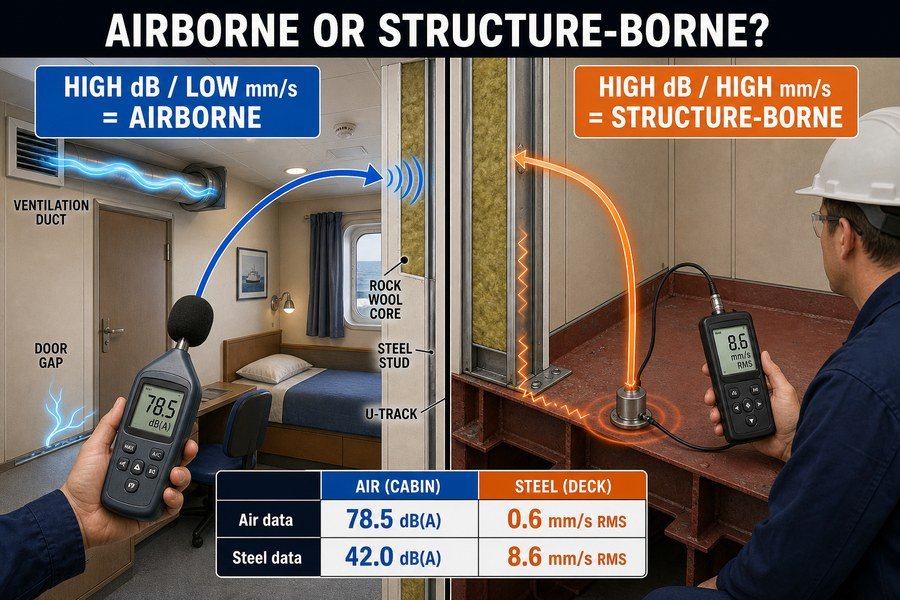
When you want to solve a noise problem, you must start with data. You cannot rely on your ears alone. The human ear cannot tell if a 100 Hz sound comes through the air or from the vibrating floor.1 Therefore, we look at two specific data points to find the truth.
Measuring Sound Pressure Levels for Airborne Noise
First, you need to check the airborne noise limit. According to the International Maritime Organization (IMO) Resolution MSC.337(91), the noise limit for standard crew cabins is 60 dB(A)2. To measure this, you place a sound meter in the middle of the empty cabin space. You must close all doors and windows. If your meter reads 65 dB(A), you have a noise problem. But this number does not tell you where the noise comes from. It only tells you that the room is too loud. If the loud noise comes mostly from ventilation ducts or engine room exhaust pipes nearby, the noise is airborne. This means sound waves travel through the air and hit your wall panels. If this is true, upgrading to a 44 dB Rw marine wall panel will solve your problem.
Testing Deck Vibrations for Structure-Borne Noise
Next, you must test the bare steel deck. You place a vibration sensor directly on the steel floor beneath the cabin. According to ISO 6954 guidelines, acceptable vibration for crew comfort is usually below 5 mm/s3. If your vibration sensor reads 7 mm/s, you have a strong structure-borne noise problem. The steel deck is shaking. This shaking moves up into your metal wall tracks and shakes the wall panels. The panels then act like giant speakers.4 When the deck vibration is high, buying better acoustic panels is a waste of money. The panels will just vibrate and create noise inside the room. You must compare the air data and the steel data to make the right choice.
| Noise Path Diagnosis | Cabin Sound Pressure Level | Steel Deck Vibration Level | Primary Solution Needed |
|---|---|---|---|
| Airborne Dominant | High (> 60 dB) | Low (< 3 mm/s) | High-Rw Acoustic Panels |
| Structure-Borne Dominant | High (> 60 dB) | High (> 5 mm/s) | Damping & Floating Floors |
| Mixed Noise Path | High (> 60 dB) | Medium (3-5 mm/s) | Decoupled Panels & Damping |
What Symptoms Indicate Structure-Borne Noise Is Bypassing Marine Accommodation Systems?
Even with thick sandwich panels, cabins can still roar. Structure-borne noise acts like water, finding any rigid connection to bypass your insulation.
Three main symptoms indicate structure-borne noise bypassing panels: rattling of loose cabin fittings, a low-frequency hum (20-200 Hz) that panels cannot block, and tactile vibration felt when touching the bulkheads or floating floors, often caused by hard mechanical flanking paths like rigid pipes or missing rubber isolators.
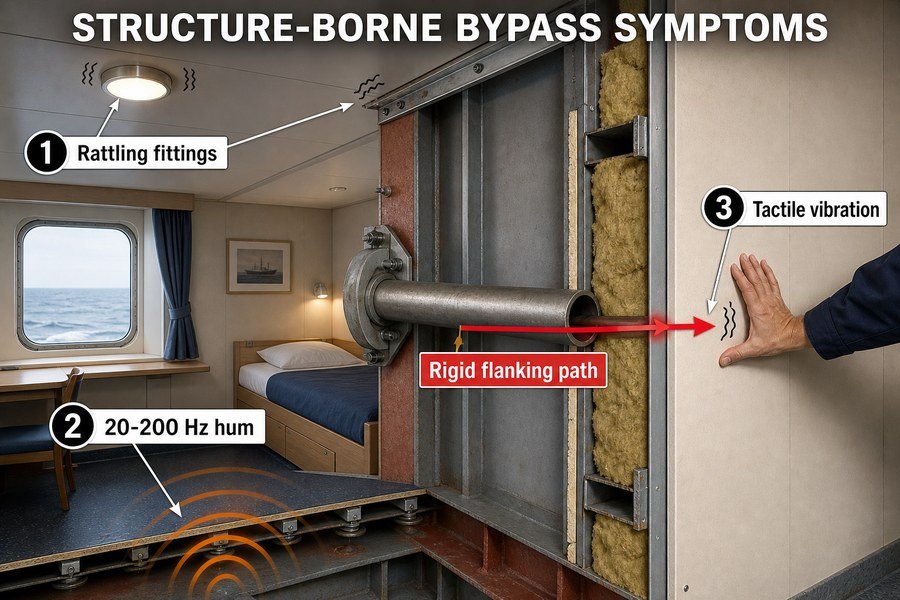
When you walk into a finished cabin during sea trials and hear loud noises, you must look for specific clues. Sometimes, the shipyard installs the best panels in the world, but the room still fails the IMO noise test. This happens because structure-borne noise bypasses the panels through physical connections5. You must look for these three clear symptoms.
Identifying Rattling and Tactile Vibrations in Cabins
The first and most obvious symptom is rattling. If you hear metal ceiling profiles, light fixtures, or loose furniture buzzing, you have structure-borne noise. Airborne noise rarely has enough physical force to shake heavy cabin fittings. The second symptom is tactile vibration. You can test this with your hands. The human threshold for feeling vibration is about 0.3 mm/s6. If you place your bare hand on the finished marine wall panel or the floating floor surface and feel a buzzing sensation, structural energy is bypassing your system. This often happens because the installation team forgot to put the 5mm rubber isolation strips under the U-profile bottom tracks. Without the rubber, the steel deck transfers the engine vibration directly into the panel frame.
Analyzing Low-Frequency Hum and Rigid Flanking Paths
The third symptom is a deep, low-frequency hum. You will hear this as a drone in the 20 Hz to 200 Hz range. Marine acoustic panels are very good at stopping high-pitched sounds, like voices or whistling air. But they cannot stop a deep engine hum. If the cabin feels quiet when you speak, but you still hear a deep roar from the main engine, structural noise is bypassing your panels. This often occurs because of rigid flanking paths. For example, if a steel water pipe touches the back of your wall panel without a rubber sleeve, the pipe transfers vibration directly to the panel face. We call this a "short circuit" in marine acoustics. You must find these hard connections and isolate them.
| Symptom of Bypassing | Human Perception | Physical Cause in Cabin | Frequency Range |
|---|---|---|---|
| Rattling Fittings | Hearing buzzing metals | Loose tracks, un-isolated ceiling lights | Varies (often 50-150 Hz) |
| Tactile Vibration | Feeling buzz on panels | Missing 5mm rubber under bottom tracks | 10-100 Hz |
| Low-Frequency Hum | Hearing a deep drone | Rigid pipes touching panel backs | 20-200 Hz |
Which Field Measurements Distinguish Airborne From Structure-Borne Noise in Ship Cabins?
You cannot rely on human ears alone to separate noise types. Without the right data, you might buy heavy panels for a vibration problem.
Two critical field measurements distinguish these noise paths: 1/3 octave band frequency analysis using a Class 1 Sound Level Meter to find airborne peaks above 500 Hz, and velocity measurements using a piezoelectric accelerometer to track structure-borne vibration peaks below 250 Hz across the steel deck and bulkheads.
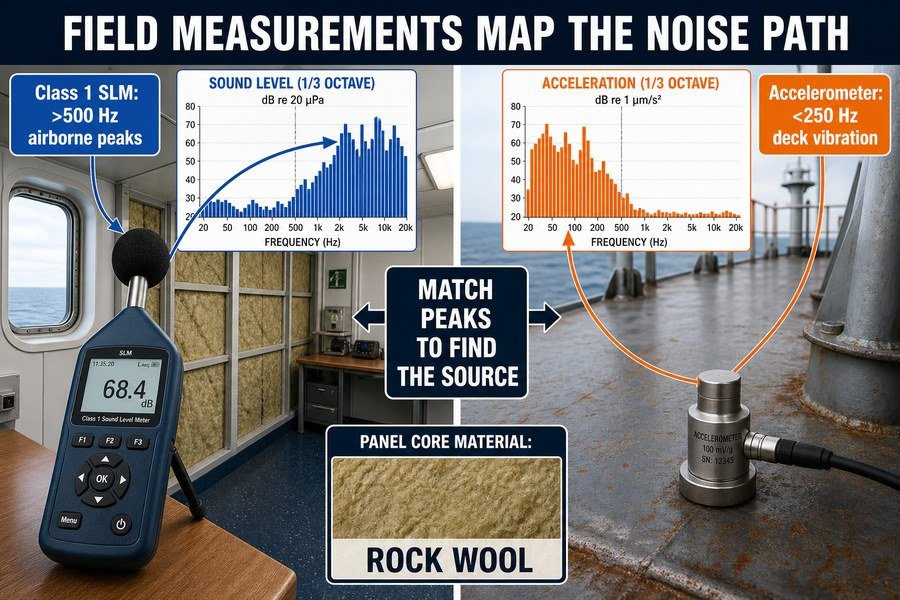
When you want to prove to a shipyard where the noise comes from, you need professional equipment. You cannot just guess. You must perform two distinct types of measurements. These tests will give you a clear map of how the sound energy travels from the engine to the cabin.
Conducting 1/3 Octave Band Frequency Analysis
The first measurement uses a Class 1 Sound Level Meter. According to the IEC 61672-1 standard, a Class 1 meter is highly accurate and legally accepted by classification societies like DNV or ABS.7 You use this meter to perform a 1/3 octave band frequency analysis. This test breaks the noise down into different frequency slices.8 If you look at the test graph and see high noise peaks in the frequencies above 500 Hz up to 8000 Hz, you are looking at airborne noise. High frequencies do not travel well through heavy steel.9 They usually come through air ducts, gaps under doors, or thin bulkheads. When you see a peak at 1000 Hz, you know you need to check the acoustic seals on your marine fire doors or add sound baffles to your HVAC vents.
Taking Velocity Measurements with Piezoelectric Accelerometers
The second measurement requires a piezoelectric accelerometer. You attach this small metal sensor directly to the bare steel deck and the steel bulkheads using a strong magnet. The sensor measures the velocity of the vibration in millimeters per second (mm/s). A standard sensor has a sensitivity of about 100 mV/g. You must look for vibration peaks in the low frequencies, specifically below 250 Hz. Main engines and propellers create strong vibrations in the 20 Hz to 100 Hz range.10 If your accelerometer shows a peak of 4 mm/s at 50 Hz on the steel deck, and your sound meter shows a loud noise in the cabin at that exact same 50 Hz frequency, you have found the link. This proves the noise in the cabin is structure-borne.
| Measurement Type | Equipment Used | Key Frequency Target | Indicated Noise Path |
|---|---|---|---|
| Acoustic Frequency Analysis | Class 1 Sound Level Meter | Peaks above 500 Hz | Airborne Noise |
| Structural Velocity Test | Piezoelectric Accelerometer | Peaks below 250 Hz | Structure-Borne Noise |
How to Avoid Over-Specifying High-Rw Marine Bulkhead Panels for Structure-Borne Noise?
Buying 50 dB Rw panels for an engine vibration issue is a costly mistake. High acoustic ratings only stop airborne noise, not structural shaking.
To avoid over-specifying High-Rw panels for structure-borne noise, you must first apply visco-elastic damping compounds to the steel deck, use floating floors with a low natural frequency (under 15 Hz), and decouple the bulkhead from the deck using 5-10 mm rubber isolation profiles instead of buying heavier panels.
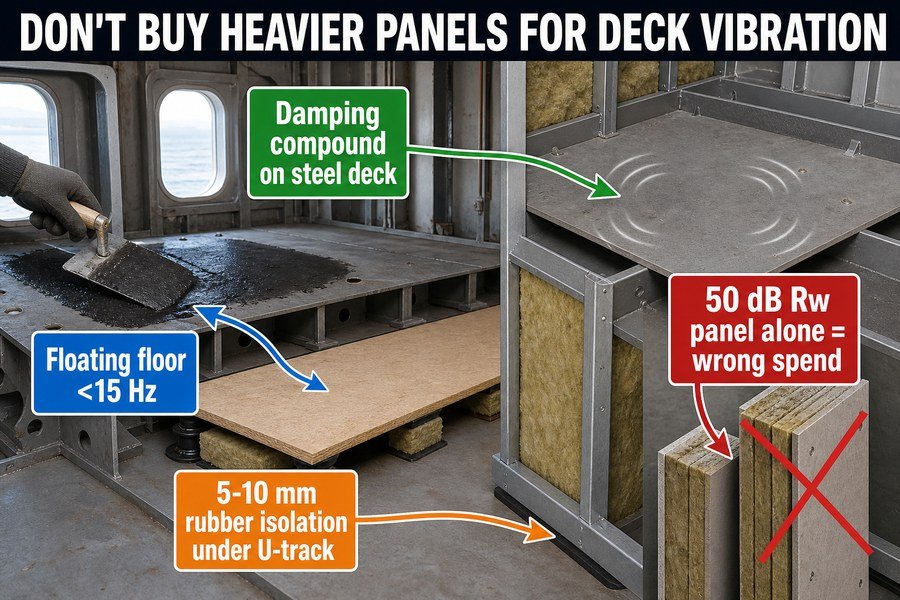
I talk to many procurement officers who try to solve every noise problem by buying expensive, heavy wall panels. They think a 50 dB panel is always better than a 35 dB panel. But if the noise comes from the floor shaking, that 50 dB panel is a waste of money. You need to spend your budget on isolating the structure, not just blocking the air11.
Applying Visco-Elastic Damping Compounds to Steel Decks
Before you install any panels, you must treat the bare steel. The best way to kill structure-borne noise is to use a visco-elastic damping compound. This is a special thick paste you spread on the steel deck. When the steel tries to vibrate, the compound turns that movement energy into a tiny amount of heat12. To work well, the damping layer must be 1 to 3 times the thickness of the steel deck13. If your steel deck is 6mm thick, you need at least 6mm of damping compound. This treatment is much cheaper than buying heavy acoustic panels. It stops the vibration before it can reach your interior walls.
Decoupling Bulkheads and Installing Low-Frequency Floating Floors
The second step is proper decoupling. You must use a floating floor system. A good floating floor uses thick mineral wool or rubber mounts. You must choose a floor system with a natural frequency under 15 Hz14. If the natural frequency is higher, it will not stop the deep engine rumble. Next, you must never screw the marine wall panel directly into the hard floor. You must place a 5-10 mm thick rubber isolation profile under the steel U-track. This rubber profile costs maybe $2 per meter. A high-Rw acoustic panel can cost $60 to $80 per square meter. If you spend $10 on rubber isolation for a small cabin, you can safely buy standard $30 per square meter panels instead of $80 panels. You save money and get a better result.
| Solution Type | Cost Implication | Primary Function | Best Application |
|---|---|---|---|
| High-Rw Acoustic Panel (50 dB) | ~$70 - $90 / sqm | Blocks airborne sound waves | Near engine room walls |
| Visco-Elastic Damping Compound | ~$15 - $25 / sqm | Reduces steel deck vibration | Decks above propellers |
| Rubber Isolation Profiles (5-10mm) | ~$2 - $4 / meter | Decouples wall from deck | Under all bottom tracks |
| Low-Frequency Floating Floor (<15 Hz) | ~$45 - $65 / sqm | Isolates entire cabin base | Lower deck crew cabins |
Why Does Treating Only Airborne Noise With Marine Bulkheads Leave Residual Low-Frequency Noise?
Many ships pass airborne tests but still sound terrible inside. Relying only on wall panels ignores the energy traveling through the ship's skeleton.
Treating only airborne noise leaves residual low-frequency noise because standard 50mm marine bulkheads lack the mass to block wavelengths longer than 1.5 meters (below 250 Hz). The steel hull easily transmits these low-frequency engine vibrations, which then re-radiate as secondary airborne noise from the cabin ceiling and walls.
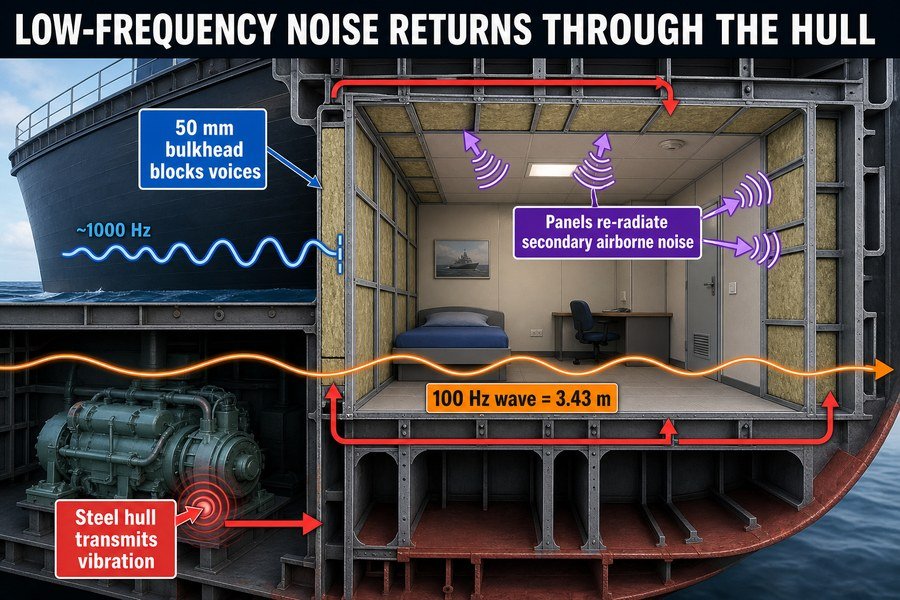
Physics is the ultimate judge in ship outfitting. You cannot cheat the laws of sound. Many buyers get confused when they install high-quality rockwool panels, but the cabin still has a deep, annoying rumble. This happens because low-frequency sound behaves very differently than high-frequency sound.
The Physical Limits of 50mm Marine Bulkheads
A standard marine wall panel is 50mm thick, filled with 120 kg/m3 density rockwool, and covered by 0.6mm galvanized steel on both sides. This design is excellent for blocking voices. A human voice is usually around 1000 Hz. The wavelength of a 1000 Hz sound is about 0.34 meters. A 50mm panel can stop this easily. But let us look at a 100 Hz engine hum. Sound travels through air at 343 meters per second. At 100 Hz, the sound wave is 3.43 meters long.15 A 50mm thick wall simply does not have enough physical mass or depth to stop a wave that is 3.43 meters long. Even if a panel has an overall rating of 44 dB Rw, its performance at 125 Hz will drop down to only 15 or 20 dB.16 This is why the low-frequency noise passes right through standard bulkheads.
How Engine Vibrations Re-Radiate as Secondary Airborne Noise
The second problem is re-radiation. Main engines create massive low-frequency energy. This energy travels easily through the solid steel hull of the ship.17 Steel is a fantastic conductor of vibration. When this vibration reaches the cabin, it shakes the steel ceiling and the metal frames of your interior panels. When these large flat surfaces shake, they act like the skin of a drum. They push the air inside the cabin. This creates what we call "secondary airborne noise." You tried to block the noise coming through the air from outside, but now the walls inside your room are actually generating the noise. To stop this, you must treat the source by decoupling the entire room from the steel hull, not just putting up thicker walls.
| Sound Frequency (Hz) | Sound Wavelength in Air (m) | 50mm Panel Effectiveness | Source of Noise in Ship |
|---|---|---|---|
| 1000 Hz | 0.34 meters | Very High (Blocks voices) | Human speech, ventilation |
| 500 Hz | 0.68 meters | High | Pumps, small machinery |
| 250 Hz | 1.37 meters | Medium | Generators, exhaust |
| 100 Hz | 3.43 meters | Very Low (Passes through) | Main engine, propellers |
Conclusion
To succeed in marine outfitting, always measure deck vibration and cabin sound pressure first. Understanding the dominant noise path prevents costly over-specification and ensures the cabin meets strict shipyard noise regulations.
-
"Modelling of Human Low Frequency Sound Localization ...", https://pmc.ncbi.nlm.nih.gov/articles/PMC3928360/. Psychoacoustic and building-acoustics literature describes low-frequency noise as difficult to localize and often requiring instrumental diagnosis to distinguish airborne from structure-borne transmission paths. Evidence role: expert_consensus; source type: paper. Supports: The human ear alone is insufficient to reliably determine whether a 100 Hz cabin noise is airborne or structure-borne.. Scope note: This supports the general diagnostic difficulty at low frequencies, but it may not prove that 100 Hz is impossible to distinguish in every cabin condition. ↩
-
"How Do Marine Interior Panel STL Ratings Meet IMO Noise ...", https://magellanmarinetech.com/how-marine-interior-panel-stl-ratings-meet-imo-noise-regulations/. IMO Resolution MSC.337(91), the Code on Noise Levels on Board Ships, specifies maximum A-weighted sound pressure levels for accommodation spaces, including a 60 dB(A) limit for cabins in relevant shipboard conditions. Evidence role: definition; source type: institution. Supports: IMO Resolution MSC.337(91) sets a 60 dB(A) noise limit for standard crew cabins.. Scope note: The exact applicability depends on vessel type, regulatory adoption, and the measurement conditions defined in the IMO code. ↩
-
"noise and vibrations on board cruise ships: are new ...", https://www.academia.edu/7913564/NOISE_AND_VIBRATIONS_ON_BOARD_CRUISE_SHIPS_ARE_NEW_STANDARDS_EFFECTIVE. ISO 6954 provides guidance for evaluating mechanical vibration on ships with respect to habitability and crew/passenger comfort, using measured vibration velocity values as assessment criteria. Evidence role: definition; source type: institution. Supports: ISO 6954 guidelines are used to evaluate shipboard vibration for crew comfort, and the article’s 5 mm/s value is presented as a practical comfort threshold.. Scope note: The phrase “below 5 mm/s” may be a simplified threshold; the standard’s limits vary by frequency range, location, and evaluation method. ↩
-
"Structure Borne Noise Analysis Using Helmholtz Equation Least ...", https://digitalcommons.wayne.edu/cgi/viewcontent.cgi?referer. Acoustics references on structure-borne sound explain that vibrating building or ship structures can excite panels, which then radiate airborne sound into adjacent spaces. Evidence role: mechanism; source type: paper. Supports: Vibrating steel decks and wall tracks can excite wall panels, causing the panels to radiate sound into the cabin.. Scope note: This supports the physical mechanism in general terms; the amount of radiated sound depends on panel mass, stiffness, damping, mounting, and vibration frequency. ↩
-
"How Do Structural Connections Impact Marine Ceiling Panel ...", https://magellanmarinetech.com/how-structural-connections-impact-marine-ceiling-panel-acoustics/. Building-acoustics and ship-acoustics literature describes flanking transmission as vibration or sound energy traveling through structural junctions and service connections, which can reduce the apparent performance of partitions; this supports the bypass mechanism in general rather than proving the specific cabin case. Evidence role: mechanism; source type: paper. Supports: Structure-borne noise can bypass acoustic panels through physical connections.. Scope note: Contextual support; it explains the physical mechanism but does not verify the described shipyard installation. ↩
-
"How to determine hands' vibration perception thresholds - PMC - NIH", https://pmc.ncbi.nlm.nih.gov/articles/PMC11682013/. Human-vibration standards and studies report perception thresholds for whole-body or hand-transmitted vibration in terms of vibration velocity or acceleration, with thresholds varying by frequency, contact condition, and posture; such sources can contextualize the cited approximate 0.3 mm/s value. Evidence role: statistic; source type: paper. Supports: Humans can perceive tactile vibration at approximately 0.3 mm/s under relevant conditions.. Scope note: The threshold is frequency- and exposure-dependent, so a single 0.3 mm/s figure should be presented as approximate rather than universal. ↩
-
"Sound level meter - Wikipedia", https://en.wikipedia.org/wiki/Sound_level_meter. IEC 61672-1 specifies performance requirements and tolerance classes for sound level meters, with Class 1 instruments subject to tighter tolerances than Class 2; classification-society rules or measurement guidelines may separately specify when such instruments are acceptable for marine noise surveys. Evidence role: definition; source type: institution. Supports: A Class 1 sound level meter is defined by IEC 61672-1 as a high-accuracy instrument and may be accepted in formal marine noise measurements.. Scope note: IEC 61672-1 supports the accuracy classification, but acceptance by DNV or ABS should be verified in the relevant class-society rules or survey procedure. ↩
-
"Octave band", https://en.wikipedia.org/wiki/Octave_band. Acoustics references describe one-third-octave-band analysis as grouping sound energy into standardized fractional-octave frequency bands, allowing broadband noise to be assessed by frequency range rather than only by an overall level. Evidence role: definition; source type: education. Supports: One-third-octave-band analysis separates measured noise into frequency bands.. Scope note: This supports the measurement principle, not the diagnostic interpretation of any specific vessel noise source. ↩
-
"How Do Structural Connections Impact Marine Ceiling Panel ...", https://magellanmarinetech.com/how-structural-connections-impact-marine-ceiling-panel-acoustics/. Acoustic transmission literature explains that massive partitions generally provide greater transmission loss at higher frequencies under the mass law, which is consistent with airborne high-frequency noise being more associated with leaks, ducts, or lightweight paths than with direct transmission through heavy steel plating. Evidence role: mechanism; source type: paper. Supports: Heavy steel structures tend to attenuate high-frequency airborne sound more effectively than low-frequency sound.. Scope note: The mass-law relationship is a general acoustic principle; actual shipboard transmission also depends on panel resonances, joints, flanking paths, and installation details. ↩
-
"[PDF] Underwater Sound Characteristics of a Ship with Controllable Pitch ...", https://dspace.mit.edu/bitstream/handle/1721.1/141117/jmse-10-00328-v2.pdf. Marine vibration studies identify propulsion machinery, engine firing orders, shaft rotation, and propeller blade-passing effects as major low-frequency vibration sources on ships, often falling in the tens-of-hertz range depending on machinery speed and configuration. Evidence role: general_support; source type: paper. Supports: Marine engines and propellers commonly generate low-frequency vibration components that can contribute to structure-borne cabin noise.. Scope note: The exact frequency range is vessel-specific and depends on engine RPM, shaft speed, blade count, mounting, and hull structure; the cited source should be used as contextual support rather than proof for every ship. ↩
-
"Evaluating Acoustics and Vibration in Buildings", https://interpro.wisc.edu/courses/evaluating-acoustics-and-vibration-in-buildings/. Acoustics literature distinguishes airborne sound transmission from structure-borne vibration and treats vibration isolation/decoupling as the relevant control path when noise is radiated by vibrating floors, decks, or machinery supports. Evidence role: expert_consensus; source type: education. Supports: When noise is caused by floor or deck vibration, structural isolation is more relevant than relying only on high airborne-sound-rated panels.. Scope note: This supports the physical distinction and design principle, not the article’s specific cost comparison between panels and isolation measures. ↩
-
"Coupled thermomechanical analysis of viscoelastic dampers", https://docs.software.vt.edu/abaqusv2024/English/SIMACAEEXARefMap/simaexa-c-viscoelasticdamper.htm. Viscoelastic damping is commonly described as dissipating mechanical vibration energy through internal material hysteresis, converting part of the vibratory energy into heat. Evidence role: mechanism; source type: research. Supports: A visco-elastic damping compound reduces vibration by dissipating mechanical energy as heat.. Scope note: This supports the damping mechanism generally; it does not verify the performance of any particular marine damping compound or installation method. ↩
-
"[PDF] Vibro-acoustical analysis and design of a multiple-layer constrained ...", https://digitalcommons.mtu.edu/cgi/viewcontent.cgi?article=1382&context=etds. Studies and design discussions of free-layer and constrained-layer viscoelastic damping show that damping performance depends strongly on the ratio of damping-layer thickness to base-plate thickness, with thicker viscoelastic layers generally increasing damping until practical or modal limits are reached. Evidence role: general_support; source type: paper. Supports: The damping layer thickness should be selected relative to the steel deck thickness, and a layer comparable to or thicker than the steel can be needed for effective damping.. Scope note: A neutral source may support thickness ratio as an important design variable without prescribing the exact 1:1 to 3:1 range for every steel deck and compound. ↩
-
"Barry-isolators-selection-guide.pdf", https://wp.optics.arizona.edu/optomech/wp-content/uploads/sites/53/2016/08/Barry-isolators-selection-guide.pdf. Vibration-isolation theory indicates that an isolator becomes effective only when excitation frequencies are sufficiently above the system natural frequency, so low natural-frequency floating floors are used to attenuate low-frequency machinery and engine vibration. Evidence role: mechanism; source type: education. Supports: A floating floor intended to reduce deep engine rumble should have a low natural frequency, such as below 15 Hz.. Scope note: This supports the rationale for specifying a low natural frequency; the exact 15 Hz threshold should be checked against the vessel’s engine, propeller, and structural excitation frequencies. ↩
-
"17.2: Speed of Sound – University Physics Volume 1", https://open.maricopa.edu/mccphy121jg5/chapter/speed-of-sound/. A university-level physics reference gives the speed of sound in air near room temperature as approximately 343 m/s and defines wavelength by λ = v/f, which supports the stated 3.43 m wavelength for a 100 Hz tone. Evidence role: definition; source type: education. Supports: Sound in air travels at about 343 m/s, so a 100 Hz sound has a wavelength of about 3.43 meters.. Scope note: The speed of sound varies with air temperature, humidity, and gas composition, so 343 m/s is an approximate room-temperature value. ↩
-
"Airborne sound insulation performance of lightweight double ...", https://pmc.ncbi.nlm.nih.gov/articles/PMC11666719/. Laboratory sound-insulation data or an acoustics standard on weighted sound reduction index can show that a single-number Rw value may obscure much lower one-third-octave performance at low frequencies such as 125 Hz. Evidence role: statistic; source type: paper. Supports: A panel with an overall Rw rating can have substantially lower transmission loss at 125 Hz than its single-number rating suggests.. Scope note: The exact 15–20 dB value requires test data for the same panel construction; general Rw standards support the principle but not the precise number for every marine bulkhead. ↩
-
"How Do Marine Interior Panel STL Ratings Meet IMO Noise ...", https://magellanmarinetech.com/how-marine-interior-panel-stl-ratings-meet-imo-noise-regulations/. Ship-noise research describes machinery-induced structure-borne vibration transmitted through hull and deck structures, supporting the claim that engine vibration can propagate through a steel ship structure toward accommodation spaces. Evidence role: mechanism; source type: research. Supports: Main-engine vibration can travel through a ship’s steel structure as structure-borne noise.. Scope note: Transmission severity depends on machinery mounting, hull geometry, damping treatments, and distance from the source. ↩