Ship cabins with too much noise ruin the passenger experience. Failing a noise test during sea trials costs thousands of dollars in rework. I will show you how to avoid these acoustic design pitfalls completely.
Engineers avoid acoustic design pitfalls for marine bulkheads by focusing on full-system testing rather than isolated materials, preventing flanking noise during installation, decoupling structural vibrations, and relying on ISO 717-1 certified assembly data instead of merely adding mass or thickness to the panels.
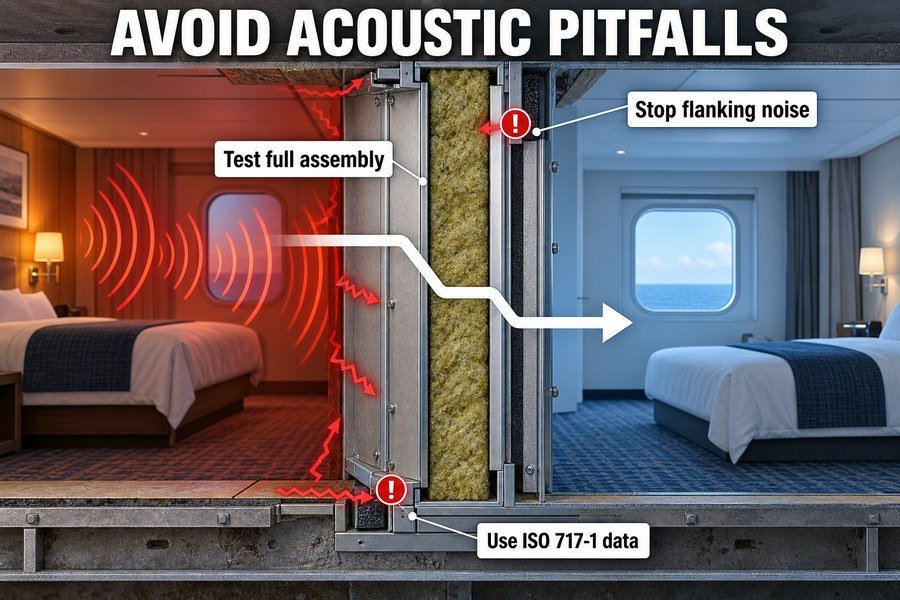
Many buyers purchase expensive panels but still fail the final acoustic test on the ship. Let us look at the real reasons why this happens and how you can fix it.
Why Does Specifying Only Core Material Cause Marine Interior Panel Acoustic Failures?
You buy top-grade rockwool core material for your panels. The cabin still sounds like a loud drum. Core material alone cannot stop all sound waves.
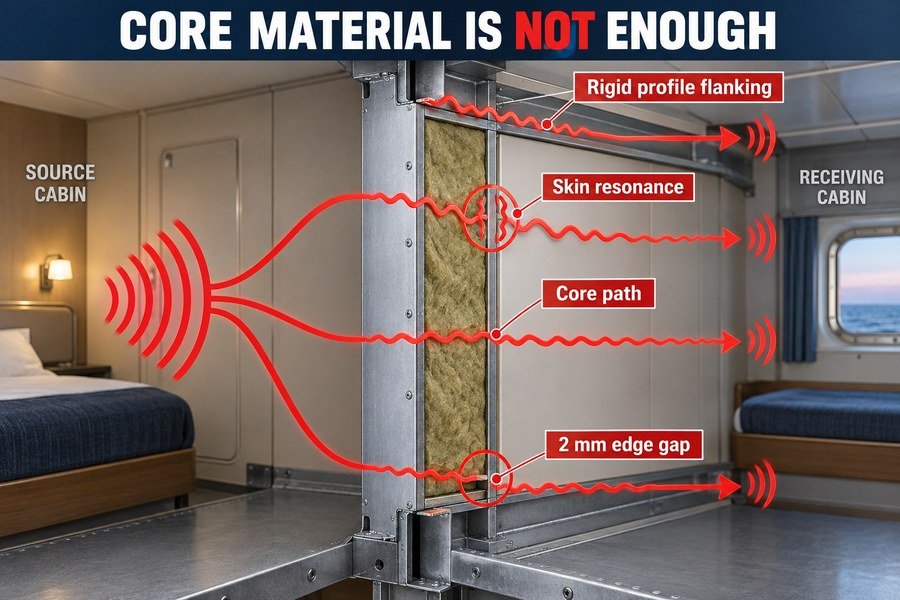
Specifying only core material causes acoustic failures because it ignores the three other critical paths of sound transmission: panel surface resonance, structural flanking noise through connecting profiles, and poor edge sealing. A complete system approach addressing all four factors is mandatory to stop sound.
I started my career in a marine outfitting factory. I saw a big mistake many times. Customers ordered thick rockwool core material. They specified a density of 150 kg/m3 according to the IMO FTP Code. They expected total silence in the cabin. The ship went to the sea trial. The cabin failed the noise test. The sound reduction index (Rw) only reached 30 dB instead of the required 44 dB. Why did this happen? Because sound acts like water. It finds the weakest point. You must look at the complete system.
The Four Paths of Sound Transmission in Marine Bulkheads
You must address four specific paths to stop noise. The first path is the core material itself. Rockwool absorbs sound waves passing directly through the center.1 But you must also address the other three paths. The second path is panel surface resonance. A flat 0.6mm steel sheet vibrates when sound hits it. This vibration creates new sound on the other side.2 The third path is structural flanking noise through connecting profiles. Sound travels extremely fast through rigid metal tracks on the floor and ceiling.3 The fourth path is poor edge sealing. A gap of just 2mm around the panel edge destroys the acoustic performance of the whole wall.4
How Core Materials Fail Without Proper System Integration
You cannot achieve a high Rw rating by ignoring system integration. A 50mm panel with excellent rockwool will fail if the metal skins vibrate together. You must isolate the skins. You must decouple the metal framework. I help my clients at Magellan Marine fix this by designing a system. We use acoustic tapes between the metal profiles and the ship deck. We apply damping materials to the steel skins. This stops the resonance.
| Sound Transmission Path | Acoustic Issue | Solution Requirement | Expected Rw Loss if Ignored |
|---|---|---|---|
| Core Material | Sound waves pass directly through the panel | Use 150 kg/m3 density rockwool | -5 dB to -8 dB |
| Panel Surface Resonance | Steel skin vibrates and amplifies sound | Apply visco-elastic damping layer | -4 dB to -6 dB |
| Structural Flanking Noise | Sound travels through metal floor tracks | Install 3mm neoprene isolation tape | -7 dB to -10 dB |
| Poor Edge Sealing | Sound leaks through tiny air gaps | Apply fire-rated acoustic sealant | -10 dB to -15 dB |
What Common Installation Mistakes Cause a Marine Bulkhead to Miss Its Rw Target?
You paid a high price for a 45 dB Rw marine panel. The sea trial only measures 35 dB. Installation errors always destroy the acoustic performance of a bulkhead.
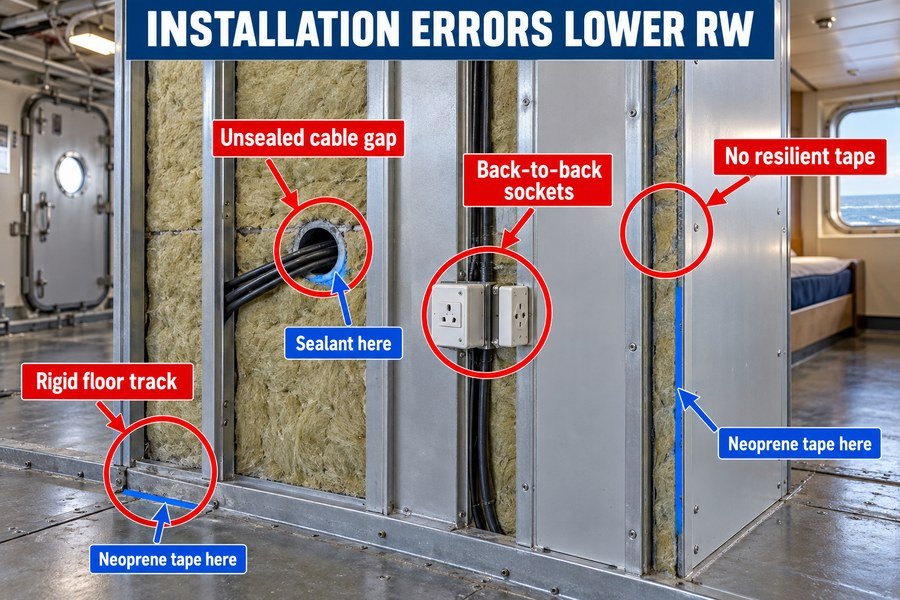
Common installation mistakes that degrade marine bulkhead Rw targets include using rigid metal-to-metal floor connections, leaving unsealed gaps around cable penetrations, installing back-to-back electrical sockets in the same cavity, and omitting resilient mounting tapes. Avoiding these four errors prevents critical flanking noise leaks.
I started my career in a marine outfitting factory. I saw a big mistake many times. Customers ordered thick rockwool core material. They specified a density of 150 kg/m3 according to the IMO FTP Code. They expected total silence in the cabin. The ship went to the sea trial. The cabin failed the noise test. The sound reduction index (Rw) only reached 30 dB instead of the required 44 dB. Why did this happen? Because sound acts like water. It finds the weakest point. You must look at the complete system.
The Four Paths of Sound Transmission in Marine Bulkheads
You must address four specific paths to stop noise. The first path is the core material itself. Rockwool absorbs sound waves passing directly through the center.5 But you must also address the other three paths. The second path is panel surface resonance. A flat 0.6mm steel sheet vibrates when sound hits it. This vibration creates new sound on the other side.6 The third path is structural flanking noise through connecting profiles. Sound travels extremely fast through rigid metal tracks on the floor and ceiling.7 The fourth path is poor edge sealing. A gap of just 2mm around the panel edge destroys the acoustic performance of the whole wall.8
How Core Materials Fail Without Proper System Integration
You cannot achieve a high Rw rating by ignoring system integration. A 50mm panel with excellent rockwool will fail if the metal skins vibrate together. You must isolate the skins. You must decouple the metal framework. I help my clients at Magellan Marine fix this by designing a system. We use acoustic tapes between the metal profiles and the ship deck. We apply damping materials to the steel skins. This stops the resonance.
| Sound Transmission Path | Acoustic Issue | Solution Requirement | Expected Rw Loss if Ignored |
|---|---|---|---|
| Core Material | Sound waves pass directly through the panel | Use 150 kg/m3 density rockwool | -5 dB to -8 dB |
| Panel Surface Resonance | Steel skin vibrates and amplifies sound | Apply visco-elastic damping layer | -4 dB to -6 dB |
| Structural Flanking Noise | Sound travels through metal floor tracks | Install 3mm neoprene isolation tape | -7 dB to -10 dB |
| Poor Edge Sealing | Sound leaks through tiny air gaps | Apply fire-rated acoustic sealant | -10 dB to -15 dB |
How Can Shipyards Stop Assuming Heavier Marine Accommodation Panels Always Insulate Better?
Heavy panels cost you more money to ship from Asia. Heavy panels also increase fuel consumption for the vessel. Mass does not always equal better sound reduction.
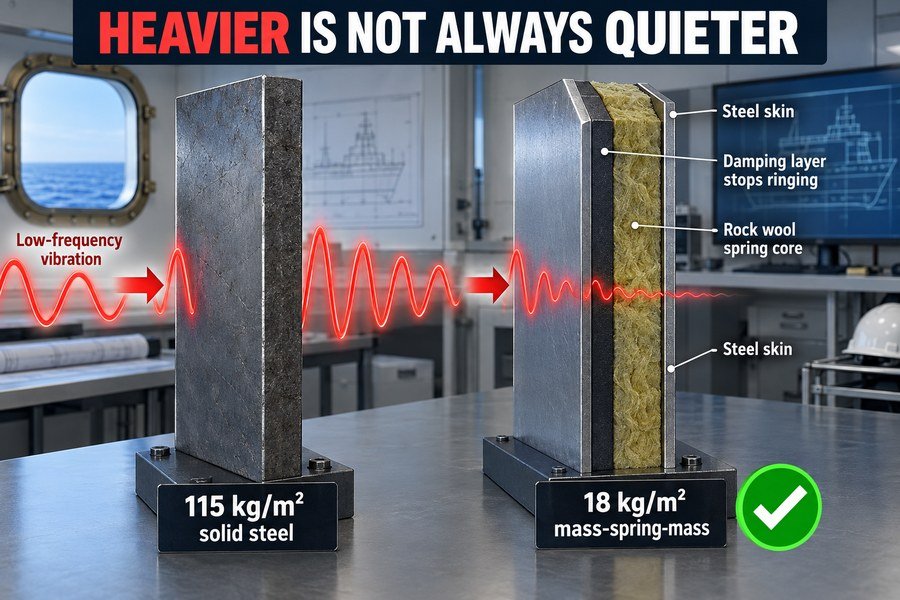
Shipyards stop assuming heavier marine accommodation panels insulate better by utilizing two principles: the mass-spring-mass design for low frequencies and constrained layer damping for structural vibrations. These two lightweight engineering methods outperform solid heavy steel plates in acoustic reduction.
Many shipyard engineers believe in the mass law. The mass law says that doubling the weight of a wall gives you a 6 dB improvement in sound insulation9. This is true for solid materials like a single steel plate. But this thinking is outdated and expensive. I help my clients reduce weight and save money. You do not need a 100 kg/m2 solid steel bulkhead to get good acoustics. You can achieve the same result with a panel that weighs only 18 kg/m2. You just need to understand modern acoustic engineering.
Implementing Mass-Spring-Mass Design in Marine Panels
The first principle is the mass-spring-mass design. Imagine two metal skins as the "mass" and the rockwool core as the "spring"10. When sound hits the first metal skin, it vibrates. The rockwool core acts like a shock absorber. It weakens the vibration before it reaches the second metal skin. A standard 50mm sandwich panel uses two 0.6mm galvanized steel skins separated by 50mm of rockwool. This setup easily achieves an Rw of 35 dB to 40 dB11. A solid steel plate would need to be 15mm thick to achieve the same result. The solid plate would weigh over 115 kg/m2. The sandwich panel weighs only 18 kg/m2.
Utilizing Constrained Layer Damping for Bulkhead Vibrations
The second principle is constrained layer damping. Ship engines produce low-frequency vibrations. These vibrations travel through the ship structure. Heavy panels just vibrate along with the ship. Constrained layer damping solves this. We apply a thin 1mm to 2mm layer of visco-elastic polymer between two thin steel sheets. This polymer converts the vibration energy into a tiny amount of heat12. It stops the panel from ringing. This method adds almost no weight. But it improves the acoustic rating by 3 dB to 5 dB.
| Engineering Method | How It Works | Weight per Square Meter | Typical Rw Performance |
|---|---|---|---|
| Single Heavy Steel Plate | Relies purely on mass law | 115 kg/m2 (15mm thick) | ~40 dB |
| Mass-Spring-Mass Panel | Uses air/rockwool as a shock absorber | 18 kg/m2 (50mm thick) | ~40 dB |
| Constrained Layer Damping | Converts vibration energy to heat | 20 kg/m2 (with polymer) | ~44 dB |
What Critical Acoustic Details Are Missed When Comparing Marine Bulkheads by Thickness Alone?
Buyers often compare supplier quotes based on a standard 50mm panel thickness. The cheaper 50mm panel fails the noise test. Thickness hides crucial internal design differences.
Comparing marine bulkheads by thickness alone misses three critical acoustic details: the internal skin asymmetry to prevent coincident dip, the structural decoupling of the metal framework, and the acoustic damping applied to the metal facings. These three factors determine actual soundproofing.
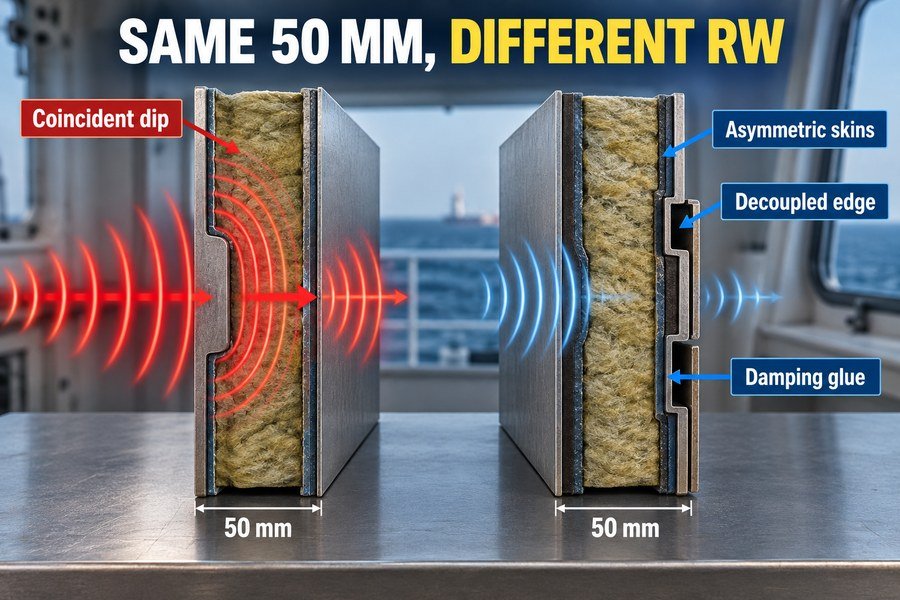
I see this problem often. A procurement officer gets two quotes for a 50mm marine wall panel. Supplier A quotes $30 per square meter. Supplier B quotes $45 per square meter. The buyer chooses Supplier A because both panels are 50mm thick. This is a huge mistake. Two panels with the exact same thickness can have a 10 dB difference in acoustic performance.13 Thickness is just the outside dimension. Sound reduction happens on the inside. You must look inside the panel to understand the price difference.
The Three Hidden Acoustic Details Inside a Marine Panel
The first hidden detail is internal skin asymmetry. A cheap panel uses 0.6mm steel on both sides. This causes a "coincident dip14". Both skins resonate at the exact same frequency. A good panel uses different thicknesses, like 0.6mm on one side and 0.8mm on the other side. This stops them from vibrating together. The second hidden detail is the structural decoupling of the framework. Cheap panels connect the front skin and back skin directly with a solid steel edge profile. Sound travels straight through this edge.15 A good acoustic panel has a thermal and acoustic break inside the edge profile.
Why 50mm Panels Perform Differently in Acoustic Tests
The third hidden detail is acoustic damping. I mentioned this earlier. A cheap panel just glues the rockwool to the bare steel. An engineered panel has a special visco-elastic glue layer applied to the inside of the metal facings. This dampens the sound. If you only look at the 50mm thickness, you miss all of this. You must ask the supplier how they build the panel. Do not just look at the outside dimensions. A well-engineered 50mm panel can reach an Rw of 44 dB. A basic 50mm panel will only reach 34 dB.
| Hidden Acoustic Detail | Standard 50mm Panel Design | Engineered 50mm Panel Design | Acoustic Benefit |
|---|---|---|---|
| Skin Asymmetry | 0.6mm steel on both sides | 0.6mm one side, 0.8mm other | Eliminates coincident dip |
| Structural Decoupling | Solid steel edge profile | Profile with acoustic break | Stops edge flanking noise |
| Acoustic Damping | Standard rigid glue | Visco-elastic damping glue | Reduces metal ringing by 4 dB16 |
How Can Buyers Verify a Marine Interior Supplier Can Engineer a Custom Rw Build-Up?
Suppliers often claim they can manufacture custom acoustic panels. You risk failing your project specifications if they lack real expertise. You must check their engineering evidence.
Buyers verify a marine interior supplier can engineer custom Rw build-ups by requesting three specific documents: ISO 717-1 laboratory test certificates for similar assemblies, documented flanking transmission data for connection joints, and detailed CAD drawings showing acoustic decoupling layers.
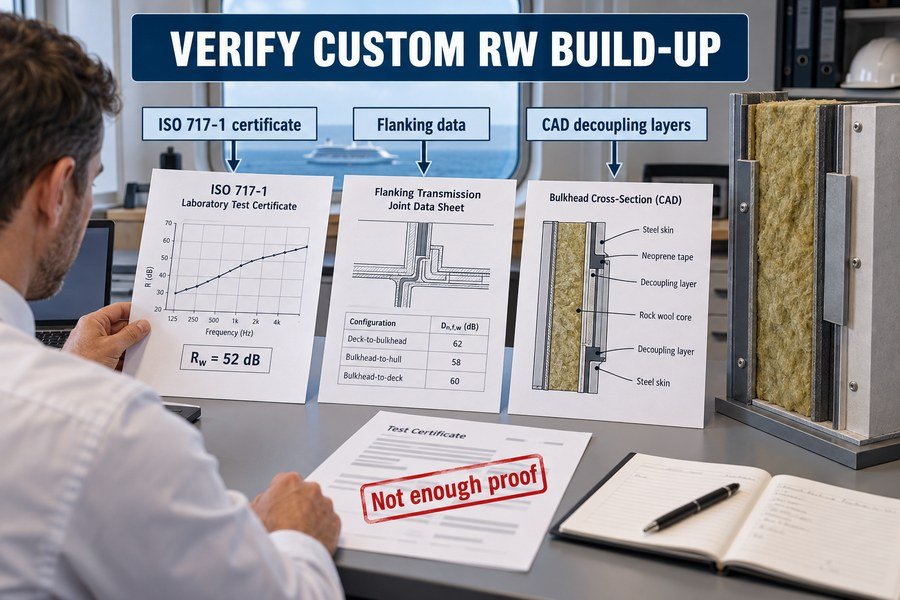
It is hard to find a good supplier in Asia who understands marine acoustics deeply. Many factories only know how to produce standard panels. When you have a strict requirement, like a cabin next to the engine room, you need a custom Rw build-up. You might need an Rw of 48 dB. A sales person will say "Yes, we can do it." Do not trust words. You must verify their capability. I use a strict process to check suppliers. You must ask for proof.
Three Documents to Request from Marine Interior Suppliers
The first document is the ISO 717-1 laboratory test certificate. This is the international standard for rating sound insulation in buildings and ships. You must ask for a certificate from a recognized lab. Good labs include DNV, Lloyd's Register, or a national acoustics institute. The certificate must show an assembly similar to your request. The second document is flanking transmission data. A good supplier knows that sound leaks through the panel joints17. Ask them for data on their specific profile connections. If they do not know what flanking transmission is, they cannot engineer a custom panel.
Validating ISO 717-1 Test Certificates for Marine Use
The third document is a detailed CAD drawing. A true acoustic supplier will draw the exact cross-section of the wall. The drawing must show the acoustic decoupling layers18. It must show the neoprene tapes. It must show the asymmetric steel skins. Look at the test certificate carefully. Check the date. Check the exact materials tested. Many buyers get tricked by fake or generic certificates. A certificate for a 100mm wall does not prove they can build a 50mm wall with the same rating19.
| Document Requested | What to Look For | Red Flag Warning |
|---|---|---|
| ISO 717-1 Test Certificate | Stamp from DNV, Lloyd's, or certified lab | Lab name is unknown or date is expired |
| Flanking Transmission Data | Test results for panel joints and profiles | Supplier says "joints don't matter" |
| Detailed CAD Drawings | Shows neoprene tapes and structural breaks | Drawing only shows a basic steel box |
Why Should Acoustics Be Specified by Tested Marine Interior Assemblies Rather Than Raw Materials?
Specifying 100 kg/m3 rockwool seems like a safe choice. The assembled wall still leaks noise through the ceiling joints. Sound travels through the weakest link, not the strongest material.
Acoustics should be specified by tested marine interior assemblies because laboratory assembly tests measure the whole system performance, account for metal profile resonance, and reveal sound leakage at panel joints. Specifying raw materials ignores these three system-level acoustic failures.
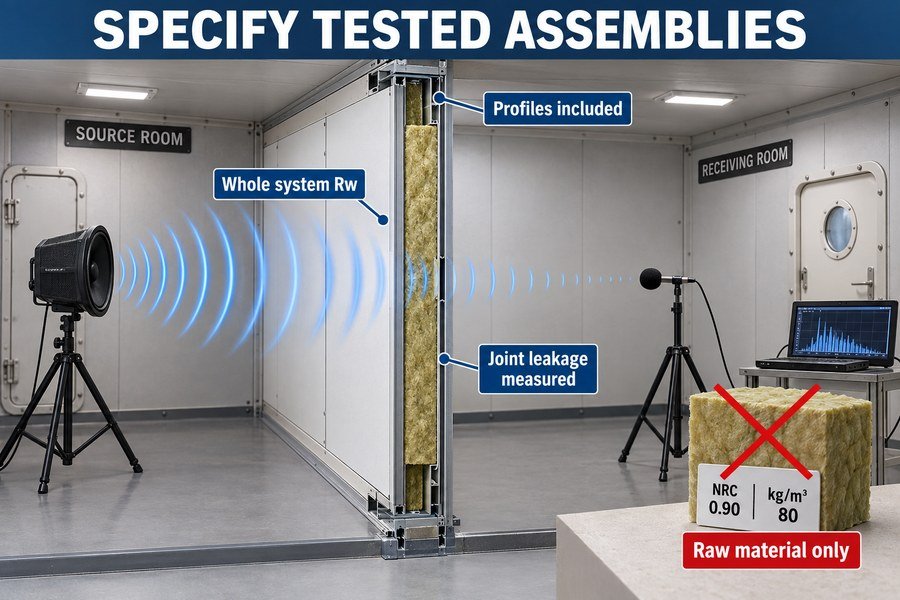
I see shipyards make this mistake on their drawing boards. The specification sheet says "Use 50mm rockwool with a Noise Reduction Coefficient (NRC) of 0.8". This specification is useless for stopping sound between cabins. NRC only measures how much sound a raw material absorbs inside a room.20 It does not measure how much sound passes through a wall.21 You need the Weighted Sound Reduction Index (Rw). Rw applies to the entire wall assembly, not the raw material.22
Three Reasons Whole-System Acoustic Testing is Mandatory
The first reason is whole system performance. An assembly test puts the panel, the floor track, the ceiling track, and the joint profiles together in a lab. The lab plays loud noise in one room and measures the noise in the next room. This proves the whole system works. The second reason is metal profile resonance. Raw material specifications ignore the steel framework. The steel framework carries sound.23 A lab test measures this negative effect. The third reason is joint leakage. Two great panels connected poorly will fail. A lab test measures the sound leaking through the specific joint design.
The Difference Between Material Sound Absorption and Assembly Insulation
You must change how you buy marine outfitting products. Stop asking for rockwool density. Start asking for assembly Rw ratings. If your shipyard requires Rw 44 dB between passenger cabins, you must buy a system certified for Rw 44 dB. The factory must provide the panels, the profiles, and the installation instructions as one package. This is the only way to guarantee success during the sea trial. This is how we operate at Magellan Marine. We supply solutions, not just pieces of metal.
| Specification Type | What It Measures | Real-World Acoustic Reliability |
|---|---|---|
| Raw Material (e.g., NRC) | Sound absorption of the core only | Very Low (Ignores framework and joints) |
| Core Density (kg/m3) | Weight of the insulation material | Low (Heavy weight does not stop resonance) |
| Tested Assembly (Rw) | Total sound stopped by the entire wall | High (Proves real-world performance) |
Conclusion
Acoustic success in marine outfitting requires looking beyond heavy materials and basic panel thickness. By focusing on tested assemblies and proper installation, you ensure quiet cabins and successful sea trials.
-
"[PDF] Acoustic Absorption in Porous Materials", https://ntrs.nasa.gov/api/citations/20110011143/downloads/20110011143.pdf. Acoustics references describe mineral wool as a porous absorber that dissipates acoustic energy through viscous and thermal losses as sound propagates through its fibre structure. Evidence role: mechanism; source type: paper. Supports: Rockwool can absorb sound waves passing through the core of a panel.. Scope note: This supports the absorption mechanism generally, but it does not by itself establish the Rw performance of the specific marine bulkhead system. ↩
-
"comparison of experimental methods to measure sound transmission loss ...", https://www.academia.edu/63196110/COMPARISON_OF_EXPERIMENTAL_METHODS_TO_MEASURE_SOUND_TRANSMISSION_LOSS_OF_ISOTROPIC_AND_SANDWICH_PANELS. Standard sound-insulation theory explains that airborne sound can excite bending vibration in thin plates, and the vibrating plate can reradiate sound into the receiving space. Evidence role: mechanism; source type: education. Supports: Thin steel skins can vibrate under airborne sound excitation and reradiate sound to the opposite side.. Scope note: The source should be used to support the general plate-vibration mechanism; the exact effect for a 0.6 mm marine steel skin depends on panel dimensions, boundary conditions, and frequency. ↩
-
"Flanking transmission - Wikipedia", https://en.wikipedia.org/wiki/Flanking_transmission. Building-acoustics literature identifies rigid structural connections as flanking transmission paths through which vibration bypasses the separating element and reduces measured sound insulation. Evidence role: mechanism; source type: institution. Supports: Rigid metal tracks can act as structural flanking paths that transmit vibration around the bulkhead.. Scope note: This provides contextual support for the flanking-transmission mechanism; it may not quantify transmission speed or loss for the exact marine track profile. ↩
-
"Airborne sound insulation performance of lightweight double ...", https://pmc.ncbi.nlm.nih.gov/articles/PMC11666719/. Acoustic-sealing guidance and sound-insulation studies show that small air leaks or perimeter gaps can substantially reduce the apparent sound reduction of a partition by allowing direct airborne leakage. Evidence role: general_support; source type: research. Supports: Small perimeter gaps can significantly reduce the acoustic performance of a wall or bulkhead.. Scope note: The evidence can support the principle that small gaps degrade sound insulation, but the word “destroys” and the exact 2 mm threshold should be treated as application-dependent unless the cited source tests that gap size directly. ↩
-
"[PDF] Acoustic Absorption in Porous Materials", https://ntrs.nasa.gov/api/citations/20110011143/downloads/20110011143.pdf. Acoustics references describe mineral wool as a porous absorber that dissipates acoustic energy through viscous and thermal losses as sound propagates through its fibre structure. Evidence role: mechanism; source type: paper. Supports: Rockwool can absorb sound waves passing through the core of a panel.. Scope note: This supports the absorption mechanism generally, but it does not by itself establish the Rw performance of the specific marine bulkhead system. ↩
-
"comparison of experimental methods to measure sound transmission loss ...", https://www.academia.edu/63196110/COMPARISON_OF_EXPERIMENTAL_METHODS_TO_MEASURE_SOUND_TRANSMISSION_LOSS_OF_ISOTROPIC_AND_SANDWICH_PANELS. Standard sound-insulation theory explains that airborne sound can excite bending vibration in thin plates, and the vibrating plate can reradiate sound into the receiving space. Evidence role: mechanism; source type: education. Supports: Thin steel skins can vibrate under airborne sound excitation and reradiate sound to the opposite side.. Scope note: The source should be used to support the general plate-vibration mechanism; the exact effect for a 0.6 mm marine steel skin depends on panel dimensions, boundary conditions, and frequency. ↩
-
"Flanking transmission - Wikipedia", https://en.wikipedia.org/wiki/Flanking_transmission. Building-acoustics literature identifies rigid structural connections as flanking transmission paths through which vibration bypasses the separating element and reduces measured sound insulation. Evidence role: mechanism; source type: institution. Supports: Rigid metal tracks can act as structural flanking paths that transmit vibration around the bulkhead.. Scope note: This provides contextual support for the flanking-transmission mechanism; it may not quantify transmission speed or loss for the exact marine track profile. ↩
-
"Airborne sound insulation performance of lightweight double ...", https://pmc.ncbi.nlm.nih.gov/articles/PMC11666719/. Acoustic-sealing guidance and sound-insulation studies show that small air leaks or perimeter gaps can substantially reduce the apparent sound reduction of a partition by allowing direct airborne leakage. Evidence role: general_support; source type: research. Supports: Small perimeter gaps can significantly reduce the acoustic performance of a wall or bulkhead.. Scope note: The evidence can support the principle that small gaps degrade sound insulation, but the word “destroys” and the exact 2 mm threshold should be treated as application-dependent unless the cited source tests that gap size directly. ↩
-
"[PDF] Ultrasonic, Normal-Incidence Insertion Loss through Common ...", https://physics.byu.edu/docs/thesis/269. Standard acoustics references describe the mass law for limp, single-leaf barriers as an approximately 6 dB increase in transmission loss for each doubling of surface mass or frequency. Evidence role: definition; source type: education. Supports: The mass law says that doubling the weight of a wall gives you a 6 dB improvement in sound insulation.. Scope note: The relationship is an idealized approximation and can deviate near coincidence, resonance, panel stiffness effects, or flanking transmission paths. ↩
-
"[PDF] optimizing sandwich panels with graded tubular cell core for ... - arXiv", https://arxiv.org/pdf/2401.11412. Acoustics literature on double-leaf partitions explains that two facing panels act as coupled masses while the intervening air or porous cavity material provides spring-like compliance and absorption, producing mass–spring–mass behavior. Evidence role: mechanism; source type: paper. Supports: In marine sandwich panels, the two metal skins function as masses and the rockwool core functions as the spring in a mass-spring-mass system.. Scope note: This supports the physical model in general; actual panel performance depends on skin stiffness, cavity depth, core flow resistivity, mechanical connections, and installation details. ↩
-
"Investigation of Sound Transmission Loss Through Sandwich ...", https://www.academia.edu/58114441/Investigation_of_Sound_Transmission_Loss_Through_Sandwich_Panel_with_Foam_Core. Laboratory measurements or peer-reviewed studies of steel-faced mineral-wool sandwich panels report weighted sound reduction indices in the approximate 35–40 dB range for comparable lightweight double-skin constructions. Evidence role: statistic; source type: paper. Supports: A 50 mm sandwich panel with two 0.6 mm galvanized steel skins and a rockwool core can achieve an Rw of about 35 dB to 40 dB.. Scope note: The cited range is only directly applicable when panel thickness, steel gauge, mineral-wool density, joints, mounting, and test standard are comparable to the described 50 mm construction. ↩
-
"Vibro-acoustical analysis and design of a multiple-layer ...", https://digitalcommons.mtu.edu/cgi/viewcontent.cgi?article=1382&context=etds. Research on constrained-layer damping describes viscoelastic interlayers as dissipating vibrational strain energy through hysteretic losses, converting part of the mechanical energy into heat and reducing panel resonance amplitudes. Evidence role: mechanism; source type: research. Supports: In constrained layer damping, a viscoelastic polymer layer converts vibration energy into heat and reduces panel ringing.. Scope note: This supports the damping mechanism; the magnitude of acoustic improvement depends on polymer loss factor, temperature, layer thickness, panel geometry, and excitation frequency. ↩
-
"How to Compare Acoustic Data Across Marine Accommodation ...", https://magellanmarinetech.com/how-compare-acoustic-data-across-marine-accommodation-panel-suppliers/. Comparative sound-insulation literature for sandwich or double-leaf panels shows that panels of the same nominal thickness can have materially different weighted sound reduction indices because skin mass, core properties, damping, and connections affect transmission loss; the exact 10 dB spread should be verified against the specific panel type and test standard. Evidence role: general_support; source type: paper. Supports: Two 50 mm marine wall panels can differ substantially, potentially by about 10 dB, in acoustic performance.. Scope note: Contextual support only unless the source tests the same 50 mm marine wall-panel constructions under the same standard. ↩
-
"[PDF] Sound Transmission Loss of Composite Sandwich Panels", https://etd.auburn.edu/bitstream/10415/1702/3/Ran%20Zhou_Dissertation.pdf. Acoustics references on plate sound transmission describe the coincidence effect, in which bending waves in a panel couple efficiently with airborne sound near the critical frequency and reduce transmission loss; applying this principle to paired metal skins supports the concern but does not by itself prove that a given asymmetric panel fully removes the dip. Evidence role: mechanism; source type: education. Supports: Symmetric metal skins can suffer a coincidence-related reduction in sound insulation, and differing skin properties can shift or reduce shared resonance effects.. Scope note: The source may explain the physical mechanism generally rather than test the exact 0.6 mm/0.8 mm marine panel combination. ↩
-
"Airborne sound insulation performance of lightweight double ...", https://pmc.ncbi.nlm.nih.gov/articles/PMC11666719/. Building-acoustics and noise-control sources on flanking transmission show that rigid mechanical bridges between leaves of a partition can carry structure-borne vibration and reduce the measured sound insulation of the assembly; the principle is applicable to panel-edge profiles, although marine-specific edge designs require direct testing. Evidence role: mechanism; source type: research. Supports: A solid steel edge connecting the front and back skins can create a structural sound path that weakens the panel’s acoustic isolation.. Scope note: The evidence is likely to be based on general partition or double-wall acoustics rather than the exact marine panel edge profile described. ↩
-
"[PDF] Vibro-acoustical analysis and design of a multiple-layer constrained ...", https://digitalcommons.mtu.edu/cgi/viewcontent.cgi?article=1382&context=etds. Studies of constrained-layer damping report that viscoelastic layers bonded to metal panels dissipate vibrational energy and can reduce panel vibration or radiated noise levels; a 4 dB reduction is plausible only as a test-specific result and should not be read as a universal value. Evidence role: mechanism; source type: paper. Supports: A viscoelastic damping glue layer can reduce ringing or vibration-radiated sound from metal facings, with reductions that may be measured in decibels.. Scope note: The magnitude of reduction depends on steel thickness, damping-layer material, temperature, frequency range, and test method. ↩
-
"Flanking transmission - Wikipedia", https://en.wikipedia.org/wiki/Flanking_transmission. Building-acoustics literature and ISO flanking-transmission standards describe flanking transmission as sound energy passing through indirect paths such as junctions, joints, and connected structural elements rather than only through the main separating panel. Evidence role: mechanism; source type: institution. Supports: Panel joints and connections can form flanking transmission paths that reduce effective sound insulation.. Scope note: Most available standards and studies address buildings; the mechanism is transferable to marine panel systems, but a source may not test the specific supplier profile discussed in the article. ↩
-
"Airborne sound insulation performance of lightweight double ...", https://pmc.ncbi.nlm.nih.gov/articles/PMC11666719/. Acoustics references on mass-spring-mass and resiliently mounted partitions explain that separating structural layers with resilient or decoupling elements can reduce vibration coupling and improve airborne sound insulation, depending on the assembly design and resonance behavior. Evidence role: mechanism; source type: education. Supports: Acoustic decoupling layers are relevant design features in high sound-insulation wall assemblies.. Scope note: This supports the acoustic rationale for showing decoupling layers in a drawing, but it does not prove that any particular CAD detail or supplier design will achieve a specified Rw value. ↩
-
"Sound transmission class - Wikipedia", https://en.wikipedia.org/wiki/Sound_transmission_class. Laboratory sound-insulation ratings are based on the tested specimen configuration, and acoustic transmission loss depends on factors such as construction, surface mass, cavities, and layer spacing; therefore, a rating for one wall thickness cannot be assumed for a different assembly without testing or validated calculation. Evidence role: expert_consensus; source type: paper. Supports: A sound-insulation certificate for one wall assembly does not demonstrate the same Rw rating for a materially different wall thickness or build-up.. Scope note: A general acoustics source can establish non-transferability across different constructions, but it may not provide direct data comparing 100 mm and 50 mm marine wall panels. ↩
-
"Noise reduction coefficient - Wikipedia", https://en.wikipedia.org/wiki/Noise_reduction_coefficient. ASTM C423 and related acoustics references define Noise Reduction Coefficient as an average of measured sound absorption coefficients for a test specimen, supporting that NRC describes absorption rather than airborne sound transmission through a partition. Evidence role: definition; source type: institution. Supports: NRC measures sound absorption of a material/specimen and does not measure sound passing through a wall.. Scope note: The standard concerns laboratory absorption testing of specimens and does not specifically evaluate marine cabin wall assemblies. ↩
-
"Sound insulation dataset of 30 wooden and 8 concrete floors ...", https://pmc.ncbi.nlm.nih.gov/articles/PMC10365936/. Standard descriptions of sound transmission loss testing, such as ASTM E90 or ISO 10140, treat airborne sound insulation as the level difference across a partition measured in adjacent rooms, distinguishing it from absorption metrics such as NRC. Evidence role: definition; source type: institution. Supports: NRC is not a measure of sound transmission through a wall; transmission loss is measured using separate airborne sound insulation tests.. Scope note: These standards describe laboratory measurement principles; field performance aboard ships can vary with installation and flanking paths. ↩
-
"Sound reduction index - Wikipedia", https://en.wikipedia.org/wiki/Sound_reduction_index. ISO 717-1 defines the weighted sound reduction index, Rw, as a single-number rating derived from the frequency-dependent sound reduction index of a building element or assembly, supporting its use for partition systems rather than as a core-material property. Evidence role: definition; source type: institution. Supports: Rw is a rating for the sound reduction performance of an element or assembly, not merely a raw insulation material.. Scope note: ISO 717-1 is a building-acoustics standard; it provides the rating method but does not by itself certify any specific marine product. ↩
-
"(PDF) Performance Details of Metal Stud Partitions", https://www.academia.edu/128962667/Performance_Details_of_Metal_Stud_Partitions. Research on lightweight framed partitions shows that studs, tracks, and other structural connections can transmit vibration and create flanking or structure-borne paths that reduce airborne sound insulation, supporting the claim that the metal framework affects wall acoustic performance. Evidence role: mechanism; source type: paper. Supports: Steel framework in a partition can carry vibration/sound and negatively affect overall acoustic insulation.. Scope note: The degree of reduction depends on stud geometry, spacing, connections, lining, and installation quality, so the evidence is mechanistic rather than a rating for a particular wall system. ↩