
Ship weight and cabin space always fight against each other. Heavy, thick walls eat your profits and payload. I will show you how the right insulation solves this problem.
Insulation thickness balances space and weight by combining high-density rock wool core layers (typically 100-150 kg/m³) with varying thicknesses (25mm to 100mm) to meet specific fire ratings like B-15 or A-60. Thinner, higher-density panels save floor space, while thicker, lower-density options reduce overall vessel weight.
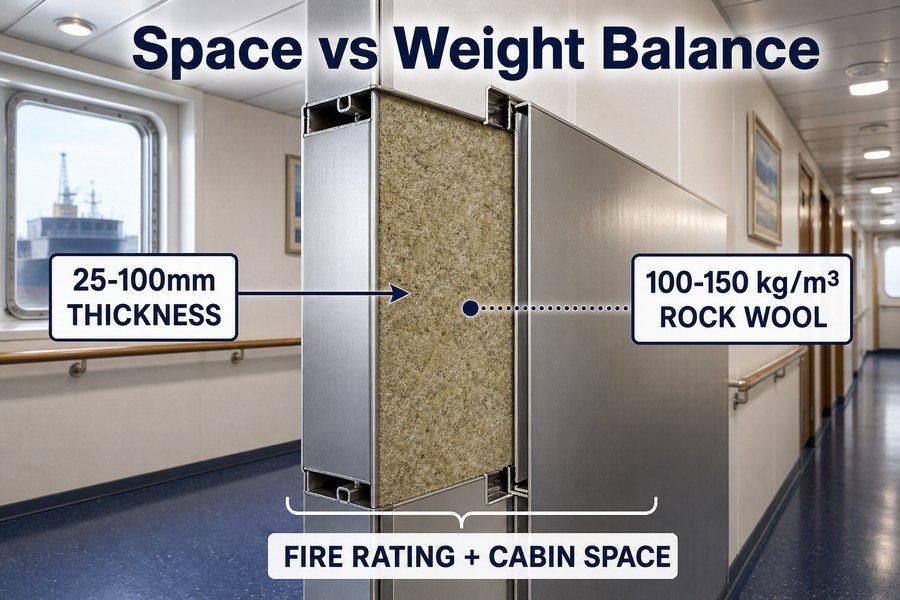
Finding the perfect balance between board thickness and weight is hard. You want a light ship, but you also want large cabins for the crew. Let us look at the details.
How Thick Must Insulation Be for an A-60 Marine Bulkhead?
Passing A-60 fire tests is a strict requirement. Thin walls will fail the test, but overly thick walls waste space. Here is the exact thickness you need.
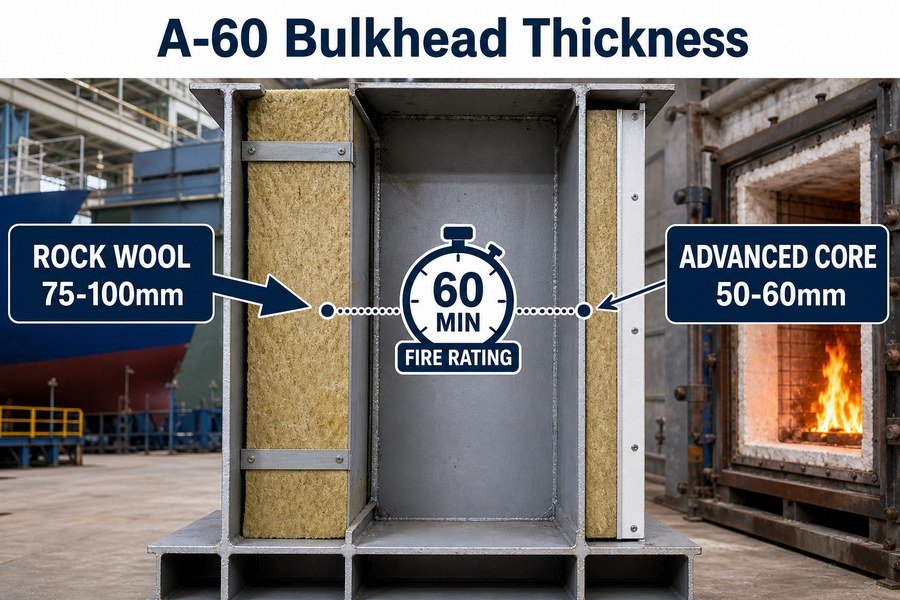
An A-60 marine bulkhead requires insulation thicknesses ranging from 50mm to 100mm, depending on the material. Standard marine rock wool needs 75mm to 100mm (density 120 kg/m³), while advanced ceramic wool or microporous insulation can achieve A-60 compliance at just 50mm to 60mm thickness under SOLAS regulations.
Standard Rock Wool Requirements for A-60 Bulkheads
Standard marine rock wool is the most common choice for shipyards. I have installed thousands of these panels during my time at Magellan Marine. To meet the A-60 standard under the SOLAS Fire Test Procedures (FTP) Code 20101, the rock wool core must stop heat transfer for 60 minutes. You cannot cheat physics. To do this with rock wool, you need a thickness between 75mm and 100mm. The density must stay around 120 kg/m³. If you use a lower density, you must use a thicker panel. A 100mm rock wool panel costs about $25 to $35 per square meter. It is cheap, but it is very bulky. This thickness takes up a lot of room in tight ship corridors. You must plan your floor tracks carefully to fit these thick panels.
Advanced Thin Insulation Materials for A-60 Bulkheads
Sometimes, you cannot afford to lose 100mm of space. This is where advanced materials help. Ceramic wool and microporous insulation are excellent upgrades. These materials have better thermal resistance. You only need 50mm to 60mm of ceramic wool to pass the exact same A-60 fire test. I highly recommend this for luxury yachts or crowded offshore living quarters. These panels save almost 50% of the wall thickness. However, the price is higher. A 50mm ceramic wool A-60 panel costs around $55 to $75 per square meter. Microporous insulation is even more expensive, often exceeding $100 per square meter. You must choose based on your project budget.
| Insulation Material Type | Required Thickness for A-60 | Core Density | Estimated Cost per Square Meter |
|---|---|---|---|
| Standard Marine Rock Wool | 75mm - 100mm | 120 kg/m³ | $25 - $35 |
| Advanced Ceramic Wool | 50mm - 60mm | 128 kg/m³ | $55 - $75 |
| Microporous Insulation | 50mm | 160 kg/m³ | $100+ |
Does Thicker A-Class Marine Wall Insulation Reduce Cabin Floor Space?
Every millimeter matters in a ship cabin. Thick A-Class walls steal room from the crew and furniture. You need to know exactly how much space you lose.
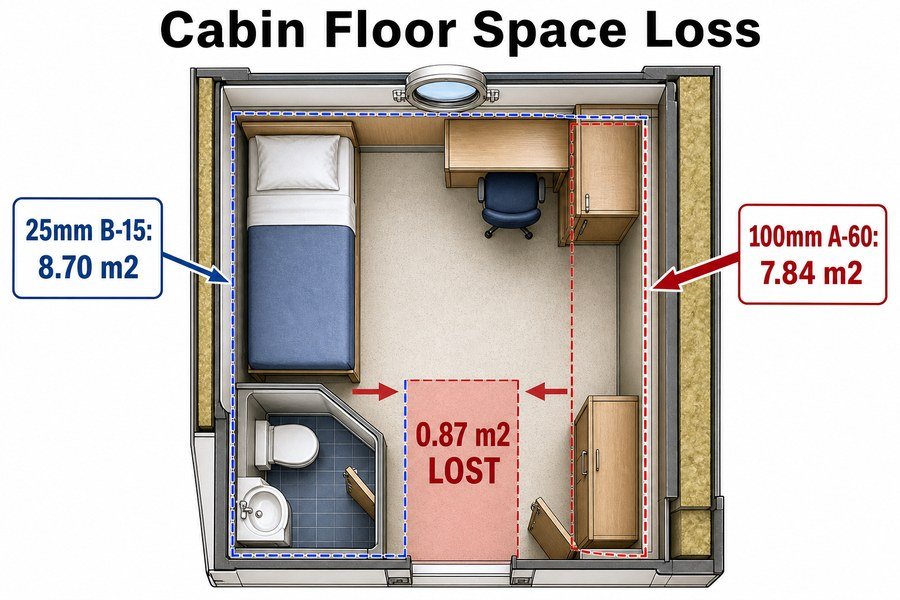
Yes, thicker A-Class marine wall insulation directly reduces cabin floor space. Upgrading from a 25mm B-15 panel to a standard 100mm A-60 rock wool panel consumes an extra 75mm per wall. In a standard 3x3m cabin, this extra thickness reduces the usable floor area by exactly 0.87 square meters.
Calculating the Space Loss from Thick A-60 Panels
I always tell my clients to calculate floor area based on the inside dimensions. Let us do the math. Imagine you have a steel room measuring exactly 3000mm by 3000mm. The total empty area is 9.0 square meters. If you use a 25mm B-15 panel on all four walls, your inside room dimension becomes 2950mm by 2950mm. Your usable floor space is 8.7 square meters. You lost 0.3 square meters to the walls. Now, imagine you must use a 100mm A-60 rock wool panel instead. You lose 100mm on all four sides. Your inside dimension shrinks to 2800mm by 2800mm. Your usable floor space drops to 7.84 square meters. The difference between the B-15 panel and the A-60 panel is 0.87 square meters of lost floor space. This is a massive loss for a single small cabin.
Financial Impact of Reduced Floor Space in Ship Cabins
Losing floor space is not just an inconvenience. It costs you money. Shipyards build cabins to fit specific furniture modules.2 If you lose 75mm of depth on a wall, a standard marine bed or wardrobe might not fit. You must then buy custom-sized furniture. Custom furniture is very expensive and takes longer to produce. For passenger ships, cabin size dictates ticket prices. A smaller cabin generates less revenue for the ship owner. Therefore, you must look closely at your drawings. If you have many cabins next to each other, the space loss multiplies. Using a 100mm standard rock wool panel is a bad idea if your client wants maximum living space.
| Panel Type | Wall Thickness | Internal Cabin Size (from 3x3m steel room) | Total Usable Floor Space |
|---|---|---|---|
| Bare Steel Wall (No Panel) | 0mm | 3000mm x 3000mm | 9.00 m² |
| Standard B-15 Panel | 25mm | 2950mm x 2950mm | 8.70 m² |
| Slim A-60 Panel (Ceramic) | 50mm | 2900mm x 2900mm | 8.41 m² |
| Standard A-60 Panel (Rock wool) | 100mm | 2800mm x 2800mm | 7.84 m² |
How to Keep Slim Marine Interior Walls While Meeting A-Class Rules?
You want thin walls, but the surveyor demands A-Class fire protection. Failing inspections delays the whole project. You can achieve both with the right strategy.
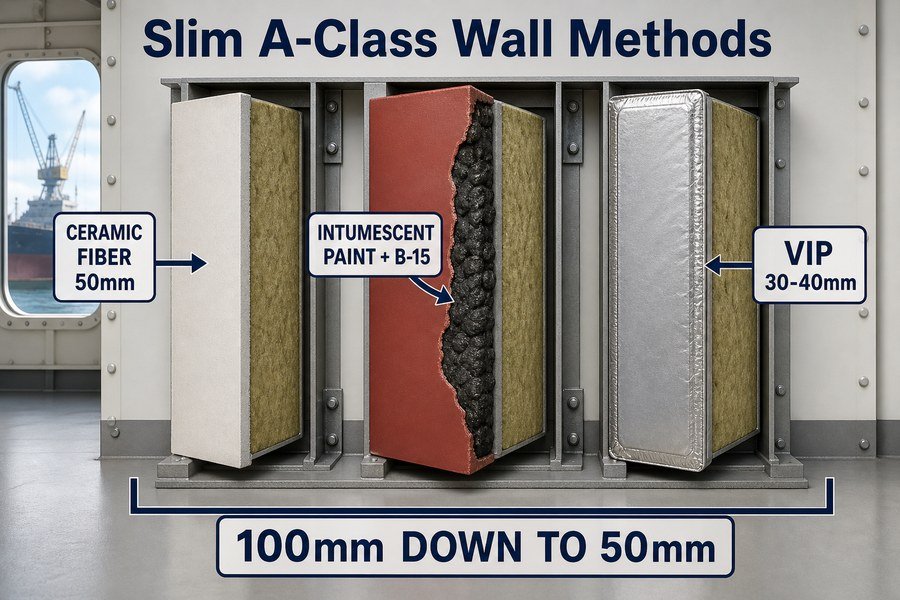
To keep slim marine interior walls while meeting A-Class rules, you must use three specific methods: apply high-density ceramic fiberboards (minimum 128 kg/m³), integrate structural steel cooling with intumescent marine paint, and utilize vacuum insulation panels (VIPs). These three solutions reduce wall thickness from 100mm down to 50mm.
Using High-Density Ceramic Fiberboards for Slim Walls
The first and most reliable method is using high-density ceramic fiberboards. As I mentioned before, this material is excellent. You need a minimum density of 128 kg/m³. Ceramic fibers can withstand temperatures above 1200°C without melting.3 Rock wool usually starts failing around 1000°C. Because ceramic fiber is so stable in a fire, the certification bodies allow you to use thinner layers. You can buy 50mm steel-faced sandwich panels with a ceramic core that hold a full A-60 certificate from DNV or ABS. This solves the thickness problem immediately. The installation is exactly the same as standard panels, so your workers do not need special training.
Integrating Intumescent Paint and Vacuum Insulation Panels
The second method involves intumescent marine paint. You can paint the bare steel bulkhead with this special coating. When a fire starts, the paint swells up and creates a thick char layer. This char layer insulates the steel. Because the steel is protected by the paint, you can use a thinner 25mm B-15 panel in front of it to complete the cosmetic look. Together, they achieve an A-Class rating without a thick panel. The third method uses Vacuum Insulation Panels (VIPs). VIPs are ultra-thin. A 20mm VIP has the same thermal resistance as 80mm of rock wool.4 However, VIPs are very fragile. You cannot cut them on the ship. If you drill a hole in a VIP, it loses its vacuum and fails. You must order them exactly to size.
| Slim Wall Method | Typical System Thickness | Core Technology | Installation Difficulty |
|---|---|---|---|
| High-Density Ceramic Fiberboard | 50mm | 128 kg/m³ Ceramic Wool | Low (Standard profiles) |
| Intumescent Paint + B-15 Panel | 25mm (panel) + Paint | Expanding fire paint | Medium (Requires painting) |
| Vacuum Insulation Panels (VIPs) | 30mm - 40mm | Sealed vacuum core | High (Cannot be cut) |
What Is the Trade-Off Between Marine Wall Insulation Thickness and Cabin Weight?
Heavy ships burn more fuel and carry less cargo. Adding thick walls adds massive weight. You must balance this insulation thickness against the total cabin weight.
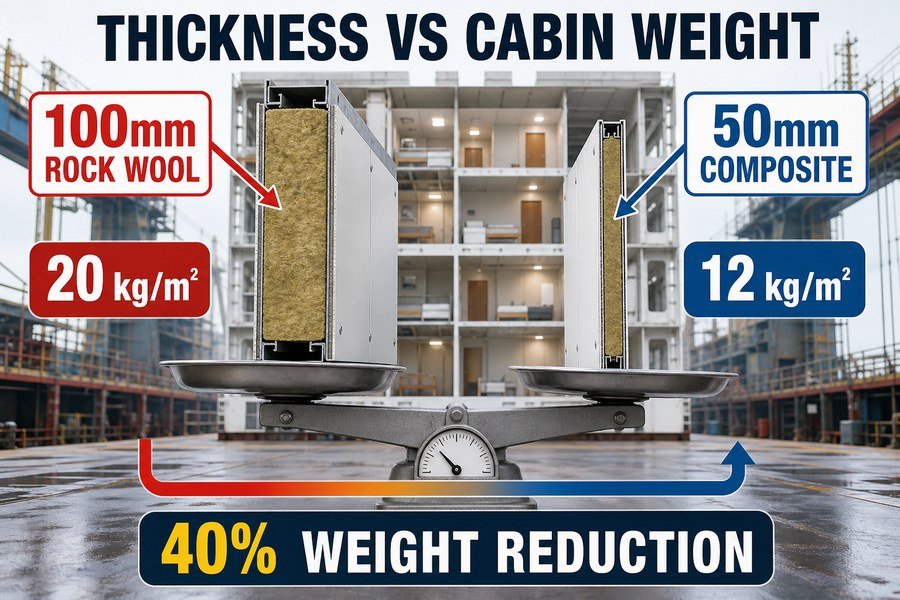
The trade-off between marine wall insulation thickness and cabin weight involves two main factors: material density and total volume. A 100mm standard rock wool panel weighs around 20 kg/m², while a 50mm high-performance composite panel weighs only 12 kg/m², reducing cabin weight by 40% but increasing material costs.
The Impact of Material Density on Total Cabin Weight
Material density and total volume control the final weight of your ship. If you use a standard 100mm rock wool panel, the core has a density of 120 kg/m³. We also must add the weight of the galvanized steel skins on both sides. The total panel weight reaches about 20 kilograms per square meter. A typical crew cabin uses about 40 square meters of wall panels. This means one cabin's walls weigh 800 kilograms. If you upgrade to a 50mm high-performance composite panel, the volume drops by half. Even if the density is slightly higher, the total weight drops to 12 kilograms per square meter. The same cabin now weighs only 480 kilograms. You save 320 kilograms per cabin. For a ship with 100 cabins, you save 32 metric tons.
Balancing High Material Costs Against Vessel Fuel Savings
You cannot just look at the purchase price of the panels. A 50mm lightweight panel costs twice as much as a 100mm heavy panel. A procurement officer might want to buy the cheaper, heavier panel to save money today. However, adding 32 extra tons to a ship increases the daily fuel consumption5. Over a 20-year lifespan, the ship owner will pay thousands of dollars in extra fuel. Furthermore, heavy ships have less draft capacity for paying cargo. If you are outfitting a fast ferry or an offshore patrol vessel, weight is the most critical factor. The shipyard will gladly pay a higher price per square meter to hit their strict weight targets.
| Wall Panel Type | Panel Thickness | Average Weight per m² | Total Weight for 100 Cabins (40m² each) |
|---|---|---|---|
| Standard Rock Wool A-60 | 100mm | 20.0 kg | 80,000 kg (80 tons) |
| Standard Rock Wool A-30 | 75mm | 17.5 kg | 70,000 kg (70 tons) |
| Lightweight Composite A-60 | 50mm | 12.0 kg | 48,000 kg (48 tons) |
How Does Insulation Choice Affect the Flush Joints of Marine Interior Bulkheads?
Uneven wall joints look terrible and cause client complaints. Wrong insulation makes panels warp during installation. You must choose the right core for flat walls.
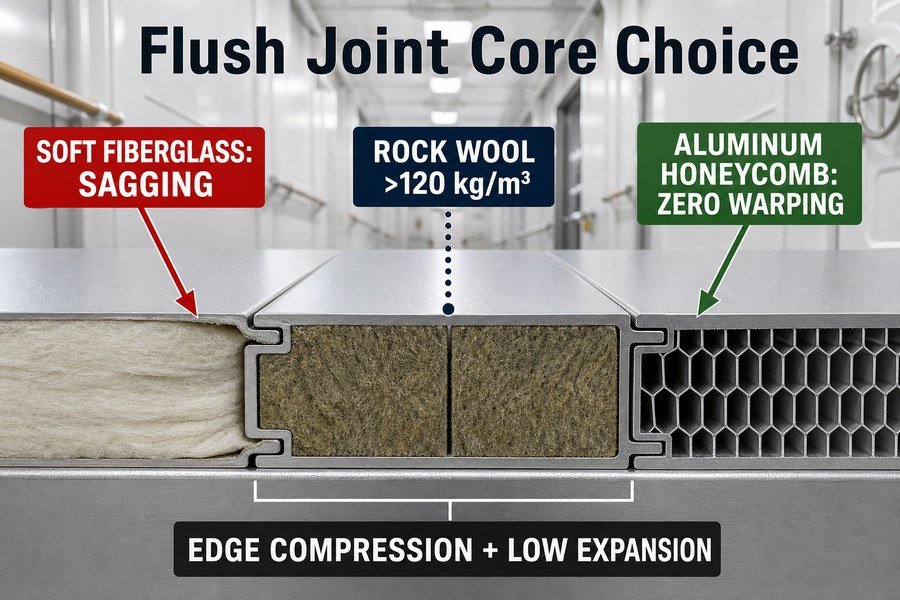
Insulation choice affects the flush joints of marine interior bulkheads in three ways: panel rigidity, thermal expansion rates, and edge-compression strength. Soft fiberglass causes joint sagging, high-density rock wool (over 120 kg/m³) provides stiff structural support, and aluminum honeycomb cores completely eliminate joint warping through zero thermal expansion.
How Panel Rigidity and Edge-Compression Support Flush Joints
Flush joints rely entirely on the core material inside the metal skins. Most marine panels use a male-and-female edge joint system. When you push two panels together, the joint must stay perfectly straight. This requires high edge-compression strength. If you use soft fiberglass insulation inside the panel, the edges will crush when you push them together. The steel skins will bend inward. This causes an ugly gap. I have seen many cheap panels fail this way. You must use high-density rock wool, ideally above 120 kg/m³6. This dense rock wool acts like a solid block. It supports the steel edges from the inside. When the workers push the panels together, the edges do not crush. The joint stays perfectly flush and invisible.
Preventing Joint Warping with Low Thermal Expansion Cores
The third way insulation affects flush joints is through thermal expansion. Ships sail through different climates. The steel hull gets very hot in the sun and very cold in the winter. The wall panels also experience these temperature changes. If the core material expands too much with heat, the panel will bow outward. This bending forces the joints to pop open. Rock wool has very low thermal expansion7, which helps keep panels straight. However, if you want zero warping, you should use aluminum honeycomb cores. Aluminum honeycomb is incredibly rigid and transfers heat evenly. It will never expand unevenly. Your joints will stay perfectly flush for the entire life of the ship, even in extreme engine room environments.
| Core Insulation Type | Panel Rigidity | Edge-Compression Strength | Flush Joint Performance |
|---|---|---|---|
| Soft Fiberglass | Very Low | Poor (Crushes easily) | Bad (High risk of sagging and gaps) |
| High-Density Rock Wool | High | Good (Supports steel edges) | Good (Standard flush finish) |
| Aluminum Honeycomb | Very High | Excellent (Rigid structure) | Perfect (Zero warping over time) |
Conclusion
Balancing space and weight in marine wall panels is a critical daily task. You must select the correct insulation thickness and core material to meet strict fire codes and maximize cabin profitability.
-
"Are Marine Fire Divisions the Same as Marine Panel Ratings?", https://magellanmarinetech.com/are-marine-fire-divisions-same-as-marine-panel-ratings/. The IMO FTP Code and SOLAS fire-classification framework define A-class divisions and A-60 performance by a standardized fire test, including integrity requirements and insulation-temperature limits over a 60-minute exposure. Evidence role: definition; source type: institution. Supports: A-60 bulkheads are evaluated under the SOLAS/IMO FTP Code framework and must meet 60-minute fire-test insulation requirements.. Scope note: This supports the regulatory definition of A-60 performance, not the adequacy of any particular rock-wool panel design. ↩
-
"(PDF) Structural Analysis in Shipbuilding Production Process", https://www.academia.edu/60865988/Structural_Analysis_in_Shipbuilding_Production_Process. Research on ship accommodation outfitting describes the use of prefabricated or modular cabin units with integrated interior components, supporting the general premise that cabin layouts are coordinated around standardized modules. Evidence role: general_support; source type: paper. Supports: Shipyards commonly design or outfit cabins around standardized cabin and furniture modules.. Scope note: This supports the modular-construction context but may not directly prove that every shipyard uses fixed furniture modules or quantify the impact of a 75 mm dimensional loss. ↩
-
"Advancements in Thermal Insulation through Ceramic Micro ...", https://pmc.ncbi.nlm.nih.gov/articles/PMC11124260/. Materials references on refractory ceramic fibers describe aluminosilicate ceramic fiber products as high-temperature insulation with classification or continuous-use temperatures commonly around 1260°C, supporting the claim that such fibers can remain stable above 1200°C. Evidence role: general_support; source type: paper. Supports: Ceramic fibers can withstand temperatures above 1200°C without melting.. Scope note: Temperature limits vary by fiber chemistry, product grade, exposure duration, and test method; the source would not prove that every ceramic fiberboard product performs identically in a certified wall assembly. ↩
-
"Vacuum insulation panel core materials and modelling the ...", https://dr.lib.iastate.edu/bitstreams/f77c7126-f49f-4b7f-b58d-7f1c941b1f20/download. Research on vacuum insulation panels reports thermal conductivities several times lower than conventional mineral wool insulation, which can make a thin VIP provide comparable thermal resistance to a much thicker rock-wool layer under ideal conditions. Evidence role: statistic; source type: research. Supports: A 20mm vacuum insulation panel can provide thermal resistance comparable to roughly 80mm of rock wool.. Scope note: The equivalence is approximate and depends on the VIP core, aging, edge losses, panel joints, and the specific thermal conductivity assumed for rock wool. ↩
-
"Fuel consumption prediction methodology for early stages ...", https://dspace.mit.edu/handle/1721.1/70435. Naval architecture and maritime energy-efficiency studies describe vessel fuel consumption as dependent on displacement and required propulsive power; added weight generally increases resistance and fuel use for a given operating profile. Evidence role: mechanism; source type: paper. Supports: Adding 32 tons of weight to a ship increases fuel consumption.. Scope note: The source can support the direction of the effect, but the magnitude of daily fuel increase depends on hull form, speed, route, loading condition, and engine efficiency. ↩
-
"The Effect of Mineral Wool Fiber Additive on Several ... - PMC", https://pmc.ncbi.nlm.nih.gov/articles/PMC10820291/. Published materials-engineering studies on mineral/rock-wool boards report that density is a major determinant of compressive strength and dimensional stability, supporting the article’s link between higher-density cores and better edge support. Evidence role: mechanism; source type: paper. Supports: High-density rock wool, ideally above 120 kg/m³, is needed to provide enough edge-compression support for flush panel joints.. Scope note: This supports the mechanical principle, but it may not verify the exact 120 kg/m³ threshold for every marine panel design or joint geometry. ↩
-
"Determination of Thermal Properties of Mineral Wool Required for ... - PMC", https://pmc.ncbi.nlm.nih.gov/articles/PMC10488771/. Technical references on mineral wool describe it as dimensionally stable under temperature changes and having low thermal expansion compared with many insulation materials, which contextualizes its use where panel flatness is important. Evidence role: mechanism; source type: institution. Supports: Rock wool has low thermal expansion, helping panels remain straight during temperature changes.. Scope note: This supports the material-property claim generally, but it does not by itself prove that rock-wool cores prevent flush-joint movement in ship interiors under all service conditions. ↩