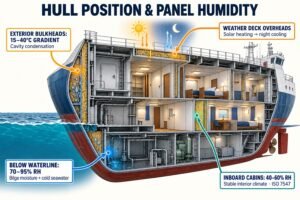
Cold ship cabins cause passenger discomfort, and condensation leads to hidden steel rust. You need proper panel insulation. Let me show you how thermal breaks solve this problem today.
Thermal breaks work in marine interior panel connections by inserting low-thermal-conductivity materials between metal joints. They completely block conductive heat transfer paths, prevent condensation, maintain cabin temperatures, and ensure fire ratings like B-15 or A-60 are met across continuous steel bulkheads and ceiling structures.
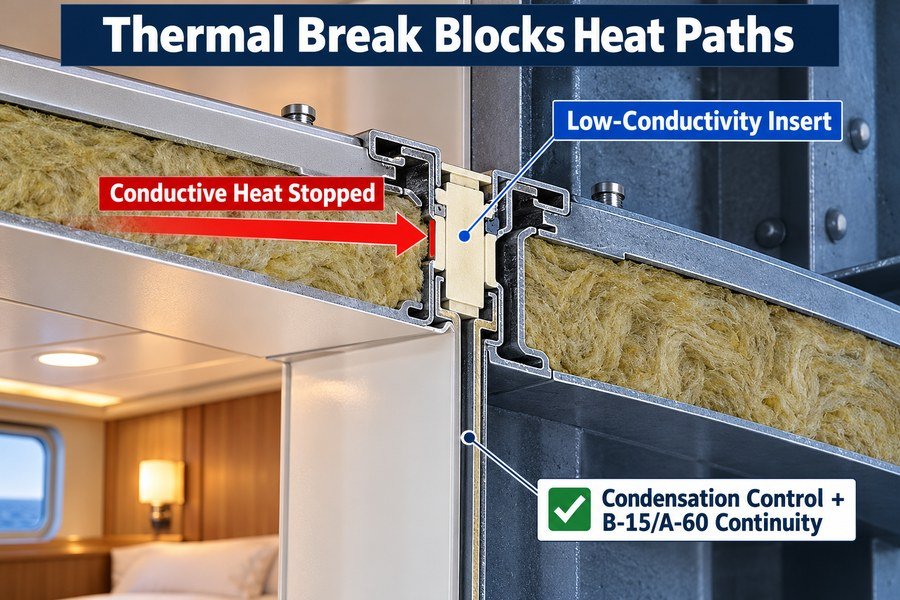
If you want to stop heat loss and pass strict shipyard inspections easily, you must understand how these small inserts work. Let us look at the details below.
What Is A Thermal Break In A Marine Bulkhead Connection?
Metal bulkheads transfer heat fast, wasting energy and failing shipyard comfort standards. You must stop this heat flow now. A thermal break is the simple fix you need.
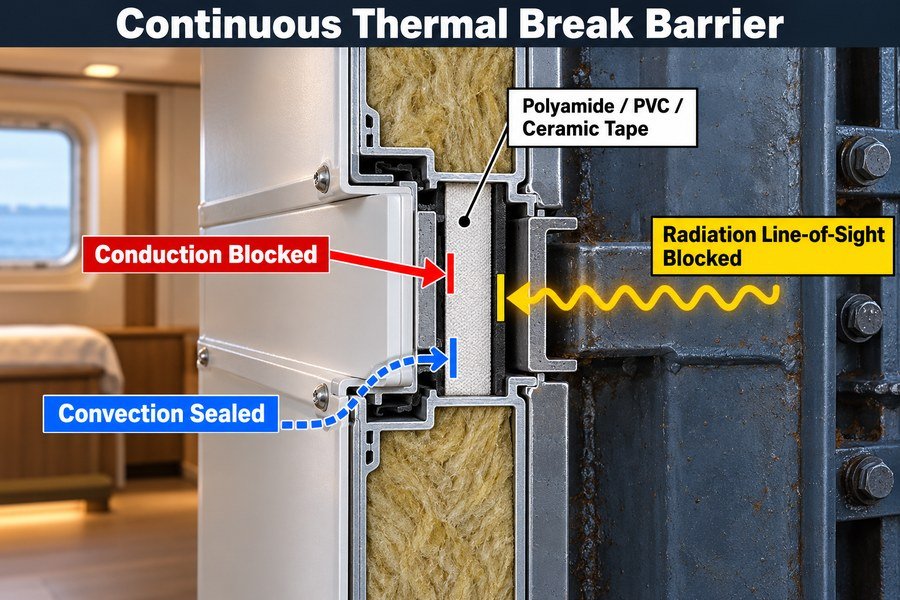
A thermal break in a marine bulkhead connection is a continuous barrier made of low-conductive materials like polyamide, PVC, or ceramic tape. It physically separates the inner and outer metal profiles, completely stopping the three types of heat flow: conduction, convection, and radiation across the joint.
Stopping Conduction Heat Transfer in Marine Bulkhead Joints
In my early days at the marine outfitting factory, we used direct steel-to-steel joints. We quickly learned this was a mistake. Heat moves through solid metal very fast. This process is called conduction. Standard steel conducts heat at a rate of 50 W/m·K1, according to MatWeb material property data. A thermal break stops this. We insert a piece of polyamide or PVC into the metal joint. Polyamide has a very low heat transfer rate of about 0.25 W/m·K2. When we place this barrier between the metal parts, the heat cannot pass through. Ceramic tape also works well for this. It physically separates the cold side from the hot side. This means the heat stops at the barrier. We see this daily at Magellan Marine. By cutting the metal path, we stop conduction completely.
Preventing Convection and Radiation in Panel Connections
A thermal break does more than just stop solid heat transfer. It also stops convection and radiation. Convection happens when hot air or cold air moves through small gaps in the bulkhead joint. When we install a PVC or polyamide thermal break, it seals the gap tightly. Because the gap is closed, the air cannot move. This stops convection heat loss. Next, we have radiation. Radiation is heat traveling across an empty space. A solid thermal break blocks the direct line of sight between the two metal profiles3. Ceramic tape is very dense and blocks this radiated heat perfectly. I always tell my clients to make sure the thermal break is continuous. If you miss a spot, heat will leak through convection or radiation.
| Heat Flow Type | How It Moves | How The Thermal Break Stops It | Material Example |
|---|---|---|---|
| Conduction | Through solid metal contact | Creates a low-conductivity physical barrier | Polyamide (PA66) |
| Convection | Air leaking through gaps | Seals the joint space tightly | PVC profiles |
| Radiation | Heat waves across empty space | Blocks the direct line of sight | Ceramic Tape |
How Do Inserts Interrupt Heat Flow In Marine Bulkhead H-Profiles?
Standard H-profiles leak heat quickly, making cabin climate control impossible and angering shipowners. You need a better panel joint. Specific inserts fix this by cutting the thermal bridge.
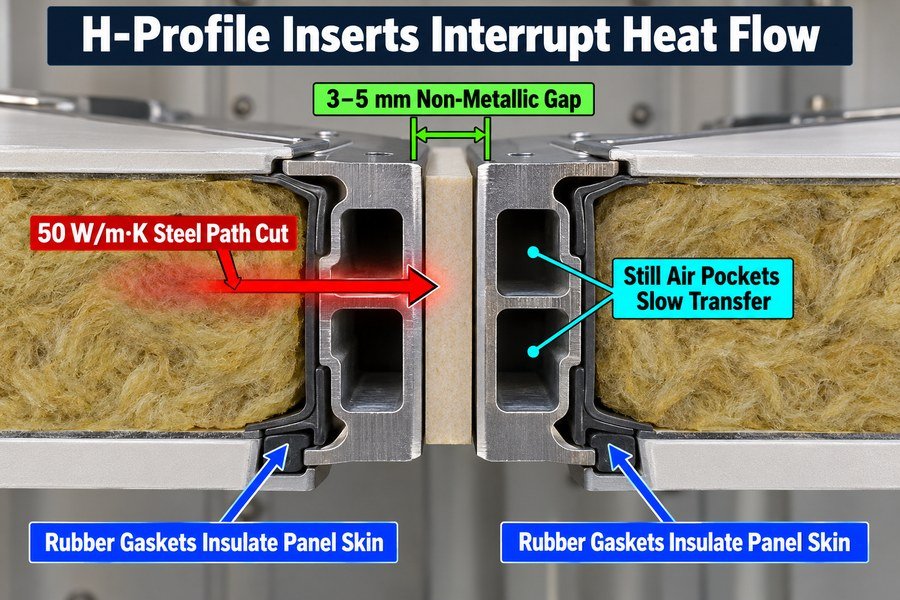
Inserts interrupt heat flow in marine bulkhead H-profiles by creating a 3-millimeter to 5-millimeter physical gap filled with non-metallic composite strips, rubber gaskets, or air pockets. This structural separation drops the thermal conductivity of the profile connection from 50 W/m·K down to 0.3 W/m·K.
Using Non-Metallic Composite Strips in H-Profiles
An H-profile connects two marine wall panels together. Standard H-profiles are made of one piece of steel or aluminum. This creates a bridge for heat to cross.4 To interrupt this heat flow, we cut the H-profile into two pieces and join them with non-metallic composite strips. I have solved many technical issues using these strips. A composite strip creates a physical gap between the two metal halves. This gap is usually 3-millimeter to 5-millimeter wide. The metal on the left does not touch the metal on the right. Because composite materials are very poor heat conductors5, the heat flow stops. According to ISO 8301 testing standards for thermal resistance, this separation drops the thermal conductivity of the connection from 50 W/m·K (for steel) down to about 0.3 W/m·K. This is a massive improvement for cabin insulation.
Applying Rubber Gaskets and Air Pockets for Heat Interruption
Besides hard composite strips, we also use rubber gaskets and air pockets inside the H-profile to interrupt heat. Rubber gaskets are placed on the inside edges of the H-profile where it grips the wall panel. These gaskets provide a 3-millimeter to 5-millimeter gap between the metal profile and the panel face. Rubber is an excellent insulator. It stops heat from moving from the panel skin into the H-profile metal frame. Also, the design of the insert often creates small, sealed air pockets inside the joint. Still air is one of the best insulators in the world.6 When the H-profile traps these air pockets, the heat cannot move across the gap easily. At Magellan Marine, we always recommend H-profiles that combine rubber gaskets, air pockets, and composite strips for the best results.
| Insert Type | Location in H-Profile | Gap Size Created | Primary Function |
|---|---|---|---|
| Composite Strips | Center of the H-profile | 3-mm to 5-mm | Joins two metal halves without transferring heat |
| Rubber Gaskets | Edges gripping the panel | 3-mm to 5-mm | Stops heat transfer from panel skin to metal frame |
| Air Pockets | Inside the sealed profile | Varies | Uses still air to slow down thermal transfer |
Why Are Thermal Breaks Needed On Marine Ceiling Hangers?
Steel hangers pull cold air directly from the steel deck above, causing water drops to ruin ceiling panels. Thermal breaks stop this costly water damage fast.
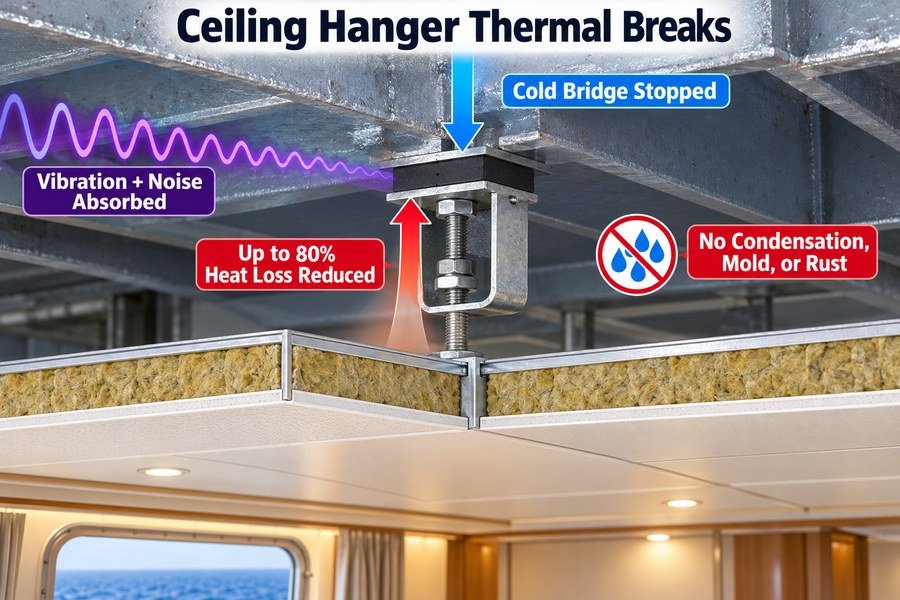
Thermal breaks are needed on marine ceiling hangers for three critical reasons: they prevent condensation that causes mold and rust, they stop 80% of heat loss through the deck, and they block structure-borne noise and vibrations from the ship engine reaching the passenger cabins.
Preventing Condensation and Heat Loss on Ceiling Hangers
Marine ceiling hangers connect the decorative ceiling panel to the bare steel deck above. The steel deck can get very cold. According to DNV GL winterization rules, external steel decks can reach -20°C in winter7. The cabin interior is kept around 22°C. Because steel conducts heat well, the hanger becomes just as cold as the deck. When the warm, moist cabin air hits the freezing steel hanger, condensation happens. Water drops form. This water ruins the ceiling panels, causes black mold, and creates hidden rust on the hanger. Thermal breaks stop this completely. We put a thermal break pad on the hanger. It stops the cold from traveling down. This prevents condensation, mold, and rust. Also, placing a thermal break on the hanger stops about 80% of the heat loss escaping through the deck. It keeps the warm air inside the cabin where it belongs.
Blocking Structure-Borne Noise and Engine Vibrations
The third reason you need thermal breaks on ceiling hangers is to block noise and vibration. A ship engine creates a lot of shaking. This shaking travels through the steel structure of the ship. We call this structure-borne noise. The International Maritime Organization (IMO) noise code limits passenger cabin noise to 55 dB(A)8. If you bolt a metal hanger directly to the steel deck, the engine vibration travels right into the ceiling panel. The ceiling panel acts like a drum and makes the cabin very noisy. The thermal break acts as a shock absorber. When we use a rubber or dense polyamide thermal break pad on the hanger, it absorbs the shaking. The vibration stops at the pad. This simple part can reduce the noise in the cabin by 5 dB to 10 dB9. It makes the room much quieter for the passengers.
| Benefit of Ceiling Thermal Break | The Problem It Solves | Impact on Cabin Quality |
|---|---|---|
| Prevents Condensation | Water drops, mold, and hidden rust | Protects ceiling panels from water damage |
| Stops Heat Loss | 80% of heat escaping to the steel deck | Keeps the cabin warm and saves heating energy |
| Blocks Noise and Vibration | Engine shaking traveling to the ceiling | Reduces cabin noise by 5 dB to 10 dB |
What Are The Best Thermal Break Materials For B-15/A-60 Marine Interior Panels?
Using the wrong material will fail fire tests and cost your project a lot of money. You must choose materials that stop heat and survive fire.
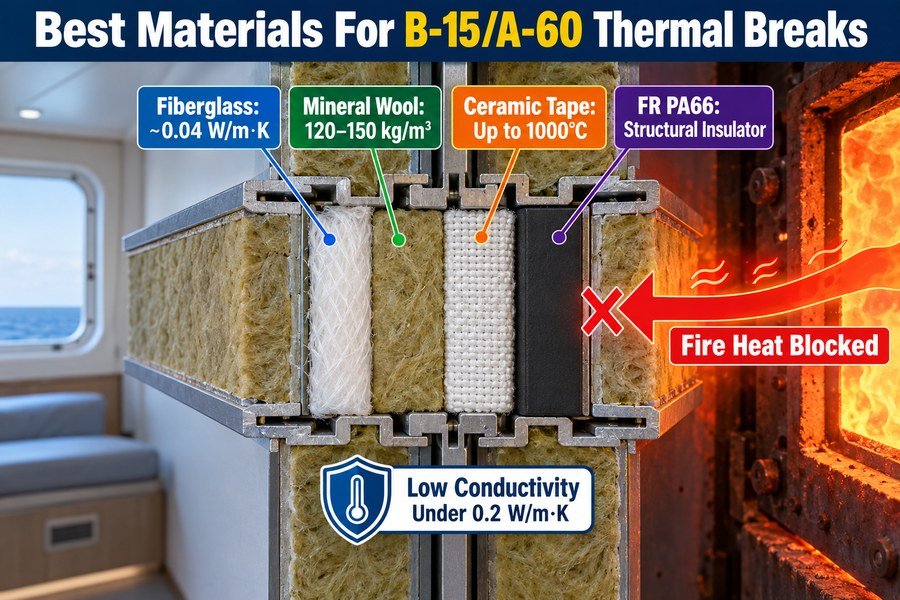
The best thermal break materials for B-15 and A-60 marine interior panels are fiberglass strips, high-density mineral wool, ceramic fiber tape, and flame-retardant polyamide (PA66). These four materials offer low thermal conductivity under 0.2 W/m·K and endure temperatures from 800°C to 1000°C without melting.
Using Fiberglass Strips and Mineral Wool for B-15/A-60 Panels
When you build B-15 or A-60 fire-rated panels, the thermal break must survive extreme heat. A B-15 rating means the panel must stop fire for 15 minutes, and an A-60 rating means it must stop fire for 60 minutes. According to the SOLAS Fire Test Procedures (FTP) Code, the furnace temperature reaches about 800°C for B-15 and 945°C for A-60 tests. Fiberglass strips are great for this. They do not burn easily and have a very low thermal conductivity of about 0.04 W/m·K10. They keep their shape during a fire. We also use high-density mineral wool. For marine use, we need a density of 120 kg/m3 to 150 kg/m3. Mineral wool stops heat transfer in normal use and acts as a strong fire block during an emergency. In my work at Magellan Marine, we pack mineral wool inside the metal joints to ensure the fire cannot pass through the gaps.
Applying Ceramic Fiber Tape and Polyamide PA66
Ceramic fiber tape is another excellent material for thermal breaks. It is very thin but incredibly strong against heat. Ceramic fiber can survive temperatures up to 1000°C without melting or breaking down11. We use this tape between metal profiles where space is very small. It stops the heat from crossing the metal joint. Finally, we use flame-retardant polyamide, also known as PA66. Regular plastic will melt and drip in a fire. This is very dangerous. But flame-retardant PA66 includes special chemicals that stop it from burning. It has a thermal conductivity of about 0.2 W/m·K. We use PA66 for structural joints because it is hard and can hold screws tightly while stopping heat transfer. All four of these materials are tested and proven for B-15 and A-60 systems.
| Thermal Break Material | Thermal Conductivity | Maximum Fire Temperature | Best Use Case |
|---|---|---|---|
| Fiberglass Strips | ~0.04 W/m·K | 800°C+ | Fire-safe panel edge strips |
| High-Density Mineral Wool | ~0.03 W/m·K | 1000°C | Packing inside hollow metal joints |
| Ceramic Fiber Tape | ~0.06 W/m·K | 1000°C+ | Thin gaps between metal profiles |
| Flame-Retardant PA66 | ~0.20 W/m·K | Varies (self-extinguishing) | Structural parts holding screws |
How Much Do Thermal Breaks Improve Marine Lining Insulation?
High energy bills eat your project profits quickly. You need to prove insulation value to your demanding clients. Thermal breaks deliver massive and measurable heat savings.
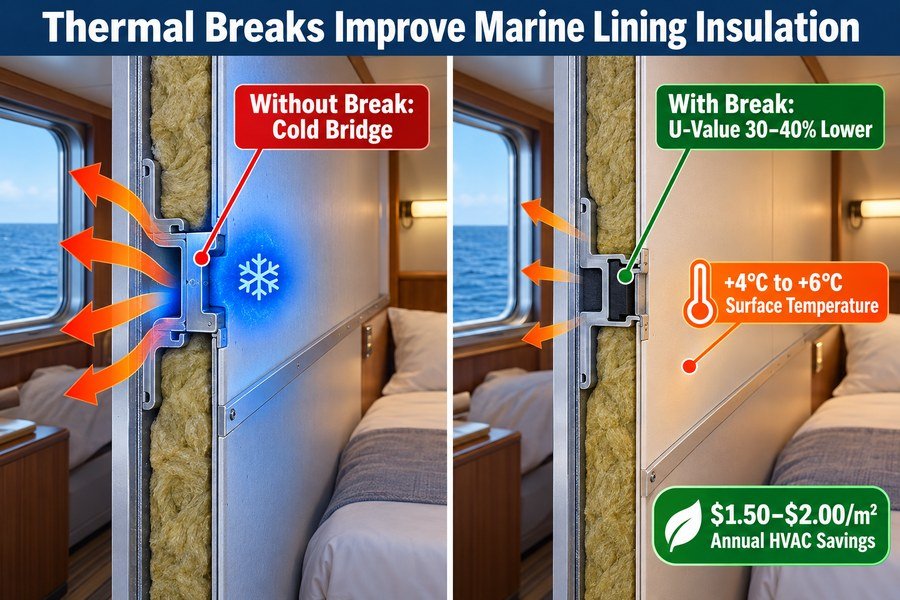
Thermal breaks improve marine lining insulation by reducing the overall U-value by 30% to 40%. Specifically, they cut energy waste by saving approximately $1.50 to $2.00 per square meter annually in HVAC costs, and they raise the interior wall surface temperature by 4°C to 6°C in winter.
Reducing U-Value and Cutting HVAC Costs in Marine Linings
When clients ask me how much thermal breaks actually help, I always point to the numbers. The U-value measures how much heat goes through a wall. A lower U-value is better. By adding a simple thermal break to the metal joints, you can reduce the overall U-value of the marine lining by 30% to 40%12. This is a huge drop. Because less heat escapes, the ship's heating, ventilation, and air conditioning (HVAC) system does not have to work as hard. According to marine HVAC design guidelines from ASHRAE, this energy efficiency saves real money. It saves approximately $1.50 to $2.00 per square meter every year in HVAC energy costs.13 If you are outfitting a cruise ship with 10,000 square meters of wall panels, that small thermal break saves the shipowner $15,000 to $20,000 every single year. This is a powerful selling point you can use with your shipyard clients.
Raising Surface Temperatures to Prevent Winter Cold Spots
Thermal breaks also improve the physical comfort inside the room. In winter, a standard metal panel joint acts like a cold bridge. It pulls the cold from outside right into the room. If you touch the wall near the joint, it feels like ice. This makes passengers very unhappy. When you install a thermal break, it cuts that cold bridge. This action raises the interior wall surface temperature by 4°C to 6°C14. Instead of the wall joint feeling cold, it feels like normal room temperature. This difference of 4°C to 6°C stops cold spots in the cabin. It also ensures that the air near the wall stays warm, which stops the condensation we talked about earlier. The insulation improvement is not just about saving energy; it is about creating a high-quality, comfortable cabin for the end user.
| Insulation Metric | Without Thermal Break | With Thermal Break | Improvement Amount |
|---|---|---|---|
| U-Value Reduction | Base Value | Much Lower | 30% to 40% better |
| Annual HVAC Cost Savings | High Energy Waste | Lower Energy Use | $1.50 to $2.00 per sq. meter |
| Interior Surface Temperature | Cold near joints | Warm and even | Raised by 4°C to 6°C |
Where Should Thermal Breaks Be Placed In Marine Bulkhead Joints?
Putting thermal breaks in the wrong place wastes time and ruins the fire rating. You must install them exactly where heat transfers most rapidly.
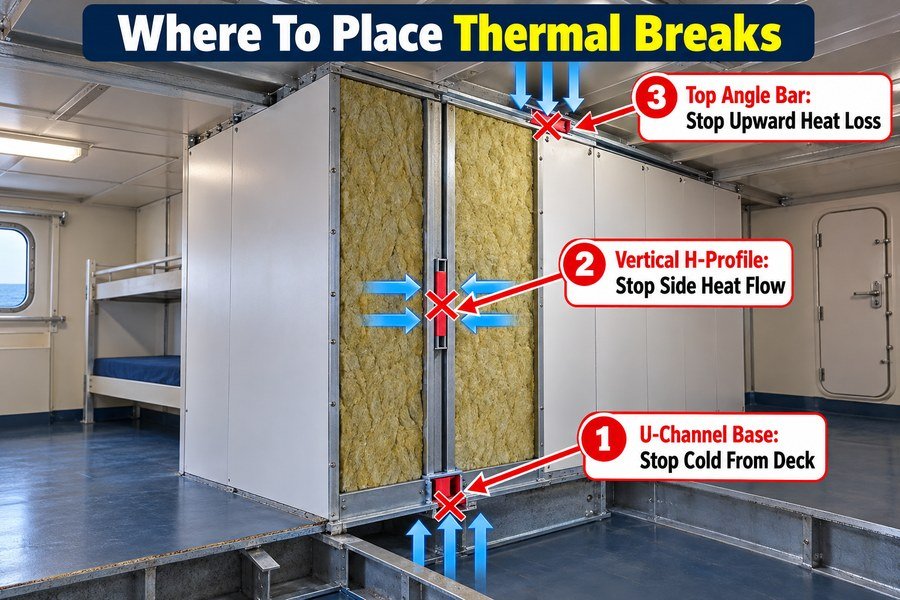
Thermal breaks should be placed in marine bulkhead joints at three specific locations: between the core insulation and the steel U-channel base, inside the vertical H-profile connecting two panels, and at the top angle bar where the bulkhead meets the deck ceiling structure.
Placing Thermal Breaks at the Steel U-Channel Base and H-Profile
To get the best results, you must put the thermal breaks in the correct places. First, look at the floor. The marine wall panel sits inside a steel U-channel base on the deck. The steel deck conducts cold.15 You must place a thermal break strip between the core insulation of the panel and the steel U-channel base. This stops the cold from creeping up from the floor into the wall panel. Second, you must look at the vertical joints. When you connect two wall panels side by side, you use a vertical H-profile. As we discussed earlier, you must place the thermal break inside the vertical H-profile. This is usually a PA66 strip or rubber gasket that separates the inner metal frame from the outer metal frame. By placing breaks at the floor base and the vertical panel connections, you block the two biggest paths for heat loss in the room.
Installing Thermal Breaks at the Top Angle Bar Connection
The third critical location is the ceiling connection. The top of the marine bulkhead meets the ship's upper deck structure using a top angle bar. This angle bar is made of solid steel and bolted to the deck. If you do not insulate this area, heat will fly out through the roof. You must install a thermal break between the top of the wall panel and the top angle bar. We usually use a strip of ceramic fiber tape or hard mineral wool16 here. It must be strong enough to hold the panel tight, but thick enough to stop the heat. When I supervise installations for Magellan Marine, I check these three locations carefully. If you miss the U-channel base, the vertical H-profile, or the top angle bar, the whole insulation system will fail. You must cover all three.
| Placement Location | Where It Is Found | What It Achieves |
|---|---|---|
| Steel U-Channel Base | Floor level | Stops cold coming up from the steel deck into the wall |
| Vertical H-Profile | Between two wall panels | Stops heat moving sideways between rooms |
| Top Angle Bar | Ceiling level | Stops heat escaping upward into the upper deck structure |
Conclusion
Thermal breaks are essential for marine interior panels. They block heat conduction, stop condensation, and save HVAC energy costs. Use the right materials and place them correctly to succeed in shipbuilding.
-
"Thermal conductivity of selected materials", https://nvlpubs.nist.gov/nistpubs/legacy/nsrds/nbsnsrds8.pdf. Engineering reference data list carbon and alloy steels with thermal conductivities on the order of tens of W/m·K, commonly near 50 W/m·K at room temperature, supporting the stated magnitude for standard steel. Evidence role: statistic; source type: education. Supports: Standard steel conducts heat at a rate of 50 W/m·K.. Scope note: The exact value varies by steel grade, temperature, and heat treatment; a single value should be treated as representative rather than universal. ↩
-
"Effect of different fillers on thermal conductivity, tribological ...", https://pmc.ncbi.nlm.nih.gov/articles/PMC9842670/. Polyamide material-property references report thermal conductivity values around 0.2–0.3 W/m·K, supporting its use as a low-conductivity insert relative to steel. Evidence role: statistic; source type: research. Supports: Polyamide has a very low heat transfer rate of about 0.25 W/m·K.. Scope note: Values differ among PA grades, fillers, moisture content, and test conditions; the figure is an approximate range value. ↩
-
"THERMAL RADIATION HEAT TRANSFER", https://ntrs.nasa.gov/api/citations/19710021465/downloads/19710021465.pdf. Radiative heat-transfer theory uses view factors to quantify energy exchange between surfaces, so inserting an opaque barrier that interrupts the view between surfaces can reduce direct radiative exchange. Evidence role: mechanism; source type: education. Supports: A solid thermal break blocks the direct line of sight between the two metal profiles.. Scope note: This supports the line-of-sight mechanism generally; it does not prove that any specific ceramic tape blocks radiation perfectly or addresses conduction through the barrier. ↩
-
"Wall Framing: Advanced Framing and Top Plates", https://bsesc.energy.gov/energy-basics/framing-wall-framing-advanced-framing-and-top-plates. A building-science or government energy-efficiency source should substantiate that continuous metal components can act as thermal bridges by providing a high-conductivity path through otherwise insulated assemblies. Evidence role: mechanism; source type: government. Supports: A one-piece steel or aluminum H-profile can create a thermal bridge between marine wall panels.. Scope note: Such sources would support the general heat-transfer mechanism, not necessarily the exact performance of this specific marine H-profile. ↩
-
"Thermal conductivity characterization of composite materials", https://researchrepository.wvu.edu/cgi/viewcontent.cgi?article=2718&context=etd. A peer-reviewed materials source should document that common non-metallic composites, such as fiber-reinforced polymers, generally have much lower thermal conductivity than metals used in structural profiles. Evidence role: general_support; source type: paper. Supports: Non-metallic composite strips can reduce conductive heat transfer because they are much less thermally conductive than metals.. Scope note: Thermal conductivity varies widely by resin, fiber type, fiber orientation, filler content, and test temperature, so the source would support the general comparison rather than every composite strip design. ↩
-
"Research on Thermal Insulation Performance and Impact on ...", https://pmc.ncbi.nlm.nih.gov/articles/PMC10419949/. A building-physics or heat-transfer source should support that stagnant air has low thermal conductivity and that many insulation systems reduce heat transfer by trapping air or other gases in small pockets. Evidence role: mechanism; source type: education. Supports: Sealed still-air pockets can reduce heat transfer in an H-profile joint because stagnant air has low thermal conductivity.. Scope note: The phrase "one of the best" is qualitative; trapped air reduces conduction and convection only when the pockets are sufficiently small and sealed, and it is not superior to all specialized insulation materials or vacuum systems. ↩
-
"A discussion on the implementation of the Polar Code ... - PMC", https://pmc.ncbi.nlm.nih.gov/articles/PMC9002038/. DNV winterization guidance uses low ambient-temperature design assumptions for vessels operating in cold climates, providing contextual support for the statement that exposed steel structures may be designed for temperatures around -20°C under specified winterization conditions. Evidence role: statistic; source type: institution. Supports: DNV GL winterization rules indicate that external steel decks can reach or be designed for approximately -20°C in winter conditions.. Scope note: The temperature applies to particular class notations, service areas, or design assumptions and is not a universal value for all ships or winter conditions. ↩
-
"What Are Cabin Noise Level Standards on Ships?", https://magellanmarinetech.com/what-are-cabin-noise-level-standards-on-ships/. The IMO Code on Noise Levels on Board Ships specifies maximum A-weighted sound pressure levels for ship accommodation spaces, including passenger cabins, supporting the stated cabin-noise limit when the cited ship type and code applicability match. Evidence role: expert_consensus; source type: institution. Supports: The IMO noise code limits passenger cabin noise to 55 dB(A).. Scope note: The exact limit may depend on vessel type, ship size, construction date, and whether the IMO noise code is mandatory for the vessel in question. ↩
-
"DETERMINATION OF ISOLATOR TRANSFER MATRIX AND ...", https://uknowledge.uky.edu/cgi/viewcontent.cgi?article=1074&context=me_etds. Research on resilient mounts and elastomeric isolators for structure-borne vibration shows that compliant isolation elements can reduce transmitted vibration and related radiated noise, with measured insertion losses sometimes falling in the 5-10 dB range under specific frequencies and installation conditions. Evidence role: statistic; source type: paper. Supports: A rubber or dense polyamide thermal break pad on a ceiling hanger can reduce cabin noise by 5 dB to 10 dB.. Scope note: A 5-10 dB cabin-noise reduction is application-specific and should not be treated as guaranteed without test data for the actual hanger, ceiling panel, vessel structure, and vibration spectrum. ↩
-
"Thermal Conductivity", http://hyperphysics.phy-astr.gsu.edu/hbase/Tables/thrcn.html. Reference data for glass-fibre insulation report thermal conductivity values in the approximate range of 0.03-0.05 W/m·K at ordinary temperatures, supporting the use of about 0.04 W/m·K as a typical order-of-magnitude value. Evidence role: statistic; source type: education. Supports: Fiberglass strips can have thermal conductivity of about 0.04 W/m·K.. Scope note: Thermal conductivity varies with fibre type, binder, density, temperature, and moisture; a generic value does not prove the performance of a specific fiberglass strip in a fire-rated panel assembly. ↩
-
"Ceramic Fiber Blanket Temperature Grades :1000°C to 1400°C ...", https://www.highlandrefractory.com/ceramic-fiber-blanket-temperature-grades.html. Technical and occupational-health references on refractory ceramic fibres describe them as high-temperature insulation materials used at service temperatures around 1000°C or above, supporting their suitability for thermal-break applications exposed to severe heat. Evidence role: mechanism; source type: government. Supports: Ceramic fiber materials can tolerate service temperatures up to about 1000°C.. Scope note: The cited temperature capability applies to specified refractory ceramic fibre grades and service conditions; it does not by itself demonstrate mechanical integrity or certification in a specific B-15 or A-60 joint design. ↩
-
"exploration and minimization of thermal bridging", https://repositories.lib.utexas.edu/bitstreams/be880dc5-3c32-4bd0-be5e-ea1e2740b726/download. A peer-reviewed thermal-bridging or panel-assembly study can support that introducing thermal breaks in metal joints or framing can substantially reduce overall thermal transmittance; the cited percentage should be treated as assembly-specific unless the source evaluates the same marine lining construction. Evidence role: statistic; source type: paper. Supports: Adding thermal breaks to metal joints can reduce the overall U-value of a marine lining by 30% to 40%.. Scope note: The 30%-40% figure is likely dependent on joint geometry, insulation thickness, metal conductivity, and test or simulation conditions. ↩
-
"ANSI/ASHRAE/IES Standard 90.1-2019", https://www.energycodes.gov/sites/default/files/2021-07/Standard_90.1-2019_Final_Determination_TSD.pdf. An HVAC energy-modeling source can document that envelope U-values affect heating and cooling loads and can be converted into annual energy-cost savings; the stated dollar-per-square-meter range requires assumptions about climate, operating schedule, energy prices, and HVAC efficiency. Evidence role: statistic; source type: institution. Supports: Thermal breaks that lower heat transfer can save approximately $1.50 to $2.00 per square meter per year in HVAC energy costs.. Scope note: A general HVAC guideline would support the calculation method, not necessarily this exact savings range for every ship or route. ↩
-
"Thermal Breaks for Steel Framing: How to Prevent ...", https://www.linkedin.com/pulse/thermal-breaks-steel-framing-how-prevent-h7smc. A thermal-bridge analysis or hygrothermal standard can support that reducing conductive bridging increases interior surface temperatures and lowers condensation risk; a 4°C-6°C increase should be cited only from a source with comparable boundary conditions and construction details. Evidence role: mechanism; source type: paper. Supports: Installing a thermal break can raise the interior wall surface temperature by 4°C to 6°C.. Scope note: The temperature increase varies with outdoor temperature, indoor humidity, material conductivity, insulation level, and joint geometry. ↩
-
"Thermal conductivity of selected materials", https://nvlpubs.nist.gov/nistpubs/legacy/nsrds/nbsnsrds8.pdf. Reference data on material thermal conductivity show that carbon steel has much higher thermal conductivity than common insulation materials, supporting the statement that an unbroken steel deck can act as a conductive heat-transfer path. Evidence role: mechanism; source type: encyclopedia. Supports: A steel deck can conduct heat or cold into adjacent wall components.. Scope note: The source would support steel's conductive properties generally, not the exact heat-flow rate in this specific marine wall assembly. ↩
-
"Thermal conductivity measurements and modeling of ...", https://www.sandia.gov/research/publications/details/thermal-conductivity-measurements-and-modeling-of-ceramic-fiber-insulation-2019-02-01/. Materials references and fire-safety guidance describe ceramic fiber and mineral wool as low-thermal-conductivity, heat-resistant insulation materials, supporting their use as insulating separators at high-temperature or fire-rated junctions. Evidence role: general_support; source type: institution. Supports: Ceramic fiber tape or hard mineral wool can serve as insulating materials at the top angle bar connection.. Scope note: The source would support the insulating properties of these materials generally, not certify a specific marine bulkhead installation design or load-bearing capacity. ↩