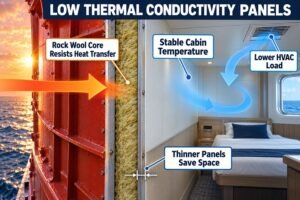
Struggling with vessel refits? Heavy panels can ruin your project. You need to know how weight limits dictate your marine interior panel choices to avoid costly delays and unhappy clients.
Weight limits strictly dictate marine interior panel selection during refurbishments by restricting total mass, affecting stability, altering material choices, and limiting structural loads. Exceeding these limits forces costly redesigns, compromises IMO safety standards, and reduces the vessel's payload capacity, making lightweight core materials mandatory for older ships.
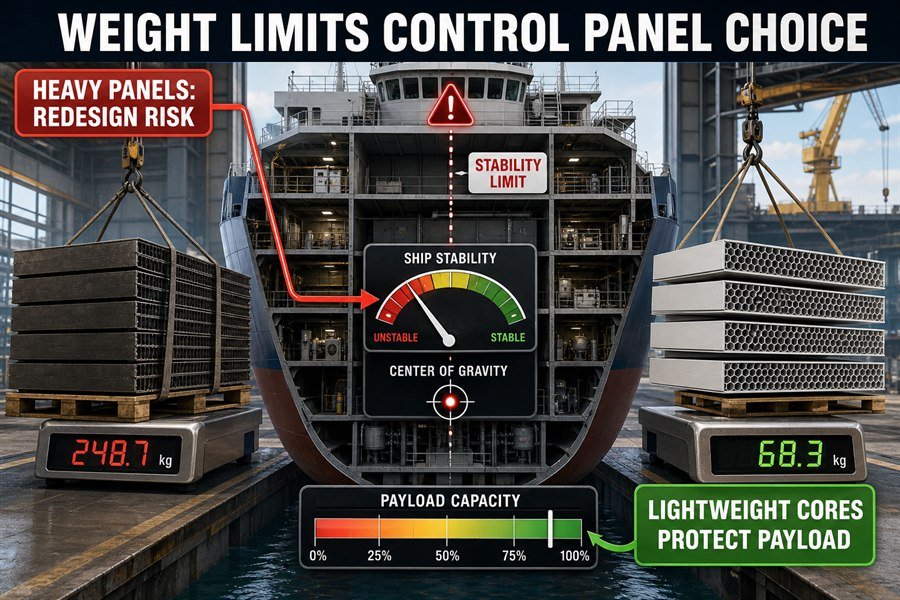
Let us look at why weight is the biggest challenge in your daily purchasing work and how you can solve it.
Why Is Weight Control Critical When Replacing Existing Marine Wall Panels?
Old ships have strict limits. Adding heavy panels causes failed inspections. You must control weight to keep the vessel safe, legal, and profitable for your shipyard clients in Europe.
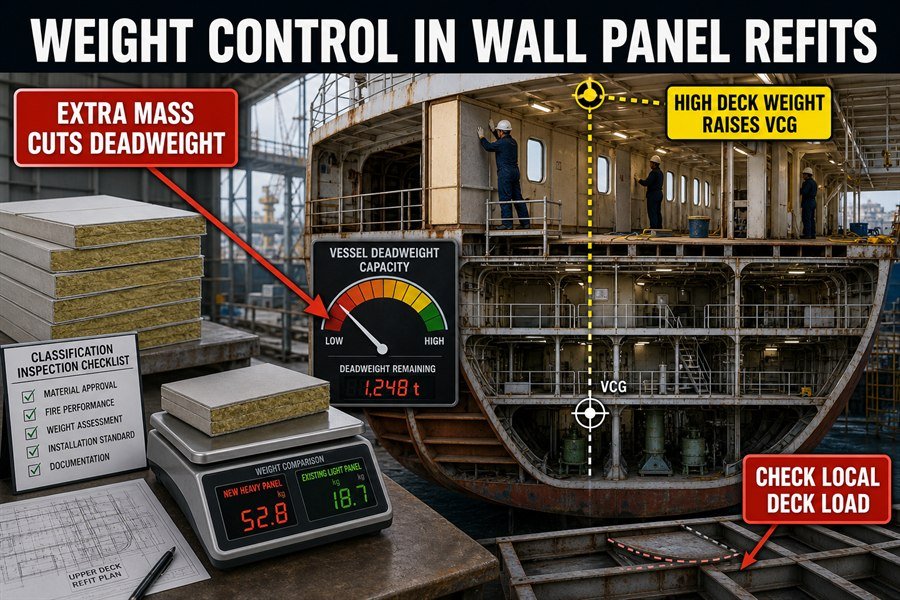
Weight control is critical because replacing existing marine wall panels impacts three main areas: compliance with deadweight limits, maintaining original center of gravity, and avoiding structural overload. Failing to manage these factors leads to SOLAS violations, reduced cargo capacity, and immediate rejection by classification societies.
I remember a project in 2019 where a buyer ignored the weight specs. They bought standard panels because the price was very low. The shipyard installed them, but the ship failed the final inspection. The buyer lost a lot of money. You must understand the three key areas of weight control to avoid this mistake.
Compliance with Deadweight Limits in Ship Refits
Every ship has a maximum allowed weight. This is the deadweight tonnage. Over a 20-year lifespan, a ship naturally gains weight. Paint layers build up. Equipment gets added. The International Maritime Organization (IMO) notes that ships often gain 1 to 2 percent of their lightship weight over time.1 When you buy replacement panels, you have a very small weight budget. If you remove old panels that weigh 14 kg/m2, you cannot install new panels that weigh 18 kg/m2. The extra weight adds up across hundreds of cabins. This extra mass cuts into the ship's cargo capacity.2 A ship that carries less cargo makes less money. Your shipyard clients will reject your materials if they reduce the ship's earning power.
Maintaining Original Center of Gravity
The center of gravity is crucial for a ship. Older ships already have a fixed center of gravity. If you put heavier panels on the upper decks, you raise this center point. This makes the ship top-heavy.3 Classification societies like DNV and ABS are very strict about this. They check the vertical center of gravity during refits. If your panels push this number too high, the ship becomes unsafe.
Avoiding Structural Overload on Deck Plates
Ship decks have specific load limits. A standard passenger cabin deck might have a load limit of 2.5 to 5.0 kN/m2.4 If you buy heavy steel-faced rockwool panels, you might exceed this local limit. The deck plates can bend. You must check the load limits of the specific ship area before you issue a purchase order.
| Refit Weight Factor | Metric Affected | Consequence of Heavy Panels | Allowable Change Limit (Typical) |
|---|---|---|---|
| Deadweight Limits | Lightship Weight | Reduced cargo capacity and lost revenue | Less than 2% of original lightship |
| Center of Gravity | VCG (Vertical Center) | Ship becomes top-heavy and unstable | Strict adherence to original VCG |
| Structural Overload | Local Deck Load (kN/m2) | Deck plates bend or require reinforcement | Must not exceed original design load |
How Do Replacement Marine Accommodation Panels Impact Vessel Stability Calculations?
Worried about safety approvals? Heavy accommodation panels change how a ship floats. You need to understand stability calculations to pass strict DNV and ABS class surveys every time.
Replacement marine accommodation panels directly impact vessel stability calculations by altering three key metrics: the transverse metacentric height (GM), the vertical center of gravity (KG), and the heeling moment. Heavier panels on upper decks raise the KG, reduce the GM, and increase rollover risks under IMO regulations.
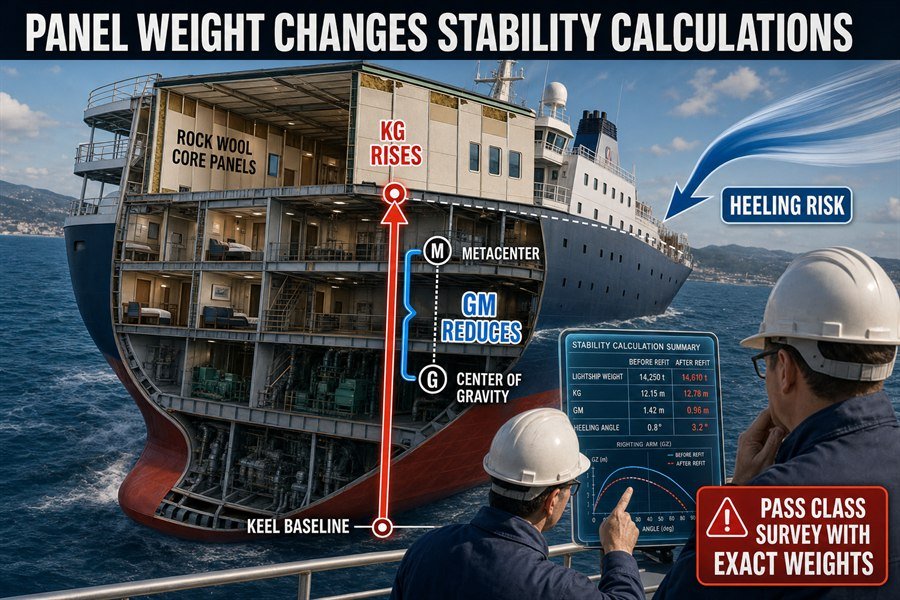
Many buyers think interior panels are just decoration. This is wrong. The panels you buy directly affect the math that keeps the ship upright. You must provide exact panel weights to the shipyard engineers. Let us break down the three stability metrics you need to know.
Altering Transverse Metacentric Height (GM)
The transverse metacentric height is known as GM. It measures the initial stability of the ship.5 A larger GM means the ship is very stable and returns to an upright position quickly. A small GM means the ship rolls slowly and might capsize. The IMO Intact Stability Code requires passenger ships to have a minimum initial GM of 0.15 meters6. When you buy heavy panels for a refit, the extra weight lowers the GM. If you drop the GM below 0.15 meters, the shipyard cannot get a safety certificate. They will return your products.
Raising the Vertical Center of Gravity (KG)
KG is the distance from the keel to the center of gravity. We talked about this earlier, but here is the exact math. If you replace 5,000 square meters of B-15 panels on deck 6, the weight matters. A standard rockwool panel weighs about 16 kg/m2. If you switch to a cheap, heavy 20 kg/m2 panel, you add 20,000 kg (20 tons) of weight high up on the ship. This immediately raises the KG. A higher KG directly reduces the GM.7 This is a very bad situation for a refit project.
Increasing the Heeling Moment in Wind
The heeling moment is the force that pushes a ship to the side. Wind is a big factor here. Ships must stay stable when strong winds hit their sides. The IMO rules state that a ship must not heel more than 10 degrees under a steady wind8. If your heavy panels raise the KG, the ship loses its ability to fight the wind. The heeling moment becomes too strong. The ship will tilt too far.
| Stability Metric | Definition | IMO Minimum Requirement | Impact of Heavy Interior Panels |
|---|---|---|---|
| GM (Metacentric Height) | Initial stability measure | Minimum 0.15 meters | Decreases GM, reducing stability |
| KG (Vertical Center) | Height of center of gravity | Varies by ship design | Raises KG, causing top-heaviness |
| Heeling Angle | Tilt caused by wind or turns | Maximum 10 degrees in wind | Increases tilt angle past safe limits |
What Lightweight Marine Interior Panel Cores Suit Weight-Sensitive Ship Refits?
Need panels that meet fire codes but weigh less? Heavy rockwool is not your only choice. You must pick the right lightweight core to save tonnage and secure orders.
Three main lightweight marine interior panel cores suit weight-sensitive refits: aluminum honeycomb for extreme weight savings, aluminum corrugated core for structural rigidity, and low-density mineral wool for cost-effective fire ratings. These materials cut weight by up to 50 percent while maintaining mandatory A-class and B-class SOLAS fire certifications.
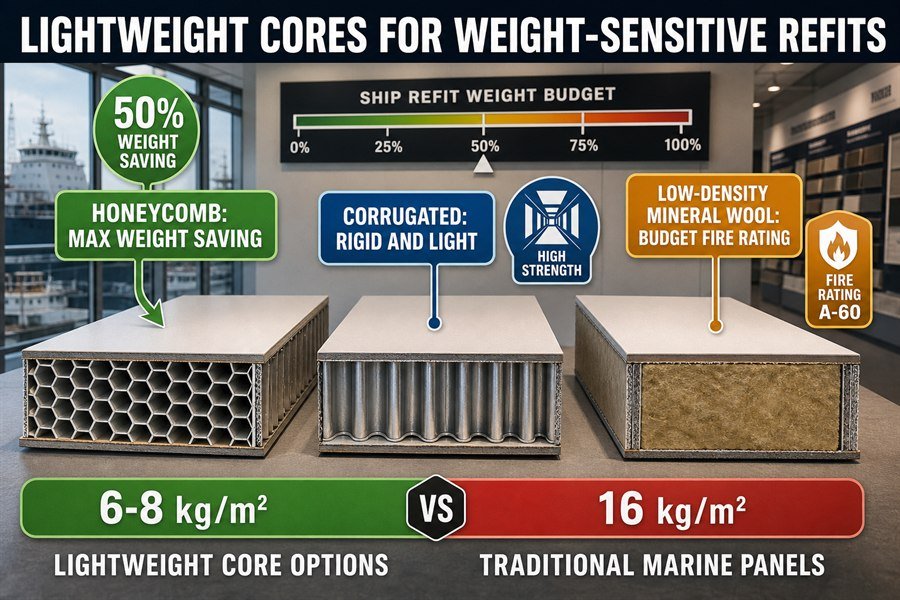
As a procurement officer, you balance price and quality daily. Asian suppliers offer many panel cores. You need to know which cores solve weight problems for your European and US clients. Here are the three best options.
Aluminum Honeycomb Cores for Extreme Weight Savings
Aluminum honeycomb is the ultimate choice for strict weight limits. These panels use a thin aluminum skin over a honeycomb structure. A standard B-15 rated aluminum honeycomb panel weighs only 6 to 8 kg/m29. Compare this to a 16 kg/m2 rockwool panel. You save 50 percent of the weight. I often recommend this for fast ferries and offshore platforms. The price is higher, often around $60 to $80 per square meter. But the massive weight savings easily justify the cost for critical refits.
Aluminum Corrugated Cores for Structural Rigidity
If honeycomb is too expensive, look at corrugated aluminum cores. These use a wavy aluminum sheet inside the panel. They weigh about 8 to 10 kg/m2. They offer excellent structural strength10. They do not bend easily. They are very good for high-traffic corridors. The price is usually in the middle, around $45 to $60 per square meter. They give you a great balance of low weight and high strength. They also pass B-15 fire tests without any issues.
Low-Density Mineral Wool Cores for Cost-Effective Fire Ratings
Sometimes your client has a tight budget but still needs to save weight. You can buy low-density mineral wool panels. Standard marine rockwool has a density of about 140 kg/m3. Low-density versions use a density of 100 to 120 kg/m3. A B-15 panel with this core weighs about 12 to 14 kg/m2. You save a few kilograms per meter. The best part is the price. These panels cost around $25 to $35 per square meter. They are cheap, they pass SOLAS fire tests11, and they help with minor weight problems.
| Panel Core Type | Average Weight (B-15 Rating) | Relative Cost | Best Use Case in Refits |
|---|---|---|---|
| Aluminum Honeycomb | 6 - 8 kg/m2 | High ($60-$80/sqm) | Extreme weight limits, fast ferries |
| Corrugated Aluminum | 8 - 10 kg/m2 | Medium ($45-$60/sqm) | High-traffic areas needing rigidity |
| Low-Density Mineral Wool | 12 - 14 kg/m2 | Low ($25-$35/sqm) | Budget-conscious, minor weight saves |
Why Do Newbuild Projects Allow More Flexible Marine Interior Panel Weight Budgets?
Wondering why new ships use heavy panels without issue? Refits are tight, but newbuilds are different. You can save money if you understand this weight flexibility.
Newbuild projects allow more flexible marine interior panel weight budgets because naval architects can adjust the hull design, increase the ship's beam for stability, and plan the center of gravity in advance. This allows the use of heavier, cheaper standard rockwool panels without violating IMO stability requirements.
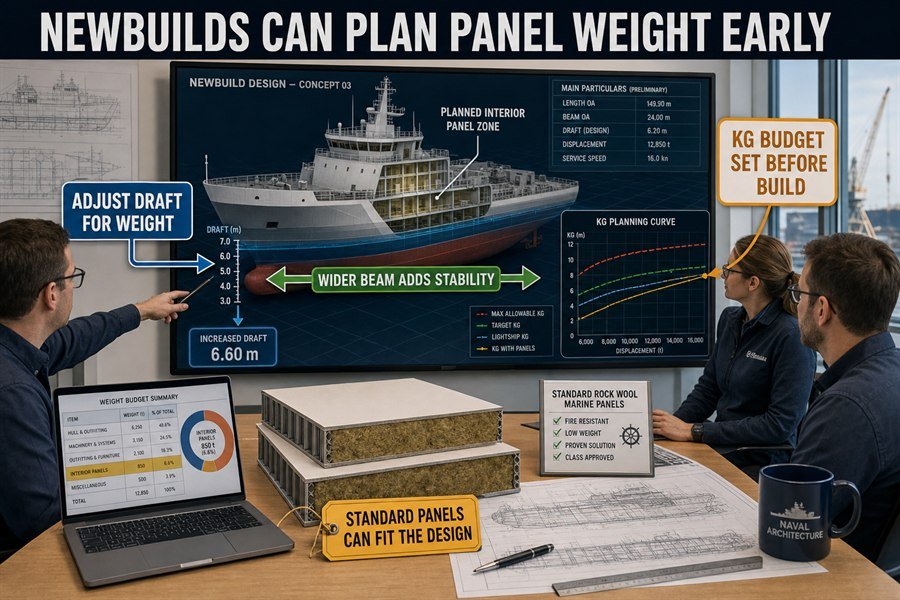
When you buy for a newbuild, your job is much easier. You do not have to fight the existing limits of an old ship. You can negotiate better prices with suppliers in China and Vietnam because you can accept heavier panels. Let us look at the three reasons why newbuilds give you this freedom.
Adjusting the Hull Design for Panel Weight
In a newbuild, the ship only exists on paper. If the interior decoration company wants to use a heavy A-60 wall panel that weighs 22 kg/m2, the naval architect simply changes the math. They can increase the ship's draft. The draft is how deep the ship sits in the water. A deeper draft allows the ship to carry more weight.12 The engineers design the hull volume to hold the exact weight of the cheap, heavy panels you bought.
Increasing the Ship's Beam for Stability
The beam is the width of the ship. Width is the biggest factor in stability. If heavy panels raise the vertical center of gravity, the engineers just make the ship wider. Adding even 0.5 meters to the ship's beam creates a massive increase in the GM (metacentric height).13 This extra width cancels out the top-heavy effect of standard interior panels. Because the shipyard fixes the stability with steel, you can buy cheaper interior products.
Planning the Center of Gravity in Advance
In a refit, you must guess the old weight. In a newbuild, a computer calculates everything. The builders know the exact KG (vertical center of gravity) before they cut the first piece of steel. They assign a specific weight budget to the interior outfitting department. Usually, they plan for standard 16 to 18 kg/m2 rockwool panels14. This means you do not have to hunt for expensive lightweight cores. You can buy high-quality, standard-weight panels at low prices, ensuring your profit margins stay high.
| Design Factor | Newbuild Flexibility | Refit Limitation | Impact on Purchasing |
|---|---|---|---|
| Hull Draft | Can be increased to support weight | Fixed by original hull shape | Can buy heavier, cheaper panels for newbuilds |
| Ship Beam (Width) | Can be widened for better stability | Fixed by original structure | No need for expensive honeycomb in newbuilds |
| Center of Gravity | Planned from day one in software | Unknown exact current state | Budgets are predictable for newbuild projects |
How Is Marine Wall Panel Weight Balanced Against Ferry Structural Limits?
Buying for a ferry project? Ferries carry many people and cars. You have to balance panel weight with strict deck load limits to pass inspections and win contracts.
Marine wall panel weight is balanced against ferry structural limits through three methods: calculating local deck point loads, using lightweight composite materials on upper passenger decks, and matching panel mass to vehicle load variations. This prevents structural deflection and ensures compliance with SOLAS passenger vessel rules.
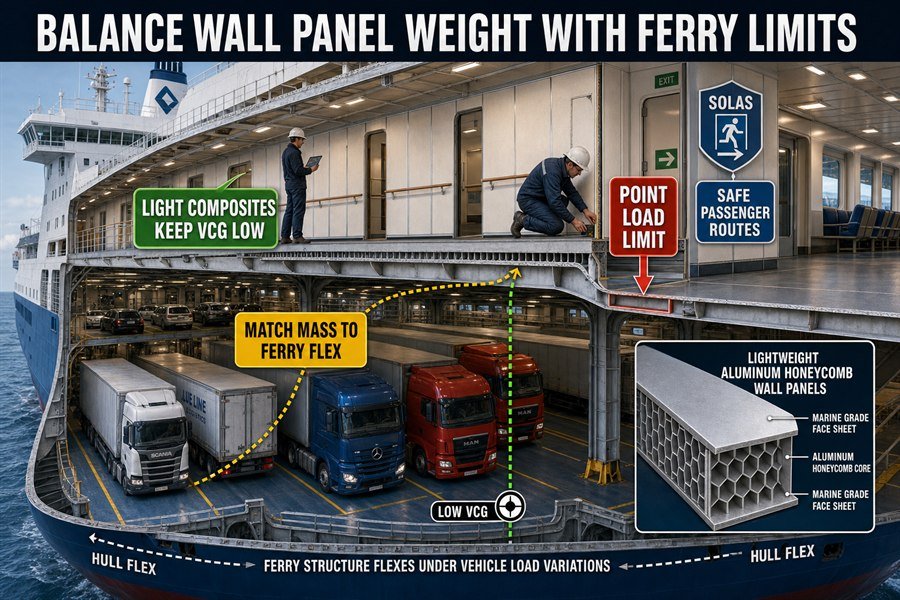
Ferries are unique. They have huge open spaces for cars and tall structures for passengers. A Ro-Ro passenger ferry has very strict weight rules. If you supply panels for a ferry refit, you must understand these three methods.
Calculating Local Deck Point Loads
Ferry decks are thin to save weight. The steel plates under the passenger cabins have strict load limits. A typical ferry passenger deck can only hold 2.5 to 3.0 kN/m215. When you install marine wall panels, the weight of the panel pushes down on a very small line of deck. This is a point load. If you use a heavy 20 kg/m2 steel panel, the point load might crack the welds on the thin deck. You must check the point load calculations provided by the shipyard before you buy.
Using Lightweight Composite Materials on Upper Decks
The top part of a ferry is called the superstructure. It is very tall. To keep the ferry from tipping over, builders often make the superstructure out of aluminum instead of steel16. If the structure is aluminum, you cannot install heavy steel panels inside it. It ruins the whole design. You must use lightweight composite panels here. Aluminum honeycomb panels are the standard choice17 for ferry superstructures. They match the low weight of the outer aluminum walls.
Matching Panel Mass to Vehicle Load Variations
A ferry changes weight every day. Sometimes it is full of heavy trucks. Sometimes it is empty. This constant change causes the ship's structure to bend and flex slightly18. Heavy, rigid panels can pop out of their tracks when the ship bends. You need panels that are light and have a little bit of flexibility. Matching the panel mass to the ship's movement keeps the walls intact. You should talk to your Asian suppliers about panel joint flexibility when buying for Ro-Ro ferries.
| Ferry Balancing Method | Problem Solved | Recommended Panel Type | SOLAS Requirement Focus |
|---|---|---|---|
| Point Load Calculation | Prevents thin deck bending | Panels under 14 kg/m2 | Structural integrity |
| Lightweight Composites | Keeps VCG low in tall ships | Aluminum Honeycomb | Intact stability for passengers |
| Load Variation Matching | Prevents panel joint cracking | Flexible joint systems | Safe evacuation routes |
Conclusion
Managing panel weight is vital for marine refits. By choosing the right lightweight cores and understanding stability rules, you can buy smart, pass inspections, and keep your shipyard clients completely satisfied.
-
"[PDF] RESOLUTION MSC.267(85) (adopted on 4 December 2008 ...", https://wwwcdn.imo.org/localresources/en/KnowledgeCentre/IndexofIMOResolutions/MSCResolutions/MSC.267(85).pdf. A maritime stability or IMO-related guidance source should be used to document that lightship weight can increase during a vessel’s service life and that such change is relevant to stability and loading calculations. Evidence role: statistic; source type: institution. Supports: Ships often gain 1 to 2 percent of their lightship weight over time.. Scope note: The specific 1–2% figure may vary by vessel type and operating history, so the source may support the general phenomenon more directly than the exact range. ↩
-
"[PDF] National Waterways Study 0. EvolUtion of the Vessels Engaged in ...", https://nmwrri.nmsu.edu/footer_pages/nm-wrri-library-database-files/wrri-library-pdfs/wrrilibrary5/005636.pdf. A naval architecture reference can support that increases in lightship weight reduce the remaining deadweight available for cargo, fuel, stores, or payload under a vessel’s displacement limits. Evidence role: mechanism; source type: education. Supports: Extra mass from replacement panels reduces available cargo capacity.. Scope note: This establishes the loading relationship generally; the commercial revenue effect depends on the ship’s trade and operating profile. ↩
-
"[PDF] Chapter 2 - Review of Intact Statical Stability - USNA", https://www.usna.edu/NAOE/_files/documents/Courses/EN455/EN455_Chapter2.pdf. A naval architecture or stability reference should support that adding weight high in a vessel raises the vertical center of gravity and can reduce stability by increasing top-heaviness. Evidence role: mechanism; source type: education. Supports: Adding heavier materials on upper decks raises the vessel’s vertical center of gravity and can make it more top-heavy.. Scope note: The degree of stability reduction depends on the amount and location of added weight and the vessel’s existing stability margin. ↩
-
"[PDF] resolution msc.143(77) - International Maritime Organization", https://wwwcdn.imo.org/localresources/en/KnowledgeCentre/IndexofIMOResolutions/MSCResolutions/MSC.143(77).pdf. A ship structural design standard, classification rule, or maritime accommodation design reference should be cited to show typical deck live-load ranges used for passenger or accommodation spaces. Evidence role: statistic; source type: institution. Supports: Passenger cabin decks may have typical load limits in the range of 2.5 to 5.0 kN/m².. Scope note: Deck load limits are design-specific and classification-society-specific; a typical range does not replace the approved drawings or rule calculations for a particular vessel. ↩
-
"[PDF] COURSE OBJECTIVES CHAPTER 4 4. STABILITY - USNA", https://www.usna.edu/NAOE/_files/documents/Courses/EN400/02.04%20Chapter%204.pdf. Naval-architecture references define transverse metacentric height (GM) as a measure of a vessel’s initial transverse stability for small angles of heel. Evidence role: definition; source type: education. Supports: Transverse metacentric height is the metric used to describe a ship’s initial stability.. ↩
-
"[PDF] RESOLUTION MSC.267(85) (adopted on 4 December 2008 ...", https://wwwcdn.imo.org/localresources/en/KnowledgeCentre/IndexofIMOResolutions/MSCResolutions/MSC.267(85).pdf. The IMO International Code on Intact Stability includes a minimum initial metacentric height criterion of 0.15 m among its general intact-stability criteria; the source should be checked for the vessel category and any applicable alternative criteria. Evidence role: expert_consensus; source type: institution. Supports: The IMO Intact Stability Code sets a minimum initial GM criterion of 0.15 meters.. Scope note: The 0.15 m value is part of a broader set of intact-stability criteria and may not be the only applicable passenger-ship requirement. ↩
-
"[PDF] COURSE OBJECTIVES CHAPTER 4 4. STABILITY - USNA", https://www.usna.edu/NAOE/_files/documents/Courses/EN400/02.04%20Chapter%204.pdf. Standard stability texts express metacentric height as GM = KM − KG, showing that, for a fixed metacentric height above keel (KM), an increase in vertical center of gravity (KG) reduces GM. Evidence role: mechanism; source type: education. Supports: Raising the ship’s vertical center of gravity reduces transverse metacentric height.. Scope note: The relationship assumes KM is unchanged or changes less significantly than KG for the loading change being discussed. ↩
-
"[PDF] RESOLUTION MSC.267(85) (adopted on 4 December 2008 ...", https://wwwcdn.imo.org/localresources/en/KnowledgeCentre/IndexofIMOResolutions/MSCResolutions/MSC.267(85).pdf. IMO intact-stability criteria include limits on allowable heel angles under specified external moments, but the exact 10-degree limit and whether it applies to steady wind depends on the vessel type and the particular criterion being applied. Evidence role: general_support; source type: institution. Supports: IMO stability rules impose limits on allowable heel angles under environmental or operational heeling moments.. Scope note: This source may support the existence of IMO heel-angle limits while requiring careful verification of whether the article’s 10-degree steady-wind formulation is exact. ↩
-
"What Are Aluminum Honeycomb Panels?", https://magellanmarinetech.com/what-are-aluminum-honeycomb-panels/. Published marine-panel specifications or classification documentation report typical mass-per-area values for B-15 aluminum honeycomb panels and can be used to contextualize the stated 6–8 kg/m² range. Evidence role: statistic; source type: institution. Supports: A standard B-15 rated aluminum honeycomb panel weighs about 6 to 8 kg/m².. Scope note: Mass varies by panel thickness, facing material, adhesive system, and certified fire-rating construction; one source may support a comparable rather than universal range. ↩
-
"Bending behavior of corrugated sandwich panels with various core ...", https://ui.adsabs.harvard.edu/abs/2025MTest..67..944E/abstract. Engineering literature on corrugated-core sandwich panels explains that corrugated geometries increase bending stiffness and load-bearing efficiency relative to flat sheets of similar mass. Evidence role: mechanism; source type: paper. Supports: Corrugated aluminum cores provide structural rigidity and resist bending in panel applications.. Scope note: This supports the structural principle of corrugated cores but does not prove the performance of every commercial marine panel design. ↩
-
"Which Fire Test Standards Apply to MED-Certified Marine ...", https://magellanmarinetech.com/which-fire-test-standards-apply-to-med-certified-marine-accommodation-panels/. IMO SOLAS and the Fire Test Procedures Code establish fire-test procedures and classification criteria for marine divisions such as B-class panels, supporting the regulatory context for claims about B-15 fire performance. Evidence role: definition; source type: institution. Supports: Marine panels must meet SOLAS/IMO fire-test requirements to be described as passing B-15 fire tests.. Scope note: The regulations define the test framework and acceptance criteria; they do not show that a particular low-density mineral-wool panel has passed unless a product-specific certificate is also cited. ↩
-
"[PDF] COURSE OBJECTIVES CHAPTER 2 2. HULL FORM AND ... - USNA", https://www.usna.edu/NAOE/_files/documents/Courses/EN400/02.02%20Chapter%202.pdf. Naval architecture references describe ship displacement as the weight of water displaced by the hull and explain that, for a given hull form, increasing draft generally increases displacement and carrying capacity. Evidence role: mechanism; source type: education. Supports: A deeper draft allows the ship to carry more weight.. Scope note: The relationship depends on the vessel’s hull geometry, load line limits, and regulatory constraints; it does not by itself prove that any specific newbuild can simply increase draft. ↩
-
"[PDF] RESOLUTION MSC.267(85) (adopted on 4 December 2008 ...", https://wwwcdn.imo.org/localresources/en/KnowledgeCentre/IndexofIMOResolutions/MSCResolutions/MSC.267(85).pdf. Naval architecture sources explain that transverse metacentric height is influenced by the waterplane moment of inertia, which increases strongly with beam, so a wider hull can improve initial transverse stability. Evidence role: mechanism; source type: education. Supports: Increasing a ship’s beam can increase metacentric height and improve stability.. Scope note: The cited principle supports the direction of the effect, but the size of the GM increase from an added 0.5 meters is vessel-specific and would require a design calculation. ↩
-
"How to choose the right marine wall panels for marine interior ...", https://magellanmarinetech.com/how-choose-right-marine-wall-panels-for-marine-interior-projects/. Technical literature on marine fire-rated sandwich or mineral-wool panels reports areal mass values in the same general range for some A-class interior panels, supporting the use of kilograms per square meter as a purchasing and weight-budget parameter. Evidence role: general_support; source type: research. Supports: Some standard marine rockwool interior panels have areal weights around 16 to 18 kg/m2.. Scope note: Panel weight varies by fire rating, facing material, thickness, manufacturer, and certification standard; neutral sources may support the range only as representative rather than universal. ↩
-
"[PDF] 2021 Seattle Building Code, Chapter 16, Structural Design", https://www.seattle.gov/documents/departments/sdci/codes/seattlebuildingcode/2021sbcchapter16.pdf. Classification-society design-load tables for accommodation or passenger spaces give uniformly distributed deck loads in the same order of magnitude, supporting the use of 2.5–3.0 kN/m² as a typical passenger-deck design range. Evidence role: statistic; source type: institution. Supports: A typical ferry passenger deck can only hold 2.5 to 3.0 kN/m².. Scope note: Deck load limits vary by flag, class rules, vessel design, and the specific deck area; this would support a typical range, not the allowable load for any particular ferry. ↩
-
"[PDF] Principles of Ship Performance Course Notes - USNA", https://www.usna.edu/NAOE/_files/documents/Courses/EN400/EN400_Course_Notes,_Summer_2020.pdf. Naval-architecture and marine-materials literature describes aluminum superstructures as a weight-saving measure that can reduce high-level mass and improve stability margins compared with steel construction. Evidence role: mechanism; source type: paper. Supports: Builders often use aluminum rather than steel in ferry superstructures to reduce top weight and help stability.. Scope note: Such sources support the engineering rationale for aluminum superstructures, but they may not prove that this is done on all or most ferries. ↩
-
"What Are Aluminum Honeycomb Panels?", https://magellanmarinetech.com/what-are-aluminum-honeycomb-panels/. Research and marine-engineering sources describe aluminum honeycomb sandwich panels as lightweight structural or interior panels used in ships because of their high stiffness-to-weight ratio, supporting their suitability for weight-sensitive ferry superstructures. Evidence role: general_support; source type: research. Supports: Aluminum honeycomb panels are commonly suitable for weight-sensitive ferry superstructure interiors.. Scope note: The evidence may demonstrate suitability and use, but it may not establish that aluminum honeycomb panels are the universal or dominant standard choice across the ferry industry. ↩
-
"[PDF] course objectives chapter 6 6. ship structures - USNA", https://www.usna.edu/NAOE/_files/documents/Courses/EN400/02.06%20Chapter%206.pdf. Naval-architecture references explain that changes in cargo or vehicle loading alter weight distribution and hull-girder shear forces and bending moments, which supports the statement that ferry structures can flex under varying load conditions. Evidence role: mechanism; source type: education. Supports: Daily changes in ferry vehicle loading can contribute to hull bending and slight structural flexing.. Scope note: This supports the structural-flexing mechanism in general; it does not directly prove that wall panels will fail or leave their tracks on a specific ferry. ↩