Are rejected marine accommodation panels delaying your ship interior project? Invalid certificates cause huge losses. I will show you exactly how to verify class certificates before you buy.
Buyers must verify six critical scope fields on a marine accommodation panel class certificate: the approved product type, fire rating range, core density and facing materials, application location (like engine rooms), maximum panel dimensions with joint systems, and the certificate's validity dates according to SOLAS and IMO FTP Code.
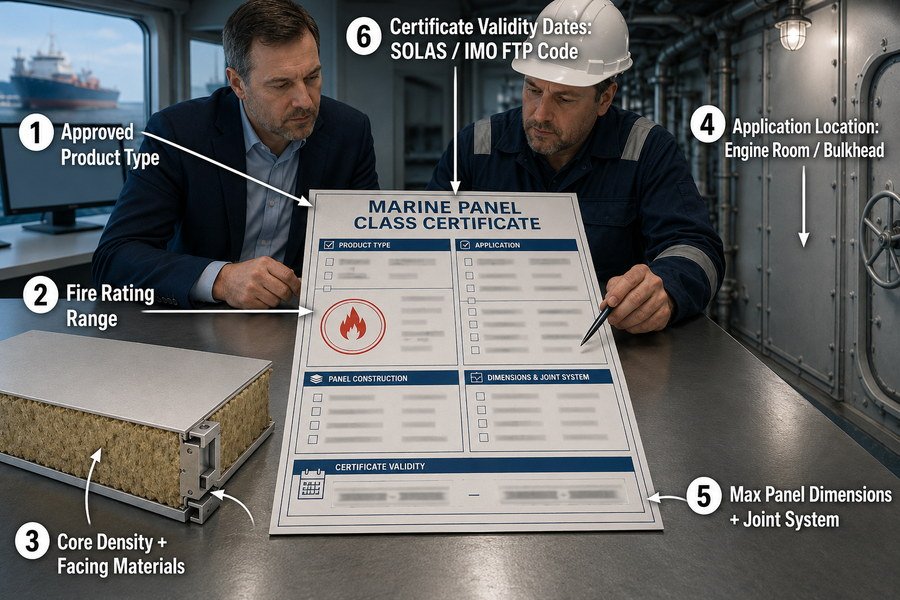
Let us break down these six critical areas so you can purchase marine wall and ceiling panels with complete confidence.
Which Fields on a Marine Accommodation Panel Class Certificate Define the Approved Product Type?
Buying the wrong panel type wastes your budget. A certificate must match what you actually order. Here is how to check the exact product approval fields.
The approved product type is defined by three specific fields: the product description (e.g., non-combustible material), the exact model name or number, and the intended use category (wall, ceiling, or continuous B-class partition) as tested under IMO 2010 FTP Code Part 1 and Part 3.
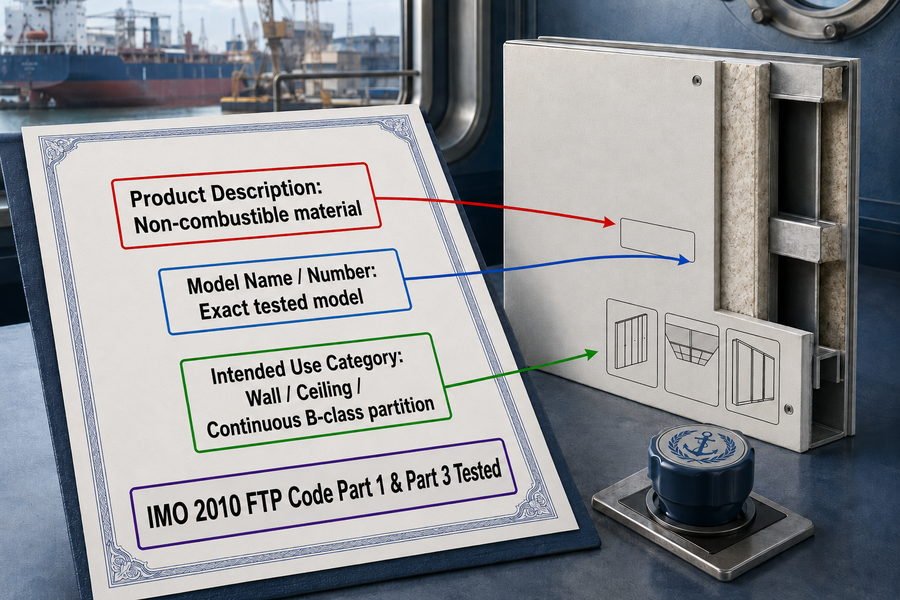
When you look at a marine panel class certificate, the product type is the very first thing you must check. If these fields do not match your purchase order, the surveyor will reject the panels on site.1
Verifying the Exact Product Description and Model Name
The certificate will clearly state a product description, such as "rockwool core sandwich panel" or "aluminum honeycomb panel." This description must match the actual material you are buying. Furthermore, you must check the exact model name or number. I remember a client who bought 2,000 square meters of wall panels from a factory. The factory shipped model "HW-50B". However, the class certificate only listed model "HW-50A". Even though the panels looked exactly the same, the class surveyor rejected the entire shipment. You must make sure the model number on the invoice, the packing list, and the class certificate are exactly the same. The IMO 2010 FTP Code Part 1 requires non-combustibility testing for specific models2, so any change in the model number means the product is technically unapproved.
Confirming the Intended Use Category for Marine Panels
The third field you must check is the intended use category. The certificate will state if the product is approved as a wall panel, a ceiling panel, or a continuous B-class partition.3 This is very important. You cannot buy an approved wall panel and install it as a ceiling panel. The IMO 2010 FTP Code Part 3 defines completely different fire resistance testing methods for walls and ceilings. Wall panels are tested vertically, while ceiling panels are tested horizontally.4 The fire behaves differently in these positions. If your certificate says "Approved for use as a Wall Panel," you can only use it for walls.
| Product Type Field | What You Need to Check | Why It Matters |
|---|---|---|
| Product Description | Matches your material (e.g., rockwool) | Ensures the base material is correct. |
| Model Name/Number | Exactly matches your purchase order | Surveyors reject unmatched model numbers. |
| Intended Use | Specifies wall, ceiling, or partition | Vertical and horizontal fire tests are different. |
How Does a QA Manager Read the Fire Rating Range on a Marine Ceiling Panel Certificate?
Does your QA team struggle to confirm fire ratings? A simple mistake here causes inspection failure. Let us learn how to read fire rating ranges correctly.
A QA manager reads the fire rating range by checking two elements: the specific fire class (B-0, B-15, A-15, A-30, or A-60) and the required insulation thickness for that rating, as mandated by SOLAS Chapter II-2 fire safety regulations.
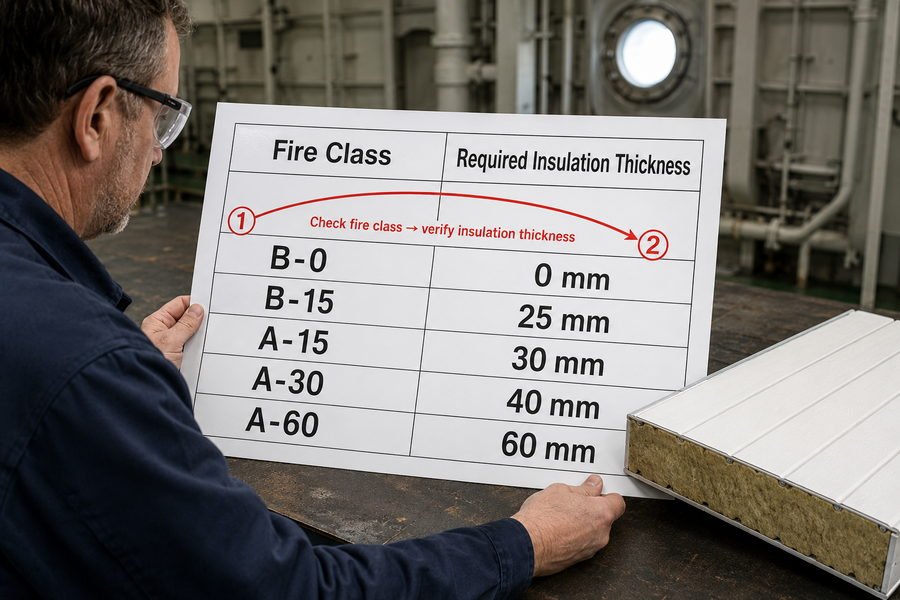
Understanding the fire rating is the core job of any QA manager in ship interior decoration. You must connect the fire class to the physical properties of the panel.
Understanding Specific Fire Classifications (B-Class and A-Class)
The first element to check is the specific fire class. SOLAS Chapter II-2 divides fire ratings into A-Class and B-Class.5 You will see ratings like B-0, B-15, A-15, A-30, and A-60 on the certificate. The letter tells you the type of boundary, and the number tells you how many minutes the panel can stop heat from passing through. For example, a B-15 rating means the panel stops flames for 30 minutes, but it only keeps the unexposed side cool for 15 minutes. An A-60 rating means the panel stops both flames and heat for a full 60 minutes. Your QA manager must read the ship's general arrangement plan and ensure the panel's fire class on the certificate meets or exceeds the plan's requirements.
Matching Insulation Thickness to the Required Fire Rating
The second element is the required insulation thickness. This is where many buyers make mistakes. A certificate might say the product family covers B-15 to A-60. However, you must read the details. The certificate will state that a 50mm thick panel achieves a B-15 rating, but you need a 100mm thick panel to achieve an A-60 rating. I once helped a European shipyard buyer who ordered 50mm panels for an A-60 zone. They thought the certificate covered all thicknesses for A-60. The surveyor stopped their work. Your QA manager must read the certificate table and match the specific fire rating to the exact panel thickness6.
| Fire Class Rating | Typical Insulation Thickness | Heat Insulation Time (SOLAS II-2) |
|---|---|---|
| B-0 | 25mm to 30mm | 0 minutes |
| B-15 | 50mm | 15 minutes |
| A-30 | 50mm to 75mm (with extra rockwool) | 30 minutes |
| A-60 | 100mm (or 50mm panel + 50mm extra) | 60 minutes |
Why Does a Marine Accommodation Panel Class Certificate Specify Core Density and Facing?
Changing the core or skin seems harmless, right? It actually ruins your fire approval. You must know why density and facing materials are strictly locked.
Certificates specify core density (e.g., 120 kg/m³) and facing materials (e.g., 0.6mm galvanized steel) because changing these four variables—core material, core density, facing material, and adhesive type—alters the panel's combustibility, smoke generation, and toxicity limits under IMO 2010 FTP Code Parts 1, 2, and 5.
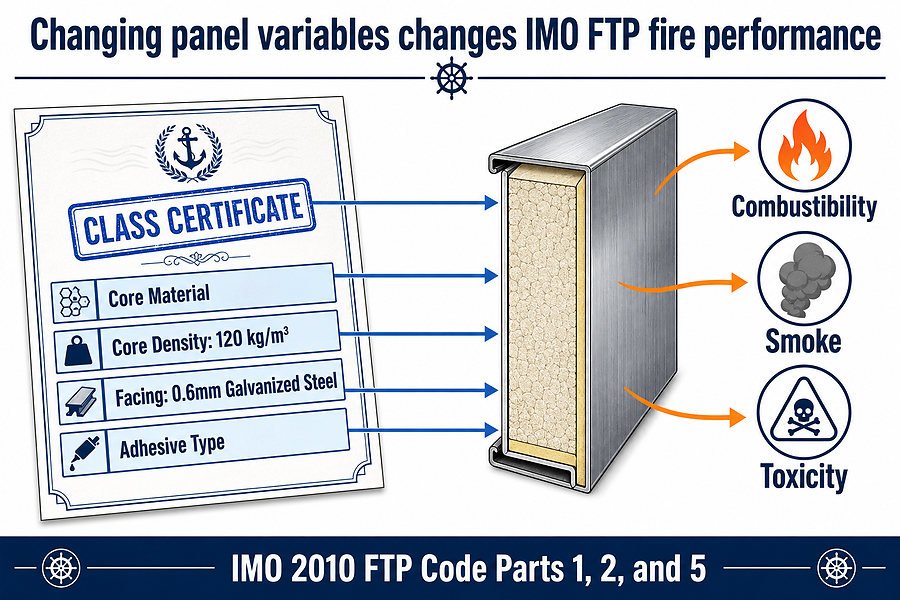
When I worked in the marine outfitting factory, we had strict controls over the raw materials. The class certificate acts like a recipe. If you change the recipe, the certificate is invalid.7
The Impact of Core Material and Core Density on Fire Resistance
The first two variables are the core material and the core density. The certificate will state exactly what is inside the panel, such as mineral wool or rockwool. It will also state the exact density, for example, 120 kg/m³. This density is critical for fire resistance.8 If a supplier tries to save money and uses 100 kg/m³ rockwool instead, the panel will fail faster in a real fire. The IMO 2010 FTP Code Part 1 tests the non-combustibility9 based on that specific 120 kg/m³ density. The certificate usually allows a small tolerance, like +/- 10%. If your panels arrive and the density is outside this range, the product no longer matches the certificate.
How Facing Material and Adhesive Type Affect Toxicity
The last two variables are the facing material and the adhesive type. Marine panels usually have a decorative facing, like PVC film on 0.6mm galvanized steel. The certificate will specify the maximum thickness of this PVC film, usually around 150 microns. It also specifies the exact brand or chemical type of the adhesive used to bond the film to the steel. The IMO 2010 FTP Code Part 2 and Part 5 test for smoke and toxicity. If the factory uses a thicker PVC film or a cheaper, untested glue, the panel will release toxic smoke when it burns. This will kill passengers before the fire even reaches them.10 You must verify that the factory used the exact facing and adhesive listed on the document.
| Material Variable | Example Specification | IMO Testing Standard | Consequence of Changing |
|---|---|---|---|
| Core Material | Rockwool | FTP Code Part 1 | Panel loses non-combustible status. |
| Core Density | 120 kg/m³ (+/- 10%) | FTP Code Part 3 | Panel burns through too quickly. |
| Facing Material | PVC Film (Max 150 microns) | FTP Code Part 5 | Produces deadly toxic smoke. |
| Adhesive Type | Polyurethane Glue | FTP Code Part 2/5 | Causes high flame spread and smoke. |
How Does a Shipyard Engineer Confirm a Marine Wall Panel Certificate Covers Engine Room Use?
Installing cabin panels in an engine room will cause a disastrous fire inspection failure. You need to verify engine room approval before installation.
A shipyard engineer confirms engine room use by verifying two items on the certificate: an A-60 structural fire protection rating and an explicit statement approving the panel for "Machinery Spaces of Category A" or high-risk zones, complying with SOLAS Chapter II-2 Part C.
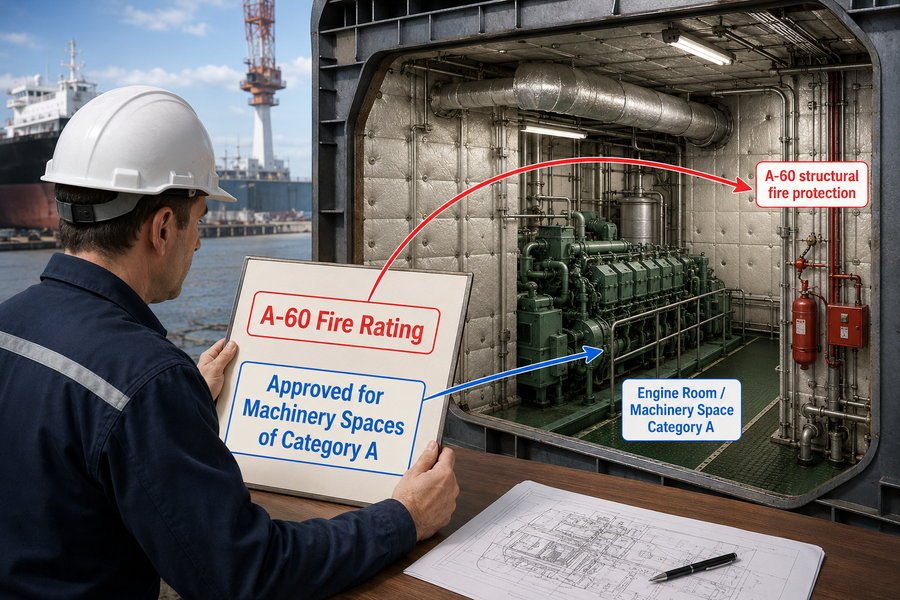
Engine rooms are the most dangerous areas on a ship.11 A fire here burns hotter and faster due to the fuel and oil. You cannot just use any panel.
Checking for A-60 Structural Fire Protection Rating
The first item the engineer must verify is the A-60 structural fire protection rating. According to SOLAS Chapter II-2, Regulation 912, the boundaries that separate an engine room from other spaces must provide the highest level of fire protection. These spaces are called "Machinery Spaces of Category A". Therefore, the certificate must clearly show that the panel assembly provides an A-60 rating13. A standard B-15 cabin wall panel is completely useless here. An A-60 panel system is much heavier. It usually involves a thick steel bulkhead plus specialized A-60 rated insulation panels. If the certificate only shows B-class ratings, you cannot use it near the engine room.
Verifying the Explicit "Machinery Spaces" Approval Statement
The second item is just as important. Even if a panel has an A-class rating, the certificate must explicitly state it is approved for "Machinery Spaces" or high-risk zones. Sometimes, an A-Class panel is only tested and approved for accommodation areas (like separating a galley from a corridor). I once saw an interior contractor try to use A-60 cabin panels near the main engine exhaust. The class surveyor stopped the work immediately because the panel's certificate did not have the specific approval statement for Machinery Spaces of Category A. The engineer must read the "Application/Limitation14" section of the certificate to find this exact phrase.
| Verification Item | What to Look For on Certificate | SOLAS Requirement |
|---|---|---|
| Fire Rating | A-60 Classification | Required for separating engine rooms from safe zones. |
| Approved Application | "Machinery Spaces of Category A" | Ensures the panel withstands oil-fed fires. |
| Structural Material | Steel core or steel bulkhead backing | Engine room boundaries must be steel or equivalent. |
Why Does a Marine Accommodation Panel Class Certificate State Max Panel Height and Joint System?
Have you ever wondered why you cannot just cut or join panels however you want? The way you join them changes their fire strength completely.
The certificate states maximum panel height and joint systems because these three factors—maximum width, maximum height, and the specific joint profile (like spline or overlapping joints)—dictate the structural integrity of the partition during a standard fire test under IMO 2010 FTP Code Part 3.
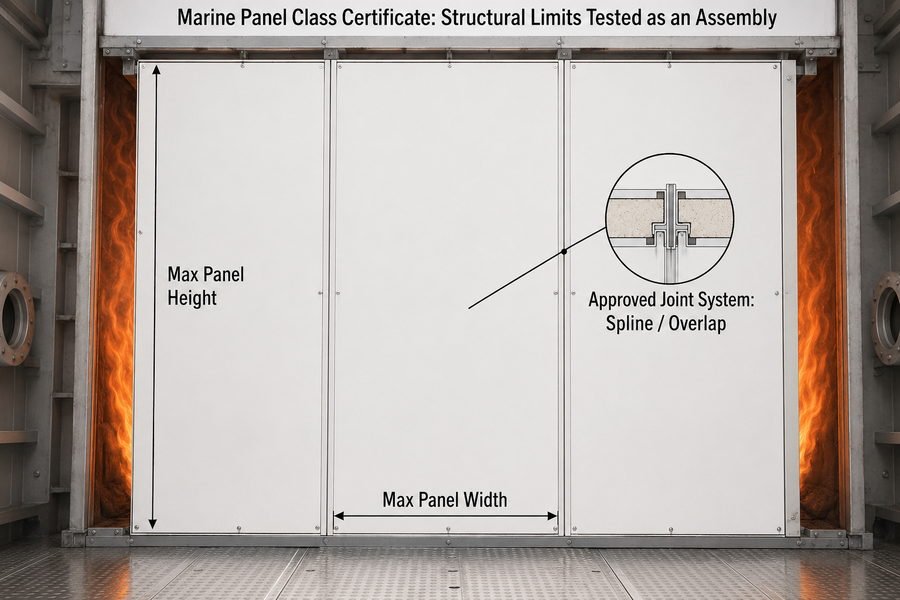
When a fire attacks a wall, the wall wants to bend and collapse15. The size of the panels and how they connect are the only things keeping the wall standing.
Understanding Limits on Maximum Panel Height and Maximum Width
The first two factors are the maximum width and maximum height. Standard marine wall panels usually have a width of 550mm or 600mm. The height can range from 2000mm up to 2400mm, depending on the ship's deck height. The class certificate limits these dimensions based on what the factory actually tested in the fire furnace16. If the factory tested a panel that was 2400mm high, the certificate will state the maximum height is 2400mm. If your ship has a ceiling height of 2600mm, you cannot simply take a 2400mm panel and stack a 200mm piece on top. It will collapse during a fire. You must order panels that have a certificate covering your required height.
The Critical Role of the Specific Joint Profile
The third factor is the specific joint profile. The joints where two panels meet are the weakest points in a fire.17 There are different ways to join panels, such as using a steel spline (a tongue that slides into grooves) or using an overlapping step joint. The certificate will show a drawing or describe the exact joint system tested. It will also specify the thickness of the joint material. For example, it might require a 0.8mm galvanized steel spline. If your installer uses a cheaper 0.5mm spline, the joint will melt and warp too early18. I have seen panels fail the 30-minute fire test at minute 25 simply because the joint was not exactly as described in the certificate.
| Dimensional Factor | Typical Value on Certificate | Why It Is Critical for Safety |
|---|---|---|
| Maximum Width | 550mm or 600mm | Prevents the panel face from warping too much. |
| Maximum Height | 2400mm or 2500mm | Ensures the wall does not buckle under its own weight. |
| Joint Profile Type | Spline joint or overlapping joint | Stops fire and smoke from leaking between panels. |
| Joint Material Thickness | 0.8mm steel spline | Maintains connection strength at high temperatures. |
How Does a Project Manager Interpret the Validity Scope on a Marine Accommodation Panel Certificate?
An expired certificate means your panels are just expensive scrap metal. Managing certificate dates is a huge headache for buyers. Here is the right way.
A project manager interprets validity scope by checking three crucial dates: the date of issue, the date of expiry (typically valid for 5 years), and the annual endorsement dates, ensuring compliance with the Marine Equipment Directive (MED) or the issuing classification society rules.
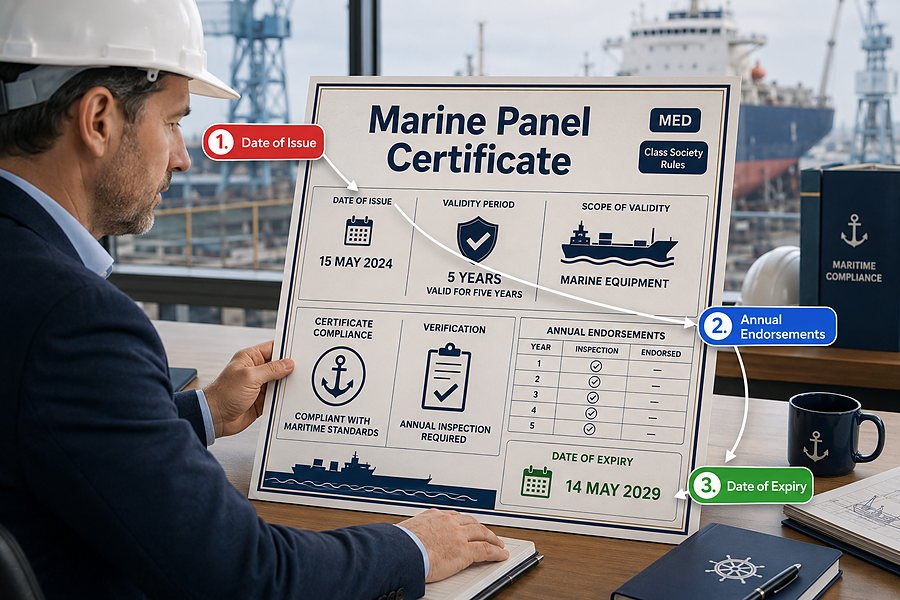
If you buy materials with an invalid certificate, you will lose all your money. Project managers must treat these dates as strictly as their own passport expiry dates.
Tracking the Date of Issue and Five-Year Expiry Date
The first two dates are the date of issue and the date of expiry. Most Type Approval Certificates (TAC) from classification societies like DNV, ABS, or Lloyd's Register are valid for exactly 5 years. You must purchase the panels, and the factory must manufacture them, before this expiry date. Let me give you an example. If you place an order on May 1st, 2026, and the certificate expires on May 2nd, 2026, you are taking a huge risk. If the factory produces the panels on May 5th, the products are technically unapproved. The panels must be manufactured while the certificate is active. Once manufactured legally, they remain valid for the life of the ship, but the production date is the key.
Managing Annual Endorsement Dates and Factory Audits
The third set of dates are the annual endorsement dates. This is very common for European projects that require the "Wheelmark" under the Marine Equipment Directive (MED). The Type Approval (Module B) is not enough. The factory also needs a quality system certificate (Module D). This Module D certificate requires an annual factory audit by the classification society. The project manager must check if the factory has completed their annual audit. If the factory misses this annual audit date, the certificate is suspended immediately. I always advise my clients to ask the supplier for their latest Module D audit report before transferring the deposit.
| Certificate Date Type | What It Means | Action Required by Buyer |
|---|---|---|
| Date of Issue | When the approval started | Verify it matches the current IMO rules. |
| Date of Expiry | Usually 5 years after issue | Ensure production finishes before this date. |
| Annual Endorsement | Yearly factory quality audit | Request the latest Module D audit report. |
Conclusion
Checking the scope fields on a marine panel class certificate prevents costly shipyard rejections. Always verify product type, fire rating, core materials, application zones, joint systems, and validity dates before buying.
-
"How Should Overseas Buyers Verify Marine Panel Compliance ...", https://magellanmarinetech.com/how-should-overseas-buyers-verify-marine-panel-compliance-claims/. Classification-society type-approval guidance generally treats certificates as applicable only to the product and conditions described in the approval documentation, supporting the need to reconcile certificate details with procurement and inspection documents. Evidence role: general_support; source type: institution. Supports: Marine panel certificate fields must match purchase documents because surveyors may reject panels when the approved product identity does not match the delivered goods.. Scope note: This supports the approval-scope principle, but rejection decisions may vary by flag state, class society, surveyor, and project contract. ↩
-
"How Is the IMO FTP Code Structured into Annexes and Parts?", https://magellanmarinetech.com/how-is-imo-ftp-code-structured-into-annexes-parts/. The IMO 2010 FTP Code, Annex 1 Part 1, sets out the non-combustibility test for marine materials and forms part of the basis for fire-test approval of products used on ships. Evidence role: definition; source type: institution. Supports: IMO 2010 FTP Code Part 1 requires non-combustibility testing as part of approval for marine materials or products.. Scope note: The Code establishes the test method and approval context; it may not use the commercial term “model” in the same way as a manufacturer’s catalogue or certificate. ↩
-
"How to Spot Unreliable Fire Test Reports for Marine Wall and ...", https://magellanmarinetech.com/how-spot-unreliable-fire-test-reports-for-marine-wall-ceiling-panels/. Marine type-approval and fire-test certificates commonly identify the approved application, such as bulkhead, deck, ceiling, lining, or class division, indicating that approval is tied to a stated installation use. Evidence role: general_support; source type: institution. Supports: Marine panel certificates state the approved intended use category, such as wall, ceiling, or partition application.. Scope note: Certificate formats differ among administrations and classification societies, so the exact wording may not always match “wall panel” or “ceiling panel.” ↩
-
"How Is the IMO FTP Code Structured into Annexes and Parts?", https://magellanmarinetech.com/how-is-imo-ftp-code-structured-into-annexes-parts/. The IMO 2010 FTP Code, Annex 1 Part 3, describes fire-resistance testing of divisions using orientations corresponding to bulkheads and decks/ceilings, supporting the distinction between vertical and horizontal test arrangements. Evidence role: mechanism; source type: institution. Supports: Marine wall and ceiling panel approvals rely on different fire-resistance test orientations: vertical for wall or bulkhead divisions and horizontal for ceiling or deck-type divisions.. Scope note: The source supports the difference in test orientation and procedure; it does not by itself address every proprietary panel system or all national approval practices. ↩
-
"[PDF] recommendation for fire test procedures for “a” and “b” class ...", https://wwwcdn.imo.org/localresources/en/KnowledgeCentre/IndexofIMOResolutions/AssemblyDocuments/A.163(ES.IV).pdf. SOLAS Chapter II-2 defines “A” and “B” class divisions as categories of structural fire protection for ships, including integrity and insulation criteria used to express ratings such as A-60 and B-15. Evidence role: definition; source type: institution. Supports: SOLAS Chapter II-2 divides fire ratings into A-Class and B-Class.. ↩
-
"Are Marine Fire Divisions the Same as Marine Panel Ratings?", https://magellanmarinetech.com/are-marine-fire-divisions-same-as-marine-panel-ratings/. IMO fire-test and approval procedures assess a tested construction or assembly, so the certified fire rating applies to the approved configuration and installation details rather than to all thicknesses or variants in a product family. Evidence role: mechanism; source type: institution. Supports: A QA manager must match a panel’s specific fire rating to the exact panel thickness stated in the certificate.. Scope note: This supports the need to check thickness and construction details in principle; the exact thickness required for a given rating remains product- and approval-specific. ↩
-
"How Do Marine Panel Surface Finishes Affect Fire Safety ...", https://magellanmarinetech.com/how-marine-panel-surface-finishes-affect-fire-safety-compliance/. International maritime type-approval and fire-test documentation generally ties a certificate to the product construction, materials, and test specimen described in the approval, supporting the principle that unapproved material changes can make the certificate inapplicable. Evidence role: general_support; source type: institution. Supports: Changing the tested and certified material specification can invalidate reliance on the marine fire certificate.. Scope note: This supports the certification principle in general; the exact invalidation procedure and tolerance depend on the flag administration, class society, and wording of the specific certificate. ↩
-
"Determination of Thermal Properties of Mineral Wool Required for ...", https://pmc.ncbi.nlm.nih.gov/articles/PMC10488771/. Experimental and modeling studies on mineral-wool and sandwich-panel fire performance report that insulation density affects heat transfer, structural response, and fire-resistance behavior, supporting the claim that core density is a material variable relevant to fire performance. Evidence role: mechanism; source type: paper. Supports: Core density is an important variable in the fire resistance of mineral-wool or rockwool marine panels.. Scope note: Such studies support the mechanism generally; they may not prove that every change from 120 kg/m³ to 100 kg/m³ will fail a particular IMO-certified panel without the relevant test data. ↩
-
"What Is the IMO FTP Code for Marine Interior Materials?", https://magellanmarinetech.com/what-imo-ftp-code-for-marine-interior-materials/. The IMO 2010 FTP Code identifies Part 1 as the non-combustibility test for materials used in ship construction, supporting the statement that non-combustible classification is assessed under that part of the Code. Evidence role: definition; source type: institution. Supports: IMO 2010 FTP Code Part 1 is the non-combustibility test used for relevant ship materials.. Scope note: The Code establishes the test method; it does not by itself verify that a specific 120 kg/m³ panel core has passed unless the product certificate or test report is also cited. ↩
-
"[PDF] Fire Conditions for Smoke Toxicity Measurement", https://tsapps.nist.gov/publication/get_pdf.cfm?pub_id=912940. Fire-safety research and public-health sources identify smoke inhalation and toxic combustion products, including carbon monoxide and irritant gases, as major causes of death in building and transport fires, supporting the general hazard described here. Evidence role: expert_consensus; source type: government. Supports: Toxic smoke can incapacitate or kill occupants before direct flame contact occurs.. Scope note: This is general fire-safety evidence; it does not directly quantify deaths from the specific PVC film, adhesive, or marine panel assembly discussed in the article. ↩
-
"[PDF] MSC.1-Circ.1321-Guidelines-For-Measures-To-Prevent-Fires-In ...", https://greenvoyage2050.imo.org/wp-content/uploads/2023/02/MSC.1-Circ.1321-Guidelines-For-Measures-To-Prevent-Fires-In-Engine-Rooms-And-Cargo-Pump-Rooms-Secretariat.pdf. Accident-investigation and maritime-safety literature identifies machinery spaces as a major location for shipboard fires because they combine ignition sources, fuel systems, lubricating oil, and hot surfaces; this supports characterizing engine rooms as high-risk spaces rather than proving they are always the single most dangerous area on every vessel. Evidence role: general_support; source type: government. Supports: Engine rooms are especially dangerous areas on ships because of their elevated fire risk.. Scope note: The source may support high fire risk in machinery spaces but may not rank all ship areas by overall danger. ↩
-
"[PDF] Supplement - International Maritime Organization", https://wwwcdn.imo.org/localresources/en/publications/Documents/Supplements/English/QF110E_122015.pdf. SOLAS Chapter II-2, Regulation 9 sets fire-containment requirements for structural divisions between spaces, including machinery spaces, and is the regulatory basis for assigning fire-integrity ratings to bulkheads and decks. Evidence role: general_support; source type: institution. Supports: SOLAS Chapter II-2, Regulation 9 governs the fire-protection rating of boundaries separating engine rooms from other spaces.. Scope note: The regulation provides the framework and tables; the exact rating depends on the adjacent spaces and vessel type. ↩
-
"What Is the Purpose and Scope of the IMO FTP Code? - Magellan ...", https://magellanmarinetech.com/what-purpose-scope-of-imo-ftp-code/. SOLAS definitions of A-class divisions describe steel or equivalent divisions that prevent smoke and flame passage for a standard fire test, with the A-60 subclass requiring insulation performance for 60 minutes; this supports the technical meaning of an A-60 rating. Evidence role: definition; source type: institution. Supports: An A-60 panel or bulkhead system must meet the A-class fire integrity criteria and maintain the required insulation performance for 60 minutes.. Scope note: This supports the regulatory definition of A-60, not the suitability of any particular manufacturer’s panel assembly. ↩
-
"What Is the IMO FTP Code for Marine Interior Materials?", https://magellanmarinetech.com/what-imo-ftp-code-for-marine-interior-materials/. Marine fire-test and type-approval documentation normally records the approved product configuration and any restrictions or limitations, so the application section of a certificate is evidence of the spaces and installation conditions for which the tested assembly is approved. Evidence role: mechanism; source type: institution. Supports: Engineers must check the certificate’s application or limitation section to confirm that the panel is approved for machinery spaces or similarly high-risk locations.. Scope note: This supports the need to check certificate scope and limitations; the exact wording varies by flag administration, classification society, and approval scheme. ↩
-
"[PDF] Best practice guidelines for structural fire resistance design of ...", https://nvlpubs.nist.gov/nistpubs/technicalnotes/nist.tn.1681.pdf. Fire-resistance research on wall and partition assemblies describes thermal bowing, loss of stiffness, and stability failure under furnace exposure, supporting the general mechanism that heated walls may deform and fail. Evidence role: mechanism; source type: paper. Supports: When exposed to fire, a wall can bend and collapse because heat causes deformation and loss of structural stability.. Scope note: This supports the general fire-response mechanism, not the failure behavior of any specific marine panel system. ↩
-
"[PDF] RESOLUTION MSC.307(88) (adopted on 3 December 2010 ...", https://wwwcdn.imo.org/localresources/en/KnowledgeCentre/IndexofIMOResolutions/MSCResolutions/MSC.307(88).pdf. IMO fire-test procedures for marine divisions require tested specimens and construction details to represent the approved arrangement, supporting the statement that certified dimensions and configurations are tied to furnace-tested assemblies. Evidence role: expert_consensus; source type: institution. Supports: Marine panel certificate limits are based on the dimensions and configurations actually tested in a fire furnace.. Scope note: The source establishes the certification principle; the exact dimensional limit depends on the individual type-approval certificate. ↩
-
"[PDF] Fire Performance of Partition Assemblies", https://tsapps.nist.gov/publication/get_pdf.cfm?pub_id=100835. Fire-resistance literature on compartmentation and joint systems identifies joints and penetrations as critical locations for heat, flame, and smoke passage, supporting the need to treat panel joints as fire-performance vulnerabilities. Evidence role: general_support; source type: research. Supports: Panel-to-panel joints are critical weak points in fire-rated wall assemblies because they can permit heat, flame, or smoke leakage if not properly designed and tested.. Scope note: This supports the general importance of joints in fire resistance; it does not prove that every marine panel joint is always the single weakest component. ↩
-
"Figure 3 - from Elevated temperature material properties of", https://www.academia.edu/figures/49144194/figure-7-proposed-strength-reduction-factors-ko-for. Structural-fire design references show that steel stiffness and strength decrease substantially at elevated temperatures and that thinner steel elements heat more rapidly, supporting the concern that underspecified joint material can deform earlier in fire exposure. Evidence role: mechanism; source type: paper. Supports: Using a thinner-than-specified steel spline can reduce joint fire performance because steel components lose stiffness and strength as temperature rises, and thinner sections heat up faster.. Scope note: This evidence explains the material mechanism; it does not by itself establish that a 0.5 mm spline will fail before 30 minutes in the specific certified panel assembly. ↩