Confused about MED rules for panels? Buying the wrong certificates stops ship delivery and wastes your money. I will show you exactly when MED applies to marine accommodation panels.
The Marine Equipment Directive (MED) applies to marine accommodation panels installed on all EU-flagged seagoing merchant vessels, passenger ships, and large commercial yachts. It regulates fire protection equipment under category MED/3.11, covering B-Class, C-Class, and continuous B-Class bulkheads, ceilings, and linings.
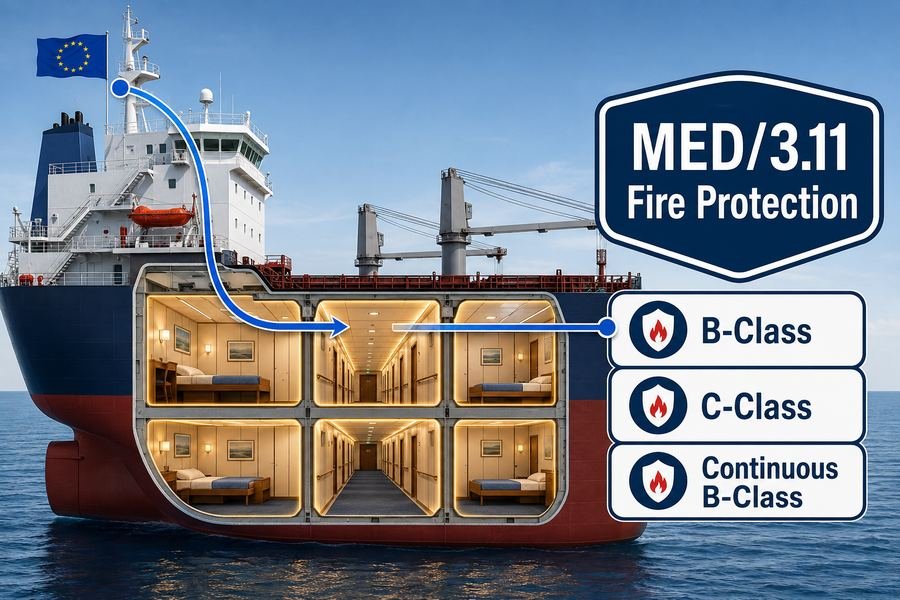
I work at Magellan Marine as a marine outfitting specialist. I help procurement officers buy the right ship interior products. Many buyers feel confused by European certification rules. You do not want to buy cheap panels and fail port inspections later. I want to share my knowledge about the Marine Equipment Directive. This guide will help you understand exact requirements for marine accommodation panels.
Are Marine Accommodation Panels MED-Regulated Equipment?
Not sure if your panels need MED approval? Installing unregulated panels causes serious safety failures and blocks your payment. Let us check the MED equipment list together.
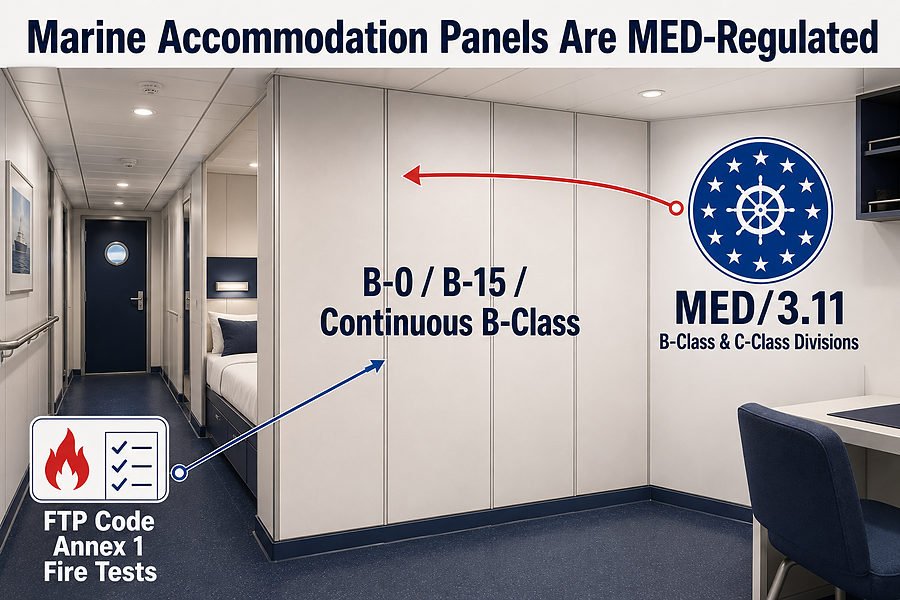
Yes, marine accommodation panels are MED-regulated equipment under item MED/3.11 for "B" and "C" Class divisions. This includes B-0, B-15, and continuous B-Class bulkheads, ceilings, and linings. They must pass FTP Code Annex 1 fire tests to receive the Wheelmark.
Understanding MED/3.11 Classification for Marine Panels
Marine accommodation panels fall directly under the European Union Marine Equipment Directive. The official document lists these panels under item number MED/3.111. This item covers "B" and "C" Class divisions. We must look at the specific types mentioned in the rule. First, the rule covers B-0 class panels. These panels stop smoke and flame for 30 minutes, but they do not control temperature rise well. Second, the rule covers B-15 class panels. These panels stop smoke and flame for 30 minutes. They also keep the unexposed side temperature from rising more than 140°C on average for the first 15 minutes2. Third, the rule covers continuous B-Class bulkheads. These are large panel systems that run from deck to deck. Fourth, the rule covers C-Class divisions. C-Class panels do not have specific fire resistance times, but they must use non-combustible materials. You must know these exact classes when you send inquiries to Asian suppliers.
Fire Test Standards for MED Wheelmark Certification
Suppliers cannot just print a Wheelmark on their panels. The MED requires strict testing. The International Maritime Organization (IMO) creates the rules. The testing standard is the IMO 2010 FTP Code Annex 1 Part 3. A test laboratory puts the panel in a massive furnace. They heat the furnace to 843°C over 30 minutes3. The laboratory measures the temperature on the safe side of the panel. A B-15 panel fails if any single point on the safe side exceeds a 225°C temperature rise. You should always ask your supplier for the FTP Code test report. The test report proves the panel actually deserves the MED Wheelmark. A real MED certificate increases the panel price. A standard non-certified 50mm rockwool panel costs around $15 per square meter in China. A MED-certified B-15 panel costs between $25 and $32 per square meter4.
| Panel Classification | Fire Resistance Time | Avg Temp Limit (15 min) | Typical Core Material | Est. Cost per Sqm |
|---|---|---|---|---|
| B-0 Class | 30 minutes (Flame) | No limit | Low-density rockwool | $18 - $22 |
| B-15 Class | 30 minutes (Flame) | 140°C rise | 150 kg/m3 rockwool | $25 - $32 |
| C Class | None (Non-combustible) | No limit | Aluminum honeycomb | $20 - $28 |
| Continuous B-Class | 30 minutes (Flame) | 140°C rise | Structural rockwool | $30 - $40 |
Which EU Flag Vessels Require MED-Certified Marine Accommodation Panels?
Do all EU ships need Wheelmark panels? Buying expensive certified panels for the wrong ship wastes your project budget. Here is the exact vessel list.
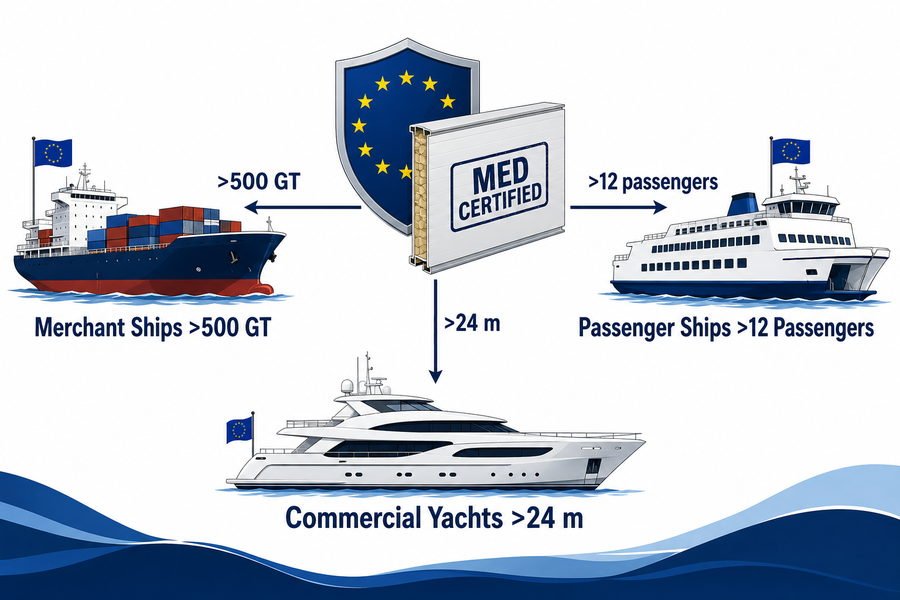
Three main vessel types require MED-certified marine accommodation panels: seagoing merchant ships over 500 Gross Tonnage (GT), passenger ships carrying more than 12 passengers, and large commercial yachts over 24 meters in length flying any European Union member state flag.
Tonnage and Passenger Rules for MED-Certified Marine Panels
You must match the panel certificate to the ship type. The European Union sets clear boundaries. First, the MED applies to seagoing merchant ships over 500 Gross Tonnage (GT)5. Gross Tonnage measures the internal volume of the ship.6 Cargo ships, oil tankers, and bulk carriers over 500 GT must use Wheelmark panels. Smaller cargo boats under 500 GT follow local national rules instead. Second, the MED applies to passenger ships carrying more than 12 passengers7. It does not matter if the passenger ship is small or large. If the ship carries 13 paying passengers on international ocean voyages, every accommodation panel must have MED approval. Third, the MED applies to large commercial yachts over 24 meters in length. These are luxury charter yachts. If the yacht is 25 meters long and available for commercial rent, the shipyard must install MED-certified panels.
Flag State Rules for EU Vessel Panel Compliance
The ship's flag decides everything. The MED only legally binds ships flying the flag of a European Union member state.8 Examples include ships registered in Malta, Cyprus, Greece, or Germany. If a shipyard in China builds a 10,000 GT cargo ship for a German owner, and the ship flies the German flag, the Chinese shipyard must buy MED-certified accommodation panels. You must ask your client about the final flag state before you place an order. If you buy panels with only a Chinese Classification Society (CCS) certificate for a French-flagged ship, the French authorities will reject the ship. You will have to tear out all the interior walls. This mistake costs hundreds of thousands of dollars. Always check the flag registry first.
| Vessel Type | Size or Capacity Trigger | Required Flag State | MED Panels Required? |
|---|---|---|---|
| Merchant Ship | Over 500 Gross Tonnage | Any EU Member State | Yes |
| Passenger Ship | Over 12 Passengers | Any EU Member State | Yes |
| Commercial Yacht | Over 24 Meters Length | Any EU Member State | Yes |
| Merchant Ship | Under 500 Gross Tonnage | Any EU Member State | No (Local rules apply) |
Are Crew Cabin Marine Accommodation Panels Within MED Scope?
Wondering about crew cabin materials? A fire in crew quarters destroys the ship just like a passenger cabin fire. Crew cabin panels must follow strict MED fire rules.
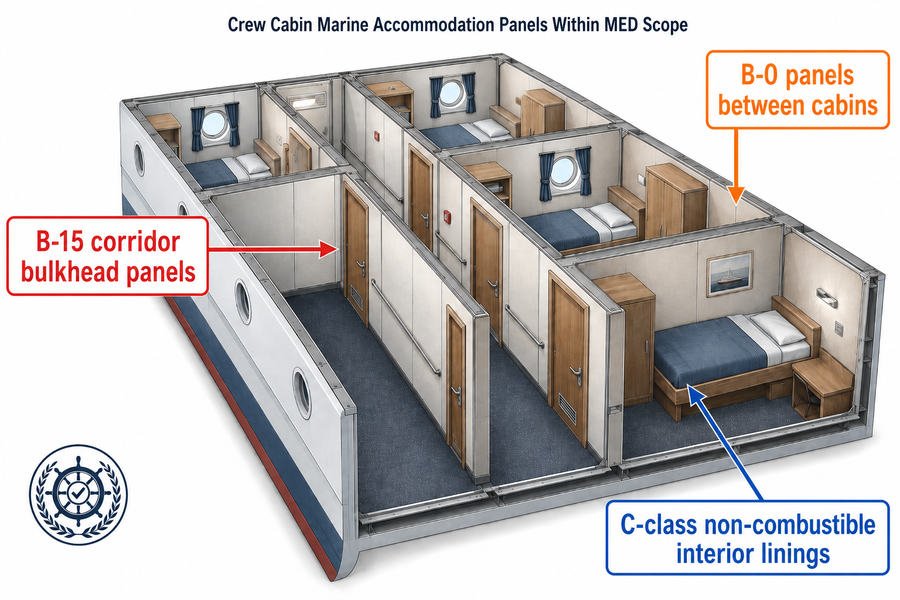
Yes, crew cabin marine accommodation panels are fully within MED scope. Depending on the cabin location and adjacent spaces, crew cabins require B-15 class panels for corridor bulkheads, B-0 class panels between cabins, and C-class panels for non-combustible interior linings.
Specific Fire Ratings for Crew Cabin Marine Accommodation Panels
The MED treats crew safety and passenger safety with equal importance.9 You must buy different MED-certified panels for different parts of the crew cabin. First, you must buy B-15 class panels for the corridor bulkheads10. The corridor is an escape route. The B-15 panel gives the crew 15 minutes of low heat to run away during a fire. Second, you must buy B-0 class panels for the bulkheads between two adjacent crew cabins. The B-0 panel stops the flame from jumping from one bed to another for 30 minutes.11 Third, you must buy C-class panels for non-combustible interior linings12. You use C-class panels against the steel hull of the ship. The steel hull already stops the fire, so the inner lining just needs to be non-combustible. You must provide the ship's general arrangement plan to your supplier. A good supplier will map out the B-15, B-0, and C-class panels for you.
Cost Impact of MED Certification on Crew Cabin Panels
Crew cabins cover a large area on a ship. Buying MED panels for crew cabins takes a large part of your budget. You cannot use cheap wooden boards. You must use PVC-laminated rockwool panels. A standard 50mm thick B-15 MED panel uses rockwool with a density of 150 kg/m3. The PVC film thickness is usually 150 microns. The steel sheet thickness is 0.6mm. If you buy a B-0 panel, the rockwool density drops to 120 kg/m3. This density difference changes the price. A B-15 panel from a top Chinese supplier costs around $28 per square meter. The B-0 panel costs around $25 per square meter. A cargo ship needs about 2,000 square meters of panels for crew cabins. Mixing B-15 and B-0 correctly according to MED rules saves you nearly $6,000 on one project.
| Application Area | Required Panel Class | Rockwool Density | Steel Skin Thickness | Est. Price (Sqm) |
|---|---|---|---|---|
| Cabin to Corridor | B-15 Class | 150 kg/m3 | 0.6 mm | $28 - $32 |
| Cabin to Cabin | B-0 Class | 120 kg/m3 | 0.6 mm | $25 - $28 |
| Lining against Hull | C Class | 100 kg/m3 | 0.6 mm | $22 - $25 |
| Wet Room (Toilet) | B-15 Class | 150 kg/m3 | 0.6 mm (Stainless) | $35 - $45 |
Does MED Cover Marine Accommodation Panels on Non-EU Vessels in EU Waters?
Building a non-EU ship that visits Europe? Port state control will detain ships with bad fire panels. You need to know the rules for non-EU vessels.
No, MED does not cover marine accommodation panels on non-EU vessels in EU waters. However, these vessels must still comply with International Maritime Organization (IMO) SOLAS regulations. Their panels require Type Approval certificates from their specific flag state or recognized classification societies.
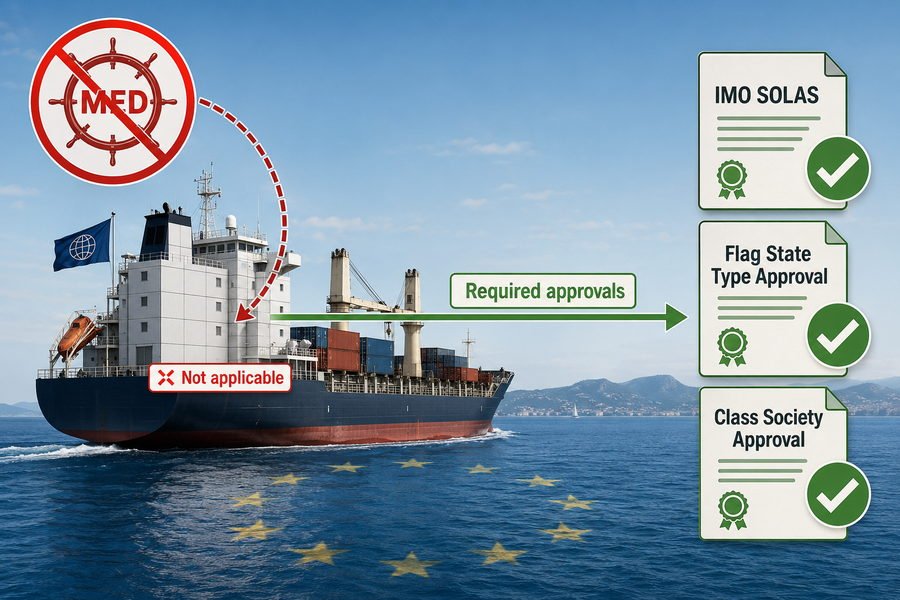
IMO SOLAS Requirements for Non-EU Vessel Accommodation Panels
Many ships visit European ports but fly foreign flags. For example, a ship might fly the flag of Panama, Liberia, or the Marshall Islands. The MED rule does not legally force a Panama-flagged ship to use the Wheelmark13. However, European Port State Control still inspects these ships14. They check the panels based on International Maritime Organization (IMO) SOLAS regulations. SOLAS Chapter II-2 controls fire protection. Your panels must meet the same fire test standards (the FTP Code) as MED panels15. Instead of a Wheelmark, the panels need a Type Approval certificate from the ship's specific flag state. Panama might approve the panel directly, or they might delegate the approval to a recognized organization.
Comparing MED Wheelmark and IACS Classification Society Approvals
Most non-EU flag states use recognized classification societies to issue panel certificates. The International Association of Classification Societies (IACS) has 11 main members. These include DNV (Norway/Germany), ABS (USA), LR (UK), and BV (France). If you outfit a Liberia-flagged ship classified by ABS, you need an ABS Type Approval certificate for your accommodation panels. An ABS certificate proves the panel passes the IMO FTP code. Many high-quality factories in China and Vietnam hold both MED Wheelmark and multiple IACS society certificates for the exact same panel. The physical panel is identical. The rockwool is identical. Only the paper certificate is different. Always tell your supplier the ship's Classification Society and Flag State before asking for a quote. If the European Port State Control finds a Panama-flagged ship using uncertified panels, they will detain the ship16. The port charges detention fees of over $10,000 per day.
| Ship Flag State | Primary Regulation | Required Certification Type | Issuing Body |
|---|---|---|---|
| Malta (EU) | MED Directive | Wheelmark Certificate | European Notified Body |
| Panama (Non-EU) | IMO SOLAS | Type Approval Certificate | Flag State or IACS Member |
| Liberia (Non-EU) | IMO SOLAS | Type Approval Certificate | Flag State or IACS Member |
| Marshall Is. (Non-EU) | IMO SOLAS | Type Approval Certificate | Flag State or IACS Member |
Are Inland Waterway Marine Accommodation Panels Exempt from MED?
Buying panels for river cruise ships? Applying ocean rules to river boats increases your costs for no reason. Inland vessels have different fire safety standards.
Yes, inland waterway marine accommodation panels are exempt from MED. Instead, European inland vessels must comply with the ES-TRIN (European Standard laying down Technical Requirements for Inland Navigation) standard, which has different fire testing protocols than the MED for accommodation materials.
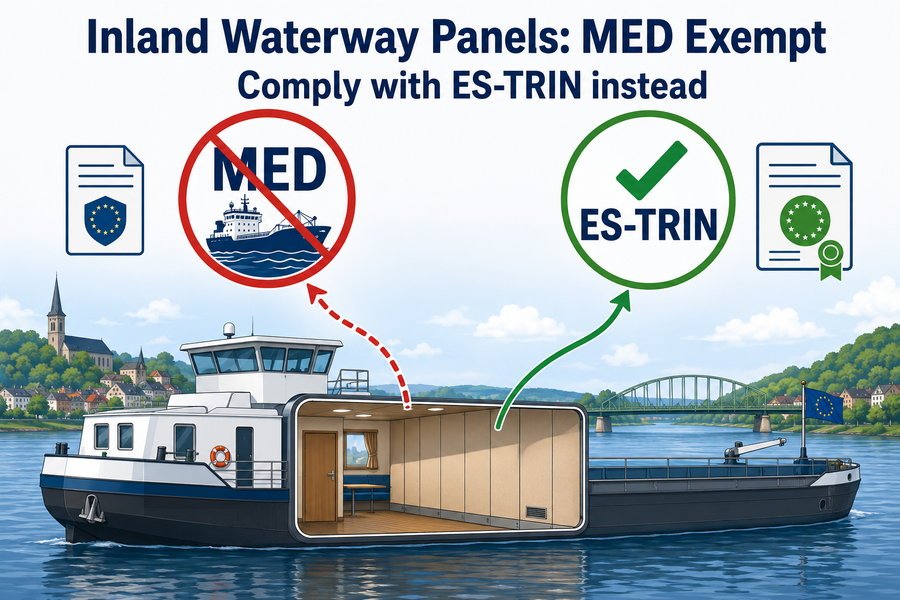
ES-TRIN Fire Safety Standards for Inland Waterway Panels
River ships operate differently than ocean ships. A river ship is always close to the shore. Passengers can escape to the land very quickly. Because of this, the European Union exempts inland waterway ships from the heavy MED ocean rules. Instead, inland vessels use the ES-TRIN standard17. Chapter 19 of the ES-TRIN standard covers fire protection on passenger vessels. ES-TRIN still requires fire-resistant panels, but the testing protocols are different. ES-TRIN uses a specific 45-minute fire test for certain bulkheads18, unlike the rigid 30-minute or 60-minute rules in SOLAS. ES-TRIN focuses heavily on low flame spread and low smoke toxicity. When you buy panels for a Rhine River cruise ship, you must ask the supplier if their panels pass the ES-TRIN fire tests, not the MED tests.
Material Density Differences in River vs Ocean Marine Panels
Weight is the biggest problem for river ships. River ships have very shallow drafts. If the ship is too heavy, it will scrape the river bottom. Because inland panels are exempt from MED, factories can design lighter panels. A MED B-15 ocean panel uses 150 kg/m3 rockwool. The total panel weight is about 18 kg per square meter. A river ship panel can use a lighter honeycomb core or a specialized low-density mineral wool. A good inland accommodation panel weighs only 12 to 14 kg per square meter. Saving 4 kg per square meter is a huge advantage. A river cruise ship uses roughly 5,000 square meters of panels. You save 20,000 kg (20 metric tons) of weight. This weight reduction saves fuel and helps the ship navigate shallow water19. The lighter inland panels usually cost more to manufacture. A lightweight aluminum honeycomb panel costs between $35 and $50 per square meter.
| Vessel Environment | Governing Regulation | Typical Panel Weight | Typical Core Material | Average Cost (Sqm) |
|---|---|---|---|---|
| Seagoing (Ocean) | MED / SOLAS | 18 kg/m2 | Heavy Rockwool | $25 - $32 |
| European River | ES-TRIN | 12 - 14 kg/m2 | Light Mineral Wool | $30 - $45 |
| European River | ES-TRIN | 8 - 10 kg/m2 | Aluminum Honeycomb | $45 - $60 |
Do Yacht Refit Marine Accommodation Panels Fall Under MED?
Refitting a luxury yacht? Wrong panels block commercial registration and ruin the owner's charter business. You must know if your yacht refit falls under MED regulations.
Yacht refit marine accommodation panels fall under MED only if the yacht operates commercially, exceeds 24 meters in length, and carries an EU flag. Private pleasure yachts of any size do not require MED-certified panels, though major class societies recommend them.
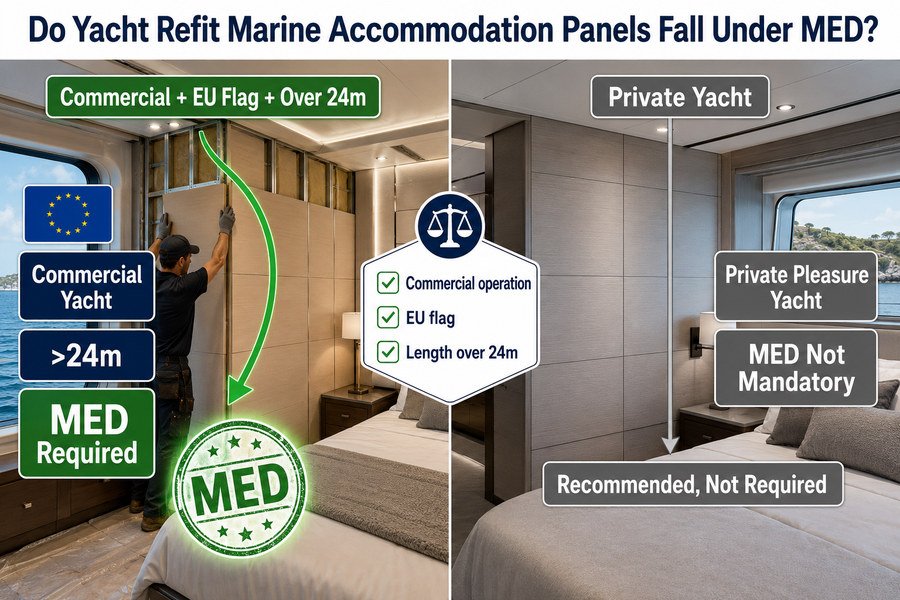
Commercial vs Private Yacht Rules for Marine Accommodation Panels
Yacht outfitting projects are very complex. The rules change depending on how the owner uses the yacht. First, we look at commercial yachts. A commercial yacht takes paying guests for charter holidays. If this commercial yacht exceeds 24 meters in length and flies an EU flag, the refit panels must have the MED Wheelmark20. You cannot use normal residential plywood in the corridors. You must buy MED-certified B-15 panels and apply luxury wood veneers over them. Second, we look at private pleasure yachts. A private yacht is only for the owner and their personal friends. Private pleasure yachts do not fall under MED21. The owner can install any panel they want. However, I always advise my clients to buy certified panels anyway. A fire on a private yacht is just as deadly as a fire on a commercial yacht.
The LY3 and REG Yacht Code Impact on Refit Marine Panels
Most large yachts follow specific industry codes. The Large Commercial Yacht Code (LY3) and the newer Red Ensign Group (REG) Yacht Code control yacht building and refitting. These codes align closely with MED and SOLAS. If you refit a 40-meter yacht under the REG code, you must install certified structural fire protection. The code requires B-15 bulkheads around the galley (kitchen) and engine room boundaries. When you order panels for a yacht refit, you face a big challenge. Yacht panels must be perfectly flat. Any bump on the panel will show through the high-gloss paint or thin leather covering. A standard cargo ship panel is too rough for a yacht. You must buy marine accommodation panels with a thicker steel skin. A 0.8mm steel skin gives a better surface than a 0.6mm skin. These premium yacht panels cost $45 to $60 per square meter before the decorative finish.
| Yacht Usage | Yacht Length | Flag State | Fire Code Standard | MED Panel Required? |
|---|---|---|---|---|
| Commercial | Over 24 meters | EU Member | REG Code / MED | Yes |
| Commercial | Over 24 meters | Non-EU | REG Code / SOLAS | No (Type Approval OK) |
| Private | Over 24 meters | Any Flag | Voluntary | No |
| Commercial | Under 24 meters | Any Flag | Local Small Craft Rules | No |
Conclusion
The MED applies mainly to EU-flagged commercial ships over 500 GT, passenger ships, and large commercial yachts. Always verify the ship's flag, size, and classification society before purchasing marine accommodation panels.
-
"[PDF] NASA-STD-8719.11B – 2020-08-20", https://standards.nasa.gov/sites/default/files/standards/NASA/B/1/nasa-std-871911b_with_change_1.pdf. The EU Marine Equipment Directive implementing acts list MED/3.11 under fire protection materials for B- and C-class divisions, supporting the regulatory classification of these marine panels. Evidence role: general_support; source type: government. Supports: Marine accommodation panels are listed under MED/3.11 in the EU Marine Equipment Directive framework.. ↩
-
"How Are Integrity and Insulation Judged in Marine Panel Fire Tests?", https://magellanmarinetech.com/how-integrity-insulation-judged-in-marine-panel-fire-tests/. SOLAS/IMO fire-safety provisions define B-class divisions by flame-resistance duration and temperature-rise criteria, including the average unexposed-face temperature limit used for B-15 classifications. Evidence role: definition; source type: institution. Supports: B-15 panels must meet the stated average temperature-rise limit for the first 15 minutes.. Scope note: The source defines the classification criteria; it does not verify that any particular supplier’s panel meets them. ↩
-
"[PDF] RESOLUTION MSC.307(88) (adopted on 3 December 2010 ...", https://wwwcdn.imo.org/localresources/en/KnowledgeCentre/IndexofIMOResolutions/MSCResolutions/MSC.307(88).pdf. The IMO 2010 FTP Code Annex 1 Part 3 specifies the standard fire-test time-temperature exposure for B-class divisions, providing context for the stated 30-minute furnace temperature condition. Evidence role: mechanism; source type: institution. Supports: The FTP Code fire test heats the furnace according to a standard curve reaching about 843°C at 30 minutes.. Scope note: This supports the prescribed laboratory test condition, not the performance of a specific product unless paired with an actual test report. ↩
-
"How Do Overseas Buyers Choose Marine Panel Suppliers by Class ...", https://magellanmarinetech.com/how-overseas-buyers-choose-marine-panel-suppliers-by-class-approval/. Independent customs, market-price, or procurement data may support the approximate order of magnitude and price premium for MED-certified B-15 marine panels compared with non-certified rockwool panels. Evidence role: statistic; source type: other. Supports: MED-certified B-15 panels are typically priced around $25–$32 per square meter.. Scope note: Panel prices vary by specification, order volume, steel thickness, freight terms, certification body, and date, so such evidence would contextualize rather than conclusively prove the quoted range. ↩
-
"[DOC] SUPPORTING STATEMENT FOR APPLICATIONS - Reginfo.gov", https://www.reginfo.gov/public/do/DownloadDocument?objectID=5077401. EU marine-equipment rules apply to equipment placed on board EU ships where international instruments require flag-state approval, while SOLAS uses a 500 gross tonnage threshold for many cargo-ship requirements. Evidence role: general_support; source type: government. Supports: The MED applies to seagoing merchant ships over 500 Gross Tonnage.. Scope note: This supports the regulatory context for the 500 GT threshold, but the specific panel requirement depends on the applicable MED implementing act and the product’s certification category. ↩
-
"International Convention on Tonnage Measurement of Ships", https://www.imo.org/en/About/Conventions/Pages/International-Convention-on-Tonnage-Measurement-of-Ships.aspx. The International Convention on Tonnage Measurement of Ships defines gross tonnage as a dimensionless value derived from the total volume of all enclosed spaces of a ship. Evidence role: definition; source type: institution. Supports: Gross Tonnage measures the internal volume of the ship.. ↩
-
"Safety regulations for different types of ships", https://www.imo.org/en/OurWork/Safety/Pages/RegulationsDefault.aspx. SOLAS and IMO materials define a passenger ship as a ship carrying more than twelve passengers, which explains the passenger-capacity threshold used for regulatory classification. Evidence role: definition; source type: institution. Supports: The MED applies to passenger ships carrying more than 12 passengers.. Scope note: This establishes the passenger-ship definition; whether a particular accommodation panel requires MED approval must still be verified against the relevant MED item list and flag-state implementation. ↩
-
"Marine Equipment Directive enters into force in the EEA", https://www.efta.int/media-resources/news/marine-equipment-directive-enters-force-eea. Directive 2014/90/EU defines its scope by reference to equipment placed on board EU ships and defines an EU ship as a ship flying the flag of a Member State. Evidence role: general_support; source type: government. Supports: The MED only legally binds ships flying the flag of a European Union member state.. Scope note: This supports the flag-state scope of the Directive, but non-EU-flag ships may still face MED requirements contractually or through port-state, class, or owner specifications. ↩
-
"Summary of SOLAS chapter II-2 - International Maritime Organization", https://www.imo.org/en/ourwork/safety/pages/summaryofsolaschapterii-2-default.aspx. The EU Marine Equipment Directive establishes common safety and performance requirements for marine equipment placed on EU ships, aligning approved equipment with international maritime safety instruments rather than distinguishing equipment obligations by crew or passenger use. Evidence role: historical_context; source type: government. Supports: The MED treats crew safety and passenger safety with equal importance.. Scope note: This supports the regulatory context for common safety approval standards, but it does not prove that every accommodation-space fire-rating rule is identical for crew and passenger areas. ↩
-
"What Is the Purpose and Scope of the IMO FTP Code? - Magellan ...", https://magellanmarinetech.com/what-purpose-scope-of-imo-ftp-code/. SOLAS Chapter II-2 and related fire-test procedures classify accommodation bulkheads and escape-route boundaries by fire integrity and insulation performance, with B-class divisions used in accommodation areas and specific ratings assigned by space category tables. Evidence role: expert_consensus; source type: institution. Supports: Corridor bulkheads in crew accommodation may require B-15 class panels under applicable marine fire-safety rules.. Scope note: The exact B-15 requirement depends on ship type, tonnage, flag administration, and the applicable SOLAS/classification-society table, so the source should be used to contextualize rather than universally prove this specification. ↩
-
"[PDF] recommendation for fire test procedures for “a” and “b” class ...", https://wwwcdn.imo.org/localresources/en/KnowledgeCentre/IndexofIMOResolutions/AssemblyDocuments/A.163(ES.IV).pdf. The IMO FTP Code describes B-class divisions as preventing flame passage for a 30-minute standard fire test, while the B-0 designation indicates no additional insulation-time requirement beyond fire integrity. Evidence role: definition; source type: institution. Supports: A B-0 panel provides B-class fire integrity for 30 minutes but has no rated insulation period.. Scope note: This supports the technical meaning of B-0 fire integrity; it does not by itself establish that B-0 is always the required rating between adjacent crew cabins. ↩
-
"[PDF] RESOLUTION A.754(18) adopted on 4 November 1993 ...", https://wwwcdn.imo.org/localresources/en/KnowledgeCentre/IndexofIMOResolutions/AssemblyDocuments/A.754(18).pdf. Marine fire-safety rules define C-class divisions as divisions constructed of approved non-combustible materials, without the same smoke, flame, or temperature-rise performance requirements applied to A- or B-class divisions. Evidence role: definition; source type: institution. Supports: C-class panels are non-combustible interior linings with less stringent fire-resistance requirements than A- or B-class divisions.. Scope note: This supports the definition of C-class materials, but the acceptability of C-class linings against a hull depends on the vessel’s approved fire-control plan and applicable structural fire-protection requirements. ↩
-
"Marine Equipment Directive enters into force in the EEA - Efta.Int", https://www.efta.int/media-resources/news/marine-equipment-directive-enters-force-eea. Directive 2014/90/EU defines its scope by reference to marine equipment placed on board ships flying the flag of an EU Member State, supporting the distinction between EU-flagged vessels subject to MED marking and non-EU-flagged vessels such as Panama-flagged ships. Evidence role: definition; source type: government. Supports: The EU Marine Equipment Directive does not directly require a Panama-flagged vessel to use Wheelmark-certified accommodation panels.. Scope note: This supports the legal scope of the MED generally; individual port-state or contractual requirements may still require equivalent documentation. ↩
-
"Port State Control - International Maritime Organization", https://www.imo.org/en/ourwork/msas/pages/portstatecontrol.aspx. The Paris Memorandum of Understanding on Port State Control describes inspections of foreign ships in European and North Atlantic ports for compliance with international conventions, including SOLAS, supporting the statement that non-EU-flagged vessels may be inspected when calling at European ports. Evidence role: general_support; source type: institution. Supports: Foreign-flag vessels visiting European ports remain subject to Port State Control inspections.. Scope note: This evidence supports the existence and scope of port-state inspection regimes, not the outcome of any specific vessel inspection. ↩
-
"What Is the Purpose and Scope of the IMO FTP Code? - Magellan ...", https://magellanmarinetech.com/what-purpose-scope-of-imo-ftp-code/. IMO SOLAS Chapter II-2 and the International Code for Application of Fire Test Procedures identify fire-test procedures for materials and constructions used on ships, supporting the claim that accommodation-panel fire performance is assessed under the IMO FTP Code framework. Evidence role: mechanism; source type: institution. Supports: Accommodation panels for SOLAS-covered ships must comply with the applicable IMO FTP Code fire-test standards.. Scope note: The source establishes the regulatory fire-testing framework; it does not verify that any particular panel product has passed the required tests. ↩
-
"[PDF] PROCEDURES FOR PORT STATE CONTROL, 2023", https://wwwcdn.imo.org/localresources/en/OurWork/IIIS/Documents/A%2033-Res.1185%20-%20PROCEDURES%20FOR%20PORT%20STATE%20CONTROL,%202023%20(Secretariat)%20(1).pdf. Paris MoU guidance and annual inspection reporting state that Port State Control may detain ships when deficiencies are serious enough to make the ship unsafe or non-compliant with applicable conventions, supporting detention as a possible consequence of major certification or safety deficiencies. Evidence role: general_support; source type: institution. Supports: Port State Control can detain a foreign-flagged ship for serious non-compliance, including safety-related certification deficiencies.. Scope note: This supports detention as an enforcement mechanism; it does not prove that every uncertified accommodation-panel case will result in detention. ↩
-
"Factsheet - 32025R2177 | European Free Trade Association - Efta.Int", https://www.efta.int/eea-lex/32025r2177. Directive (EU) 2016/1629 and CESNI materials identify ES-TRIN as the technical standard used for Union certificates for inland navigation vessels, supporting the distinction between inland-waterway requirements and seagoing marine-equipment regimes. Evidence role: historical_context; source type: government. Supports: European inland waterway vessels are governed by ES-TRIN rather than the MED/SOLAS framework used for seagoing vessels.. Scope note: This supports the regulatory framework for inland vessels in Europe, but it does not by itself establish the certification status of any particular panel product. ↩
-
"Are Marine Fire Divisions the Same as Marine Panel Ratings?", https://magellanmarinetech.com/are-marine-fire-divisions-same-as-marine-panel-ratings/. ES-TRIN fire-protection provisions specify fire-resistance requirements for certain passenger-vessel divisions, including time-rated performance criteria, supporting the article’s claim that some inland-vessel bulkheads are assessed under ES-TRIN-specific fire-test durations. Evidence role: mechanism; source type: institution. Supports: ES-TRIN uses a 45-minute fire-test requirement for certain bulkheads rather than simply applying SOLAS A-30 or A-60 categories.. Scope note: The citation should be tied to the exact ES-TRIN clause that states the 45-minute requirement; otherwise it only supports the broader point that ES-TRIN uses its own time-rated fire-resistance criteria. ↩
-
"[PDF] Chapter 7 Resistance and Powering of Ships", https://www.usna.edu/NAOE/_files/documents/Courses/EN400/02.07%20Chapter%207.pdf. Naval-architecture and inland-waterway guidance explains that vessel displacement affects draft and that reduced displacement can lower resistance and energy demand, providing contextual support for the claim that lighter accommodation materials can improve shallow-water operation and fuel use. Evidence role: general_support; source type: research. Supports: Reducing panel weight can reduce vessel displacement, which can help shallow-water navigation and may reduce fuel consumption.. Scope note: This supports the physical relationship between weight, draft, resistance, and energy use, but it does not quantify fuel savings for the specific panel weights or vessel design described in the article. ↩
-
"Marine Equipment Directive enters into force in the EEA - Efta.Int", https://www.efta.int/media-resources/news/marine-equipment-directive-enters-force-eea. Directive 2014/90/EU establishes that specified marine equipment placed on board ships flying an EU Member State flag must meet harmonised approval requirements and carry the Wheelmark conformity mark. Evidence role: general_support; source type: government. Supports: An EU-flagged commercial yacht requiring regulated marine equipment may need MED Wheelmark-approved refit panels.. Scope note: The source supports the regulatory framework, but whether a particular accommodation panel is covered depends on the vessel’s certification basis, flag administration interpretation, and the equipment category listed under MED implementing rules. ↩
-
"Raft of shipping rules in force from 1 January 2026", https://www.imo.org/en/mediacentre/pressbriefings/pages/raft-of-shipping-rules-in-force-from-1-january-2026.aspx. SOLAS generally excludes pleasure yachts not engaged in trade from its application, which helps explain why SOLAS- and MED-derived mandatory equipment regimes are commonly linked to commercial operation rather than purely private use. Evidence role: historical_context; source type: institution. Supports: Private pleasure yachts are generally outside the mandatory SOLAS/MED commercial-yacht equipment regime.. Scope note: This is contextual support only; private yachts may still face national flag-state, class, insurance, port-state, or voluntary compliance requirements. ↩