You buy building panels cheaply, but shipyard inspectors reject them, causing huge delays. Here is exactly why ship panels face stricter rules and how to pass inspections.
Marine accommodation panels face stricter regulations than standard building panels because ships are isolated, moving environments. Regulations must cover fire containment (SOLAS), moisture resistance, structural vibration tolerance, and low toxicity, ensuring passenger survival at sea where land-based emergency services are completely unavailable.
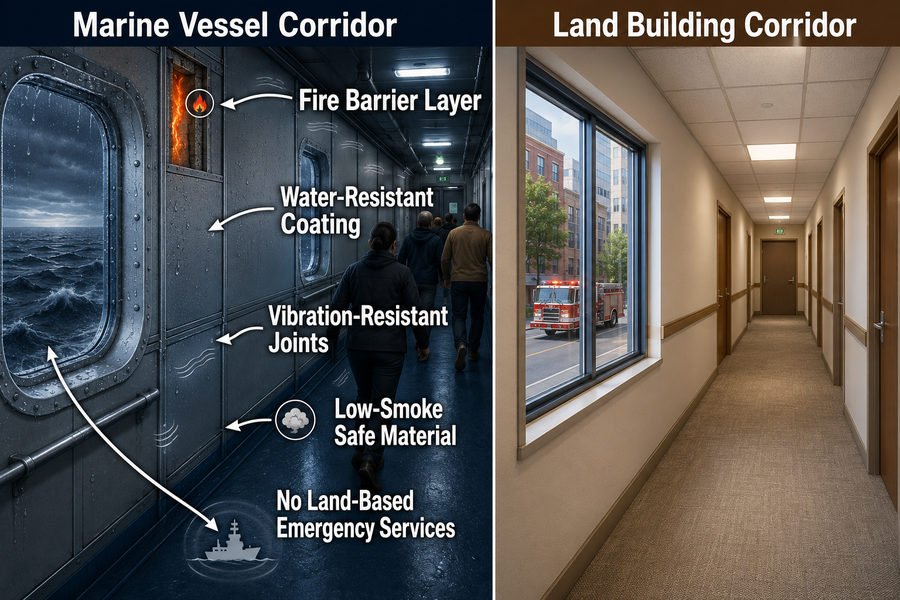
Many buyers think land and sea panels are the same. Let us look closely at why this mistake costs thousands of dollars and how you can avoid it.
Why Are Standard Gypsum Drywall Panels Banned From Ship Interiors?
Standard drywall cracks at sea, leading to failed inspections and ruined interiors. You must use approved marine boards to save your project timeline.
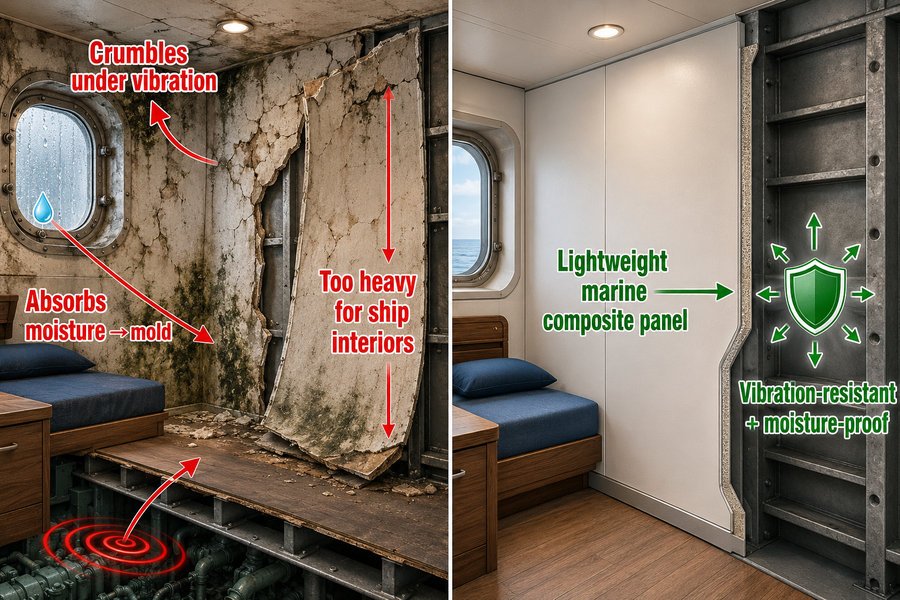
Standard gypsum drywall is banned from ship interiors for three main reasons: it crumbles under constant engine vibration, absorbs marine moisture leading to severe mold, and adds too much weight. Ship interiors require specialized lightweight, vibration-resistant, and moisture-proof composite panels.
Reason 1: The Impact of Engine Vibration on Drywall Integrity
A ship constantly vibrates. A marine diesel engine creates strong vibrations, usually between 5 Hz and 100 Hz1. Standard gypsum drywall consists of crushed rock powder pressed between heavy paper layers. It has no flexibility. Under constant ship vibration, standard drywall cracks at the joints within just a few weeks. I saw this exact problem on a river ferry project in 2015. The buyer used cheap drywall. We had to tear out 500 square meters of broken walls. Marine accommodation panels use steel skins or PVC films bonded to high-density rockwool. This composite structure flexes with the ship movement and never cracks.
Reason 2: Marine Moisture Absorption and Weight Issues in Standard Drywall
The ocean environment is very wet. Humidity on a ship often stays above 80%. Normal drywall acts like a dry sponge. It absorbs water from the air, becomes soft, and grows mold very quickly2. Weight is another huge problem. Standard 15mm fire-rated drywall weighs about 11.5 kg per square meter. You need thick steel studs to hold it. A standard B-15 marine rockwool panel of 50mm thickness weighs only about 14 kg to 16 kg per square meter, but it provides the wall structure and the fire insulation all at once. Saving weight is critical. Every extra ton of heavy drywall reduces the ship's cargo capacity and slows the ship down3.
Reason 3: Compliance Differences Between Land and Sea Panels
Standard drywall does not meet the International Maritime Organization (IMO) rules. When standard drywall burns, the paper and paint can release toxic smoke. Marine panels pass strict IMO tests to ensure they release almost zero toxic gas4.
| Feature | Standard Gypsum Drywall | Marine Composite Rockwool Panel |
|---|---|---|
| Vibration Tolerance | Very Low (Cracks easily) | High (Flexes with hull) |
| Moisture Resistance | Poor (Absorbs water and molds) | Excellent (Galvanized steel face) |
| Average Weight | Heavy (Requires heavy studs) | Lightweight (Self-supporting) |
| IMO Certification | None | Yes (Wheelmark / DNV / ABS) |
What Regulatory Risks Come From Using Commercial Panels in Vessel Accommodations?
Using cheap commercial panels seems smart until the port authority grounds your ship. These hidden regulatory risks can bankrupt your entire interior outfitting project.
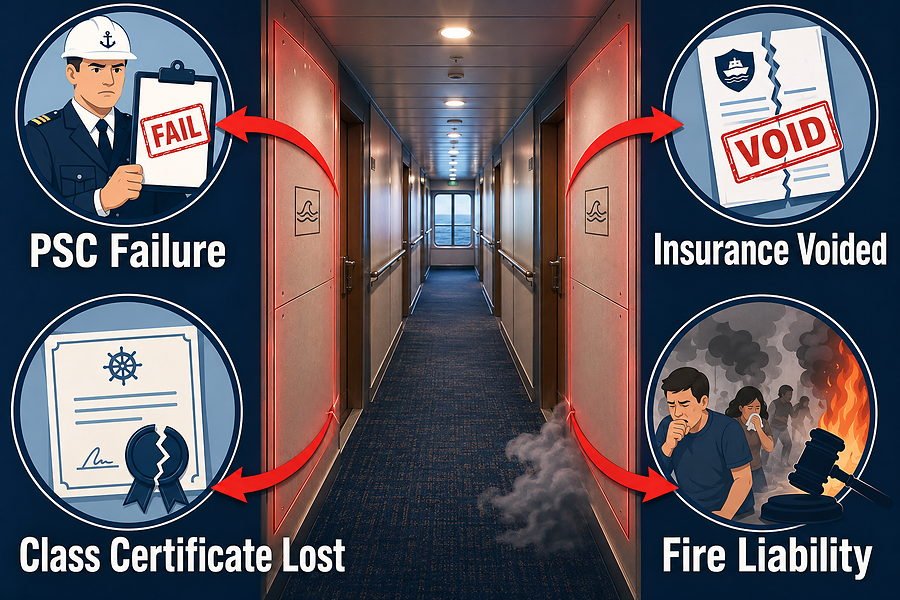
Using commercial panels in vessel accommodations creates four major regulatory risks: failing the Port State Control (PSC) inspection, voiding the ship's marine insurance, losing the vessel's classification society certificate, and facing severe legal liabilities if a fire occurs and toxic smoke harms passengers.
Risk 1 and Risk 2: Failing Port State Control and Voiding Marine Insurance
When a commercial ship enters a port, Port State Control (PSC) inspectors check the safety materials. If they find commercial building panels without a marine wheelmark or a classification certificate, they will detain the ship immediately5. A detained ship cannot leave the port. This costs the ship owner $10,000 to $50,000 per day6 in port fees and lost cargo business. Furthermore, if you install unapproved commercial panels, you automatically void the ship's marine insurance7. If a fire starts on board, the insurance investigators will check the panel certificates. If they find land-based commercial panels, the insurance company will refuse to pay any money for the damages.
Risk 3 and Risk 4: Losing Classification Certificates and Facing Legal Liabilities
Every commercial ship must register with a classification society like DNV, ABS, or Lloyd's Register. These societies enforce the Safety of Life at Sea (SOLAS) rules. Commercial panels do not have approvals from these societies. If the marine surveyor sees commercial panels during the annual check, they will cancel the ship's certificate. Without this certificate, the ship cannot sail legally anywhere in the world. Finally, commercial boards often use cheap glues. These glues release deadly cyanide gas when they burn8. If passengers die from toxic smoke because you used unapproved materials, you will face huge legal lawsuits. I always tell my clients that saving 20% on panel costs is never worth losing your entire business.
| Regulatory Risk | Consequence of Using Commercial Panels | Action Required |
|---|---|---|
| PSC Inspection | Ship detention; fines of $10,000+ per day. | Use only Wheelmark approved panels. |
| Marine Insurance | Policy voided; claims denied after a fire. | Keep all marine certificates on file. |
| Class Certificate | Loss of DNV/ABS/LR registry status. | Buy from certified marine suppliers. |
| Legal Liability | Lawsuits due to toxic smoke injuries. | Ensure IMO FTP Code compliance. |
Why Must Marine Accommodation Panels Carry Vessel-Specific Approvals?
You buy a certified panel but the inspector still rejects it. This happens when you ignore vessel-specific approvals. Match the panel to the ship type.
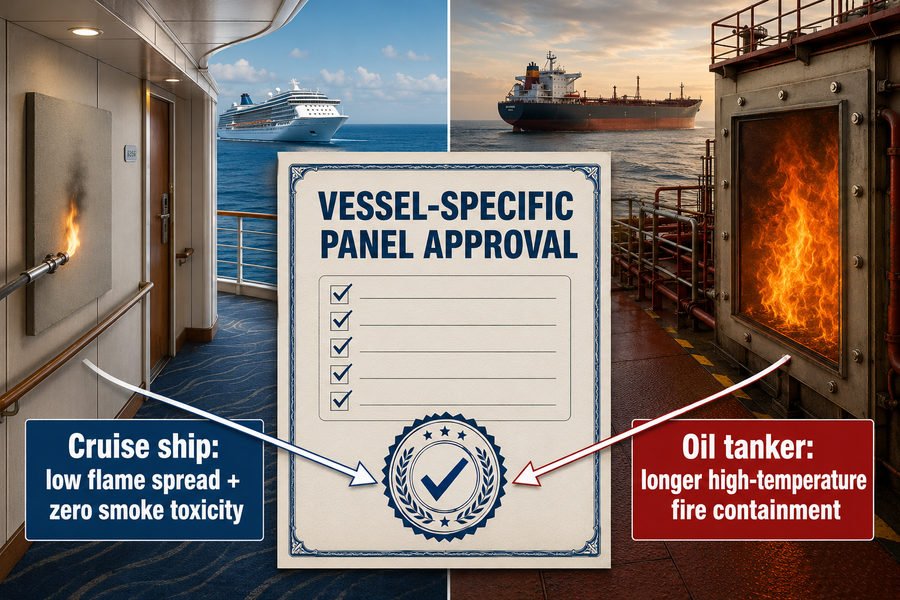
Marine accommodation panels must carry vessel-specific approvals because different ships face different operational hazards. A passenger cruise ship requires panels with extreme low flame spread and zero smoke toxicity, while an oil tanker requires panels that can contain high-temperature hydrocarbon fires for longer durations.
Approval Variations for Passenger Cruise Ships
Passenger ships have thousands of people sleeping in tight cabin spaces. Evacuation takes a long time. Because of this, panels on a cruise ship must meet very strict smoke and toxicity limits under IMO 2010 FTP Code Part 2 and Part 59. During the lab test, the carbon monoxide release limit cannot exceed 1450 ppm. The panels must give people at least 30 to 60 minutes to escape without breathing deadly fumes. You cannot use just any marine panel here. The certificate must specifically state it is approved for passenger vessel cabins.
Approval Variations for Oil Tankers and Cargo Vessels
Oil tankers carry millions of gallons of highly flammable liquids. The fire risk is much higher, and oil fires burn much hotter than regular cabin fires. According to SOLAS Chapter II-2, the walls separating the machinery space from the accommodation block on a tanker must withstand extreme heat. Sometimes, tankers require H-class ratings. An H-class test exposes the panel to a hydrocarbon fire reaching 1100°C in just 10 minutes10. A standard passenger ship panel will melt and fail this test instantly. I once helped a buyer who bought passenger panels for a chemical tanker. The surveyor rejected all of them. We had to order specific high-temperature panels, which delayed his project by 45 days.
| Vessel Type | Primary Fire Hazard | Key Panel Requirement |
|---|---|---|
| Passenger Cruise Ship | Slow evacuation, large crowds. | Low flame spread, strictly zero toxic smoke. |
| Oil / Chemical Tanker | Hydrocarbon fuel explosions. | Extreme heat resistance (up to 1100°C). |
| Offshore Platform | Industrial fires, extreme weather. | H-Class fire ratings, high wind load tolerance. |
| River Ferry | Fast evacuation, shallow water. | Lightweight B-Class panels, basic smoke control. |
Are ASTM or EN Building Panel Ratings Valid for Shipboard Bulkhead Linings?
Do not trust land-based fire certificates for your ship project. Relying on ASTM or EN land ratings will cause your entire installation to fail marine survey.
ASTM or EN building panel ratings are never directly valid for shipboard bulkhead linings. Ships strictly follow the IMO FTP Code. While ASTM E119 or EN 13501 test for building fires, the IMO FTP Code includes unique marine tests for vibration, marine humidity, and steel-deck heat transfer.
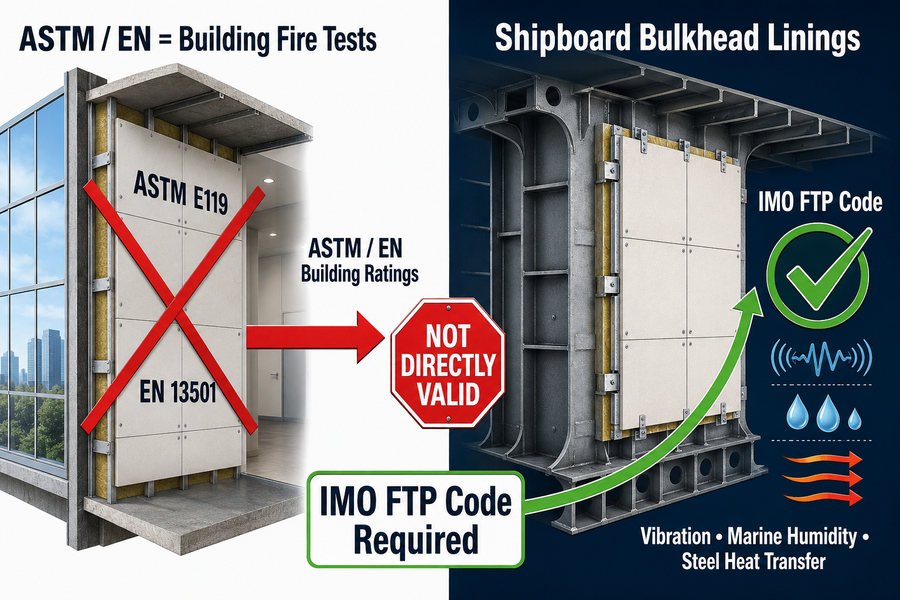
Differences Between ASTM E119 Building Tests and IMO FTP Code Marine Tests
ASTM E119 is the standard fire test for building materials in the United States. EN 13501 is the standard for buildings in Europe. These tests check how long a brick or wood wall can hold back a fire in a static building. However, they are completely invalid for ships. Ships use steel structures. Steel conducts heat very fast. The IMO FTP Code Part 3 requires a marine panel to stop heat from transferring through a steel bulkhead. If the unexposed side of the panel reaches 140°C above the starting temperature, the panel fails the test.11 ASTM and EN tests do not account for ship steel heat transfer in this specific way.
Why Marine Humidity and Vibration Render Land Standards Invalid
Land standards also do not test for the harsh ocean environment. A building does not move. A ship rolls and pitches in the waves constantly. The IMO requires marine panel products to endure heavy salt air and severe mechanical stress. An EN-rated fire door for a land hotel will rust and jam shut on a ship within six months. I remind all my buyers: unless you see the steering wheel logo (the European Wheelmark)12 or a certificate from ABS, DNV, or Lloyd's Register, you cannot use the panel on a ship. Land certificates mean absolutely nothing to a marine surveyor.
| Feature | ASTM E119 / EN 13501 (Land) | IMO FTP Code (Marine) |
|---|---|---|
| Primary Focus | Static building fire containment. | Steel deck heat transfer & ship movement. |
| Temperature Limit Rule | Varies by building code. | Max 140°C average rise on unexposed side. |
| Vibration Testing | Not required. | Panel joints must withstand ship flexing. |
| Surveyor Acceptance | Will be rejected instantly. | Fully accepted worldwide. |
Why Are Marine Accommodation Panel Approvals Tied to Vessel Type and Compartment Function?
Putting a cabin panel in a kitchen area will get your ship detained. You must match the panel rating strictly to the specific room's function.
Marine panel approvals are tied to compartment function because different rooms have different fire risks. Under SOLAS regulations, ship spaces are divided into categories. A galley (kitchen) needs high-fire-risk A-Class panels, while a sleeping cabin only needs lower-risk B-Class panels, and stairway enclosures require strict A-Class smoke containment.
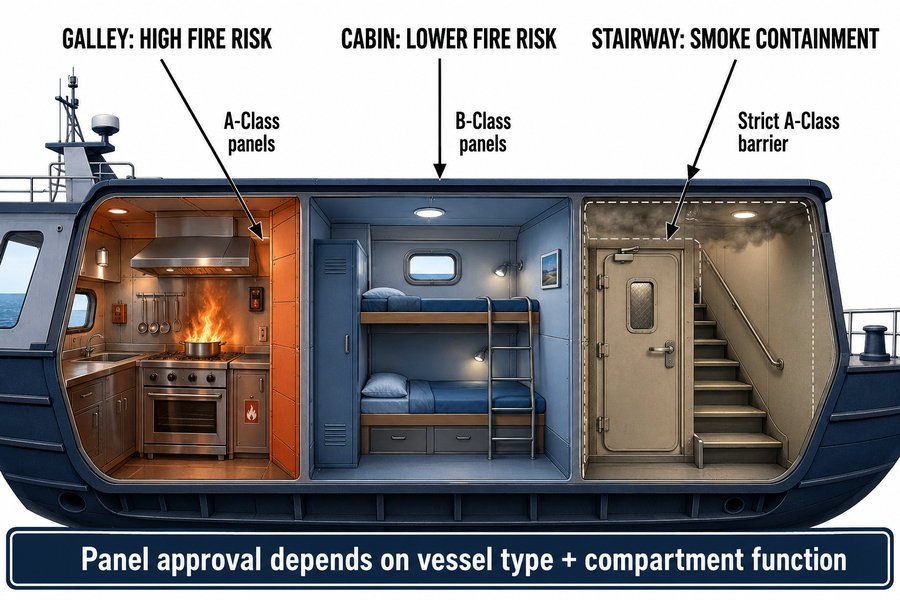
Compartment Function Rules for High-Risk Galley Areas and Stairways
SOLAS Chapter II-2 categorizes every single room on a ship. A galley (Category 12) is a very high fire risk because of cooking oils, deep fryers, and hot stoves. Therefore, the walls separating a galley from other spaces must use A-60 class panels13. An A-60 panel must stop smoke and flames for a full 60 minutes and keep the cold side temperature from rising more than 140°C. Stairway enclosures are also critical areas. They are the only escape routes for passengers. Stairways act like chimneys during a fire. They pull smoke upwards. Because of this, stairway enclosures also require strict A-Class panels to prevent smoke from spreading between different decks.
Compartment Function Rules for Low-Risk Sleeping Cabins
Sleeping cabins (Category 6) have a much lower fire risk. For the partition walls between two sleeping cabins, SOLAS usually requires only B-15 class panels. A B-15 panel must stop flames for 30 minutes, but it only needs to control the temperature rise for 15 minutes14. A standard B-15 panel is about 50mm thick and costs around $30 to $45 per square meter in Asia. An A-60 panel might be 100mm thick or require extra insulation layers, costing $60 to $90 per square meter. If you use expensive A-60 panels in a B-15 cabin area, you waste your project budget and add too much weight. If you use B-15 panels in an A-60 galley area, you fail the inspection. You must buy exactly what the room requires.
| Room Type | SOLAS Category | Typical Panel Requirement | Estimated Cost (Per Sqm) |
|---|---|---|---|
| Sleeping Cabin | Category 6 | B-15 Class | $30 - $45 |
| Corridor | Category 7 | B-15 Class | $30 - $45 |
| Galley / Kitchen | Category 12 | A-60 Class | $60 - $90 |
| Main Stairway | Category 2 | A-0 or A-60 Class | $50 - $90 |
Why Are Commercial Fire-Rated Boards Not Accepted as Marine Accommodation Panel Substitutes?
You found a cheap fire board that looks just like a marine panel. Do not buy it. It lacks the critical marine joint systems required by law.
Commercial fire-rated boards are not accepted as marine panel substitutes for three key reasons: their joint connection systems fail under ship movement, they lack certified low-flame-spread decorative surface films, and their core materials degrade when exposed to continuous marine salt spray and high-humidity environments.
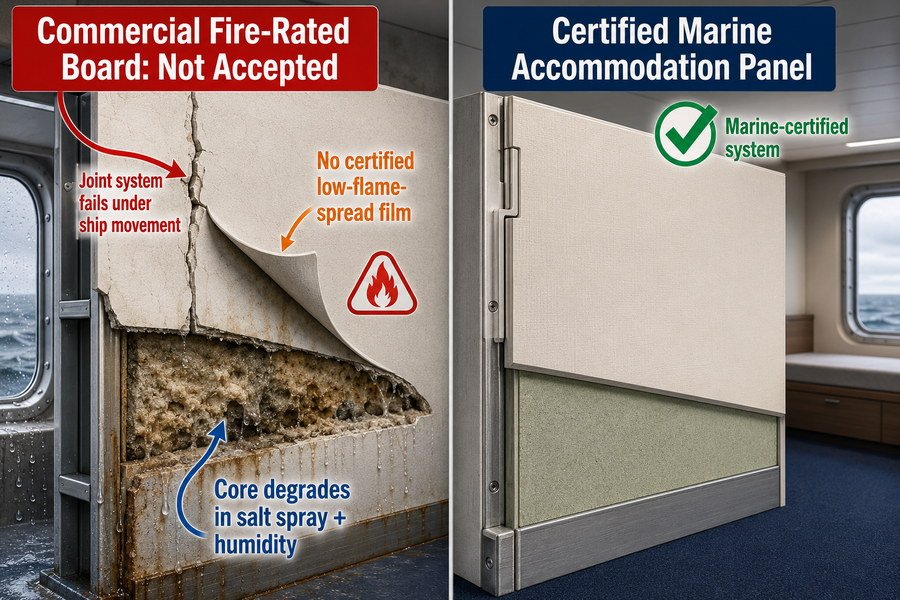
Joint Connection Failures in Commercial Fire Boards
Marine panels use very specific tongue-and-groove or metal spline connection systems. These joints are tested together as a complete wall system in the fire lab. When a ship rolls in the ocean waves, the ship walls flex. Marine joints stay locked together. They prevent fire and smoke from shooting through the cracks. Commercial fire boards usually use simple flat edges. Workers cover these flat edges with paper tape and mud. When the ship moves, the dry mud cracks, and the joint opens up. If a fire starts, the flames will easily pass through these broken joints in just a few minutes. The IMO tests the whole panel system, including the joints, not just the board itself.15
Surface Films and Core Material Degradation in Commercial Substitutes
Commercial fire boards usually require wet paint or wallpaper after installation. On a ship, you cannot just use any paint or wallpaper from a local store. You must use PVC or PET surface films that pass the IMO low flame spread tests16. Approved marine panels come from the factory with these safe films already permanently bonded to the metal surface. Also, the inner core material of a commercial board often breaks down in wet sea air. A good marine panel uses high-density rockwool, typically 120 kg per cubic meter. This dense rockwool resists moisture and salt. I once had to replace commercial boards on a workboat because the salt air turned the core into wet mush in less than a year.
| Component | Commercial Fire Board | Marine Accommodation Panel |
|---|---|---|
| Joint System | Tape and mud (cracks under motion). | Tongue-and-groove or spline (secure). |
| Surface Finish | Standard paint (high flame spread). | IMO certified PVC/PET film. |
| Core Material | Gypsum or light foam (rots in salt air). | 120 kg/m3 density rockwool. |
| Installation Speed | Slow (requires framing, mudding, painting). | Fast (modular, pre-finished). |
Conclusion
Marine panels are highly specialized safety systems. Always choose IMO-certified panels over commercial building boards to ensure passenger safety, pass strict marine inspections, and avoid costly shipyard delays.
-
"Vibration diagnosis study about the marine diesel engine based on ...", https://ui.adsabs.harvard.edu/abs/2010csps....3...48C/abstract. A marine engineering or vibration-control source should document the typical low-frequency vibration range associated with ship propulsion machinery and hull response, providing context for why interior partitions may be exposed to repeated dynamic loading. Evidence role: statistic; source type: paper. Supports: A marine diesel engine creates strong vibrations, usually between 5 Hz and 100 Hz.. Scope note: The exact frequency range can vary by engine speed, mounting system, hull structure, and measurement location. ↩
-
"A Brief Guide to Mold, Moisture and Your Home | US EPA", https://www.epa.gov/mold/brief-guide-mold-moisture-and-your-home. A building-science or public-health source should support that gypsum board and paper facings can absorb moisture and that damp cellulose-faced materials can support mold growth under humid conditions. Evidence role: mechanism; source type: government. Supports: Normal drywall absorbs moisture from humid air, can soften, and can support mold growth.. Scope note: Such sources usually establish moisture and mold susceptibility in general building conditions, not specifically in ship accommodation spaces. ↩
-
"Ship's Tonnage Terms Explained — San Pedro News Pilot 20 ...", https://cdnc.ucr.edu/?a=d&d=SPNP19411020.2.194. A naval architecture source should explain that a vessel’s deadweight and displacement determine available payload and that added lightweight reduces cargo allowance and may increase resistance or fuel demand at a given speed. Evidence role: general_support; source type: education. Supports: Additional interior weight reduces a ship’s payload margin and can adversely affect operating performance.. Scope note: The source may support the underlying naval-architecture principle rather than quantify the effect of one ton of interior material on a specific vessel. ↩
-
"What Is the IMO FTP Code for Marine Interior Materials?", https://magellanmarinetech.com/what-imo-ftp-code-for-marine-interior-materials/. The IMO Fire Test Procedures Code specifies smoke and toxicity testing for materials used on ships, supporting that certified marine interior materials are assessed against regulated smoke and toxic-gas criteria. Evidence role: definition; source type: institution. Supports: Marine panels used in regulated ship interiors must satisfy IMO fire-test requirements addressing smoke and toxic gas emissions.. Scope note: The IMO tests set maximum permitted concentrations and performance criteria; they do not demonstrate that emissions are literally zero. ↩
-
"[PDF] PROCEDURES FOR PORT STATE CONTROL, 2023", https://wwwcdn.imo.org/localresources/en/OurWork/IIIS/Documents/A%2033-Res.1185%20-%20PROCEDURES%20FOR%20PORT%20STATE%20CONTROL,%202023%20(Secretariat)%20(1).pdf. Port State Control regimes authorize detention when deficiencies create a serious safety, security, or environmental risk, including failures to comply with applicable statutory requirements; however, detention depends on the inspector’s assessment and is not automatic for every documentation defect. Evidence role: general_support; source type: institution. Supports: PSC inspectors may detain a vessel when non-compliant safety materials or missing approvals constitute a serious deficiency.. Scope note: Supports PSC detention authority and practice, but not the absolute claim that detention is immediate in every case. ↩
-
"[PDF] PROCEDURES FOR PORT STATE CONTROL, 2023", https://wwwcdn.imo.org/localresources/en/OurWork/IIIS/Documents/A%2033-Res.1185%20-%20PROCEDURES%20FOR%20PORT%20STATE%20CONTROL,%202023%20(Secretariat)%20(1).pdf. Studies and maritime-industry analyses of vessel detention and off-hire costs report that delays can impose substantial daily costs through port charges, charter-party off-hire exposure, and lost operating revenue; the exact amount varies by vessel type, port, cargo, and charter terms. Evidence role: statistic; source type: paper. Supports: A detained commercial vessel can generate significant daily financial losses, potentially reaching tens of thousands of dollars per day.. Scope note: Can support the plausibility of high daily detention costs, but a single source may not verify the exact USD 10,000–50,000 range for all commercial ships. ↩
-
"[PDF] applying the knowing neglect standard in time hull insurance", https://digitalcommons.mainelaw.maine.edu/cgi/viewcontent.cgi?article=1889&context=mlr. Marine insurance law and policy terms commonly require disclosure, seaworthiness, and compliance with statutory or class requirements, and a material breach may affect cover or claims; whether cover is voided depends on the governing law and the specific policy wording. Evidence role: mechanism; source type: government. Supports: Installing unapproved materials may jeopardize marine insurance coverage if it breaches policy, seaworthiness, or statutory-compliance obligations.. Scope note: Supports the legal mechanism by which non-compliance may affect insurance, but not the categorical claim that all policies are automatically voided. ↩
-
"Intoxication by cyanide in fires: a study in monkeys using ... - PubMed", https://pubmed.ncbi.nlm.nih.gov/6098227/. Fire-toxicology literature identifies hydrogen cyanide as a lethal combustion product associated with nitrogen-containing polymers and resins used in some building and furnishing materials; the risk depends on the material chemistry, fire conditions, ventilation, and exposure concentration. Evidence role: mechanism; source type: paper. Supports: Some adhesives, resins, or composite materials can generate toxic hydrogen cyanide during combustion, creating a serious smoke-inhalation hazard.. Scope note: Supports the general combustion-toxicity mechanism, but not the claim that all cheap glues or all commercial boards release cyanide when burned. ↩
-
"[PDF] RESOLUTION MSC.307(88) (adopted on 3 December 2010 ...", https://wwwcdn.imo.org/localresources/en/KnowledgeCentre/IndexofIMOResolutions/MSCResolutions/MSC.307(88).pdf. The IMO 2010 FTP Code sets out test procedures for smoke and toxicity and for surface flammability of materials used on ships, providing the regulatory context for panel approval in passenger-vessel interiors. Evidence role: definition; source type: institution. Supports: Panels on a cruise ship must meet strict smoke and toxicity limits under IMO 2010 FTP Code Part 2 and Part 5.. Scope note: The source would support the applicable test framework, but individual panel certificates are still needed to verify approval for a specific vessel use. ↩
-
"[PDF] RESOLUTION MSC.307(88) (adopted on 3 December 2010 ...", https://wwwcdn.imo.org/localresources/en/KnowledgeCentre/IndexofIMOResolutions/MSCResolutions/MSC.307(88).pdf. Hydrocarbon fire test curves used for H-class divisions specify a rapid temperature rise to about 1100°C within the early stage of the test, supporting the statement that H-class-rated panels are assessed against more severe hydrocarbon-fire exposure than standard cellulosic fire tests. Evidence role: mechanism; source type: institution. Supports: An H-class test exposes the panel to a hydrocarbon fire reaching 1100°C in just 10 minutes.. Scope note: The source would substantiate the test curve and rating context; it does not by itself prove that any particular passenger-ship panel would fail the test. ↩
-
"[PDF] RESOLUTION MSC.307(88) (adopted on 3 December 2010 ...", https://wwwcdn.imo.org/localresources/en/KnowledgeCentre/IndexofIMOResolutions/MSCResolutions/MSC.307(88).pdf. The IMO FTP Code fire-resistance criteria for A-class divisions specify limits on temperature rise on the unexposed face, including a 140°C average-rise criterion, supporting the stated marine test threshold. Evidence role: definition; source type: institution. Supports: The IMO FTP Code Part 3 uses a 140°C unexposed-side temperature-rise failure criterion for relevant marine fire-resistance tests.. Scope note: The criterion applies within the FTP Code’s specified division/fire-test context and may also include additional point-temperature and integrity requirements not stated in the article. ↩
-
"Directive 96/98/EC - Wikipedia", https://en.wikipedia.org/wiki/Directive_96/98/EC. EU Marine Equipment Directive materials explain that the Wheelmark indicates conformity assessment for marine equipment placed on board EU-flagged ships, supporting the article’s point that marine-specific approval marks differ from ordinary land-building certificates. Evidence role: general_support; source type: government. Supports: The European Wheelmark is a recognized marine-equipment conformity mark relevant to shipboard acceptance.. Scope note: This supports the EU Wheelmark portion of the claim; it does not by itself prove worldwide acceptance rules or that ABS, DNV, or Lloyd’s Register certificates are always required for every ship or panel type. ↩
-
"Which vessel areas under SOLAS Chapter II-2 demand the ...", https://magellanmarinetech.com/which-vessel-areas-under-solas-chapter-ii-2-demand-strictest-marine-panel-requirements/. SOLAS Chapter II-2, Regulation 9 classifies galleys as high fire-risk service spaces and uses tabulated fire-integrity requirements to determine the A-class rating of boundaries between galleys and adjacent spaces. Evidence role: general_support; source type: institution. Supports: Walls separating a galley from other ship spaces may be required under SOLAS fire-integrity tables to use A-60 class divisions.. Scope note: The precise rating depends on the ship type and the category of the adjacent space; the source may support A-60 for many relevant boundaries rather than as a universal rule for every galley wall. ↩
-
"[PDF] recommendation for fire test procedures for “a” and “b” class ...", https://wwwcdn.imo.org/localresources/en/KnowledgeCentre/IndexofIMOResolutions/AssemblyDocuments/A.163(ES.IV).pdf. The SOLAS/FTP Code definitions of B-class divisions state that they prevent flame passage for the first half hour, while B-15 insulation performance is measured by limiting temperature rise for 15 minutes. Evidence role: definition; source type: institution. Supports: A B-15 fire division resists flame passage for 30 minutes and meets its insulation temperature-rise criterion for 15 minutes.. ↩
-
"[PDF] RESOLUTION MSC.307(88) (adopted on 3 December 2010 ...", https://wwwcdn.imo.org/localresources/en/KnowledgeCentre/IndexofIMOResolutions/MSCResolutions/MSC.307(88).pdf. The IMO FTP Code fire-resistance test procedures evaluate representative bulkhead or deck assemblies, including construction details such as joints and related discontinuities, supporting the statement that approval is based on an assembled division rather than only on a board material. Evidence role: general_support; source type: institution. Supports: IMO fire testing for marine wall divisions assesses the complete panel system, including joints, rather than only the board itself.. Scope note: This supports the regulatory test approach but does not establish the performance of any particular marine panel or joint design. ↩
-
"How Does the IMO FTP Code Connect with Other Marine Fire Safety ...", https://magellanmarinetech.com/how-imo-ftp-code-connect-with-other-marine-fire-safety-frameworks/. The IMO FTP Code includes surface flammability test procedures used to determine low flame-spread characteristics for materials used on ships, supporting the need for compliant surface finishes in marine accommodation areas. Evidence role: definition; source type: institution. Supports: Surface films or finishes used on ships must meet IMO low flame-spread testing requirements where applicable.. Scope note: This supports the existence and purpose of IMO low-flame-spread testing; it does not prove that PVC or PET films are uniquely required or that any specific film is approved. ↩