Hull vibrations keep passengers awake and cause shipyard rejections. You lose money when cabins fail noise tests. I will show you which panel features solve structure-borne noise problems completely.
Marine panels target structure-borne noise through three primary design features: structural decoupling mounts that break physical contact, resilient joint systems that absorb panel-to-panel friction, and high-elasticity core materials instead of heavy mass. These features stop engine vibrations from becoming cabin noise according to IMO noise limits.
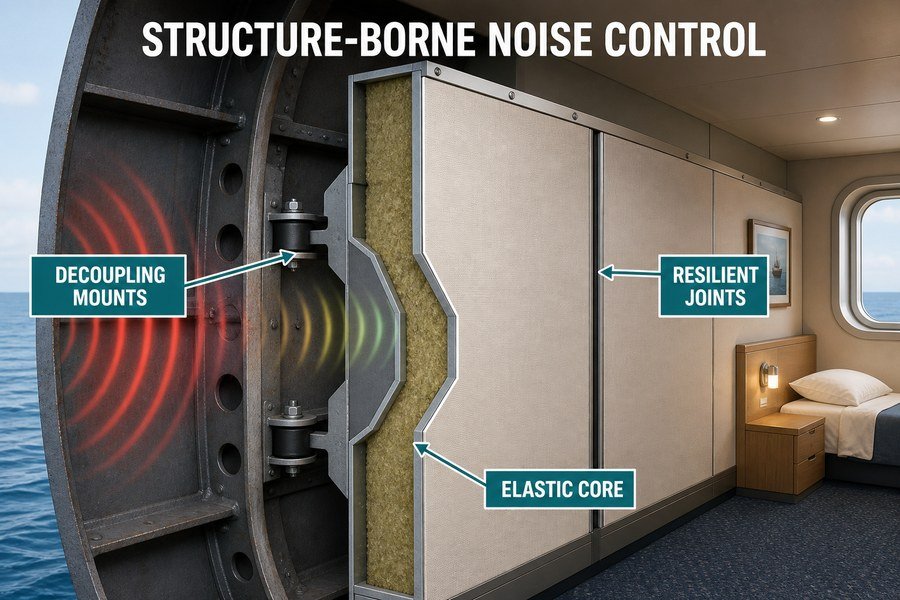
Let us explore the exact details that make these panels work, so you can buy the right products without wasting your budget on ineffective heavy materials.
How Does Structural Decoupling Separate Marine Lining Panels From Hull Vibration?
Rigid panels transfer engine shaking directly into the cabin. Your clients complain about rattling walls. Structural decoupling breaks this path so vibration never reaches the passenger space.
Structural decoupling separates marine lining panels from the steel hull using three methods: floating floor tracks, rubber shock mounts (isolators), and flexible ceiling hangers. These three components create an elastic gap that stops vibration transfer, easily meeting the DNV Comfort Class noise requirement of 45 dB(A).
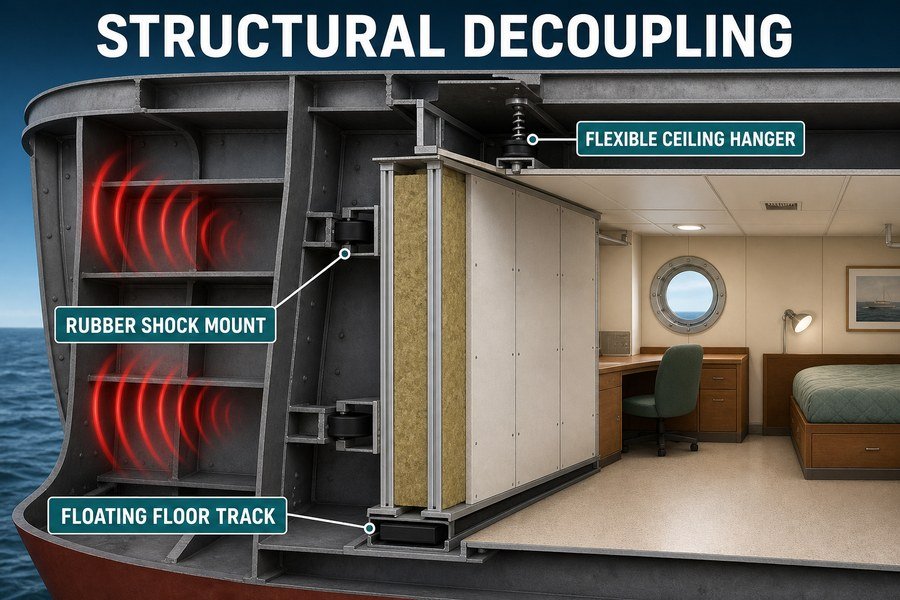
Shipyards often struggle with structure-borne noise. Engine vibrations travel through the steel decks and into the cabin walls.1 We solve this problem using structural decoupling2. This means we break the physical connection between the steel ship and the interior cabin panels. We use three main components to do this. I always tell my clients to check these three items when they buy outfitting materials from Asia.
Rubber Shock Mounts and Floating Floor Tracks for Bulkheads
The first two methods work together at the base and the back of the wall. We use floating floor tracks to hold the bottom of the lining panels. A standard steel track sits directly on the deck. A floating track sits on a 5mm thick rubber base. This rubber base costs about $1.50 per meter, but it stops deck vibrations from entering the panel.
Next, we use rubber shock mounts to attach the back of the panels to the ship's steel structure. These mounts are also called isolators. We never screw a panel directly to the steel frame. We place a rubber mount between the panel and the steel. According to ISO 20283-5 standards for ship vibration, a high-quality rubber isolator should provide at least 3mm to 5mm of deflection3. This small movement absorbs the shaking. Good rubber mounts cost around $2.00 to $3.50 each. You will need about four mounts per standard wall panel. This small cost prevents huge noise problems later.
Flexible Ceiling Hangers for Overhead Isolation
The third method deals with the ceiling. Engine vibrations travel up the steel pillars and into the deck above the cabin. If you hang the ceiling panels with rigid steel wire, the noise will enter the room. We use flexible ceiling hangers instead. These hangers have small steel springs or rubber inserts inside them.
When the upper deck vibrates, the spring absorbs the energy. The ceiling panel stays completely still. A standard flexible hanger costs about $4.50. You usually need one hanger every square meter. I have seen many European shipyards reject cabins because the Asian supplier provided cheap, rigid hangers. Always specify flexible hangers with a rated load of 15kg to 25kg to match your ceiling panel weight.
| Decoupling Component | Material | Typical Cost (USD) | Function in Cabin |
|---|---|---|---|
| Floating Floor Track | Galvanized Steel + Rubber | $8.00 / meter | Stops deck vibration at the base |
| Rubber Shock Mount | Natural Rubber / Neoprene | $2.50 / piece | Isolates wall panels from steel frames |
| Flexible Ceiling Hanger | Steel Spring / Rubber | $4.50 / piece | Drops overhead noise transmission |
What Isolation Details Block Low-Frequency Vibration From Entering Marine Lining Panels?
Low-frequency engine rumble penetrates standard partitions easily. Shipowners hate this deep hum. Specific isolation details absorb these long waves before they reach the cabin interior.
Three isolation details block low-frequency vibration: tuned elastomeric dampeners, air gap cavities (usually 50mm to 100mm), and constrained layer damping (CLD) steel skins. Together, they target the 20 Hz to 200 Hz frequency range where large marine diesel engines generate the most structural noise.
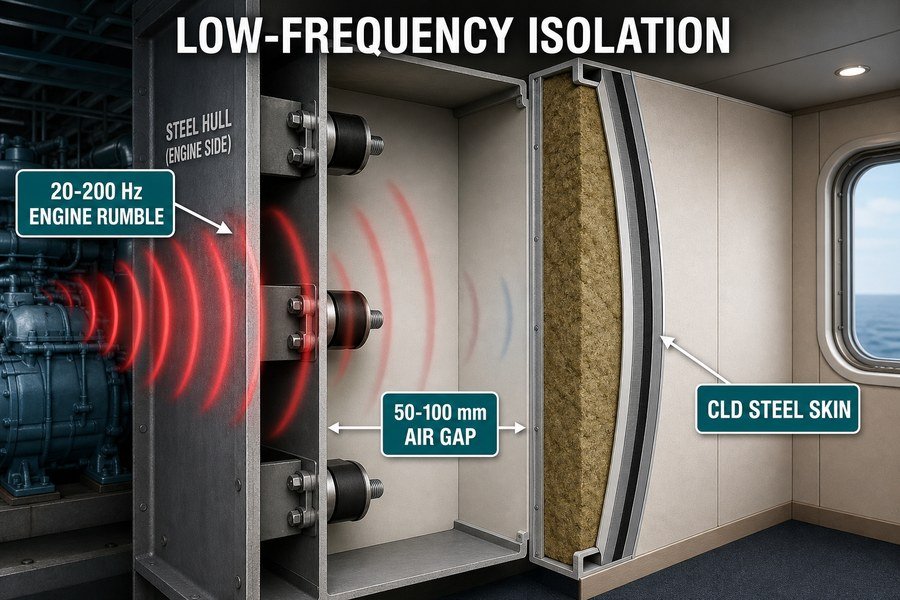
Low-frequency noise is the hardest problem to solve in shipbuilding. Large diesel engines produce strong vibrations between 20 Hz and 200 Hz. These long sound waves pass right through standard materials. You need specific isolation details to stop them. When I worked in the factory, we tested many designs to meet IMO (International Maritime Organization) regulations4. We found that you must combine three specific details to block this deep hum successfully.
Tuned Elastomeric Dampeners and Air Gap Cavities
First, we use tuned elastomeric dampeners. These are special rubber blocks. Standard rubber is too hard to stop low frequencies. Tuned dampeners use a softer silicone blend. They target frequencies below 100 Hz. They cost around $5.00 each, but they are essential for cabins located right above the engine room.
Second, we design air gap cavities behind the panels. Sound waves lose energy when they cross different materials. We leave an empty space between the steel hull and the back of the marine panel. For low-frequency noise, this air gap must be between 50mm and 100mm wide5. If the gap is less than 50mm, the long sound waves will jump across the space. An air gap is free, but it takes up valuable cabin space. You must plan this detail early in the ship design process.
Constrained Layer Damping (CLD) Steel Skins on Panels
The third detail is the panel skin itself. Standard panels use a single sheet of 0.6mm galvanized steel. This thin steel vibrates easily at low frequencies. We solve this by using Constrained Layer Damping (CLD) steel skins.
A CLD skin uses two thinner steel sheets (like 0.4mm) with a 0.1mm viscoelastic polymer layer glued between them. When the low-frequency sound hits the panel, the two steel sheets slide against each other slightly. The polymer layer in the middle turns this sliding motion into heat6. This completely kills the vibration. CLD panels cost about $15 to $20 more per square meter than standard panels. However, European clients love them because they provide excellent acoustic comfort without adding thick layers of insulation.
| Isolation Detail | Target Frequency Range | Space Required | Estimated Cost Impact |
|---|---|---|---|
| Tuned Dampeners | 20 Hz - 100 Hz | 30mm - 50mm | $5.00 / piece |
| Air Gap Cavities | All Low Frequencies | 50mm - 100mm | $0 (Uses Cabin Space) |
| CLD Steel Skins | 50 Hz - 200 Hz | 0.9mm (Total skin) | +$18.00 / square meter |
How Do Resilient Joints Between Marine Bulkhead Panels Reduce Structure-Borne Noise Transmission?
Metal-to-metal panel joints squeak when the ship rolls. Hard joints ruin the noise reduction of the whole wall. Resilient joints absorb movement and stop sound leaks.
Resilient joints reduce transmission using two main mechanisms: flexible PVC or silicone spline profiles that prevent metal-to-metal contact, and expansion gaps that allow 2mm to 4mm of movement. This stops structural energy from traveling horizontally across the bulkhead system, maintaining overall acoustic integrity.
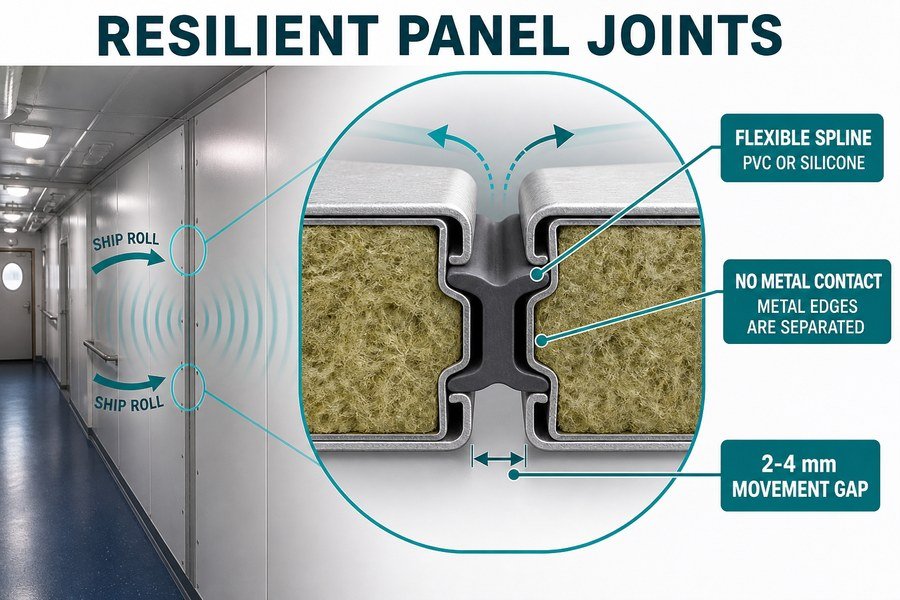
A marine panel never works alone. You connect dozens of panels together to build a cabin corridor. If you connect them with hard metal joints, the vibration will travel from the first panel all the way to the last panel7. The ship also bends and twists in the ocean waves.8 Hard joints will squeak and crack under this pressure. We use resilient joints to solve these problems. I always check the joint design when I audit a new panel supplier in Asia. A bad joint ruins a good panel. We rely on two specific mechanisms for resilient joints.
Flexible PVC and Silicone Spline Profiles in Panel Joints
The first mechanism is the flexible spline profile. We insert this profile between the edges of two panels. The profile stops the metal skins from touching each other. We usually make these splines from PVC or silicone.
PVC is the standard choice. It costs about $0.50 per meter. It works well for standard passenger cabins. We specify a material hardness of Shore A 60 to Shore A 70. This hardness is firm enough to hold the panels tightly, but soft enough to absorb vibration. For luxury cruise ships, we use silicone splines. Silicone costs about $1.20 per meter. It keeps its flexibility longer than PVC, especially in hot ocean climates.9 The flexible spline eats the vibration energy before it can move to the next panel.
Maintaining Expansion Gaps for Bulkhead Movement
The second mechanism is the expansion gap. You cannot push the panels completely tight against each other. You must leave a small space. We design the panel edges to create a 2mm to 4mm expansion gap when they lock together.
This gap gives the metal room to expand when the ship gets hot. More importantly, it gives the joint room to flex when the ship rolls in the water. If you do not have this 2mm to 4mm gap, the panels will grind against each other. This grinding creates structure-borne noise right next to the passenger's bed. The flexible spline fills this gap, so the wall still looks solid and stops fire10, but the panels can move safely.
| Joint Material Type | Shore Hardness | Typical Lifespan | Price (USD per meter) |
|---|---|---|---|
| Standard PVC Spline | Shore A 65 | 10-15 Years | $0.50 |
| Premium Silicone | Shore A 60 | 20+ Years | $1.20 |
| Rigid Metal (Poor) | N/A | Fails quickly | $0.80 |
Why Is Mechanical Elasticity More Effective Than Mass for Mitigating Structure-Borne Noise in Marine Bulkheads?
Adding heavy steel makes ships burn more fuel. Extra weight cuts into the cargo capacity. Mechanical elasticity stops vibration better without adding useless dead weight to the vessel.
Mechanical elasticity is more effective than mass because it acts like a spring to absorb vibrational energy, whereas mass only resists it. Using mineral wool cores with high elasticity achieves a 40 dB(A) noise reduction while weighing 30% less than a solid steel mass equivalent.
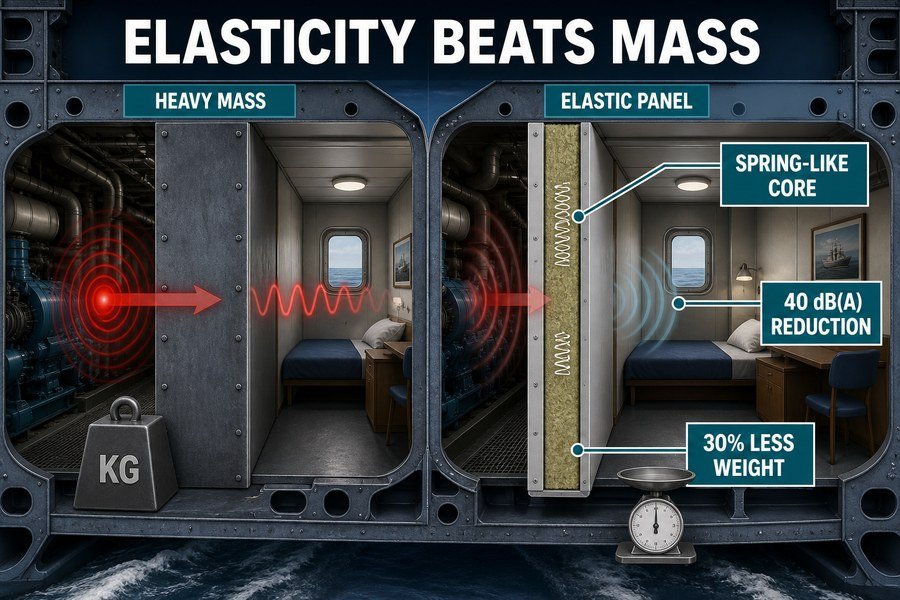
Many old shipbuilders think that a heavier wall is a quieter wall. This idea comes from the "mass law" in acoustics. The mass law says that if you double the weight of a wall, you block 6 decibels of noise11. But ships cannot carry unlimited weight. Heavy cabins make the ship sit lower in the water. The ship burns more expensive fuel to move. Today, we use mechanical elasticity instead of mass. Elasticity is much more effective for marine bulkheads. When you buy panels for European shipyards, you must offer them lightweight, high-elasticity options.
The Physics of Elasticity in Mineral Wool Cores
Mass only resists vibration because it is heavy. Elasticity works differently. Elasticity acts like a sponge or a spring. We achieve this elasticity by using special mineral wool cores inside the panels.
We measure this property using "dynamic stiffness" (MN/m³). A low dynamic stiffness means the core is highly elastic.12 When structure-borne noise hits the panel skin, the steel skin vibrates. But the elastic mineral wool inside the panel flexes and moves. It absorbs the kinetic energy and turns it into harmless microscopic heat13. It traps the vibration inside the core. A high-quality elastic mineral wool core costs about $25 per square meter. It stops the vibration actively, rather than just standing in the way like a heavy piece of steel.
Weight Savings and Fuel Efficiency for Shipyards
The biggest advantage of elasticity is the weight savings. Let us look at the numbers. To get a 40 dB(A) noise reduction using the old mass method, you need a panel that weighs about 25 kg per square meter. That is very heavy.
By using mechanical elasticity, we can achieve the exact same 40 dB(A) reduction with a panel that weighs only 15 kg to 17 kg per square meter. This is a 30% weight reduction. On a large cruise ship with 50,000 square meters of panels, you save over 400 tons of dead weight. The shipowner saves thousands of dollars in fuel every single month. This is why you should always promote elastic panels to your shipyard clients.
| Mitigation Approach | Weight per Square Meter | Noise Reduction Level | Impact on Ship Fuel |
|---|---|---|---|
| Heavy Mass Approach | 25 kg/m² | 40 dB(A) | High fuel consumption |
| Elasticity Approach | 16 kg/m² | 40 dB(A) | Excellent fuel savings |
| Standard Panel | 14 kg/m² | 32 dB(A) | Good fuel savings |
How Do Edge Sealants Affect Structure-Borne vs. Airborne Isolation in Marine Accommodation Panels?
Bad seals let both vibration and talking pass through walls. You fail inspections when sound leaks at the edges. Proper edge sealants handle both airborne and structure-borne threats.
Edge sealants manage both threats by using two specific properties: dense mass to block high-frequency airborne noise, and high elasticity to absorb low-frequency structure-borne vibration. Polyurethane and advanced silicone sealants applied at 5mm thickness stop flanking transmission paths along the deck and ceiling tracks.
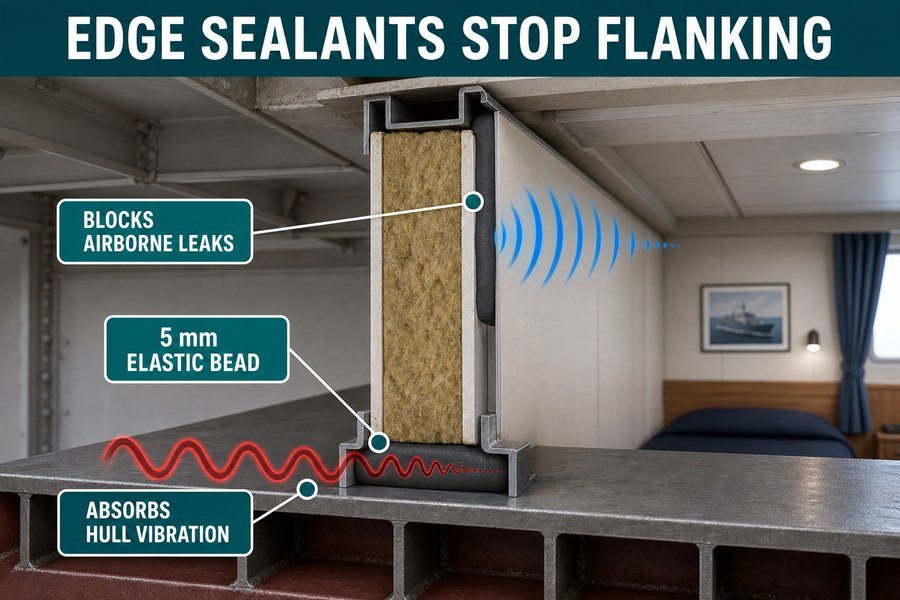
The edges of a marine panel are the weakest points for noise. You can buy the most expensive acoustic panel in the world, but if you leave a tiny gap at the bottom, the noise will enter the cabin. We call this "flanking transmission14." Sound behaves like water. It always finds the easiest way into the room. We use edge sealants to plug these holes. But marine panels face two different types of noise: airborne (like people talking) and structure-borne (like the engine running). A good sealant must fight both types at the same time. I always advise procurement officers to buy high-grade sealants to avoid project failures.
Blocking Airborne Noise with Dense Edge Sealants
Airborne noise travels through the air. It includes voices, music, and television sounds. These are high-frequency sounds. To stop airborne noise, the sealant needs mass. It must be dense and heavy.
When the installation workers put the panel into the floor track, they leave a small gap. We fill this gap with sealant. A dense sealant blocks the sound waves from passing through the crack. If you do not use a dense sealant, the panel's Sound Transmission Class (STC) rating will drop significantly15. A panel tested at 40 dB in the laboratory might only perform at 32 dB on the ship if the edges are not sealed properly.
Absorbing Structure-Borne Vibration with High Elasticity
Structure-borne noise travels through the steel. To stop this, the sealant needs high elasticity. It must stay rubbery and flexible. If the sealant dries hard like a rock, the deck vibrations will travel straight through the hard sealant and into the panel.
We use polyurethane (PU) or advanced silicone sealants for this job. We apply a bead of sealant that is at least 5mm thick. PU sealant costs about $4.00 per tube. It has excellent elasticity and stops low-frequency vibration well. Silicone sealant costs about $6.00 per tube. It cures faster and stays flexible for many years. The 5mm thickness is very important. It acts as a tiny shock absorber all the way around the edge of the panel. It stops the hull vibrations from touching the panel edges.
| Edge Sealant Type | Airborne Acoustic Blocking | Vibration Absorption | Typical Curing Time |
|---|---|---|---|
| Polyurethane (PU) | Excellent | Very Good | 24 - 48 Hours |
| Advanced Silicone | Good | Excellent | 12 - 24 Hours |
| Cheap Acrylic | Poor (Cracks easily) | Poor (Dries hard) | 2 - 4 Hours |
Conclusion
Structure-borne noise ruins ship comfort. By choosing panels with structural decoupling, resilient joints, elastic cores, and proper sealants, you deliver quiet, compliant cabins without adding excessive weight.
-
"How Do Structural Connections Impact Marine Ceiling Panel ...", https://magellanmarinetech.com/how-structural-connections-impact-marine-ceiling-panel-acoustics/. Technical literature on shipboard noise and vibration describes structure-borne sound as vibration transmitted through a vessel’s hull, decks, bulkheads, and other structural members, which can then radiate as noise in accommodation spaces. Evidence role: mechanism; source type: paper. Supports: Engine vibrations can travel through ship structures such as steel decks and cabin walls as structure-borne noise.. Scope note: This supports the general transmission pathway, not the noise level in any specific ship design. ↩
-
"Soundproofing", https://en.wikipedia.org/wiki/Soundproofing. Acoustics references explain that vibration isolation or resilient mounting reduces structure-borne sound transmission by interrupting or softening the mechanical path between a vibration source and a receiving structure. Evidence role: definition; source type: encyclopedia. Supports: Structural decoupling means reducing vibration transmission by breaking or softening the physical connection between the ship structure and interior panels.. Scope note: The source would establish the principle of decoupling; performance still depends on installation details, load, frequency, and material properties. ↩
-
"Barry-isolators-selection-guide.pdf", https://wp.optics.arizona.edu/optomech/wp-content/uploads/sites/53/2016/08/Barry-isolators-selection-guide.pdf. Vibration-isolation design references show that an isolator’s static deflection is related to its natural frequency and isolation effectiveness, supporting the relevance of specifying rubber-mount deflection for vibration control. Evidence role: mechanism; source type: paper. Supports: Rubber isolator deflection is an important design parameter for reducing vibration transmission.. Scope note: This would support why deflection matters, but it may not prove that ISO 20283-5 specifically requires a 3–5 mm deflection range for ship cabin panel mounts. ↩
-
"How Do Marine Interior Panel STL Ratings Meet IMO Noise ...", https://magellanmarinetech.com/how-marine-interior-panel-stl-ratings-meet-imo-noise-regulations/. The IMO Code on Noise Levels on Board Ships sets measurement procedures and maximum permissible noise levels for different shipboard spaces, providing regulatory context for acoustic design work in shipbuilding. Evidence role: historical_context; source type: institution. Supports: Ship acoustic designs may be tested or specified to comply with IMO noise regulations.. Scope note: The IMO code regulates onboard noise levels rather than prescribing the specific isolation details described in the article. ↩
-
"Airborne sound insulation performance of lightweight double ...", https://pmc.ncbi.nlm.nih.gov/articles/PMC11666719/. Acoustics literature on double-panel partitions shows that the depth of the air cavity affects mass-air-mass resonance and low-frequency transmission loss, supporting the engineering rationale for using a substantial air gap behind panels. Evidence role: mechanism; source type: paper. Supports: For low-frequency noise control, an air gap behind panels should be sized substantially, with the article specifying 50 mm to 100 mm.. Scope note: General partition-acoustics sources support the mechanism but may not directly validate the article’s exact 50–100 mm marine-panel specification. ↩
-
"Viscoelastic Vibration Dampers for Turbomachine Blades", https://ntrs.nasa.gov/citations/20110024079. Constrained-layer damping theory explains that a viscoelastic core dissipates vibrational energy as heat through shear deformation between constraining face sheets, supporting the described damping mechanism. Evidence role: mechanism; source type: research. Supports: In constrained layer damping panels, relative motion between steel sheets is dissipated as heat by the viscoelastic polymer layer.. Scope note: This supports the physical mechanism of CLD, not the article’s stronger claim that it completely eliminates vibration. ↩
-
"DETERMINATION OF ISOLATOR TRANSFER MATRIX AND ...", https://uknowledge.uky.edu/cgi/viewcontent.cgi?article=1074&context=me_etds. Studies of structure-borne sound and vibration isolation describe rigid mechanical connections as transmission paths for vibrational energy, while resilient interlayers can reduce coupling between connected elements. Evidence role: mechanism; source type: paper. Supports: Hard metal joints can transmit vibration through connected panel assemblies, whereas resilient joints reduce vibration transfer.. Scope note: This supports the physical mechanism generally; it does not prove the magnitude of transmission in this specific marine panel system. ↩
-
"Torsion and Shear Stresses in Ships", https://www.academia.edu/79525607/Torsion_and_Shear_Stresses_in_Ships. Naval architecture references describe ships as flexible structures subject to wave-induced vertical bending, horizontal bending, and torsional loads in service. Evidence role: mechanism; source type: education. Supports: Ships experience bending and twisting loads from ocean waves.. Scope note: The source would establish the general ship-structure loading environment, not the exact deformation experienced by a particular cabin corridor. ↩
-
"Physical Properties of Maxillofacial Elastomers", https://deepblue.lib.umich.edu/bitstreams/afe9542b-604c-44c6-b943-64f2f551a13c/download. Materials references report that silicone elastomers generally retain elastic properties over a wider temperature range and show better heat-aging resistance than plasticized PVC, whose flexibility can decline through plasticizer loss and thermal aging. Evidence role: expert_consensus; source type: research. Supports: Silicone splines can retain flexibility longer than PVC in warm or hot operating environments.. Scope note: This is contextual materials evidence; actual service life depends on formulation, additives, UV exposure, and installation conditions. ↩
-
"What Is the Purpose and Scope of the IMO FTP Code?", https://magellanmarinetech.com/what-purpose-scope-of-imo-ftp-code/. IMO/SOLAS fire-safety rules and the IMO Fire Test Procedures Code require ship bulkhead and lining assemblies to demonstrate specified fire integrity and insulation performance through approved testing. Evidence role: definition; source type: institution. Supports: A marine wall joint can only be said to stop or resist fire if it forms part of an approved fire-tested assembly.. Scope note: Such standards support the need for tested fire-rated assemblies; they do not show that a particular flexible spline stops fire unless that complete joint and panel system has been certified. ↩
-
"Ultrasonic, Normal-Incidence Insertion Loss through ...", https://physics.byu.edu/docs/thesis/269. The source explains the acoustic mass law, under which an ideal limp barrier gains about 6 dB of transmission loss for each doubling of surface mass at a fixed frequency. Evidence role: mechanism; source type: education. Supports: The acoustic mass law predicts roughly a 6 dB improvement in sound blocking when wall surface mass is doubled.. Scope note: This relationship is an idealized rule of thumb and does not account for stiffness, damping, coincidence effects, leaks, or real shipboard panel assemblies. ↩
-
"A Low-Stress Method for Determining Static and Dynamic Material ... - PMC", https://pmc.ncbi.nlm.nih.gov/articles/PMC10142812/. The source defines dynamic stiffness as the ratio of dynamic force to dynamic displacement for resilient materials, supporting the interpretation that lower dynamic stiffness corresponds to greater compliance under vibration. Evidence role: definition; source type: institution. Supports: Low dynamic stiffness indicates that a core material is more compliant or elastic under dynamic loading.. Scope note: The source may define dynamic stiffness generally for resilient layers; applying it to a specific mineral wool panel core depends on the tested material and installation details. ↩
-
"[PDF] Rigid-Frame Porous Material Acoustic Attenuation on Compressor ...", https://docs.lib.purdue.edu/cgi/viewcontent.cgi?article=3094&context=icec. The source describes acoustic damping in porous or fibrous materials as energy dissipation through viscous and thermal losses, which converts part of the vibration or sound energy into heat. Evidence role: mechanism; source type: paper. Supports: Elastic mineral wool or porous fibrous cores can dissipate vibrational or acoustic energy as heat through damping mechanisms.. Scope note: This supports the general damping mechanism of porous fibrous materials; it does not by itself quantify the performance of the specific panel described in the article. ↩
-
"Flanking transmission", https://en.wikipedia.org/wiki/Flanking_transmission. A building-acoustics reference defines flanking transmission as sound reaching a receiving room by paths other than the main separating element, supporting the claim that gaps and junctions can bypass an otherwise rated panel. Evidence role: definition; source type: encyclopedia. Supports: Noise can bypass a marine panel through edge gaps via flanking transmission.. Scope note: Most available sources discuss buildings rather than ship cabins, so the evidence supports the acoustic principle rather than this specific marine installation. ↩
-
"Sound transmission class - Wikipedia", https://en.wikipedia.org/wiki/Sound_transmission_class. Acoustics guidance on STC notes that laboratory ratings assume controlled assemblies and that field performance can be reduced by leaks, penetrations, and flanking paths, supporting the statement that unsealed edges can materially lower effective sound isolation. Evidence role: general_support; source type: institution. Supports: Poorly sealed panel edges can significantly reduce the field sound-isolation performance compared with the laboratory STC rating.. Scope note: The source may not verify the article’s illustrative 40 dB to 32 dB example unless a field-test study with similar assemblies is found. ↩