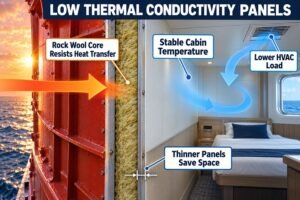
Are crew complaints about engine hum ignoring your panel upgrades? Picking the wrong noise path wastes thousands of dollars. Here is how to ensure your proposal fixes the exact problem.
A complete marine panel proposal addresses both airborne and structure-borne noise paths by providing laboratory test reports per ISO 10140-2, detailed installation drawings showing vibration isolation mounts, and an itemized bill of materials for dampening materials like mineral wool and elastic sealants.
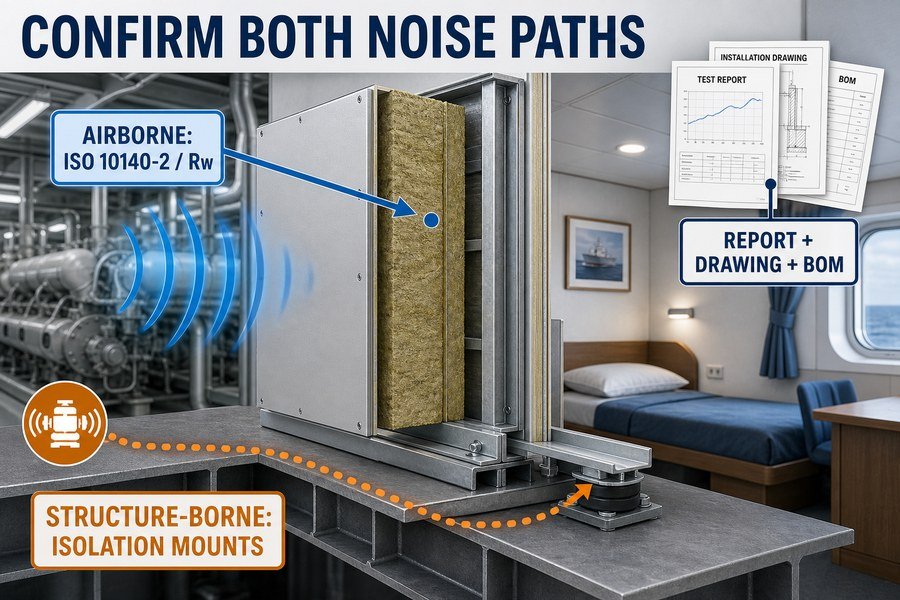
I see this issue often when reviewing bids from Asian suppliers for major European shipyard projects. A cheap price looks great until the vessel fails its sea trial noise test. Let's break down exactly what documents you need to ask for before you sign that purchase order.
What Documentation Confirms Both Noise Paths Are Addressed in a Marine Interior Panel Quotation?
Missing documents mean hidden risks. If a supplier only gives a basic quote, you might fail class approvals. Ask for these specific files to guarantee both paths are covered.
To confirm both noise paths are addressed, you must request three documents: an ISO 10140-2 acoustic laboratory test report for airborne noise, a detailed installation node drawing showing anti-vibration profiles for structure-borne noise, and a verified bill of materials specifying sound-absorbing core densities.
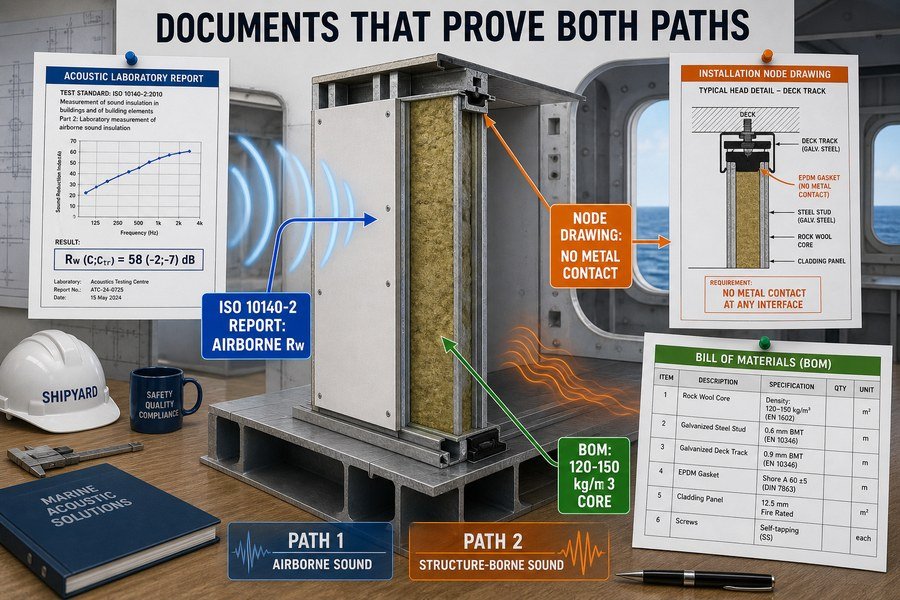
To safely purchase high-quality marine outfitting products in Asia, you cannot just look at the total price. I always tell my clients to demand the technical paperwork up front. Let us look closely at the three essential documents you must receive.
Evaluating ISO 10140-2 Acoustic Laboratory Test Reports
The most important document for airborne noise is the acoustic test report. This test must follow the ISO 10140-2 standard1. It measures how well the panel stops sound traveling through the air, like people talking or TV noise. The report will give you a Weighted Sound Reduction Index (Rw)2. For a standard B-15 marine cabin panel, you should look for an Rw value between 33 dB and 36 dB3. High-acoustic panels will show Rw values from 40 dB to 44 dB. If a supplier cannot provide this lab report from a recognized testing center, you should not trust their acoustic claims.
Reviewing Installation Node Drawings for Anti-Vibration Profiles
Airborne lab tests mean nothing if the panel vibrates from engine power. Structure-borne noise travels through the steel deck. To stop this, you need the second document: detailed installation node drawings. These CAD drawings must show exactly how the panel meets the floor and ceiling. You are looking for anti-vibration profiles4, often made of EPDM rubber with a thickness of 2mm to 5mm. If the drawing shows the steel panel directly touching the steel deck without an isolation gasket, the structure-borne noise path is completely ignored in their proposal.
Verifying the Bill of Materials for Core Densities
The final document is the detailed Bill of Materials (BOM). The BOM proves the supplier is actually using the materials needed to absorb sound. Check the density of the mineral wool or rockwool inside the panel. Standard thermal panels might use 100 kg/m³ rockwool, but good acoustic panels need a density of 120 kg/m³ to 150 kg/m³. The BOM must also list any viscoelastic damping layers or acoustic dampening glue used between the steel skin and the core.
| Document Type | Target Noise Path | Key Value to Check | Warning Sign |
|---|---|---|---|
| ISO 10140-2 Test Report | Airborne Noise | Rw (e.g., 35 dB to 44 dB) | Report is older than 5 years or missing. |
| Installation Node Drawing | Structure-Borne Noise | EPDM rubber gasket (2-5mm) | Metal-to-metal contact at the deck profile. |
| Bill of Materials (BOM) | Both Paths | Rockwool density (120-150 kg/m³) | Vague material descriptions without density kg/m³. |
How to Verify a Proposed Marine Bulkhead System Matches the Vessel's Acoustic Report?
Guessing specs leads to project delays. If the panel does not match the acoustic engineer's exact demands, the shipyard will reject it. Here is how to cross-check the numbers.
You verify a bulkhead system by matching the panel's Weighted Sound Reduction Index (Rw) against the acoustic report's required field performance (R'w), ensuring a minimum 3 dB to 5 dB safety margin, and confirming the total panel weight does not exceed the vessel's structural load limits.
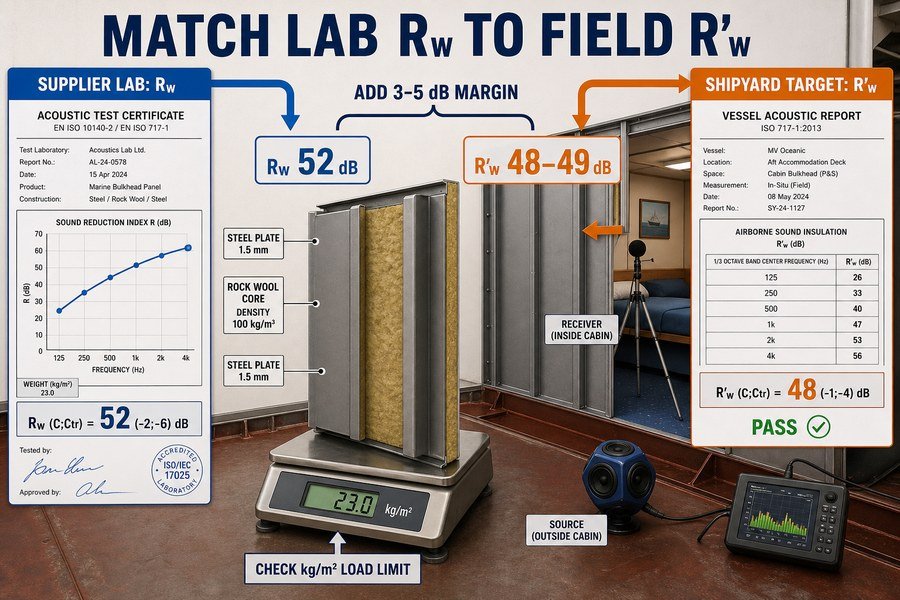
When you get an acoustic report from a European shipyard, it tells you the exact noise limits the vessel must meet to pass IMO MSC.337(91) rules. Matching a supplier's quote to this report takes three specific steps.
Matching Weighted Sound Reduction Index (Rw) to Field Performance (R'w)
First, you must understand the difference between lab numbers and real-world numbers. The acoustic report will state the required field sound reduction, written as R'w (with an apostrophe)5. The panel supplier will give you the lab tested sound reduction, written as Rw (no apostrophe). You must compare these two. Laboratory conditions are perfect. Ships are not. Therefore, the Rw number from your Chinese or Vietnamese supplier must always be higher than the R'w number required by the shipyard's acoustic report.
Calculating the 3 dB to 5 dB Safety Margin
This brings us to the second step: calculating the safety margin to account for flanking noise. Flanking noise is sound that sneaks around the panel through the ceiling or floor. Because of flanking noise, a panel loses performance once installed on a ship. According to ISO 140-4 field test guidelines, this loss is usually between 3 dB and 5 dB6. So, if the shipyard's acoustic report requires an R'w of 35 dB between two cabins, you must buy a panel with a lab Rw of at least 38 dB to 40 dB. If you buy a 35 dB panel, it will only perform at about 31 dB on the ship, and you will fail the test.
Confirming Panel Weight Against Structural Load Limits
Third, you must check the weight. High acoustic performance often means heavy materials.7 A standard 50mm marine panel weighs about 16 to 18 kg/m². A high-acoustic panel can weigh 22 to 26 kg/m². You must check the vessel's acoustic report and structural plan to ensure this extra weight is allowed. If you add 8 kg/m² across a 3000-square-meter cruise ship interior, you just added 24 extra tons to the ship. The naval architect must approve this load.
| Acoustic Requirement | Required Lab Value (Rw) | Flanking Loss Margin | Typical Panel Weight |
|---|---|---|---|
| R'w 30 dB (Standard) | Minimum Rw 34 dB | ~ 4 dB | 16 - 18 kg/m² |
| R'w 35 dB (High Privacy) | Minimum Rw 39 dB | ~ 4 dB | 20 - 22 kg/m² |
| R'w 40 dB (Near Engine) | Minimum Rw 45 dB | ~ 5 dB | 24 - 26 kg/m² |
Why Must Noise Diagnosis Precede Marine Accommodation Panel Orders?
Ordering panels before finding the noise source wastes money. Adding heavy sound insulation will not fix vibrations from the engine room. Diagnosis must always happen first.
Noise diagnosis must precede orders to prevent three costly mistakes: applying airborne insulation to structure-borne vibration problems, over-specifying heavy materials that waste budget and fuel, and missing flanking noise paths through ceilings and decks that render expensive wall panels completely useless.
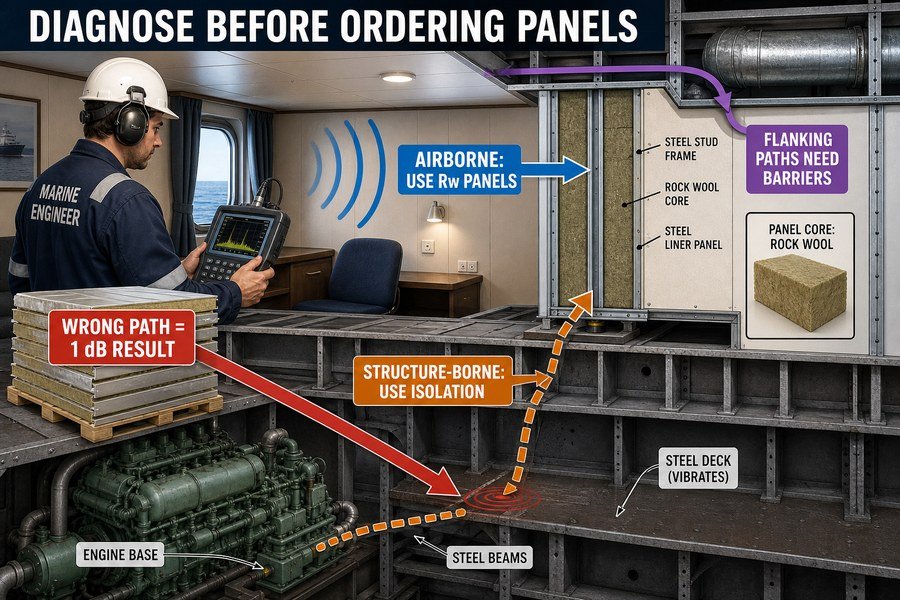
I once had a client who spent $100,000 on high-acoustic panels because the crew cabins were too loud. After installation, the noise only dropped by 1 dB. Why? They treated the wrong noise path. Diagnosis is critical to avoid these three massive mistakes.
Preventing the Application of Airborne Insulation to Vibration Problems
The most common mistake is buying airborne noise insulation to fix a vibration problem. Airborne noise travels through the air, mostly in high frequencies above 500 Hz.8 Structure-borne noise starts as vibration from the main engine or propellers, travels through the ship's steel hull, and shakes the cabin walls.9 This vibration happens at low frequencies, usually between 10 Hz and 200 Hz. If you put a heavy 50mm rockwool panel on a vibrating floor, the panel will still shake and make noise. You must diagnose if the noise is airborne or structure-borne before you buy. If it is structure-borne, you need isolation mounts, not just thicker panels.
Avoiding Over-Specification of Heavy Materials
Without a proper noise test, procurement teams get scared and just buy the highest rated panel they can find. This is a waste of budget and fuel. A high-acoustic 44 dB panel costs nearly double the price of a standard 34 dB panel. More importantly, as discussed earlier, it adds massive weight to the ship. Extra weight means the ship burns more fuel every single day of its 25-year life.10 A proper diagnosis tells you exactly where you need heavy panels and where standard panels are enough.
Identifying Flanking Noise Paths Through Ceilings and Decks
Finally, a diagnosis checks for flanking paths. You can buy the best wall panel in the world, but if the noise travels up over the ceiling panels and drops back down into the next cabin, the wall panel is useless. A pre-order noise diagnosis will map out the ceiling voids and air conditioning ducts. It will tell you if you need to order acoustic barriers for the ceiling space in addition to the wall panels.
| Mistake | Root Cause | Consequence | Corrective Action |
|---|---|---|---|
| Wrong Insulation Type | Treating vibration as airborne noise. | Wall still hums; $0 return on investment. | Use vibration spectrum analysis first. |
| Over-Specification | Guessing specs for safety. | High initial cost; increased lifetime fuel cost. | Specify panels strictly to acoustic zones. |
| Ignored Flanking Paths | Only focusing on the wall divider. | Sound leaks over ceilings and under floors. | Order acoustic ceiling barriers and baffles. |
What Evidence Proves a Marine Bulkhead Panel Controls Structure-Borne Rather Than Just Airborne Noise?
Sales pitches often confuse airborne limits with vibration control. Installing the wrong system means the crew still feels the engine thrum. Look for these specific physical proofs.
Evidence of structure-borne noise control includes the presence of decoupling elements like viscoelastic damping layers within the panel, structural drawings detailing resilient rubber isolation mounts at the deck and ceiling joints, and dynamic stiffness test reports for these specific isolating materials.
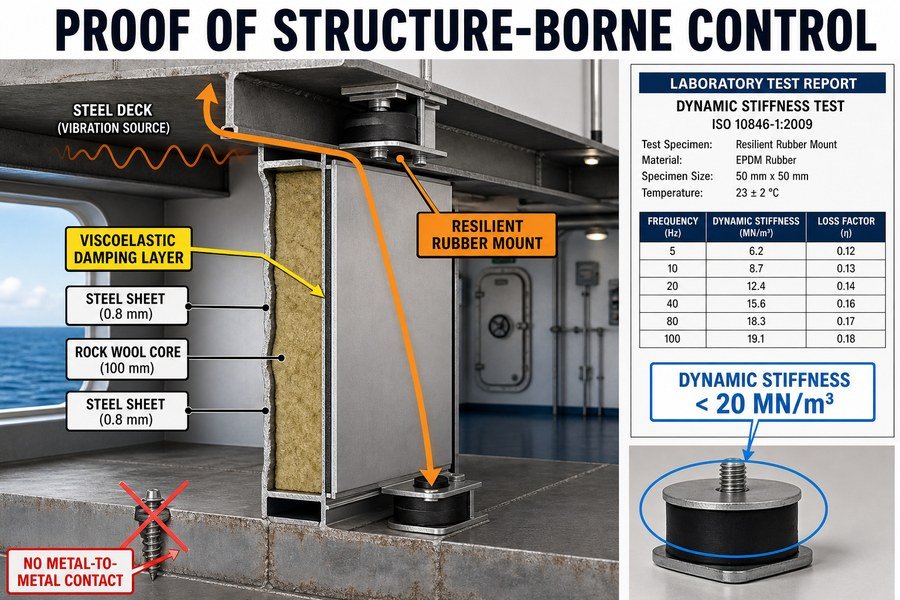
When you talk to a sales rep in Asia, they will often say, "Yes, our panel is great for noise." But you need engineering proof that it stops structure-borne vibration. I train procurement officers to look for three specific pieces of evidence.
Inspecting Panels for Viscoelastic Damping Layers
First, look at the physical makeup of the panel itself. A standard panel is just two steel sheets with rockwool in the middle. A panel designed to stop structure-borne noise will use Constrained Layer Damping (CLD)11. This means there is a viscoelastic damping layer built into the steel. Usually, this is a 1mm to 2mm layer of specialized polymer sandwiched between two thinner sheets of steel. This polymer turns vibration energy into tiny amounts of heat12, stopping the panel from vibrating. You must see this polymer layer listed in the technical data sheet.
Checking Structural Drawings for Resilient Rubber Isolation Mounts
The second piece of evidence is the connection method. How does the panel attach to the ship? If it uses metal screws directly into a steel floor track, it will transmit vibration. The structural drawings must show resilient rubber isolation mounts13. Look for floating floor tracks resting on Sylomer pads, or U-channels lined with EPDM rubber that has a Shore A hardness of 45 to 60. The drawings should clearly state that the metal panel never touches the steel deck directly.
Reviewing Dynamic Stiffness Test Reports for Isolating Materials
Finally, ask for the test reports of the rubber mounts themselves. You are looking for a dynamic stiffness test, usually conducted under the ISO 9052-1 standard14. Dynamic stiffness measures how well a material acts like a spring to isolate vibration. It is measured in Meganewtons per cubic meter (MN/m³). For good vibration isolation in marine outfitting, you want a lower number. An isolating material with a dynamic stiffness of less than 20 MN/m³ is excellent for decoupling marine panels from engine vibrations.
| Evidence Type | What to Look For | Purpose | Acceptable Values |
|---|---|---|---|
| Internal Panel Structure | Viscoelastic Damping Layer | Converts vibration energy to heat. | 1mm - 2mm polymer layer. |
| Installation Drawings | Resilient Rubber Mounts | Decouples panel from the steel deck. | EPDM rubber, Shore A hardness 45 - 60. |
| Component Lab Tests | Dynamic Stiffness Report | Proves the rubber actually isolates. | < 20 MN/m³ (ISO 9052-1). |
How to Compare a Heavy Airborne Marine Bulkhead Bid Against a Lighter Decoupled System Bid?
Choosing between a cheap heavy panel and an expensive light decoupled system is tough. Pick the heavy one, and fuel costs rise. Here is how to evaluate them.
Compare these bids by analyzing four factors: the initial material cost per square meter, the added vessel fuel consumption due to the heavy system's weight, the installation labor time for complex decoupled mounts, and the long-term acoustic performance compliance for sea trials.
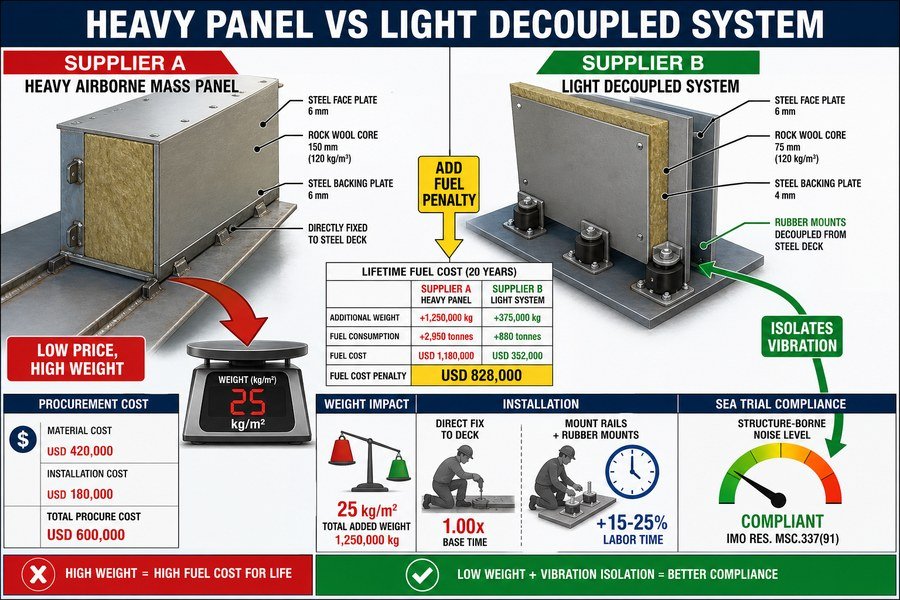
This is the ultimate procurement challenge. You have two quotes on your desk. Supplier A offers a massive 25 kg/m² panel that absorbs sound through sheer mass. Supplier B offers a high-tech 16 kg/m² decoupled system with rubber mounts. Supplier A is cheaper today, but is it the right choice? You must compare these four factors.
Analyzing Initial Material Cost Per Square Meter
First, look at the pure material cost. Heavy standard panels rely on thick steel and dense rockwool. These are cheap materials. You can usually buy these heavy panels for $45 to $65 per square meter in Asia15. The light decoupled systems use expensive viscoelastic polymers and custom rubber extrusion mounts. These systems will cost you $90 to $130 per square meter. If you are buying 5,000 square meters for a project, Supplier A looks very attractive to your immediate budget.
Calculating Added Fuel Consumption from Heavy Systems
However, you must calculate the weight penalty. The heavy panel is 25 kg/m². The light system is 16 kg/m². That is a difference of 9 kg/m². Across 5,000 square meters, you just added 45 metric tons of dead weight to the ship. A ship operates for 25 years.16 Carrying an extra 45 tons every day increases fuel consumption significantly17. Many European shipyards now calculate a penalty of $5 to $10 for every extra kilogram of outfitting weight18 to account for lifetime fuel costs. When you add this fuel penalty, the heavy system suddenly becomes the expensive choice.
Evaluating Installation Labor Time for Decoupled Mounts
Next, compare the labor. Heavy panels are simple to install: put down a steel track, slide the panel in, and secure it. It is fast. Decoupled systems take longer. The workers must carefully install the rubber gaskets, ensure no metal touches metal, and use special acoustic sealants like Sikaflex. This complex process can add 15% to 25% to your installation labor time. You must factor local shipyard labor rates into your comparison.
Ensuring Long-Term Acoustic Performance for Sea Trials
Finally, evaluate the risk of failing the sea trial. A heavy panel might meet the 60 dB limit required for an engine control room, but it offers zero protection against low-frequency vibration. If the ship's engine creates unexpected structural vibrations during the sea trial, the heavy panel will hum, and you will fail the test. The lighter decoupled system acts as an insurance policy against structure-borne noise, guaranteeing the ship passes the IMO MSC.337(91) regulations regardless of engine vibration19.
| Evaluation Factor | Heavy Airborne Panel (Supplier A) | Light Decoupled System (Supplier B) | Winner |
|---|---|---|---|
| Initial Material Cost | $45 - $65 / sqm | $90 - $130 / sqm | Heavy Panel |
| Added Weight / Fuel Penalty | High (25 kg/m²) | Low (16 kg/m²) | Decoupled System |
| Installation Labor Time | Fast & Simple | Slow & Complex (+20% time) | Heavy Panel |
| Sea Trial Acoustic Reliability | High risk if vibration exists | Low risk, isolates vibration | Decoupled System |
Conclusion
Confirming noise paths requires checking ISO 10140-2 lab reports, matching acoustic targets with safety margins, diagnosing sources before ordering, verifying decoupled mounts, and analyzing total lifetime weight costs.
-
"Sound insulation dataset of 30 wooden and 8 concrete floors ...", https://pmc.ncbi.nlm.nih.gov/articles/PMC10365936/. ISO 10140-2 specifies laboratory procedures for measuring the airborne sound insulation of building elements, providing the technical basis for reporting airborne transmission performance. Evidence role: definition; source type: institution. Supports: ISO 10140-2 is the relevant laboratory standard for measuring airborne sound insulation performance.. Scope note: The standard defines the laboratory measurement method; single-number ratings such as Rw are commonly derived using related rating standards such as ISO 717-1. ↩
-
"Sound reduction index - Wikipedia", https://en.wikipedia.org/wiki/Sound_reduction_index. The weighted sound reduction index, Rw, is a single-number rating used to summarize airborne sound insulation performance from frequency-band sound reduction measurements. Evidence role: definition; source type: institution. Supports: An acoustic test report can report a Weighted Sound Reduction Index, Rw, as a single-number measure of airborne sound insulation.. Scope note: This supports the meaning of Rw generally; it does not verify any specific marine panel’s rated value. ↩
-
"Why Do Marine Accommodation Panels Perform Differently in ...", https://magellanmarinetech.com/why-marine-accommodation-panels-perform-differently-in-labs-versus-onboard/. Published technical data and studies on marine accommodation partitions commonly report airborne sound reduction ratings in the mid-30 dB range for standard cabin wall constructions, with higher-performance constructions achieving higher values. Evidence role: general_support; source type: paper. Supports: Standard B-15 marine cabin panels are expected to have Rw values around 33–36 dB, while higher-acoustic panels may reach substantially higher ratings.. Scope note: This is contextual support for typical performance ranges; actual Rw values depend on panel construction, joints, doors, penetrations, and the test laboratory method. ↩
-
"Why Do Marine Accommodation Panels Perform Differently in Labs ...", https://magellanmarinetech.com/why-marine-accommodation-panels-perform-differently-in-labs-versus-onboard/. Acoustics literature describes resilient interlayers, gaskets, and mounts as methods for reducing structure-borne sound transmission by interrupting rigid mechanical paths between connected building or ship structures. Evidence role: mechanism; source type: paper. Supports: Anti-vibration profiles or isolation gaskets can reduce structure-borne noise transmission by preventing direct rigid contact between panels and steel decks.. Scope note: This supports the physical mechanism of resilient isolation; it does not prove that a specific EPDM thickness will meet a particular ship noise target. ↩
-
"Sound reduction index - Wikipedia", https://en.wikipedia.org/wiki/Sound_reduction_index. Acoustic standards distinguish laboratory sound reduction index measurements from apparent or field sound reduction indices, commonly denoted with a prime symbol such as R′; this supports the notation distinction but not the numerical margin needed for a particular ship installation. Evidence role: definition; source type: education. Supports: R′w denotes field or apparent weighted sound reduction, while Rw denotes laboratory weighted sound reduction.. Scope note: The notation is standardized in building acoustics contexts and must be applied carefully to marine specifications if the shipyard report uses equivalent terminology. ↩
-
"Airborne sound insulation performance of lightweight double ...", https://pmc.ncbi.nlm.nih.gov/articles/PMC11666719/. Field sound insulation studies and standards on flanking transmission document that installed partitions can perform below laboratory ratings because sound also travels through adjacent structures; this supports the need for an allowance, but a fixed 3–5 dB range should be treated as a rule of thumb rather than a universal ISO 140-4 value. Evidence role: mechanism; source type: paper. Supports: Installed panels can lose several decibels of apparent sound reduction compared with laboratory Rw ratings because of flanking transmission.. Scope note: ISO 140-4 specifies field measurement methods; it may not itself prescribe a universal 3–5 dB deduction for all shipboard panel installations. ↩
-
"[PDF] Ultrasonic, Normal-Incidence Insertion Loss through Common Building ...", https://physics.byu.edu/docs/thesis/269. The mass law for sound insulation states that, for many homogeneous barriers, transmission loss generally increases with surface mass and frequency; this supports the general relationship between heavier constructions and higher airborne sound insulation, with exceptions for multilayer and resonant systems. Evidence role: mechanism; source type: encyclopedia. Supports: Higher acoustic performance is often associated with increased material mass or surface density.. Scope note: Mass law is a general acoustic principle and does not directly validate the specific kg/m² ranges given for marine sandwich panels. ↩
-
"An experimental technique of separating airborne and structure- ...", https://ui.adsabs.harvard.edu/abs/1990aiaa.confY....M/abstract. Standard acoustics references distinguish airborne sound transmission through air from structure-borne transmission through solid elements; the 500 Hz threshold is a practical simplification rather than a universal boundary. Evidence role: definition; source type: education. Supports: Airborne noise travels through the air and is commonly discussed separately from lower-frequency structure-borne vibration.. Scope note: The frequency cutoff is context-dependent and may vary by source, vessel type, and measurement method. ↩
-
"Aircraft Propeller Induced Structure-Borne Noise", https://ntrs.nasa.gov/api/citations/19890019784/downloads/19890019784.pdf. Marine noise-control literature describes ship machinery and propellers as sources of structure-borne vibration that can propagate through the hull and radiate as noise in accommodation spaces. Evidence role: mechanism; source type: paper. Supports: Structure-borne noise can originate from engines or propellers, travel through a ship’s hull structure, and radiate into cabins via vibrating surfaces.. Scope note: This supports the transmission mechanism generally; the dominant source and path must still be verified for a specific vessel by measurement. ↩
-
"[PDF] ENERGY EFFICIENCY WHITE PAPER - Maritime Administration", https://www.maritime.dot.gov/sites/marad.dot.gov/files/2020-12/15099.01_%20SOCP%20Marine%20Vessel%20Energy%20Efficiency_Rev-_signed.pdf. Naval architecture and maritime energy-efficiency sources relate vessel displacement and resistance to fuel consumption, supporting the general claim that additional onboard weight can increase operating fuel demand. Evidence role: mechanism; source type: institution. Supports: Adding weight to a ship can increase resistance or displacement-related energy demand, leading to higher fuel consumption over its service life.. Scope note: The magnitude of fuel impact depends on vessel type, speed, loading condition, route, and propulsion system; the source may not verify a 25-year service life for all ships. ↩
-
"[PDF] AlAA 2003-1 81 3 11 th AIAA/ASME/AHS Adaptive ...", https://ntrs.nasa.gov/api/citations/20030063018/downloads/20030063018.pdf. A technical source on constrained-layer damping describes CLD as a sandwich construction in which a viscoelastic layer between stiff constraining layers dissipates bending-vibration energy, supporting the identification of this panel design as a vibration-control treatment. Evidence role: definition; source type: education. Supports: A panel designed to stop structure-borne noise will use Constrained Layer Damping (CLD).. Scope note: Most general CLD sources discuss plates or beams rather than marine wall panels specifically. ↩
-
"Experimental and Theoretical Investigation of Viscoelastic ...", https://swb.skku.edu/_res/sdr/etc/155.pdf. Engineering literature on viscoelastic damping explains that cyclic deformation of polymers dissipates mechanical vibration energy as heat through hysteresis, supporting the stated mechanism of vibration reduction. Evidence role: mechanism; source type: paper. Supports: The viscoelastic polymer layer converts vibration energy into heat, reducing panel vibration.. Scope note: This supports the physical mechanism generally; it does not verify the performance of any specific panel product or polymer thickness. ↩
-
"Barry-isolators-selection-guide.pdf", https://wp.optics.arizona.edu/optomech/wp-content/uploads/sites/53/2016/08/Barry-isolators-selection-guide.pdf. Guidance on vibration isolation describes resilient mounts as compliant elements that reduce transmission of vibration between a source and a supporting structure by introducing spring-like separation between rigid components. Evidence role: mechanism; source type: institution. Supports: Resilient rubber isolation mounts reduce structure-borne vibration transfer between the panel assembly and the ship structure.. Scope note: The source may establish the general isolation principle rather than the exact marine panel detail shown in the article. ↩
-
"On the Dynamic Stiffness of Materials used under Floating ...", https://www.academia.edu/64432880/On_the_Dynamic_Stiffness_of_Materials_used_under_Floating_Floors_Analysis_of_the_Resonance_Frequency_Dependence_by_Excitation_Force_Amplitude_using_Different_Measurement_Technique. ISO 9052-1 specifies a method for determining the dynamic stiffness of materials used under floating floors in dwellings, supporting the use of this standard for laboratory characterization of resilient isolation materials. Evidence role: definition; source type: institution. Supports: Dynamic stiffness testing of rubber or resilient mounts can be conducted under ISO 9052-1.. Scope note: The standard is directly about materials under floating floors in buildings, so its relevance to marine outfitting is contextual unless a marine specification also adopts it. ↩
-
"Aluminum Honeycomb vs Rock Wool Core for Marine ...", https://magellanmarinetech.com/aluminum-honeycomb-rock-wool-core-marine-accommodation-panels-how-compare/. A shipbuilding cost-estimation source or audited procurement benchmark reports approximate unit-price ranges for marine acoustic panels, providing context for the stated low-cost range. Evidence role: statistic; source type: other. Supports: Heavy standard panels can usually be purchased for $45 to $65 per square meter in Asia.. Scope note: Panel prices vary by country, order volume, certification class, steel thickness, core material, and whether the figure is material-only or installed cost. ↩
-
"Life-cycle assessment of ships: The effects of fuel ...", https://ui.adsabs.harvard.edu/abs/2020PIMEM.234..143D/abstract. Studies of merchant-ship lifetimes and fleet turnover commonly use service lives of roughly 20–30 years, supporting 25 years as a plausible planning assumption for lifecycle calculations. Evidence role: general_support; source type: institution. Supports: A ship operates for 25 years.. Scope note: Actual service life differs by vessel type, maintenance, regulation, and market conditions; the source would support the assumption rather than prove it for a specific ship. ↩
-
"A new method for calculating fuel consumption and ...", https://www.academia.edu/52069581/A_new_method_for_calculating_fuel_consumption_and_displacement_of_a_ship_in_maritime_transport. Naval architecture and maritime energy-efficiency literature shows that added displacement increases required propulsion power and fuel use, supporting the claim that persistent outfitting weight can raise lifetime fuel consumption. Evidence role: mechanism; source type: paper. Supports: Carrying an extra 45 tons every day increases fuel consumption significantly.. Scope note: The magnitude of the increase depends on hull form, operating profile, speed, loading condition, and propulsion system; the source would support the mechanism, not the article’s unstated fuel-cost total. ↩
-
"What Is The Typical Range Of Weight Per Square Meter For ...", https://magellanmarinetech.com/what-is-typical-range-of-weight-per-square-meter-for-marine-wall-panels/. Lifecycle-cost and lightweighting studies in shipbuilding quantify economic penalties for added vessel weight by converting extra mass into fuel and operational costs over the ship’s service life. Evidence role: statistic; source type: research. Supports: Many European shipyards calculate a penalty of $5 to $10 for every extra kilogram of outfitting weight to account for lifetime fuel costs.. Scope note: A source may support the practice of assigning a cost per kilogram without confirming the exact $5–$10/kg range or its use by “many European shipyards.” ↩
-
"Why Do Marine Accommodation Panels Perform Differently in Labs ...", https://magellanmarinetech.com/why-marine-accommodation-panels-perform-differently-in-labs-versus-onboard/. IMO Resolution MSC.337(91) establishes the Code on Noise Levels on Board Ships, while acoustics literature explains that resilient or decoupled mountings reduce structure-borne vibration transmission compared with rigid connections. Evidence role: expert_consensus; source type: institution. Supports: A lighter decoupled system reduces structure-borne noise risk and is relevant to compliance with IMO MSC.337(91) noise requirements.. Scope note: Such sources support the regulatory context and the isolation mechanism, but they do not prove that any specific decoupled system will guarantee compliance regardless of engine vibration. ↩