Ship noise hurts crew rest and causes failed inspections. Are you buying the right acoustic panels to pass the rules? Let us break down marine noise categories.
The International Maritime Organization (IMO) Resolution MSC.337(91) classifies marine accommodation noise into specific categories: sleeping cabins (60 dB(A)), offices (65 dB(A)), passageways (75 dB(A)), and workspaces (85 dB(A)). Meeting these exact limits requires precise selection of rated acoustic marine wall panels, ceiling systems, and fire doors.
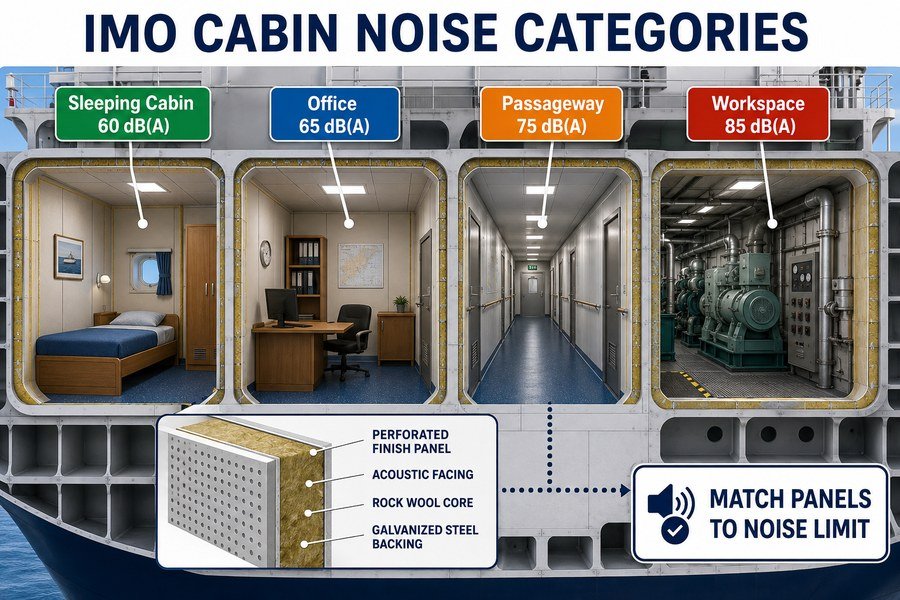
If you buy the wrong panels, you either fail the noise test or waste money on expensive materials you do not need. I learned this the hard way at the marine outfitting factory. Let me show you how to exactly match your materials to the right noise rules to protect your project budget.
What Noise Categories Separate Marine Sleeping Cabins From Working Spaces?
Loud engine noise ruins crew sleep and causes complaints. How do you separate rest areas from work areas? You need to know the strict boundary rules.
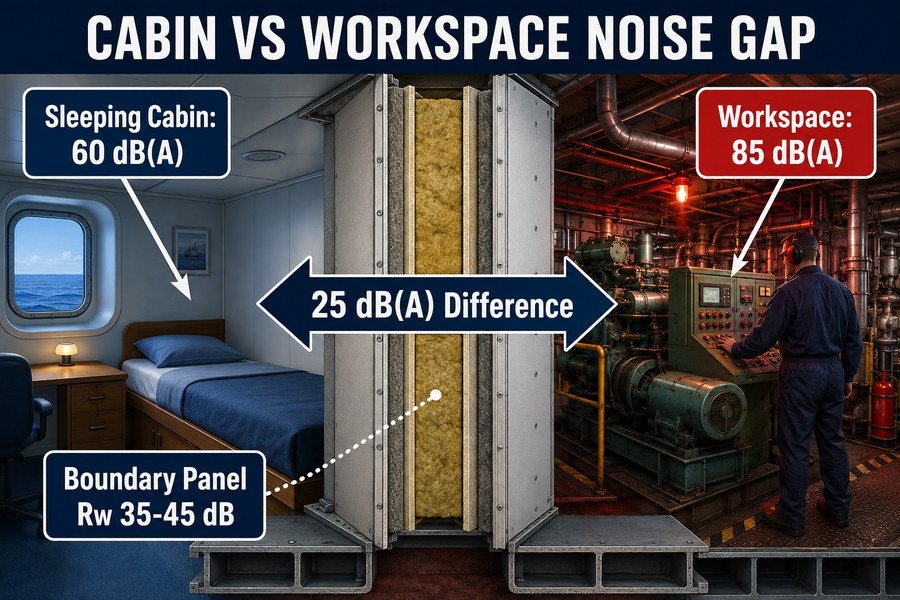
IMO rules separate sleeping cabins, limited to 60 dB(A), from working spaces, which allow up to 85 dB(A). This 25 dB(A) gap means the walls dividing these two categories need high-performance acoustic marine panels with a sound reduction index (Rw) of 35 to 45 dB.
Noise Limit Differences Between Cabins and Workspaces
I remember a client who used standard wall panels between a crew cabin and a machinery room. The noise test failed because the IMO limits are very different. A sleeping cabin has a strict limit of 60 dB(A). But a working space, like a machinery control room, allows up to 85 dB(A). The gap between them is 25 dB(A). This means the wall separating them must block a lot of sound. You cannot just use a basic 25mm panel. You need a panel that stops the noise from passing through. We look at the Sound Reduction Index (Rw) to measure this. The Rw value tells us exactly how much sound the panel blocks.
Choosing Marine Wall Panels for Cabin-to-Workspace Boundaries
To stop the 85 dB(A) noise from ruining the 60 dB(A) cabin, you need marine wall panels with an Rw rating of 35 to 45 dB. I always suggest a 50mm thick rockwool panel for this job. The rockwool core density should be at least 120 kg/m3. A standard panel costs around $15 to $18 per square meter. But a high-acoustic 50mm panel costs between $25 and $35 per square meter. Paying a little more for the right panel saves you from failing the whole ship inspection. You must also check the marine fire door. If the door leaks sound, the good wall panel is useless.
| Space Category | IMO Noise Limit | Required Boundary Panel Rw | Estimated Panel Cost (USD/sqm) |
|---|---|---|---|
| Sleeping Cabin | 60 dB(A) | N/A (Receiving end) | N/A |
| Working Space | 85 dB(A) | N/A (Source end) | N/A |
| Dividing Boundary | N/A | 35 to 45 dB | $25 to $35 |
How Are Marine Accommodation Spaces Grouped by Allowable Noise Level?
Buying premium acoustic panels for every room is too expensive. How do you group spaces to save money? You must group them by their allowable noise limits.
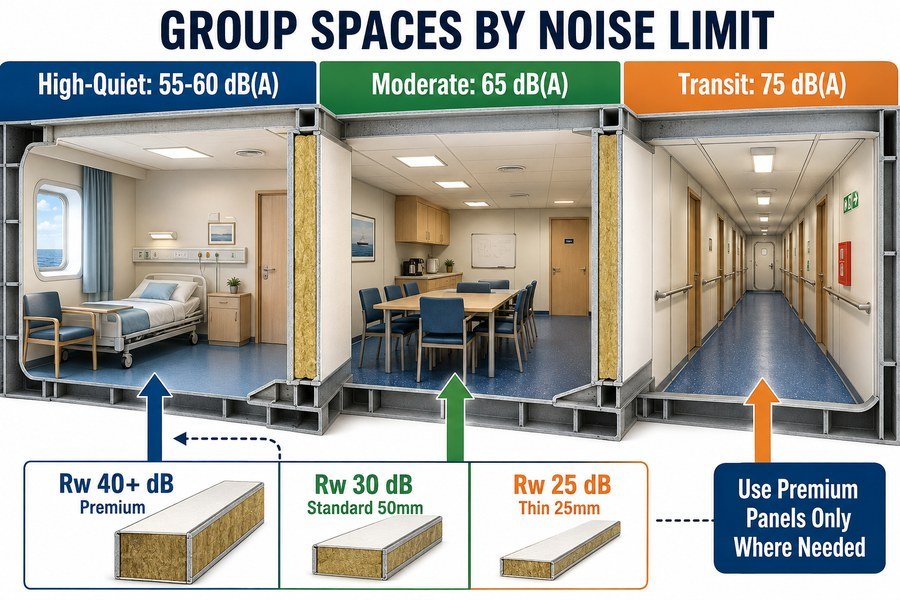
Marine spaces are grouped into three allowable noise levels: high-quiet zones like hospitals and passenger cabins (55-60 dB(A)), moderate zones like offices (65 dB(A)), and transit zones like corridors (75 dB(A)). You must match panel acoustic ratings to each specific group to control costs.
High-Quiet Zones: Hospitals and Passenger Cabins
The IMO groups spaces based on what people do in them. The first group is high-quiet zones. These include ship hospitals and passenger sleeping cabins. The IMO MSC.337(91) rule limits these spaces to a very strict 55 dB(A) or 60 dB(A). People need to rest and heal here. So, the noise must be very low. When I worked in the factory, we made special double-skin panels just for these rooms. You must buy panels with an Rw rating of at least 40 dB to 45 dB for these areas.
Moderate Zones and Transit Zones
The second group is moderate zones. These include ship offices and dining messes. The IMO limit here is 65 dB(A). People talk and work here, so a little more noise is fine. You can use standard 50mm marine wall panels with an Rw of 30 dB. The third group is transit zones, like corridors and passageways. The limit here is 75 dB(A). People just walk through, so they do not need quiet. You can use thin 25mm panels with an Rw of 25 dB. A 25mm panel costs about $15 per square meter, while a 50mm high-acoustic panel costs about $30 per square meter. By grouping spaces, you buy the expensive panels only when you truly need them. This strategy keeps your project on budget and shortens your delivery time.
| Noise Group | Space Type | IMO Limit dB(A) | Recommended Panel Rw | Panel Cost (USD/sqm) |
|---|---|---|---|---|
| High-Quiet | Hospital / Passenger Cabin | 55 - 60 | 40+ dB | $30 - $40 |
| Moderate | Office / Dining Mess | 65 | 30 dB | $20 - $25 |
| Transit | Corridor / Passageway | 75 | 25 dB | $15 - $18 |
Which Cabin Classifications Demand the Highest Marine Panel Acoustic Performance?
Failing a noise test in a VIP cabin delays the whole ship. Which rooms need your absolute best materials? High-grade cabins demand very strict acoustic attention.
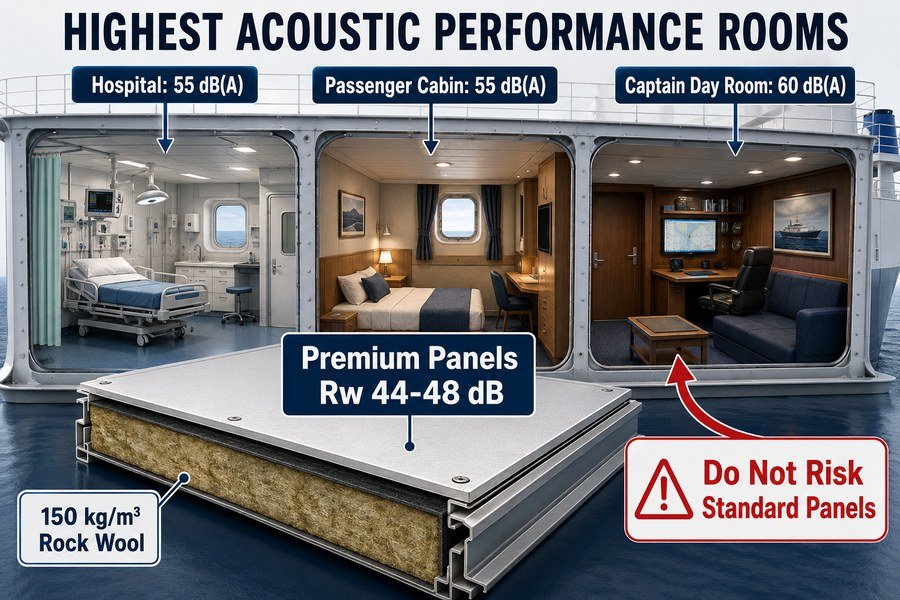
The classifications demanding the highest acoustic performance are medical hospitals (55 dB(A)), passenger sleeping cabins (55 dB(A)), and Captain day rooms (60 dB(A)). To meet these strict limits, you must install premium marine acoustic panels with an Rw rating between 44 dB and 48 dB.
Acoustic Requirements for Ship Hospitals and Passenger Cabins
Some rooms on a ship cannot fail a noise test. Medical hospitals and passenger sleeping cabins are the strictest classifications. The IMO sets their noise limit at 55 dB(A). Captain and Chief Engineer day rooms follow closely at 60 dB(A). At Magellan Marine, I often see buyers try to save money on these rooms. They buy standard panels and then fail the sea trial. You cannot take risks here. You must use materials that block out engine vibrations and hallway noise completely.
Material Specifications for High-Acoustic Marine Panels
To hit the 55 dB(A) or 60 dB(A) target, you need premium acoustic panels. These panels must have an Rw rating between 44 dB and 48 dB.1 How do we make these? In the factory, we use a 50mm thick panel. But we fill it with high-density rockwool, around 150 kg/m3. Sometimes, we add a thin sheet of galvanized steel or special sound-damping rubber inside the core. A normal panel weighs about 14 kg per square meter. A high-acoustic panel weighs over 20 kg per square meter. You will pay around $40 to $50 per square meter for these premium panels. It is expensive, but replacing a failed panel on a finished ship costs ten times more. You also need to match these panels with premium B-15 class acoustic fire doors.
| Cabin Classification | IMO Limit dB(A) | Required Panel Rw | Rockwool Density | Est. Cost (USD/sqm) |
|---|---|---|---|---|
| Medical Hospital | 55 | 44 - 48 dB | 150 kg/m3 | $40 - $50 |
| Passenger Cabin | 55 | 44 - 48 dB | 150 kg/m3 | $40 - $50 |
| Captain Day Room | 60 | 40 - 45 dB | 120 kg/m3 | $35 - $40 |
How Does the Noise Category of a Ship Passageway Differ From an Adjacent Cabin?
Corridors are noisy. Doors and walls between corridors and cabins often leak sound. Why does this happen? The passageway has a much higher allowed noise limit.
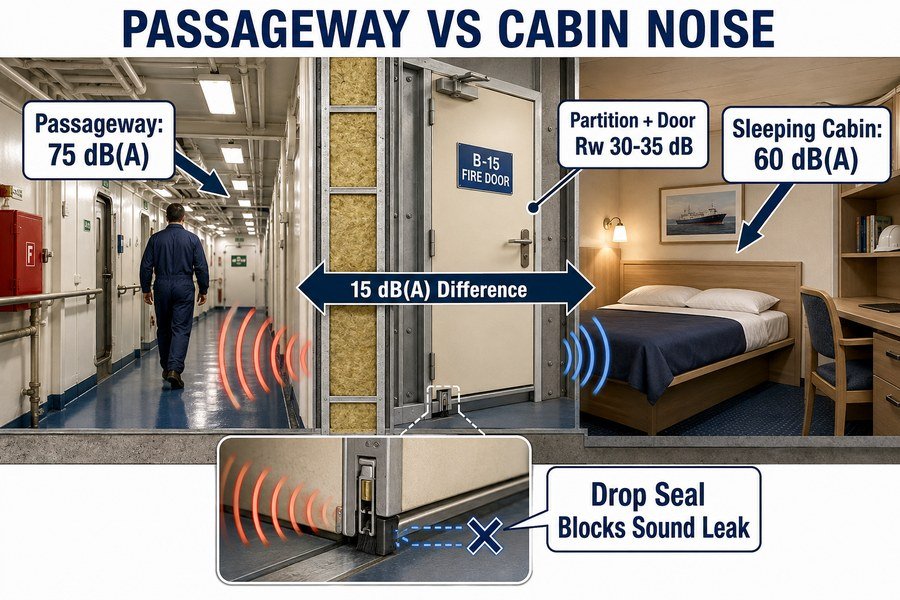
A ship passageway has a high noise limit of 75 dB(A), while its adjacent sleeping cabin is restricted to 60 dB(A). Because of this 15 dB(A) difference, the partition walls and marine fire doors connecting them must provide an acoustic reduction rating of Rw 30 to 35 dB.
Understanding the 15 dB(A) Difference Between Corridors and Cabins
Think about a busy ship corridor. Crew members walk by with heavy boots. Trolleys roll on the hard deck. The public address system announces messages. Because of this, IMO rules allow a passageway to reach 75 dB(A). But the sleeping cabin right next to it must stay at 60 dB(A) or lower. This creates a 15 dB(A) difference between the two spaces. Sound always travels from loud areas to quiet areas. If the wall between them is weak, the cabin will get too loud.
Selecting Marine Fire Doors for Corridor-to-Cabin Partitions
To block this noise, the partition walls and doors must have an Rw rating of 30 to 35 dB2. When clients come to me with noise problems, the issue is almost always the door. A good marine wall panel stops the sound. But if you buy a cheap fire door, the sound leaks through the gaps. You must buy a B-15 class marine fire door with acoustic seals. Never buy a door with an open ventilation louver for a sleeping cabin. The sound will go right through the hole. Instead, buy a door with a mechanical drop seal at the bottom. A standard B-15 door costs around $250. An acoustic B-15 door with drop seals costs about $350 to $400. That extra $100 keeps the cabin quiet and passes the inspection easily.
| Space / Element | IMO Limit dB(A) | Required Rw Rating | Key Acoustic Feature | Est. Door Cost (USD) |
|---|---|---|---|---|
| Passageway | 75 | N/A | N/A | N/A |
| Sleeping Cabin | 60 | N/A | N/A | N/A |
| Marine Fire Door | N/A | 30 - 35 dB | Bottom Drop Seal | $350 - $400 |
How Do Office and Control Spaces Fit Into Marine Cabin Noise Classifications?
Crew members cannot work if their office is too loud. Do you treat offices like normal cabins? No, they have their own specific noise rules.
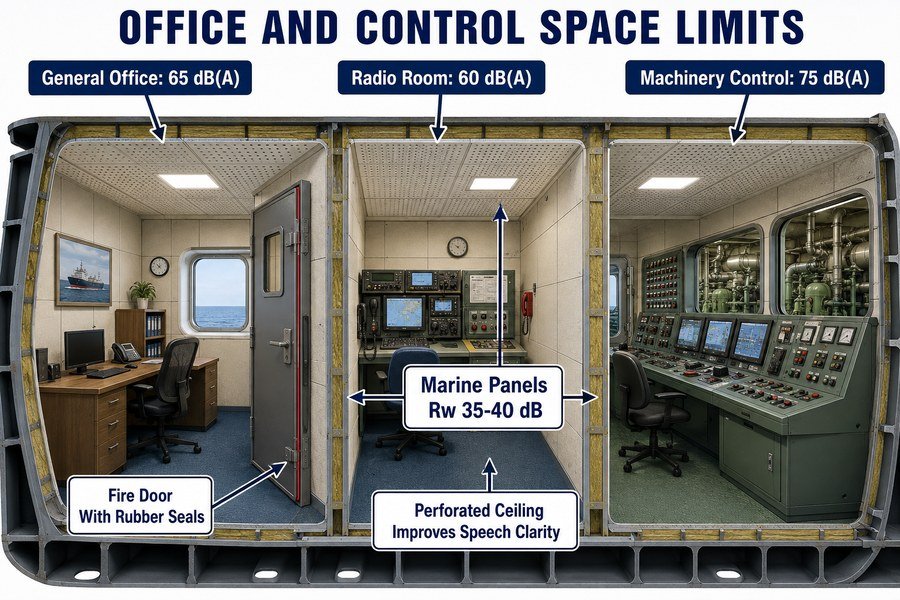
Offices and control spaces fit into marine classifications as moderate work zones, with IMO limits set at 65 dB(A) for offices and 60 dB(A) for radio rooms. They sit between sleeping cabins and loud workspaces, requiring marine panels with an Rw rating of 35 to 40 dB.
Noise Rules for Marine Offices and Radio Rooms
Offices and control spaces are very important on a ship. Crew members need to focus, read, and talk on the radio. The IMO sets the limit for general offices at 65 dB(A). But for radio rooms, the limit is stricter at 60 dB(A). People must hear radio messages clearly. These spaces are moderate work zones. They are not as quiet as a hospital, but they are much quieter than an engine room.
Outfitting Solutions for Moderate-Level Work Zones
You need to buy marine panels with an Rw rating of 35 to 40 dB for these rooms. In my time working with ship interior decorations, I learned a great trick for offices. The noise does not just come from outside. It also bounces around inside the room. To fix this, you should buy perforated marine ceiling panels3. A standard ceiling panel costs about $18 per square meter. A perforated ceiling panel with a thin acoustic fleece inside costs about $22 to $26 per square meter. The small holes trap the sound inside the room. This makes conversations much clearer. You also need to make sure the marine fire door has good rubber seals. A B-0 or B-15 door with standard seals is usually enough for a 65 dB(A) office. By choosing the right mix of panels and ceilings, you solve the problem easily and save money.
| Space Type | IMO Limit dB(A) | Recommended Panel Rw | Suggested Ceiling Type | Est. Ceiling Cost (USD/sqm) |
|---|---|---|---|---|
| General Office | 65 | 35 dB | Perforated Acoustic | $22 - $26 |
| Radio Room | 60 | 40 dB | Perforated Acoustic | $22 - $26 |
| Machinery Control | 75 | 30 dB | Standard Solid | $18 - $20 |
Conclusion
Understanding IMO noise categories—from 55 dB(A) hospitals to 85 dB(A) workspaces—helps you buy the exact marine wall panels and doors you need, saving money while ensuring compliance.
-
"How Do ISO (Rw) and ASTM (STC) Marine Interior Panel Standards ...", https://magellanmarinetech.com/how-iso-rw-astm-stc-marine-interior-panel-standards-differ/. Marine accommodation acoustic standards, classification-society comfort rules, or peer-reviewed studies on ship cabin partitions can document typical airborne sound insulation requirements and measured weighted sound reduction indices for cabin wall systems in the Rw/STC 40-50 dB range; this supports the plausibility of specifying Rw 44-48 dB panels for stringent cabin noise control. Evidence role: general_support; source type: institution. Supports: High-acoustic marine panels for 55-60 dB(A) cabin targets should have an Rw rating of about 44-48 dB. Scope note: Such sources would support the range as an acoustic design benchmark rather than proving it is a universal IMO requirement for every ship hospital or passenger cabin. ↩
-
"How to Match a Marine Accommodation Panel System to ...", https://magellanmarinetech.com/how-match-marine-accommodation-panel-system-to-the-correct-noise-path/. Published marine-accommodation acoustic guidance and sound-insulation standards describe weighted sound reduction index ratings for partitions and doors and show that door assemblies, seals, and flanking paths materially affect achieved room-to-room noise isolation. Evidence role: general_support; source type: institution. Supports: Corridor-to-cabin partitions and doors should have an Rw rating of about 30 to 35 dB to control noise transfer. Scope note: Such sources can support the plausibility of the 30-35 dB Rw range as design guidance, but the exact required rating depends on room geometry, absorption, leakage, flanking transmission, and the applicable class or owner specification. ↩
-
"Investigating the Potential of Transparent Parallel-Arranged ...", https://pmc.ncbi.nlm.nih.gov/articles/PMC9859406/. Acoustics literature describes perforated panels backed by an air cavity or porous layer as sound absorbers that can reduce room reverberation and thereby support clearer speech communication. Evidence role: mechanism; source type: paper. Supports: Perforated ceiling panels with acoustic backing can absorb sound inside a room and improve conversational clarity. Scope note: This evidence supports the acoustic mechanism in general; actual performance depends on hole geometry, backing material, cavity depth, installation quality, and the specific marine room design. ↩