Shipyard clients reject noisy cabins, yet many builders face failed acoustic tests. Understanding how a marine bulkhead's core configuration impacts sound blocking is the key to passing inspections.
Core configuration dictates acoustic insulation through four primary mechanisms: core mass (density), dynamic stiffness, internal damping (air pockets), and multi-layer barriers (septums). Adjusting these four variables within a standard 50mm marine bulkhead can shift sound reduction (Rw) from a basic 30 dB to a premium 45 dB.
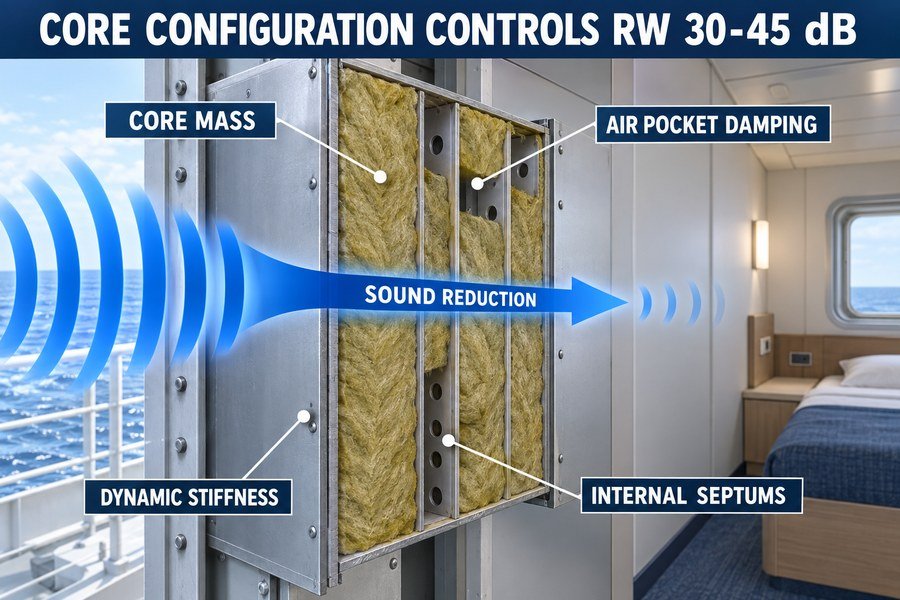
If you think buying a thicker panel is the only way to meet passenger ship noise rules, the following details will save your budget and deck space.
Why Do Two Equal-Thickness Marine Accommodation Panels Deliver Vastly Different Rw Values?
It frustrates procurement teams when two 50mm panels look identical but one fails the noise test. The hidden core design makes all the difference.
Two equal-thickness 50mm panels yield different Rw values due to three internal differences: the mineral wool's density, the orientation of the core fibers, and the presence of decoupled metal skins. A perpendicular fiber core with acoustic glue outperforms a standard parallel fiber core by up to 5 dB.
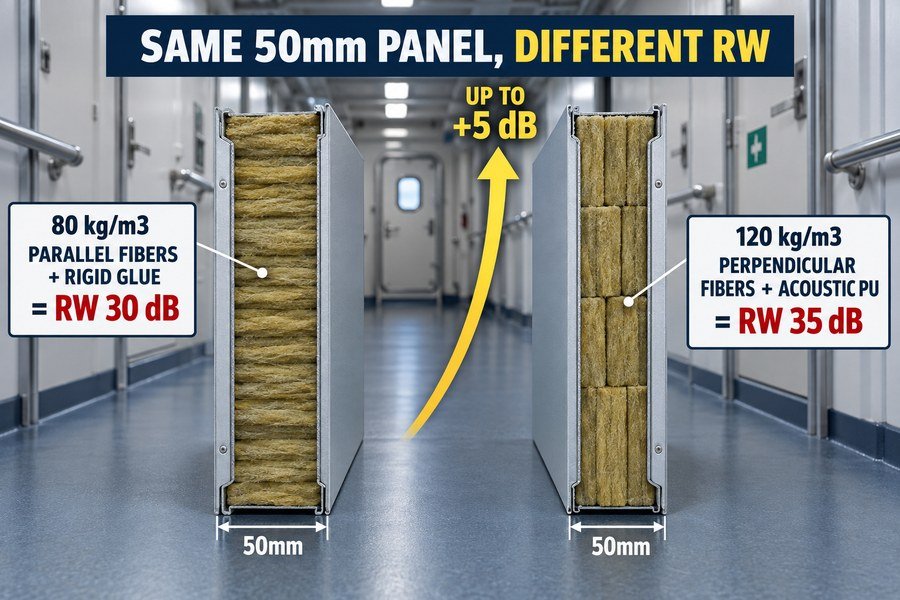
At Magellan Marine, I meet many buyers who purchase standard 50mm marine wall panels from factories in Asia. They get a cheap price, maybe $18 per square meter. But when they send these panels to a European shipyard, the panels fail the IMO A.468(XII) noise limits. The client then compares this panel to another 50mm panel that costs $26 per square meter. Both look the same on the outside. Both use 0.6mm galvanized steel skins. So why does the second panel easily achieve an Rw of 35 dB while the first one only hits 30 dB? The secret lies in the three internal differences I mentioned in the summary. I will break them down now.
Impact of Mineral Wool Density on 50mm Marine Panels
The first major difference is the density of the mineral wool inside the panel. The cheap panel usually uses rock wool with a density of 80 kg/m3. The premium panel uses rock wool with a density of 120 kg/m3. The extra rock wool mass in the premium panel creates a stronger barrier against sound waves. A heavier core absorbs more sound energy.1 This simple density upgrade accounts for about 2 dB of the total performance gap. But density alone does not explain everything.
How Core Fiber Orientation and Skin Decoupling Change Acoustic Performance
The second difference is the orientation of the core fibers. In a standard cheap panel, the rock wool fibers run parallel to the steel skins. Sound waves pass through these long fibers easily. In a high-quality panel, factories cut the rock wool into strips and turn them 90 degrees. We call this perpendicular fiber orientation2. This forces sound waves to hit the fibers sideways, which traps the sound energy much better.
The third difference is decoupled metal skins. Standard panels use hard, rigid glue to attach the steel skin to the wool. This rigid glue acts like a bridge for sound. Premium panels use a flexible acoustic polyurethane glue. This flexible glue decouples the skin from the core3. It stops vibrations on the front skin from traveling straight to the back skin. This decoupling effect adds another 2 to 3 dB of sound insulation.
| Panel Type | Mineral Wool Density | Fiber Orientation | Glue Type | Expected Rw Value | Estimated Price (Per Sqm) |
|---|---|---|---|---|---|
| Standard 50mm Panel | 80 kg/m3 | Parallel | Rigid Epoxy | 30 dB | $18.00 |
| Premium 50mm Panel | 120 kg/m3 | Perpendicular | Flexible Acoustic PU | 35 dB | $26.00 |
How Does Mineral Wool Density Alter a Marine Bulkhead's Sound Insulation?
High engine noise ruins the cruise experience. Many buyers guess the wrong rock wool density, paying more for materials that block less sound.
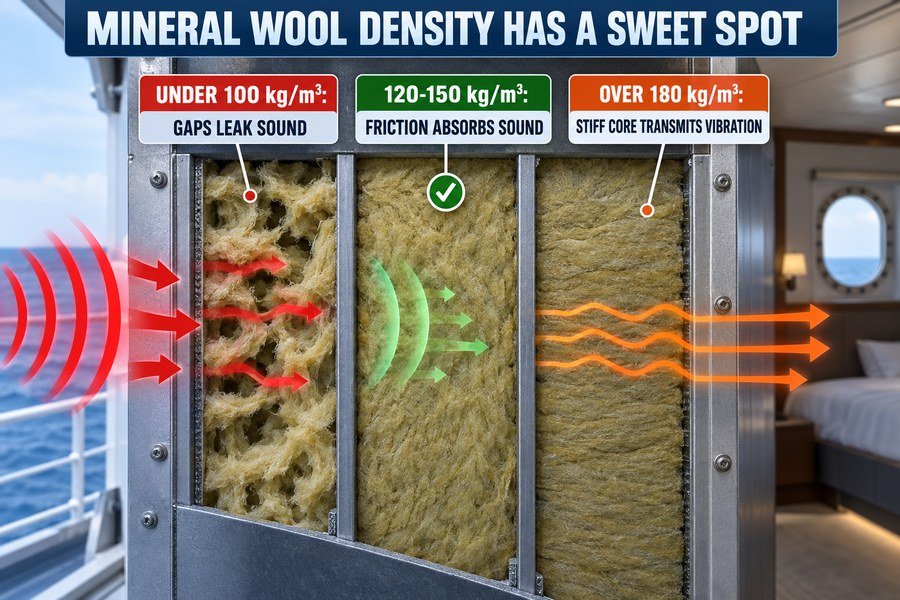
Mineral wool density alters sound insulation across three distinct ranges: low density (under 100 kg/m3) leaves gaps for sound, optimal density (120-150 kg/m3) maximizes sound energy absorption through air friction, and excessive density (over 180 kg/m3) solidifies the core, inadvertently transmitting low-frequency engine vibrations directly.
When I worked at the marine outfitting factory, I saw customers make a very common mistake. They believed that heavier is always better. Because they wanted to supply high-quality ship interior products to European shipyards, they asked us to use the heaviest rock wool possible. They thought this would solve all acoustic problems. But sound insulation does not follow a straight, simple line4. The relationship between density and sound blocking changes depending on which of the three density ranges you use. You must pick the right range to get competitive pricing and good quality.
The Flaws of Low-Density Mineral Wool Below 100 kg/m3
Let us look at the first range. This is low-density mineral wool, usually between 60 kg/m3 and 100 kg/m3. In this range, the wool has too much air and not enough solid fiber. When a sound wave enters the panel, it finds very little resistance. The fibers are too far apart to trap the sound wave through friction. Panels in this range usually only achieve an Rw of 28 dB to 30 dB. They are cheap, but they will fail strict shipyard inspections for passenger cabins. I only recommend this density for basic cargo ship corridors where noise rules are lower.
Finding the Sweet Spot (120-150 kg/m3) and the Danger of Densities Over 180 kg/m3
The second range is the optimal density. This sits between 120 kg/m3 and 150 kg/m3. In this zone, the rock wool has the perfect ratio of solid fiber to trapped air. When sound enters, it rubs against the tight fibers. This friction turns the sound energy into tiny amounts of heat.5 This is how you maximize sound absorption. Panels with 120 kg/m3 rock wool easily reach 33 dB to 35 dB.
The third range is excessive density, anything over 180 kg/m3. This is where buyers waste money. When you pack rock wool this tight, you remove too much air. The core becomes a solid, hard block. Because it is so stiff, low-frequency engine vibrations travel right through the solid wool.6 The sound insulation actually drops. You pay a high price for 180 kg/m3 wool, but your low-frequency noise control gets worse.
| Density Range | Core Characteristic | Acoustic Performance Result | Best Application Area |
|---|---|---|---|
| Under 100 kg/m3 | Too much air, loose fibers | Poor sound friction, Rw ~30 dB | Cargo ship dry areas |
| 120-150 kg/m3 | Perfect fiber-to-air ratio | Max sound absorption, Rw ~35 dB | Passenger cabin walls |
| Over 180 kg/m3 | Solidified, no air pockets | Transmits engine vibration, Rw drops | Not recommended for acoustics |
Why Does a Rigid Core Ruin a Marine Interior Sandwich Panel's Overall Acoustic Insulation?
You might think a stiff, solid wall blocks sound perfectly. In reality, a rigid sandwich panel creates a drum effect that amplifies low-frequency noise.
A rigid core ruins acoustic insulation through two failures: structural bridging and the mass-spring-mass resonance effect. When a core lacks flexibility, sound waves hit the steel skin and transfer vibration directly through the rigid core to the opposite skin without losing energy, dropping Rw by 4 to 8 dB.
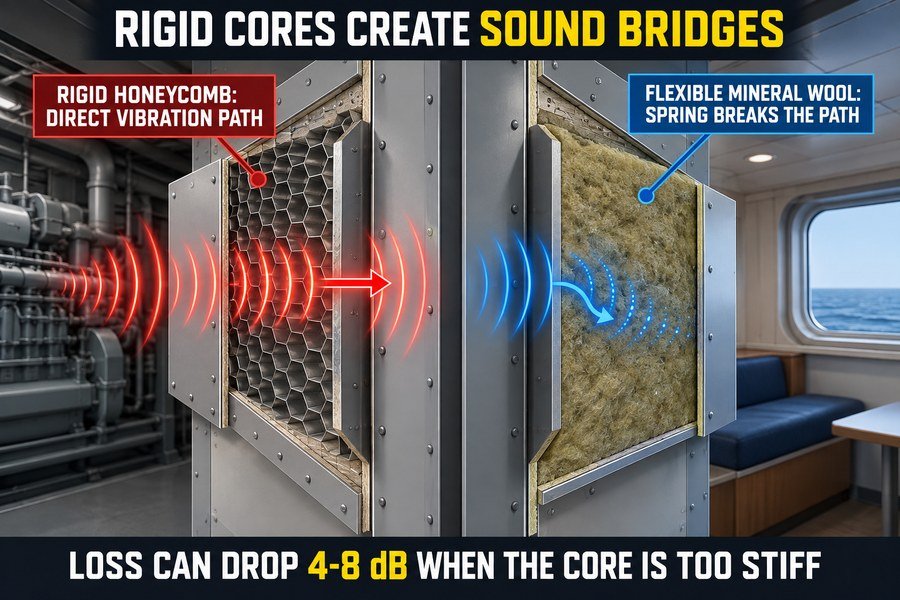
I once helped a client who bought a batch of aluminum honeycomb panels for a luxury yacht project. Honeycomb panels are incredibly strong and lightweight. The client loved them. But when the European shipyard tested the cabins, the acoustic results were terrible. The cabins were so loud that people could hear regular talking from the next room. The client was shocked. They asked me why a strong panel failed the noise test so badly. The answer is that acoustic insulation hates stiffness7. A rigid core ruins sound blocking because of the two specific failures I highlighted in the snippet: structural bridging and the mass-spring-mass resonance effect. I will explain both.
The Problem of Structural Bridging in Marine Sandwich Panels
The first failure is structural bridging. Think of a rigid core, like aluminum honeycomb or very dense calcium silicate. These materials form a hard, solid bridge between the front steel skin and the back steel skin of the panel.8 When a sound wave hits the front skin, the skin starts to vibrate. Because the core is rigid, it cannot compress or absorb this vibration. Instead, the core carries the vibration directly to the back skin. The back skin then vibrates and pushes the sound into the next room. This direct transfer bypasses the mass of the panel entirely. This bridging effect will easily drop your overall Rw value by 4 to 8 dB compared to a flexible rock wool core.9
Understanding the Mass-Spring-Mass Resonance Failure in Rigid Cores
The second failure involves the mass-spring-mass resonance effect.10 In a good acoustic panel, the front skin is a mass, the soft core acts like a spring, and the back skin is another mass. The soft spring absorbs energy. But when you use a rigid core, you remove the spring. The whole panel acts as one single, stiff mass. It acts like the skin of a drum. When low-frequency engine noise hits this stiff panel, it hits the resonance frequency of the rigid structure. Instead of blocking the noise, the wall actually amplifies the low-frequency sound. To fix this, you must always choose a core material that has some dynamic flexibility, like 120 kg/m3 mineral wool.
| Core Material Type | Structural Bridging Risk | Spring Effect | Acoustic Result (50mm thick) |
|---|---|---|---|
| Aluminum Honeycomb | Very High (direct metal path) | None (Too rigid) | Poor (Rw ~28 dB) |
| Dense Calcium Silicate | High (solid mineral bridge) | None (Too rigid) | Medium (Rw ~30 dB) |
| Mineral Wool (120 kg/m3) | Low (soft fibers break path) | Excellent (Soft spring) | Good (Rw ~35 dB) |
How Does an Internal Septum Layer Boost a Marine Accommodation Core's Sound Transmission Loss?
Reaching an Rw of 45 dB with standard rock wool requires very thick walls. This eats up cabin space unless you use an internal septum.
An internal septum layer boosts sound transmission loss by introducing three acoustic barriers: a heavy mass layer (like 1mm galvanized steel) that reflects sound, a break in acoustic pathways, and a shift in resonance frequency. This thin addition increases overall panel performance by 5 to 7 dB.
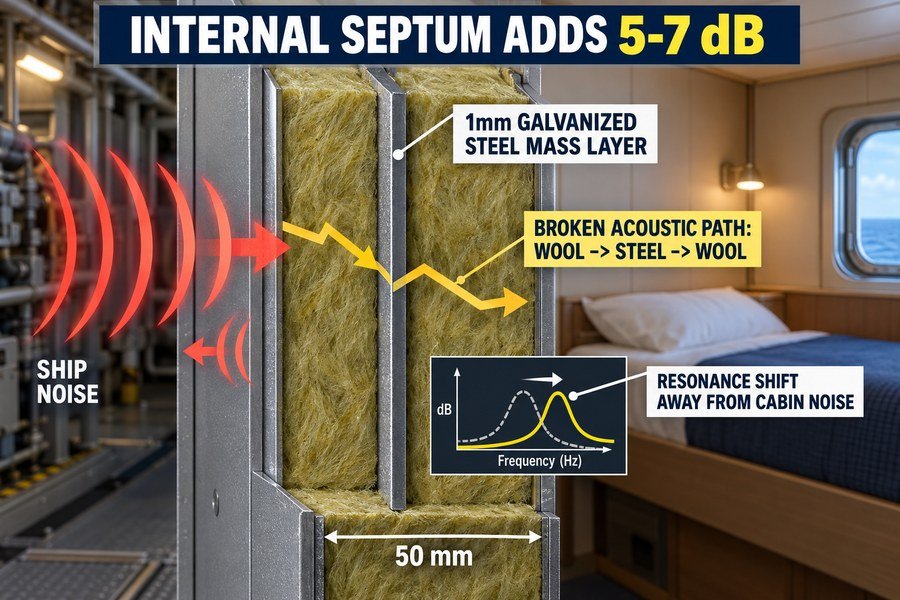
Shipyards always want to save space. A standard 50mm marine panel gives you about 35 dB of sound reduction.11 If a shipyard asks you for a panel that delivers 44 dB, you have a problem. If you only use regular rock wool, you would need a panel that is 100mm thick to hit 44 dB. That takes away 50mm of space from every cabin. When you build a ship with 500 cabins, that lost space equals lost money. The smart way to solve this is to use an internal septum layer inside a standard 50mm panel. This simple addition introduces the three vital acoustic barriers I outlined above. I will show you how these three barriers work to give you high acoustic performance without increasing the thickness of the panel.
Heavy Mass Reflection and Breaking Acoustic Pathways
The first barrier is heavy mass reflection. A septum is usually a 1mm or 1.5mm thick sheet of flat galvanized steel placed right in the middle of the rock wool core. When sound travels through the first layer of rock wool, it hits this steel sheet. The heavy mass of the steel stops the sound wave and reflects a large portion of it back into the first wool layer.
The second barrier is a break in acoustic pathways. Sound loves to travel in a straight line through continuous materials. By splitting the rock wool core into two separate 25mm halves with a steel sheet in between, you destroy the continuous pathway. The sound must change mediums: from air, to wool, to steel, back to wool, and back to air. Every time sound changes mediums, it loses significant energy.12
Shifting the Resonance Frequency with a 1mm Steel Septum
The third barrier involves a shift in resonance frequency. Every panel has a specific frequency where it naturally vibrates easily. At this frequency, sound passes right through. By adding a heavy steel septum in the middle, you change the weight distribution of the whole panel. This shifts the resonance frequency to a point outside the normal range of human speech and engine noise.13 Combined, these three barriers push a standard 50mm panel from 35 dB up to 43 dB or even 45 dB. The cost of a septum panel is higher, usually around $35 to $40 per square meter, but it is the only way to meet strict acoustic limits in thin spaces.
| Panel Construction (50mm total) | Core Layers | Acoustic Barriers Present | Rw Value | Space Required |
|---|---|---|---|---|
| Standard Panel | 50mm Rock Wool | Basic friction only | 35 dB | 50mm |
| Double Panel System | 2x 50mm Rock Wool + Air Gap | Breaking pathways | 45 dB | 100mm+ |
| Septum Panel | 25mm Wool + 1mm Steel + 25mm Wool | Mass reflection, broken paths, shifted resonance | 44 dB | 50mm |
How Do Mixed-Density Core Layers Widen a Marine Bulkhead's Insulation Frequency Range?
Ship noise includes both high-pitch HVAC hums and low-pitch engine rumbles. A single-density panel cannot block both effectively, leading to passenger complaints.
Mixed-density core layers widen insulation frequency by targeting two separate noise types: a dense outer layer (150 kg/m3) blocks low-frequency engine rumbles, while a lighter inner layer (100 kg/m3) absorbs high-frequency voice and HVAC sounds. This dual-action approach ensures compliance across the entire 100 Hz to 3150 Hz spectrum.
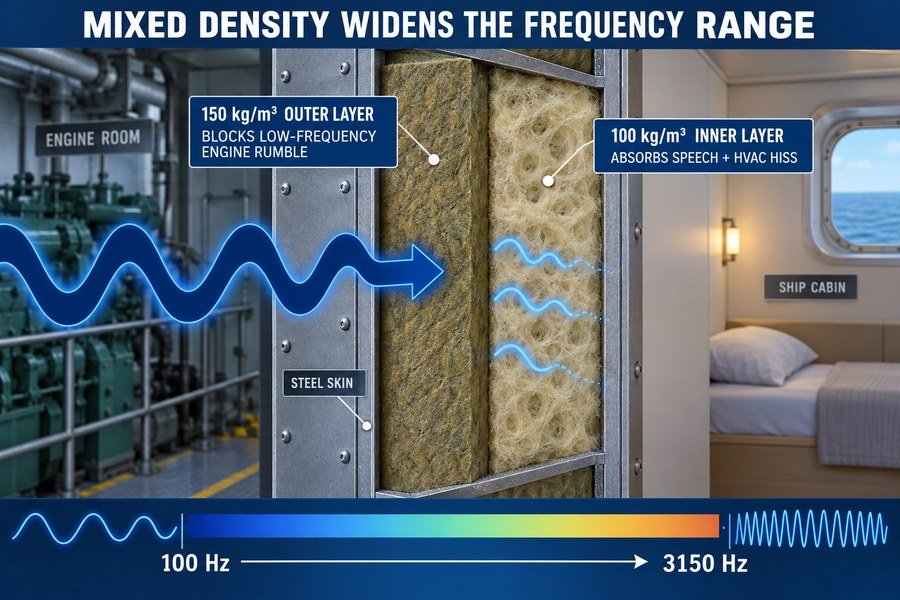
When you look at an ISO 717-1 acoustic laboratory report, you will see a graph. This graph tests the panel from very low frequencies (100 Hz) up to very high frequencies (3150 Hz). I often see buyers get confused when their panel has a high overall Rw number, but the shipyard still complains about noise. This happens because a single-density core only works well at specific frequencies14. For example, a standard 120 kg/m3 panel might block medium frequencies perfectly, but it fails to stop the very low rumble of the ship's generators. To solve this, advanced manufacturers use mixed-density core layers. They combine two different densities of wool in one panel to target the two separate noise types mentioned in the snippet.
Blocking Low-Frequency Engine Rumbles with High-Density Outer Layers
The first target is low-frequency noise. This comes from the ship's engines, propellers, and large generators. These low-frequency sounds have very long sound waves that push hard against the walls. To stop them, you need heavy mass.15 In a mixed-density panel, the factory uses a heavy rock wool layer, usually 150 kg/m3, right behind the steel skin. This heavy layer adds the necessary mass to resist the strong, slow pushes of low-frequency engine rumbles. It stops the wall from vibrating in tune with the engines.
Absorbing High-Frequency HVAC Noise Using Lighter Inner Layers
The second target is high-frequency noise. This includes human voices, music, and the high-pitched hiss of the HVAC air conditioning system. High-frequency sound waves are very short and fast. They pass right through heavy, dense mass. To trap them, you need a softer material with lots of tiny air pockets. Therefore, the factory places a lighter rock wool layer, around 100 kg/m3, next to the heavy layer. The fast sound waves enter the soft layer and get trapped by friction in the small air spaces. By combining 150 kg/m3 and 100 kg/m3 wools together, the panel passes the shipyard tests across the entire frequency range. You pay a slightly higher price for manufacturing complexity, but you guarantee zero passenger complaints.
| Targeted Noise Type | Frequency Range | Best Wool Density to Block | Mixed-Density Panel Solution |
|---|---|---|---|
| Engine Rumbles, Generators | Low (100 Hz - 400 Hz) | Heavy (150 kg/m3) | Outer layer uses 150 kg/m3 wool |
| Speech, Music, HVAC Hiss | High (1000 Hz - 3150 Hz) | Light (100 kg/m3) | Inner layer uses 100 kg/m3 wool |
| Full Spectrum Ship Noise | Broad (100 Hz - 3150 Hz) | Combination required | Both layers bonded together in one core |
Conclusion
Mastering core configurations—density, flexibility, septums, and mixed layers—helps you buy the right panels. You save money, pass IMO noise tests, and easily secure high-value European shipyard projects.
-
"Acoustic Performance of Sound Absorbing Materials ... - PMC", https://pmc.ncbi.nlm.nih.gov/articles/PMC9105389/. Peer-reviewed studies of porous mineral-wool absorbers show that density and related flow-resistivity parameters influence acoustic absorption and sound transmission behavior in fibrous materials. Evidence role: mechanism; source type: paper. Supports: Increasing mineral-wool density can improve the acoustic behavior of a marine wall panel by changing absorption and transmission properties.. Scope note: Such studies support the physical mechanism generally; they do not prove the exact dB gain for the specific panel constructions described. ↩
-
"Sound Absorption Properties of Natural Fibers: A Review", https://www.academia.edu/105954057/Sound_Absorption_Properties_of_Natural_Fibers_A_Review. Research on anisotropic fibrous acoustic materials indicates that fiber orientation affects airflow resistivity, wave propagation, and sound absorption characteristics, providing a mechanism by which rotated mineral-wool strips may alter panel acoustic performance. Evidence role: mechanism; source type: paper. Supports: Changing rock-wool fibers from parallel to perpendicular orientation can influence how sound travels through the panel core.. Scope note: The evidence is contextual unless the source tests the same marine sandwich-panel geometry and materials. ↩
-
"Quieting a rib-framed honeycomb core sandwich panel ... - PMC", https://pmc.ncbi.nlm.nih.gov/articles/PMC6662235/. Studies of sandwich panels and viscoelastic adhesive layers show that compliant interlayers can reduce vibration transmission and increase damping, which can improve sound-insulation performance in layered structures. Evidence role: mechanism; source type: paper. Supports: A flexible acoustic polyurethane adhesive can reduce direct vibration transfer between metal skins and the core compared with a rigid adhesive.. Scope note: This supports the decoupling principle generally; the claimed 2–3 dB improvement would require test data for the exact adhesive, skins, and core assembly. ↩
-
"Comparison of the sound absorption properties of acoustic ...", https://bioresources.cnr.ncsu.edu/resources/comparison-of-the-sound-absorption-properties-of-acoustic-absorbers-made-from-used-copy-paper-and-corrugated-board/. A peer-reviewed acoustics source on fibrous porous absorbers supports that density, porosity, and airflow resistivity affect absorption and transmission in frequency-dependent, non-linear ways rather than through a simple 'heavier is better' rule. Evidence role: expert_consensus; source type: paper. Supports: The relationship between mineral wool density and sound insulation is not simply linear.. Scope note: This would support the general acoustic principle, not the article's exact density breakpoints. ↩
-
"[PDF] Rigid-Frame Porous Material Acoustic Attenuation on Compressor ...", https://docs.lib.purdue.edu/cgi/viewcontent.cgi?article=3094&context=icec. An educational or research source on porous sound absorbers supports that acoustic energy is dissipated mainly through viscous and thermal losses as air oscillates through interconnected pores and fibers. Evidence role: mechanism; source type: education. Supports: Mineral wool absorbs sound partly by converting acoustic energy into heat through frictional and thermal losses in the fibrous structure.. Scope note: This explains the physical mechanism generally and does not prove the specific performance of the panels described in the article. ↩
-
"Inverse-designed metastructures with customizable low ...", https://ui.adsabs.harvard.edu/abs/2025EuJMA.11005515H/abstract. Research on porous elastic materials and floating or layered partitions supports that excessive stiffness or unfavorable dynamic stiffness can reduce vibration isolation, especially at low frequencies where structure-borne transmission is difficult to attenuate. Evidence role: mechanism; source type: paper. Supports: Very dense, stiff mineral wool can be less effective against low-frequency vibration transmission than a less rigid porous core.. Scope note: This would support the underlying vibration-isolation principle; it may not directly verify that all rock wool above 180 kg/m3 performs worse in the specific marine panel described. ↩
-
"[PDF] Transverse coupled resonances for ultrathin lightweight acoustic ...", https://upcommons.upc.edu/bitstreams/9268a3ec-6aa2-4051-a928-79e88f1ead90/download. Acoustic theory for double-leaf partitions describes sound insulation as depending on mechanical coupling, cavity compliance, damping, and resonance behavior; this supports the general point that excessive stiffness can reduce isolation, but the phrase is a simplified design rule rather than a universal law. Evidence role: expert_consensus; source type: education. Supports: Rigid or overly stiff sandwich panel constructions can perform poorly for acoustic insulation compared with more compliant, damped assemblies.. Scope note: Contextual support only; stiffness can improve transmission loss in some single-panel mass-law situations, so the claim needs framing around sandwich or double-leaf constructions. ↩
-
"Airborne sound insulation performance of lightweight double ...", https://pmc.ncbi.nlm.nih.gov/articles/PMC11666719/. Studies and guidance on sandwich panels and double-leaf partitions describe how rigid connections or core materials can create mechanical coupling between facings, increasing structure-borne transmission; this supports the bridging mechanism, although performance depends on facing thickness, core geometry, damping, and boundary conditions. Evidence role: mechanism; source type: paper. Supports: Rigid cores can mechanically couple the two skins of a sandwich panel and transmit vibration from one face to the other.. Scope note: Does not by itself quantify the effect for aluminum honeycomb or dense calcium silicate in a specific marine panel. ↩
-
"How Does Installation Affect Marine Wall Panel STL? - Magellan ...", https://magellanmarinetech.com/how-installation-affect-marine-wall-panel-stl/. Comparative acoustic measurements of sandwich or double-leaf panels with rigid versus porous fibrous cores can document reductions in weighted sound reduction index caused by stronger mechanical coupling; this would support the magnitude of the claimed Rw loss only if the tested assemblies closely match the panel thickness, skins, and mounting conditions described here. Evidence role: statistic; source type: paper. Supports: Structural bridging from a rigid core can reduce the weighted sound reduction index by roughly 4–8 dB compared with a flexible mineral-wool core in comparable panel assemblies.. Scope note: A 4–8 dB difference is assembly-specific and should not be presented as universal without matching test data. ↩
-
"[PDF] The finite layer method for modelling the sound transmission ...", https://upcommons.upc.edu/bitstreams/6ce7ff3e-10c0-4bbc-baa9-c0aea47a9c5a/download. Building-acoustics references define the mass–spring–mass resonance of double-leaf partitions as a low-frequency resonance determined by the masses of the leaves and the compliance of the intervening cavity or resilient layer; this supports the mechanism discussed, though exact resonance and amplification depend on the tested assembly. Evidence role: definition; source type: encyclopedia. Supports: Double-skin acoustic panels can exhibit mass–spring–mass resonance that reduces sound insulation at low frequencies.. Scope note: The source would support the general acoustic principle, not necessarily the yacht cabin example or the specific panel values in the table. ↩
-
"How to choose the right marine wall panels for marine interior ...", https://magellanmarinetech.com/how-choose-right-marine-wall-panels-for-marine-interior-projects/. A classification test report, type-approval document, or peer-reviewed measurement study for 50 mm mineral-wool marine partition panels can substantiate that such assemblies commonly achieve sound reduction values in the mid-30 dB range under standardized airborne-sound insulation testing. Evidence role: statistic; source type: institution. Supports: A standard 50 mm marine panel provides about 35 dB of sound reduction.. Scope note: The exact Rw value depends on panel skins, core density, joints, installation details, and the test standard used. ↩
-
"Tunable sound transmission at an impedance-mismatched ...", https://pmc.ncbi.nlm.nih.gov/articles/PMC5048161/. Acoustics texts on acoustic impedance explain that when a sound wave encounters an interface between materials with different characteristic impedances, part of the incident energy is reflected and part is transmitted, providing the physical basis for energy loss across layered assemblies. Evidence role: mechanism; source type: education. Supports: Sound loses energy when passing through multiple material interfaces because impedance changes cause reflection and transmission losses.. Scope note: The magnitude of energy loss depends on frequency, angle of incidence, damping, coupling, and the impedance contrast between the specific materials. ↩
-
"Effect of Additional Mass on Natural Frequencies of Weight ...", https://pmc.ncbi.nlm.nih.gov/articles/PMC10490749/. Research on mass-spring-mass resonance in double-leaf and sandwich partitions shows that changing mass distribution and cavity properties shifts resonance frequencies that govern low-frequency transmission loss. Evidence role: mechanism; source type: paper. Supports: Adding a steel septum changes panel mass distribution and can shift the resonance frequency of the partition.. Scope note: A source may verify the resonance-shift mechanism, but the assertion that the shifted resonance falls outside both speech and engine-noise ranges requires product-specific measurements or modeling. ↩
-
"Sound Transmission Loss of Composite Sandwich Panels", https://etd.auburn.edu/bitstream/10415/1702/3/Ran%20Zhou_Dissertation.pdf. Acoustic insulation research shows that multilayer panels and porous-core constructions have frequency-dependent transmission loss, with material density, layer arrangement, and resonance effects influencing performance across the spectrum. Evidence role: mechanism; source type: paper. Supports: Single-density acoustic cores can provide uneven sound-insulation performance across different frequency bands.. Scope note: This provides general acoustic support for frequency-dependent behavior; it does not prove that every single-density marine panel fails at the same frequencies. ↩
-
"Analytic Modeling of Sound Transmission through Membrane ...", https://composites.usc.edu/analytic-modeling-of-sound-transmission-through-membrane-type-acoustic-metamaterials/. The acoustic mass law states that, above resonance-controlled regions, increasing the surface mass of a barrier generally increases airborne sound transmission loss, with the effect especially relevant to resisting long-wavelength low-frequency excitation. Evidence role: mechanism; source type: education. Supports: Heavier wall or panel layers are generally more effective at improving airborne sound insulation, including for low-frequency noise control.. Scope note: Mass law is an idealized rule and does not account for panel stiffness, mounting details, coincidence effects, or flanking transmission in a ship installation. ↩