Heat and fire can easily ruin a ship cabin. If gaps exist in your panels, safety fails. I will show you how to build a continuous insulation barrier for maximum protection.
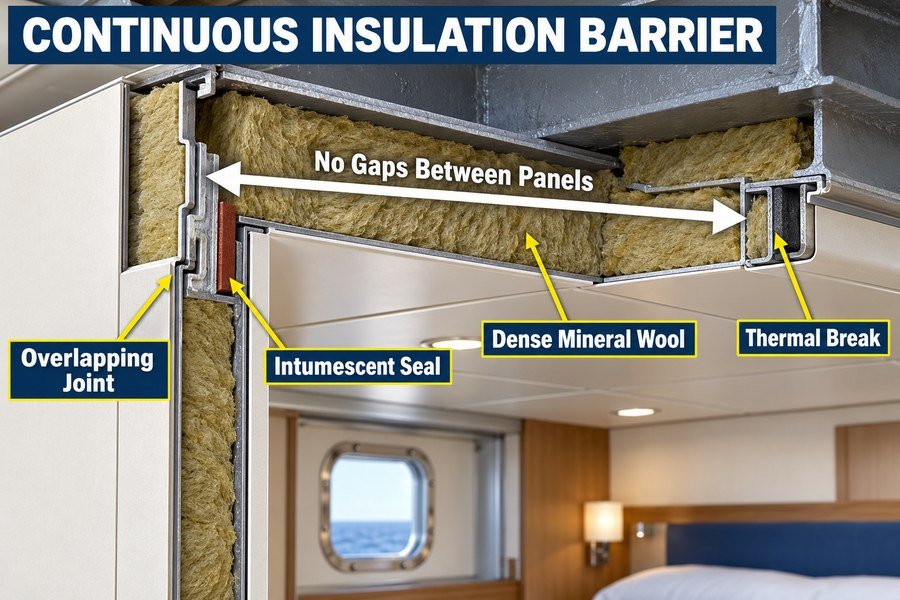
Insulation continuity in marine accommodation panels is achieved by using overlapping joints, intumescent seals, dense mineral wool packing, and thermal break profiles. These four methods work together to seal every gap between wall panels, ceiling panels, and ship decks, ensuring full compliance with SOLAS fire regulations.
Let me explain exactly how we use these specific methods in real shipyard projects to protect lives and pass strict safety inspections.
What Is Insulation Continuity in Marine Accommodation Panels?
You buy expensive fire-rated panels for your ship. But if they do not connect right, fire spreads fast. Continuity means no weak points exist anywhere.
Insulation continuity in marine accommodation panels refers to the unbroken barrier of fire and thermal protection across all joints, penetrations, and edges. It consists of three main elements: panel-to-panel connections, panel-to-deck boundaries, and pipe penetration seals, which block heat transfer and meet IMO FTP Code standards.
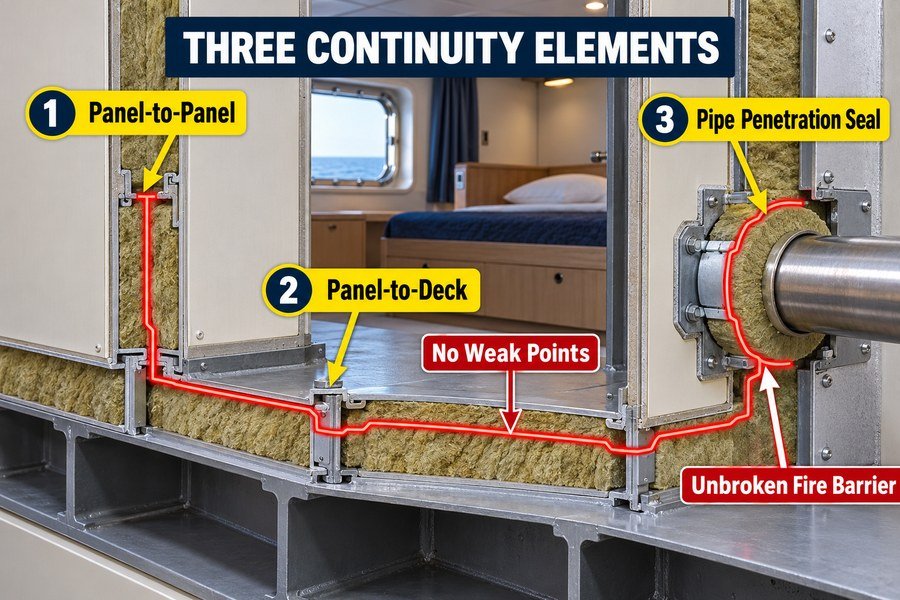
The Three Elements of Insulation Continuity
In my years as a marine outfitting specialist, I have seen many good panels fail because of bad connections. Insulation continuity means the protection never stops. If a wall panel has rockwool inside, the joint between two panels must also resist fire just as well as the center of the panel. The first element is panel-to-panel connections. When we join two B-15 wall panels, we cannot leave an empty gap. We must use a joint system that keeps the rockwool continuous from one board to the next.
The second element is panel-to-deck boundaries. A wall panel must sit firmly on a steel deck. The gap between the bottom of the panel and the steel deck is a major weak point. We must fill this gap completely with insulation. The third element is pipe penetration seals. Ships have many pipes and electrical cables. When a pipe goes through an A-60 bulkhead, it breaks the insulation layer. We must use special sealing compounds around the pipe to fix this break. All three elements must work together. If you miss just one, the fire will find the hole.
IMO FTP Code Standards for Marine Insulation
The International Maritime Organization (IMO) creates the rules for ship safety. The Fire Test Procedures (FTP) Code tells us exactly how well our continuous insulation must perform. For example, IMO FTP Code Part 3 states that an A-60 bulkhead must stop flames and smoke for a full 60 minutes. It also states that the unexposed side of the panel cannot get hotter than 180°C above the starting temperature1. If your insulation is not continuous, the heat at the joint will rise very fast2. The joint will fail the 180°C limit in less than 15 minutes. To pass this test, factories use rockwool with a specific density. We typically use rockwool with a density of 120 kg/m³ to 140 kg/m³ inside the joints. This high density stops heat from moving.
| Continuity Element | Typical Gap Size | Required Material | Purpose |
|---|---|---|---|
| Panel-to-Panel Connections | 2mm to 5mm | Z-profile steel with rockwool | Stop fire between wall units |
| Panel-to-Deck Boundaries | 10mm to 30mm | Ceramic fiber tape and sealant | Prevent heat transfer from steel deck |
| Pipe Penetration Seals | 10mm to 50mm clearance | Intumescent mastic (expands at 200°C) | Seal holes around cables and pipes |
How to Maintain Unbroken Insulation Across Marine Ceilings?
Ceiling panels often sag or shift. This creates dangerous hidden gaps above cabins. Here is how to lock your ceiling insulation tight.
To maintain unbroken insulation across marine ceilings, you must use tight spline joints, overlapping edge profiles, mineral wool infills at margins, and suspended hangers with thermal pads. These four techniques stop heat from leaking through the ceiling grid and keep B-15 or A-60 ratings intact.
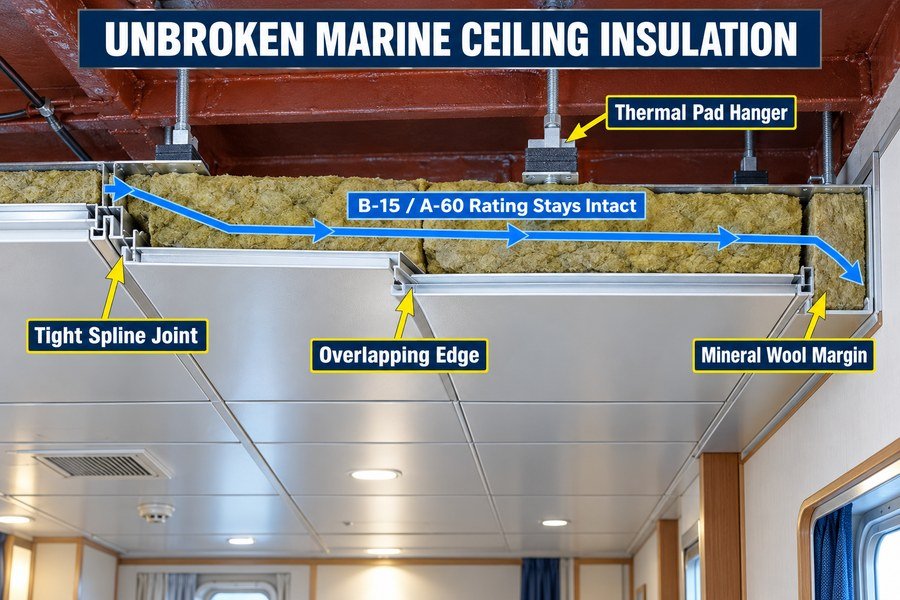
Four Techniques for Unbroken Marine Ceilings
Ceilings are very hard to insulate properly. Gravity pulls down on the panels all day. Ship vibrations shake them loose.3 If you do not lock them together securely, gaps will open. I always check four specific techniques when I inspect a ship ceiling. The first technique is using tight spline joints. We insert a thin metal spline into the edges of two adjoining ceiling panels. This spline aligns the panels perfectly and blocks smoke from passing through the crack4.
The second technique is using overlapping edge profiles. Instead of flat edges touching each other, the edges step over one another. If the panels pull apart slightly by 2mm during a storm, the overlap still covers the gap. The fire cannot see a straight path through the ceiling. The third technique is applying mineral wool infills at margins. The margin is the corner where the ceiling meets the steel wall of the ship. We cannot just push the ceiling panel against the bare steel. We must stuff extra rockwool into this corner. We usually use a 50mm thick strip of 100 kg/m³ rockwool to close the margin.
The fourth technique is using suspended hangers with thermal pads. Ceiling panels hang from the steel deck above using long metal rods. Metal conducts heat quickly. We place rubber or ceramic thermal pads between the steel deck and the hanger rod. This pad stops the heat from traveling down the rod and ruining the ceiling insulation.
Suspension System Thermal Pads
Let us look closer at these thermal pads. A standard steel hanger rod conducts heat very fast. During a ship fire, the steel deck above the cabin might reach 800°C. If the metal rod touches the deck directly, the rod gets red hot immediately. It will literally melt the ceiling panel from the inside out. We stop this dangerous heat transfer by using a thermal pad made of ceramic fiber or high-temperature silicone. This pad is usually only 5mm thick, but it can stop 80% of the heat transfer. The ceiling panel stays cool and safe below.
| Ceiling Insulation Technique | Location | Primary Material | Benefit |
|---|---|---|---|
| Tight Spline Joints | Between panels | 1.2mm Galvanized steel spline | Blocks smoke and flame path |
| Overlapping Edge Profiles | Panel edges | Formed steel sheets | Keeps barrier closed during vibration |
| Mineral Wool Infills | Ceiling margins | 100 kg/m³ rockwool (50mm thick) | Seals gap at the steel bulkhead |
| Hangers with Thermal Pads | Suspension points | 5mm ceramic fiber pads | Stops heat traveling down metal rods |
Why Is Insulation Continuity Critical for Marine B-15/A-60 Interior Panels?
Ship owners will reject interiors that fail safety tests. A tiny gap ruins a whole A-60 bulkhead. Continuity saves both lives and money.
Insulation continuity is critical for B-15 and A-60 marine interior panels because it prevents structural steel melting, blocks toxic smoke passage, and reduces HVAC energy loss by up to 30%. These three reasons ensure passenger safety and help shipyards pass strict classification society inspections.
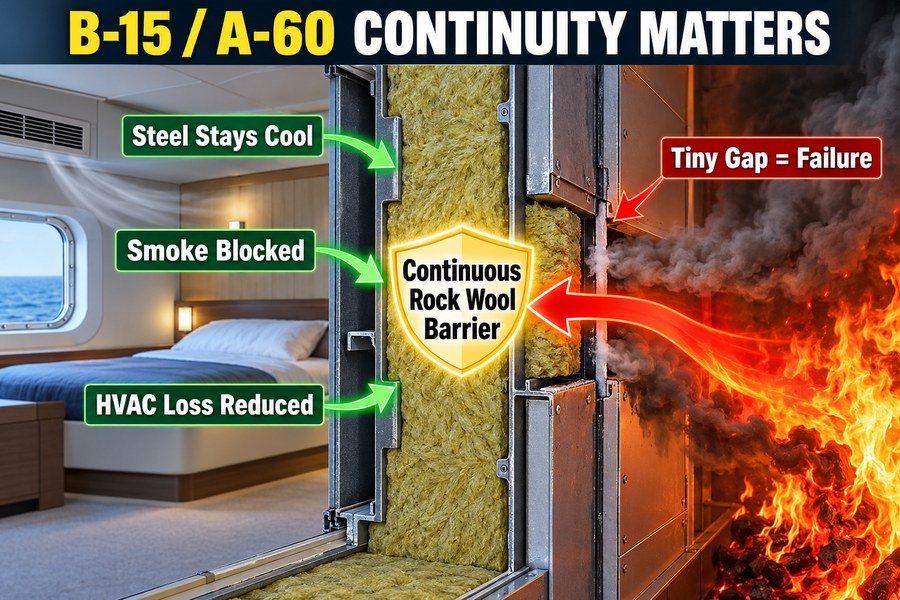
Three Reasons B-15/A-60 Continuity Matters
Why do we care so much about every tiny gap in the wall? I always tell my clients that a fire wall is only as strong as its weakest joint. The first reason insulation continuity is critical is that it prevents structural steel melting. Ship bulkheads hold the heavy ship together. If fire heat passes through a bad joint in an A-60 panel, it will directly hit the steel ship structure. According to classification societies like DNV or Lloyd's Register, structural steel loses half its strength when it reaches 400°C. Continuous insulation keeps the steel well below this danger zone.
The second reason is blocking toxic smoke passage. In a serious ship fire, smoke kills many more people than flames. A B-15 cabin partition must stop smoke completely for 15 minutes5. If the insulation at the top of the panel has a small 5mm gap, heavy black smoke will fill the next cabin in less than two minutes. Continuous insulation seals the room like a tight box.
The third reason is reducing HVAC energy loss. Ships burn a lot of expensive diesel fuel to run air conditioning systems. When a ship sails in hot areas like the Middle East, the outside steel gets very hot. If the insulation inside the wall panels is continuous, the cold air stays inside the cabin. A well-sealed cabin reduces HVAC energy loss by up to 30%6. This saves the ship owner thousands of dollars in fuel costs every single month.
Classification Society Inspections for Marine Panels
Shipyards cannot just promise the panels are safe. They must prove it to a classification society. An inspector from DNV or ABS will walk through the ship during construction. They look very closely at the joints. They check the continuity between the B-15 doors and the wall panels. If they see a gap where the rockwool is missing, they will reject the entire room instantly. You will have to take the walls down and rebuild them properly. This costs a lot of time and money. Buying panels that naturally lock together to form a continuous barrier makes the inspection very easy to pass.
| Reason for Continuity | Affected System | Risk of Failure | Solved by Continuity |
|---|---|---|---|
| Prevent Steel Melting | Ship structure | Hull collapse at 400°C | Keeps steel cool during fire |
| Block Toxic Smoke | Passenger health | Smoke inhalation | Seals gaps against gas |
| Reduce HVAC Energy | Ship generators | High diesel fuel costs | Cuts energy loss by up to 30% |
How Do Overlapping Details Prevent Gaps in Marine Bulkheads?
Standard butt joints crack when a ship vibrates at sea. These cracks let deadly fire through. Overlapping joints solve this problem completely.
Overlapping details prevent gaps in marine bulkheads by using Z-profile joints, tongue-and-groove connections, offset mineral wool layers, and cover strips. These four overlapping designs allow the wall panels to flex under ship vibration while keeping a 100% sealed barrier against fire and heat.
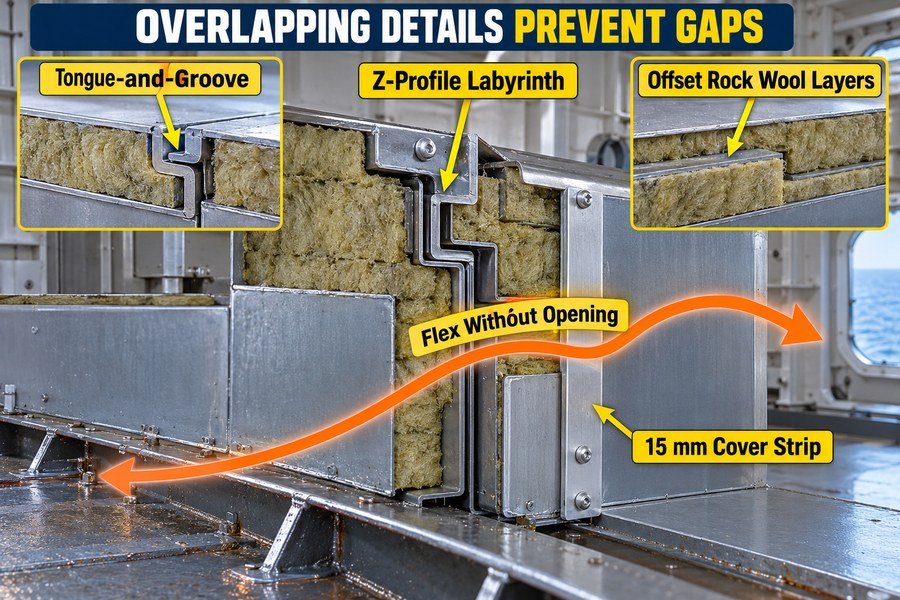
Four Overlapping Designs for Marine Bulkheads
A ship on the ocean never stops moving. The massive engines cause vibration, and the ocean waves cause the hull to twist7. Because of this constant movement, flat edges pushed against each other will eventually pull apart. We need joints that can move safely. The first overlapping design we use is Z-profile joints. The metal edge of the panel is shaped like the letter Z. When two Z-profiles lock together, they form a tight labyrinth. If the panels pull apart by 3mm, the Z-shape still overlaps securely. The fire cannot go straight through.
The second design is tongue-and-groove connections. This is very common in 50mm thick composite panels. One panel has a long metal tongue. The next panel has a deep groove. We push the tongue firmly into the groove. This creates a very strong mechanical bond. Even under heavy ship vibration, the tongue stays safely inside the groove, keeping the insulation continuous.
The third design is offset mineral wool layers. Inside a 50mm panel, we do not use one solid piece of rockwool. We use two 25mm layers. We slide the second layer slightly to the side. This means the seam of the first layer does not match the seam of the second layer. If heat gets past the first layer's seam, it hits solid rockwool in the second layer.
The fourth design is cover strips. Sometimes we must leave a small gap between panels for thermal expansion. We cover this gap with a flat steel strip that overlaps both panels by at least 15mm on each side. We screw this strip tightly to the panels. This strip protects the soft joint underneath.
Ship Vibration Impact on Bulkhead Joints
Ship vibration is the enemy of panel insulation. The main engine operates at low frequencies, usually around 10 Hz to 20 Hz.8 This low rumble travels quickly through the steel deck and shakes the wall panels. Over five years, a standard flat joint will fail. The screws will loosen, and the rockwool will turn to dust at the edges9. Overlapping joints spread this vibration force over a much larger area. The tongue-and-groove joint allows the panels to slide slightly against each other without breaking the seal. This flexibility ensures the A-60 fire rating lasts for the entire 20-year lifespan of the ship.
| Overlapping Design | How It Works | Best Used For |
|---|---|---|
| Z-Profile Joints | Labyrinth shape blocks straight paths | A-60 heavy duty bulkheads |
| Tongue-and-Groove | Deep insertion prevents pulling apart | B-15 standard cabin walls |
| Offset Mineral Wool | Staggered internal seams block heat | High thermal insulation panels |
| Cover Strips | External steel strip covers expansion gaps | Panel-to-deck or corner joints |
How to Prevent Conductive Bypass in Marine Accommodation Panels?
Metal conducts heat very fast. Even with thick rockwool, metal frames can get dangerously hot. Thermal bypass ruins good insulation panels.
To prevent conductive bypass in marine accommodation panels, builders must install PVC thermal breaks, use non-metallic fasteners, apply ceramic fiber tape between steel and panels, and leave a 5mm air gap. These four methods stop heat from traveling through the metal framing of the ship.
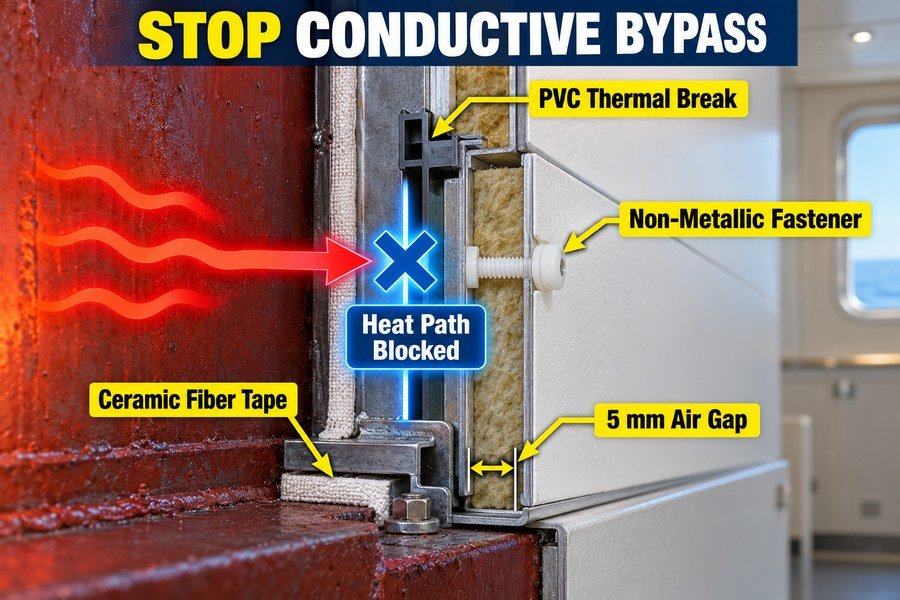
Four Methods to Stop Conductive Bypass in Panels
Conductive bypass happens when heat finds a fast path through a solid material. Steel is a great conductor of heat. If the steel face of a wall panel touches the hot steel hull of the ship, the wall panel gets hot instantly. The rockwool inside the panel cannot help at all. We must break this metal-to-metal contact completely. I always enforce four methods to stop this. The first method is to install PVC thermal breaks. A thermal break is a piece of hard plastic or PVC placed inside the metal frame of the panel. PVC does not conduct heat well.10 It separates the hot outside steel face from the cool inside steel face.
The second method is to use non-metallic fasteners. If you use a thick steel bolt to hold an insulated panel to the ship, that bolt acts like a highway for heat. The heat travels straight down the bolt into the cabin. We replace these bolts with high-strength nylon fasteners or we cover the steel bolts with thick insulated plastic caps.
The third method is to apply ceramic fiber tape between the steel and the panels. When we mount a steel U-channel base track to the steel deck, we do not let the metal touch the metal. We put a 3mm thick strip of ceramic fiber tape directly under the track. This tape acts as a strong shield against the heat.
The fourth method is to leave a 5mm air gap. Air is actually a very poor conductor of heat.11 When we build panels next to the ship's outer hull, we do not push the panels against the hull. We leave a 5mm to 10mm gap of empty air. This air gap stops direct conduction completely.
Applying Ceramic Fiber Tape to Steel Deck
Ceramic fiber tape is one of my absolute favorite materials in marine outfitting. It is cheap, easy to cut, and incredibly effective. Unlike normal rubber, ceramic fiber tape does not melt. It can easily withstand temperatures up to 1000°C. During installation, the workers simply roll out the tape along the steel deck before they screw down the bottom panel tracks. This simple step takes only five minutes per cabin but prevents massive thermal bypass. It also helps to absorb small vibrations from the deck, making the cabin much quieter for the passenger.
| Prevention Method | Location | Material Used | Function |
|---|---|---|---|
| PVC Thermal Breaks | Inside panel frames | Rigid PVC plastic | Stops heat transfer between metal faces |
| Non-Metallic Fasteners | Mounting points | Nylon or insulated steel | Stops heat traveling through screws |
| Ceramic Fiber Tape | Under bottom tracks | 3mm Ceramic fiber | Separates panel track from steel deck |
| 5mm Air Gap | Between panel and hull | Empty air | Prevents direct physical heat conduction |
How Does a Continuous Thermal Envelope Improve Marine Interior Panels?
Cabin temperatures often fluctuate wildly. High AC bills hurt the ship owner's profit margin. A tight thermal envelope fixes this issue completely.
A continuous thermal envelope improves marine interior panels by cutting HVAC cooling loads by 25%, preventing hidden wall condensation, reducing noise transmission by 45 decibels, and extending the panel lifespan. These four benefits make the ship cabin much more comfortable and lower operating costs.
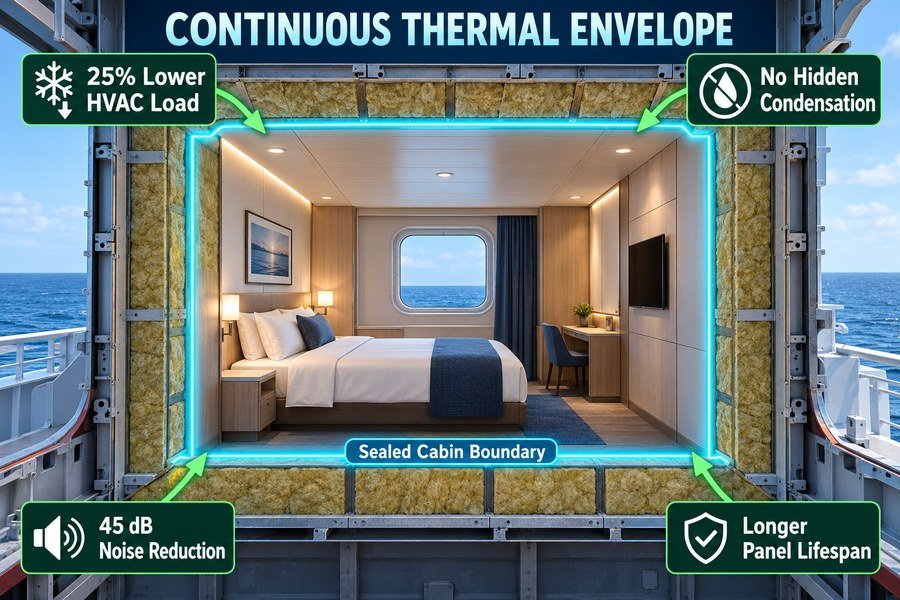
Four Benefits of a Continuous Thermal Envelope
When we connect all our panels, ceilings, and floors perfectly, we create a sealed box. We call this box the thermal envelope. If the envelope is continuous, it changes the entire environment inside the cabin. I see four massive benefits when this is done correctly. The first benefit is cutting HVAC cooling loads by 25%12. On a cruise ship with 1,000 cabins, the air conditioning works very hard. If every cabin leaks cold air through bad joints, the chillers must run at maximum power. A tight envelope keeps the cold air strictly inside, lowering the energy bill by a quarter.
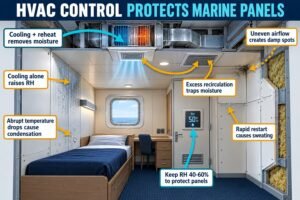
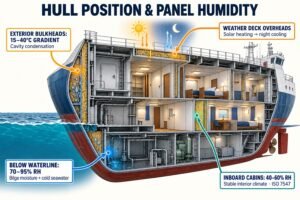
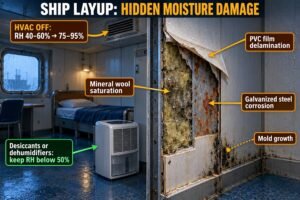
The second benefit is preventing hidden wall condensation. When warm, humid sea air hits a cold, poorly insulated metal joint, water drops form quickly. This condensation happens inside the walls where you cannot see it. Over time, it causes severe rust and dangerous mold. A continuous thermal envelope stops cold spots, so water never condenses.
The third benefit is reducing noise transmission by 45 decibels. Heat and sound travel through the exact same gaps. If your insulation is continuous, the sound barrier is also continuous. A good A-60 bulkhead with tight joints can block 45 decibels of noise13. Passengers will not hear the main engine or their loud neighbors.
The fourth benefit is extending the panel lifespan. When panels are not exposed to internal rust from condensation or extreme temperature changes, they last much longer. The steel faces do not warp, and the rockwool stays dry and mechanically strong.
Condensation Prevention in Marine Cabins
Condensation is a hidden killer in modern shipbuilding. I have opened up five-year-old wall panels and found them completely rusted from the inside out. This happens because the dew point is reached inside the wall cavity. The dew point is the specific temperature at which the air cannot hold its water vapor. If there is a break in the insulation, the steel panel becomes as cold as the ocean water outside. The warm cabin air touches that cold steel, and water appears instantly. By keeping the insulation continuous and using proper vapor barriers, we keep the inner steel face warm. The temperature never drops to the dew point, and the wall stays perfectly dry.
| Benefit of Thermal Envelope | Measurement | Operational Advantage |
|---|---|---|
| Cut HVAC Loads | 25% energy reduction | Saves massive amounts of diesel fuel |
| Prevent Condensation | Zero hidden water drops | Stops internal rust and toxic mold |
| Reduce Noise Transmission | 45 decibels blocked | Increases passenger sleeping comfort |
| Extend Panel Lifespan | 20+ years durability | Reduces shipyard warranty claims and repairs |
Conclusion
Building continuous insulation requires good materials and careful joint design. By using thermal breaks and overlapping edges, you ensure safe, comfortable, and SOLAS-compliant ship cabins that last for decades.
-
"Are Marine Fire Divisions the Same as Marine Panel Ratings?", https://magellanmarinetech.com/are-marine-fire-divisions-same-as-marine-panel-ratings/. The IMO 2010 FTP Code fire-test criteria for A-class divisions include temperature-rise limits on the unexposed face, including a maximum point temperature rise of 180°C above the initial temperature; this supports the stated limit for tested bulkheads. Evidence role: definition; source type: institution. Supports: The unexposed side of an A-class panel cannot exceed 180°C above the starting temperature at any single point during the test period.. Scope note: The Code also includes an average temperature-rise criterion, so the 180°C value is only one part of the full acceptance criteria. ↩
-
"Impact of Elevated Temperatures on the Integrity of PIR-Core ...", https://pmc.ncbi.nlm.nih.gov/articles/PMC12786826/. Fire-resistance literature on insulated assemblies identifies joints, gaps, and penetrations as thermal bridges or discontinuities that can accelerate heat transfer and undermine compartment performance; this supports the mechanism described for poorly insulated panel joints. Evidence role: mechanism; source type: paper. Supports: Discontinuous insulation at a joint can cause faster heat transfer during a fire test.. Scope note: Such sources may support the general mechanism rather than the article’s implied performance of a specific B-15 or A-60 joint design. ↩
-
"Study of Vibration Loosening of Bolted Joints-A Review", https://www.academia.edu/63504570/_Study_of_Vibration_Loosening_of_Bolted_Joints_A_Review_. Studies of shipboard vibration and structural dynamics document that vessels impose cyclic vibration loads on attached equipment and interior structures, which can contribute to loosening or fatigue in poorly restrained assemblies. Evidence role: mechanism; source type: paper. Supports: Ship vibrations can loosen inadequately restrained ceiling panels.. Scope note: This supports the general vibration mechanism, not the failure rate of any specific ceiling-panel system. ↩
-
"Smoke Management | NIST", https://www.nist.gov/el/beed/nist-multizone-modeling/applications/smoke-management. Fire-safety literature on compartmentation and joint sealing explains that unsealed gaps and joints can permit smoke and hot gas leakage, while properly detailed joints help maintain the integrity of a fire or smoke barrier. Evidence role: mechanism; source type: government. Supports: Tight spline joints can help prevent smoke movement through panel cracks by maintaining joint closure.. Scope note: This supports the principle of sealed joints limiting smoke passage; it does not independently verify this exact spline-joint design. ↩
-
"What Is the Purpose and Scope of the IMO FTP Code?", https://magellanmarinetech.com/what-purpose-scope-of-imo-ftp-code/. SOLAS/IMO fire-test provisions define B-class divisions by flame integrity and insulation-temperature criteria, including the 15-minute insulation rating for B-15 divisions; this provides the regulatory context for the time rating but does not by itself establish complete smoke-tightness. Evidence role: definition; source type: institution. Supports: A B-15 partition has a defined 15-minute fire-insulation performance requirement under marine fire-safety standards.. Scope note: B-15 classification primarily concerns fire integrity and insulation performance; smoke leakage requirements may be addressed separately by door, penetration, or ventilation rules. ↩
-
"Methodology for Estimated Energy Savings", https://www.energystar.gov/saveathome/seal_insulate/methodology. Energy-efficiency studies of building envelopes and HVAC systems show that reducing air leakage and improving insulation continuity can materially reduce heating and cooling loads, offering contextual support for the energy-loss mechanism. Evidence role: general_support; source type: government. Supports: Improved sealing and continuous insulation can reduce HVAC energy losses substantially.. Scope note: Evidence from buildings or general HVAC research may not directly prove a 30% reduction for ship cabins, which depends on climate, vessel operation, ventilation rates, and cabin construction. ↩
-
"Assessment of Cumulative Lifetime Seaway Loads for Ships", https://ctsm.umd.edu/archive-papers/sikorajpmichael16718.pdf. Naval-architecture sources describe wave-induced hull-girder bending and torsional loads as normal dynamic responses of ships at sea, supporting the need to account for relative movement in attached structures. Evidence role: mechanism; source type: education. Supports: Ocean waves can make a ship’s hull twist or deform dynamically, creating movement that affects bulkhead joints.. Scope note: This supports the general mechanical environment of ships, not the performance of any specific bulkhead joint design. ↩
-
"vibration of marine diesel engine foundation", https://www.academia.edu/5180778/VIBRATION_OF_MARINE_DIESEL_ENGINE_FOUNDATION. Marine vibration references report that ship machinery and propulsion systems generate low-frequency structural vibration, with dominant components depending on engine speed, firing order, shaft rotation, and hull response. Evidence role: general_support; source type: research. Supports: Ship main engines can generate low-frequency vibration that is transmitted through the vessel structure.. Scope note: The source should be checked carefully because a universal 10–20 Hz range may not apply to all main engines or vessel types. ↩
-
"The Influences of Moisture on the Mechanical, Morphological ...", https://pmc.ncbi.nlm.nih.gov/articles/PMC7288152/. Studies on mineral wool materials describe mechanical degradation, fiber breakage, and loss of integrity under repeated handling, compression, or vibration-like stresses, providing contextual support for edge damage in poorly protected joints. Evidence role: mechanism; source type: paper. Supports: Mineral wool at exposed or stressed panel edges can degrade mechanically under repeated movement or vibration.. Scope note: Such sources usually address mineral wool durability in general and may not directly prove a five-year failure mode in marine bulkhead joints. ↩
-
"(PDF) Investigation of the Thermal Conductivity of Polyvinyl ...", https://www.academia.edu/108452679/Investigation_of_the_Thermal_Conductivity_of_Polyvinyl_Chloride_Pvc_Ceiling_Material_Produced_In_Epz_Calabar_For_Application_Tropical_Climate_Zones. A materials-property source comparing thermal conductivity values supports that rigid PVC has much lower thermal conductivity than steel, explaining its use as a thermal break material. Evidence role: mechanism; source type: education. Supports: PVC is a poor heat conductor compared with steel and can reduce conductive heat transfer when used as a thermal break.. Scope note: This supports the material principle; actual panel performance depends on geometry, contact pressure, and installation details. ↩
-
"TABLE A–9", https://www.me.psu.edu/cimbala/me433/Links/Table_A_9_CC_Properties_of_Air.pdf. Standard heat-transfer references list still air as having low thermal conductivity relative to metals, supporting the claim that an air gap can reduce direct conductive heat transfer. Evidence role: mechanism; source type: education. Supports: Still air has low thermal conductivity and an air space can reduce conductive heat transfer between solid surfaces.. Scope note: An air gap can still transfer heat by convection and radiation, so the evidence supports reduced conduction rather than complete thermal isolation. ↩
-
"Investigation of the Impact of Commercial Building ...", https://www.nist.gov/publications/investigation-impact-commercial-building-envelope-airtightness-hvac-energy-use-0. Energy-modeling studies of building envelopes show that improved airtightness and continuous insulation can materially reduce cooling demand by limiting uncontrolled heat and air transfer. Evidence role: statistic; source type: paper. Supports: A continuous thermal envelope can reduce HVAC cooling loads, with the article claiming a 25% reduction.. Scope note: The cited evidence should be used as contextual support unless it specifically models cruise-ship cabins; the exact 25% reduction will vary with climate, ventilation rates, occupancy, equipment loads, and HVAC design. ↩
-
"How Do Marine Interior Panel STL Ratings Meet IMO Noise ...", https://magellanmarinetech.com/how-marine-interior-panel-stl-ratings-meet-imo-noise-regulations/. Acoustic transmission-loss literature for insulated partition or bulkhead assemblies reports that sealed, layered constructions can achieve substantial airborne sound reduction, including values in the range of roughly 45 dB under test conditions. Evidence role: statistic; source type: paper. Supports: A tight insulated bulkhead assembly can block about 45 decibels of airborne noise.. Scope note: A laboratory sound-reduction value may not predict perceived noise in a ship cabin because flanking paths, low-frequency engine noise, penetrations, and installation quality can substantially change field performance. ↩