Are you tired of buying marine accomodation panels only to have the shipyard reject them over certificate issues? It costs time and money. Here is how I solve this problem.
Matching a vessel's class requirement to marine accomodation panel certificates involves four steps: identifying the vessel's classification society, determining the required fire rating, verifying the Type Approval Certificate against the specific panel model, and confirming the application area complies with SOLAS regulations.
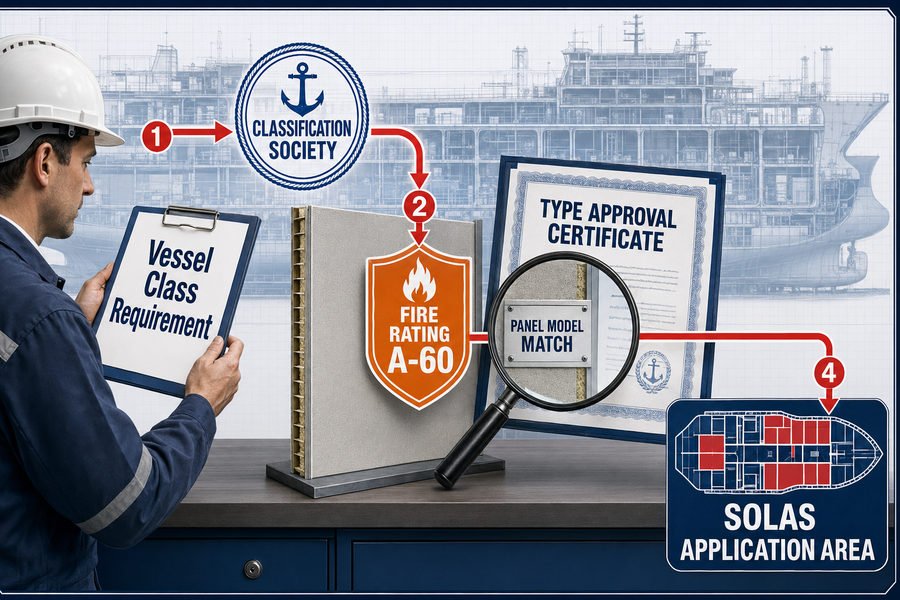
Let us look at the exact steps you need to follow to avoid expensive mistakes and keep your shipyard clients happy.
Which Certificate Must a Marine Wall Panel Hold for a DNV-Classed Vessel?
Do you worry about buying wall panels that DNV surveyors will reject? Failing a DNV inspection stops the whole project. Let me show you the right certificates.
For a DNV-classed vessel, a marine wall panel must hold a valid DNV Type Approval Certificate (TAC), a Marine Equipment Directive (MED) Wheelmark certificate for EU-flagged ships, and a Non-Combustible Material certificate in accordance with the IMO 2010 FTP Code.
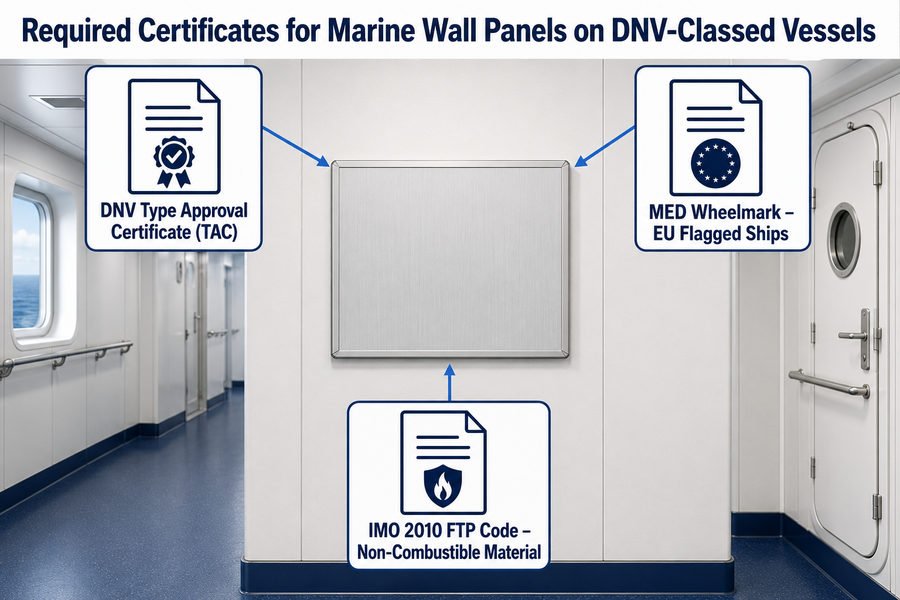
I often see procurement officers make a big mistake. They buy a panel with an ABS certificate for a DNV-classed ship. The DNV surveyor will reject this panel immediately. You must understand the specific documents required.
Understanding the DNV Type Approval Certificate (TAC) Requirement
The first document you need is the DNV Type Approval Certificate (TAC). This certificate proves the panel passes DNV rules. DNV rules follow the International Convention for the Safety of Life at Sea (SOLAS)1. The TAC clearly lists the approved product name and the manufacturer. I always check the validity date. A DNV TAC usually lasts for exactly 5 years. An expired TAC is completely useless for your project. You must ask the supplier for the most recent version.
The Role of MED Wheelmark Certificates for EU-Flagged Ships
The second document is the Marine Equipment Directive (MED) Wheelmark certificate2. You need this if the ship flies an EU flag. Many large shipyards in Europe require this. The Wheelmark shows the panel meets strict European maritime safety standards. The certificate has two parts: Module B (product design approval) and Module D (production quality assurance). Your supplier must have both modules. If the supplier only has Module B, the shipyard will not accept the panels.
Verifying Non-Combustible Material Certificates via IMO 2010 FTP Code
The third document is the Non-Combustible Material certificate. The IMO 2010 FTP Code governs the fire testing. Part 1 of the FTP Code tests non-combustible materials. For example, a rockwool core must pass the Part 1 test. It must not burn when the testing furnace reaches 750 degrees Celsius3. I always check this test report. The report must come from an independent laboratory.
| Certificate Type | Governing Body | Key Purpose | Typical Validity |
|---|---|---|---|
| Type Approval Certificate (TAC) | DNV | Confirms product meets DNV and SOLAS rules | 5 Years |
| MED Wheelmark (Modules B & D) | European Union | Mandatory for EU-flagged vessels | 5 Years (Module B), 3 Years (Module D) |
| Non-Combustible Certificate | IMO (FTP Code Part 1) | Proves core material withstands 750°C | Permanent for the specific material tested |
How to Confirm a Marine Ceiling Panel Certificate Covers the Required Fire Rating?
Are you confused by fire ratings on ceiling panels? A B-15 certificate will not work if the shipyard needs a B-30 rating. Let me clarify how to check this.
To confirm a marine ceiling panel certificate covers the required fire rating, you must check three elements: the fire class designation (B-0, B-15, or B-30), the maximum approved panel thickness, and the specific joint profiles detailed in the fire test report appendix.
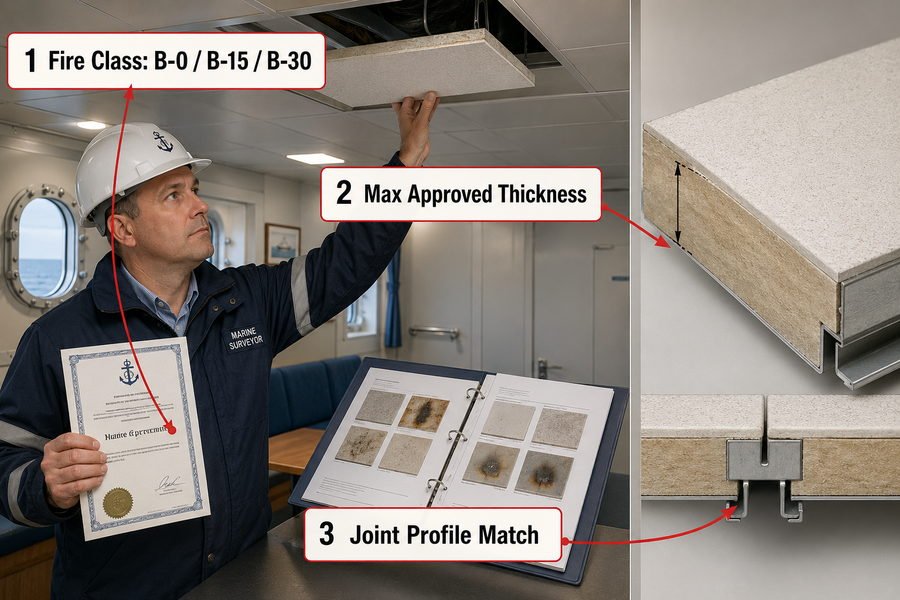
Many buyers look at the first page of a certificate and stop there. This is a very risky habit. The real details hide in the technical appendix. I always read the full document to confirm the fire rating.
Identifying the Correct Fire Class Designation for Ceiling Panels
The first element to check is the exact fire class designation. SOLAS Chapter II-2 defines these ratings.4 The most common ceiling ratings are B-0, B-15, and B-30. The number means the panel stops heat transfer for that many minutes.5 A B-15 panel stops heat for 15 minutes. A B-30 panel stops heat for 30 minutes. If your shipyard specifies a B-15 ceiling, you cannot use a B-0 panel. The surveyor will fail the installation. I always match the designation exactly.
Checking Maximum Approved Panel Thickness Specifications
The second element is the approved panel thickness. A fire rating directly connects to the thickness of the panel.6 For example, a standard B-0 ceiling panel usually has a thickness of 25mm. A standard B-15 ceiling panel often requires a thickness of 50mm. You cannot buy a 25mm panel and claim it has a B-15 rating, even if the supplier says so. The certificate explicitly states the minimum thickness required to pass the fire test. You must verify this number.
Reviewing Joint Profiles in the Fire Test Report Appendix
The third element is the specific joint profile. A ceiling system connects multiple panels together. Fire usually breaks through the joints first. The test report appendix shows the exact joint profile used during the fire test. Common profiles include standard box joints or concealed joints. If you buy a B-15 panel but use a different joint profile than the tested one, the certificate becomes invalid.7
| Fire Class | Heat Insulation Time | Typical Panel Thickness | Core Density Requirement |
|---|---|---|---|
| B-0 | 0 Minutes | 25mm | Minimum 100 kg/m3 |
| B-15 | 15 Minutes | 50mm | Minimum 120 kg/m3 |
| B-30 | 30 Minutes | 50mm (with special facing) | Minimum 140 kg/m3 |
Why Must the Certificate Holder Match the Marine Accomodation Panel Supplier on the RFQ?
Do you receive quotes from suppliers who use another company's certificates? This hidden risk can delay your delivery. I will explain why names must match.
The certificate holder must match the marine accomodation panel supplier on the Request for Quote (RFQ) to guarantee product traceability, ensure legal liability for the 5-year warranty period, and comply with class society rules regarding unauthorized manufacturing or rebranding.
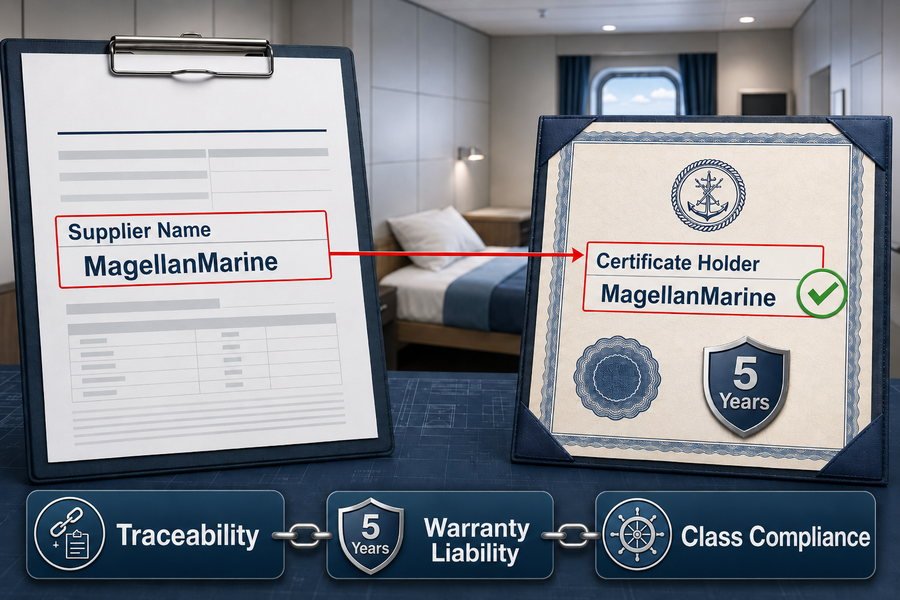
I see many trading companies pretend to be factories. They send you an impressive certificate. But the company name on the certificate is different from the company quoting you. You must stop and ask questions.
Guaranteeing Marine Panel Product Traceability
The first reason is product traceability. The maritime industry requires strict tracking. If a fire happens on a ship, investigators must trace the panels back to the original factory8. The International Maritime Organization (IMO) demands clear records.9 If you buy from a trading company that uses a third-party certificate, you lose this traceability. You do not know who actually made the panels. I always ensure the supplier name matches the certificate holder to maintain a clear supply chain.
Ensuring Legal Liability and Warranty Coverage
The second reason is legal liability and warranty coverage. Shipyards usually demand a 5-year warranty10 for marine outfitting products. If the panel fails, you need a company to take responsibility. If the company on your purchase order does not match the company on the class certificate, you have a big legal problem. The factory on the certificate has no contract with you. They will not honor the warranty. You will lose money replacing the defective panels.
The third reason is class society rules. Classification societies like DNV, ABS, and LR strictly control who can use their certificates. A factory cannot simply lend its certificate to a trading company. The rules forbid unauthorized rebranding. If a supplier wants to sell another factory's approved panels under their own name, they must sign a formal OEM agreement. The class society must issue a new certificate under the trading company's name.
| Verification Area | Correct Practice | Incorrect Practice | Consequence of Failure |
|---|---|---|---|
| Company Name | RFQ name matches TAC holder | RFQ name differs from TAC | Surveyor rejects the shipment |
| Traceability | Direct factory tracking via ISO 9001 | Buying through unauthorized brokers | Fails IMO traceability audits |
| OEM Agreement | Class society issues a rebranding TAC | Supplier "borrows" a PDF certificate | Voids all product warranties |
How to Verify a Marine Accomodation Panel Model Against Its Class Approval Certificate?
Do you struggle to read complex class certificates? Buying a panel that does not match the approved model ruins the project. I will show you the exact process.
To verify a marine accomodation panel model against its class approval certificate, you must match four critical data points: the exact product name, the core material density, the surface finish type, and the manufacturer's drawing numbers listed in the certificate.
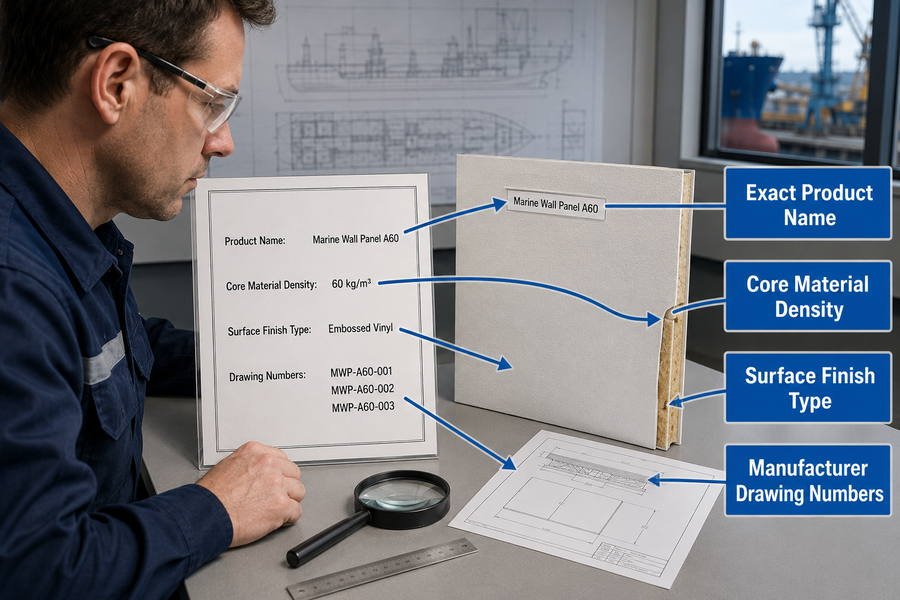
A certificate does not approve a whole factory. It only approves specific product models.11 I always conduct a line-by-line comparison before placing an order. Let me explain the four data points you must check.
Matching the Exact Product Name and Core Material Density
The first data point is the exact product name. Manufacturers produce many panel series. The certificate will list a name like "Type A-60 Wall Panel Model 200". Your purchase order must use this exact name. The second data point is the core material density. The fire test relies heavily on the rockwool density.12 For a standard B-15 wall panel, the certificate usually requires a rockwool density of 120 kg/m3. If your supplier tries to save money by using 100 kg/m3 rockwool, the panel no longer matches the certificate. The product will fail a fire inspection.
Confirming Surface Finish Type and Manufacturer Drawing Numbers
The third data point is the surface finish type. Marine panels often use a PVC film finish. The IMO FTP Code Part 5 limits the thickness of this finish to control smoke and toxicity.13 A common approved PVC film thickness is 150 microns. If the supplier applies a thicker film or changes from PVC to a different laminate, the certificate becomes void. The fourth data point is the manufacturer's drawing numbers. Class societies approve specific construction drawings. The certificate lists these drawing numbers. I always ask the supplier for these drawings. I check the joints, the steel sheet thickness, and the dimensions.
| Verification Point | What to Check on Certificate | Typical Acceptable Value | Risk if Mismatched |
|---|---|---|---|
| Product Name | Exact model designation | Matches RFQ exactly | Total rejection by shipyard |
| Core Density | Rockwool weight per cubic meter | 120 kg/m3 for B-15 | Fails fire insulation tests |
| Surface Finish | Approved facing material and thickness | PVC film up to 150 microns | Produces toxic smoke in a fire |
| Drawing Numbers | Structural design references | Specific drawing IDs (e.g., DWG-001) | Joint failures during installation |
Which Spec Fields Define Marine Accomodation Panel Certification Scope?
Have you ever bought a panel that passed fire tests but failed acoustic tests? Missing scope details causes huge problems. Here are the fields to check.
Five specification fields define a marine accomodation panel's certification scope: the fire rating classification, the acoustic reduction value, the maximum structural span, the permitted core material suppliers, and the approved installation methods.
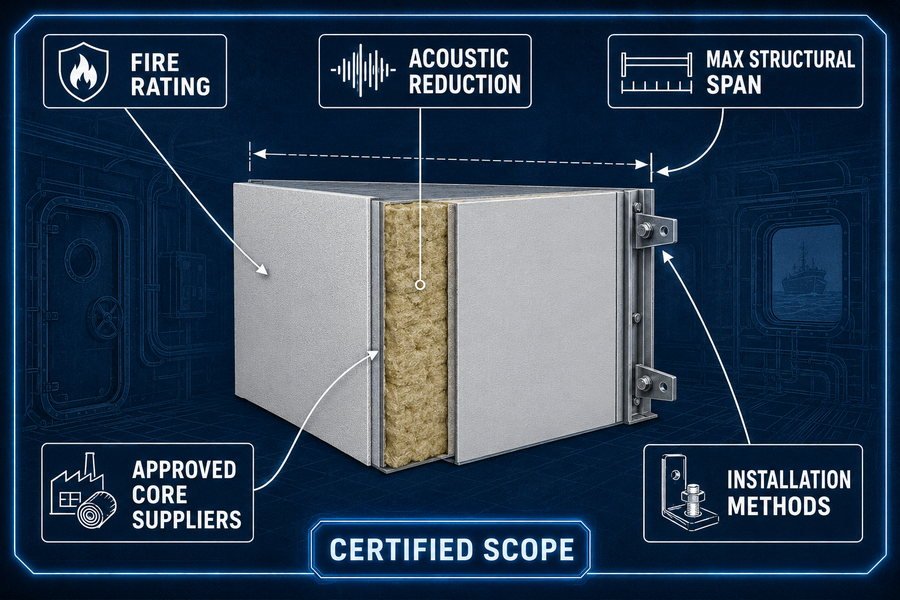
A certificate has boundaries. These boundaries define the certification scope. If you use the panel outside these boundaries, the class society will not accept it. I always verify these five fields carefully.
Reviewing Fire Rating and Acoustic Reduction Values
The first field is the fire rating classification. We already discussed this, but it is the foundation of the scope. The certificate clearly states if the panel is A-Class, B-Class, or C-Class. The second field is the acoustic reduction value. Passenger ships have strict noise limits.14 The ISO 10140-2 standard defines the acoustic testing methods. A standard marine wall panel usually offers a sound reduction index (Rw) between 35dB and 45dB. You must find this exact number in the certificate appendix. If the shipyard requires 45dB and the certificate only shows 35dB, you cannot use that panel in passenger cabins.
Evaluating Maximum Structural Span and Permitted Core Suppliers
The third field is the maximum structural span. The certificate states the maximum length a panel can span without additional support. A common maximum span is 3000mm.15 If your cabin ceiling requires a single 3500mm span, the current certificate does not cover it. The fourth field is the permitted core material suppliers. Fire tests use specific rockwool brands. The certificate lists these approved brands. If the panel factory changes the rockwool supplier to a cheaper, unlisted brand, the certification scope is broken.
Confirming Approved Installation Methods for Marine Panels
The fifth field is the approved installation method. A panel only performs well if installed correctly. The certificate specifies the exact steel profiles, screws, and sealants allowed. It also defines the distance between fastening points. I always check these installation details. If the shipyard uses a different framing system, the panel might fail an inspection.
| Scope Field | Standard / Metric | Typical Value | Importance |
|---|---|---|---|
| Acoustic Reduction | ISO 10140-2 (Rw) | 35dB to 45dB | Required for passenger comfort |
| Maximum Span | Structural limit | Up to 3000mm | Prevents panel sagging or collapse |
| Core Suppliers | Listed approved brands | Specific company names | Ensures consistent fire performance |
| Installation Method | Fastener spacing and profiles | Max 300mm screw spacing | Maintains structural integrity in fire |
Why Does Application Area Matter When Matching Marine Accomodation Panel Certificates?
Do you know that a panel approved for a dry cabin might fail in a wet room? Using panels in the wrong area violates class rules. I will explain why.
The application area matters because marine accomodation panels must meet different environmental rules: C-Class panels are restricted to dry areas, wet spaces require B-Class panels with moisture-resistant certifications, and public spaces demand strict low-flame spread characteristics in accordance with IMO FTP Code Part 5.
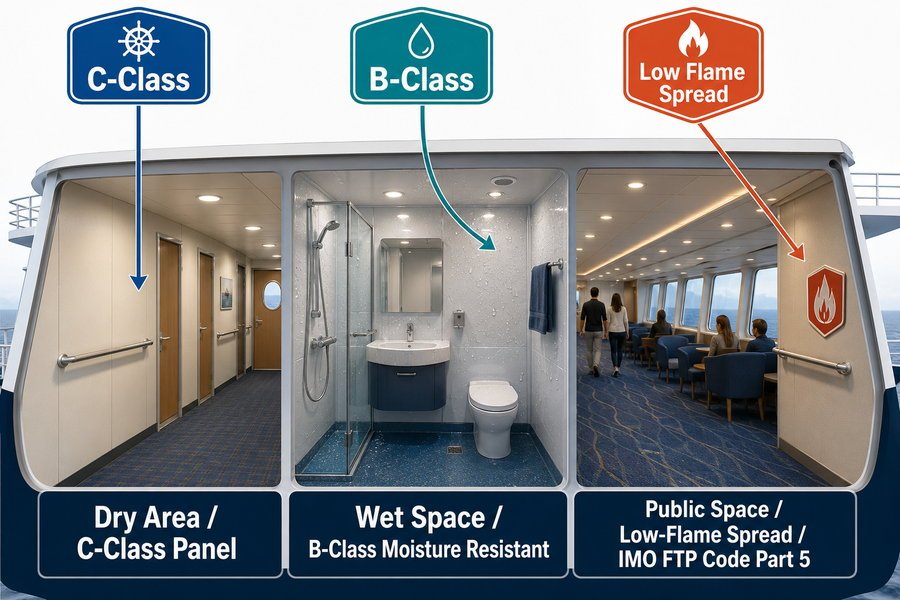
A ship has many different zones. The rules for a bedroom are very different from the rules for a shower room or a corridor. I always ask my clients where they will install the panels before I recommend a product.
Restricting C-Class Marine Panels to Dry Areas
The first application area includes standard dry cabins. These spaces have low fire risks. You can often use C-Class panels here. C-Class panels do not need to meet strict heat insulation rules like A-Class or B-Class panels. They only need to be non-combustible.16 However, you must restrict C-Class panels to these specific dry areas. If you install a standard C-Class panel in a hallway, the class surveyor will reject it. Hallways serve as escape routes and require much higher fire ratings.17
Managing Wet Spaces with Moisture-Resistant B-Class Panels
The second application area includes wet spaces. These are bathrooms, showers, and laundry rooms. Regular panels absorb water. The water destroys the rockwool core over time.18 For wet spaces, you must use B-Class panels with specific moisture-resistant certifications. The steel sheet must have a thicker zinc coating to prevent rust. The bottom track of the panel system must feature a stainless steel profile. I always check the certificate to see if the panel is approved for "wet space application."
Ensuring Low-Flame Spread Characteristics for Public Spaces
The third application area includes public spaces. These are dining rooms, lounges, and stairways. These areas contain many people. The IMO FTP Code Part 5 strictly controls surface materials in these zones.19 The panels must have low-flame spread characteristics. This means the surface finish cannot catch fire easily or produce toxic smoke. When checking the certificate for a public space panel, you must verify the Part 5 test results.
| Application Area | Panel Class Needed | Key Certification Requirement | Material Modification |
|---|---|---|---|
| Dry Cabins | C-Class or B-Class | Non-combustible core (IMO Part 1) | Standard PVC finish |
| Wet Spaces | B-Class (Moisture-Resistant) | Corrosion resistance approval | Stainless steel base profiles |
| Public Spaces | B-Class or A-Class | Low-flame spread (IMO Part 5) | Low-toxicity surface laminates |
Conclusion
Matching marine panel certificates requires careful attention to class rules, fire ratings, and supplier details. Follow these practical steps to ensure smooth shipyard approvals and avoid costly project delays.
-
"International Convention for the Safety of Life at Sea (SOLAS), 1974", https://www.imo.org/en/about/conventions/pages/international-convention-for-the-safety-of-life-at-sea-(solas),-1974.aspx. The International Maritime Organization identifies SOLAS as the principal international treaty setting minimum safety standards for ship construction, equipment, and operation, providing context for why classification and flag-state approval regimes reference SOLAS-related safety requirements. Evidence role: historical_context; source type: institution. Supports: DNV rules are connected to SOLAS safety requirements for ships.. Scope note: This is contextual support for the relationship between maritime safety regulation and approval regimes; it does not show that every DNV rule directly derives from SOLAS. ↩
-
"Directive 96/98/EC - Wikipedia", https://en.wikipedia.org/wiki/Directive_96/98/EC. The European Commission describes the Marine Equipment Directive as the EU framework requiring specified marine equipment placed on board EU-flagged ships to comply with MED conformity assessment and bear the wheel mark, supporting the stated relevance of Wheelmark certification for EU-flagged vessels. Evidence role: expert_consensus; source type: government. Supports: EU-flagged ships require applicable marine equipment to have MED Wheelmark certification.. Scope note: The requirement applies to equipment within the scope of the MED and its implementing regulations; whether a specific panel is covered depends on its certified use and product category. ↩
-
"What Is the Purpose and Scope of the IMO FTP Code? - Magellan ...", https://magellanmarinetech.com/what-purpose-scope-of-imo-ftp-code/. The IMO 2010 FTP Code, Part 1, specifies the non-combustibility test method using a furnace maintained at approximately 750°C to assess whether materials meet non-combustibility criteria for shipboard fire safety applications. Evidence role: mechanism; source type: institution. Supports: IMO 2010 FTP Code Part 1 tests non-combustible materials in a furnace at 750°C.. Scope note: This supports the test condition and regulatory context; the pass/fail status of a particular rockwool core must be established by the specific laboratory test report for that material. ↩
-
"What Is the Purpose and Scope of the IMO FTP Code?", https://magellanmarinetech.com/what-purpose-scope-of-imo-ftp-code/. The cited SOLAS/IMO source should establish that fire divisions on ships are regulated under SOLAS Chapter II-2 and the FTP Code, including B-class divisions and their insulation-time designations. Evidence role: definition; source type: institution. Supports: SOLAS Chapter II-2 defines the fire class designations used for marine ceiling panels.. Scope note: SOLAS provides the regulatory framework; the detailed test procedures and approval conditions are usually found in the FTP Code and individual type-approval documents. ↩
-
"[PDF] recommendation for fire test procedures for “a” and “b” class ...", https://wwwcdn.imo.org/localresources/en/KnowledgeCentre/IndexofIMOResolutions/AssemblyDocuments/A.163(ES.IV).pdf. The source should confirm that the numerical suffix in B-class fire divisions refers to the required insulation performance period, such as 0, 15, or 30 minutes, under the applicable IMO fire-test regime. Evidence role: definition; source type: institution. Supports: In B-0, B-15, and B-30 ratings, the number indicates the insulation time in minutes.. Scope note: This supports the meaning of the rating designation; it does not by itself prove that any particular commercial panel meets that rating. ↩
-
"Are Marine Fire Divisions the Same as Marine Panel Ratings?", https://magellanmarinetech.com/are-marine-fire-divisions-same-as-marine-panel-ratings/. The source should show that marine fire-division approvals are tied to the tested construction, including dimensions such as panel thickness and materials, so a rating cannot be assumed for an untested thickness. Evidence role: mechanism; source type: institution. Supports: Panel thickness is a material part of the approved fire-rated construction and must match the tested or certified specification.. Scope note: The source may support the principle that approval is construction-specific, but exact thickness values such as 25 mm or 50 mm are product- and certificate-specific rather than universal. ↩
-
"What Is the Purpose and Scope of the IMO FTP Code? - Magellan ...", https://magellanmarinetech.com/what-purpose-scope-of-imo-ftp-code/. The cited source should document that fire-test approvals for marine divisions apply to the tested assembly and installation details, including joints, so materially different joint profiles fall outside the tested approval scope. Evidence role: mechanism; source type: institution. Supports: Changing the joint profile from the tested configuration can place the ceiling system outside the scope of its B-15 approval.. Scope note: The word “invalid” may depend on the approval body’s wording; a source may more precisely state that the altered assembly is outside the approved or tested configuration. ↩
-
"[PDF] In-the-field job aid for investigators", https://wwwcdn.imo.org/localresources/en/OurWork/MSAS/Documents/IN-THE-FIELD%20JOB%20AID%20FOR%20INVESTIGATORS.pdf. Marine casualty investigation guidance emphasizes collecting documentary evidence on equipment, materials, certificates, and maintenance history, which contextually supports the need to identify the manufacturer of fire-relevant ship components after an incident. Evidence role: mechanism; source type: institution. Supports: After a ship fire, investigators may need documentary evidence that identifies the source and approval status of installed panels.. Scope note: Such guidance supports traceability as an investigative practice, not necessarily a direct legal requirement that every marine panel be traced to its original factory in all cases. ↩
-
"What Is the IMO FTP Code for Marine Interior Materials?", https://magellanmarinetech.com/what-imo-ftp-code-for-marine-interior-materials/. IMO and SOLAS-related fire-safety approval frameworks require documented approval, marking, and certification for materials used in ship construction, supporting the need for records that allow approved products to be identified during survey or investigation. Evidence role: general_support; source type: institution. Supports: The IMO requires clear documentation and records for approved marine materials, supporting traceability expectations.. Scope note: The source may establish documentation and approval requirements generally, rather than proving a panel-by-panel factory traceability rule for every product category. ↩
-
"Shipbuilding Contract for the Construction and Sale of One - SEC.gov", https://www.sec.gov/Archives/edgar/data/1978867/000110465923110163/tm2323833d9_ex10-4.htm. Standard shipbuilding and marine construction contract forms commonly include defined guarantee or defects-liability periods for supplied work and materials, providing context for warranty expectations in shipyard procurement. Evidence role: historical_context; source type: institution. Supports: Shipyards may require formal warranty coverage for marine outfitting products, including multi-year defect-liability obligations depending on the contract.. Scope note: Neutral sources may show that warranty periods are contract-dependent and may not confirm that five years is the usual term for marine outfitting panels specifically. ↩
-
"Directive 96/98/EC - Wikipedia", https://en.wikipedia.org/wiki/Directive_96/98/EC. A marine type-approval certificate identifies the approved product or product type rather than granting blanket approval to all products made by a manufacturing site. Evidence role: definition; source type: institution. Supports: A certificate does not approve a whole factory; it approves specific product models or product types.. Scope note: The exact scope of approval depends on the flag-state, notified-body, or classification-society scheme and the wording of the individual certificate. ↩
-
"How Are Integrity and Insulation Judged in Marine Panel Fire Tests?", https://magellanmarinetech.com/how-integrity-insulation-judged-in-marine-panel-fire-tests/. Fire-resistance testing of insulated marine divisions evaluates a tested construction as a whole, and the density and thickness of mineral-wool insulation are material parameters recorded in approved designs because they affect heat transfer through the panel. Evidence role: mechanism; source type: paper. Supports: Rockwool density is an important parameter in the fire performance of insulated marine wall panels.. Scope note: This supports the material relevance of insulation density, but it does not establish that every B-15 panel must use one fixed density. ↩
-
"[PDF] RESOLUTION MSC.307(88) (adopted on 3 December 2010 ...", https://wwwcdn.imo.org/localresources/en/KnowledgeCentre/IndexofIMOResolutions/MSCResolutions/MSC.307(88).pdf. The IMO FTP Code includes test procedures for surface flammability and for smoke and toxicity of materials used on ships, providing the regulatory context for controlling combustible surface finishes on marine panels. Evidence role: general_support; source type: institution. Supports: IMO FTP Code requirements regulate surface finishes used on marine panels because of fire, smoke, and toxicity concerns.. Scope note: Part 5 concerns surface flammability; smoke and toxicity are addressed separately in the FTP Code, so a source may support the regulatory context rather than a specific universal thickness limit. ↩
-
"[PDF] MSC.337(91) (adopted on 30 November 2012) CODE ON NOISE ...", https://wwwcdn.imo.org/localresources/en/KnowledgeCentre/IndexofIMOResolutions/MSCResolutions/MSC.337(91).pdf. The IMO Code on Noise Levels on Board Ships sets maximum noise-level criteria for shipboard spaces, including accommodation areas, providing regulatory context for acoustic requirements on passenger vessels. Evidence role: expert_consensus; source type: institution. Supports: Passenger ships are subject to defined shipboard noise limits, making acoustic performance relevant for cabin and accommodation materials.. Scope note: The code gives shipboard noise-level limits rather than prescribing a specific wall-panel Rw value. ↩
-
"How to choose the right marine wall panels for marine interior ...", https://magellanmarinetech.com/how-choose-right-marine-wall-panels-for-marine-interior-projects/. Marine panel type-approval certificates and installation manuals commonly state maximum unsupported spans or module dimensions as part of the approved configuration; examples showing 3000 mm spans would support this as an industry-context value. Evidence role: case_reference; source type: institution. Supports: A 3000 mm maximum span is a commonly encountered certified span value for some marine panel systems.. Scope note: A cited example would demonstrate that 3000 mm is used in some approved systems, but it would not prove that all marine panels share this limit. ↩
-
"Are Marine Fire Divisions the Same as Marine Panel Ratings?", https://magellanmarinetech.com/are-marine-fire-divisions-same-as-marine-panel-ratings/. SOLAS fire-safety definitions describe C-class divisions as constructed of approved non-combustible materials and not required to satisfy the temperature-rise criteria specified for A- and B-class divisions. Evidence role: definition; source type: institution. Supports: C-Class panels do not need to meet strict heat insulation rules like A-Class or B-Class panels; they only need to be non-combustible.. ↩
-
"Summary of SOLAS chapter II-2 - International Maritime Organization", https://www.imo.org/en/ourwork/safety/pages/summaryofsolaschapterii-2-default.aspx. SOLAS Chapter II-2 treats corridors and escape routes as regulated accommodation-space elements and requires fire integrity measures for means of escape, supporting the need for higher-rated divisions than unprotected C-class dry-cabin panels. Evidence role: general_support; source type: institution. Supports: Hallways serve as escape routes and require higher fire ratings than standard C-Class cabin applications.. Scope note: The exact required rating depends on ship type, space category, tonnage, and the applicable flag/class interpretation. ↩
-
"Determination of Thermal Properties of Mineral Wool Required for ...", https://pmc.ncbi.nlm.nih.gov/articles/PMC10488771/. Research on mineral-wool insulation reports that moisture uptake can degrade insulation performance and affect material durability, providing contextual support for avoiding ordinary rockwool-core panels in persistently wet marine spaces. Evidence role: mechanism; source type: paper. Supports: Water exposure can damage or degrade a rockwool-core panel over time.. Scope note: Evidence typically concerns mineral-wool insulation behavior under moisture exposure and may not directly test every marine panel construction or coating system. ↩
-
"What Is the Purpose and Scope of the IMO FTP Code? - Magellan ...", https://magellanmarinetech.com/what-purpose-scope-of-imo-ftp-code/. The IMO Fire Test Procedures Code, Part 5, sets the test method for surface flammability of bulkhead, ceiling, and deck finish materials and is used to verify low-flame-spread performance for shipboard interior surfaces. Evidence role: definition; source type: institution. Supports: IMO FTP Code Part 5 controls surface materials by requiring low-flame-spread testing for shipboard interior finishes.. Scope note: Part 5 primarily addresses surface flammability; smoke and toxicity are addressed separately in the FTP Code, so it does not by itself prove low-toxicity performance. ↩