Worried about buying fake certified panels? Installing uncertified materials can cause huge fines and project delays. Here is how you can easily check a supplier's Wheel Mark certification.
To verify a supplier's Wheel Mark certification for marine accommodation panels, you must check the EC Type Examination (Module B) certificate, confirm the production quality assurance (Module D) document, cross-reference both in the EU MarED database, and inspect the physical steering wheel symbol with the notified body number.
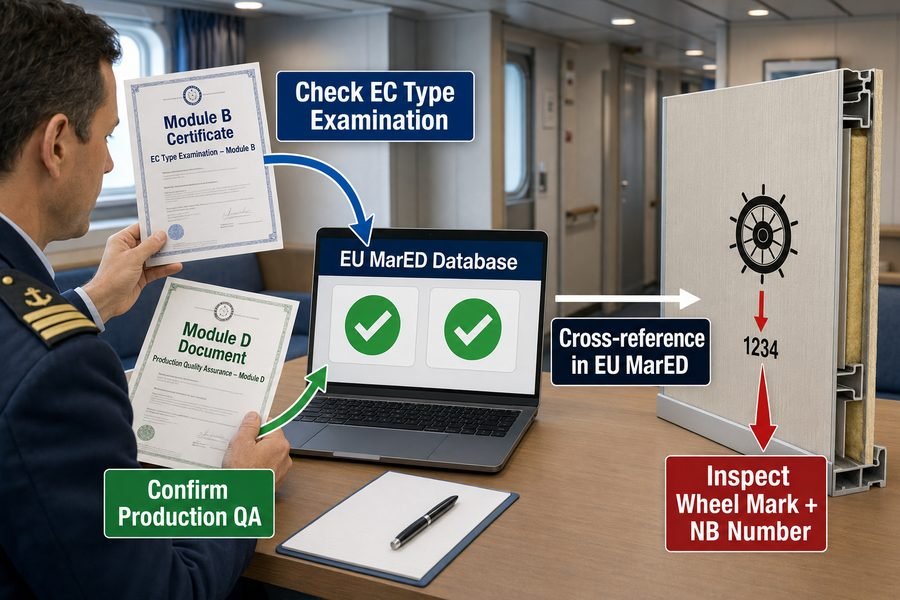
Let's break down exactly what to look for when you check these documents so you don't get tricked.
Which Certificate and Notified Body Numbers Must Appear on a Marine Accommodation Panel Wheel Mark Document?
Confused by the different numbers on a certificate? Missing the right numbers means your panels will fail shipyard inspection. Here are the exact numbers you need.
A valid Wheel Mark document for marine accommodation panels must show two main numbers: the 4-digit Notified Body (NB) number conducting the approval, and the specific Module B (EC Type Examination) and Module D (Quality Assurance) certificate numbers. Both must be clearly printed on the supplier’s official declaration.
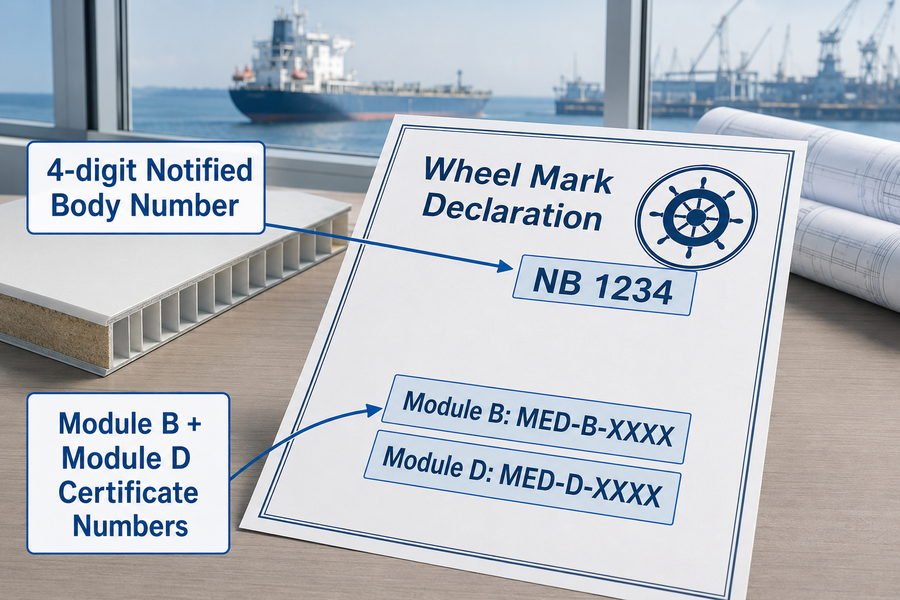
Finding these numbers is the first step, but you must also understand what each number means for your project.
Identifying the 4-Digit Notified Body Number
When I review a supplier's certificate, the very first thing I look for is the 4-digit Notified Body (NB) number. The Marine Equipment Directive (MED) 2014/90/EU requires this number. It tells you which European authorized testing company approved the product. For example, if you see the number 0098, you know DNV issued the certificate. If you see 0474, you know RINA issued it.1 If a certificate has a Wheel Mark symbol but no 4-digit number next to it, the certificate is fake. I once saw a client buy panels from an Asian supplier. The supplier used a fake 5-digit number. The shipyard inspector noticed this immediately and rejected the entire $40,000 order. You must find this exact 4-digit code on the paper.
Checking the Module B and Module D Certificate Numbers
Next, you must find both the Module B and Module D certificate numbers on the document. Module B is the EC Type Examination certificate. It proves the product design passes the fire tests. Module D is the Quality Assurance certificate. It proves the factory can make the panels exactly like the tested design. You need both. A Module B certificate alone is not enough to sell a marine panel. I always check the issue date and expire date for both numbers. A Module B certificate is usually valid for 5 years. A Module D certificate is valid for 3 years, but the factory needs an audit every 12 months.2 If the supplier only gives you a Module B number, you must ask for the Module D number before you pay any money.
| Certificate Element | What It Proves | Typical Validity Period | Example Format / Value |
|---|---|---|---|
| Notified Body Number | Which agency approved the panel | Permanent to the agency | 0098 (DNV), 0474 (RINA) |
| Module B Number | The panel design passed fire testing | 5 Years | MEDB0000123 |
| Module D Number | The factory quality system is approved | 3 Years (with yearly audits) | MEDD0000456 |
How to Cross-Check Marine Accommodation Panel Wheel Mark Certificates in the EU MarED Database?
Do you trust the PDF document your supplier sent? Fake certificates are common in Asia. You must check the official database to be sure.
To cross-check Marine Accommodation Panel certificates in the EU MarED database, you must register for a free account, enter the 4-digit Notified Body number and the exact Certificate Number into the search bar, and verify that the database status shows "Valid" instead of "Withdrawn" or "Expired."
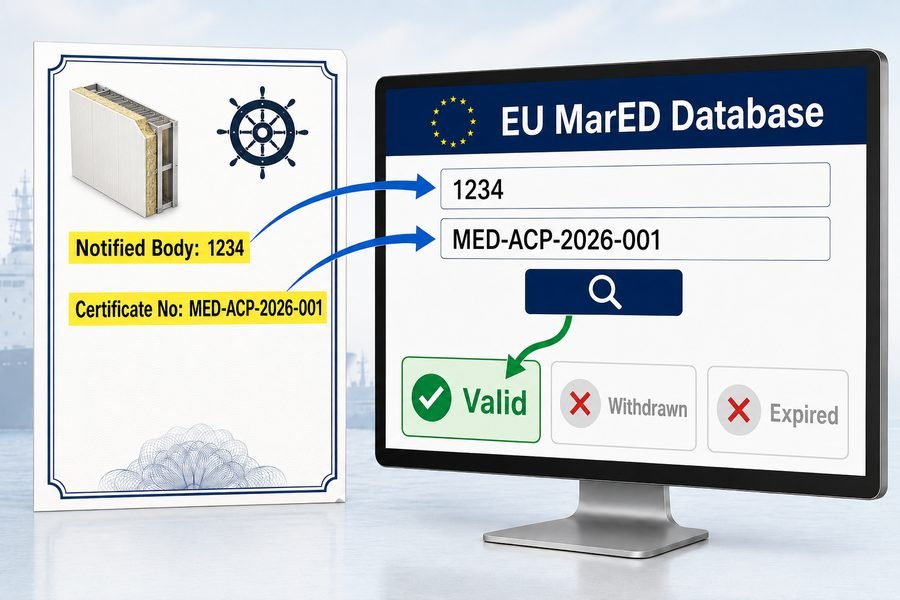
Using the database is the only way to know if a piece of paper is a real legal document. Let me show you how I do it.
Registering and Searching the EU MarED Database Platform
The EU MarED Database is a website located at www.mared.org. This is the official database for all marine equipment approved for European ships.3 First, you must register for a free account. Anyone can do this. After you log in, you will see a search page. You take the Module B certificate number from your supplier and type it into the exact "Certificate Number" search bar. You also need to select the Notified Body number from the drop-down menu. I do this for every single supplier I work with at Magellan Marine. Sometimes, Asian suppliers send old certificates. The PDF looks real because it was real three years ago. But when you put the certificate number into the MarED database, it will not show up if it is fake. You must make sure you type the letters and numbers exactly as they appear on the paper.
Interpreting the Status Results in the EU MarED Database
When you click search, the database will give you a status result. You will see one of three words: "Valid", "Expired", or "Withdrawn". You want to see "Valid". This means the certificate is good today. If you see "Expired", it means the 5-year time limit is over4. The supplier must renew it before you buy. If you see "Withdrawn", this is a big warning sign. It means the Notified Body canceled the certificate. This usually happens because the factory failed a quality audit or changed the product materials without permission. If you buy panels with a "Withdrawn" status, European port authorities will not let the ship sail5. If the database shows "Valid", you can trust the supplier and move forward with your purchase.
| Database Status | Meaning for Your Purchase | Required Action |
|---|---|---|
| Valid | Certificate is active and legal to use. | Proceed with purchase. |
| Expired | The 5-year validity period has ended. | Stop. Ask supplier for the renewed certificate. |
| Withdrawn | The certification was canceled due to failure. | Stop immediately. Find a new panel supplier. |
What Module D Production Surveillance Evidence Should a Marine Accommodation Panel Supplier Provide?
Does your supplier only show you a product design certificate? That is not enough for shipyards. You need proof of their factory quality control.
A marine accommodation panel supplier must provide three pieces of Module D evidence: a valid EC Quality System Certificate, an annual factory surveillance audit report from the Notified Body, and a Declaration of Conformity (DoC) signed by the manufacturer linking the Module B design to the factory production.
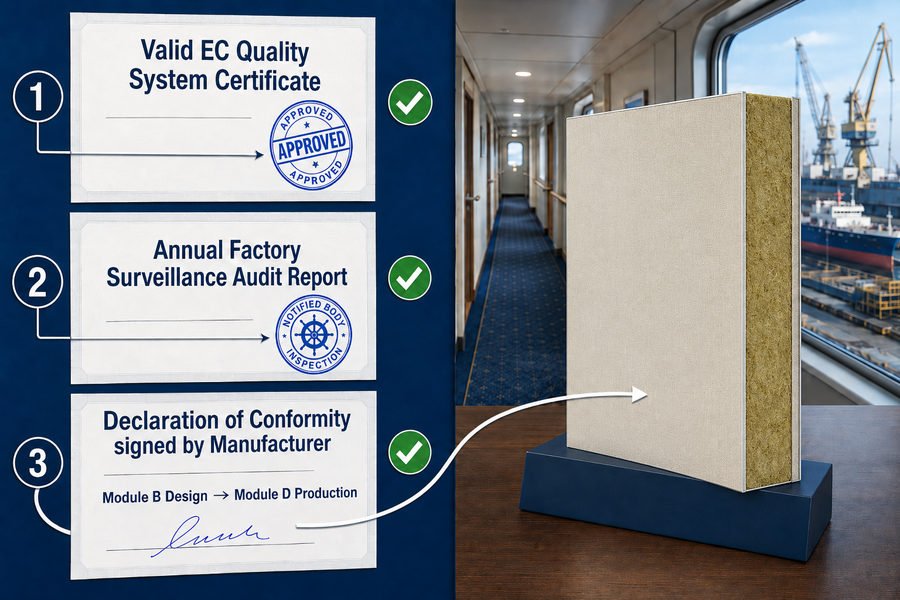
If your supplier cannot show you these production documents, you will face huge risks when delivering the panels to your European buyers.
Requesting the EC Quality System Certificate and Annual Audit Report
Module D is all about the factory's quality system.6 A good design means nothing if the factory makes mistakes during mass production. First, you must ask the supplier for their EC Quality System Certificate (Module D certificate). This document proves the Notified Body inspected their factory. Next, you must ask for the annual factory surveillance audit report. The Marine Equipment Directive requires the Notified Body to visit the factory every 12 months. They check the machines, the raw materials, and the worker training. I always ask Asian suppliers for their last audit date. If the audit is older than 12 months, their Module D certificate is suspended.7 You cannot buy from them until they pass a new audit. This rule protects you from factories that drop their quality after they get the initial certificate.
Reviewing the Manufacturer's Declaration of Conformity (DoC)
The final piece of evidence you need is the Declaration of Conformity, or DoC. This is a very important paper. The manufacturer writes and signs the DoC, not the testing agency. According to MED 2014/90/EU Article 16, every single batch of marine panels must come with a DoC. This document links the Module B design to the Module D factory production. It states that the panels in your specific order are identical to the panels that passed the fire tests. It must list the Module B number, the Module D number, and the serial numbers of your panels. When your panels arrive at the shipyard in Europe, the shipyard inspector will ask for the DoC first. If you do not have it, they will not accept the delivery, even if the panels are perfect.
| Module D Evidence Type | Issued By | What It Shows the Buyer |
|---|---|---|
| EC Quality System Certificate | Notified Body (e.g., DNV, LR) | Factory passed the initial quality control inspection. |
| Annual Audit Report | Notified Body | Factory passed the required 12-month quality check. |
| Declaration of Conformity (DoC) | The Panel Manufacturer | Links the specific order to the approved B and D certificates. |
Why Does "EU Approved" Labeling Not Confirm Wheel Mark Compliance?
Have you seen suppliers claim their panels are "EU Approved"? This is a common sales trick. "EU Approved" does not mean it can be used on ships.
"EU Approved" labeling does not confirm Wheel Mark compliance because it often refers to general CE marking for land-based construction, completely lacking the strict IMO SOLAS fire testing requirements (FTP Code 2010) and specific Marine Equipment Directive oversight required for shipboard marine accommodation panels.
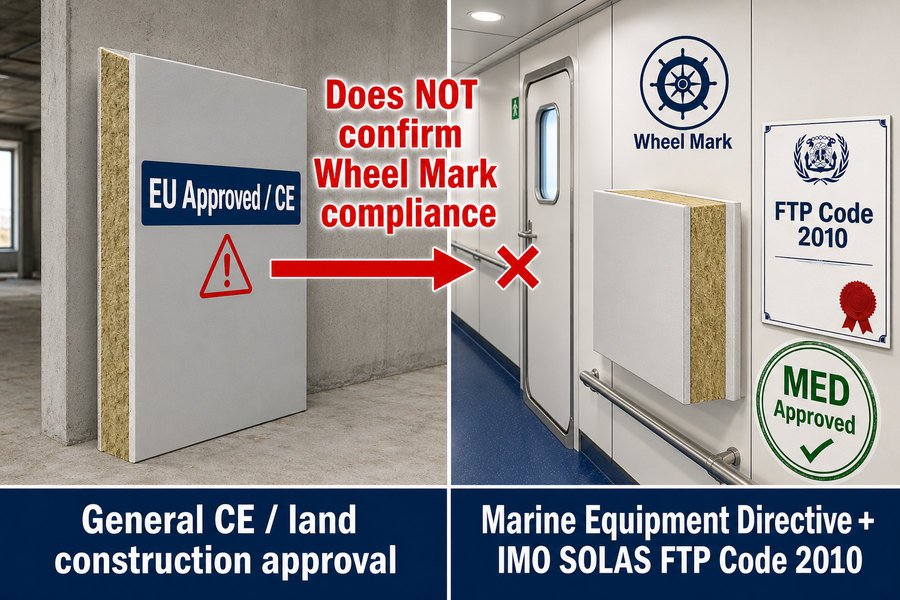
Knowing the difference between land building materials and real marine materials will save you from making a very expensive purchasing mistake.
Differences Between CE Marking and Marine Wheel Mark Certification
Many buyers get tricked by the letters "CE". Suppliers will say "Our panels are EU Approved with CE marks." But CE marking is for land buildings under the Construction Products Regulation. It is not for ships. Marine accommodation panels must follow the Marine Equipment Directive (MED). This directive uses the Wheel Mark symbol, not the CE mark. The rules are very different. For a CE mark, a factory can sometimes self-test their products. For a Wheel Mark, a strict independent Notified Body must supervise the tests and audit the factory. I have seen interior decoration companies buy CE-marked panels because they were 30% cheaper. When the ship was built, the marine surveyor rejected every single panel. The buyer lost hundreds of thousands of dollars. You must ignore "EU Approved" claims and only look for the Wheel Mark.
Required IMO SOLAS Fire Testing for Marine Panels
The biggest difference between CE marks and Wheel Marks is the fire testing. Land panels use a test called EN 13501. Marine panels must pass the IMO 2010 FTP Code tests8. This is the global law written by the International Maritime Organization (IMO) under SOLAS. The IMO tests are much harder. For example, a B-15 marine panel must stop a fire from passing through for 30 minutes, and keep the unexposed side cool for 15 minutes9. The oven temperature reaches about 840 degrees Celsius. The IMO tests also check for toxic smoke. A CE-marked panel might burn well but release dark, poisonous smoke. That is deadly on a ship where people cannot run outside. Because of these strict IMO SOLAS rules, you can never use a standard "EU Approved" panel for marine outfitting. You must buy the Wheel Mark panel.
| Feature | CE Marked "EU Approved" Panels | Wheel Marked Marine Panels |
|---|---|---|
| Target Application | Land-based buildings and houses | Commercial ships and offshore platforms |
| Governing Law | Construction Products Regulation | Marine Equipment Directive 2014/90/EU |
| Fire Testing Standard | EN 13501 (European Land Standard) | IMO 2010 FTP Code (Global Marine Standard) |
| Factory Audit Rules | Often allows self-declaration | Requires strict independent annual audits |
Which Wheel Mark Certificate Scope Details Must Match the Ordered Marine Accommodation Panel Specification?
Is your panel thickness slightly different from the certificate? Even a tiny change makes the certification void. You must match the details exactly.
When verifying the Wheel Mark certificate scope, you must ensure four specific details match your ordered marine accommodation panels exactly: the panel thickness, the core material density, the surface finish material, and the approved fire rating class (such as B-15 or C-Class).
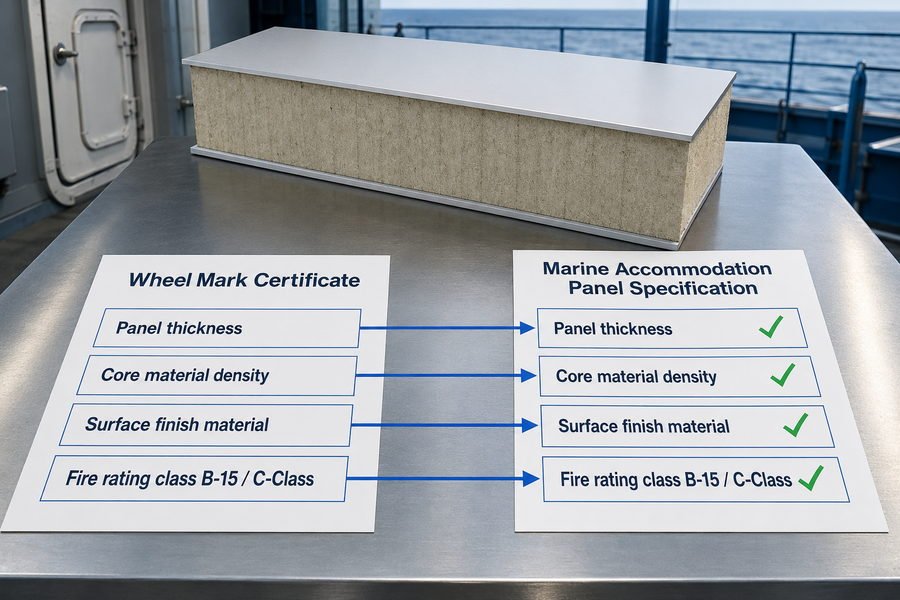
Many buyers fail here. They buy a certified panel but change the thickness to save money, ruining the certification. Let me explain the exact details to check.
Matching Panel Thickness and Core Material Density
The first two things you must check on the certificate scope are thickness and density. The Wheel Mark certificate will clearly list the exact sizes the factory is allowed to make. For example, the certificate might say the panel thickness is 50mm. If you ask the supplier to make a 25mm panel to save money, that 25mm panel is not certified. The fire test was only for the 50mm size. Next, you must check the core material density. Most marine panels use rockwool inside. The certificate will state the required rockwool density, usually 100 kg/m3 or 120 kg/m3. If the factory uses 80 kg/m3 rockwool to cut costs, the panel will fail a real fire.10 The shipyard will ask for a sample. They will weigh it. If the density does not match the exact number on the certificate, they will reject your entire shipment.
Verifying Surface Finishes and Fire Rating Classes
The next two details you must check are the surface finish and the fire rating class. Marine panels usually have a PVC film finish or a painted steel finish. The certificate will limit the calorific value of this finish. For example, the IMO FTP Code says the finish must not exceed a calorific value of 45 MJ/m211. If you pick a custom thick PVC film that is not listed on the certificate, your panel loses its Wheel Mark status. Finally, you must check the fire rating class. The certificate will say exactly what the panel is: B-15, B-0, or C-Class12. If your shipyard project requires a B-15 bulkhead, but the supplier's certificate only shows approval for a B-0 class, you cannot use it. The B-0 panel will get too hot on the back side during a fire. You must read the certificate scope table line by line and compare it to your purchase order.
| Scope Detail on Certificate | Why It Matters for Certification | Example of an Invalid Change |
|---|---|---|
| Panel Thickness | Thin panels burn through faster than tested. | Changing a certified 50mm panel to 30mm. |
| Core Material Density | Low density rockwool fails to stop heat transfer. | Using 80 kg/m3 rockwool instead of 120 kg/m3. |
| Surface Finish Material | Wrong finish creates toxic smoke and spreads fire. | Using a thick unapproved decorative vinyl film. |
| Fire Rating Class | Determines where the panel can be installed on board. | Installing a C-Class panel in a B-15 zone. |
What Wheel Mark Symbol and ID Number Must Be Physically Marked on Certified Marine Accommodation Panels?
Are your delivered panels missing the physical mark? Shipyard inspectors check the panels, not just the paper. Missing marks cause instant rejection.
Certified marine accommodation panels must physically display the distinct steering wheel symbol, the 4-digit identification number of the notified body that conducted the production surveillance, and the four-digit year the mark was affixed (for example, 0098/2024). These marks must be visible, legible, and indelible on the product.
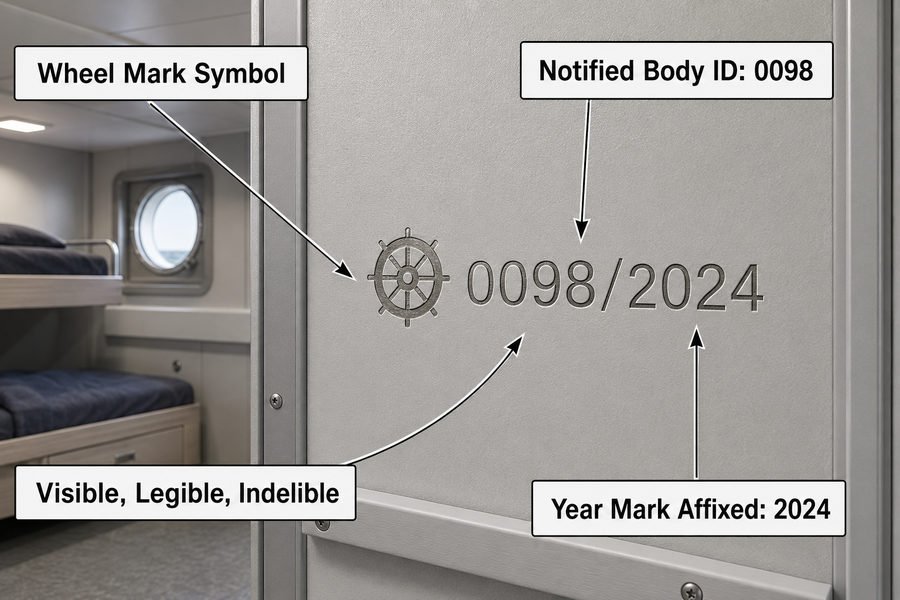
Finding the physical mark on the actual panel is your final safety check before you pay the balance to your supplier. Let us look at how this mark must appear.
Identifying the Steering Wheel Symbol and Notified Body Number
When your container of marine panels arrives, you must open it and look at the actual product. Article 10 of the Marine Equipment Directive says the Wheel Mark must go on the product itself.13 You should look for a picture of a ship's steering wheel. This is the official Wheel Mark symbol. Right next to this wheel, or right below it, you must see the 4-digit Notified Body number14. This number tells you who did the Module D factory audit. For instance, if DNV audits the factory, you will see the wheel symbol and the numbers 0098. I always tell my clients to check this mark. If the paper certificate says DNV (0098), but the sticker on the panel says LR (0038), you have a big problem. The numbers must match exactly. The mark is usually placed on the edge of the panel or on the back steel skin.
Locating the Year of Production on the Marine Panel
The final part of the physical mark is the four-digit year15. The law requires the factory to show the year they put the mark on the panel. So, a complete mark will look like this: the wheel symbol, then 0098/2024. This proves the panel was made in 2024. The directive states that these marks must be visible, legible, and indelible16. "Visible and legible" means you can read it easily without special tools. "Indelible" means it cannot wash off or rub off easily. It is usually printed with strong ink or put on a permanent metal sticker. Sometimes, if a marine product is too small, the mark can go on the packaging. But marine accommodation panels are large. They are usually 2 meters high. Therefore, the mark must be on the panel itself. If the factory forgot to print the mark, the shipyard will treat the panel as uncertified waste.
| Physical Mark Component | Purpose of the Mark | Legal Requirement (MED Article 10) |
|---|---|---|
| Steering Wheel Symbol | Identifies the product as marine approved. | Must be visible and indelible. |
| 4-Digit Notified Body ID | Shows who did the factory quality audit. | Must match the Module D certificate exactly. |
| Four-Digit Year (e.g., 2024) | Shows when the certification mark was applied. | Must be placed next to the Notified Body ID. |
Conclusion
To avoid costly shipyard rejections, always cross-check the Module B and D certificates online, match the technical specs precisely, and ensure the physical wheel mark is on every panel.
-
"Directive 96/98/EC - Wikipedia", https://en.wikipedia.org/wiki/Directive_96/98/EC. The European Commission’s NANDO database lists notified-body identification numbers and the corresponding organizations, including the MED notified bodies associated with numbers such as 0098 and 0474. Evidence role: case_reference; source type: government. Supports: Notified-body numbers such as 0098 and 0474 can be mapped to specific organizations such as DNV and RINA.. Scope note: The database can confirm the organization assigned to a notified-body number, but it does not by itself verify that a particular certificate was actually issued by that organization. ↩
-
"Conformity Assessment of Medical Devices: An Overview from a ...", https://pmc.ncbi.nlm.nih.gov/articles/PMC12821529/. Notified-body and MED certification guidance commonly treats Module B certificates as time-limited and Module D approvals as subject to periodic surveillance audits, supporting the article’s discussion of expiry dates and continuing factory oversight. Evidence role: general_support; source type: institution. Supports: Module B and Module D certificates have typical validity periods, and Module D factory approvals require recurring surveillance audits.. Scope note: Exact validity periods and audit intervals may depend on the notified body, certificate terms, product category, and applicable MED implementing rules; the source may support these as common practice rather than a universal statutory rule. ↩
-
"Directive 96/98/EC - Wikipedia", https://en.wikipedia.org/wiki/Directive_96/98/EC. The European Commission’s Marine Equipment Directive materials and the MarED database documentation describe MarED as the common database for certificates issued under the EU Marine Equipment Directive, supporting its role as an official verification source for MED-approved equipment. Evidence role: definition; source type: government. Supports: The EU MarED Database is the official database for marine equipment approved for use on European ships.. Scope note: This supports MarED’s official role for MED certificates, but it may not prove that every approved item is always present or current in the database. ↩
-
"Directive 96/98/EC - Wikipedia", https://en.wikipedia.org/wiki/Directive_96/98/EC. EU Marine Equipment Directive conformity-assessment rules state that EC type-examination certificates are valid for a defined period, commonly not exceeding five years, supporting the statement that an expired certificate may require renewal before purchase. Evidence role: historical_context; source type: government. Supports: An expired MarED certificate can mean that the certificate’s five-year validity period has ended.. Scope note: The exact validity period can depend on the certificate and applicable conformity-assessment module, so the source should be checked against Module B wording specifically. ↩
-
"Port State Control - International Maritime Organization", https://www.imo.org/en/ourwork/iiis/pages/port%20state%20control.aspx. EU and Paris MoU port State control rules allow authorities to record deficiencies and detain ships where equipment or statutory certification does not comply with applicable safety requirements, providing contextual support for the risk that non-compliant marine equipment can prevent a vessel from sailing. Evidence role: general_support; source type: institution. Supports: Ships fitted with panels linked to a withdrawn certificate may face port State control action that can prevent departure.. Scope note: This is contextual support for enforcement risk; an actual sailing prohibition would depend on the inspection findings, flag-state requirements, and severity of the non-compliance. ↩
-
"How to Avoid EU Rejection of Marine Accommodation Panels for ...", https://magellanmarinetech.com/how-avoid-eu-rejection-marine-accommodation-panels-for-med-non-compliance/. Directive 2014/90/EU describes Module D as production-quality assurance, under which a notified body assesses and monitors the manufacturer’s approved quality system for production, final product inspection, and testing. Evidence role: definition; source type: government. Supports: Module D concerns the manufacturer’s production quality system rather than only the product design.. ↩
-
"AI Act Compliance Within the MyHealth@EU Framework - PMC - NIH", https://pmc.ncbi.nlm.nih.gov/articles/PMC12599979/. The Marine Equipment Directive requires at least annual Module D audits and allows the notified body to restrict, suspend, or withdraw an approval where the manufacturer no longer satisfies the applicable requirements. Evidence role: general_support; source type: government. Supports: A lapsed or non-compliant Module D surveillance status can put the validity of the factory’s quality-system approval at risk.. Scope note: This supports the regulatory basis for annual surveillance and possible suspension, but it may not prove that suspension is automatic solely because an audit date is older than twelve months. ↩
-
"How Does the IMO FTP Code Connect with Other Marine Fire Safety ...", https://magellanmarinetech.com/how-imo-ftp-code-connect-with-other-marine-fire-safety-frameworks/. The International Maritime Organization’s 2010 FTP Code sets out fire test procedures used under SOLAS for materials and components installed on ships, including divisions, surface materials, smoke, and toxicity testing categories relevant to marine accommodation panels. Evidence role: expert_consensus; source type: institution. Supports: Marine panels used in ship accommodation areas are assessed under the IMO 2010 FTP Code fire-test framework rather than ordinary building fire classifications.. Scope note: The source establishes the applicable IMO test framework; the exact tests required for a particular panel depend on its certified use and classification. ↩
-
"How Are Integrity and Insulation Judged in Marine Panel Fire ...", https://magellanmarinetech.com/how-integrity-insulation-judged-in-marine-panel-fire-tests/. SOLAS fire-division definitions specify that B-class divisions must prevent flame passage for at least 30 minutes, while a B-15 rating indicates that the insulation-temperature-rise criterion is maintained for 15 minutes during the standard fire test. Evidence role: definition; source type: institution. Supports: A B-15 marine panel is expected to maintain integrity for 30 minutes and insulation performance for 15 minutes under the relevant marine fire test.. Scope note: This supports the formal B-15 performance criteria; furnace-temperature details and test setup should be verified separately in the FTP Code test procedure. ↩
-
"Determination of Thermal Properties of Mineral Wool Required for ...", https://pmc.ncbi.nlm.nih.gov/articles/PMC10488771/. Fire-resistance and insulation studies on mineral-wool sandwich panels show that core composition and density influence heat transfer and fire performance, providing technical context for why a lower-density core may not meet the performance of the tested certified assembly. Evidence role: mechanism; source type: paper. Supports: Changing the rockwool core density from the certified value can compromise the fire performance of a marine panel.. Scope note: This would not prove that every 80 kg/m3 rockwool panel fails; it supports the mechanism that density changes can materially affect fire performance and invalidate assumptions from a tested assembly. ↩
-
"[PDF] RESOLUTION MSC.307(88) (adopted on 3 December 2010 ...", https://wwwcdn.imo.org/localresources/en/KnowledgeCentre/IndexofIMOResolutions/MSCResolutions/MSC.307(88).pdf. SOLAS/IMO fire-safety requirements restrict the calorific value of combustible materials used on bulkheads, linings, ceilings, and associated finishes, supporting the stated 45 MJ/m2 limit as a regulatory design constraint for certain onboard surface materials. Evidence role: definition; source type: institution. Supports: IMO/SOLAS fire-safety rules include a 45 MJ/m2 calorific-value limit for relevant combustible finish materials used onboard ships.. Scope note: The precise applicability depends on the material location and regulatory category; the source should be checked against the exact panel finish and vessel type. ↩
-
"What Do A-Class, B-Class, and C-Class Divisions Mean in Marine ...", https://magellanmarinetech.com/what-a-class-b-class-c-class-divisions-mean-in-marine-wall-ceiling-panels/. SOLAS and the IMO FTP Code define B-class and C-class divisions and distinguish B-15 from B-0 by insulation performance during the standard fire test, supporting that these ratings are not interchangeable for locations requiring a specified fire class. Evidence role: definition; source type: institution. Supports: Marine fire divisions such as B-15, B-0, and C-Class have defined meanings and installation consequences under IMO/SOLAS fire-test standards.. Scope note: The source defines the fire-class categories; project-specific installation requirements still depend on the vessel rules and approved fire-control plan. ↩
-
"What EU Market Requirements Apply to Marine Accommodation ...", https://magellanmarinetech.com/what-eu-market-requirements-apply-to-marine-accommodation-panels/. Directive 2014/90/EU, Article 10, provides that the wheel mark is to be affixed visibly, legibly and indelibly to the product or its data plate, with packaging or accompanying documents used only where the product’s nature does not allow direct marking. Evidence role: general_support; source type: government. Supports: Article 10 of the Marine Equipment Directive requires the Wheel Mark to be affixed to the marine equipment product itself where feasible.. Scope note: This supports the general marking requirement, but the precise application to a specific panel design may depend on the product’s construction and certification file. ↩
-
"Directive 96/98/EC - Wikipedia", https://en.wikipedia.org/wiki/Directive_96/98/EC. Directive 2014/90/EU states that the wheel mark must be followed by the identification number of the notified body involved in the production-control phase, supporting the use of a notified-body number alongside the mark. Evidence role: definition; source type: government. Supports: The Wheel Mark is accompanied by a notified body identification number indicating the body involved in production control.. Scope note: The directive supports the presence and function of the notified-body number, but it does not by itself verify which notified body audited any individual factory. ↩
-
"Directive 96/98/EC - Wikipedia", https://en.wikipedia.org/wiki/Directive_96/98/EC. Directive 2014/90/EU requires the wheel mark to be followed by the year in which the mark was affixed, supporting the inclusion of a four-digit year as part of the marking convention. Evidence role: definition; source type: government. Supports: The Marine Equipment Directive requires the marking to include the year in which the Wheel Mark was affixed.. Scope note: The source supports the year-of-affixing requirement; it does not prove the manufacturing date of any particular panel unless the marking rules are correctly followed by the manufacturer. ↩
-
"Marine Equipment Directive enters into force in the EEA - Efta.Int", https://www.efta.int/media-resources/news/marine-equipment-directive-enters-force-eea. Article 10 of Directive 2014/90/EU specifies that the wheel mark shall be affixed visibly, legibly and indelibly, establishing the legal durability and readability standard for the mark. Evidence role: definition; source type: government. Supports: The Marine Equipment Directive requires Wheel Marks to be visible, legible, and indelible.. Scope note: The directive states the required qualities of the mark but does not define specific test methods for ink, labels, or abrasion resistance in this passage. ↩