Fires at sea are a shipbuilder's worst nightmare. When flames break out, poor interior materials put lives and vessels at immediate risk. Fortunately, certified marine interior panels effectively trap fires.
Marine interior panels contain fire and prevent its spread through three primary mechanisms: non-combustible core materials (like mineral wool), seamless joint profiles that block gas, and strict structural integrity under heat. Together, these elements meet SOLAS A-Class, B-Class, and C-Class standards to ensure passenger safety and vessel survival.
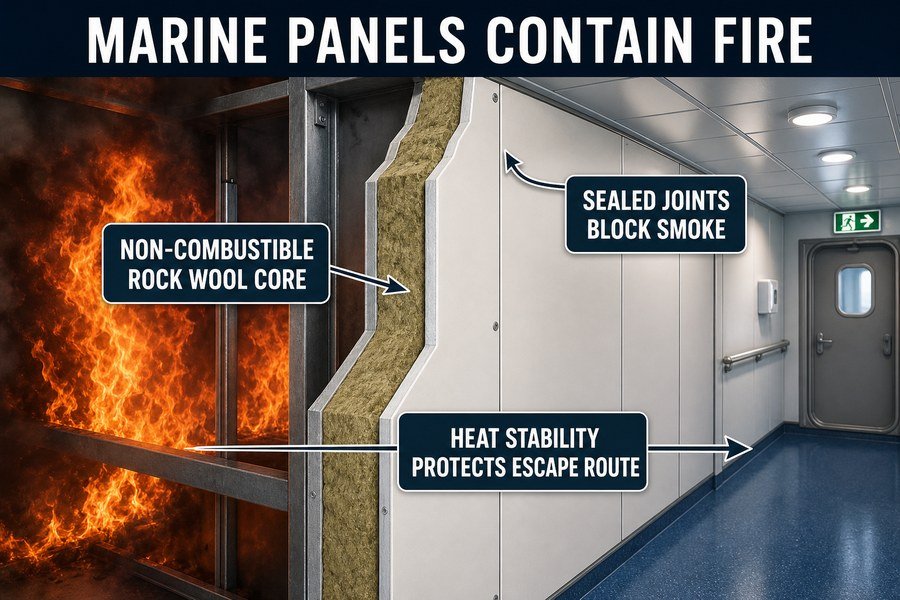
Understanding how these panels work can help you make smart purchasing decisions and avoid costly shipyard rejections. Let us look at the exact technical details behind these life-saving barriers.
How Do Interconnected Marine Wall Panels Act as a Seamless Fire Barrier?
Buying high-quality panels is not enough if they do not fit together perfectly. Small gaps allow fire to jump between cabins. We must focus on the connection systems.
Interconnected marine wall panels act as a seamless fire barrier using three main connection types: continuous spline joints, tongue-and-groove locking profiles, and overlapping Z-lock edges. These specific joints expand when exposed to high heat, completely sealing structural gaps against the passage of smoke, toxic gases, and flames.
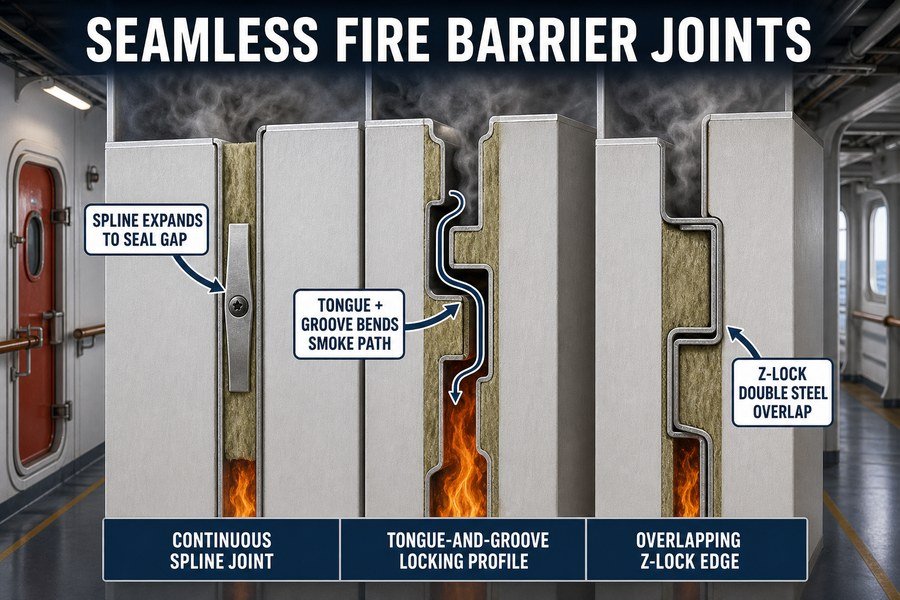
During my early years working in a marine outfitting factory, I saw many panel designs fail fire tests. They failed because their connection systems were weak. When the temperature rose, the metal warped, and gaps appeared. Fire easily slipped through these gaps. To solve this, the industry relies on three specific connection designs. We must understand each of them to know how they block fire.
Evaluating Continuous Spline Joints for Marine Walls
The first connection type is the continuous spline joint. In this system, two flat panel edges meet, and a separate steel spline slides into a slot between them. This creates a bridge. When a fire starts on one side, the heat hits the spline first. According to SOLAS Chapter II-2 standards for B-15 panels, the joint must stop flames and hot gases for at least 15 minutes. The spline absorbs the heat and expands, pushing tightly against the panel slots.1 This expansion physically blocks smoke and fire from passing through. For procurement teams buying panels in Asia for European shipyards, spline joints are very popular because they are cheap to produce and easy to install on site. They save labor costs while maintaining high safety standards.
Understanding Tongue-and-Groove and Z-Lock Edge Profiles
The second type is the tongue-and-groove locking profile. Here, one panel has a protruding edge (the tongue), and the next panel has a matching slot (the groove). They interlock directly. This design forces fire and smoke to travel through a complex, bent path2. Fire prefers a straight line. By forcing the heat to turn corners inside the joint, the tongue-and-groove system causes the hot gases to cool down. The third type is the overlapping Z-lock edge. This profile looks like a letter "Z" when viewed from the top. One panel overlaps the other. This creates a double layer of steel at the connection. Under extreme heat, these two layers fuse together. Shipyards in the United States often demand Z-lock panels for heavy-duty areas because they offer superior rigidity3.
| Connection Type | Heat Response Mechanism | Primary Advantage | Best Application Area |
|---|---|---|---|
| Continuous Spline | Spline expands to seal gaps | Fast and cheap installation | Standard passenger cabins |
| Tongue-and-Groove | Forces fire through a complex path | Good balance of price and strength | Corridors and crew quarters |
| Overlapping Z-lock | Double steel layers fuse together | Maximum structural rigidity | High-vibration engine casing walls |
What Properties Stop Flame Penetration Through a Marine Ceiling Panel?
Ceiling fires spread very fast because heat rises. If a ceiling fails, the fire moves quickly to the deck above. The right core properties prevent this disaster.
Marine ceiling panels stop flame penetration through three critical properties: a non-combustible rock wool core (density 100-150 kg/m³), galvanized steel face sheets (0.5-0.7mm thick), and heat-activated intumescent coatings. These three components work together to block heat transfer and maintain structural stability according to IMO 2010 FTP Code requirements.
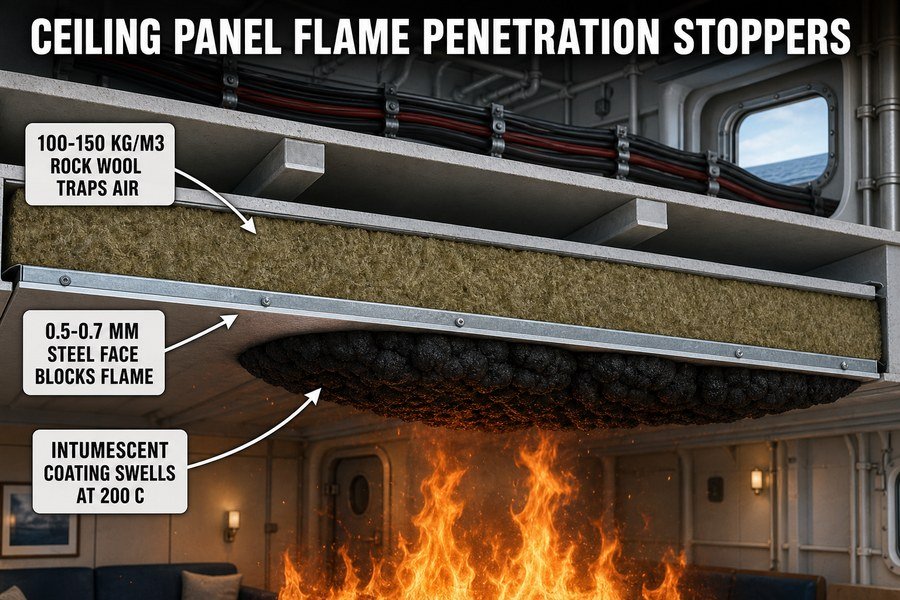
When I review ceiling plans for large shipyards, I always look closely at the material data sheets. A ceiling must stop fire from reaching the steel deck above it. If the steel deck gets too hot, it will ignite the carpet in the room above. To prevent this, the ceiling relies on three specific properties. If you miss even one of these properties during your procurement process, the local marine surveyor will fail the entire ship.
The Role of High-Density Rock Wool Cores in Ceilings
The first critical property is the non-combustible rock wool core. You cannot use normal residential insulation on a ship. The IMO 2010 FTP Code Part 1 strictly regulates this.4 The rock wool must have a density between 100 and 150 kg/m³. If you buy cheap panels with a density of 80 kg/m³, the insulation will melt under the intense heat of a cabin fire. A density of 150 kg/m³ ensures the rock fibers are packed tightly enough to trap air. Trapped air is a terrible conductor of heat. Therefore, even if a fire reaches 900°C below the ceiling, the temperature on the back side of the ceiling panel will stay safe5. This protects the critical electrical cables running above the ceiling.
Steel Face Sheets and Intumescent Coatings for Fire Resistance
The second property is the thickness of the galvanized steel face sheets. A standard marine ceiling panel uses steel faces that are 0.5 to 0.7mm thick. This steel acts as the first physical shield against direct flames. It stops the fire from immediately eating the rock wool. The third property is the heat-activated intumescent coating. This coating is painted on the back of the steel face. During normal days, it just looks like paint. But when a fire hits and the temperature crosses 200°C6, a chemical reaction happens. The coating swells up and creates a thick, black foam. This foam acts as a second insulation layer. It keeps the steel from warping too fast.
| Ceiling Panel Property | Specification Value | Primary Fire-Stopping Function |
|---|---|---|
| Rock Wool Core | 100 - 150 kg/m³ density | Traps air to prevent heat transfer |
| Galvanized Steel Faces | 0.5 - 0.7mm thickness | Provides direct physical flame barrier |
| Intumescent Coating | Activates at 200°C | Expands to create protective foam layer |
How Do Edge Joints Prevent Flames From Bypassing Marine Wall Panels?
Panel faces rarely fail during a fire. The edges are the real weak points. If flames bypass the edges, your whole fire rating becomes useless.
Edge joints prevent flames from bypassing marine wall panels through two critical mechanisms: the application of intumescent fire seals that swell up to 30 times their size at 200°C, and the use of high-temperature ceramic fiber tapes. Both methods fill thermal expansion gaps and block fire paths completely.
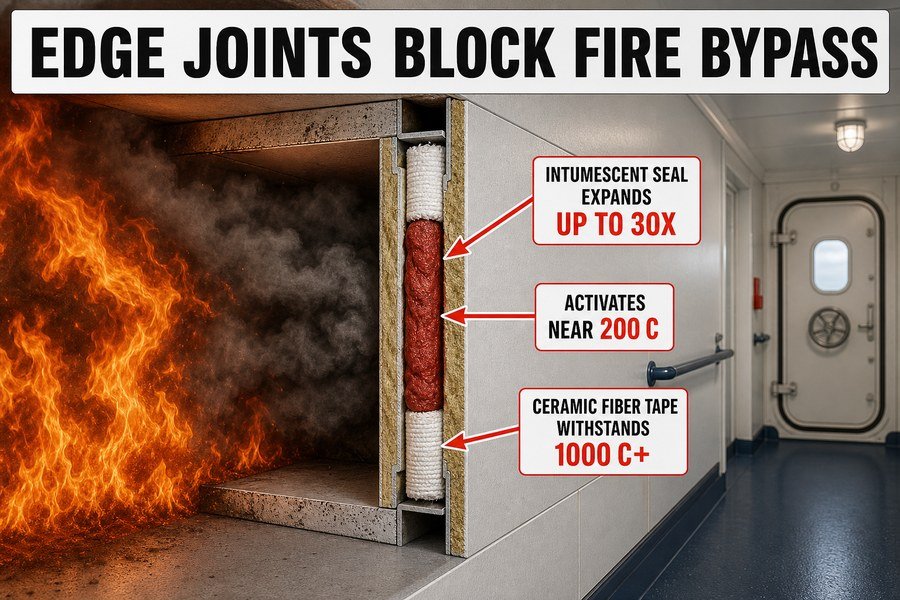
I have helped many clients who failed their initial fire inspections because they ignored the edge joints. A marine wall panel might be rated A-60, meaning it stops fire for 60 minutes. But a panel is just a block. It must touch the ceiling, the floor, and other panels. When metal gets hot, it moves and bends. This movement creates gaps at the edges. To stop fire from rushing through these new gaps, the industry uses two very specific edge joint protection mechanisms. You must ensure your factory suppliers include these in their delivery.
Expansion Mechanics of Intumescent Fire Seals on Panel Edges
The first mechanism is the intumescent fire seal. This is a special rubber-like strip installed along the very edge of the wall panel. It sits hidden inside the joint. When a fire breaks out, the heat quickly travels to the joint. Once the temperature at the edge hits roughly 200°C, the intumescent seal begins to chemically change. It swells and expands aggressively, sometimes growing up to 30 times its original size. As the metal panels warp and pull apart from the heat, the expanding seal chases the metal. It fills the new gaps instantly. It turns into a hard, solid char that completely blocks smoke and flames. Without this seal, toxic smoke would easily bypass the panel and kill passengers in the next room.
Applying High-Temperature Ceramic Fiber Tapes to Marine Wall Joints
The second mechanism is the use of high-temperature ceramic fiber tapes. While intumescent seals react to heat, ceramic fiber tapes are passive. They are wrapped around the edges of the panel before installation. These tapes can survive temperatures well over 1000°C without melting or burning. When the ship moves and vibrates, the ceramic tape acts as a cushion between the hard metal edges. More importantly, during a fire, the tape stays in place. Even if the steel edge melts slightly, the ceramic fiber tape remains intact, holding a physical barrier against the flame. Shipyards often use both mechanisms together to guarantee passing the IMO FTP Code Part 3 fire tests.
| Edge Protection Mechanism | Action Type | Activation Temperature | Primary Benefit |
|---|---|---|---|
| Intumescent Fire Seals | Active (Expands) | ~200°C | Fills moving gaps caused by warping |
| Ceramic Fiber Tapes | Passive (Static) | Withstands >1000°C | Provides a permanent, non-melting cushion |
Why Is Structural Integrity Vital for a Marine Wall Panel Containing a Fire?
A panel can block flames, but it fails if it collapses. Ships vibrate and shift constantly. Without structural strength, a burning bulkhead will fall apart.
Structural integrity is vital for marine wall panels because it ensures three outcomes during a fire: the panel supports its own weight without buckling, withstands internal ship vibrations, and resists the pressure of fire hoses. This structural stability guarantees the panel meets the 60-minute A-60 standard without collapsing.
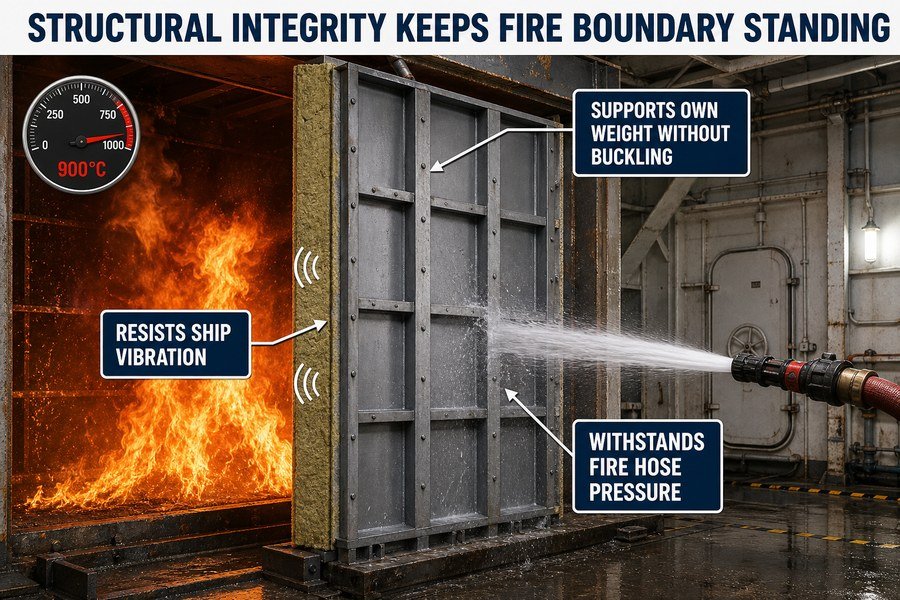
I always tell procurement officers that buying marine panels is different from buying hotel panels. A ship is a moving machine. When a fire happens at sea, the ship does not stop moving. The engines keep running, the waves keep hitting the hull, and the crew uses high-pressure water hoses to fight the flames. A wall panel must stand up to all this physical violence while it is melting. Therefore, structural integrity is not just a nice feature; it is a vital life-saving requirement that delivers three specific safety outcomes.
Preventing Panel Buckling Under Extreme Marine Fire Heat
The first outcome of structural integrity is that the panel supports its own weight without buckling. When a fire hits a wall, the temperature on the fire side can reach 900°C in just a few minutes7. Steel loses about 50% of its strength at 600°C8. If the interior rock wool core is not glued perfectly to the steel face with high-quality, heat-resistant adhesive, the steel face will peel off and buckle. Once it buckles, the whole panel drops. High structural integrity means the panel uses reinforced steel framing and dense core materials. This ensures the wall stands tall and maintains the fire boundary for the full 60 minutes required by the SOLAS A-60 standard9.
Resisting Ship Vibrations and Fire Hose Pressures During Emergencies
The second outcome is withstanding internal ship vibrations. Even during a fire emergency, a ship's structure vibrates violently. If the panel's internal structure is weak, the vibrations will shake the burnt rock wool into dust. The insulation will fall to the bottom of the panel, leaving the top empty and exposed to fire. Strong structural design prevents this shifting. The third outcome is resisting the pressure of fire hoses. When firefighters arrive, they spray water at high pressure directly onto the burning wall. If the panel is structurally weak, the water jet will punch a hole right through it. This breaks the fire barrier and pushes the fire into the next zone. Structural integrity ensures the panel absorbs this hard physical impact.
| Structural Challenge During Fire | Panel Structural Requirement | Result if Integrity Fails |
|---|---|---|
| Extreme Heat (900°C) | High-quality heat-resistant adhesive | Steel face peels, panel buckles and falls |
| Constant Ship Vibration | Dense core and tight framing | Insulation turns to dust and drops |
| High-Pressure Fire Hoses | Strong steel face and rigid core | Water punches hole through the wall |
What Installation Errors Let Fire Breach a Marine Ceiling Panel System?
You can buy the best materials in the world, but poor installation ruins them. Simple mistakes on the job site can leave deadly openings for fires.
Fire can breach a marine ceiling panel system due to three common installation errors: missing or improperly cut insulation around pipe penetrations, the use of uncertified non-fire-rated fastening screws, and leaving air gaps wider than 3mm at connection profiles. These mistakes destroy the continuous fire boundary.
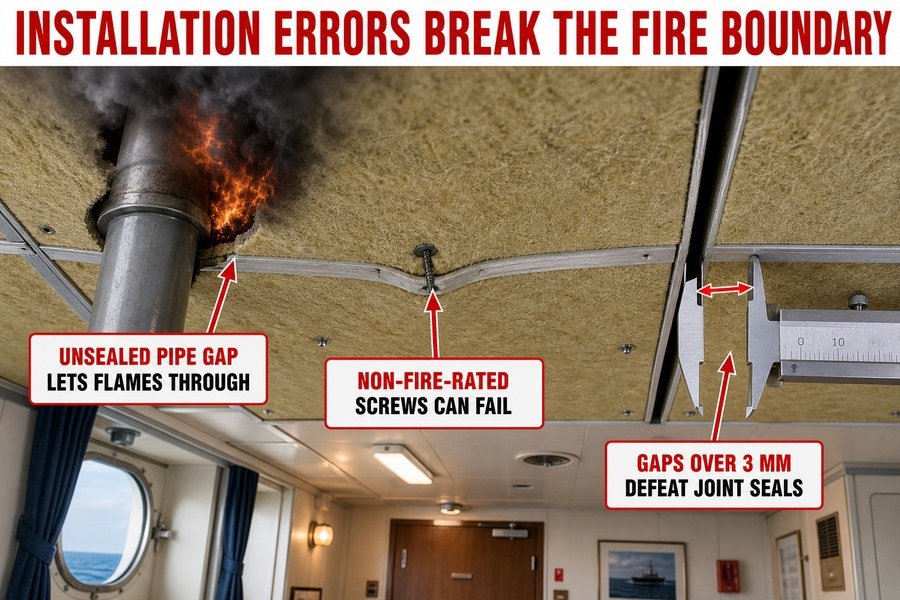
Over my years at Magellan Marine, I have walked through many ships under construction. The most frustrating thing I see is excellent, expensive ceiling panels installed badly. A European shipyard might spend millions of dollars buying top-quality panels from Asia, but the local workers make simple mistakes. These mistakes ruin the fire rating. A fire does not care about the brand of your panel; it only looks for the weakest point. There are three common installation errors that you must track and prevent.
Dangers of Improper Insulation Around Ceiling Pipe Penetrations
The first common error involves pipe penetrations. Ships have thousands of pipes and cables running through the ceilings. Workers must cut holes in the ceiling panels to let these pipes pass. The error happens when the workers fail to pack the space around the pipe with approved fire-stop insulation10. I often see workers cut a hole that is too big, slide the pipe through, and leave a gap of free air around it. When a fire happens, the smoke and flames act like water; they rush straight to the easiest exit. They will flow right through the gap around the pipe11, breaching the ceiling system instantly. Every single penetration must be packed tight and sealed with marine-grade fire mastic.
Risks of Uncertified Fasteners and Excessive Air Gaps in Ceilings
The second error is the use of uncertified, non-fire-rated fastening screws. Sometimes workers run out of the correct screws provided by the panel factory. Instead of waiting, they use standard cheap screws from a local hardware store. In a fire, cheap screws melt at low temperatures. The ceiling panel simply drops from the roof because the screws failed. You must only use the factory-supplied, fire-rated steel fasteners12. The third error is leaving air gaps wider than 3mm at the connection profiles. The IMO guidelines generally allow a maximum tolerance of a 3mm gap for joints.13 If workers rush the job and leave a 5mm or 6mm gap between panels, the intumescent seals cannot expand enough to cross the distance. The fire will slip through the gap.
| Installation Error | Location of Flaw | Mechanism of Fire Breach |
|---|---|---|
| Improper Pipe Insulation | Around pipes and cables | Flames pass through the open air gap |
| Uncertified Screws | Ceiling mounting points | Screws melt, ceiling drops entirely |
| Gaps Wider than 3mm | Between panel connection joints | Intumescent seals fail to close the wide gap |
How Are Installed Marine Interior Panels Inspected for Fire-Containment Flaws?
Shipyards and classification societies are very strict. If your panels fail inspection, you will face huge delays. You must know exactly what inspectors look for.
Installed marine interior panels are inspected for fire-containment flaws using three standardized methods: visual checks for proper joint alignment (maximum 3mm tolerance), thermal imaging to detect missing core insulation, and verifying IMO Type Approval certificates against the actual installed materials. These three checks ensure total compliance.
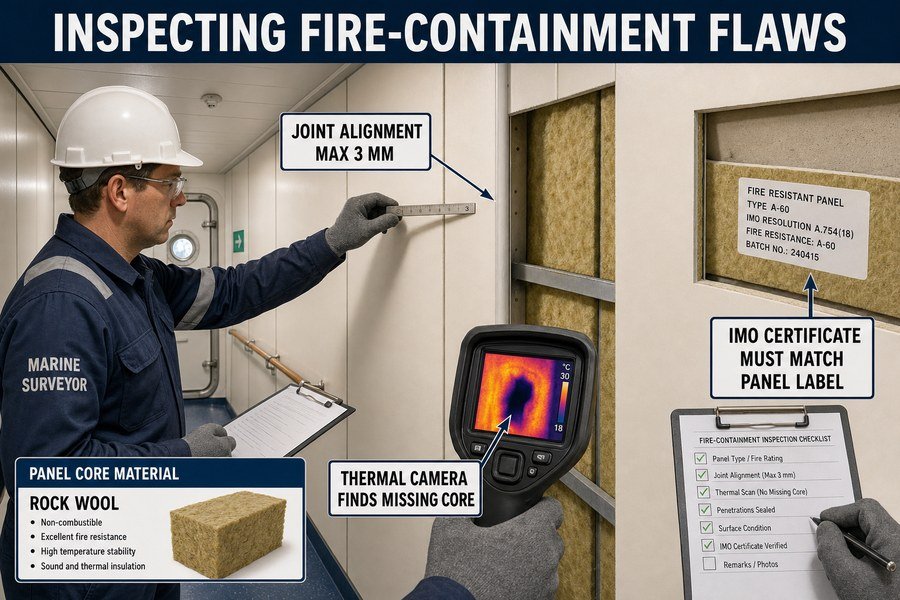
Before a ship can sail, a marine surveyor from a classification society like DNV or Lloyd's Register must approve the interior outfitting14. They do not just look at the walls and say it looks nice. They are hunting for mistakes. If they find flaws, they will force the shipyard to rip out the panels and do it again. This destroys profit margins. To prevent this, successful decoration companies and their procurement officers must understand the three methods inspectors use to check for fire-containment flaws.
Conducting Visual Alignment Checks and IMO Certificate Verification
The first method is the visual check for proper joint alignment. The inspector will walk the corridors with a small measuring tool. They check the joints between every single wall and ceiling panel. As I mentioned before, the standard tolerance is usually a maximum of 3mm15. If the inspector finds gaps of 4mm or uneven alignments where the interlocking lips do not connect fully, they will mark it as a fail. The second method is verifying IMO Type Approval certificates against the actual materials. The inspector will hold the factory certificate and look at the printed labels on the back of the installed panels. If you bought panels from a supplier who swapped the materials to save money, the inspector will catch the mismatch. The label on the panel must exactly match the test report numbers on the IMO certificate.16
Utilizing Thermal Imaging for Hidden Insulation Flaws in Marine Panels
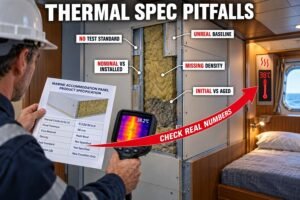
The third method is using thermal imaging to detect missing core insulation17. Visual checks only show the outside of the panel. Inspectors want to know what is inside. Sometimes, during shipping or rough installation, the rock wool core inside the panel breaks or falls down, leaving the top half of the panel hollow. A hollow panel cannot stop fire. Inspectors use handheld infrared thermal cameras. They heat the room slightly or use the natural temperature differences of the ship. The camera shows a clear color map of the wall. If there is missing insulation, that spot will show up as a bright cold or hot spot on the camera screen. This modern tool makes it impossible to hide internal panel damage.
| Inspection Method | Tool Used | Defect Targeted | Pass/Fail Criteria |
|---|---|---|---|
| Visual Alignment Check | Measuring gauge | Wide gaps at connection joints | Maximum 3mm gap allowed |
| Certificate Verification | IMO Type Approval paperwork | Counterfeit or unapproved materials | Labels must match certificates exactly |
| Thermal Imaging | Infrared thermal camera | Missing or broken internal insulation | Uniform temperature reading across panel |
Conclusion
In summary, proper marine panels stop fires through non-combustible materials, precise joints, and strong structural integrity. Avoiding installation errors and passing strict inspections ensures safe, compliant, and cost-effective outfitting.
-
"Calculation of Relative Thermal Elongation of Structural ...", https://www.nist.gov/publications/calculation-relative-thermal-elongation-structural-steels. Engineering references on structural steel at elevated temperatures describe thermal expansion as a predictable material response that can change fit-up and contact forces in constrained assemblies. Evidence role: mechanism; source type: education. Supports: A steel spline can expand when heated, potentially tightening contact within a slotted panel joint.. Scope note: This provides contextual support for the thermal-expansion mechanism, not direct proof that every marine spline joint seals effectively under fire-test conditions. ↩
-
"Siding | UC ANR Fire Network", https://ucanr.edu/program/uc-anr-fire-network/siding. Fire-protection and fluid-flow literature describes tortuous or labyrinth paths as increasing flow resistance and heat-transfer surface area, which can reduce direct passage of hot gases through gaps. Evidence role: mechanism; source type: paper. Supports: A tongue-and-groove joint can improve fire and smoke resistance by making the leakage path less direct.. Scope note: The source may support the general labyrinth-path principle rather than a specific tongue-and-groove marine wall-panel design. ↩
-
"origami inspired design of thin walled tubular structures", https://hammer.purdue.edu/articles/thesis/Origami_inspired_design_of_thin_walled_tubular_structures_for_impact_loading/9077651/1/files/16603220.pdf. Structural-engineering sources on thin-walled steel profiles and overlapping joints show that folded or interlocking edge geometries can increase local stiffness compared with simple flat-edge connections. Evidence role: general_support; source type: paper. Supports: Overlapping Z-lock edge profiles can provide greater joint rigidity than simpler panel-edge connections.. Scope note: This supports the structural principle behind Z-lock rigidity, but it does not verify purchasing preferences of United States shipyards. ↩
-
"What Is the Purpose and Scope of the IMO FTP Code?", https://magellanmarinetech.com/what-purpose-scope-of-imo-ftp-code/. The IMO 2010 FTP Code, Part 1, sets out the non-combustibility test used to assess materials for shipboard fire-safety applications. Evidence role: definition; source type: institution. Supports: The IMO 2010 FTP Code Part 1 regulates non-combustibility requirements for shipboard materials.. Scope note: This supports the regulatory basis for non-combustibility testing, but it does not by itself establish a required rock-wool density range. ↩
-
"What Is the Purpose and Scope of the IMO FTP Code?", https://magellanmarinetech.com/what-purpose-scope-of-imo-ftp-code/. Marine fire-test standards for class divisions specify a standard furnace temperature curve and maximum permitted temperature rise on the unexposed face, which provides the benchmark for whether the back side of a ceiling remains within accepted limits during testing. Evidence role: statistic; source type: institution. Supports: A fire-rated marine ceiling must limit heat transfer to the unexposed side under a standardized fire exposure.. Scope note: This supports the test criterion, not the performance of a particular ceiling panel unless that exact assembly has passed the relevant fire test. ↩
-
"Reformative Effects of Intumescent Coating on the Structural ...", https://pmc.ncbi.nlm.nih.gov/articles/PMC9685761/. Studies of intumescent coatings describe heat-triggered reactions that expand the coating into an insulating char layer, with activation temperature depending on the coating formulation. Evidence role: mechanism; source type: paper. Supports: Intumescent coatings can activate under heat and expand into an insulating char or foam layer.. Scope note: A 200°C activation point is formulation-specific and should be supported by the coating’s test data or technical documentation if stated as an exact threshold. ↩
-
"Methodology for Developing and - Implementing Alternative", https://www.nrc.gov/docs/ML0705/ML070530536.pdf. Standard hydrocarbon fire curves used in fire-safety engineering rise to approximately 900°C within the first few minutes, supporting the plausibility of very rapid severe heating in fuel-fed fires. Evidence role: general_support; source type: paper. Supports: In some severe marine fire scenarios, the fire-side temperature can reach about 900°C within minutes.. Scope note: This supports a severe-fire scenario; actual shipboard compartment temperatures depend on fuel load, ventilation, suppression, and the fire curve required by the applicable marine test standard. ↩
-
"Best practice guidelines for structural fire resistance design of ...", https://nvlpubs.nist.gov/nistpubs/technicalnotes/nist.tn.1681.pdf. Structural-fire design references such as Eurocode 3 report that carbon steel retains roughly half of its room-temperature yield strength near 600°C, supporting the stated reduction in load-bearing capacity at elevated temperature. Evidence role: statistic; source type: institution. Supports: Steel loses about 50% of its strength at around 600°C.. Scope note: The exact reduction depends on steel grade, stress-strain model, heating rate, and whether yield strength, elastic modulus, or ultimate strength is being compared. ↩
-
"What Is the Purpose and Scope of the IMO FTP Code?", https://magellanmarinetech.com/what-purpose-scope-of-imo-ftp-code/. IMO/SOLAS fire-test requirements for A-class divisions define A-60 divisions as maintaining integrity for 60 minutes while limiting temperature rise on the unexposed side, supporting the stated 60-minute fire-boundary requirement. Evidence role: definition; source type: institution. Supports: SOLAS/IMO A-60 fire divisions are required to maintain a fire boundary for 60 minutes under the applicable test conditions.. Scope note: The standard defines test performance criteria; it does not by itself prove that a particular panel design will meet them without certification testing. ↩
-
"What Is the Purpose and Scope of the IMO FTP Code?", https://magellanmarinetech.com/what-purpose-scope-of-imo-ftp-code/. IMO/SOLAS fire-safety provisions and the IMO FTP Code treat penetrations in fire-resisting divisions as details that must be protected with approved or tested fire-stopping systems, supporting the need for approved insulation around pipe and cable openings. Evidence role: expert_consensus; source type: institution. Supports: Workers must pack the space around pipe penetrations with approved fire-stop insulation.. Scope note: The source would support the general requirement for approved fire-stopping, not the author’s specific observations at individual shipyards. ↩
-
"Fire Wall Penetrations", https://www.ocwr.gov/publications/fast-facts/fire-wall-penetrations/. Fire-protection guidance on compartmentation explains that unsealed service penetrations can allow hot gases, smoke, and flames to bypass fire-resisting barriers, providing a mechanism for loss of fire integrity at pipe openings. Evidence role: mechanism; source type: government. Supports: Smoke and flames can pass through unsealed gaps around pipe penetrations and compromise a fire-rated ceiling system.. Scope note: Most accessible sources may discuss compartmentation generally; the mechanism is applicable to ships but may not be based on a ship-ceiling-specific experiment. ↩
-
"What Is the Purpose and Scope of the IMO FTP Code?", https://magellanmarinetech.com/what-purpose-scope-of-imo-ftp-code/. Fire-resistance testing standards for marine divisions evaluate assemblies as installed systems, so substitutions of untested fasteners can affect whether the tested fire performance remains applicable. Evidence role: general_support; source type: institution. Supports: Ceiling panels in a fire-rated marine assembly should use the tested or approved fasteners specified for that system.. Scope note: This supports the principle of using tested or approved fasteners; it may not prove that every non-factory screw will fail in the same way during a fire. ↩
-
"What Keeps Marine Interior Panels Structurally Stable During Fire?", https://magellanmarinetech.com/what-keeps-marine-interior-panels-structurally-stable-during-fire/. An IMO FTP Code provision, approved installation manual, or classification-society rule would be needed to substantiate a stated 3 mm joint-gap tolerance for fire-rated ceiling systems. Evidence role: definition; source type: institution. Supports: IMO-related guidance generally allows a maximum 3 mm gap at ceiling-panel joints.. Scope note: The 3 mm figure may be product- or approval-specific rather than a universal IMO tolerance, so the citation should clarify the scope of the rule. ↩
-
"What Approval Differences Separate Marine Accommodation Panels ...", https://magellanmarinetech.com/what-approval-differences-separate-marine-accommodation-panels-from-standard-building-panels/. Classification societies and recognized organizations conduct statutory and class surveys that include verification of ship construction and fire-safety arrangements against applicable IMO/SOLAS requirements. Evidence role: general_support; source type: institution. Supports: A classification-society marine surveyor may be responsible for approving or verifying interior outfitting before a vessel enters service.. Scope note: The exact approval responsibility can vary by flag state, vessel type, and whether the survey is statutory or class-based. ↩
-
"How to choose the right marine fire door for different ship ...", https://magellanmarinetech.com/how-to-choose-right-marine-fire-door-for-different-ship-compartments/. Installation or approval documentation for fire-rated marine accommodation panels may specify maximum joint gaps or alignment tolerances, supporting the relevance of measured joint clearances during inspection. Evidence role: general_support; source type: institution. Supports: Marine panel joint alignment can be subject to a defined tolerance, such as a maximum 3 mm gap.. Scope note: A cited source may document a tolerance for a specific panel system or approval standard rather than prove a universal 3 mm rule for all marine interiors. ↩
-
"What Is the Purpose and Scope of the IMO FTP Code?", https://magellanmarinetech.com/what-purpose-scope-of-imo-ftp-code/. IMO fire-test and type-approval procedures require approved fire-protection materials and assemblies to be traceable to their certificates and tested configurations, supporting the need to compare installed product markings with approval documentation. Evidence role: definition; source type: institution. Supports: Inspectors verify that installed marine panels correspond to the IMO Type Approval certificate and associated test documentation.. Scope note: The source may establish traceability and conformity requirements without using the article’s exact wording about matching every printed number. ↩
-
"Infrared Thermography for Temperature Measurement and ...", https://pmc.ncbi.nlm.nih.gov/articles/PMC4168422/. Infrared thermography is an established non-destructive testing method for identifying insulation defects, voids, and thermal bridges by detecting surface-temperature anomalies associated with differences in heat transfer. Evidence role: mechanism; source type: paper. Supports: Thermal imaging can reveal missing or damaged insulation inside panels through abnormal temperature patterns.. Scope note: Most neutral sources discuss thermography in buildings or composite structures, so the evidence may support the detection principle rather than prove routine use in marine-panel inspections. ↩