Choosing the wrong marine interior panels leads to deadly smoke in a fire. I will show you how different panel materials compare to keep your ship projects completely safe.
Marine interior panel materials vary drastically in smoke performance. Inorganic cores like rock wool and aluminum honeycomb produce near-zero smoke. However, surface laminates, structural adhesives, and PVC films add measurable toxic smoke. Overall smoke performance depends heavily on the combination of these materials under strict IMO regulations.
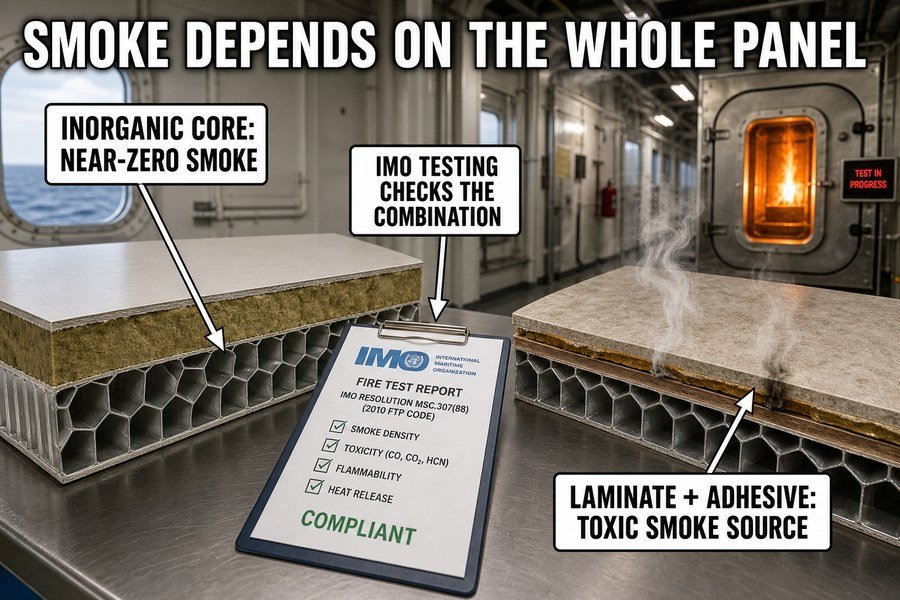
Understanding these material differences is the first step to successful procurement. Let us look closely at the core materials that make up the bulk of your panels.
Which Marine Interior Panel Cores Produce the Lowest Smoke Density?
High smoke density from burning panel cores traps passengers during an emergency. You need cores that stay clear. Let us look at the lowest smoke-producing options available today.
The three marine interior panel cores producing the lowest smoke density are mineral rock wool, aluminum honeycomb, and calcium silicate. Because they are completely inorganic and non-combustible, they generate zero to negligible smoke density, easily passing the strict IMO 2010 FTP Code Part 2 requirements for marine applications.
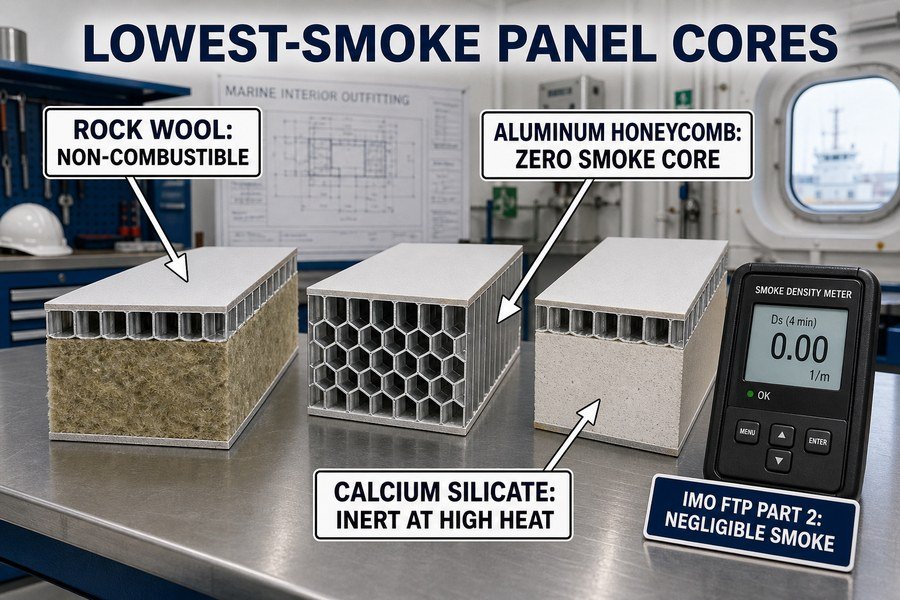
Based on my years in marine outfitting, the core material dictates the baseline safety of your entire interior project. If you buy panels from factories in developing countries, you must know how these three specific cores behave. I have helped many buyers secure high-quality products at competitive prices by simply understanding these material properties.
Zero Smoke Density from Mineral Rock Wool Cores
Mineral rock wool is the most common core for A-Class fire doors and bulkheads. Manufacturers melt basalt rock at temperatures over 1,500°C and spin it into fibers.1 Because it is essentially spun rock, it contains no organic matter to burn. According to the IMO 2010 FTP Code Part 1, pure rock wool is completely non-combustible. Therefore, it produces absolutely zero smoke density on its own. When you source rock wool panels, always ask the supplier for the density. A density of 120 kg/m³ to 150 kg/m³ offers the best balance of fire insulation and structural strength.2 Many Asian suppliers offer excellent pricing on these, but you must demand the DNV or ABS certificates to prove they used marine-grade rock wool, not cheap building-grade wool that might contain organic binders.
Ultra-Low Smoke Output of Aluminum Honeycomb and Calcium Silicate Cores
Aluminum honeycomb and calcium silicate are the other two top performers. Aluminum honeycomb uses thin aluminum foil formed into hexagonal cells. The aluminum alloy (typically 3003 grade) melts at 660°C but does not burn or generate smoke. It is perfect for lightweight B-Class and C-Class partitions. Calcium silicate, on the other hand, is a dense, heavy board made of silicon dioxide and calcium oxide. It is completely inert and does not release any smoke even at 1,000°C. While calcium silicate is too heavy for standard cabin walls, we often use it behind heating appliances. Both materials ensure excellent visibility during a fire.
| Core Material Type | Typical Density | Combustibility (IMO Part 1) | Smoke Density Contribution | Cost Profile |
|---|---|---|---|---|
| Mineral Rock Wool | 120 - 150 kg/m³ | Non-combustible | Zero | Low to Medium |
| Aluminum Honeycomb | 25 - 40 kg/m³ (core) | Non-combustible | Zero | Medium to High |
| Calcium Silicate | 800 - 1,000 kg/m³ | Non-combustible | Zero | High |
How Does Rock Wool Compare to Honeycomb in Marine Wall Panel Smoke?
You often have to choose between rock wool and honeycomb for marine wall panels. A wrong choice ruins safety and budgets. Here is how their smoke performances actually compare.
Both rock wool and aluminum honeycomb cores inherently produce zero smoke. However, honeycomb panels often use more adhesive to bond the metallic cells to the face sheets than rock wool panels do. Consequently, honeycomb panels can produce slightly higher overall smoke levels solely due to this internal adhesive volume.
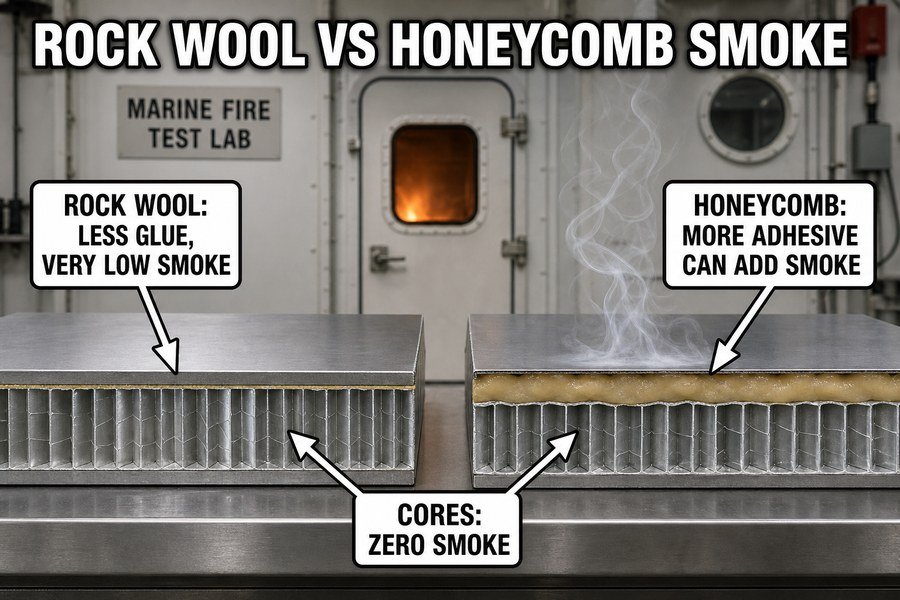
When you talk to sales reps at trade shows, they usually claim both panels are completely smoke-free. But from a technical procurement perspective, you have to look at how the factory actually builds the panel. Let me break down the real differences.
Smoke Performance Baseline for Rock Wool Wall Panels
A standard marine rock wool wall panel consists of a rock wool core sandwiched between two galvanized steel sheets. The factory applies a very thin layer of glue to attach the steel. Because rock wool provides a large, flat surface area, the factory uses less glue. A typical application rate is around 100 to 120 grams per square meter. In a fire, the steel sheets protect the rock wool and the thin glue line for up to 60 minutes in an A-60 test3. The rock wool itself never smokes. This makes rock wool panels incredibly safe. If you are decorating large shipyards in Europe or the US, these panels are your safest bet to pass strict safety inspections, and sourcing them from China keeps your costs very low.
Adhesive-Driven Smoke Factors in Aluminum Honeycomb Panels
Aluminum honeycomb panels present a different challenge. The core is mostly air. To bond the flat steel or aluminum face sheet to the thin edges of the honeycomb cells, the factory must use a thicker, stronger layer of adhesive. They often apply 150 to 200 grams of glue per square meter. If a fire breaks out, the metal face heats up quickly. Because the honeycomb structure conducts heat fast, the thick layer of organic glue starts to bake and release smoke.4 The core itself produces zero smoke, but the extra glue creates measurable smoke density. You must ensure the supplier uses marine-certified low-smoke adhesives, otherwise, the panel will fail the IMO FTP Code Part 2 smoke test5.
| Panel Core Type | Typical Adhesive Amount | Heat Conduction Speed | Overall Panel Smoke Risk | Recommended Application |
|---|---|---|---|---|
| Rock Wool Panel | 100 - 120 g/m² | Slow | Very Low | A-Class Bulkheads |
| Honeycomb Panel | 150 - 200 g/m² | Fast | Low to Medium | C-Class Partitions |
Do Surface Laminates Increase Marine Accommodation Panel Smoke Toxicity?
Beautiful cabin walls are useless if they release toxic gas in a fire. You must know how decorative laminates change the safety profile of your marine accommodation panels.
Yes, surface laminates significantly increase marine panel smoke toxicity. The three main laminate types—PVC films, melamine, and PET—release different toxic gases. PVC releases hydrogen chloride, melamine releases nitrogen oxides, and PET releases carbon monoxide. All must stay below strict IMO toxicity limits to pass certification.
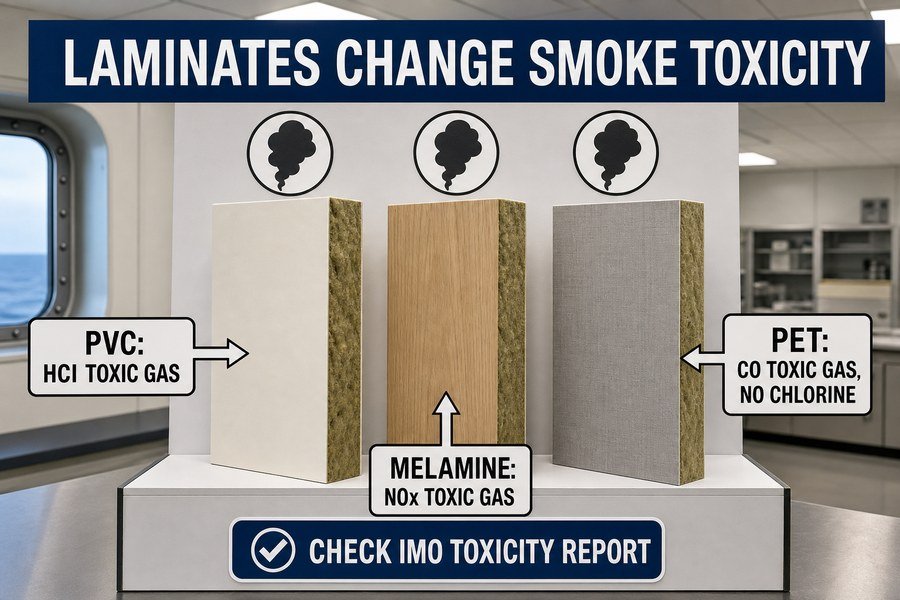
I always tell buyers that the core stops the fire, but the surface finish kills the passengers. The decorative film on the panel face is organic, meaning it will burn. Understanding these three materials helps you balance aesthetic demands from Western shipyards with safety regulations.
Hydrogen Chloride Toxicity from PVC Film Laminates
Polyvinyl chloride (PVC) film is the most popular laminate because it is cheap, easy to clean, and looks great. Factories in Asia use it extensively. However, when PVC burns, it releases hydrogen chloride (HCl) gas6. HCl is highly toxic and turns into hydrochloric acid in the lungs. According to the IMO 2010 FTP Code Part 2, the maximum allowed concentration of HCl during the smoke test is 600 ppm (parts per million). Marine-grade PVC films are specially formulated to be very thin, usually around 150 microns, to keep the total fuel load low. If your supplier uses thicker architectural PVC film to save money, it will exceed the 600 ppm limit7. Always verify the PVC thickness and the lab test reports before placing your order.
Nitrogen Oxides and Carbon Monoxide from Melamine and PET Laminates
Melamine and Polyethylene Terephthalate (PET) are the other two main options. Shipyards often specify Melamine because it is hard and scratch-resistant. However, melamine resins contain nitrogen. When burned, they release nitrogen oxides (NOx). The IMO limit for NOx is also 600 ppm. PET is an eco-friendly alternative that is becoming very popular in modern European ships. PET does not contain halogens like chlorine, so it does not produce HCl. Instead, it primarily produces carbon monoxide (CO) when it burns. The IMO limit for CO is higher, at 1,450 ppm, because it is slightly less immediately lethal at low doses than HCl. PET generally produces less toxic smoke overall, making it a safer, though slightly more expensive, choice.
| Laminate Material Type | Primary Toxic Gas Released | IMO Maximum Limit | Cost Profile | Scratch Resistance |
|---|---|---|---|---|
| PVC Film | Hydrogen Chloride (HCl) | 600 ppm | Low | Medium |
| Melamine Resin | Nitrogen Oxides (NOx) | 600 ppm | Medium | High |
| PET Film | Carbon Monoxide (CO) | 1,450 ppm | High | Medium |
How Does Aluminum-Faced Marine Ceiling Panel Smoke Compare to Steel-Faced?
Choosing the metal face for ceiling panels impacts both ship weight and fire safety. If you pick the wrong metal, the ceiling might fail early and smoke heavily.
Galvanized steel-faced ceiling panels withstand higher temperatures without melting, protecting internal materials from releasing smoke. In contrast, aluminum-faced panels melt at 660°C. This lower melting point exposes the internal adhesives and core to direct flames faster, leading to a quicker release of smoke and toxic gases.
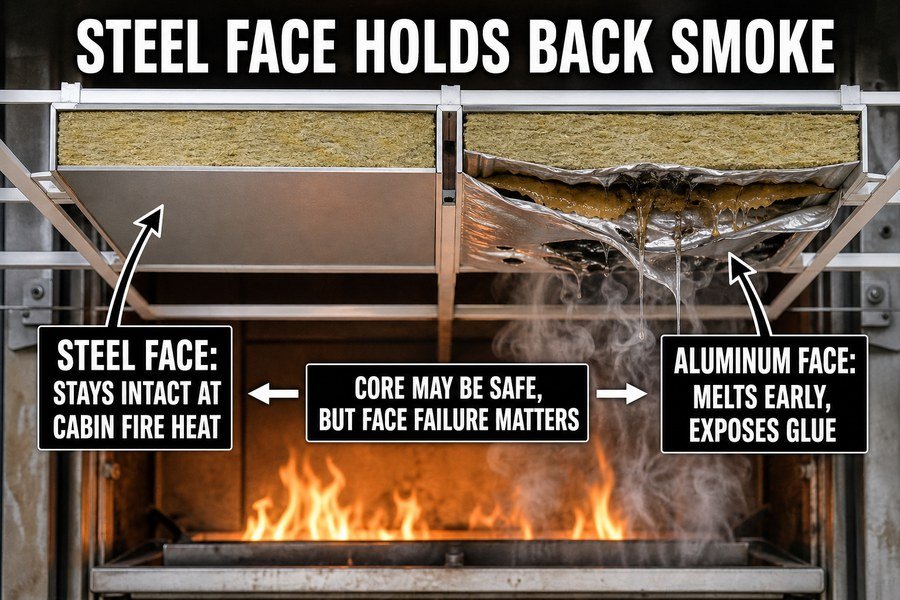
Many buyers focus so heavily on the decorative side of the ceiling that they forget about the structural metal. As a procurement officer, you must balance the shipyard's weight limits against fire safety. Here is exactly how these two metals compare.
High-Temperature Smoke Prevention of Galvanized Steel-Faced Panels
Galvanized steel is the standard for B-15 class marine ceilings. We usually use steel sheets with a thickness of 0.5 mm to 0.7 mm. Steel has a melting point of around 1,400°C to 1,500°C. In a standard cabin fire, temperatures reach about 800°C to 900°C within the first 30 minutes. The steel face remains completely intact. Because the steel does not melt, it acts as a physical barrier. It blocks the fire from reaching the glue and the core inside the panel. This prevents those internal materials from combusting and releasing smoke. If you want to avoid logistics headaches and ensure your panels pass European shipyard inspections on the first try, specify galvanized steel faces. They are heavier, but they are cheaper and far safer.
Premature Smoke Release in Aluminum-Faced Ceiling Panels
Aluminum-faced ceilings are popular for high-speed ferries and naval vessels where every kilogram matters. However, aluminum has a severe weakness in fire: it melts at just 660°C8. In a cabin fire, the aluminum face can warp and melt within the first 10 to 15 minutes. Once the aluminum face disappears, the flames directly attack the polyurethane adhesives and the internal structure. Even if you use a rock wool core, the sudden exposure of the burning adhesives causes a rapid spike in smoke density and toxic gas release. You must ensure that if the shipyard requires aluminum ceilings, the manufacturer uses specialized intumescent paints or high-grade adhesives to compensate for this early failure.
| Panel Face Material | Melting Point | Structural Integrity in Fire | Smoke Barrier Effectiveness | Panel Weight Impact |
|---|---|---|---|---|
| Galvanized Steel | ~1,450°C | High (Remains intact) | Excellent | Heavy |
| Marine Aluminum | ~660°C | Low (Melts quickly) | Poor | Light |
What Are the Smoke Trade-Offs Between Light and Heavy Marine Wall Panels?
Shipyards always want lighter panels to save fuel, but lightweight panels often hide fire safety risks. You must balance the weight against smoke performance for your projects.
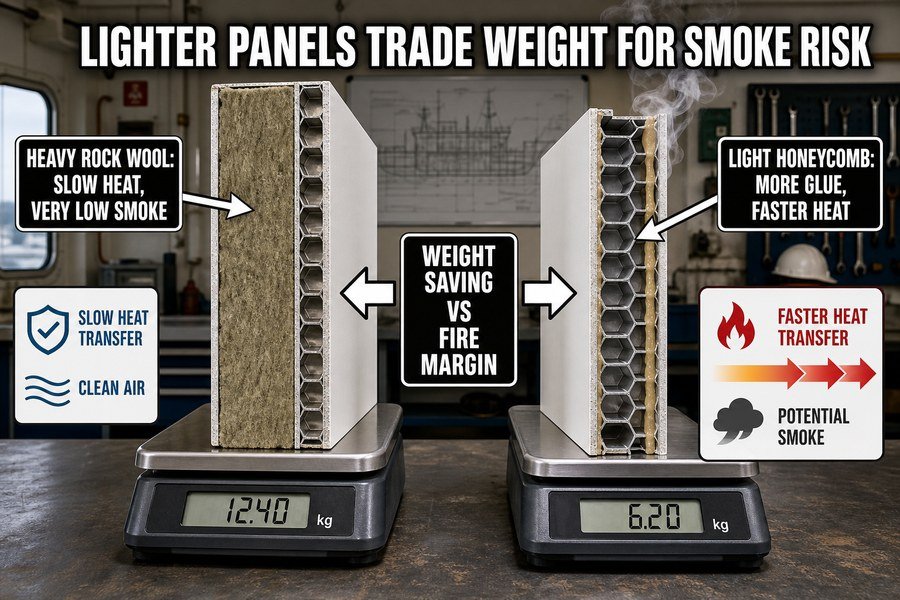
The two main trade-offs between light and heavy marine wall panels involve core density and adhesive volume. Heavy panels use dense rock wool, which resists fire longer with less smoke. Light panels use honeycomb cores, reducing ship weight but requiring more smoke-producing adhesives and failing faster under heat.
You constantly deal with European designers asking for ultra-lightweight interiors to meet green energy goals. Meanwhile, your Asian suppliers push heavy, traditional panels because they are easier to make. Let me break down the actual engineering facts so you can negotiate better.
Smoke Benefits of Heavy, High-Density Rock Wool Panels
Heavy marine panels almost always rely on high-density rock wool, usually around 150 kg/m³9. A standard 50 mm thick A-60 wall panel can weigh over 18 kg per square meter10. This heavy mass is incredible for fire safety. The high density means there is very little air inside the core, which starves the fire of oxygen. Furthermore, the thick rock wool blocks heat transfer, keeping the unexposed side of the panel cool. Because the unexposed side stays cool, the decorative laminates and adhesives on that side do not bake, blister, or smoke. Heavy panels give you maximum peace of mind regarding smoke toxicity and density, and they are generally cheaper to buy.
Adhesive Smoke Risks in Lightweight Honeycomb Panels
Lightweight panels, using aluminum honeycomb or corrugated cores, weigh drastically less. A 50 mm C-Class honeycomb panel might only weigh 6 to 8 kg per square meter. However, the trade-off is significant. To achieve strength with such low mass, these panels rely heavily on structural adhesives. As I mentioned earlier, more adhesive means more potential smoke11. Additionally, because the core is mostly empty space, heat transfers much faster from the fire side to the safe side. This rapid heat transfer can cause the adhesives on the unexposed side to start smoking prematurely. When sourcing lightweight panels, you must demand IMO FTP Code Part 2 certificates specifically for the lightweight design, as they are much harder to pass.
| Panel Weight Category | Core Material Example | Panel Weight (50mm thick) | Unexposed Side Heat Transfer | Smoke Generation Risk |
|---|---|---|---|---|
| Heavy Marine Panel | High-Density Rock Wool | 15 - 18 kg/m² | Very Slow | Very Low |
| Light Marine Panel | Aluminum Honeycomb | 6 - 8 kg/m² | Fast | Medium |
How Do Adhesives Affect Marine Interior Panel Toxic Smoke Release?
You might buy the best non-combustible core, but the wrong glue will ruin the panel. Adhesives are the hidden source of deadly toxic smoke on ships.
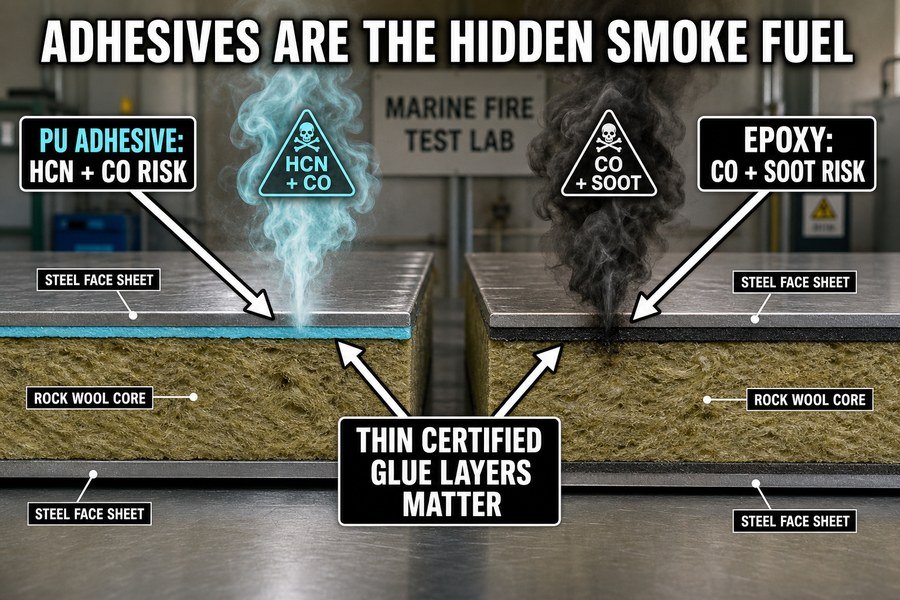
Adhesives heavily affect toxic smoke release in marine panels by acting as the primary combustible fuel source. The two common marine adhesives—polyurethane (PU) and epoxy—release different toxic gases. PU adhesives release hydrogen cyanide and carbon monoxide, while epoxies primarily release carbon dioxide and soot when burned.
I often see procurement officers negotiate hard on the steel and the rock wool, completely ignoring the glue. Asian factories will happily use cheaper glue to lower your price, but that glue will fail the fire test. You need to understand these two specific adhesives.
Toxic Hydrogen Cyanide Release from Polyurethane Adhesives
Polyurethane (PU) is the most widely used adhesive in marine panel manufacturing. It cures quickly at room temperature, which speeds up factory production times and lowers your lead times. However, PU adhesives contain nitrogen compounds. When a fire reaches the PU glue line, it burns and releases hydrogen cyanide (HCN) gas, alongside carbon monoxide. Hydrogen cyanide is extremely lethal even in small doses. The IMO FTP Code Part 2 strictly limits HCN emissions to a maximum of 140 ppm12. To pass this, good factories apply the PU glue in very thin, precise layers, typically not exceeding 150 grams per square meter. If a cheap factory uses 300 grams to cover up bad steel processing, the HCN levels will spike, and the panel will fail certification.
Carbon Monoxide and Soot Output from Epoxy Adhesives
Epoxy adhesives are the second major option. They create an incredibly strong bond and resist moisture better than PU. Epoxies do not typically contain nitrogen, so they do not release hydrogen cyanide when they burn. Instead, the primary toxic gas released is carbon monoxide (CO), along with carbon dioxide (CO2) and a significant amount of dark black soot. While CO is dangerous (with a 1,450 ppm limit), the lack of HCN makes epoxies slightly safer in terms of acute chemical toxicity. However, epoxies are more expensive and take much longer to cure. If you specify epoxy adhesives for better toxicity performance, be prepared for longer lead times and higher prices from your suppliers in China and Vietnam.
| Adhesive Type | Primary Toxic Gas Released | IMO Maximum Limit (ppm) | Cure Time Impact | Cost Profile |
|---|---|---|---|---|
| Polyurethane (PU) | Hydrogen Cyanide (HCN) | 140 ppm | Fast (Shorter Lead Times) | Low |
| Epoxy Resin | Carbon Monoxide (CO) | 1,450 ppm | Slow (Longer Lead Times) | High |
Conclusion
Marine panel smoke performance depends entirely on core materials, metal faces, laminates, and adhesives. By verifying IMO FTP Code certificates, you secure safe, compliant, and cost-effective outfitting for any shipyard.
-
"(PDF) Fiber Selection for Reinforced Additive Manufacturing", https://www.academia.edu/70460251/Fiber_Selection_for_Reinforced_Additive_Manufacturing. A technical reference on mineral-wool manufacture documents that stone wool is produced by melting basalt or similar mineral feedstock at high temperatures and fiberizing the melt, supporting the described production mechanism. Evidence role: mechanism; source type: education. Supports: Mineral rock wool is made by melting basalt rock at temperatures over 1,500°C and spinning the melt into fibers.. Scope note: Exact furnace temperatures vary by feedstock and production process, so the source may support a typical range rather than the precise threshold stated. ↩
-
"Determination of Thermal Properties of Mineral Wool ... - PMC", https://pmc.ncbi.nlm.nih.gov/articles/PMC10488771/. Experimental or technical literature on mineral-wool insulation shows that density affects thermal insulation, fire resistance, and mechanical performance, providing contextual support for selecting a mid-to-high density range in fire-rated panels. Evidence role: general_support; source type: paper. Supports: Mineral rock wool density in the 120–150 kg/m³ range is presented as a practical balance between fire insulation and structural strength for marine panels.. Scope note: A source may support the relationship between density and performance, but the phrase “best balance” is application-dependent and would require panel-specific test data for direct proof. ↩
-
"What Is the Purpose and Scope of the IMO FTP Code?", https://magellanmarinetech.com/what-purpose-scope-of-imo-ftp-code/. The cited maritime fire-safety standard defines A-60 class divisions as non-combustible divisions that prevent flame passage and limit unexposed-side temperature rise for 60 minutes under the standard fire test, supporting the time-rating context for the claim. Evidence role: definition; source type: institution. Supports: In an A-60 test, a compliant rock wool wall panel can maintain the required fire-resistance performance for up to 60 minutes.. Scope note: It verifies the A-60 performance criterion, not that every rock-wool wall panel with a thin glue line achieves it. ↩
-
"Which Parameters Determine the Fire Rating of Marine ...", https://magellanmarinetech.com/which-parameters-determine-fire-rating-marine-aluminum-honeycomb-panels/. A fire-behavior or heat-transfer study on aluminum honeycomb sandwich panels can support the mechanism that metallic honeycomb skins or cores transfer heat to polymeric adhesive layers, whose thermal decomposition may contribute smoke. Evidence role: mechanism; source type: paper. Supports: Heat transfer through aluminum honeycomb sandwich structures can accelerate thermal decomposition of organic adhesive layers, contributing to smoke generation.. Scope note: Such evidence would support the mechanism, not the specific adhesive loading or smoke density of the article’s example panels. ↩
-
"IMO 2010 FTP Code Part 2 | Smoke and Toxicity Testing", https://measurlabs.com/products/imo-2010-ftpc-part-2-smoke-toxicity/. The IMO FTP Code Part 2 prescribes smoke and toxicity testing for shipboard materials and includes criteria for smoke density and toxic gas concentrations, supporting the claim that adhesive-containing panels must satisfy low-smoke fire-test requirements. Evidence role: definition; source type: institution. Supports: Marine interior panels and their adhesive systems may need to meet the IMO FTP Code Part 2 smoke and toxicity requirements.. Scope note: It establishes the applicable test framework and acceptance criteria, but does not prove that any particular non-certified adhesive or panel will fail. ↩
-
"Polyvinyl chloride film thermal decomposition products as ...", http://stacks.cdc.gov/view/cdc/184179. Combustion and toxicology literature on polyvinyl chloride supports that heating or burning PVC can evolve hydrogen chloride, which forms hydrochloric acid in contact with moisture and can injure respiratory tissues; exposure severity depends on dose, ventilation, and fire conditions. Evidence role: mechanism; source type: paper. Supports: When PVC burns, it releases hydrogen chloride gas, which is toxic and can form hydrochloric acid in the lungs.. Scope note: The source would support the chemical mechanism and toxicity, not the exact gas concentration from a specific laminate panel. ↩
-
"Chlorine and Hydrogen Chloride", https://nepis.epa.gov/Exe/ZyPURL.cgi?Dockey=9100B1XA.TXT. Studies of PVC combustion show that hydrogen chloride generation is related to the amount of chlorine-containing PVC available and the combustion conditions, providing a mechanistic basis for thicker PVC films increasing HCl emissions; this does not directly prove that every architectural PVC film exceeds the IMO limit. Evidence role: mechanism; source type: paper. Supports: Using a thicker architectural PVC film can increase HCl emissions and may cause the material to exceed the 600 ppm limit.. Scope note: Contextual support only; compliance or failure requires an FTP Code Part 2 test on the actual finished laminate or panel system. ↩
-
"Engineering Metrology Toolbox", https://emtoolbox.nist.gov/. Reference data for aluminum give a melting point of about 660°C, supporting the material-property comparison with steel in high-temperature fire exposure. Evidence role: definition; source type: encyclopedia. Supports: Aluminum melts at approximately 660°C.. ↩
-
"How to choose the right marine wall panels for marine interior ...", https://magellanmarinetech.com/how-choose-right-marine-wall-panels-for-marine-interior-projects/. Classification-society type-approval documentation for A-class marine accommodation panels identifies mineral or rock-wool cores in high-density ranges, including examples near 150 kg/m³, supporting this as a documented construction pattern. Evidence role: general_support; source type: institution. Supports: Heavy marine panels commonly use high-density rock wool cores around 150 kg/m³.. Scope note: Such approvals cover specific certified panel designs and do not prove that heavy marine panels 'almost always' use this density. ↩
-
"How to choose the right marine wall panels for marine interior ...", https://magellanmarinetech.com/how-choose-right-marine-wall-panels-for-marine-interior-projects/. Published type-approval or marine equipment certification data for 50 mm A-60 wall or bulkhead panel systems report surface masses in the high-teen kg/m² range, supporting the plausibility of weights above 18 kg/m² for some approved designs. Evidence role: statistic; source type: institution. Supports: A 50 mm A-60 wall panel can weigh more than 18 kg/m².. Scope note: The evidence would substantiate representative examples, not a universal 'standard' weight across all A-60 panels. ↩
-
"What Smoke Toxicity and Density Limits Must Marine Wall and Ceiling ...", https://magellanmarinetech.com/what-smoke-toxicity-density-limits-must-marine-wall-ceiling-panels-meet/. Fire-safety studies of polymeric adhesives and sandwich composites report that organic resin systems can contribute to smoke and toxic-gas production under thermal decomposition, supporting the general mechanism that greater combustible adhesive content may increase smoke potential. Evidence role: mechanism; source type: paper. Supports: Increasing the amount of structural adhesive in a lightweight panel can increase potential smoke generation during fire exposure.. Scope note: This supports the general fire-chemistry mechanism; actual smoke output must be verified by design-specific IMO FTP Code Part 2 testing. ↩
-
"What Is the Purpose and Scope of the IMO FTP Code?", https://magellanmarinetech.com/what-purpose-scope-of-imo-ftp-code/. The IMO Fire Test Procedures Code smoke and toxicity provisions list concentration limits for fire effluents, including hydrogen cyanide, providing regulatory support for the cited 140 ppm threshold. Evidence role: definition; source type: institution. Supports: The IMO FTP Code Part 2 sets a maximum HCN concentration limit of 140 ppm.. Scope note: The limit applies within the specified IMO FTP Code test method and should not be generalized to all fire-test regimes. ↩