A ship fire is terrifying, but flames are not the biggest threat. Smoke and toxic gases kill much faster, especially in confined spaces. How can you protect crew members during these emergencies?
Smoke and toxicity in confined ship spaces cause rapid asphyxiation and zero visibility, making evacuation impossible. According to IMO regulations, safe marine interiors require materials generating low smoke density (Ds max < 200) and toxic gases under strict limits, preventing deaths from carbon monoxide, hydrogen cyanide, and hydrogen chloride.
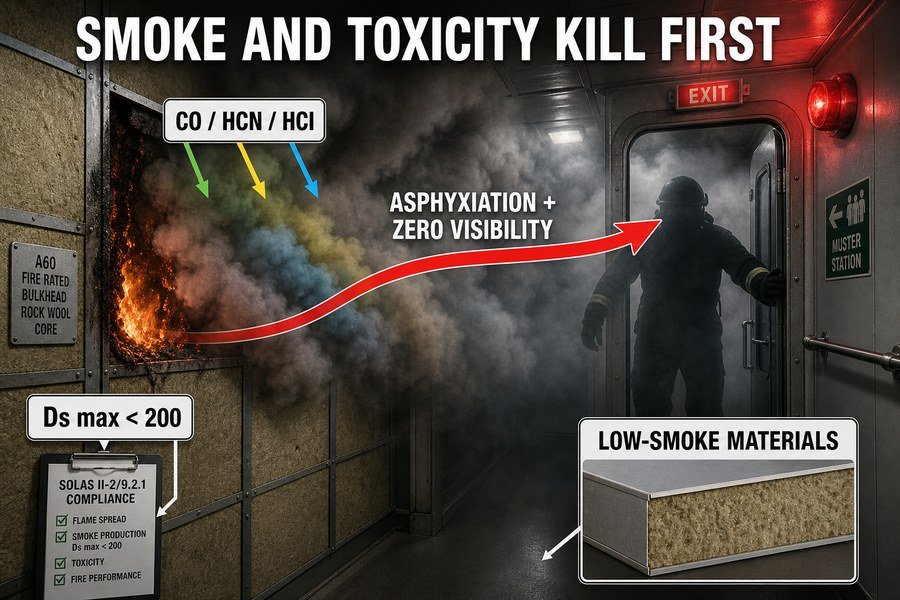
When you buy ship interior outfitting products, you must look past the fire rating. I often tell my clients at Magellan Marine that a panel can stop a fire for 60 minutes, but if it releases toxic smoke, the crew will not survive minute five. Let us look at why smoke and toxicity dictate survival rates on board.
Why Does Marine Accommodation Panel Smoke Pose Greater Risks in Cabins?
Crew cabins are small and packed tight. When a panel burns, thick smoke traps people inside instantly. Why is cabin smoke so deadly compared to open decks?
Marine accommodation panel smoke in cabins poses severe risks because it displaces oxygen, reduces visibility below 0.5 meters, and traps heat. The small volume of a cabin (typically 10-15 cubic meters) means lethal smoke concentrations accumulate in under 3 minutes, causing disorientation and preventing crew from finding the exit.
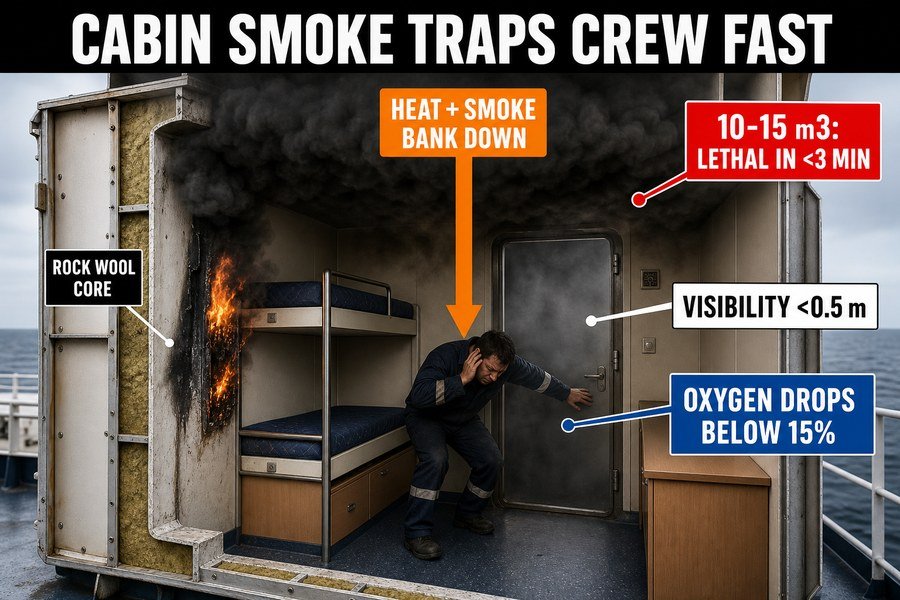
I have seen many interior designs for shipboard cabins. The standard cabin size for crew members is very small. We are usually looking at spaces of 10 to 15 cubic meters. When a fire starts, the marine accommodation panel surface begins to burn and release smoke. This small volume means the room fills up instantly.
Oxygen Displacement and Rapid Heat Trapping in Small Cabins
The first major problem is oxygen displacement and heat trapping. A standard fire needs oxygen to burn. In a closed cabin of 12 cubic meters, the fire consumes the room's oxygen very fast. The oxygen level drops from the normal 21% down to below 15%1. At this level, humans lose muscle control. At the same time, the marine panels trap the heat inside the small box. The temperature at the ceiling can reach 300°C in just a few minutes2. I always remind buyers that cheap panels with thick, uncertified PVC laminates burn faster and consume more oxygen. The heat has nowhere to go, so it pushes the smoke layer down to the floor very quickly. You must buy panels that pass the IMO FTP Code Part 2 tests to ensure they do not accelerate this process.
Visibility Reduction and Disorientation from Panel Smoke
The second problem is visibility reduction. The smoke from burning plastics and adhesives is thick and black. In under 3 minutes, the visibility drops below 0.5 meters. Crew members wake up, but they cannot see their own hands. They become disoriented. They cannot find the door handle. A distance of just two meters to the exit feels like a maze. This is why you must check the specific optical density (Ds) on the product certificate. If the Ds value is high, the panel will blind the crew before the flames ever reach them.
| Cabin Volume | Time to 0.5m Visibility | Time to <15% Oxygen | Survival Threat Level |
|---|---|---|---|
| 10 cubic meters | 1.5 minutes | 2.5 minutes | Extreme |
| 15 cubic meters | 2.2 minutes | 3.5 minutes | Very High |
| 20 cubic meters | 3.0 minutes | 4.8 minutes | High |
How Does Poor Ventilation Intensify Marine Interior Panel Toxic Gas?
Ships often shut down HVAC systems during a fire to stop flames from spreading. But this traps toxic gases inside. How does poor ventilation turn cabins into gas chambers?
Poor ventilation intensifies toxic gas from marine interior panels by trapping combustion byproducts like Carbon Monoxide (CO), Hydrogen Cyanide (HCN), and Sulfur Dioxide (SO2) in a sealed zone. Without fresh air dilution, CO levels quickly exceed the IMO 1450 ppm limit, causing rapid crew incapacitation within 5 minutes.
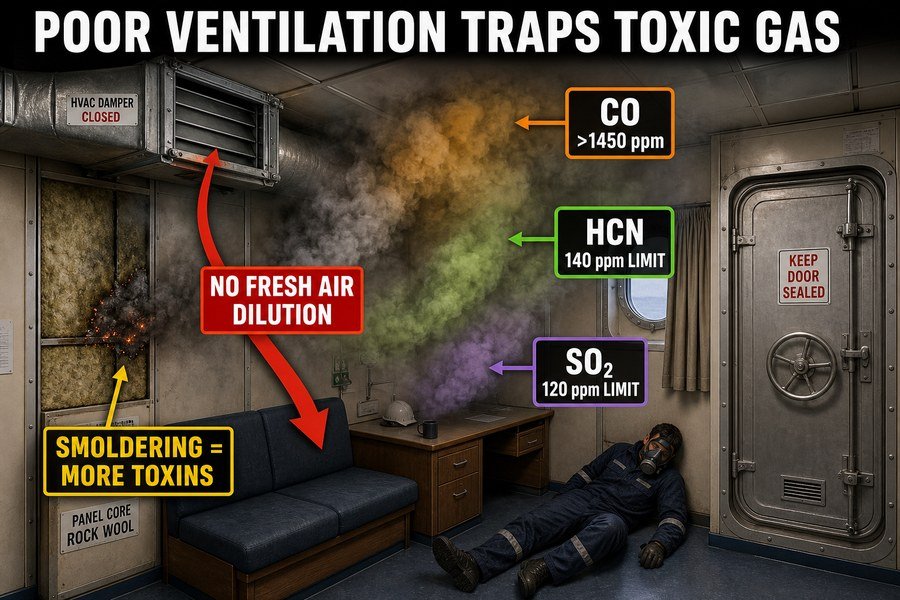
When a ship's fire alarm rings, the ventilation system shuts down automatically. This starves the fire of oxygen, which is good. But it also creates a sealed box. The marine interior panels start to smolder. Smoldering actually creates more toxic gas than a bright, open flame.
Accumulation of Carbon Monoxide (CO) Without Fresh Air Dilution
The biggest killer in any ship fire is Carbon Monoxide (CO). When the ventilation stops, there is no fresh air dilution. The CO gets trapped in the sealed zone. According to the IMO FTP Code Part 2, the maximum allowed concentration of CO from burning materials is 1,450 ppm3. However, if you use non-compliant panels, the CO levels can spike past 2,000 ppm in just 5 minutes in a sealed cabin. At this level, the gas binds to the hemoglobin in the blood. The crew members pass out quickly and silently. I always check the test reports from the factory. If the core material uses low-grade glue, it will produce massive amounts of CO when the air supply is cut off.
The Lethal Impact of Trapped Hydrogen Cyanide (HCN) and Sulfur Dioxide (SO2)
In addition to CO, we must worry about Hydrogen Cyanide (HCN) and Sulfur Dioxide (SO2). HCN comes from burning polyurethane foams and some plastic laminates. The IMO limits HCN to 140 ppm. HCN is highly lethal because it stops the cells from using oxygen. SO2 comes from the sulfur in cheap rubber seals and certain adhesives. The IMO limits SO2 to 120 ppm. SO2 burns the eyes and lungs, causing spasms that stop breathing. Without ventilation to push these gases out, they mix together. This combination incapacitates a person much faster than one gas alone.4 This is why you must source panels with certified low-toxicity finishes.
| Toxic Gas | Source in Marine Panels | IMO FTP Code Limit | Effect on Trapped Crew |
|---|---|---|---|
| Carbon Monoxide (CO) | Adhesives, wood derivatives | 1,450 ppm | Unconsciousness, asphyxiation |
| Hydrogen Cyanide (HCN) | Polyurethane, certain plastics | 140 ppm | Cellular suffocation |
| Sulfur Dioxide (SO2) | Rubber parts, low-grade glue | 120 ppm | Severe lung irritation, spasms |
What Smoke Performance Suits Marine Wall Panels in Interior Stairwells?
Stairwells are the main way out during a ship fire. If they fill with dark smoke, the vertical escape route is gone. What smoke performance do panels need here?
Marine wall panels in interior stairwells require strictly tested low-flame-spread surfaces that produce minimal smoke, mandated by IMO FTP Code Part 2. Materials must achieve a maximum specific optical density (Ds) below 200, ensuring at least 3 meters of visibility so crew can safely navigate vertical escape routes.
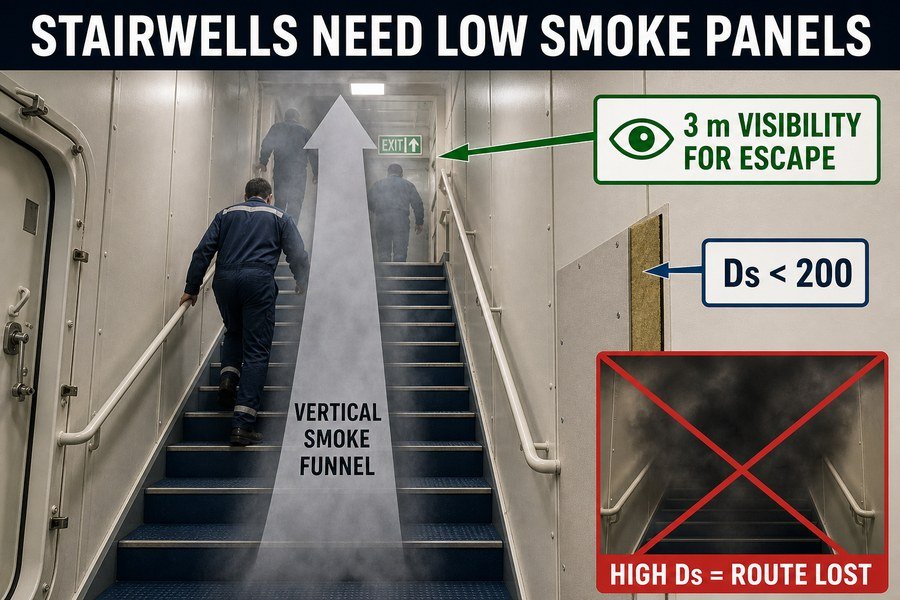
Stairwells act like large chimneys.5 Heat and smoke naturally rise up through them. If the marine wall panels inside the stairwell catch fire, they will add more smoke to the funnel. This makes vertical evacuation impossible. Therefore, the standards for stairwell panels are the strictest on the ship.
Meeting IMO FTP Code Part 2 Smoke Density (Ds) Requirements
To keep stairwells clear, the panels must have low-flame-spread surfaces. This means the fire will not travel up the wall easily. More importantly, they must produce minimal smoke. The International Maritime Organization (IMO) tests this using the FTP Code Part 2. They measure the specific optical density, which we call "Ds". For stairwells, the maximum allowed Ds is 200. I have tested many surface materials in my career. Standard PVC films often fail this test because they create thick, black soot.6 Instead, I always advise buyers to choose melamine laminates or PET films. These materials burn much cleaner. They keep the Ds value well below the 200 limit.
Maintaining 3 Meters of Visibility in Vertical Escape Routes
Why do we care so much about the Ds value? It is all about visibility. During an emergency, crew members need at least 3 meters of visibility to move safely. They need to see the stairs, the handrails, and the exit signs. If the visibility drops below 3 meters, people trip and fall. A fall in a stairwell can block the route for everyone behind them. By ensuring the marine wall panels have a Ds below 200, we guarantee that the smoke remains thin enough to see through for a longer time. This buys the crew the precious minutes they need to climb to the muster deck.
| Panel Surface Material | Typical Smoke Density (Ds) | Visibility Impact in Stairwells | IMO Part 2 Compliance |
|---|---|---|---|
| Low-grade PVC Film | 300 - 450 | < 1 meter (Blindness) | Fails |
| Fire-retardant PVC | 150 - 190 | ~ 3 meters | Passes |
| Melamine Laminate | 50 - 100 | > 5 meters (Clear view) | Passes Easily |
| Stainless Steel finish | < 10 | Excellent visibility | Passes Easily |
How Does Marine Ceiling Panel Smoke Affect Corridor Breathing Time?
Corridors are horizontal chimneys during a fire. Ceiling panels that produce heavy smoke will quickly cut off the escape path. How does this impact breathing time?
Marine ceiling panel smoke severely cuts corridor breathing time by banking down from the ceiling to the floor level. Heavy smoke from non-compliant ceilings drops to head height (1.8 meters) in just 2 minutes, reducing available safe egress time (ASET) and forcing crew to crawl through toxic air.
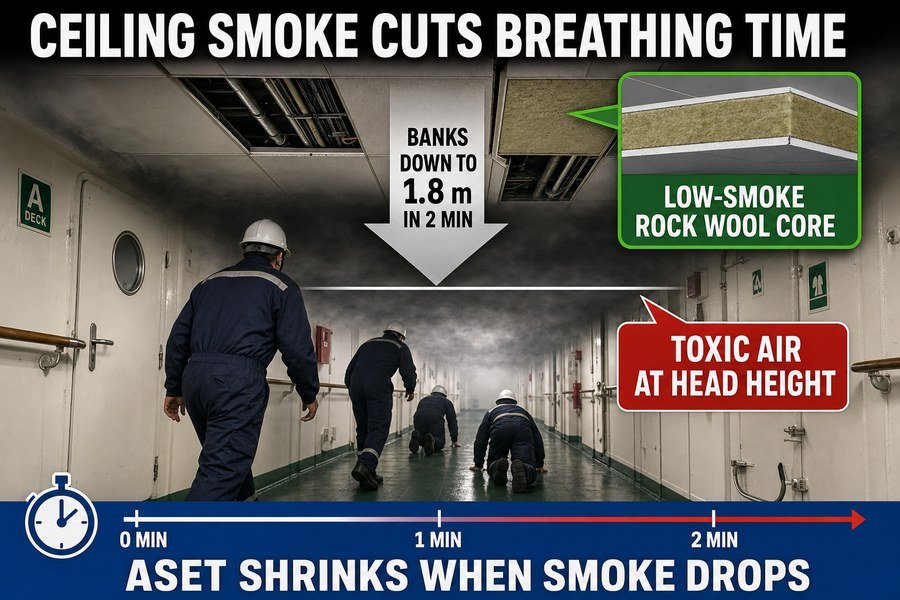
When I walk through a ship's corridor, I always look up. The marine ceiling panels run the entire length of the hallway. Behind these panels are hundreds of cables and pipes. When a fire starts, the hot smoke hits the ceiling first. How that ceiling reacts determines if the crew lives or dies.
Smoke Banking Dynamics and Head Height (1.8 Meters) Reduction
The most dangerous behavior of smoke in a corridor is called "banking down." Hot smoke rises, hits the ceiling, and spreads out horizontally. As more smoke is produced, the layer gets thicker and pushes downward toward the floor.7 If the marine ceiling panels burn easily, they add massive amounts of smoke to this layer. Heavy smoke from non-compliant ceilings drops very fast. Within just 2 minutes, the smoke layer drops to head height, which is about 1.8 meters. When the smoke hits 1.8 meters, a standing person breathes in pure toxins. This forces the crew members to drop to their hands and knees and crawl. Crawling is very slow. It turns a quick walk into a desperate struggle.
Impact on Available Safe Egress Time (ASET) for Evacuation
This banking effect directly reduces the Available Safe Egress Time (ASET). ASET is the time people have to escape before the conditions become deadly. We compare ASET against RSET, which is the Required Safe Egress Time (the time it actually takes to walk out). If the ASET is shorter than the RSET, people die. By installing high-quality ceiling panels with non-combustible rockwool cores and low-smoke paints, you slow down the smoke production.8 This keeps the smoke layer above 1.8 meters for a longer time. It increases the ASET, giving the crew enough breathing time to walk upright and escape the corridor safely.
| Smoke Layer Height | Time from Ignition (Poor Ceiling) | Time from Ignition (Quality Ceiling) | Crew Movement Status |
|---|---|---|---|
| Ceiling Level (2.2m) | 30 seconds | 2 minutes | Walking normally, full visibility |
| Head Height (1.8m) | 2 minutes | 6 minutes | Must duck, coughing starts |
| Chest Height (1.4m) | 3.5 minutes | 10 minutes | Must crawl, severe eye irritation |
| Floor Level (0.5m) | 5 minutes | 15+ minutes | Trapped, zero visibility |
Why Do Low-Toxicity Marine Ceiling Panels Matter in Windowless Spaces?
Deep inside the ship, spaces like control rooms and engine areas have no windows. If fire breaks out, toxic fumes have nowhere to go. Why is panel choice critical here?
Low-toxicity marine ceiling panels matter in windowless spaces because trapped crews cannot vent the room. Using IMO-compliant panels limits deadly Hydrogen Chloride (HCl) under 600 ppm and Nitrogen Oxides (NOx) under 350 ppm, extending survival time from 4 minutes to over 15 minutes while awaiting rescue teams.
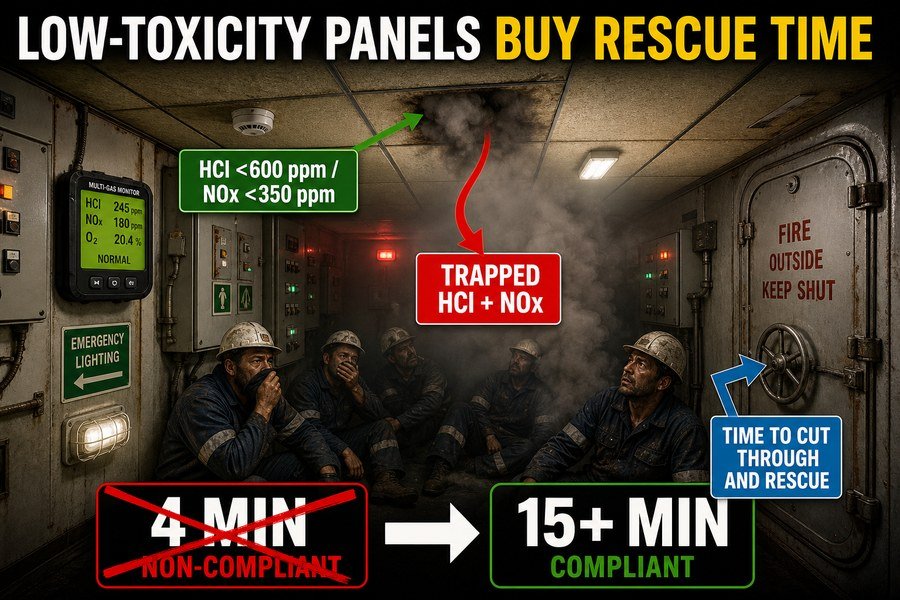
Engine control rooms and lower deck stores are completely enclosed. They are steel boxes without a single window. I have designed outfitting for many of these spaces. You cannot open a window to let fresh air in or push toxic smoke out. If a fire blocks the single heavy steel door, the crew is totally trapped.
Trapped Gases in Windowless Spaces and Hydrogen Chloride (HCl) Dangers
Because the crew cannot vent the room, any gas produced by the marine ceiling panels stays in the room. This makes low-toxicity panels absolutely critical. We pay special attention to Hydrogen Chloride (HCl). HCl is a highly corrosive gas. It often comes from burning PVC cable coatings and cheap panel laminates. When inhaled, HCl mixes with the moisture in the lungs to form hydrochloric acid. The IMO strictly limits HCl emissions to 600 ppm for interior materials.9 If you use non-compliant panels in a windowless room, the HCl levels will quickly exceed this limit. The gas will burn the crew's respiratory system, making it impossible to breathe even if they have oxygen masks.
Managing Nitrogen Oxides (NOx) to Extend Rescue Time to 15 Minutes
We must also manage Nitrogen Oxides (NOx). NOx gases are produced when high-nitrogen adhesives burn. The IMO limits NOx to 350 ppm. NOx causes delayed lung damage.10 The immediate danger in a windowless space is that high NOx and HCl concentrations will kill trapped crew members in under 4 minutes. However, if you purchase high-quality, IMO-compliant ceiling panels that use advanced, low-toxicity binders, you drastically reduce these emissions. By limiting the HCl and NOx, you extend the survival time. Instead of dying in 4 minutes, the trapped crew can survive for over 15 minutes.11 This extra time is exactly what the onboard firefighting team needs to cut through the door and execute a rescue.
| Toxic Gas Type | IMO Concentration Limit | Health Effect in Windowless Room | Survival Time (Compliant Panels) |
|---|---|---|---|
| Hydrogen Chloride (HCl) | 600 ppm | Severe lung tissue burns | Extends to 15+ mins |
| Nitrogen Oxides (NOx) | 350 ppm | Respiratory failure | Extends to 15+ mins |
| Hydrogen Bromide (HBr) | 600 ppm | Eye and throat corrosion | Extends to 15+ mins |
| Hydrogen Fluoride (HF) | 600 ppm | Deep tissue damage | Extends to 15+ mins |
Conclusion
Fire safety requires more than blocking flames. Choosing IMO-compliant panels with low smoke and toxicity ensures crew members can breathe, see, and escape confined spaces during a ship fire.
-
"Clarification of OSHA's requirement for breathing air to ...", http://www.osha.gov/laws-regs/standardinterpretations/2007-04-02-0. Occupational safety guidance on oxygen-deficient atmospheres reports that oxygen concentrations around 14-16% can impair judgment, coordination, and physical performance; this supports the physiological hazard of oxygen depletion below 15%, though it does not establish how quickly a particular cabin fire reaches that level. Evidence role: expert_consensus; source type: government. Supports: At oxygen levels below about 15%, humans can suffer impaired muscle control or coordination. Scope note: The source would support human effects of low oxygen, not the modeled depletion rate in the article’s scenario. ↩
-
"Estimating Temperatures in Compartment Fires", https://tsapps.nist.gov/publication/get_pdf.cfm?pub_id=907752. Fire dynamics research on compartment fires shows that hot upper-layer gas temperatures in enclosed rooms can rise to several hundred degrees Celsius within minutes under suitable fuel and ventilation conditions; this supports the plausibility of rapid ceiling-layer heating, but the exact temperature-time curve depends on cabin geometry, fuel load, ventilation, and materials. Evidence role: mechanism; source type: research. Supports: In a small enclosed cabin fire, ceiling temperatures can reach roughly 300°C within a few minutes. Scope note: Contextual support only; it does not verify the exact 300°C timing for the specific cabin and panel scenario described. ↩
-
"What Smoke Toxicity and Density Limits Must Marine Wall and ...", https://magellanmarinetech.com/what-smoke-toxicity-density-limits-must-marine-wall-ceiling-panels-meet/. The IMO FTP Code smoke and toxicity test specifies a carbon monoxide concentration limit of 1,450 ppm for qualifying materials tested under Part 2 conditions. Evidence role: statistic; source type: institution. Supports: According to the IMO FTP Code Part 2, the maximum allowed concentration of CO from burning materials is 1,450 ppm. ↩
-
"Focus on Smoke inhalation—The Most Common Cause of Acute ...", https://www.dir.ca.gov/dosh/doshreg/Smoke%20inhalation%20and%20cyanide%20exposure.pdf. Fire-effluent toxicology literature treats combined exposure to asphyxiant and irritant gases, including CO, HCN, and acidic gases, as a cumulative hazard that can reduce time to incapacitation compared with evaluating a single gas in isolation. Evidence role: expert_consensus; source type: paper. Supports: A mixture of trapped CO, HCN, and SO2 can incapacitate a person faster than one gas alone. Scope note: The source would support the principle of additive or interactive toxicity in fire atmospheres, but the exact speed of incapacitation depends on dose, exposure duration, ventilation, and occupant physiology. ↩
-
"Design manual for smoke control systems", https://nvlpubs.nist.gov/nistpubs/Legacy/IR/nistir4551.pdf. Building-fire literature describes the stack effect in vertical shafts, including stairwells, whereby buoyant hot gases and smoke can move upward through connected vertical spaces during a fire. Evidence role: mechanism; source type: paper. Supports: Stairwells can function like chimneys by allowing heat and smoke to rise vertically. Scope note: This source would support the general fire-dynamics mechanism; shipboard geometry and ventilation conditions may alter the magnitude of the effect. ↩
-
"Smoke and Carbon Monoxide - Formation from Materials Tested", https://www.govinfo.gov/content/pkg/GOVPUB-C13-85a7c851aff486396da31ca983994061/pdf/GOVPUB-C13-85a7c851aff486396da31ca983994061.pdf. Combustion studies of polyvinyl chloride report significant smoke and soot production under fire conditions, supporting the general concern that PVC-based surface films can perform poorly in smoke-density testing. Evidence role: mechanism; source type: paper. Supports: PVC films can produce high smoke or soot during combustion, making them at risk of failing smoke-density requirements. Scope note: This would not prove that every commercial PVC film fails IMO FTP Code Part 2; additives, thickness, substrate, and fire-retardant formulations can change measured Ds values. ↩
-
"Features, Limitations and Uncertainties in Enclosure Fire Hazard ...", https://nvlpubs.nist.gov/nistpubs/Legacy/IR/nistir6152.pdf. Fire dynamics literature describes compartment smoke filling as the formation of a hot upper layer that spreads below the ceiling and descends as combustion products accumulate. Evidence role: mechanism; source type: research. Supports: Hot smoke forms an upper layer under the ceiling and descends as smoke production continues. Scope note: The descent rate depends on fire size, ventilation, corridor geometry, and material properties, so the source supports the mechanism rather than any specific timing in this article. ↩
-
"What Is the IMO FTP Code for Marine Interior Materials?", https://magellanmarinetech.com/what-imo-ftp-code-for-marine-interior-materials/. Marine fire-test standards and materials research indicate that non-combustible substrates and low-smoke surface finishes are evaluated to limit flame spread, smoke production, and toxic combustion products in shipboard applications. Evidence role: expert_consensus; source type: institution. Supports: Non-combustible rockwool cores and low-smoke coatings can reduce a ceiling system’s contribution to smoke production compared with combustible or non-compliant materials. Scope note: Such evidence supports the fire-performance rationale for these materials, but the exact reduction in smoke production or increase in evacuation time must be verified for the specific panel assembly and fire scenario. ↩
-
"What Is the Purpose and Scope of the IMO FTP Code?", https://magellanmarinetech.com/what-purpose-scope-of-imo-ftp-code/. The IMO Fire Test Procedures Code smoke and toxicity test specifies maximum gas concentration criteria for materials used in ship interiors, including a 600 ppm criterion for hydrogen chloride under the prescribed test method. Evidence role: definition; source type: institution. Supports: The IMO strictly limits HCl emissions to 600 ppm for interior materials. Scope note: This supports the regulatory test criterion, not the actual concentration that would occur in a specific enclosed room fire. ↩
-
"Medical Management Guidelines for Nitrogen Oxides", https://wwwn.cdc.gov/tsp/mmg/mmgdetails.aspx?mmgid=394&toxid=69. Medical and occupational-health sources report that nitrogen dioxide and related nitrogen oxides can cause delayed pulmonary injury, including delayed-onset pulmonary edema after inhalation exposure. Evidence role: mechanism; source type: government. Supports: NOx exposure can cause delayed lung damage. Scope note: The source would support the toxicological mechanism for NOx exposure generally, not the severity in a particular ship compartment fire. ↩
-
"Combustion Products and Their Effects on Life Safety", https://tsapps.nist.gov/publication/get_pdf.cfm?pub_id=900093. Fire-safety tenability literature supports estimating incapacitation or survival time from toxic-gas exposure using concentration-time models such as fractional effective dose, but such evidence would provide only contextual support unless the cited study models the same compartment volume, fire load, ventilation, and panel materials. Evidence role: general_support; source type: paper. Supports: Lower toxic-gas emissions from compliant panels can increase available survival or rescue time in an enclosed fire scenario. Scope note: This does not directly prove the article’s specific 4-minute versus 15-minute survival figures without a room-specific fire and toxic-gas calculation. ↩