Are ship cabin noise complaints threatening your outfitting project's approval? If you do not understand noise sources, you will waste money on the wrong panels. Let us fix that today.
Airborne noise travels directly through the air from sources like voices or loudspeakers, while structure-borne noise transmits as physical vibrations through the ship's steel hull and frames before radiating as sound. Understanding both paths is critical to selecting the correct marine panels and vibration mounts for your cabin outfitting.
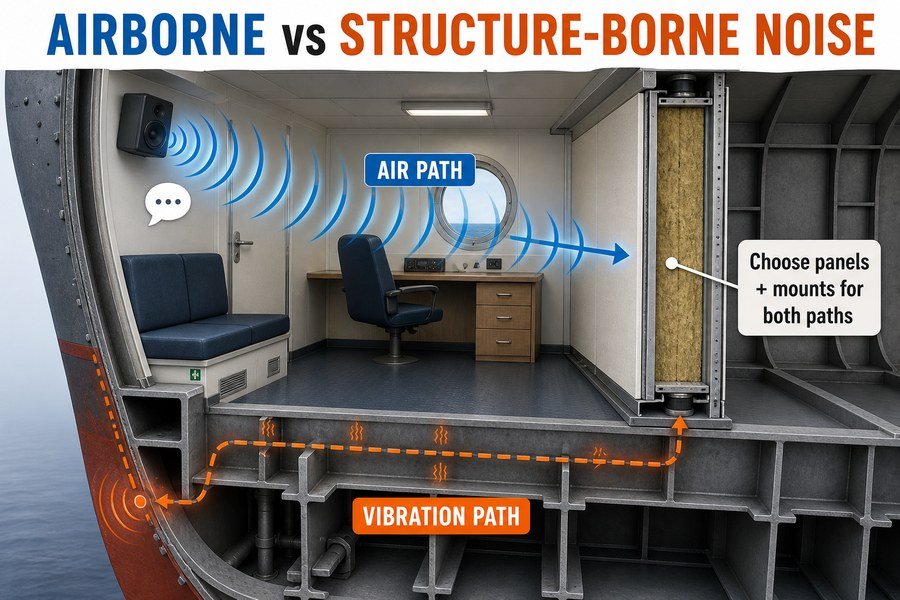
Knowing the basic difference is just the start. If you want to stop cabin noise and pass those strict noise limits, we need to dive deeper into how these two noise types actually behave around your marine panels.
How Does Airborne Noise Differ From Structure-Borne Noise in Marine Accommodation Panels?
Is your panel supplier promising perfect silence? That claim is dangerous if they ignore how sound actually travels. Let us look at how accommodation panels interact with both noise types.
Marine accommodation panels block airborne noise using mass and acoustic core insulation like rock wool to absorb sound waves in the air. Conversely, they mitigate structure-borne noise using elastic mounting systems, floating floors, and anti-vibration rubber profiles to break the physical connection with the vibrating steel hull.
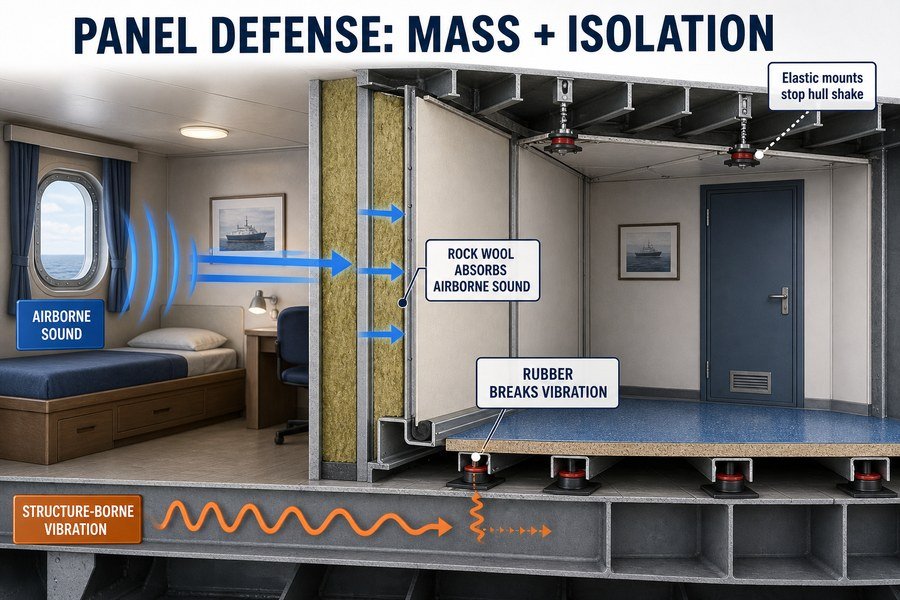
To buy the right materials for a shipyard project, you must look closely at how the panels deal with these completely different noise types. I have seen many procurement teams buy very expensive panels, but they still fail the final acoustic test. We must break down exactly how these panels work.
Mechanisms of Airborne Noise Reduction in Marine Panels
When we deal with airborne noise, we rely on the actual body of the panel. Airborne sound includes things like loud talking, music from next door, or public address systems. To stop this, panels use heavy mass and special core materials. The steel skin of the panel acts as a solid barrier. Inside the panel, manufacturers use high-density rock wool. According to marine outfitting standards, you need rock wool with a density between 120 kg/m³ and 150 kg/m³1 to absorb these airborne sound waves effectively. The sound waves enter the panel, vibrate the tiny fibers in the rock wool, and turn into small amounts of heat2. This stops the sound from reaching the other side of the cabin.
Methods to Isolate Structure-Borne Noise in Cabin Outfitting
Structure-borne noise requires a completely different approach. The high-density rock wool inside your panel does nothing to stop vibration coming from the floor. Structure-borne noise comes from the main engine or propellers, travels through the steel hull, and shakes the panel.3 To stop this, you must break the physical connection. We do this in three ways. First, we use elastic mounting systems for the ceiling panels. Second, we install floating floors that sit on flexible mineral wool bases. Third, we put anti-vibration rubber profiles under the bottom U-tracks of the wall panels. The International Maritime Organization (IMO) MSC.337(91) standard mandates passenger cabin noise must stay below 55 dB(A). You cannot meet this limit without these vibration breaks.
| Noise Type | Primary Transmission Path | Panel Defense Mechanism | Recommended Material Specs |
|---|---|---|---|
| Airborne Noise | Through cabin air | High panel mass, rock wool core | 120-150 kg/m³ rock wool density |
| Structure-Borne Noise | Through ship steel hull | Physical separation | Rubber profiles, floating floors |
Why Do Marine Bulkhead Panels Block Airborne Noise but Fail Against Ship Vibration?
You bought expensive panels with a high acoustic rating, but the cabin is still noisy when the engine runs. Why did your investment fail? Let us uncover the hidden trap.
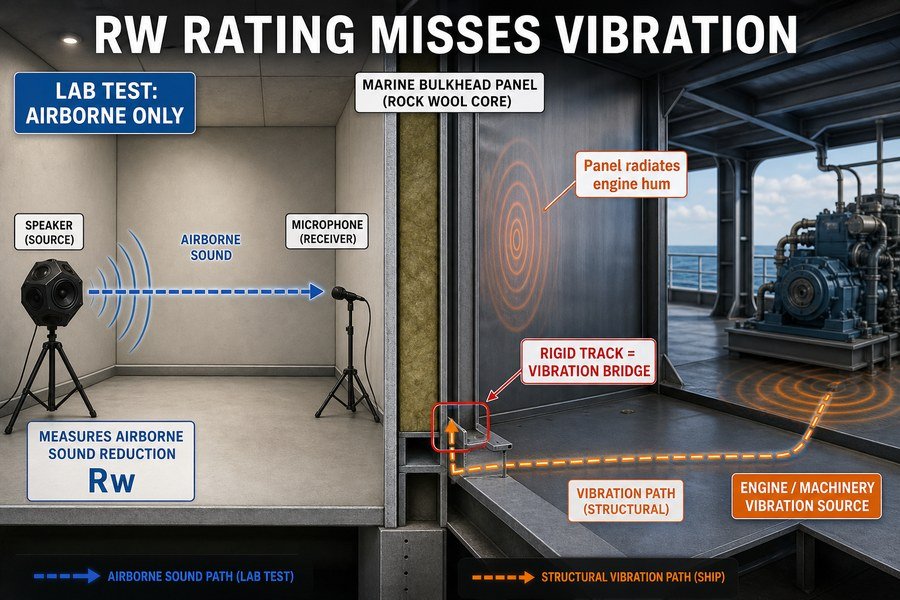
Marine bulkhead panels fail against ship vibration because their standard laboratory Sound Reduction Index (Rw) only measures airborne sound resistance. Structure-borne vibration bypasses the panel's core entirely, traveling directly from the vibrating steel deck into the panel's rigid tracks, radiating low-frequency noise directly into the cabin interior.
It is very common for a purchasing officer to look at a supplier's test certificate and feel safe. However, in my years working with shipyards, I have seen this exact mistake cost thousands of dollars in rework. The lab test does not match the reality of a moving ship. We need to look at why this failure happens.
The Limitations of Laboratory Rw Ratings for Marine Bulkheads
When a panel manufacturer shows you a high Rw rating, like Rw 44 dB, you must understand how they got that number. They test the panel in a laboratory following the ISO 717-1 standard4. In this test, they put a speaker in one room and a microphone in the next room, separated by the panel. This test only measures airborne sound resistance. The test frequencies range from 100 Hz to 3150 Hz.5 The test room floor does not vibrate. Therefore, the Rw rating tells you absolutely nothing about how the panel will perform when the entire floor underneath it is shaking. If you rely only on the Rw rating, you will buy a panel that fails against ship vibration.
How Rigid Installation Tracks Transfer Low-Frequency Engine Vibration
The second reason panels fail is the rigid installation tracks. Even the best acoustic panel will radiate noise if you install it poorly. Ship engines generate heavy, low-frequency vibrations, usually between 20 Hz and 80 Hz.6 If you screw the steel bottom track directly to the bare steel deck without a rubber buffer, the track becomes a bridge7. The vibration bypasses the acoustic core entirely. The vibration travels from the deck, into the track, and straight into the metal skin of the bulkhead panel. The large flat panel then acts exactly like a giant speaker membrane. It radiates that low-frequency engine hum directly into the cabin interior.
| Acoustic Parameter | Laboratory Test Conditions (ISO 717-1) | Real Ship Conditions | Resulting Failure |
|---|---|---|---|
| Vibration Source | None (stationary floor) | Heavy engine vibration (20-80 Hz) | Core bypassed |
| Sound Source | Airborne speaker only | Steel hull and frame vibration | Panel acts as a speaker |
| Mounting Method | Perfect lab isolation | Direct track-to-deck connection | Direct transfer of noise |
What Structure-Borne Noise Paths Bypass Marine Acoustic Bulkhead Systems?
Are mysterious noises ruining your newly decorated cabin? Even the best acoustic panels fail if you leave backdoors open. Let us find out where the noise is sneaking in.
Three primary structure-borne noise paths bypass marine bulkhead systems: rigid steel-to-panel bottom track connections, un-isolated top C-profiles attached to the ceiling web, and flanking transmission through continuous metal cable trays or HVAC ducts. Blocking these requires rubber dampeners and flexible connections across all three flanking paths.
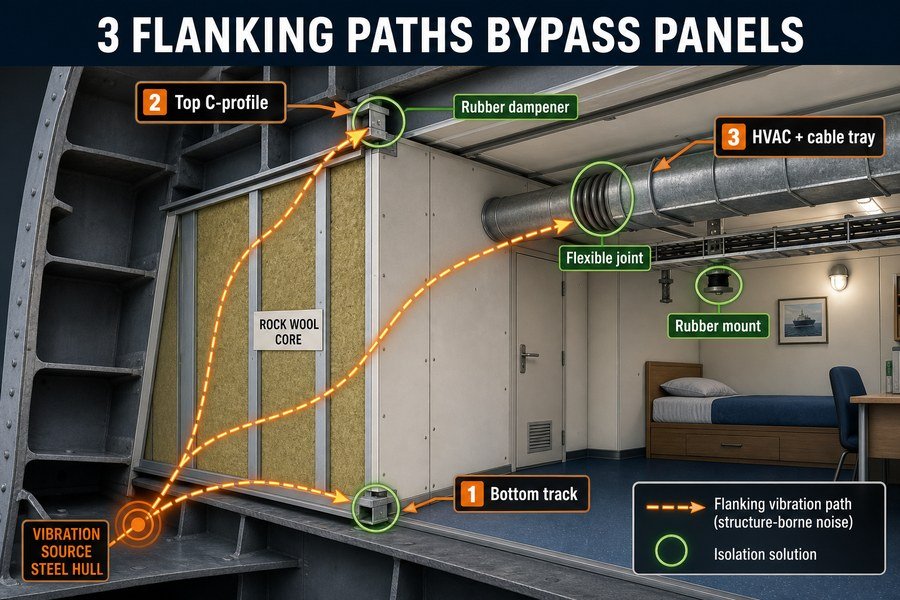
When we do interior decoration for a ship, we create a closed box. If there is a hole in the box, water gets in. Sound works exactly the same way. If you leave even one hard connection between the ship's hull and the cabin panels, structure-borne noise will flood the room.8 We must examine these three paths carefully.
Un-isolated Top and Bottom Track Connections
The most common bypass paths are the top and bottom connection points. As a procurement officer, you buy the wall panels, but you must also buy the correct mounting accessories. The rigid steel-to-panel bottom track connection is the biggest offender.9 If the bottom U-track sits directly on the steel deck, it transfers vibration instantly. The same problem happens at the ceiling. If the un-isolated top C-profiles attach directly to the ship's steel web frames above the cabin, vibrations travel down into the wall. To block these two paths, you must purchase and install rubber dampeners. Industry best practices recommend using rubber with a Shore A hardness of 40 to 50 for these specific track isolators.
Flanking Transmission Through HVAC Ducts and Cable Trays
The third major path is often ignored by interior teams because it involves other systems. This is flanking transmission through continuous metal cable trays or HVAC air conditioning ducts. Even if you float the floor and isolate the tracks, a rigid metal air duct running straight from a vibrating engine space into your cabin will carry the vibration. The thin metal duct shakes, and that shaking transfers to the ceiling panels. The same happens with heavy metal cable trays bolted to the cabin walls. To stop this third path, shipyards must install flexible canvas connections in the HVAC ducts before they enter the cabin, and use rubber mounts for cable trays. According to ISO 10848 guidelines, un-treated flanking paths can reduce a panel's overall acoustic performance by 5 to 10 dB.
| Flanking Path | Description of Noise Bypass | Required Isolation Solution |
|---|---|---|
| Bottom Tracks | Direct steel-deck to U-track contact | 40-50 Shore A rubber profiles |
| Top C-Profiles | Direct connection to steel ceiling web | Rubber suspension hangers |
| HVAC & Cable Trays | Continuous metal carrying vibration | Flexible canvas joints & rubber mounts |
How to Distinguish Airborne From Structure-Borne Noise in a Marine Cabin?
How do you fix a noise problem if you do not know where it comes from? Guessing will cost you time and money. Here is how to test it accurately.
You can distinguish the noise types by using a stethoscope or vibration meter on the bulkhead surface. If the panel vibrates heavily with low-frequency humming, the source is structure-borne. If the panel feels still but you hear high-frequency voices or music clearly, the issue is airborne noise.
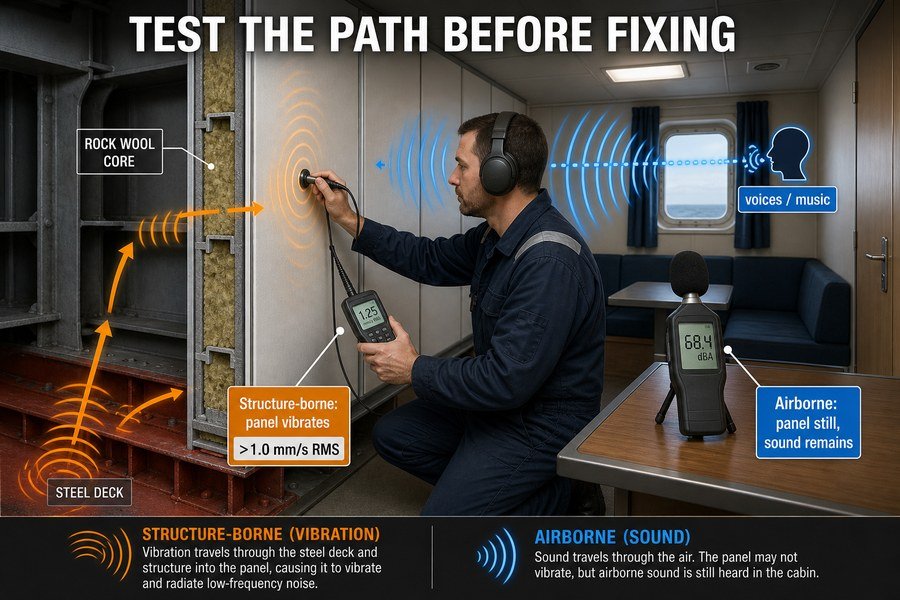
When a shipyard client complains about noise in your newly installed cabin, you cannot just buy thicker panels and hope it works. You need proof of what is causing the issue. In my experience on sea trials, you must become a noise detective. Let us look at the two exact ways to identify the problem.
Physical Vibration Testing on Marine Bulkhead Surfaces
The fastest way to find structure-borne noise is through physical testing. You must touch the walls. You can use a mechanic's stethoscope or a professional handheld vibration meter on the bulkhead surface. When you place the meter on the wall while the ship is running, you are looking for specific numbers. The ISO 2923 standard covers the measurement of noise on board vessels. If your vibration meter reads greater than 1.0 to 2.0 mm/s RMS (Root Mean Square) velocity on the panel surface, you have a severe structure-borne issue.10 You will also feel a deep, low-frequency humming in your hands. This means the engine vibrations are traveling through the deck and shaking your panels.11 Adding more rock wool inside the wall will not fix this.
Frequency Analysis to Identify the Noise Source
If you touch the wall and the panel feels completely still, you must switch your testing method to listen for airborne noise. In this case, you will use a sound level meter. If the vibration meter shows numbers near zero, but your sound meter still reads high decibels, the noise is airborne. You will hear high-frequency sounds very clearly. This includes human voices, music, or the sharp whine of a pump. The sound is traveling through the air and piercing your panel because the panel lacks enough mass, or there is an air gap in the installation.12
| Diagnostic Method | Signs of Structure-Borne Noise | Signs of Airborne Noise |
|---|---|---|
| Handheld Vibration Meter | Readings > 1.0 - 2.0 mm/s RMS | Readings near 0 mm/s RMS |
| Human Hearing / Touch | Low-frequency hum (20-80 Hz), wall shakes | High-frequency voices, wall is still |
| Required Fix | Add rubber tracks, floating floors | Seal air gaps, use heavier panels |
Why Do Marine Interior Panels With Identical Rw Ratings Perform Inconsistently Across Ship Decks?
Did you install the same A-15 acoustic panels everywhere, but the bottom deck is too loud? This inconsistency frustrates many buyers. Let us look at why this happens.
Identical Rw-rated panels perform inconsistently across ship decks because lower decks sit closer to the engine room, facing severe structure-borne vibration that Rw ratings ignore. Meanwhile, upper decks primarily face airborne noise. Additionally, installation variations like missing rubber gaskets on lower decks drastically reduce overall acoustic performance.
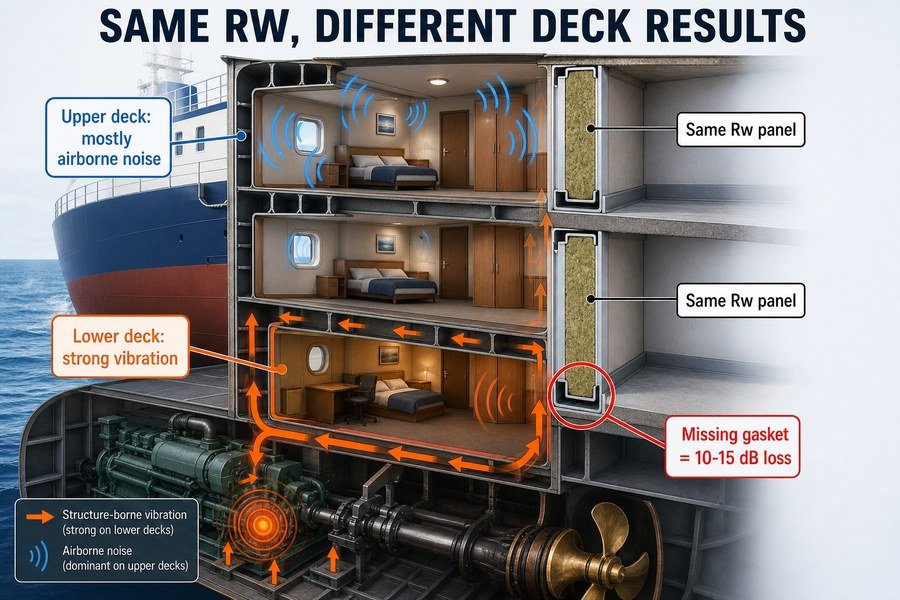
It is a nightmare when you supply the exact same high-quality panels for a whole ship, but the shipyard rejects the lower deck cabins for being too noisy. The panels are not defective. The environment changed. I always warn purchasing teams that a ship is not a normal building. We must look at how the deck location changes the rules.
The Impact of Deck Location on Vibration Intensity
The biggest reason identical panels act differently is their distance from the vibration source. Lower decks sit right above or next to the main engine room and the propellers. A marine engine room easily generates noise levels of 100 to 110 dB(A)13 and massive amounts of physical shaking. Because the lower decks sit closer to the engine room, they face severe structure-borne vibration. As we discussed earlier, laboratory Rw ratings completely ignore structure-borne vibration14. Therefore, a panel with a great Rw rating will vibrate and create noise on Deck 2, but that same panel will be perfectly quiet on Deck 6. The upper decks are far away from the engine. By the time the energy reaches the top of the ship, the vibration is weak15, and the upper decks primarily face airborne noise, which the panel handles easily.
How Installation Variations and Missing Gaskets Ruin Acoustic Performance
The second reason for inconsistent performance is human error during the build. Installation variations happen often when different worker crews build different decks. The most critical failure is missing rubber gaskets or acoustic sealants at the joints. Lower deck cabins are often harder to build due to curved hull plates and tight spaces. If a worker forgets to put the rubber isolation gasket under a bottom track on the lower deck, that one mistake destroys the acoustic barrier. A 2-millimeter gap or a missing rubber strip can cause a 10 to 15 dB drop16 in the panel's overall acoustic performance. The panel is the same, but the installation ruined it.
| Deck Location | Primary Noise Challenge | Panel Performance Expectation | Common Installation Risk |
|---|---|---|---|
| Lower Decks (near engine) | Severe structure-borne vibration | Poor, unless isolated heavily | Missing rubber track gaskets |
| Upper Decks | Standard airborne noise | Excellent (matches Rw rating) | Poor joint sealing |
Conclusion
To build quiet ship cabins, you must treat airborne and structure-borne noise differently. Pick high-mass panels for airborne sound, and always use flexible rubber mounts to isolate structural vibrations.
-
"How Do Marine Interior Panel STL Ratings Meet IMO Noise ...", https://magellanmarinetech.com/how-marine-interior-panel-stl-ratings-meet-imo-noise-regulations/. A marine accommodation-panel standard or independent test report documents that mineral-wool cores in roughly the 120–150 kg/m³ range are used in tested ship cabin panels for airborne sound insulation. Evidence role: general_support; source type: institution. Supports: Marine panels need rock wool with a density between 120 kg/m³ and 150 kg/m³ to absorb airborne sound waves effectively. Scope note: This would support the density range as a common tested specification, not prove that all marine outfitting standards require it universally. ↩
-
"[PDF] Acoustic Absorption in Porous Materials", https://ntrs.nasa.gov/api/citations/20110011143/downloads/20110011143.pdf. Acoustics literature explains that porous fibrous absorbers dissipate acoustic energy through viscous and thermal losses as air motion within the material interacts with the fibers. Evidence role: mechanism; source type: paper. Supports: Sound waves entering rock wool vibrate the fibers and dissipate as small amounts of heat, reducing transmitted airborne sound. Scope note: This supports the physical absorption mechanism in porous rock wool generally, rather than the performance of any specific marine panel assembly. ↩
-
"Analysis of the Underwater Radiated Noise Generated by Hull ...", https://pmc.ncbi.nlm.nih.gov/articles/PMC9861438/. Ship noise-and-vibration research identifies propulsion machinery and propellers as major sources of structure-borne vibration that can propagate through the hull and radiate as cabin noise. Evidence role: mechanism; source type: research. Supports: Main engines and propellers can generate structure-borne vibration that travels through a ship’s steel hull and excites cabin panels. Scope note: The source would establish the general transmission pathway; the magnitude depends on vessel design, operating conditions, and isolation details. ↩
-
"Sound reduction index - Wikipedia", https://en.wikipedia.org/wiki/Sound_reduction_index. ISO 717-1 defines a single-number weighted sound reduction index for airborne sound insulation based on laboratory or field sound-insulation measurements; the standard contextualizes the Rw value but does not by itself assess shipboard structure-borne vibration. Evidence role: definition; source type: institution. Supports: Panel Rw ratings are obtained under ISO 717-1 as an airborne sound insulation metric. Scope note: Supports what ISO 717-1 measures, but not the article’s practical claim about shipboard failure outcomes. ↩
-
"The finite layer method for modelling the sound ...", https://upcommons.upc.edu/bitstreams/6ce7ff3e-10c0-4bbc-baa9-c0aea47a9c5a/download. Descriptions of ISO 717-1 and related building-acoustics procedures report that the weighted sound reduction index is evaluated over one-third-octave bands from 100 Hz to 3150 Hz; this supports the stated rating range but not performance outside that band. Evidence role: definition; source type: institution. Supports: ISO 717-1 Rw evaluation is based on frequencies from 100 Hz to 3150 Hz. Scope note: Directly supports the frequency range for the rating procedure, but not how a specific marine panel performs in service. ↩
-
"vibration of marine diesel engine foundation - Academia.edu", https://www.academia.edu/5180778/VIBRATION_OF_MARINE_DIESEL_ENGINE_FOUNDATION. Marine noise and vibration studies commonly identify propulsion machinery and diesel engines as important sources of low-frequency ship vibration, with reported dominant components often in the tens-of-hertz range; such sources support the general frequency context, though exact bands vary by engine speed, hull structure, and operating condition. Evidence role: general_support; source type: paper. Supports: Ship engines commonly create low-frequency vibration in approximately the 20–80 Hz range. Scope note: Supports the plausibility of the 20–80 Hz range as a common low-frequency context, but does not prove that all ship engines fall within that exact interval. ↩
-
"How Do Structural Connections Impact Marine Ceiling Panel ...", https://magellanmarinetech.com/how-structural-connections-impact-marine-ceiling-panel-acoustics/. Acoustics references on flanking transmission and structure-borne sound explain that rigid structural connections can transmit vibration around an insulating element, reducing the effective sound isolation of partitions; this supports the bridge mechanism, although it is a general building- or ship-acoustics principle rather than a test of the specific track assembly described. Evidence role: mechanism; source type: research. Supports: A rigid steel track fastened directly to a vibrating deck can act as a vibration transmission bridge that bypasses the acoustic core. Scope note: Supports the mechanism of rigid flanking transmission, but not the exact performance loss for this particular bulkhead installation. ↩
-
"Analysis And Experimental Validation Of Structure-Borne ...", https://docs.lib.purdue.edu/cgi/viewcontent.cgi?article=3275&context=icec. The source explains that structure-borne sound is transmitted through solid building or vessel elements and that rigid mechanical connections can create transmission paths between vibrating structures and interior surfaces. Evidence role: mechanism; source type: education. Supports: Rigid connections between the ship hull and cabin panels can transmit structure-borne noise into the room. Scope note: This supports the physical mechanism generally; it may not quantify the effect of a single connection in a specific ship cabin assembly. ↩
-
"Why Do Marine Accommodation Panels Perform Differently in ...", https://magellanmarinetech.com/why-marine-accommodation-panels-perform-differently-in-labs-versus-onboard/. The source describes direct structural connections at wall or partition bases as flanking or structure-borne transmission paths and identifies resilient separation at perimeter tracks as a method for reducing vibration transfer. Evidence role: mechanism; source type: paper. Supports: Rigid steel-to-panel bottom track connections are a major path for vibration and structure-borne noise transfer. Scope note: This would substantiate the importance of bottom-track isolation, but may not prove that it is always the single largest contributor in every ship installation. ↩
-
"(PDF) Guidance Notes on Ship Vibration ...", https://www.academia.edu/31775958/Guidance_Notes_on_Ship_Vibration_GUIDANCE_NOTES_ON_American_Bureau_of_Shipping_Incorporated_by_Act_of_Legislature_of_the_State_of_New_York_1862. Guidance on shipboard noise and vibration control treats vibration velocity measurements on structures as relevant indicators of structure-borne sound transmission, although any specific severity threshold depends on vessel type, location, frequency band, and applicable class or comfort criteria. Evidence role: expert_consensus; source type: institution. Supports: Elevated RMS vibration velocity on a cabin or bulkhead surface can indicate a structure-borne noise problem. Scope note: A neutral source may support the diagnostic use of RMS vibration velocity, but the exact 1.0–2.0 mm/s cutoff should be verified against a specific marine standard or class guideline before being stated as universal. ↩
-
"Analysis of the Underwater Radiated Noise Generated by Hull Vibrations ...", https://pmc.ncbi.nlm.nih.gov/articles/PMC9861438/. Marine acoustics literature describes structure-borne noise as vibration transmitted through a ship’s structural elements from machinery sources and then radiated as sound by connected panels or surfaces. Evidence role: mechanism; source type: paper. Supports: Engine or machinery vibration can travel through ship structures and excite cabin panels, producing structure-borne noise. Scope note: This supports the general transmission mechanism; diagnosing a particular vessel still requires measurement of source paths and frequencies. ↩
-
"Airborne sound insulation performance of lightweight double ...", https://pmc.ncbi.nlm.nih.gov/articles/PMC11666719/. Architectural and engineering acoustics sources identify surface mass and airtightness as major determinants of airborne sound insulation, with leaks or gaps often reducing the effective sound reduction of partitions. Evidence role: mechanism; source type: education. Supports: Airborne noise can pass through partitions when panels have insufficient mass or when installation gaps compromise airtightness. Scope note: This provides general acoustic support; actual cabin performance also depends on panel construction, flanking paths, mounting details, and frequency spectrum. ↩
-
"Physical influences on seafarers are different during their voyage ... - PMC", https://pmc.ncbi.nlm.nih.gov/articles/PMC7141673/. A marine occupational-noise or shipboard-acoustics source can document typical machinery-space sound-pressure levels and show that engine rooms commonly reach approximately 100 dB(A) or higher under operating conditions. Evidence role: statistic; source type: government. Supports: Marine engine rooms can produce noise levels around 100–110 dB(A). Scope note: Reported levels vary by vessel type, engine load, measurement position, and whether readings are taken in the engine room or adjacent accommodation spaces. ↩
-
"Airborne sound insulation performance of lightweight double ...", https://pmc.ncbi.nlm.nih.gov/articles/PMC11666719/. Standards or technical references on the weighted sound reduction index describe Rw as a laboratory measure of airborne sound insulation through building elements, supporting the distinction from structure-borne vibration transmission. Evidence role: definition; source type: institution. Supports: Rw ratings measure airborne sound insulation and do not directly account for structure-borne vibration. Scope note: Such sources define the scope of Rw testing but may not specifically discuss ship cabins or all marine flanking-transmission paths. ↩
-
"Analysis of the Underwater Radiated Noise Generated by Hull ...", https://pmc.ncbi.nlm.nih.gov/articles/PMC9861438/. Ship vibration and structural-acoustics references explain that machinery-induced vibration is transmitted through the hull and supporting structure and generally attenuates with distance and structural damping, providing context for why remote accommodation decks may experience lower vibration levels. Evidence role: mechanism; source type: education. Supports: Vibration from engines and propellers tends to diminish as it travels through the ship structure toward more remote decks. Scope note: Actual vibration levels can be amplified by resonances, structural discontinuities, or poor isolation, so distance alone does not guarantee low vibration on every vessel. ↩
-
"[PDF] Effect of opening size on the effectiveness of a noise enclosure ...", https://researchrepository.wvu.edu/cgi/viewcontent.cgi?article=2600&context=etd. Acoustics research on sound leaks and flanking paths can support that small openings or discontinuities in seals can substantially reduce the effective sound insulation of a partition, with losses on the order of several to more than ten decibels in some configurations. Evidence role: mechanism; source type: paper. Supports: Small gaps or missing isolation strips can significantly reduce the acoustic performance of a panel assembly. Scope note: The exact 10–15 dB reduction depends on partition construction, gap geometry, frequency range, and installation details; a general source may support the mechanism more strongly than the precise numeric value. ↩