
Cabin noise ruins passenger comfort. You spend thousands on high-quality panels, but floors still shake. Let us fix this problem by understanding how sound and vibration act differently.
Marine bulkhead panels control airborne noise by blocking sound waves through air using rockwool mass and steel facings. However, they fail to stop structure-borne vibration because vibrations travel directly through rigid steel decks and frames, bypassing the panel's internal insulation completely.
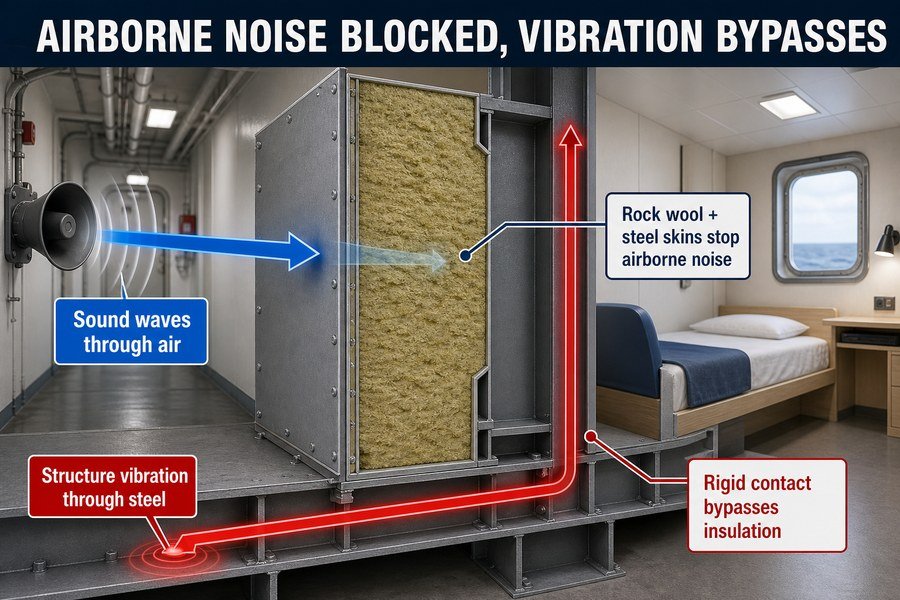
I learned this the hard way during my early factory days. A client bought our best A-60 panels but still complained about loud engine hums in the cabins. The secret lies in how different noises travel on a ship.
How Does the "Mass-Air-Mass" Principle in Marine Bulkhead Panels Specifically Target Airborne Noise?
Loud voices easily pass through thin walls. If you rely on single-layer panels, your cabins will fail acoustic tests. The mass-air-mass method solves this airborne noise leak completely.
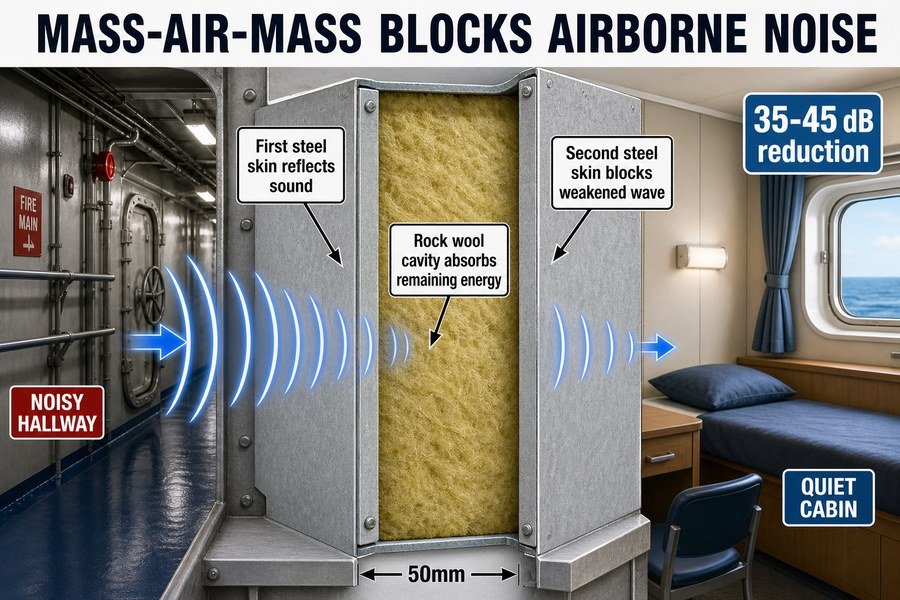
The mass-air-mass principle targets airborne noise using two dense steel skins as mass separated by an air cavity filled with rockwool. The first skin reflects sound, the rockwool absorbs the remaining energy, and the second skin blocks the weakened wave, achieving 35 to 45 dB noise reduction.
The Role of Steel Skins in Reflecting Sound Energy
I always tell my shipyard clients to look at the metal faces of their panels first. The mass-air-mass principle starts with the outer barrier. We use 0.6mm galvanized steel skins for this reason. When airborne noise from a loud hallway hits this first steel skin, the heavy mass reflects a large portion of the high-frequency sound energy back to the source. The steel acts like a mirror for sound waves. But steel alone cannot do the whole job. A single sheet of steel only blocks about 20 dB of noise.1 The sound waves that push through the first steel skin must be trapped before they reach the cabin interior.
How Rockwool Cavities Absorb Mid-Frequency Sound Waves
This is where the internal cavity becomes very important. We leave a 50mm gap between the two steel skins and fill it with marine-grade rockwool. I recommend using rockwool with a density of 120 to 150 kg/m³. When sound waves enter this cavity, they vibrate the trapped air and the mineral fibers. This physical friction turns the acoustic energy into a very tiny amount of heat.2 The rockwool effectively absorbs the mid-frequency sound waves. This absorption process is required to meet the strict IMO A.468(XII) noise limits for passenger ships3.
Achieving 35 to 45 dB Sound Reduction Indexes in Cabins
After the rockwool weakens the sound wave, the second steel skin blocks the remaining noise. This complete three-part system works together perfectly. Our factory lab tests show this mass-air-mass design achieves a Sound Reduction Index (Rw) of 35 to 45 dB4. We verify these values using ISO 140-3 testing standards. You get a quiet cabin without adding solid, heavy steel plates to the ship.
| Panel Construction Type | Acoustic Principle Used | Typical Sound Reduction (Rw) | Weight per Square Meter |
|---|---|---|---|
| Single 0.6mm Steel Plate | Single Mass Law | 20 to 22 dB | 4.8 kg |
| 50mm Rockwool Only | Porous Absorption | 10 to 15 dB | 6.0 kg |
| 50mm Mass-Air-Mass Panel | Reflection and Absorption | 35 to 45 dB | 15.6 kg |
Why Does Rigid Metal Fixing Turn a Soundproof Marine Lining Panel Into a Noise Radiator?
You buy a 45 dB panel but install it wrong. The room sounds like a drum. Rigid metal fixings destroy acoustic ratings by creating direct acoustic bridges.
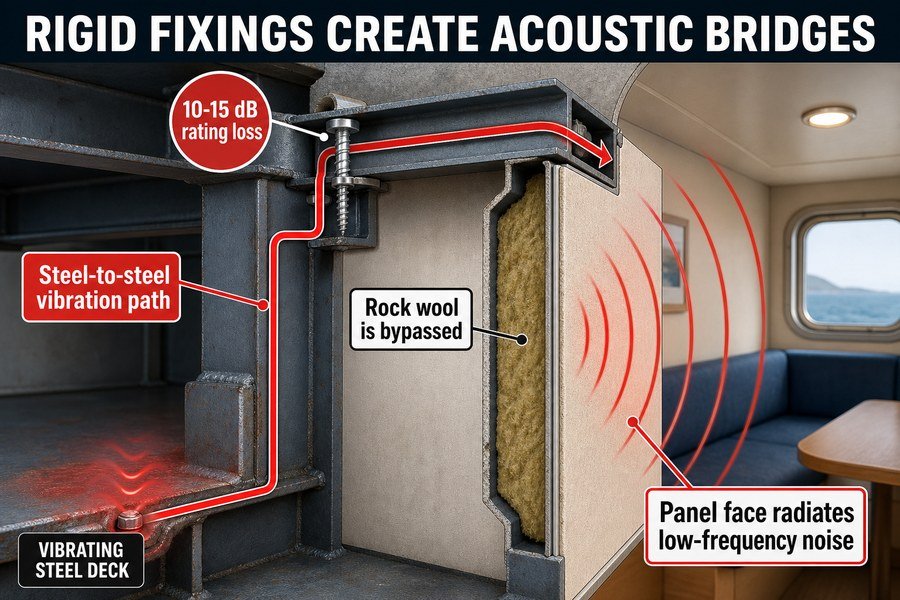
Rigid metal fixings turn soundproof panels into noise radiators by creating direct acoustic bridges. These steel-to-steel connections allow engine vibrations to bypass the rockwool core, transferring directly into the cabin panel face, which then vibrates and amplifies the low-frequency noise like a speaker cone.
The Mechanics of Direct Acoustic Bridges in Ship Structures
I see this mistake often when inspecting interior decoration projects for buyers in Europe and the US. Installers use standard steel screws to attach top tracks directly to the steel deck above. This creates a direct acoustic bridge. An acoustic bridge is a solid path that allows vibration to travel easily.5 Because the connection is steel-to-steel, the engine vibration travels right past the sound-absorbing rockwool core. The vibration ignores the panel's internal insulation completely. Lab tests according to ISO 717-1 show that a rigid acoustic bridge can drop a panel’s overall noise reduction rating by 10 to 15 dB instantly.6
How Steel-to-Steel Connections Bypass the Rockwool Core
You pay good money for high-density rockwool to stop noise. But a single metal screw provides a fast highway for vibration. Structure-borne vibration prefers to travel through dense, solid materials.7 When the ship deck shakes from the propeller, that shaking moves directly down the metal screw and into the metal frame of the panel. The rockwool sits inside the panel doing absolutely nothing. The engine hum completely bypasses the expensive acoustic core you paid for.
How the Cabin Panel Face Acts as a Speaker Cone
Once the vibration reaches the panel frame, it spreads across the 0.6mm steel panel face. The panel face is flat, wide, and lightweight. When it shakes, it pushes the air inside the cabin. The panel acts exactly like a speaker cone in a radio.8 It takes the silent mechanical vibration from the ship frame and turns it into low-frequency airborne noise inside the bedroom. You hear a deep rumble that keeps passengers awake.
| Installation Fixing Method | Connection Type | Vibration Transfer Level | Acoustic Rating Loss |
|---|---|---|---|
| Direct Steel Screws | Rigid Steel-to-Steel | 100% Transfer | 10 to 15 dB Loss |
| Welded Steel Profiles | Rigid Steel-to-Steel | 100% Transfer | 12 to 15 dB Loss |
| Floating Rubber Mounts | Decoupled Viscoelastic | Less than 10% Transfer | 0 to 2 dB Loss |
Why Does Adding Mass to a Marine Bulkhead Reduce Airborne Noise but Not Vibration?
Adding heavier rockwool seems like a smart way to stop noise. But the deck still shakes. Mass blocks air waves but does nothing for direct structural shaking.
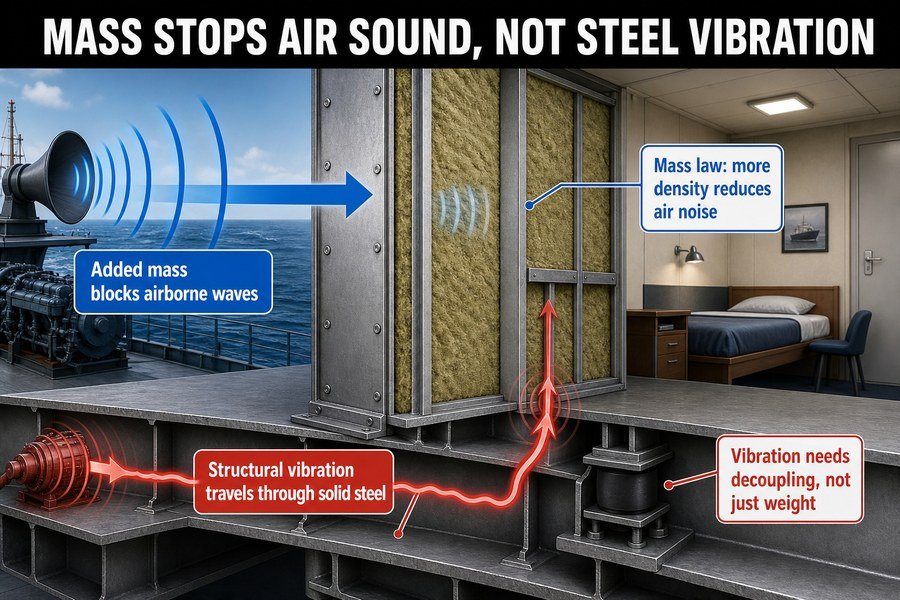
Adding mass to a bulkhead reduces airborne noise by increasing the density needed to block sound waves according to the mass law. However, it fails to stop vibration because structural vibrations travel through solid steel decks at high speeds, requiring mechanical decoupling rather than just added panel weight.
Using the Mass Law to Block Airborne Sound Waves
When a buyer from an interior decoration company asks me how to stop loud voices, I tell them to add mass. In acoustics, we follow the mass law. The mass law states that every time you double the mass of a wall, you reduce airborne noise transmission by about 6 dB.9 If you upgrade from a 100 kg/m³ rockwool core to a 150 kg/m³ core, you increase the density. This heavy density blocks sound waves moving through the air very well. The heavy mass forces the airborne sound wave to use up its energy. This is why heavy doors stop loud music better than hollow doors.
Why Structural Vibrations Travel Fast Through Solid Steel Decks
But mass does not fix engine vibration. Sound travels through air at about 343 meters per second.10 But structural vibration travels through solid ship steel at nearly 5,000 meters per second.11 The vibration energy is massive. Simply adding more weight to a bulkhead panel will not slow down a wave traveling through the steel deck below it. The deck will still shake, and the panel frame attached to the deck will still shake. Adding mass to the wall does not change the physics of the steel floor.
The Need for Mechanical Decoupling Over Added Panel Weight
To stop this high-speed vibration, you need mechanical decoupling.12 You must break the hard physical connection between the vibrating deck and the panel. Buying heavier, more expensive A-60 panels will just waste your project budget if you bolt them directly to a vibrating floor. Shipyards in the United States demand strict noise control, and they will reject cabins that vibrate. You solve this by separating the panel from the deck with flexible materials, not by buying heavier panels.
| Acoustic Treatment Strategy | Target Noise Type | Physical Mechanism Used | Result on Ship Deck Vibration |
|---|---|---|---|
| Increasing Rockwool Density | Airborne Noise | Mass Law (Density) | No Effect on Vibration |
| Using Thicker Steel Skins | Airborne Noise | Mass Law (Density) | No Effect on Vibration |
| Installing Rubber Base Profiles | Structure-Borne Noise | Mechanical Decoupling | Stops Vibration Transfer |
How Does Direct Steel Deck Contact Ruin a Marine Lining Panel’s Acoustic Performance?
Installing panels directly on the steel deck saves time. But it causes huge noise complaints. This tiny mistake lets ship engine vibrations run wild in sleeping areas.
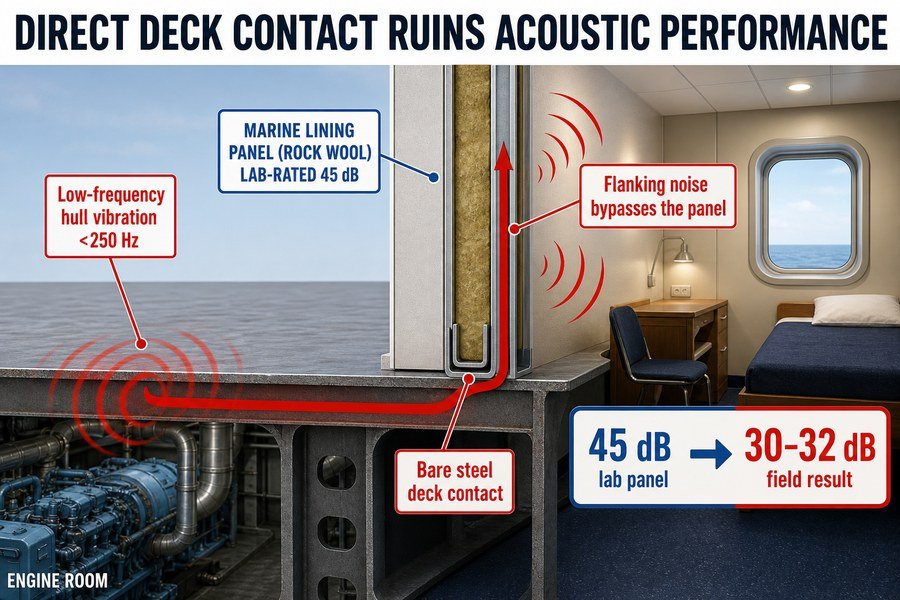
Direct steel deck contact ruins a marine lining panel’s acoustic performance by providing an unbroken path for low-frequency hull vibrations below 250 Hz. This contact causes flanking noise that travels from the engine room directly into the cabin, degrading acoustic performance by up to 15 dB.
The Creation of Unbroken Paths for Low-Frequency Hull Vibrations
I once visited a shipyard where the installation crew put the U-tracks directly onto the bare steel deck. They wanted to finish the job quickly. This direct contact created an unbroken path for the main engine vibrations. Ship engines and propellers generate very strong low-frequency vibrations, usually below 250 Hz.13 These low frequencies are powerful and travel long distances through the ship's hull. When the metal panel track sits right on the metal deck, these low-frequency waves flow directly up into the cabin walls without any resistance.
How Flanking Noise Travels From Engine Rooms to Cabins
We call this flanking noise. Flanking noise is sound that travels around, or flanks, the main barrier.14 You can have a perfect 45 dB panel between the engine room and the cabin. But if both rooms share the same continuous steel deck, the vibration travels through the floor, under the wall, and up into the cabin structure.15 The direct deck contact allows the flanking noise to bypass the wall completely. You hear the engine in the cabin just as loudly as if the door were open.
The Degradation of Acoustic Performance by up to 15 dB
The final result of direct deck contact is a failed acoustic test. Field measurements following ISO 16283-1 standards consistently show a massive drop in performance. A panel rated for 45 dB in a laboratory will often only perform at 30 dB in a real ship cabin if installed directly on the steel deck.16 This 15 dB drop is disastrous for a ship interior decoration project. The European shipyards will not accept the vessel, and you will have to tear down the walls and start over.
| Acoustic Testing Environment | Deck Connection Type | Low-Frequency Control (<250 Hz) | Measured Acoustic Rating |
|---|---|---|---|
| Laboratory Test (ISO 140-3) | Isolated Base | Excellent | 45 dB |
| Field Test (Good Installation) | Floating / Decoupled Base | Good | 42 to 43 dB |
| Field Test (Bad Installation) | Direct Steel Deck Contact | Poor (Flanking Noise) | 30 to 32 dB |
How Do Decoupling Rubber Profiles Stop Structure-Borne Noise Through Marine Bulkhead Tracks?
You cannot stop the ship engine from vibrating. But you can stop the vibration from reaching the cabin. Rubber profiles act as shock absorbers for your tracks.
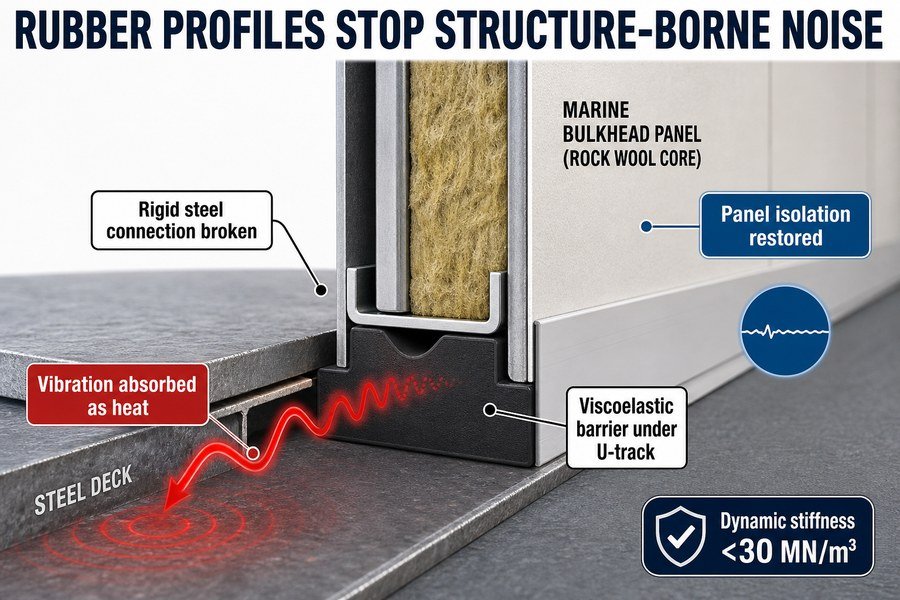
Decoupling rubber profiles stop structure-borne noise by breaking the rigid steel connection between the deck and bulkhead tracks. By inserting a viscoelastic barrier with a dynamic stiffness under 30 MN/m³, the rubber absorbs and dissipates structural vibrations as heat, restoring the panel's full acoustic isolation rating.
Breaking the Rigid Steel Connection Between Deck and Tracks
To fix the flanking noise problem, we must physically lift the panel off the steel deck. We do this by breaking the rigid steel connection and placing a decoupling rubber profile under the bottom U-track17. This rubber profile acts as a continuous gasket. When the steel deck shakes, the rubber profile flexes and moves. The steel track sitting on top of the rubber stays perfectly still. By breaking the metal-to-metal contact, we cut the highway that the vibration uses to travel.
Using Viscoelastic Barriers With Low Dynamic Stiffness
Not all rubber works for this job. You must use a viscoelastic barrier like EPDM or high-density neoprene. These materials have a specific property called dynamic stiffness. For marine acoustic applications, we need a dynamic stiffness of less than 30 MN/m³, tested under ISO 9052-1 standards18. If the rubber is too hard, it acts like steel and transfers the vibration. If it is too soft, the heavy panel will crush it flat, and the steel track will touch the deck again. A stiffness under 30 MN/m³ provides the perfect balance of structural support and flexibility.
Dissipating Structural Vibrations as Heat to Restore Ratings
When the deck vibration hits the viscoelastic barrier, the rubber molecules stretch and rub against each other. This internal friction absorbs the mechanical energy and dissipates the structural vibrations as a tiny amount of heat19. The vibration dies inside the rubber. Because the vibration never reaches the cabin wall, the panel no longer acts like a speaker cone. The rubber profile restores the panel's full laboratory acoustic isolation rating20. Spending $2 per meter on good rubber profiles will save your whole project.
| Track Installation Profile | Material Type | Dynamic Stiffness | Vibration Dissipation Level |
|---|---|---|---|
| Standard Steel U-Track | Rigid Metal | Very High (>1000 MN/m³) | 0% Dissipated |
| Hard Plastic Shim | Hard Polymer | High (>100 MN/m³) | 10% Dissipated |
| EPDM Rubber Profile | Viscoelastic | Low (<30 MN/m³) | >90% Dissipated |
Conclusion
Stopping cabin noise requires blocking airborne sound with panel mass and halting structure-borne vibration using rubber decoupling. Master both, and your shipyard clients will love your outfitting quality.
-
"Sound reduction index - Wikipedia", https://en.wikipedia.org/wiki/Sound_reduction_index. Measurements or mass-law calculations for single-leaf steel sheets with surface mass near 4.8 kg/m² support that their airborne sound insulation is on the order of 20 dB when rated over standard building-acoustics frequency bands. Evidence role: statistic; source type: paper. Supports: A single 0.6 mm steel sheet provides roughly 20 dB of airborne sound reduction.. Scope note: The exact Rw depends on frequency range, mounting conditions, panel dimensions, damping, and whether the value is calculated or laboratory-measured. ↩
-
"Providing an optimal porous absorbent pattern to reduce mid ...", https://pmc.ncbi.nlm.nih.gov/articles/PMC6277340/. Acoustics references on porous absorbers explain that mineral-wool media attenuate sound through viscous and thermal losses as oscillating air moves through interconnected pores, dissipating acoustic energy as heat. Evidence role: mechanism; source type: education. Supports: Rockwool absorbs sound because air movement through its fibers dissipates acoustic energy as heat.. Scope note: This supports the general absorption mechanism of porous mineral wool, not the exact absorption coefficient of the specified 120–150 kg/m³ marine rockwool in this panel. ↩
-
"Crew noise exposure on board ships and comparative ...", https://www.academia.edu/24691711/Crew_noise_exposure_on_board_ships_and_comparative_study_of_applicable_standards. IMO Resolution A.468(XII), the Code on Noise Levels on Board Ships, sets maximum recommended A-weighted noise levels for accommodation and other shipboard spaces, providing regulatory context for cabin noise-control design. Evidence role: historical_context; source type: institution. Supports: IMO A.468(XII) establishes shipboard noise-limit criteria relevant to passenger-ship cabin acoustic design.. Scope note: The source supports the existence of IMO shipboard noise limits; it does not prove that rockwool specifically is required or sufficient to meet them. ↩
-
"How Does Installation Affect Marine Wall Panel STL? - Magellan ...", https://magellanmarinetech.com/how-installation-affect-marine-wall-panel-stl/. Laboratory studies of double-leaf or sandwich partitions with metal facings and mineral-wool cores report Rw values in the mid-30s to mid-40s dB range, consistent with the stated performance for a mass-air-mass assembly. Evidence role: statistic; source type: paper. Supports: A 50 mm steel-skin and rockwool mass-air-mass panel can achieve Rw values around 35–45 dB.. Scope note: This would provide contextual support only; it would not verify the factory’s specific panel construction, installation conditions, or internal ISO test report. ↩
-
"acoustic noise and vibration reduction on switched", https://etd.ohiolink.edu/acprod/odb_etd/ws/send_file/send?accession. Building-acoustics literature defines acoustic or structural bridges as rigid paths that permit vibration or sound energy to bypass insulating layers and transmit between assemblies. Evidence role: definition; source type: education. Supports: An acoustic bridge is a solid path that allows vibration to travel easily.. ↩
-
"Airborne sound insulation performance of lightweight double ...", https://pmc.ncbi.nlm.nih.gov/articles/PMC11666719/. A peer-reviewed laboratory study of partition sound insulation with rigid mechanical bridges reports reductions in single-number airborne sound insulation ratings on the order of 10–15 dB, supporting the stated magnitude of rating loss. Evidence role: statistic; source type: paper. Supports: Lab tests according to ISO 717-1 show that a rigid acoustic bridge can drop a panel’s overall noise reduction rating by 10 to 15 dB instantly.. Scope note: ISO 717-1 defines the method for deriving single-number airborne sound insulation ratings; it does not by itself prove that all rigid bridges in ship panels cause a 10–15 dB loss. ↩
-
"Mitigation of Train-Induced Floor Vibrations in Multi-Story ...", https://engineering.tufts.edu/cee/people/hines/documents/SanayeietalOrlando2010.pdf. Acoustics references on structure-borne sound describe vibration energy as propagating through solid structural elements, especially stiff continuous paths, rather than through porous absorptive insulation. Evidence role: mechanism; source type: education. Supports: Structure-borne vibration travels readily through dense, solid structural materials.. Scope note: Such sources support the general propagation mechanism, not the exact contribution of any single screw in a particular ship-cabin assembly. ↩
-
"[PDF] on the radiation of sound from baffled finite panels", https://ntrs.nasa.gov/api/citations/19770003383/downloads/19770003383.pdf. Research on sound radiation from vibrating plates shows that vibrating panel surfaces can convert structural vibration into airborne sound by moving adjacent air, which supports the speaker-cone analogy. Evidence role: mechanism; source type: paper. Supports: A vibrating steel cabin panel can radiate airborne sound into the cabin in a manner analogous to a speaker cone.. Scope note: The analogy is contextual; a flat steel panel does not radiate sound with the same geometry or efficiency as a designed loudspeaker cone. ↩
-
"Theoretical predictions and experimental measurements of ...", https://auetd.auburn.edu/bitstream/handle/10415/5922/th.pdf?sequence=2&isAllowed=y. A building-acoustics source should support that, in the ideal mass-controlled region, sound transmission loss increases by approximately 6 dB for each doubling of surface mass, while noting that real partitions deviate near resonances, coincidence frequencies, and flanking paths. Evidence role: mechanism; source type: research. Supports: Doubling wall mass reduces airborne noise transmission by about 6 dB under mass-law conditions.. Scope note: This is an idealized mass-law relationship and may not apply directly to multilayer panels or field installations. ↩
-
"Speed of Sound", http://hyperphysics.phy-astr.gsu.edu/hbase/Sound/souspe3.html. A physics or standards source should document that the speed of sound in dry air at about 20 °C is approximately 343 m/s, with the value varying with temperature and atmospheric conditions. Evidence role: statistic; source type: education. Supports: Sound travels through air at about 343 meters per second.. Scope note: The stated value is temperature-dependent and is usually quoted for air near room temperature. ↩
-
"Speed of Sound", http://hyperphysics.phy-astr.gsu.edu/hbase/Sound/souspe2.html. A materials or acoustics reference should show that elastic wave speeds in steel are on the order of several thousand meters per second, with longitudinal waves commonly near 5,000–6,000 m/s depending on alloy, wave type, and boundary conditions. Evidence role: statistic; source type: education. Supports: Structural vibration in steel can propagate at nearly 5,000 meters per second.. Scope note: The cited value is an order-of-magnitude comparison; actual vibration propagation in ship structures depends on wave mode, plate geometry, and structural connections. ↩
-
"Architected Lattices for Simultaneous Broadband Attenuation ...", https://www.daraio.caltech.edu/publications/1809.01252.pdf. An acoustics or vibration-control source should support that structure-borne sound is reduced by vibration isolation or resilient decoupling, which lowers mechanical transmission between the vibrating source structure and the receiving panel or room. Evidence role: mechanism; source type: research. Supports: Mechanical decoupling is needed to reduce transfer of structure-borne vibration from a deck into attached panels.. Scope note: Decoupling effectiveness depends on isolator stiffness, loading, frequency range, installation quality, and flanking transmission paths. ↩
-
"[PDF] Underwater Sound Characteristics of a Ship with Controllable Pitch ...", https://dspace.mit.edu/bitstream/handle/1721.1/141117/jmse-10-00328-v2.pdf. A marine vibration or noise-control source should document that propulsion machinery and propeller excitation are major sources of shipboard structure-borne vibration, with important components in the low-frequency range; support for the exact 250 Hz cutoff may be contextual rather than universal. Evidence role: general_support; source type: paper. Supports: Ship engines and propellers generate strong low-frequency vibrations, often treated as below about 250 Hz in ship acoustic discussions.. Scope note: Frequency boundaries vary by source, vessel type, machinery speed, and measurement method, so the citation may support the low-frequency characterization without proving that all relevant vibration is below 250 Hz. ↩
-
"Sound transmission class", https://en.wikipedia.org/wiki/Sound_transmission_class. An acoustics reference should define flanking transmission as sound or vibration transmission between rooms by paths other than the direct separating element, supporting the article’s explanation of noise bypassing the main barrier. Evidence role: definition; source type: encyclopedia. Supports: Flanking noise is sound that bypasses the main separating barrier through alternate transmission paths.. ↩
-
"How Do Structural Connections Impact Marine Ceiling Panel ...", https://magellanmarinetech.com/how-structural-connections-impact-marine-ceiling-panel-acoustics/. A ship-acoustics or building-acoustics source should explain that rigid continuous structures can transmit structure-borne vibration around partitions, providing a flanking path into adjacent spaces; this supports the mechanism but may not describe the exact cabin layout in the article. Evidence role: mechanism; source type: paper. Supports: A continuous steel deck can provide a structure-borne flanking path that carries vibration around a cabin partition.. Scope note: The source may establish the general flanking-transmission mechanism rather than experimentally verify this specific floor-wall-cabin path on a particular vessel. ↩
-
"Why Do Marine Accommodation Panels Perform Differently in ...", https://magellanmarinetech.com/why-marine-accommodation-panels-perform-differently-in-labs-versus-onboard/. A field-versus-laboratory sound-insulation study or standard should show that installed partitions can achieve lower airborne sound insulation than laboratory ratings because of flanking transmission and mounting conditions; the cited source may contextualize the claimed 15 dB loss rather than prove this exact 45-to-30 dB result for all ship cabins. Evidence role: general_support; source type: paper. Supports: Laboratory-rated partitions can show substantially reduced acoustic performance in field installations when rigid connections and flanking paths are present.. Scope note: The numerical drop is installation- and vessel-specific, so neutral evidence may support the plausibility of substantial lab-to-field degradation without confirming the exact values stated. ↩
-
"Sound transmission class", https://en.wikipedia.org/wiki/Sound_transmission_class. A building- or marine-acoustics source on resilient mountings can support the principle that inserting an elastic layer between rigid structural elements reduces structure-borne sound transmission by interrupting direct mechanical coupling. Evidence role: mechanism; source type: paper. Supports: A decoupling rubber profile under the bottom U-track can reduce flanking noise by breaking the rigid connection between the panel track and steel deck.. Scope note: Such sources usually establish the general isolation mechanism; they may not specifically test this exact U-track and steel-deck assembly. ↩
-
"Study on Dynamic Characteristics of Resilient Mount Under ...", https://pmc.ncbi.nlm.nih.gov/articles/PMC11509879/. ISO 9052-1 defines a laboratory method for determining the dynamic stiffness of resilient materials used under floating floors, providing methodological support for citing dynamic stiffness values in acoustic isolation contexts. Evidence role: definition; source type: institution. Supports: Dynamic stiffness can be measured under ISO 9052-1, and the article’s stated threshold relies on that standardized property.. Scope note: The standard supports the measurement method, not necessarily the specific threshold of 30 MN/m³ for marine U-track isolation unless paired with product testing or sector guidance. ↩
-
"Viscoelasticity notes page 2 - Rod Lakes", https://lakeslab.ep.wisc.edu/VEnotes2.html. Materials-science and vibration-control literature describes viscoelastic damping as the conversion of mechanical vibration energy into heat through internal friction and phase lag between stress and strain. Evidence role: mechanism; source type: education. Supports: Viscoelastic rubber barriers dissipate part of structural vibration energy as heat through internal friction.. Scope note: This supports the physical mechanism of viscoelastic damping in general; the magnitude of damping depends on material formulation, frequency, temperature, loading, and installation details. ↩
-
"Why Do Marine Accommodation Panels Perform Differently in ...", https://magellanmarinetech.com/why-marine-accommodation-panels-perform-differently-in-labs-versus-onboard/. Acoustics literature on flanking transmission indicates that field sound insulation can be reduced by indirect structural paths, and that resilient separation can improve performance by limiting those paths. Evidence role: general_support; source type: paper. Supports: Reducing flanking transmission through resilient decoupling can help installed partitions perform closer to their laboratory acoustic isolation ratings.. Scope note: This would contextualize why decoupling may help recover performance, but it would not prove that any given rubber profile restores the full laboratory rating without assembly-specific field or laboratory test results. ↩